Newborn Screening
For Your
Baby’s Health
Department
of Health
Why is my baby tested?
To help make sure your baby will
be as healthy as possible. The
blood test provides important
information about your baby’s
health that you and your doctor
might not otherwise know. The
Newborn Screening Program
identifies infants who may have
one of several rare, but treatable
diseases that don’t show
symptoms right away. With early
diagnosis and medical treatment,
serious illness, and even death,
can often be prevented, so it is
very important for us to test your
baby’s sample and report the
results to your baby’s doctor. Ask
your baby’s doctor for your baby’s
results.
Is newborn screening
new?
No. Every state has a newborn
screening program. The New
York State program is mandated
by Public Health Law, and it
began in 1965. Some diseases
can affect a child very early in life
– even within the first few days.
Timely testing and diagnosis are
important for treatments to work
the best.
For how many diseases
is my baby tested?
The number has increased from
one in 1965 to more than 45
today. They are listed in this
booklet. Although these diseases
are rare, 1 in 300 babies born
in New York every day has one
of these diseases. Most of the
diseases are serious and can
even be fatal. Some may slow
down a baby’s development,
cause intellectual disabilities,
increase a baby’s risk for
infection, or cause other problems
if undetected and untreated.
That is why:
Early treatment
is very important!
But my baby seems
very healthy. Are these
tests still needed?
Yes. Most infants with a disease
identified by the Newborn
Screening Program show no
signs of the disease right after
birth and look healthy. With these
special laboratory tests, we can
identify a baby who may have
one of these diseases and tell
the baby’s doctor of the need for
more tests and special care. Most
of the time, it is very important to
start treatment before your baby
shows symptoms or becomes
sick. Many of the diseases are
genetic, and they are inherited
from the baby’s parents.
Every baby has two sets of genes
– one from their mother and the
other from their father. Sometimes
only one set of the genes has a
problem, but because the other
set doesn’t, the baby is not sick.
These babies are called carriers.
Although these babies are not
sick, this means that at least
one or sometimes even both of
their parents are also carriers.
Newborn screening tests can
identify carriers for some genetic
diseases some of the time, but the
program is not designed to find
all carriers. It is important to get
genetic counseling if your baby
has a carrier result because most
parents who are carriers do not
know. Counselors can help you
understand this information.
But children in our
family have never
had any of those
health problems.
Parents who have already had
healthy children do not expect
any problems, and they are
almost always right. But there
is still a chance your new baby
may have one of these diseases.
Each of these diseases is very
rare, and the chances are
excellent that your child will not
have one of them, but altogether
1 in 300 babies born in New
York every day does have one
of them. A negative newborn
screen for your new baby does
not guarantee that your future
children will be negative too.
Some babies and parents can be
carriers for diseases even if no
one in your family has a disease.
Many families go for genetic
counseling to better understand
these risks to their future children
and other family members. It is
also important to remember that
newborn screening does NOT
find all babies who are carriers for
these genetic diseases. The tests
are designed to find most babies
with these genetic diseases.
How is my baby tested?
All the tests are performed on
a tiny sample of blood taken by
pricking the baby’s heel. The
blood is put on a special filter
paper. The sample is usually taken
when the baby is one or two days
old. The sample is sent for testing
to the laboratory at the State
Health Department in Albany.
Will I get the
test results?
Be sure to tell the nurse at the
hospital the name and office
information for your baby’s doctor
or clinic. This doctor will be told
of the results and will contact you
immediately if anything is wrong.
To be sure, ask about the result
when you bring your baby to the
doctor or clinic for his or her first
check-up. The hospital nurse
should give you a pink form, which
will tell you how to get the test
results from your baby’s doctor.
If all the tests are
screen-negative, does
that mean my baby will
be healthy?
The Newborn Screening Program
only looks for a few of many
diseases a baby could have. In
addition, some babies with these
diseases may not be identified for
several reasons. You should bring
your baby to the doctor or clinic
for all their check-ups. Always
watch your baby for unexpected
symptoms or behavior, and call
the doctor immediately if things
don’t seem right.
1 in 300 babies born each day in NYS
has one of the screened diseases!
A negative newborn screen
for your new baby does not
guarantee that your future
children will not have a disease.
Also, newborn screening
does NOT find all babies who
are carriers for these genetic
diseases. Carriers have one
gene mutation but are healthy.
Babies and their parents can be
carriers without any family history
of a disease. Many families go
to genetic counseling to better
understand disease and carrier
risks to their future children and
other family members.
Does a “repeat test”
mean my baby may
have a disease?
Not necessarily. Repeat testing
may be needed for a number of
reasons. The most common is that
the blood was put on the special
filter paper incorrectly. Usually this
does not mean there is anything
wrong with your baby. It simply
means that another blood sample
must be taken as soon as possible.
When the first test results
suggest a problem, the results
are not considered final until the
screening tests are done again.
This requires a new blood sample.
In general, a doctor will discuss
the need for further diagnostic
testing only after a baby’s second
screen is also abnormal. On very
rare occasions, because a disease
may cause a baby to become
very sick quickly, the doctor will
treat the baby immediately while
waiting for the results of the
second series of tests. If you are
asked to have your baby retested,
please bring in your baby as soon
as possible, so the repeat test can
be done immediately, to determine
if your baby needs treatment.
What if my baby has
one of these diseases?
The tested diseases all have
treatments that can lessen the
effects of the disease.
Sometimes the symptoms can be
completely prevented if a special
diet or other medical treatment
is started early. Most of these
diseases are very complicated
to treat, and medical care should
be coordinated by a doctor who
specializes in the specific disease.
If my new baby has a
disease, will my future
children have it?
That depends on the disease.
Most of these diseases are
genetic and inherited by children
from their parents. A negative
newborn screen does not
guarantee that future children
will not have the disease. Also,
newborn screening does NOT
Be Informed: Get your baby’s newborn
screening results from his or her doctor!
See our website for much more information
on newborn screening.
find all babies who are carriers
for these genetic diseases.
Carriers have one gene mutation
and are healthy. Babies and
their parents can be carriers
without any family history of the
disease. Many families seek
genetic counseling to better
understand how their child got
the disease, and to understand
disease and carrier risks to their
future children and other family
members. Some diseases are not
inherited. For example, congenital
hypothyroidism has many causes,
while HIV infection is caused by a
virus, not a gene mutation.
Why is my baby tested
for HIV?
We test the baby for HIV
antibodies. If the test is positive,
that means the mother has the
virus and we want to be sure
the baby is not infected with the
virus. HIV can be transmitted by
an infected mother to her baby
before it is born, during delivery
or from breastfeeding. In NYS,
most pregnant women are tested
for HIV before the baby is born.
Ideally, the mother should get
medicine during pregnancy and
labor to protect the baby from the
HIV infection.
How much will these
tests cost me?
Nothing. These tests are done at
no cost to families.
How can I make it
easier for the doctor to
help my baby?
First, be sure you tell the nurse
at the hospital where your baby
was born the name of your
baby’s doctor so we can contact
the doctor if we need to. If you
change your doctor, let us know
by emailing or calling us (see
back of this booklet). If your
doctor asks you to bring your
baby in for a repeat test, do so
as soon as you can. If your baby
does have a disease, quick action
is very important.
If you do not have a telephone,
give your doctor the phone
number of someone who can
contact you immediately. If you
move soon after your baby is born,
tell your doctor or clinic your new
address and phone number right
away. Then your doctor will know
where to reach you if your child
needs more tests or treatment.
Remember, time is very
important. As a parent, you can
help the Newborn Screening
Program make sure that your
baby is as healthy as possible by
making sure your baby’s doctor
knows how to reach you.
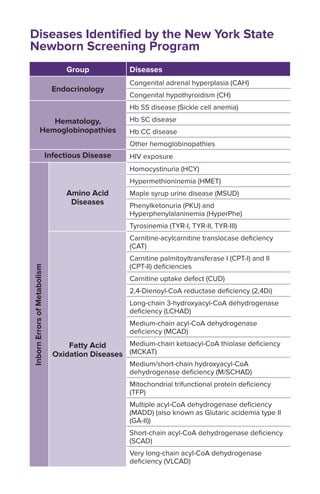
Group Diseases
Endocrinology
Congenital adrenal hyperplasia (CAH)
Congenital hypothyroidism (CH)
Hematology,
Hemoglobinopathies
Hb SS disease (Sickle cell anemia)
Hb SC disease
Hb CC disease
Other hemoglobinopathies
Infectious Disease HIV exposure
InbornErrorsofMetabolism
Amino Acid
Diseases
Homocystinuria (HCY)
Hypermethioninemia (HMET)
Maple syrup urine disease (MSUD)
Phenylketonuria (PKU) and
Hyperphenylalaninemia (HyperPhe)
Tyrosinemia (TYR-I, TYR-II, TYR-III)
Fatty Acid
Oxidation Diseases
Carnitine-acylcarnitine translocase deficiency
(CAT)
Carnitine palmitoyltransferase I (CPT-I) and II
(CPT-II) deficiencies
Carnitine uptake defect (CUD)
2,4-Dienoyl-CoA reductase deficiency (2,4Di)
Long-chain 3-hydroxyacyl-CoA dehydrogenase
deficiency (LCHAD)
Medium-chain acyl-CoA dehydrogenase
deficiency (MCAD)
Medium-chain ketoacyl-CoA thiolase deficiency
(MCKAT)
Medium/short-chain hydroxyacyl-CoA
dehydrogenase deficiency (M/SCHAD)
Mitochondrial trifunctional protein deficiency
(TFP)
Multiple acyl-CoA dehydrogenase deficiency
(MADD) (also known as Glutaric acidemia type II
(GA-II))
Short-chain acyl-CoA dehydrogenase deficiency
(SCAD)
Very long-chain acyl-CoA dehydrogenase
deficiency (VLCAD)
Diseases Identified by the New York State
Newborn Screening Program
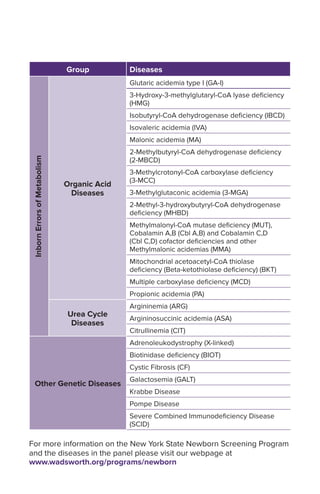
For more information on the New York State Newborn Screening Program
and the diseases in the panel please visit our webpage at
www.wadsworth.org/programs/newborn
Group Diseases
InbornErrorsofMetabolism
Organic Acid
Diseases
Glutaric acidemia type I (GA-I)
3-Hydroxy-3-methylglutaryl-CoA lyase deficiency
(HMG)
Isobutyryl-CoA dehydrogenase deficiency (IBCD)
Isovaleric acidemia (IVA)
Malonic acidemia (MA)
2-Methylbutyryl-CoA dehydrogenase deficiency
(2-MBCD)
3-Methylcrotonyl-CoA carboxylase deficiency
(3-MCC)
3-Methylglutaconic acidemia (3-MGA)
2-Methyl-3-hydroxybutyryl-CoA dehydrogenase
deficiency (MHBD)
Methylmalonyl-CoA mutase deficiency (MUT),
Cobalamin A,B (Cbl A,B) and Cobalamin C,D
(Cbl C,D) cofactor deficiencies and other
Methylmalonic acidemias (MMA)
Mitochondrial acetoacetyl-CoA thiolase
deficiency (Beta-ketothiolase deficiency) (BKT)
Multiple carboxylase deficiency (MCD)
Propionic acidemia (PA)
Urea Cycle
Diseases
Argininemia (ARG)
Argininosuccinic acidemia (ASA)
Citrullinemia (CIT)
Other Genetic Diseases
Adrenoleukodystrophy (X-linked)
Biotinidase deficiency (BIOT)
Cystic Fibrosis (CF)
Galactosemia (GALT)
Krabbe Disease
Pompe Disease
Severe Combined Immunodeficiency Disease
(SCID)
0503	12/17
The New York State Newborn Screening Program is a
service provided by the State Health Department to families
with newborn babies.
Important: Questions about newborn screening?
Need to let us know information about your baby’s doctor?
Write, call or visit our website:
Newborn Screening Program
Wadsworth Center
New York State Department of Health
P.O. Box 22002
Albany NY 12201- 2002
Email: nbsinfo@health.ny.gov
www.wadsworth.org/programs/newborn
Dear Parents,
Your child’s specimen(s) will be stored by the
Newborn Screening Program for up to 27 years
under secure conditions where access is strictly
controlled. Should the need arise, the specimen(s)
may be used for diagnostic purposes for your
child with your consent. A portion of the specimen
will also be stripped of all information that might
identify your child and may be used in public
health research that has been reviewed and
approved by a Board charged with overseeing
compliance with all applicable laws and ethical
guidelines. You may arrange to have your child’s
specimen(s) destroyed or prevented from being
used in public health research by calling (518)
473-7552 for instructions. You may visit our
website for more information or to download a
copy of the form we need to honor your written
request. Note: Upon request, we will completely
destroy specimens. We cannot do this until 8
weeks after you give birth.

Newborn screening

  • 1.
    Newborn Screening For Your Baby’sHealth Department of Health
  • 2.
    Why is mybaby tested? To help make sure your baby will be as healthy as possible. The blood test provides important information about your baby’s health that you and your doctor might not otherwise know. The Newborn Screening Program identifies infants who may have one of several rare, but treatable diseases that don’t show symptoms right away. With early diagnosis and medical treatment, serious illness, and even death, can often be prevented, so it is very important for us to test your baby’s sample and report the results to your baby’s doctor. Ask your baby’s doctor for your baby’s results. Is newborn screening new? No. Every state has a newborn screening program. The New York State program is mandated by Public Health Law, and it began in 1965. Some diseases can affect a child very early in life – even within the first few days. Timely testing and diagnosis are important for treatments to work the best. For how many diseases is my baby tested? The number has increased from one in 1965 to more than 45 today. They are listed in this booklet. Although these diseases are rare, 1 in 300 babies born in New York every day has one of these diseases. Most of the diseases are serious and can even be fatal. Some may slow down a baby’s development, cause intellectual disabilities, increase a baby’s risk for infection, or cause other problems if undetected and untreated. That is why: Early treatment is very important! But my baby seems very healthy. Are these tests still needed? Yes. Most infants with a disease identified by the Newborn Screening Program show no signs of the disease right after birth and look healthy. With these special laboratory tests, we can identify a baby who may have one of these diseases and tell the baby’s doctor of the need for more tests and special care. Most of the time, it is very important to start treatment before your baby shows symptoms or becomes sick. Many of the diseases are genetic, and they are inherited from the baby’s parents. Every baby has two sets of genes – one from their mother and the other from their father. Sometimes only one set of the genes has a problem, but because the other set doesn’t, the baby is not sick. These babies are called carriers. Although these babies are not sick, this means that at least one or sometimes even both of their parents are also carriers. Newborn screening tests can identify carriers for some genetic
  • 3.
    diseases some ofthe time, but the program is not designed to find all carriers. It is important to get genetic counseling if your baby has a carrier result because most parents who are carriers do not know. Counselors can help you understand this information. But children in our family have never had any of those health problems. Parents who have already had healthy children do not expect any problems, and they are almost always right. But there is still a chance your new baby may have one of these diseases. Each of these diseases is very rare, and the chances are excellent that your child will not have one of them, but altogether 1 in 300 babies born in New York every day does have one of them. A negative newborn screen for your new baby does not guarantee that your future children will be negative too. Some babies and parents can be carriers for diseases even if no one in your family has a disease. Many families go for genetic counseling to better understand these risks to their future children and other family members. It is also important to remember that newborn screening does NOT find all babies who are carriers for these genetic diseases. The tests are designed to find most babies with these genetic diseases. How is my baby tested? All the tests are performed on a tiny sample of blood taken by pricking the baby’s heel. The blood is put on a special filter paper. The sample is usually taken when the baby is one or two days old. The sample is sent for testing to the laboratory at the State Health Department in Albany. Will I get the test results? Be sure to tell the nurse at the hospital the name and office information for your baby’s doctor or clinic. This doctor will be told of the results and will contact you immediately if anything is wrong. To be sure, ask about the result when you bring your baby to the doctor or clinic for his or her first check-up. The hospital nurse should give you a pink form, which will tell you how to get the test results from your baby’s doctor. If all the tests are screen-negative, does that mean my baby will be healthy? The Newborn Screening Program only looks for a few of many diseases a baby could have. In addition, some babies with these diseases may not be identified for several reasons. You should bring your baby to the doctor or clinic for all their check-ups. Always watch your baby for unexpected symptoms or behavior, and call the doctor immediately if things don’t seem right.
  • 4.
    1 in 300babies born each day in NYS has one of the screened diseases! A negative newborn screen for your new baby does not guarantee that your future children will not have a disease. Also, newborn screening does NOT find all babies who are carriers for these genetic diseases. Carriers have one gene mutation but are healthy. Babies and their parents can be carriers without any family history of a disease. Many families go to genetic counseling to better understand disease and carrier risks to their future children and other family members. Does a “repeat test” mean my baby may have a disease? Not necessarily. Repeat testing may be needed for a number of reasons. The most common is that the blood was put on the special filter paper incorrectly. Usually this does not mean there is anything wrong with your baby. It simply means that another blood sample must be taken as soon as possible. When the first test results suggest a problem, the results are not considered final until the screening tests are done again. This requires a new blood sample. In general, a doctor will discuss the need for further diagnostic testing only after a baby’s second screen is also abnormal. On very rare occasions, because a disease may cause a baby to become very sick quickly, the doctor will treat the baby immediately while waiting for the results of the second series of tests. If you are asked to have your baby retested, please bring in your baby as soon as possible, so the repeat test can be done immediately, to determine if your baby needs treatment. What if my baby has one of these diseases? The tested diseases all have treatments that can lessen the effects of the disease. Sometimes the symptoms can be completely prevented if a special diet or other medical treatment is started early. Most of these diseases are very complicated to treat, and medical care should be coordinated by a doctor who specializes in the specific disease. If my new baby has a disease, will my future children have it? That depends on the disease. Most of these diseases are genetic and inherited by children from their parents. A negative newborn screen does not guarantee that future children will not have the disease. Also, newborn screening does NOT
  • 5.
    Be Informed: Getyour baby’s newborn screening results from his or her doctor! See our website for much more information on newborn screening. find all babies who are carriers for these genetic diseases. Carriers have one gene mutation and are healthy. Babies and their parents can be carriers without any family history of the disease. Many families seek genetic counseling to better understand how their child got the disease, and to understand disease and carrier risks to their future children and other family members. Some diseases are not inherited. For example, congenital hypothyroidism has many causes, while HIV infection is caused by a virus, not a gene mutation. Why is my baby tested for HIV? We test the baby for HIV antibodies. If the test is positive, that means the mother has the virus and we want to be sure the baby is not infected with the virus. HIV can be transmitted by an infected mother to her baby before it is born, during delivery or from breastfeeding. In NYS, most pregnant women are tested for HIV before the baby is born. Ideally, the mother should get medicine during pregnancy and labor to protect the baby from the HIV infection. How much will these tests cost me? Nothing. These tests are done at no cost to families. How can I make it easier for the doctor to help my baby? First, be sure you tell the nurse at the hospital where your baby was born the name of your baby’s doctor so we can contact the doctor if we need to. If you change your doctor, let us know by emailing or calling us (see back of this booklet). If your doctor asks you to bring your baby in for a repeat test, do so as soon as you can. If your baby does have a disease, quick action is very important. If you do not have a telephone, give your doctor the phone number of someone who can contact you immediately. If you move soon after your baby is born, tell your doctor or clinic your new address and phone number right away. Then your doctor will know where to reach you if your child needs more tests or treatment. Remember, time is very important. As a parent, you can help the Newborn Screening Program make sure that your baby is as healthy as possible by making sure your baby’s doctor knows how to reach you.
  • 6.
    Group Diseases Endocrinology Congenital adrenalhyperplasia (CAH) Congenital hypothyroidism (CH) Hematology, Hemoglobinopathies Hb SS disease (Sickle cell anemia) Hb SC disease Hb CC disease Other hemoglobinopathies Infectious Disease HIV exposure InbornErrorsofMetabolism Amino Acid Diseases Homocystinuria (HCY) Hypermethioninemia (HMET) Maple syrup urine disease (MSUD) Phenylketonuria (PKU) and Hyperphenylalaninemia (HyperPhe) Tyrosinemia (TYR-I, TYR-II, TYR-III) Fatty Acid Oxidation Diseases Carnitine-acylcarnitine translocase deficiency (CAT) Carnitine palmitoyltransferase I (CPT-I) and II (CPT-II) deficiencies Carnitine uptake defect (CUD) 2,4-Dienoyl-CoA reductase deficiency (2,4Di) Long-chain 3-hydroxyacyl-CoA dehydrogenase deficiency (LCHAD) Medium-chain acyl-CoA dehydrogenase deficiency (MCAD) Medium-chain ketoacyl-CoA thiolase deficiency (MCKAT) Medium/short-chain hydroxyacyl-CoA dehydrogenase deficiency (M/SCHAD) Mitochondrial trifunctional protein deficiency (TFP) Multiple acyl-CoA dehydrogenase deficiency (MADD) (also known as Glutaric acidemia type II (GA-II)) Short-chain acyl-CoA dehydrogenase deficiency (SCAD) Very long-chain acyl-CoA dehydrogenase deficiency (VLCAD) Diseases Identified by the New York State Newborn Screening Program
  • 7.
    For more informationon the New York State Newborn Screening Program and the diseases in the panel please visit our webpage at www.wadsworth.org/programs/newborn Group Diseases InbornErrorsofMetabolism Organic Acid Diseases Glutaric acidemia type I (GA-I) 3-Hydroxy-3-methylglutaryl-CoA lyase deficiency (HMG) Isobutyryl-CoA dehydrogenase deficiency (IBCD) Isovaleric acidemia (IVA) Malonic acidemia (MA) 2-Methylbutyryl-CoA dehydrogenase deficiency (2-MBCD) 3-Methylcrotonyl-CoA carboxylase deficiency (3-MCC) 3-Methylglutaconic acidemia (3-MGA) 2-Methyl-3-hydroxybutyryl-CoA dehydrogenase deficiency (MHBD) Methylmalonyl-CoA mutase deficiency (MUT), Cobalamin A,B (Cbl A,B) and Cobalamin C,D (Cbl C,D) cofactor deficiencies and other Methylmalonic acidemias (MMA) Mitochondrial acetoacetyl-CoA thiolase deficiency (Beta-ketothiolase deficiency) (BKT) Multiple carboxylase deficiency (MCD) Propionic acidemia (PA) Urea Cycle Diseases Argininemia (ARG) Argininosuccinic acidemia (ASA) Citrullinemia (CIT) Other Genetic Diseases Adrenoleukodystrophy (X-linked) Biotinidase deficiency (BIOT) Cystic Fibrosis (CF) Galactosemia (GALT) Krabbe Disease Pompe Disease Severe Combined Immunodeficiency Disease (SCID)
  • 8.
    0503 12/17 The New YorkState Newborn Screening Program is a service provided by the State Health Department to families with newborn babies. Important: Questions about newborn screening? Need to let us know information about your baby’s doctor? Write, call or visit our website: Newborn Screening Program Wadsworth Center New York State Department of Health P.O. Box 22002 Albany NY 12201- 2002 Email: nbsinfo@health.ny.gov www.wadsworth.org/programs/newborn Dear Parents, Your child’s specimen(s) will be stored by the Newborn Screening Program for up to 27 years under secure conditions where access is strictly controlled. Should the need arise, the specimen(s) may be used for diagnostic purposes for your child with your consent. A portion of the specimen will also be stripped of all information that might identify your child and may be used in public health research that has been reviewed and approved by a Board charged with overseeing compliance with all applicable laws and ethical guidelines. You may arrange to have your child’s specimen(s) destroyed or prevented from being used in public health research by calling (518) 473-7552 for instructions. You may visit our website for more information or to download a copy of the form we need to honor your written request. Note: Upon request, we will completely destroy specimens. We cannot do this until 8 weeks after you give birth.