POSTbrief
www.parliament.uk/post | 020 7219 2840 | POST@parliament.uk | @POST_UK
POSTbriefs are responsive policy briefings from the Parliamentary Office of Science
and Technology based on mini literature reviews and peer review.
Bereavement Care
after the Loss of a
Baby in the UK
By Rebecca Montacute
and Sarah Bunn
Number 21, July 2016
Inside:
Background	2
Hospital care	 2
Staff	3
Post-mortems 	 4
Consent	4
Rights of parents	 5
Maternity and Paternity
Entitlements	5
Funerals 	 7
Further support 	 8
Bereavement Care after the Loss of a Baby in the UK2
Background
In 2014 there were 3,245 stillbirths and 2,689 infant deaths in England and
Wales1
(for a detailed overview of stillbirths and infant mortality in the UK,
please see POSTnote 527, Stillbirth and Infant Mortality in the UK). The death
of a baby is a traumatic event for parents and their families, and the care they
receive afterwards can have a long-term impact on how families cope with
their loss.2
In the case of stillbirths, this also includes the care parents receive
in the final stages of pregnancy once a baby’s death has been confirmed, and
during the birth. Stigma can make it difficult for families to talk about their
baby and their grief, and parents can suffer psychological conditions such as
depression and anxiety for years after their baby’s death.3
This brief discusses bereavement care in the UK for parents following a late
miscarriage, stillbirth or a baby’s death at the start of life. This includes care
of parents in hospital, issues surrounding consent for post mortems; care of
parents in the community and parents’ financial rights following bereavement.
Hospital care
An independent study funded by the Department of Health examined the
experiences of parents who had a stillbirth (a baby born dead after 24 weeks
of pregnancy) or a neonatal death (a death in the first 28 days of life). The
study found that the majority of parents felt positive about the care that they
had received, and that they were treated with kindness, sensitivity and respect.
However, 30% of women who had stillborn babies reported they did not
always feel listened to by staff, were not taken seriously and did not feel fully
informed about what was happening. Over half of these women did not feel
involved with decisions made during this time, and afterwards did not feel
confident about the decisions that were made at the time.4
National Institute of Clinical Excellence (NICE) care guidelines on stillbirths and
neonatal deaths advise that all parents should be offered the opportunity to
see photographs of their baby, hold their baby and produce mementos such as
footprints and memory boxes.5
For some parents, holding their baby can give a sense of finality that can help
with the grieving process.3
A study by the stillbirth and neonatal death charity
Sands in 2010, found that whilst the majority of maternity units followed NICE
guidelines, there were several issues identified with the care received.
1	 Office of National Statistics, Deaths registered in England and Wales: 2014 (2014)
2	 Ellis A et al. Systematic review to understand and improve care after stillbirth: a review
	 of parents’ and healthcare professionals’ experiences. BMC Pregnancy and Childbirth
	(2016)
3	 Heazell, A.E.P. et al. Stillbirths: economic and psychosocial consequences. Lancet (2016)
4	 National Perinatal Epidemiology Unit, Listening to Parents after stillbirth or the death of
	 their baby after birth, (2014)
5	 NICE guidelines, Antenatal and postnatal mental health: clinical management and service
	 guidance, (2014)
Bereavement Care after the Loss of a Baby in the UK3
Parents report that hearing the sounds of live babies during labour and
afterwards can be upsetting. However, only half of maternity units surveyed
by Sands had a room away from the labour ward for bereaved parents.
Additionally, fewer than half of units had a designated bereavement support
midwife trained to help parents after the death of a baby. All midwives
receive some bereavement training, but this does not include counselling, that
specialist bereavement support midwives are often trained in.6
Another study
of postnatal care following a stillbirth or neonatal death found that one third
of women did not receive information on breast milk suppression, and one
quarter did not receive information about counselling services.7
Following the death of a baby shortly after birth, 75% of women saw a
midwife after leaving hospital. A further study published in the Lancet found
that after a stillbirth, 90% of women were visited at home by a midwife, but
4% of women were not offered a visit by a midwife at all.3
There are also challenges in supporting parents from different cultural
backgrounds. In the Sands survey half of units serving high numbers of
non-English speakers had no information leaflets available in the other
main languages spoken locally. Sometimes women require interpreters to
understand fully difficult issues which may require their consent. One third of
all units surveyed were found not to use a trained interpreter and two-fifths of
all units expected the father to act as an interpreter for the mother. Sands say
that as fathers are also likely to be distressed at this time, mothers may not get
a full translation of what is said, so decisions the mother makes may then not
be fully informed.8
Babies who are sick when they are born (for example babies born prematurely)
often need to spend time in a neonatal unit (NNU). For babies who spent
time in the NNU before their death, the majority of parents reported being
able to see and touch their babies before they died. Parents in NNUs often
want to help with the care of their baby, such as changing their baby’s nappy
or cleaning their hands. Almost half of mothers reported being allowed to
do so, but some were unable to as their baby was too sick. Once a baby has
died in an NNU, guidelines are that staff should give parents information on
counselling services available to them. However, 21% of parents have reported
not being given this information.7
Staff
Caring for bereaved parents can be difficult for staff, which can result in
increased stress and staff absences.2
However parents are more likely to
suffer psychological problems in the future if they do not receive adequate
professional support following the death of their baby.2
Sands recommends
that all staff who come into contact with parents during birth and early
infancy should be trained in how to care for them following the death of a
baby. Fewer than half of doctors and midwives were found to have mandatory
training in care after the death of a baby. The majority of doctors and
6	 Royal College of Midwives, Who cares when you lose a baby? (2010)
7	 National Perinatal Epidemiology Unit, Listening to Parents after stillbirth or the death of
	 their baby after birth, (2014)
8	 Sands, Stillbirth and neonatal death charity, Bereavement Care Report, (2010)
Bereavement Care after the Loss of a Baby in the UK4
midwives have optional courses available to them in this area, but the charity
warns that due to pressures on staff time and the potentially upsetting nature
of the subject matter, staff are unlikely to attend optional courses. Staff who
responded to the Sands survey reported they wanted more training for junior
doctors, who are often called in during the crisis leading to a baby’s death.
Staff also said they wanted more training for sonographers in how to break
bad news to parents, as a scan is often where problems during pregnancy are
first detected. Almost one in five maternity units surveyed by Sands did not
have a member of staff trained to counsel parents if an anomaly was found
during a routine scan.3
Healthcare professionals are often deeply affected by the death of a baby in
their care. Professionals have reported feeling guilt, anger, blame, anxiety and
sadness after caring for parents with a stillborn baby, but have also reported
positive feelings including honour and privilege at helping parents following
the death of their baby.2
Post-mortems
A post-mortem (or autopsy) is the medical examination of a body after death.
Post-mortems can often determine why a baby died or can give important new
information following the death of a baby. This information can inform the
care of women during subsequent pregnancies, for example ensuring women
have additional monitoring and tests if necessary. Post-mortem information
also contributes to a better understanding of the underlying causes of stillbirths
and infant deaths.
A study by Sands shows that if a diagnosis of why a stillbirth occurred has
already been made, a post-mortem will confirm it in 50-60% of cases. In 10-
30% of cases, a post mortem will provide new information which changes the
diagnosis from the one made previously. If a diagnosis had not been made,
20% of post mortems provide new information which is important to the
diagnosis, for instance by ruling out a possible cause.9
Consent
A Coroner is a government official whose role is to confirm and certify deaths
in their area. Stillbirths are not referred to the Coroner, but all infant deaths
are. In cases where the cause of death of an infant is unclear, a post-mortem is
usually ordered by the Coroner. This does not require parental consent.
However, parental consent is required for hospital post-mortems. If an infant
death is unexplained after a post-mortem, the death is usually registered
as ‘Sudden Infant Death Syndrome’ (SIDS), or unascertained (unknown).
Unexplained deaths make up 9% of all infant deaths.
Half of stillbirths in the UK are unexplained,10
and it is thought more would
be explained if a post mortem had taken place. Parents report that knowing
why their baby died can help the grieving process. In a study of parental
9	Sands, Deciding about a post mortem examination, information for parents, (2014)
10	 MBRRACE-UK Mothers and Babies: Reducing Risk through Audits and Confidential
	 Enquiries across the UK. Perinatal Confidential Enquiry 2015. (2015).
Bereavement Care after the Loss of a Baby in the UK5
experiences of the consent process after stillbirth, 34% of parents who
declined a post-mortem regretted it, compared with 17% of parents who had
chosen to have post-mortems.11
One study found that for one in three stillbirths, there is no record of whether
or not a post-mortem was offered.1
Many different factors influence a
parental decision on whether to have a post-mortem. One key factor is the
interaction parents have with healthcare professionals.2
Research suggests
that better information and communication with parents about post-mortems
could increase the take up rate. Parents often want to have a funeral quickly.
However, if a post-mortem takes place, families may wait more than two
weeks for their baby’s body to be returned to them. The Royal College of
Pathologists estimates that more specialist pathologists are needed to keep
up with demand. Many babies are transferred long distances to other units
where a pathologist is available, which delays the return of the baby’s body
to their family. The prospect of this long wait before a funeral can take place
is thought to be one of the main reasons parents currently turn down post-
mortems.4,12
Rights of parents
Maternity and Paternity Entitlements
The rights of parents following the death of a baby depend on the length of
pregnancy, whether a baby was stillborn or lived after birth, and the parents’
employment situation.
If a baby is born dead before 24 weeks of pregnancy, parents and their
partners are entitled to sick leave for up to 28 weeks, with the same benefits
as when any employee takes time off for illness (which will depend on the time
someone has worked for their employer and their normal pay). However, this
requires confirmation of sickness from a GP. If a parent is not sick, they can
claim time off for dependents or compassionate leave, but this can depend on
the employer and they may not be paid during this time.
If a baby is born dead after 24 weeks, or is born alive at any stage of
pregnancy but then dies, mothers are entitled to full maternity leave (52
weeks) and fathers to full paternity leave (2 weeks). Shared parental leave
and pay were introduced in 2015, which allows parents to split 52 weeks of
parental leave between them, with the first 2 weeks reserved for the mother.
Shared parental leave requires the mother to opt out of her maternity leave
and give notice to her employers of when her maternity leave will end. If notice
has not already been given before the baby dies, the other partner is no longer
entitled to shared parental leave and pay. If a baby dies and parents have
already opted into shared parental leave and pay, they are still able to take any
leave they have already booked, but are no longer entitled to any leave they
11	 Heazell, A. E. P. et al A difficult conversation? The views and experiences of parents and
	 professionals on the consent process for perinatal postmortem after stillbirth (2012).
Bereavement Care after the Loss of a Baby in the UK6
have not already booked with their employers.12
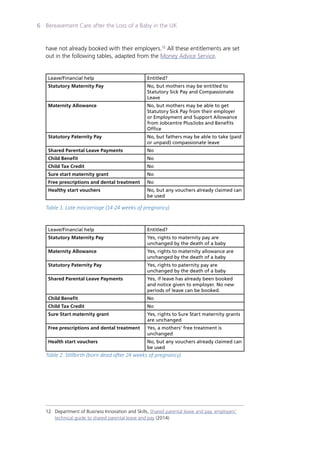
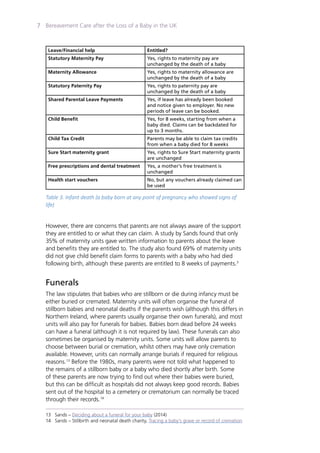
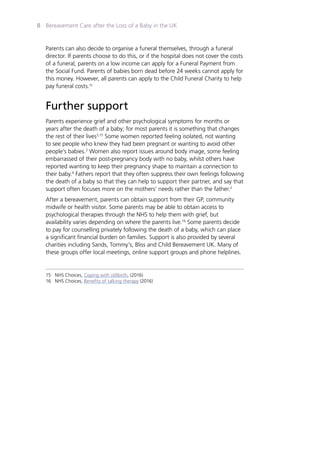
All these entitlements are set
out in the following tables, adapted from the Money Advice Service.
Leave/Financial help Entitled?
Statutory Maternity Pay No, but mothers may be entitled to
Statutory Sick Pay and Compassionate
Leave
Maternity Allowance No, but mothers may be able to get
Statutory Sick Pay from their employer
or Employment and Support Allowance
from Jobcentre Plus/Jobs and Benefits
Office
Statutory Paternity Pay No, but fathers may be able to take (paid
or unpaid) compassionate leave
Shared Parental Leave Payments No
Child Benefit No
Child Tax Credit No
Sure start maternity grant No
Free prescriptions and dental treatment No
Healthy start vouchers No, but any vouchers already claimed can
be used
Table 1. Late miscarriage (14-24 weeks of pregnancy)
Leave/Financial help Entitled?
Statutory Maternity Pay Yes, rights to maternity pay are
unchanged by the death of a baby
Maternity Allowance Yes, rights to maternity allowance are
unchanged by the death of a baby
Statutory Paternity Pay Yes, rights to paternity pay are
unchanged by the death of a baby
Shared Parental Leave Payments Yes, if leave has already been booked
and notice given to employer. No new
periods of leave can be booked.
Child Benefit No
Child Tax Credit No
Sure Start maternity grant Yes, rights to Sure Start maternity grants
are unchanged
Free prescriptions and dental treatment Yes, a mothers’ free treatment is
unchanged
Health start vouchers No, but any vouchers already claimed can
be used
Table 2. Stillbirth (born dead after 24 weeks of pregnancy)
12	 Department of Business Innovation and Skills, Shared parental leave and pay, employers’ 		
	 technical guide to shared parental leave and pay (2014)
Bereavement Care after the Loss of a Baby in the UK7
Leave/Financial help Entitled?
Statutory Maternity Pay Yes, rights to maternity pay are
unchanged by the death of a baby
Maternity Allowance Yes, rights to maternity allowance are
unchanged by the death of a baby
Statutory Paternity Pay Yes, rights to paternity pay are
unchanged by the death of a baby
Shared Parental Leave Payments Yes, if leave has already been booked
and notice given to employer. No new
periods of leave can be booked.
Child Benefit Yes, for 8 weeks, starting from when a
baby died. Claims can be backdated for
up to 3 months.
Child Tax Credit Parents may be able to claim tax credits
from when a baby died for 8 weeks
Sure Start maternity grant Yes, rights to Sure Start maternity grants
are unchanged
Free prescriptions and dental treatment Yes, a mother’s free treatment is
unchanged
Health start vouchers No, but any vouchers already claimed can
be used
Table 3. Infant death (a baby born at any point of pregnancy who showed signs of
life)
However, there are concerns that parents are not always aware of the support
they are entitled to or what they can claim. A study by Sands found that only
35% of maternity units gave written information to parents about the leave
and benefits they are entitled to. The study also found 69% of maternity units
did not give child benefit claim forms to parents with a baby who had died
following birth, although these parents are entitled to 8 weeks of payments.3
Funerals
The law stipulates that babies who are stillborn or die during infancy must be
either buried or cremated. Maternity units will often organise the funeral of
stillborn babies and neonatal deaths if the parents wish (although this differs in
Northern Ireland, where parents usually organise their own funerals), and most
units will also pay for funerals for babies. Babies born dead before 24 weeks
can have a funeral (although it is not required by law). These funerals can also
sometimes be organised by maternity units. Some units will allow parents to
choose between burial or cremation, whilst others may have only cremation
available. However, units can normally arrange burials if required for religious
reasons.13
Before the 1980s, many parents were not told what happened to
the remains of a stillborn baby or a baby who died shortly after birth. Some
of these parents are now trying to find out where their babies were buried,
but this can be difficult as hospitals did not always keep good records. Babies
sent out of the hospital to a cemetery or crematorium can normally be traced
through their records.14
13	 Sands – Deciding about a funeral for your baby (2014)
14	 Sands – Stillbirth and neonatal death charity, Tracing a baby’s grave or record of cremation
Bereavement Care after the Loss of a Baby in the UK8
Parents can also decide to organise a funeral themselves, through a funeral
director. If parents choose to do this, or if the hospital does not cover the costs
of a funeral, parents on a low income can apply for a Funeral Payment from
the Social Fund. Parents of babies born dead before 24 weeks cannot apply for
this money. However, all parents can apply to the Child Funeral Charity to help
pay funeral costs.15
Further support
Parents experience grief and other psychological symptoms for months or
years after the death of a baby; for most parents it is something that changes
the rest of their lives3,15
Some women reported feeling isolated, not wanting
to see people who knew they had been pregnant or wanting to avoid other
people’s babies.3
Women also report issues around body image, some feeling
embarrassed of their post-pregnancy body with no baby, whilst others have
reported wanting to keep their pregnancy shape to maintain a connection to
their baby.4
Fathers report that they often suppress their own feelings following
the death of a baby so that they can help to support their partner, and say that
support often focuses more on the mothers’ needs rather than the father.2
After a bereavement, parents can obtain support from their GP, community
midwife or health visitor. Some parents may be able to obtain access to
psychological therapies through the NHS to help them with grief, but
availability varies depending on where the parents live.16
Some parents decide
to pay for counselling privately following the death of a baby, which can place
a significant financial burden on families. Support is also provided by several
charities including Sands, Tommy’s, Bliss and Child Bereavement UK. Many of
these groups offer local meetings, online support groups and phone helplines.
15	 NHS Choices, Coping with stillbirth, (2016)
16	 NHS Choices, Benefits of talking therapy (2016)

POST-PB-0021

  • 1.
    POSTbrief www.parliament.uk/post | 0207219 2840 | POST@parliament.uk | @POST_UK POSTbriefs are responsive policy briefings from the Parliamentary Office of Science and Technology based on mini literature reviews and peer review. Bereavement Care after the Loss of a Baby in the UK By Rebecca Montacute and Sarah Bunn Number 21, July 2016 Inside: Background 2 Hospital care 2 Staff 3 Post-mortems 4 Consent 4 Rights of parents 5 Maternity and Paternity Entitlements 5 Funerals 7 Further support 8
  • 2.
    Bereavement Care afterthe Loss of a Baby in the UK2 Background In 2014 there were 3,245 stillbirths and 2,689 infant deaths in England and Wales1 (for a detailed overview of stillbirths and infant mortality in the UK, please see POSTnote 527, Stillbirth and Infant Mortality in the UK). The death of a baby is a traumatic event for parents and their families, and the care they receive afterwards can have a long-term impact on how families cope with their loss.2 In the case of stillbirths, this also includes the care parents receive in the final stages of pregnancy once a baby’s death has been confirmed, and during the birth. Stigma can make it difficult for families to talk about their baby and their grief, and parents can suffer psychological conditions such as depression and anxiety for years after their baby’s death.3 This brief discusses bereavement care in the UK for parents following a late miscarriage, stillbirth or a baby’s death at the start of life. This includes care of parents in hospital, issues surrounding consent for post mortems; care of parents in the community and parents’ financial rights following bereavement. Hospital care An independent study funded by the Department of Health examined the experiences of parents who had a stillbirth (a baby born dead after 24 weeks of pregnancy) or a neonatal death (a death in the first 28 days of life). The study found that the majority of parents felt positive about the care that they had received, and that they were treated with kindness, sensitivity and respect. However, 30% of women who had stillborn babies reported they did not always feel listened to by staff, were not taken seriously and did not feel fully informed about what was happening. Over half of these women did not feel involved with decisions made during this time, and afterwards did not feel confident about the decisions that were made at the time.4 National Institute of Clinical Excellence (NICE) care guidelines on stillbirths and neonatal deaths advise that all parents should be offered the opportunity to see photographs of their baby, hold their baby and produce mementos such as footprints and memory boxes.5 For some parents, holding their baby can give a sense of finality that can help with the grieving process.3 A study by the stillbirth and neonatal death charity Sands in 2010, found that whilst the majority of maternity units followed NICE guidelines, there were several issues identified with the care received. 1 Office of National Statistics, Deaths registered in England and Wales: 2014 (2014) 2 Ellis A et al. Systematic review to understand and improve care after stillbirth: a review of parents’ and healthcare professionals’ experiences. BMC Pregnancy and Childbirth (2016) 3 Heazell, A.E.P. et al. Stillbirths: economic and psychosocial consequences. Lancet (2016) 4 National Perinatal Epidemiology Unit, Listening to Parents after stillbirth or the death of their baby after birth, (2014) 5 NICE guidelines, Antenatal and postnatal mental health: clinical management and service guidance, (2014)
  • 3.
    Bereavement Care afterthe Loss of a Baby in the UK3 Parents report that hearing the sounds of live babies during labour and afterwards can be upsetting. However, only half of maternity units surveyed by Sands had a room away from the labour ward for bereaved parents. Additionally, fewer than half of units had a designated bereavement support midwife trained to help parents after the death of a baby. All midwives receive some bereavement training, but this does not include counselling, that specialist bereavement support midwives are often trained in.6 Another study of postnatal care following a stillbirth or neonatal death found that one third of women did not receive information on breast milk suppression, and one quarter did not receive information about counselling services.7 Following the death of a baby shortly after birth, 75% of women saw a midwife after leaving hospital. A further study published in the Lancet found that after a stillbirth, 90% of women were visited at home by a midwife, but 4% of women were not offered a visit by a midwife at all.3 There are also challenges in supporting parents from different cultural backgrounds. In the Sands survey half of units serving high numbers of non-English speakers had no information leaflets available in the other main languages spoken locally. Sometimes women require interpreters to understand fully difficult issues which may require their consent. One third of all units surveyed were found not to use a trained interpreter and two-fifths of all units expected the father to act as an interpreter for the mother. Sands say that as fathers are also likely to be distressed at this time, mothers may not get a full translation of what is said, so decisions the mother makes may then not be fully informed.8 Babies who are sick when they are born (for example babies born prematurely) often need to spend time in a neonatal unit (NNU). For babies who spent time in the NNU before their death, the majority of parents reported being able to see and touch their babies before they died. Parents in NNUs often want to help with the care of their baby, such as changing their baby’s nappy or cleaning their hands. Almost half of mothers reported being allowed to do so, but some were unable to as their baby was too sick. Once a baby has died in an NNU, guidelines are that staff should give parents information on counselling services available to them. However, 21% of parents have reported not being given this information.7 Staff Caring for bereaved parents can be difficult for staff, which can result in increased stress and staff absences.2 However parents are more likely to suffer psychological problems in the future if they do not receive adequate professional support following the death of their baby.2 Sands recommends that all staff who come into contact with parents during birth and early infancy should be trained in how to care for them following the death of a baby. Fewer than half of doctors and midwives were found to have mandatory training in care after the death of a baby. The majority of doctors and 6 Royal College of Midwives, Who cares when you lose a baby? (2010) 7 National Perinatal Epidemiology Unit, Listening to Parents after stillbirth or the death of their baby after birth, (2014) 8 Sands, Stillbirth and neonatal death charity, Bereavement Care Report, (2010)
  • 4.
    Bereavement Care afterthe Loss of a Baby in the UK4 midwives have optional courses available to them in this area, but the charity warns that due to pressures on staff time and the potentially upsetting nature of the subject matter, staff are unlikely to attend optional courses. Staff who responded to the Sands survey reported they wanted more training for junior doctors, who are often called in during the crisis leading to a baby’s death. Staff also said they wanted more training for sonographers in how to break bad news to parents, as a scan is often where problems during pregnancy are first detected. Almost one in five maternity units surveyed by Sands did not have a member of staff trained to counsel parents if an anomaly was found during a routine scan.3 Healthcare professionals are often deeply affected by the death of a baby in their care. Professionals have reported feeling guilt, anger, blame, anxiety and sadness after caring for parents with a stillborn baby, but have also reported positive feelings including honour and privilege at helping parents following the death of their baby.2 Post-mortems A post-mortem (or autopsy) is the medical examination of a body after death. Post-mortems can often determine why a baby died or can give important new information following the death of a baby. This information can inform the care of women during subsequent pregnancies, for example ensuring women have additional monitoring and tests if necessary. Post-mortem information also contributes to a better understanding of the underlying causes of stillbirths and infant deaths. A study by Sands shows that if a diagnosis of why a stillbirth occurred has already been made, a post-mortem will confirm it in 50-60% of cases. In 10- 30% of cases, a post mortem will provide new information which changes the diagnosis from the one made previously. If a diagnosis had not been made, 20% of post mortems provide new information which is important to the diagnosis, for instance by ruling out a possible cause.9 Consent A Coroner is a government official whose role is to confirm and certify deaths in their area. Stillbirths are not referred to the Coroner, but all infant deaths are. In cases where the cause of death of an infant is unclear, a post-mortem is usually ordered by the Coroner. This does not require parental consent. However, parental consent is required for hospital post-mortems. If an infant death is unexplained after a post-mortem, the death is usually registered as ‘Sudden Infant Death Syndrome’ (SIDS), or unascertained (unknown). Unexplained deaths make up 9% of all infant deaths. Half of stillbirths in the UK are unexplained,10 and it is thought more would be explained if a post mortem had taken place. Parents report that knowing why their baby died can help the grieving process. In a study of parental 9 Sands, Deciding about a post mortem examination, information for parents, (2014) 10 MBRRACE-UK Mothers and Babies: Reducing Risk through Audits and Confidential Enquiries across the UK. Perinatal Confidential Enquiry 2015. (2015).
  • 5.
    Bereavement Care afterthe Loss of a Baby in the UK5 experiences of the consent process after stillbirth, 34% of parents who declined a post-mortem regretted it, compared with 17% of parents who had chosen to have post-mortems.11 One study found that for one in three stillbirths, there is no record of whether or not a post-mortem was offered.1 Many different factors influence a parental decision on whether to have a post-mortem. One key factor is the interaction parents have with healthcare professionals.2 Research suggests that better information and communication with parents about post-mortems could increase the take up rate. Parents often want to have a funeral quickly. However, if a post-mortem takes place, families may wait more than two weeks for their baby’s body to be returned to them. The Royal College of Pathologists estimates that more specialist pathologists are needed to keep up with demand. Many babies are transferred long distances to other units where a pathologist is available, which delays the return of the baby’s body to their family. The prospect of this long wait before a funeral can take place is thought to be one of the main reasons parents currently turn down post- mortems.4,12 Rights of parents Maternity and Paternity Entitlements The rights of parents following the death of a baby depend on the length of pregnancy, whether a baby was stillborn or lived after birth, and the parents’ employment situation. If a baby is born dead before 24 weeks of pregnancy, parents and their partners are entitled to sick leave for up to 28 weeks, with the same benefits as when any employee takes time off for illness (which will depend on the time someone has worked for their employer and their normal pay). However, this requires confirmation of sickness from a GP. If a parent is not sick, they can claim time off for dependents or compassionate leave, but this can depend on the employer and they may not be paid during this time. If a baby is born dead after 24 weeks, or is born alive at any stage of pregnancy but then dies, mothers are entitled to full maternity leave (52 weeks) and fathers to full paternity leave (2 weeks). Shared parental leave and pay were introduced in 2015, which allows parents to split 52 weeks of parental leave between them, with the first 2 weeks reserved for the mother. Shared parental leave requires the mother to opt out of her maternity leave and give notice to her employers of when her maternity leave will end. If notice has not already been given before the baby dies, the other partner is no longer entitled to shared parental leave and pay. If a baby dies and parents have already opted into shared parental leave and pay, they are still able to take any leave they have already booked, but are no longer entitled to any leave they 11 Heazell, A. E. P. et al A difficult conversation? The views and experiences of parents and professionals on the consent process for perinatal postmortem after stillbirth (2012).
  • 6.
    Bereavement Care afterthe Loss of a Baby in the UK6 have not already booked with their employers.12 All these entitlements are set out in the following tables, adapted from the Money Advice Service. Leave/Financial help Entitled? Statutory Maternity Pay No, but mothers may be entitled to Statutory Sick Pay and Compassionate Leave Maternity Allowance No, but mothers may be able to get Statutory Sick Pay from their employer or Employment and Support Allowance from Jobcentre Plus/Jobs and Benefits Office Statutory Paternity Pay No, but fathers may be able to take (paid or unpaid) compassionate leave Shared Parental Leave Payments No Child Benefit No Child Tax Credit No Sure start maternity grant No Free prescriptions and dental treatment No Healthy start vouchers No, but any vouchers already claimed can be used Table 1. Late miscarriage (14-24 weeks of pregnancy) Leave/Financial help Entitled? Statutory Maternity Pay Yes, rights to maternity pay are unchanged by the death of a baby Maternity Allowance Yes, rights to maternity allowance are unchanged by the death of a baby Statutory Paternity Pay Yes, rights to paternity pay are unchanged by the death of a baby Shared Parental Leave Payments Yes, if leave has already been booked and notice given to employer. No new periods of leave can be booked. Child Benefit No Child Tax Credit No Sure Start maternity grant Yes, rights to Sure Start maternity grants are unchanged Free prescriptions and dental treatment Yes, a mothers’ free treatment is unchanged Health start vouchers No, but any vouchers already claimed can be used Table 2. Stillbirth (born dead after 24 weeks of pregnancy) 12 Department of Business Innovation and Skills, Shared parental leave and pay, employers’ technical guide to shared parental leave and pay (2014)
  • 7.
    Bereavement Care afterthe Loss of a Baby in the UK7 Leave/Financial help Entitled? Statutory Maternity Pay Yes, rights to maternity pay are unchanged by the death of a baby Maternity Allowance Yes, rights to maternity allowance are unchanged by the death of a baby Statutory Paternity Pay Yes, rights to paternity pay are unchanged by the death of a baby Shared Parental Leave Payments Yes, if leave has already been booked and notice given to employer. No new periods of leave can be booked. Child Benefit Yes, for 8 weeks, starting from when a baby died. Claims can be backdated for up to 3 months. Child Tax Credit Parents may be able to claim tax credits from when a baby died for 8 weeks Sure Start maternity grant Yes, rights to Sure Start maternity grants are unchanged Free prescriptions and dental treatment Yes, a mother’s free treatment is unchanged Health start vouchers No, but any vouchers already claimed can be used Table 3. Infant death (a baby born at any point of pregnancy who showed signs of life) However, there are concerns that parents are not always aware of the support they are entitled to or what they can claim. A study by Sands found that only 35% of maternity units gave written information to parents about the leave and benefits they are entitled to. The study also found 69% of maternity units did not give child benefit claim forms to parents with a baby who had died following birth, although these parents are entitled to 8 weeks of payments.3 Funerals The law stipulates that babies who are stillborn or die during infancy must be either buried or cremated. Maternity units will often organise the funeral of stillborn babies and neonatal deaths if the parents wish (although this differs in Northern Ireland, where parents usually organise their own funerals), and most units will also pay for funerals for babies. Babies born dead before 24 weeks can have a funeral (although it is not required by law). These funerals can also sometimes be organised by maternity units. Some units will allow parents to choose between burial or cremation, whilst others may have only cremation available. However, units can normally arrange burials if required for religious reasons.13 Before the 1980s, many parents were not told what happened to the remains of a stillborn baby or a baby who died shortly after birth. Some of these parents are now trying to find out where their babies were buried, but this can be difficult as hospitals did not always keep good records. Babies sent out of the hospital to a cemetery or crematorium can normally be traced through their records.14 13 Sands – Deciding about a funeral for your baby (2014) 14 Sands – Stillbirth and neonatal death charity, Tracing a baby’s grave or record of cremation
  • 8.
    Bereavement Care afterthe Loss of a Baby in the UK8 Parents can also decide to organise a funeral themselves, through a funeral director. If parents choose to do this, or if the hospital does not cover the costs of a funeral, parents on a low income can apply for a Funeral Payment from the Social Fund. Parents of babies born dead before 24 weeks cannot apply for this money. However, all parents can apply to the Child Funeral Charity to help pay funeral costs.15 Further support Parents experience grief and other psychological symptoms for months or years after the death of a baby; for most parents it is something that changes the rest of their lives3,15 Some women reported feeling isolated, not wanting to see people who knew they had been pregnant or wanting to avoid other people’s babies.3 Women also report issues around body image, some feeling embarrassed of their post-pregnancy body with no baby, whilst others have reported wanting to keep their pregnancy shape to maintain a connection to their baby.4 Fathers report that they often suppress their own feelings following the death of a baby so that they can help to support their partner, and say that support often focuses more on the mothers’ needs rather than the father.2 After a bereavement, parents can obtain support from their GP, community midwife or health visitor. Some parents may be able to obtain access to psychological therapies through the NHS to help them with grief, but availability varies depending on where the parents live.16 Some parents decide to pay for counselling privately following the death of a baby, which can place a significant financial burden on families. Support is also provided by several charities including Sands, Tommy’s, Bliss and Child Bereavement UK. Many of these groups offer local meetings, online support groups and phone helplines. 15 NHS Choices, Coping with stillbirth, (2016) 16 NHS Choices, Benefits of talking therapy (2016)