COPD Assessment
Revised GOLD (global initiative for chronic obstructive lung disease)
guidelines.
Defination of COPD
Chronic Obstructive Pulmonary Disease (COPD) is a common,
preventable and treatable disease that is characterized by persistent
respiratory symptoms and airflow limitation that is due to airway
and/or alveolar abnormalities usually caused by significant exposure to
noxious particles or gases.
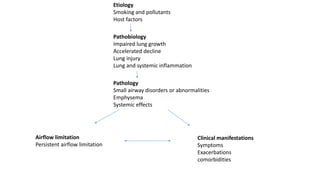
Etiology
Smoking and pollutants
Host factors
Pathobiology
Impaired lung growth
Accelerated decline
Lung injury
Lung and systemic inflammation
Pathology
Small airway disorders or abnormalities
Emphysema
Systemic effects
Airflow limitation
Persistent airflow limitation
Clinical manifestations
Symptoms
Exacerbations
comorbidities
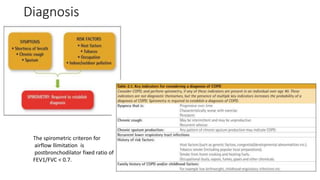
Diagnosis
The spirometric criteron for
airflow llimitation is
postbronchodilator fixed ratio of
FEV1/FVC < 0.7.
Assessment
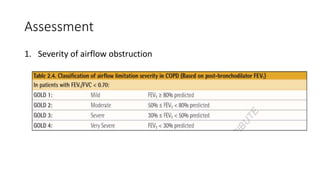
1. Severity of airflow obstruction
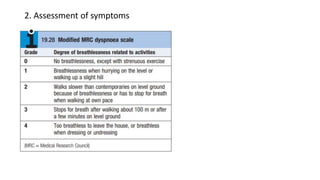
2. Assessment of symptoms
CAT assessment
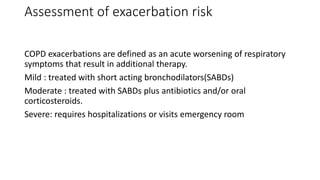
Assessment of exacerbation risk
COPD exacerbations are defined as an acute worsening of respiratory
symptoms that result in additional therapy.
Mild : treated with short acting bronchodilators(SABDs)
Moderate : treated with SABDs plus antibiotics and/or oral
corticosteroids.
Severe: requires hospitalizations or visits emergency room
Assessment of comorbidities
• Cardiovascular disease
• Skeletal muscle dysfunction
• Metabolic syndrome
• Osteoporosis
• Depression
• Anxiety
• Lung cancer
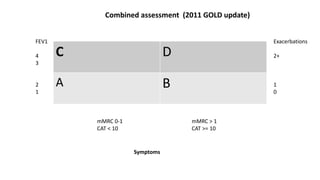
C D
A B
FEV1
4
3
2
1
Exacerbations
2+
1
0
mMRC 0-1
CAT < 10
mMRC > 1
CAT >= 10
Symptoms
Combined assessment (2011 GOLD update)
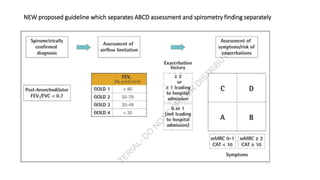
NEW proposed guideline which separates ABCD assessment and spirometry finding separately
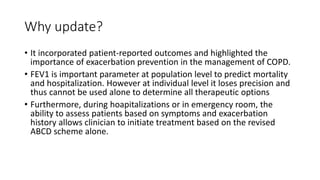
Why update?
• It incorporated patient-reported outcomes and highlighted the
importance of exacerbation prevention in the management of COPD.
• FEV1 is important parameter at population level to predict mortality
and hospitalization. However at individual level it loses precision and
thus cannot be used alone to determine all therapeutic options
• Furthermore, during hoapitalizations or in emergency room, the
ability to assess patients based on symptoms and exacerbation
history allows clinician to initiate treatment based on the revised
ABCD scheme alone.
References
• Global strategy for the diagnosis, management and prevention of
COPD, 2018 report (GOLD)
• Davidson’s principles and practice of medicine 22nd edition

Copd assessment

  • 1.
    COPD Assessment Revised GOLD(global initiative for chronic obstructive lung disease) guidelines.
  • 2.
    Defination of COPD ChronicObstructive Pulmonary Disease (COPD) is a common, preventable and treatable disease that is characterized by persistent respiratory symptoms and airflow limitation that is due to airway and/or alveolar abnormalities usually caused by significant exposure to noxious particles or gases.
  • 3.
    Etiology Smoking and pollutants Hostfactors Pathobiology Impaired lung growth Accelerated decline Lung injury Lung and systemic inflammation Pathology Small airway disorders or abnormalities Emphysema Systemic effects Airflow limitation Persistent airflow limitation Clinical manifestations Symptoms Exacerbations comorbidities
  • 4.
    Diagnosis The spirometric criteronfor airflow llimitation is postbronchodilator fixed ratio of FEV1/FVC < 0.7.
  • 5.
    Assessment 1. Severity ofairflow obstruction
  • 6.
  • 7.
  • 8.
    Assessment of exacerbationrisk COPD exacerbations are defined as an acute worsening of respiratory symptoms that result in additional therapy. Mild : treated with short acting bronchodilators(SABDs) Moderate : treated with SABDs plus antibiotics and/or oral corticosteroids. Severe: requires hospitalizations or visits emergency room
  • 9.
    Assessment of comorbidities •Cardiovascular disease • Skeletal muscle dysfunction • Metabolic syndrome • Osteoporosis • Depression • Anxiety • Lung cancer
  • 10.
    C D A B FEV1 4 3 2 1 Exacerbations 2+ 1 0 mMRC0-1 CAT < 10 mMRC > 1 CAT >= 10 Symptoms Combined assessment (2011 GOLD update)
  • 11.
    NEW proposed guidelinewhich separates ABCD assessment and spirometry finding separately
  • 12.
    Why update? • Itincorporated patient-reported outcomes and highlighted the importance of exacerbation prevention in the management of COPD. • FEV1 is important parameter at population level to predict mortality and hospitalization. However at individual level it loses precision and thus cannot be used alone to determine all therapeutic options • Furthermore, during hoapitalizations or in emergency room, the ability to assess patients based on symptoms and exacerbation history allows clinician to initiate treatment based on the revised ABCD scheme alone.
  • 15.
    References • Global strategyfor the diagnosis, management and prevention of COPD, 2018 report (GOLD) • Davidson’s principles and practice of medicine 22nd edition