LEADING
COLLABORATION
IN THE ARM
ECOSYSTEM
New Zephyr features
LWM2M / FOTA Framework
Marti Bolivar <marti.bolivar@linaro.org>
David Brown <david.brown@linaro.org>
Ricardo Salveti <ricardo.salveti@linaro.org>
Mike Scott <michael.scott@linaro.org>
LEADING COLLABORATION
IN THE ARM ECOSYSTEM
Zephyr and LTD
“changing at an alarming pace”
LEADING COLLABORATION
IN THE ARM ECOSYSTEM
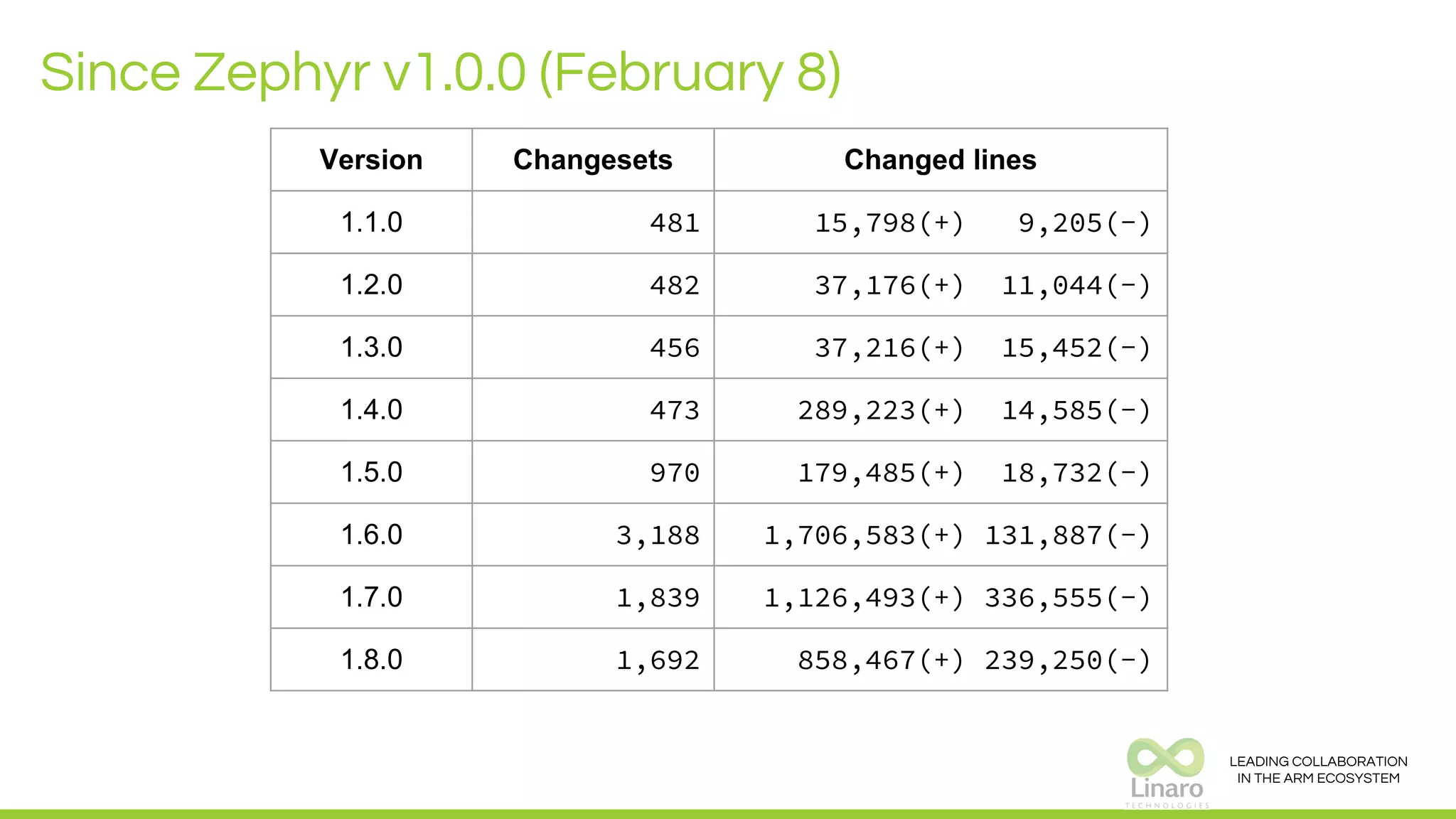
Version Changesets Changed lines
1.1.0 481 15,798(+) 9,205(-)
1.2.0 482 37,176(+) 11,044(-)
1.3.0 456 37,216(+) 15,452(-)
1.4.0 473 289,223(+) 14,585(-)
1.5.0 970 179,485(+) 18,732(-)
1.6.0 3,188 1,706,583(+) 131,887(-)
1.7.0 1,839 1,126,493(+) 336,555(-)
1.8.0 1,692 858,467(+) 239,250(-)
Since Zephyr v1.0.0 (February 8)
LEADING COLLABORATION
IN THE ARM ECOSYSTEM
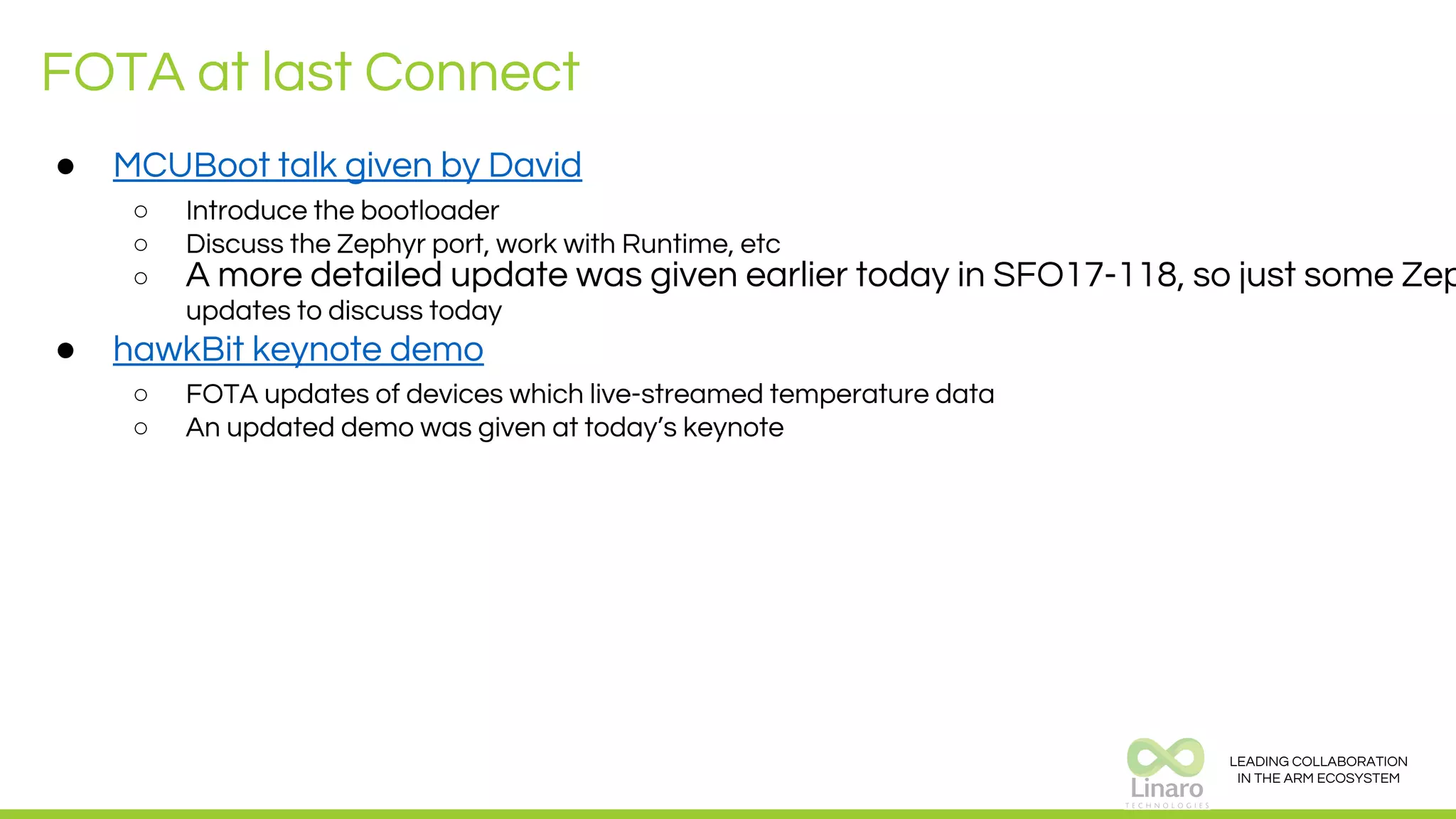
FOTA at last Connect
● MCUBoot talk given by David
○ Introduce the bootloader
○ Discuss the Zephyr port, work with Runtime, etc
○ A more detailed update was given earlier today in SFO17-118, so just some Zep
updates to discuss today
● hawkBit keynote demo
○ FOTA updates of devices which live-streamed temperature data
○ An updated demo was given at today’s keynote
LEADING COLLABORATION
IN THE ARM ECOSYSTEM
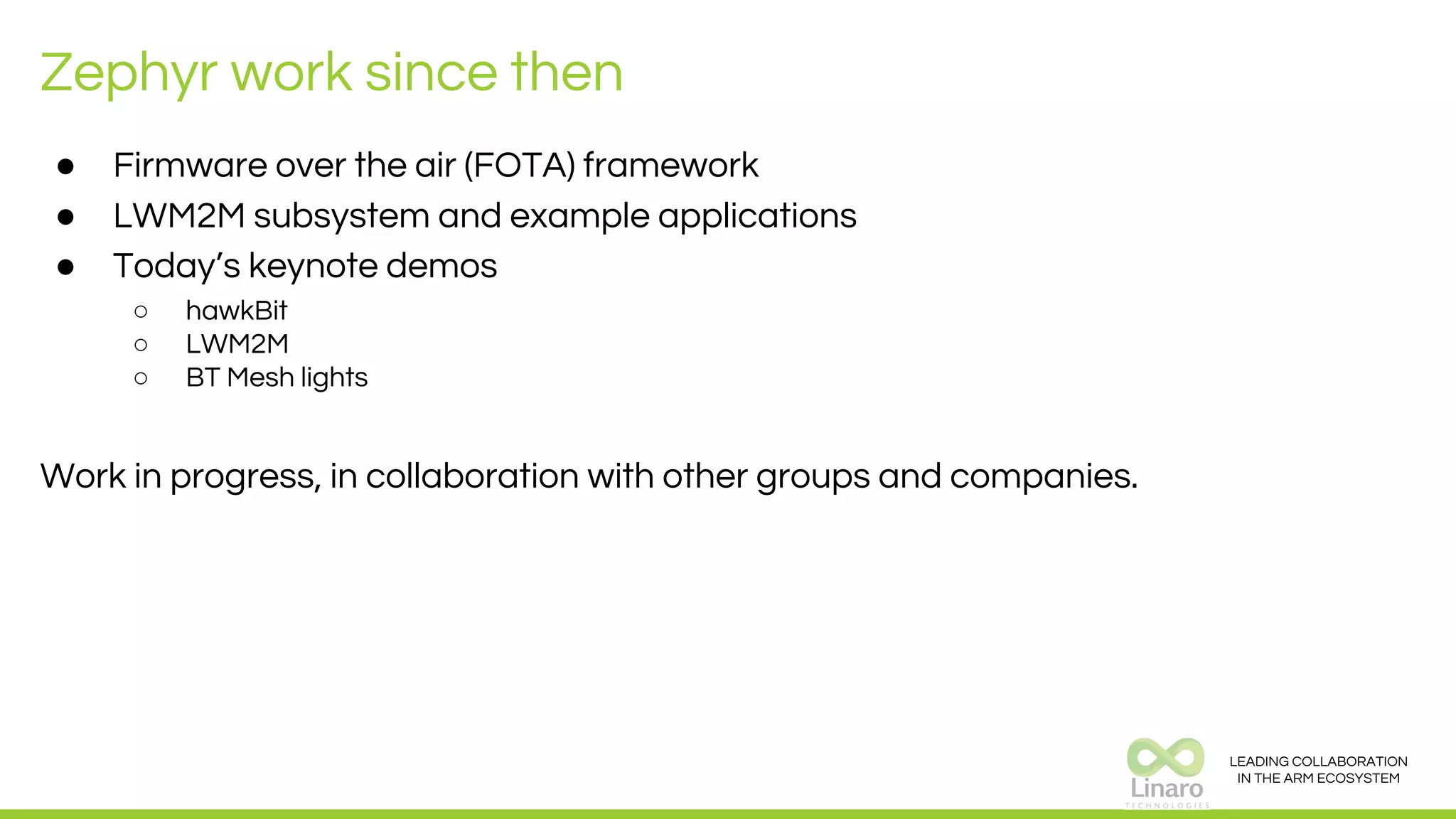
Zephyr work since then
● Firmware over the air (FOTA) framework
● LWM2M subsystem and example applications
● Today’s keynote demos
○ hawkBit
○ LWM2M
○ BT Mesh lights
Work in progress, in collaboration with other groups and companies.
LEADING COLLABORATION
IN THE ARM ECOSYSTEM
MCUBoot + FOTA framework
LEADING COLLABORATION
IN THE ARM ECOSYSTEM
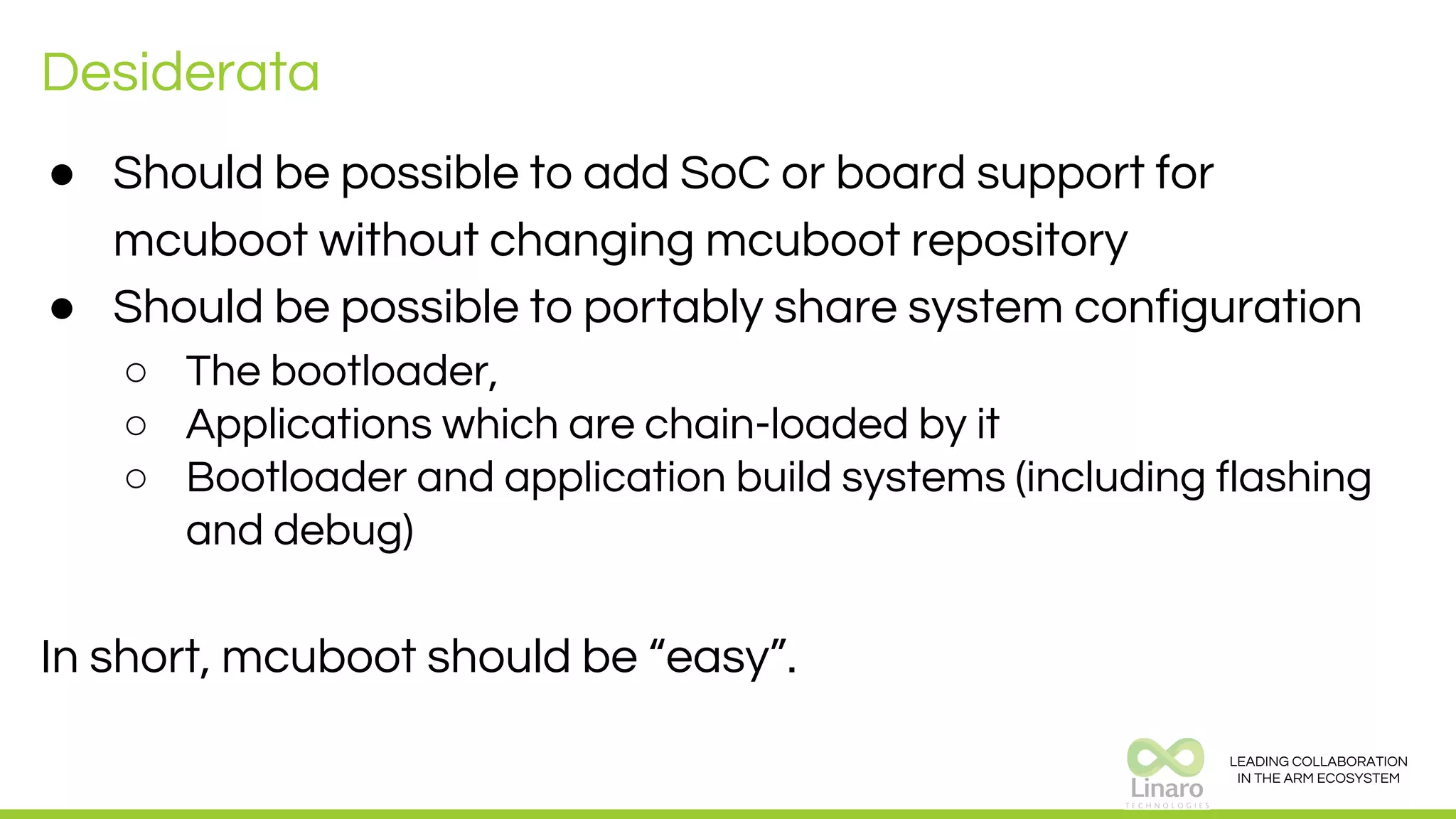
Desiderata
● Should be possible to add SoC or board support for
mcuboot without changing mcuboot repository
● Should be possible to portably share system configuration
○ The bootloader,
○ Applications which are chain-loaded by it
○ Bootloader and application build systems (including flashing
and debug)
In short, mcuboot should be “easy”.
LEADING COLLABORATION
IN THE ARM ECOSYSTEM
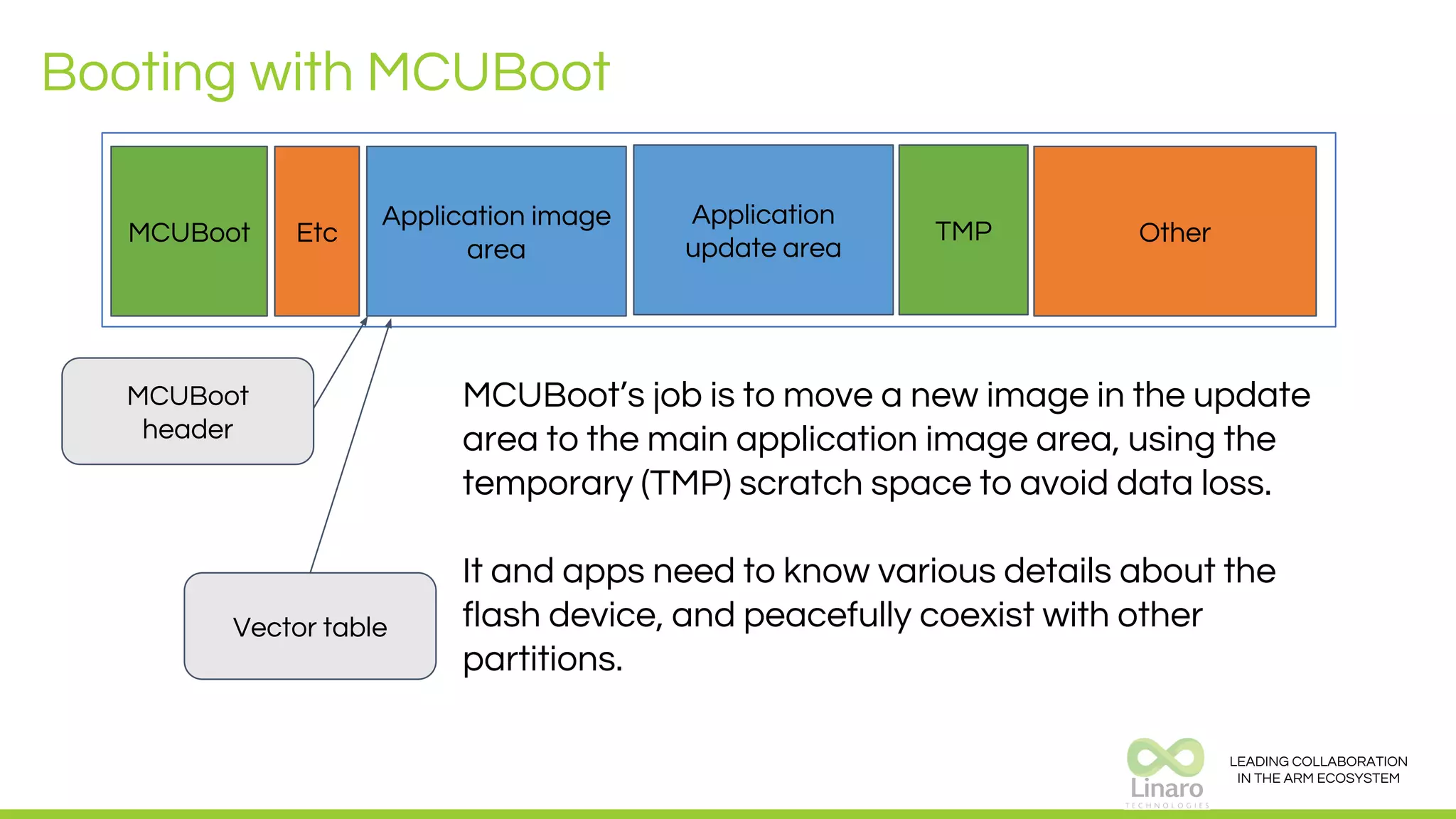
Booting with MCUBoot
Application image
area
Other
Application
update area
TMPMCUBoot Etc
MCUBoot’s job is to move a new image in the update
area to the main application image area, using the
temporary (TMP) scratch space to avoid data loss.
It and apps need to know various details about the
flash device, and peacefully coexist with other
partitions.
MCUBoot
header
Vector table
LEADING COLLABORATION
IN THE ARM ECOSYSTEM
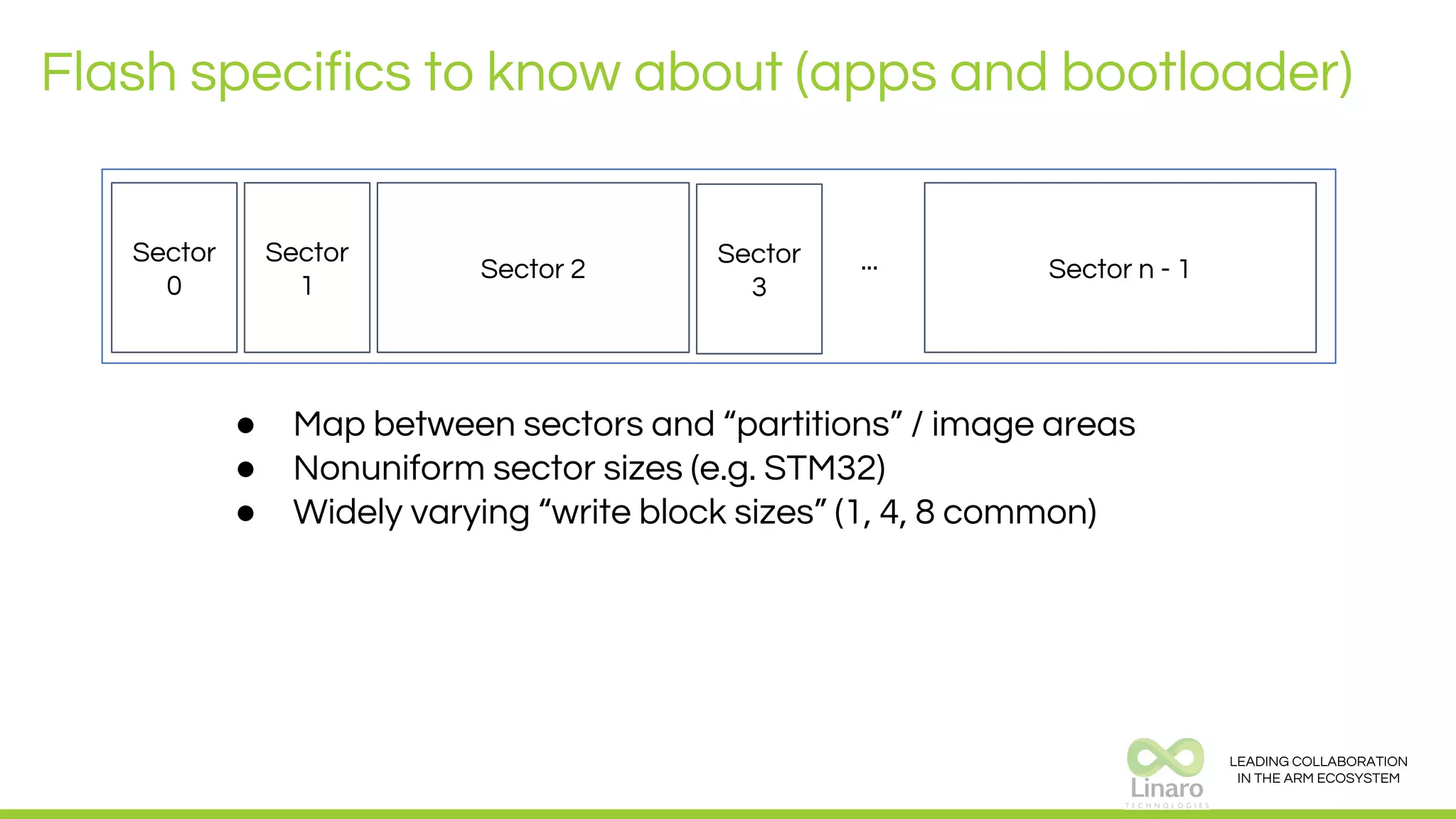
Flash specifics to know about (apps and bootloader)
Sector
0
Sector
1
Sector 2 Sector n - 1...Sector
3
● Map between sectors and “partitions” / image areas
● Nonuniform sector sizes (e.g. STM32)
● Widely varying “write block sizes” (1, 4, 8 common)
LEADING COLLABORATION
IN THE ARM ECOSYSTEM
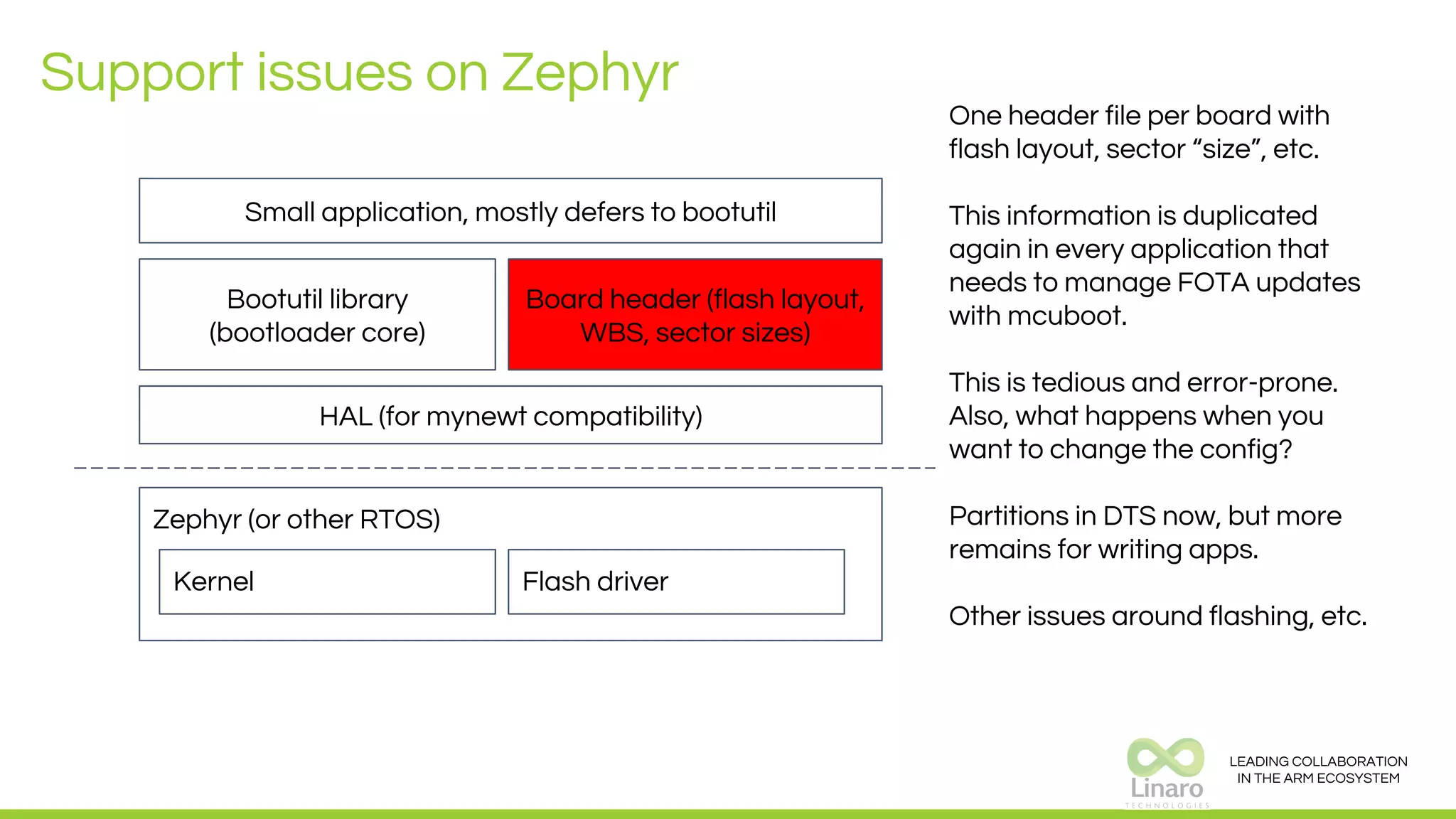
Support issues on Zephyr
Zephyr (or other RTOS)
Kernel Flash driver
Bootutil library
(bootloader core)
Board header (flash layout,
WBS, sector sizes)
Small application, mostly defers to bootutil
HAL (for mynewt compatibility)
One header file per board with
flash layout, sector “size”, etc.
This information is duplicated
again in every application that
needs to manage FOTA updates
with mcuboot.
This is tedious and error-prone.
Also, what happens when you
want to change the config?
Partitions in DTS now, but more
remains for writing apps.
Other issues around flashing, etc.
LEADING COLLABORATION
IN THE ARM ECOSYSTEM
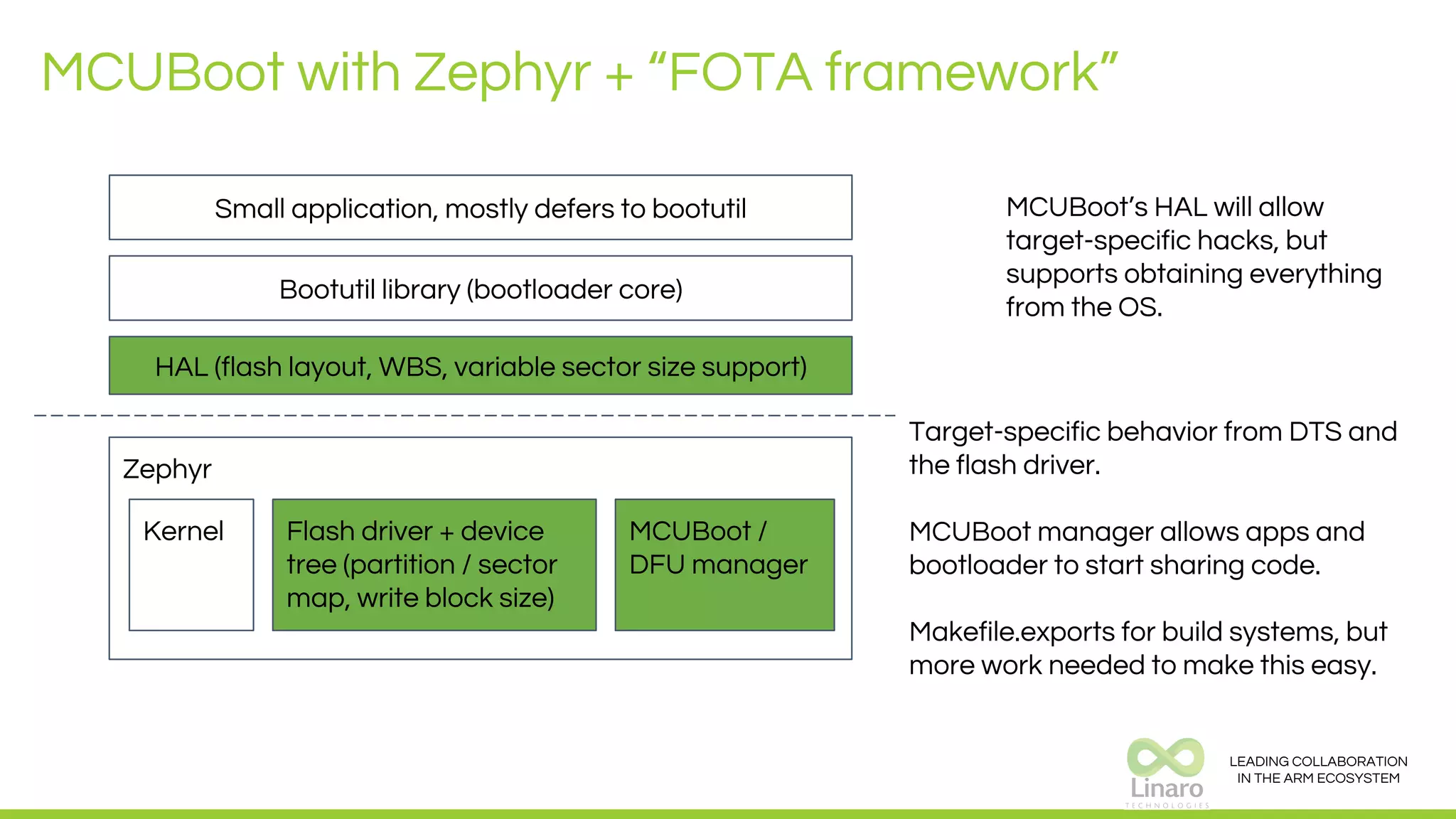
MCUBoot with Zephyr + “FOTA framework”
Zephyr
Kernel Flash driver + device
tree (partition / sector
map, write block size)
Bootutil library (bootloader core)
Small application, mostly defers to bootutil
HAL (flash layout, WBS, variable sector size support)
MCUBoot /
DFU manager
MCUBoot’s HAL will allow
target-specific hacks, but
supports obtaining everything
from the OS.
Target-specific behavior from DTS and
the flash driver.
MCUBoot manager allows apps and
bootloader to start sharing code.
Makefile.exports for build systems, but
more work needed to make this easy.
LEADING COLLABORATION
IN THE ARM ECOSYSTEM
LWM2M
LEADING COLLABORATION
IN THE ARM ECOSYSTEM
LWM2M from 10,000 ft (3048 m)
UDP, L2, PHY
CoAP [+DTLS]
LWM2M
IPSO objects
Application callbacks, etc.
LEADING COLLABORATION
IN THE ARM ECOSYSTEM
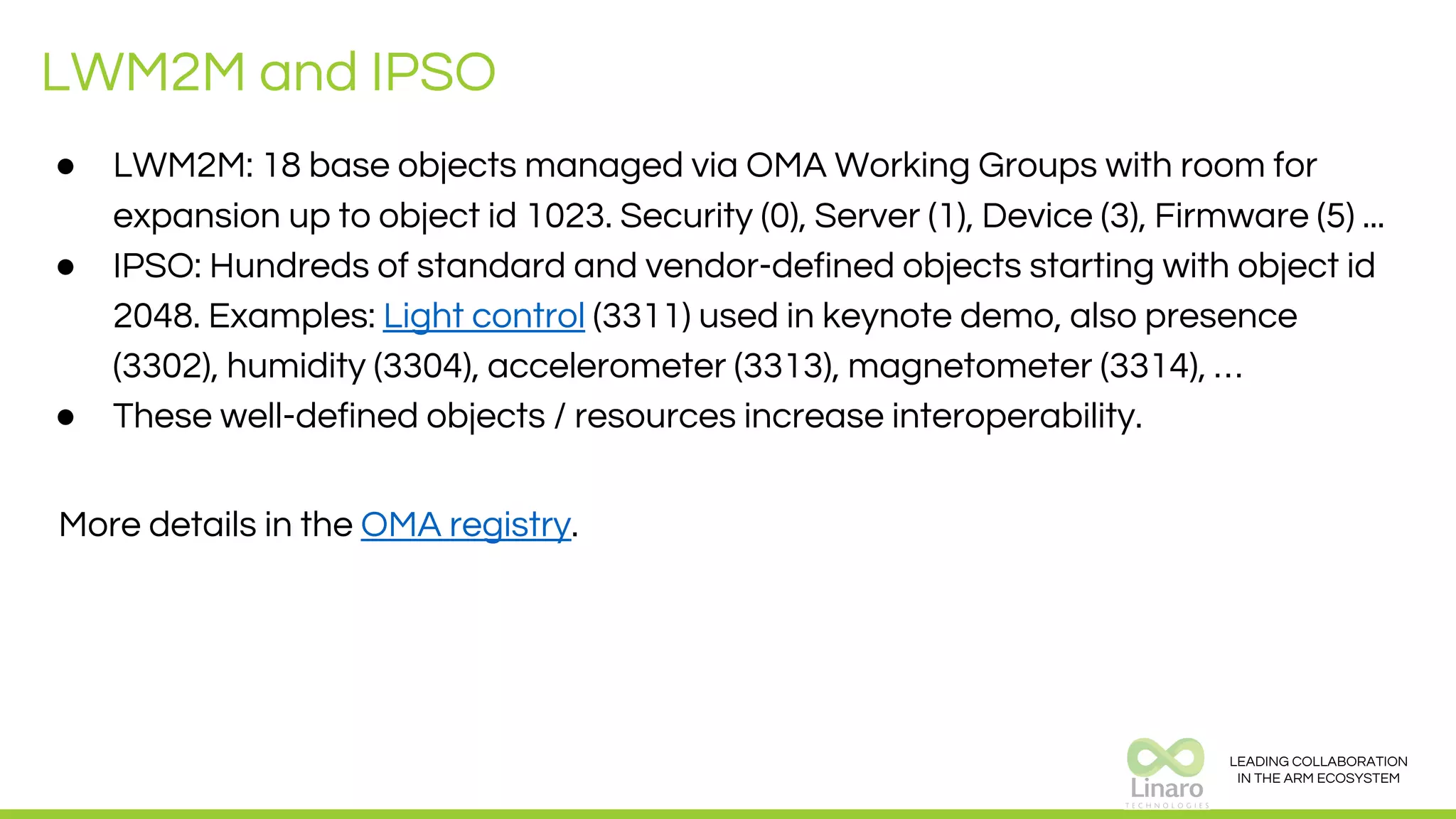
LWM2M and IPSO
● LWM2M: 18 base objects managed via OMA Working Groups with room for
expansion up to object id 1023. Security (0), Server (1), Device (3), Firmware (5) ...
● IPSO: Hundreds of standard and vendor-defined objects starting with object id
2048. Examples: Light control (3311) used in keynote demo, also presence
(3302), humidity (3304), accelerometer (3313), magnetometer (3314), …
● These well-defined objects / resources increase interoperability.
More details in the OMA registry.
LEADING COLLABORATION
IN THE ARM ECOSYSTEM
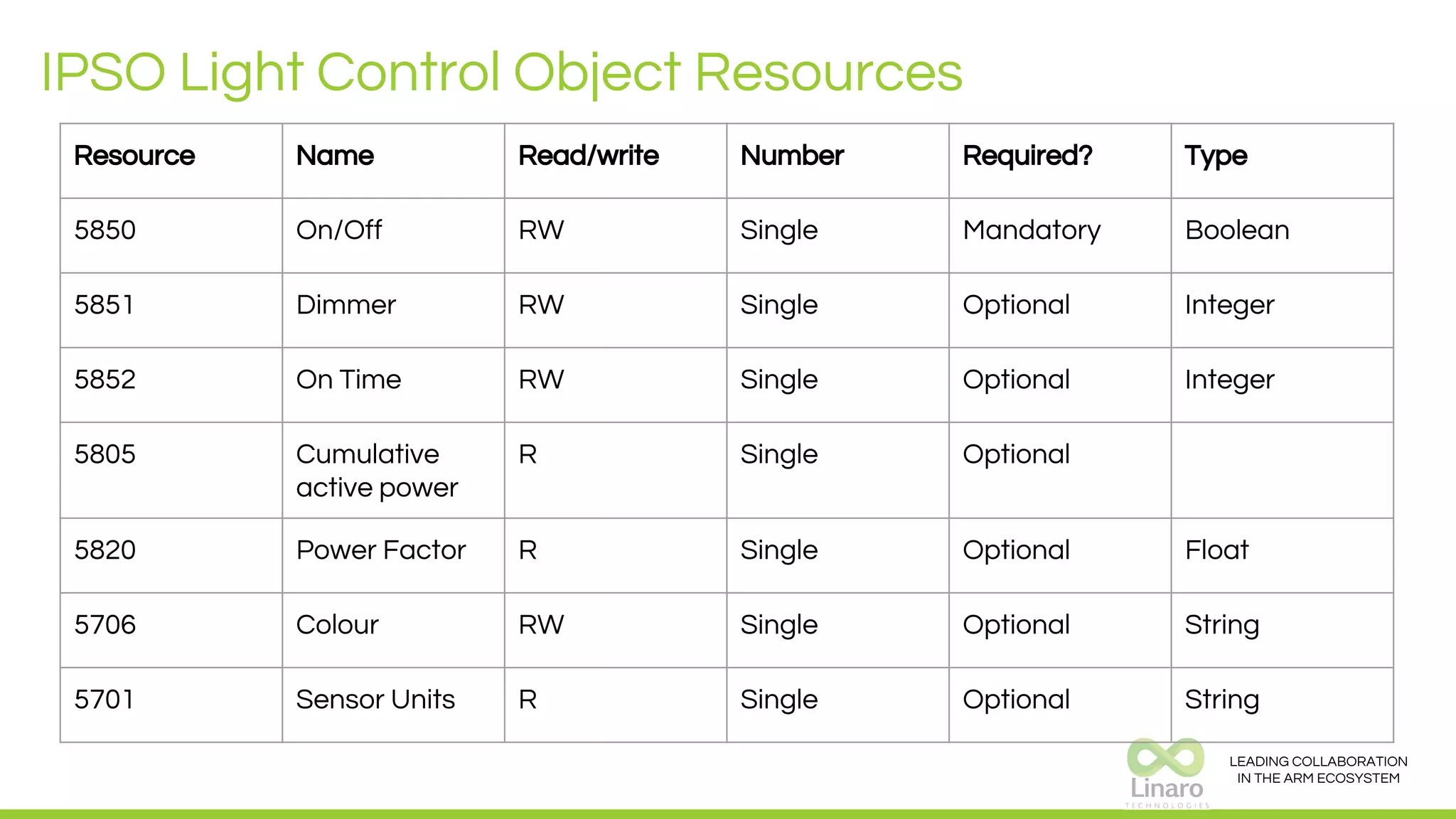
Resource Name Read/write Number Required? Type
5850 On/Off RW Single Mandatory Boolean
5851 Dimmer RW Single Optional Integer
5852 On Time RW Single Optional Integer
5805 Cumulative
active power
R Single Optional
5820 Power Factor R Single Optional Float
5706 Colour RW Single Optional String
5701 Sensor Units R Single Optional String
IPSO Light Control Object Resources
LEADING COLLABORATION
IN THE ARM ECOSYSTEM
IPSO Light Control in Source Form
static struct lwm2m_engine_obj_field fields[] = {
OBJ_FIELD_DATA(LIGHT_ON_OFF_ID, RW, BOOL),
OBJ_FIELD_DATA(LIGHT_DIMMER_ID, RW, U8),
OBJ_FIELD_DATA(LIGHT_ON_TIME_ID, RW, S32),
OBJ_FIELD_DATA(LIGHT_CUMULATIVE_ACTIVE_POWER_ID, R,
FLOAT32),
OBJ_FIELD_DATA(LIGHT_POWER_FACTOR_ID, R, FLOAT32),
OBJ_FIELD_DATA(LIGHT_COLOUR_ID, RW, STRING),
OBJ_FIELD_DATA(LIGHT_SENSOR_UNITS_ID, R, STRING),
};
LEADING COLLABORATION
IN THE ARM ECOSYSTEM
Instance-specific data declarations
/* Initialize instance resource data. */
INIT_OBJ_RES_DATA(res[avail], i, LIGHT_ON_OFF_ID,
&on_off_value[avail], sizeof(*on_off_value));
INIT_OBJ_RES_DATA(res[avail], i, LIGHT_DIMMER_ID,
&dimmer_value[avail], sizeof(*dimmer_value));
[...]
INIT_OBJ_RES_DATA(res[avail], i, LIGHT_SENSOR_UNITS_ID,
units[avail], LIGHT_STRING_SHORT);
LEADING COLLABORATION
IN THE ARM ECOSYSTEM
Application level
/* Resource initialization */
lwm2m_engine_set_string("3/0/0", CLIENT_MANUFACTURER);
lwm2m_engine_set_string("3/0/1", CLIENT_MODEL_NUMBER);
[...]
/* Engine startup */
ret = lwm2m_rd_client_start(&client, CONFIG_NET_APP_PEER_IPV6_ADDR,
CONFIG_LWM2M_PEER_PORT, CONFIG_BOARD,
rd_client_event);
LEADING COLLABORATION
IN THE ARM ECOSYSTEM
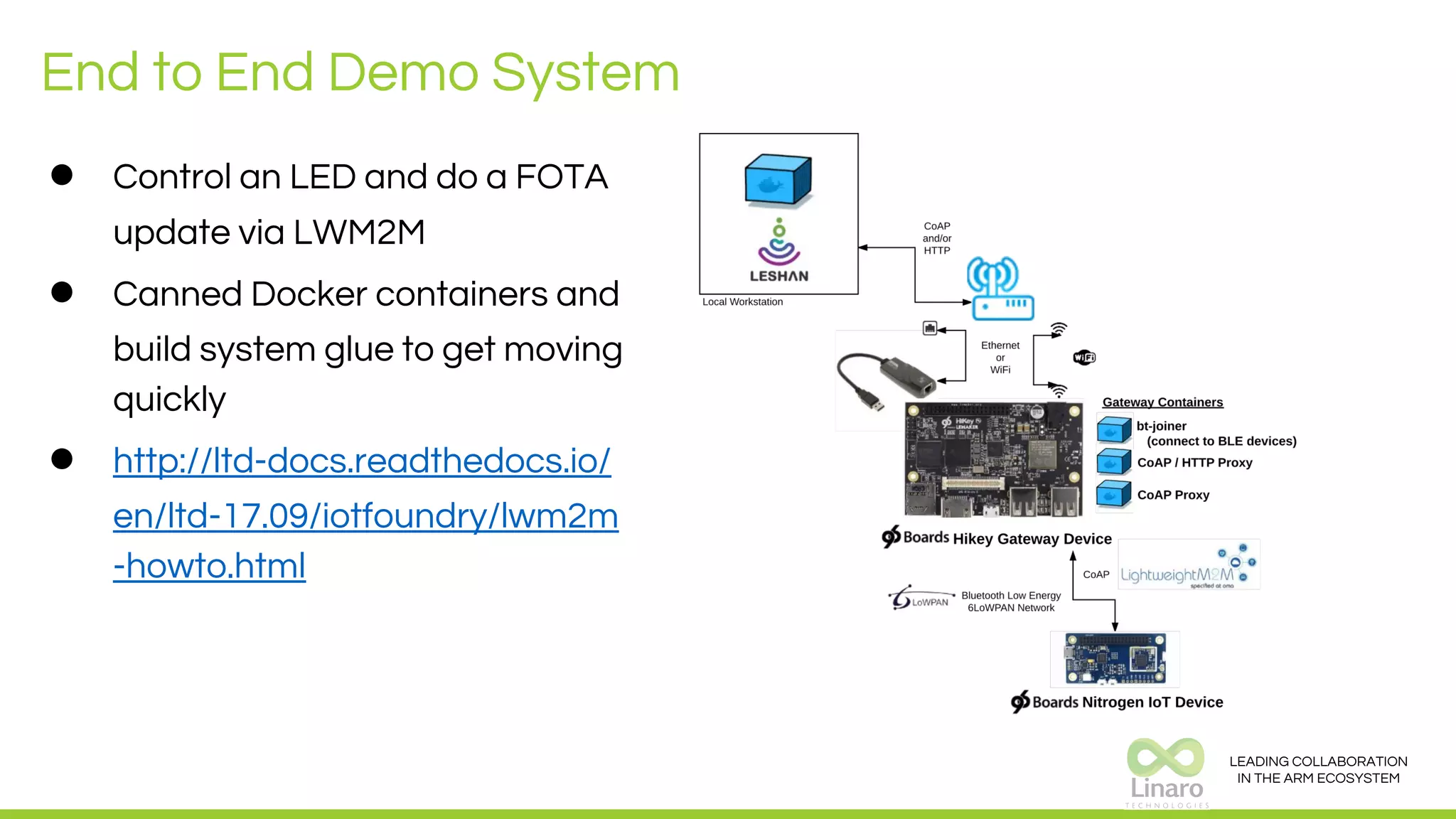
End to End Demo System
● Control an LED and do a FOTA
update via LWM2M
● Canned Docker containers and
build system glue to get moving
quickly
● http://ltd-docs.readthedocs.io/
en/ltd-17.09/iotfoundry/lwm2m
-howto.html
LEADING COLLABORATION
IN THE ARM ECOSYSTEM
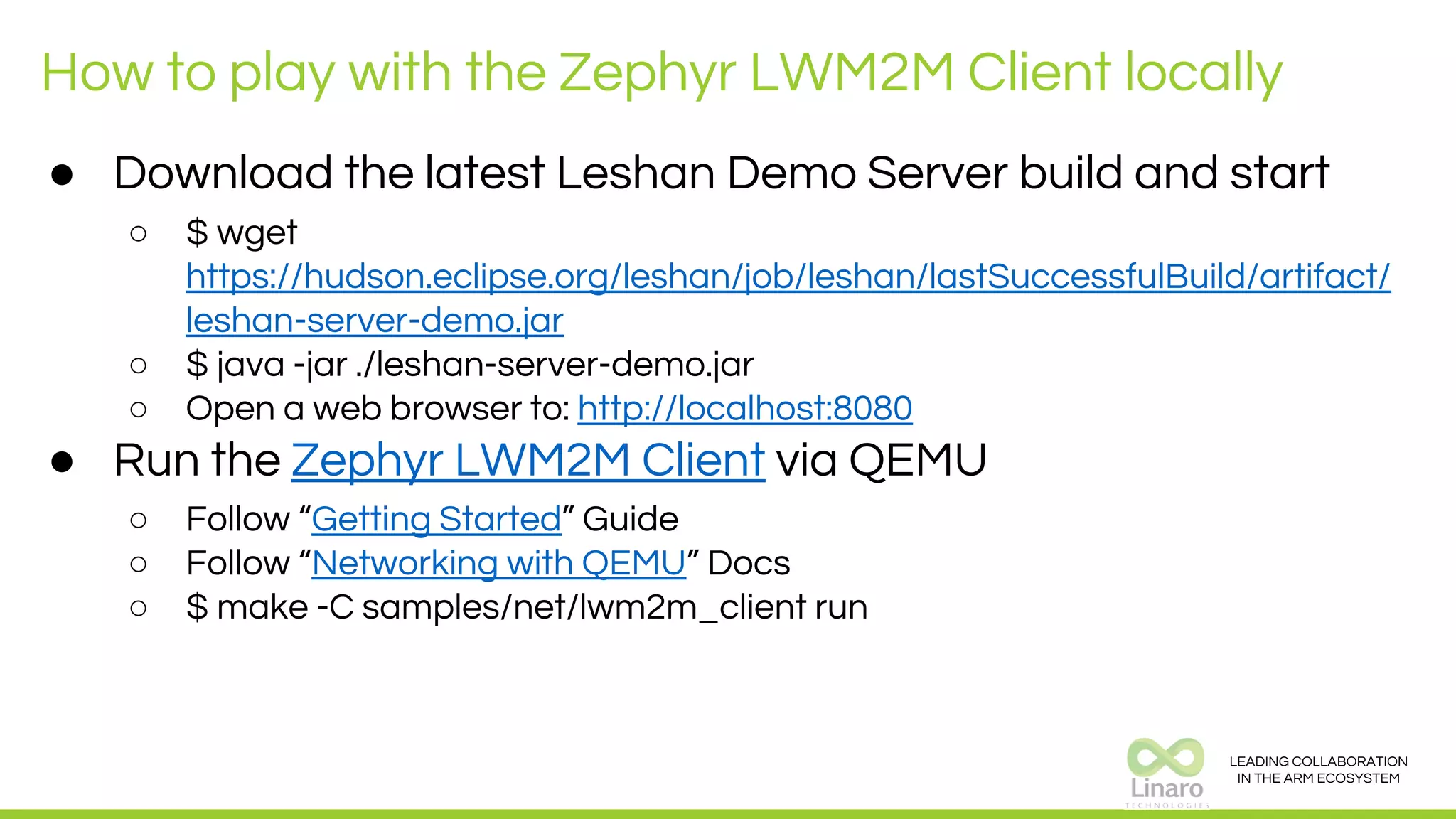
How to play with the Zephyr LWM2M Client locally
● Download the latest Leshan Demo Server build and start
○ $ wget
https://hudson.eclipse.org/leshan/job/leshan/lastSuccessfulBuild/artifact/
leshan-server-demo.jar
○ $ java -jar ./leshan-server-demo.jar
○ Open a web browser to: http://localhost:8080
● Run the Zephyr LWM2M Client via QEMU
○ Follow “Getting Started” Guide
○ Follow “Networking with QEMU” Docs
○ $ make -C samples/net/lwm2m_client run
LEADING COLLABORATION
IN THE ARM ECOSYSTEM
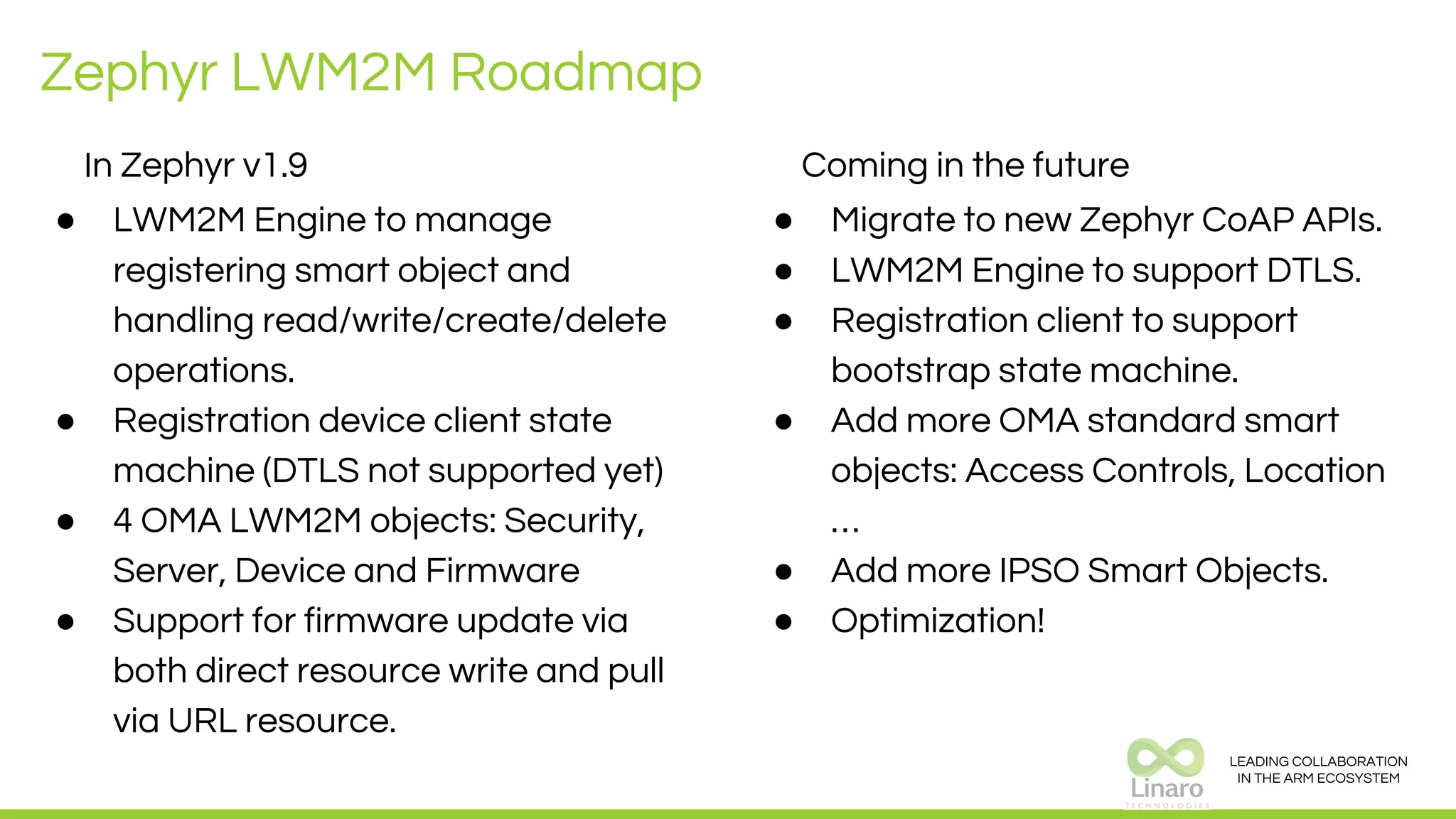
Zephyr LWM2M Roadmap
In Zephyr v1.9
● LWM2M Engine to manage
registering smart object and
handling read/write/create/delete
operations.
● Registration device client state
machine (DTLS not supported yet)
● 4 OMA LWM2M objects: Security,
Server, Device and Firmware
● Support for firmware update via
both direct resource write and pull
via URL resource.
Coming in the future
● Migrate to new Zephyr CoAP APIs.
● LWM2M Engine to support DTLS.
● Registration client to support
bootstrap state machine.
● Add more OMA standard smart
objects: Access Controls, Location
…
● Add more IPSO Smart Objects.
● Optimization!

New Zephyr features: LWM2M / FOTA Framework - SFO17-113

  • 1.
    LEADING COLLABORATION IN THE ARM ECOSYSTEM NewZephyr features LWM2M / FOTA Framework Marti Bolivar <marti.bolivar@linaro.org> David Brown <david.brown@linaro.org> Ricardo Salveti <ricardo.salveti@linaro.org> Mike Scott <michael.scott@linaro.org>
  • 2.
    LEADING COLLABORATION IN THEARM ECOSYSTEM Zephyr and LTD “changing at an alarming pace”
  • 3.
    LEADING COLLABORATION IN THEARM ECOSYSTEM Version Changesets Changed lines 1.1.0 481 15,798(+) 9,205(-) 1.2.0 482 37,176(+) 11,044(-) 1.3.0 456 37,216(+) 15,452(-) 1.4.0 473 289,223(+) 14,585(-) 1.5.0 970 179,485(+) 18,732(-) 1.6.0 3,188 1,706,583(+) 131,887(-) 1.7.0 1,839 1,126,493(+) 336,555(-) 1.8.0 1,692 858,467(+) 239,250(-) Since Zephyr v1.0.0 (February 8)
  • 4.
    LEADING COLLABORATION IN THEARM ECOSYSTEM FOTA at last Connect ● MCUBoot talk given by David ○ Introduce the bootloader ○ Discuss the Zephyr port, work with Runtime, etc ○ A more detailed update was given earlier today in SFO17-118, so just some Zep updates to discuss today ● hawkBit keynote demo ○ FOTA updates of devices which live-streamed temperature data ○ An updated demo was given at today’s keynote
  • 5.
    LEADING COLLABORATION IN THEARM ECOSYSTEM Zephyr work since then ● Firmware over the air (FOTA) framework ● LWM2M subsystem and example applications ● Today’s keynote demos ○ hawkBit ○ LWM2M ○ BT Mesh lights Work in progress, in collaboration with other groups and companies.
  • 6.
    LEADING COLLABORATION IN THEARM ECOSYSTEM MCUBoot + FOTA framework
  • 7.
    LEADING COLLABORATION IN THEARM ECOSYSTEM Desiderata ● Should be possible to add SoC or board support for mcuboot without changing mcuboot repository ● Should be possible to portably share system configuration ○ The bootloader, ○ Applications which are chain-loaded by it ○ Bootloader and application build systems (including flashing and debug) In short, mcuboot should be “easy”.
  • 8.
    LEADING COLLABORATION IN THEARM ECOSYSTEM Booting with MCUBoot Application image area Other Application update area TMPMCUBoot Etc MCUBoot’s job is to move a new image in the update area to the main application image area, using the temporary (TMP) scratch space to avoid data loss. It and apps need to know various details about the flash device, and peacefully coexist with other partitions. MCUBoot header Vector table
  • 9.
    LEADING COLLABORATION IN THEARM ECOSYSTEM Flash specifics to know about (apps and bootloader) Sector 0 Sector 1 Sector 2 Sector n - 1...Sector 3 ● Map between sectors and “partitions” / image areas ● Nonuniform sector sizes (e.g. STM32) ● Widely varying “write block sizes” (1, 4, 8 common)
  • 10.
    LEADING COLLABORATION IN THEARM ECOSYSTEM Support issues on Zephyr Zephyr (or other RTOS) Kernel Flash driver Bootutil library (bootloader core) Board header (flash layout, WBS, sector sizes) Small application, mostly defers to bootutil HAL (for mynewt compatibility) One header file per board with flash layout, sector “size”, etc. This information is duplicated again in every application that needs to manage FOTA updates with mcuboot. This is tedious and error-prone. Also, what happens when you want to change the config? Partitions in DTS now, but more remains for writing apps. Other issues around flashing, etc.
  • 11.
    LEADING COLLABORATION IN THEARM ECOSYSTEM MCUBoot with Zephyr + “FOTA framework” Zephyr Kernel Flash driver + device tree (partition / sector map, write block size) Bootutil library (bootloader core) Small application, mostly defers to bootutil HAL (flash layout, WBS, variable sector size support) MCUBoot / DFU manager MCUBoot’s HAL will allow target-specific hacks, but supports obtaining everything from the OS. Target-specific behavior from DTS and the flash driver. MCUBoot manager allows apps and bootloader to start sharing code. Makefile.exports for build systems, but more work needed to make this easy.
  • 12.
    LEADING COLLABORATION IN THEARM ECOSYSTEM LWM2M
  • 13.
    LEADING COLLABORATION IN THEARM ECOSYSTEM LWM2M from 10,000 ft (3048 m) UDP, L2, PHY CoAP [+DTLS] LWM2M IPSO objects Application callbacks, etc.
  • 14.
    LEADING COLLABORATION IN THEARM ECOSYSTEM LWM2M and IPSO ● LWM2M: 18 base objects managed via OMA Working Groups with room for expansion up to object id 1023. Security (0), Server (1), Device (3), Firmware (5) ... ● IPSO: Hundreds of standard and vendor-defined objects starting with object id 2048. Examples: Light control (3311) used in keynote demo, also presence (3302), humidity (3304), accelerometer (3313), magnetometer (3314), … ● These well-defined objects / resources increase interoperability. More details in the OMA registry.
  • 15.
    LEADING COLLABORATION IN THEARM ECOSYSTEM Resource Name Read/write Number Required? Type 5850 On/Off RW Single Mandatory Boolean 5851 Dimmer RW Single Optional Integer 5852 On Time RW Single Optional Integer 5805 Cumulative active power R Single Optional 5820 Power Factor R Single Optional Float 5706 Colour RW Single Optional String 5701 Sensor Units R Single Optional String IPSO Light Control Object Resources
  • 16.
    LEADING COLLABORATION IN THEARM ECOSYSTEM IPSO Light Control in Source Form static struct lwm2m_engine_obj_field fields[] = { OBJ_FIELD_DATA(LIGHT_ON_OFF_ID, RW, BOOL), OBJ_FIELD_DATA(LIGHT_DIMMER_ID, RW, U8), OBJ_FIELD_DATA(LIGHT_ON_TIME_ID, RW, S32), OBJ_FIELD_DATA(LIGHT_CUMULATIVE_ACTIVE_POWER_ID, R, FLOAT32), OBJ_FIELD_DATA(LIGHT_POWER_FACTOR_ID, R, FLOAT32), OBJ_FIELD_DATA(LIGHT_COLOUR_ID, RW, STRING), OBJ_FIELD_DATA(LIGHT_SENSOR_UNITS_ID, R, STRING), };
  • 17.
    LEADING COLLABORATION IN THEARM ECOSYSTEM Instance-specific data declarations /* Initialize instance resource data. */ INIT_OBJ_RES_DATA(res[avail], i, LIGHT_ON_OFF_ID, &on_off_value[avail], sizeof(*on_off_value)); INIT_OBJ_RES_DATA(res[avail], i, LIGHT_DIMMER_ID, &dimmer_value[avail], sizeof(*dimmer_value)); [...] INIT_OBJ_RES_DATA(res[avail], i, LIGHT_SENSOR_UNITS_ID, units[avail], LIGHT_STRING_SHORT);
  • 18.
    LEADING COLLABORATION IN THEARM ECOSYSTEM Application level /* Resource initialization */ lwm2m_engine_set_string("3/0/0", CLIENT_MANUFACTURER); lwm2m_engine_set_string("3/0/1", CLIENT_MODEL_NUMBER); [...] /* Engine startup */ ret = lwm2m_rd_client_start(&client, CONFIG_NET_APP_PEER_IPV6_ADDR, CONFIG_LWM2M_PEER_PORT, CONFIG_BOARD, rd_client_event);
  • 19.
    LEADING COLLABORATION IN THEARM ECOSYSTEM End to End Demo System ● Control an LED and do a FOTA update via LWM2M ● Canned Docker containers and build system glue to get moving quickly ● http://ltd-docs.readthedocs.io/ en/ltd-17.09/iotfoundry/lwm2m -howto.html
  • 20.
    LEADING COLLABORATION IN THEARM ECOSYSTEM How to play with the Zephyr LWM2M Client locally ● Download the latest Leshan Demo Server build and start ○ $ wget https://hudson.eclipse.org/leshan/job/leshan/lastSuccessfulBuild/artifact/ leshan-server-demo.jar ○ $ java -jar ./leshan-server-demo.jar ○ Open a web browser to: http://localhost:8080 ● Run the Zephyr LWM2M Client via QEMU ○ Follow “Getting Started” Guide ○ Follow “Networking with QEMU” Docs ○ $ make -C samples/net/lwm2m_client run
  • 21.
    LEADING COLLABORATION IN THEARM ECOSYSTEM Zephyr LWM2M Roadmap In Zephyr v1.9 ● LWM2M Engine to manage registering smart object and handling read/write/create/delete operations. ● Registration device client state machine (DTLS not supported yet) ● 4 OMA LWM2M objects: Security, Server, Device and Firmware ● Support for firmware update via both direct resource write and pull via URL resource. Coming in the future ● Migrate to new Zephyr CoAP APIs. ● LWM2M Engine to support DTLS. ● Registration client to support bootstrap state machine. ● Add more OMA standard smart objects: Access Controls, Location … ● Add more IPSO Smart Objects. ● Optimization!