AN DEVELOPMENTAL APPROACH OF COLLABORATIVE NEURAL
NETWORK &OCR BASED ASSISTIVE SYSTEM FOR TEXT DETECTION
WITH VOICE OUTPUT
Abstract:
Reading is apparently essential in today’s society. Printed text everywhere in the form of reports,
receipts, bank statements, classroom handouts, instructions on medicine bottles, etc. And while
optical aids, video magnifiers, and screen readers can help blind users and those with low vision to
access, there documents. There are few devices that can provide good common hand-held objects
printed with text such as invention packages. Objects printed with text such as prescription
medication bottles. The most well-known answers for tag restriction in computerized pictures are
through the execution of edge extraction, morphological administrators, and Sobel administrator. An
edge methodology is ordinarily straightforward and quick. Sobel administrator for edge discovery
gives constructive outcomes on the picture. The confinement of tags through morphologically based
methodologies is not defenseless to clamor but rather is moderate in execution. After the limitation of
the tag comes the character division process. Normal character division procedures depend on
histogram investigation and thresholding. Other late methodologies proposed are the utilization of
counterfeit neural systems.
Existing System:
• Today, there are already a few systems that have some promise for portable use, but they
cannot handle product labeling. For example, portable bar code readers designed to help blind
people identify different products in an extensive product database can enable users who are
blind to access information about these products.
• But a big limitation is that it is very hard for blind users to find the position of the bar code
and to correctly point the bar code reader at the bar code.
ProposedSystem:
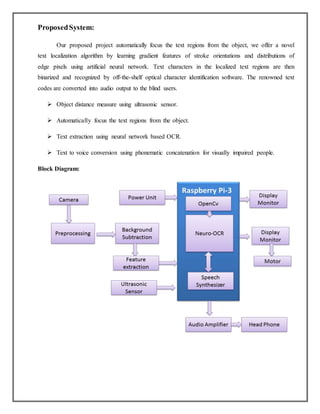
Our proposed project automatically focus the text regions from the object, we offer a novel
text localization algorithm by learning gradient features of stroke orientations and distributions of
edge pixels using artificial neural network. Text characters in the localized text regions are then
binarized and recognized by off-the-shelf optical character identification software. The renowned text
codes are converted into audio output to the blind users.
 Object distance measure using ultrasonic sensor.
 Automatically focus the text regions from the object.
 Text extraction using neural network based OCR.
 Text to voice conversion using phonematic concatenation for visually impaired people.
Block Diagram:
Hardware required:
 Raspberry pi
 Web Camera
 Relay
 Ultrasonic sensor
 HDMI Converter
Software Used:
• Python IDLE
• Raspian jessie OS
• Machine learning Library
• Opencv
• Neural OCR

OCR Projects using Python for CSE/IT Students

  • 1.
    AN DEVELOPMENTAL APPROACHOF COLLABORATIVE NEURAL NETWORK &OCR BASED ASSISTIVE SYSTEM FOR TEXT DETECTION WITH VOICE OUTPUT Abstract: Reading is apparently essential in today’s society. Printed text everywhere in the form of reports, receipts, bank statements, classroom handouts, instructions on medicine bottles, etc. And while optical aids, video magnifiers, and screen readers can help blind users and those with low vision to access, there documents. There are few devices that can provide good common hand-held objects printed with text such as invention packages. Objects printed with text such as prescription medication bottles. The most well-known answers for tag restriction in computerized pictures are through the execution of edge extraction, morphological administrators, and Sobel administrator. An edge methodology is ordinarily straightforward and quick. Sobel administrator for edge discovery gives constructive outcomes on the picture. The confinement of tags through morphologically based methodologies is not defenseless to clamor but rather is moderate in execution. After the limitation of the tag comes the character division process. Normal character division procedures depend on histogram investigation and thresholding. Other late methodologies proposed are the utilization of counterfeit neural systems. Existing System: • Today, there are already a few systems that have some promise for portable use, but they cannot handle product labeling. For example, portable bar code readers designed to help blind people identify different products in an extensive product database can enable users who are blind to access information about these products. • But a big limitation is that it is very hard for blind users to find the position of the bar code and to correctly point the bar code reader at the bar code.
  • 2.
    ProposedSystem: Our proposed projectautomatically focus the text regions from the object, we offer a novel text localization algorithm by learning gradient features of stroke orientations and distributions of edge pixels using artificial neural network. Text characters in the localized text regions are then binarized and recognized by off-the-shelf optical character identification software. The renowned text codes are converted into audio output to the blind users.  Object distance measure using ultrasonic sensor.  Automatically focus the text regions from the object.  Text extraction using neural network based OCR.  Text to voice conversion using phonematic concatenation for visually impaired people. Block Diagram:
  • 3.
    Hardware required:  Raspberrypi  Web Camera  Relay  Ultrasonic sensor  HDMI Converter Software Used: • Python IDLE • Raspian jessie OS • Machine learning Library • Opencv • Neural OCR