MACHINELEARNINGBASEDBLINDTEXTREADINGUSINGOCRALGORITHM
By Madhumitha.G
Pooja.M
Premalatha.K
ABSTRACT
the project aims to develop an innovation
solution to enhance the accessibility of printed
and handwritten text for visually impaired
individuals by machine.
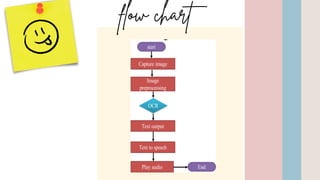
the real time image acquisition,preprocessing,ocr
text extraction,for effective text to speech
conversion.
we explore user interface issues and access
robustness of the algorithm in extracting and
reading text.
user intraction is through voice commends,haptic
feedback,and audio cues to ensure a seamless
reading experience.
INTRODUCTION
System that automatically finds and track text regions in
surrounding Reading challenges can affect people who are
visuallyimpaired, those with learning disabilities or low
literacyskills, as well as those who have difficulty in Holding
books or documents.
These individuals may benefit from the use of various reading
technologies and strategies.
They are scanning, recognition and reading text. Initially a
printed documentis scanned by a Camera.
OCR then converts imagesinto recognized characters.
There are varieties of software-based solutions Available
for OCR. However, there is little work done in the area of
hardware implementation of OCR.
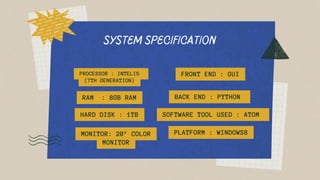
SYSTEM SPECIFICATION
PROCESSOR : INTELI5
(7TH GENERATION)
FRONT END : GUI
RAM : 8GB RAM BACK END : PYTHON
HARD DISK : 1TB SOFTWARE TOOL USED : ATOM
MONITOR: 20’ COLOR
MONITOR
PLATFORM : WINDOWS8
EXISTING SYSTEM
Printed documents can be quickly converted into
digital text files through optical character
recognition and then beedited by the user.
Consequently, minimaltime is required to
digitizedocuments;this is particularly
helpful when archiving volumes of printed
materials.
This study demonstrates how image-processing
technologies can be used in combination with
optical character recognition to
improverecognition accuracy
1
2
3
•To assist blind people to read texts which will be helpful
for them to recognize texts in real-time situations like
knowing the texts in transport vehicles (buses).
•The main motivation behind our project is to help the
visually impaired people to better recognize all the texts
in front of them and help them live their day to day life
just like any other normal person.
•To help visually impaired people to involve in their
studies by reading texts oftheir own without someone’s
help.
• To developa text reading aid usingvideo processing
technique.
OBJECTIVES
FEATURES
FEATURES
•Itcan recognize text from real-timevideo by video
processing techniquewhich is useful in assisting the
blind people to read texts in real time.
•Itshows better accuracylevel in recognizing texts
from images when comparedwith other existing
methods.
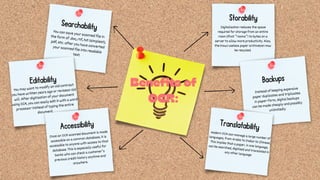
Searchability
Editability
Accessibility
Storability
Backups
Translatability
Once an OCR scanned document is made
accessible on a common database, it is
accessible to anyone with access to that
database. This is especially useful for
banks who can check a customer’s
previous credit history anytime and
anywhere.
You may want to modify an old contract
you have written years ago or revisean old
will. After digitization of your document
using OCR, you can easily edit it with a word
processor instead of typing the entire
document.
.
You can save your scanned file in
the form of .doc,.rtf,.txt (simplest),
pdf, etc. after you have converted
your scanned file into readable
text.
Modern OCR can manage a large number of
languages, from Arabic to Indian to Chinese.
This implies that a paper, in one language,
can be searched, digitized and translated in
any other language.
Instead of keeping expensive
paper duplicates and triplicates
in paper-form, digital backups
can be made cheaply and possibly
unlimitedly.
Digitalization reduces the space
required for storage from an entire
room (ifnot “rooms”) to bytes on a
server to allow more productivity. Also,
the (now) useless paper archivecan now
be recycled.
Benefits of
OCR:
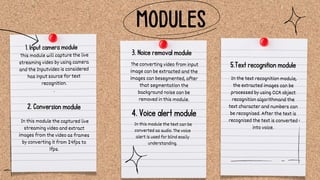
In this module the captured live
streaming video and extract
images from the video as frames
by converting it from 24fps to
1fps.
In the text recognition module,
the extracted images can be
processed by using OCR object
recognition algorithmand the
text character and numbers can
be recognized. After the text is
recognized the text is converted
into voice.
1. Input camera module
This module will capture the live
streaming video by using camera
and the Inputvideo is considered
has input source for text
recognition.
.
2. Conversion module
5.Text recognition module
MODULES
3. Noice removal module
The converting video from input
image can be extracted and the
images can besegmented, after
that segmentation the
background noise can be
removed in this module.
4. Voice alert module
In this module the text can be
converted as audio. The voice
alert is used for blind easily
understanding.
IMPLEMENTATION
Implementation is the processof making an idea a reality.
In order to successfully and fully implement a design, all the specifications must be
met, through both software components and hardware.
The number of inter-dependent tasks and communication neededfor successful
implementation is best managed carefully.
It also covers IT support in most cases, as a buggy application is never part of the
original idea.
In computer science, it is used as the name for the act of turning pseudocode into
executable codein order to realize an application, idea model, design or algorithm.
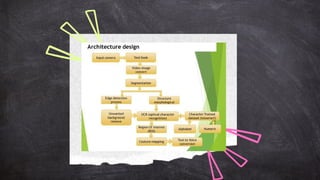
flow chart
sample screenshot
Conclusion
The voice assisted text reading system for visually impaired is discussed.
The output is shown for the various input data set like only text inputs,
text with images merged etc.
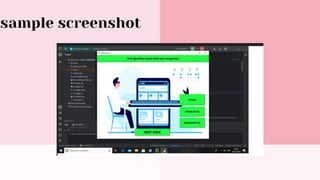
The work is simulated using atom software and the speech output is
produced.
An output produced as audio output to read the corresponding input
which helps the blind people to read any printed text in vocal form.
THANK
YOU

Colorful Modern Group Project Creative Presentation.pdf

  • 1.
  • 2.
    ABSTRACT the project aimsto develop an innovation solution to enhance the accessibility of printed and handwritten text for visually impaired individuals by machine. the real time image acquisition,preprocessing,ocr text extraction,for effective text to speech conversion. we explore user interface issues and access robustness of the algorithm in extracting and reading text. user intraction is through voice commends,haptic feedback,and audio cues to ensure a seamless reading experience.
  • 3.
    INTRODUCTION System that automaticallyfinds and track text regions in surrounding Reading challenges can affect people who are visuallyimpaired, those with learning disabilities or low literacyskills, as well as those who have difficulty in Holding books or documents. These individuals may benefit from the use of various reading technologies and strategies. They are scanning, recognition and reading text. Initially a printed documentis scanned by a Camera. OCR then converts imagesinto recognized characters. There are varieties of software-based solutions Available for OCR. However, there is little work done in the area of hardware implementation of OCR.
  • 4.
    SYSTEM SPECIFICATION PROCESSOR :INTELI5 (7TH GENERATION) FRONT END : GUI RAM : 8GB RAM BACK END : PYTHON HARD DISK : 1TB SOFTWARE TOOL USED : ATOM MONITOR: 20’ COLOR MONITOR PLATFORM : WINDOWS8
  • 5.
    EXISTING SYSTEM Printed documentscan be quickly converted into digital text files through optical character recognition and then beedited by the user. Consequently, minimaltime is required to digitizedocuments;this is particularly helpful when archiving volumes of printed materials. This study demonstrates how image-processing technologies can be used in combination with optical character recognition to improverecognition accuracy 1 2 3
  • 6.
    •To assist blindpeople to read texts which will be helpful for them to recognize texts in real-time situations like knowing the texts in transport vehicles (buses). •The main motivation behind our project is to help the visually impaired people to better recognize all the texts in front of them and help them live their day to day life just like any other normal person. •To help visually impaired people to involve in their studies by reading texts oftheir own without someone’s help. • To developa text reading aid usingvideo processing technique. OBJECTIVES
  • 7.
    FEATURES FEATURES •Itcan recognize textfrom real-timevideo by video processing techniquewhich is useful in assisting the blind people to read texts in real time. •Itshows better accuracylevel in recognizing texts from images when comparedwith other existing methods.
  • 9.
    Searchability Editability Accessibility Storability Backups Translatability Once an OCRscanned document is made accessible on a common database, it is accessible to anyone with access to that database. This is especially useful for banks who can check a customer’s previous credit history anytime and anywhere. You may want to modify an old contract you have written years ago or revisean old will. After digitization of your document using OCR, you can easily edit it with a word processor instead of typing the entire document. . You can save your scanned file in the form of .doc,.rtf,.txt (simplest), pdf, etc. after you have converted your scanned file into readable text. Modern OCR can manage a large number of languages, from Arabic to Indian to Chinese. This implies that a paper, in one language, can be searched, digitized and translated in any other language. Instead of keeping expensive paper duplicates and triplicates in paper-form, digital backups can be made cheaply and possibly unlimitedly. Digitalization reduces the space required for storage from an entire room (ifnot “rooms”) to bytes on a server to allow more productivity. Also, the (now) useless paper archivecan now be recycled. Benefits of OCR:
  • 10.
    In this modulethe captured live streaming video and extract images from the video as frames by converting it from 24fps to 1fps. In the text recognition module, the extracted images can be processed by using OCR object recognition algorithmand the text character and numbers can be recognized. After the text is recognized the text is converted into voice. 1. Input camera module This module will capture the live streaming video by using camera and the Inputvideo is considered has input source for text recognition. . 2. Conversion module 5.Text recognition module MODULES 3. Noice removal module The converting video from input image can be extracted and the images can besegmented, after that segmentation the background noise can be removed in this module. 4. Voice alert module In this module the text can be converted as audio. The voice alert is used for blind easily understanding.
  • 11.
    IMPLEMENTATION Implementation is theprocessof making an idea a reality. In order to successfully and fully implement a design, all the specifications must be met, through both software components and hardware. The number of inter-dependent tasks and communication neededfor successful implementation is best managed carefully. It also covers IT support in most cases, as a buggy application is never part of the original idea. In computer science, it is used as the name for the act of turning pseudocode into executable codein order to realize an application, idea model, design or algorithm.
  • 12.
  • 13.
  • 14.
    Conclusion The voice assistedtext reading system for visually impaired is discussed. The output is shown for the various input data set like only text inputs, text with images merged etc. The work is simulated using atom software and the speech output is produced. An output produced as audio output to read the corresponding input which helps the blind people to read any printed text in vocal form.
  • 15.