New Techniques in
SQLi Obfuscation
SQL never before used in SQL Injection
           Nick Galbreath
             @ngalbreath
          nick@client9.com
           nickg@etsy.com
  DEFCON 20 at the Rio in sunny Las Vegas
       2012-07-27 Friday 4:20 pm!
Follow along or get the latest version:


http://
www.client9.com/
20120727/
     Nick Galbreath    DEFCON20           @ngalbreath
whoami
• Nick Galbreath
• Director of Engineering at Etsy
 • Security, Fraud, Enterprise Features
• Published book on Cryptography
   (Wiley, 2002)
• Fixing broken authentication systems and
   password storage for the last 15 years.

Nick Galbreath     DEFCON20       @ngalbreath
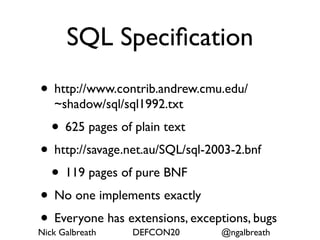
SQL Specification
• http://www.contrib.andrew.cmu.edu/
   ~shadow/sql/sql1992.txt
  • 625 pages of plain text
• http://savage.net.au/SQL/sql-2003-2.bnf
   • 119 pages of pure BNF
• No one implements exactly
• Everyone has extensions, exceptions, bugs
Nick Galbreath   DEFCON20         @ngalbreath
Regexp Based WAF
(?:)s*whens*d+s*then)|(?:"s*(?:#|--|{))|(?:/*!s?d+)|(?:ch(?:a)?rs*(s*d)|(?:(?:(n?and|x?or|not)s+||||&&)s*w+()
(?:[s()]cases*()|(?:)s*likes*()|(?:havings*[^s]+s*[^ws])|(?:ifs?([dw]s*[=<>~])
(?:"s*ors*"?d)|(?:x(?:23|27|3d))|(?:^.?"$)|(?:(?:^["]*(?:[d"]+|[^"]+"))+s*(?:n?and|x?or|not||||&&)s*[w"[+&!@(),.-])|(?:[^ws]w+s*[|-]
s*"s*w)|(?:@w+s+(and|or)s*["d]+)|(?:@[w-]+s(and|or)s*[^ws])|(?:[^ws:]s*dW+[^ws]s*".)|(?:Winformation_schema|table_nameW)
(?:"s**.+(?:or|id)W*"d)|(?:^")|(?:^[ws"-]+(?<=ands)(?<=ors)(?<=xors)(?<=nands)(?<=nots)(?<=||)(?<=&&)w+()|(?:"[sd]*[^ws]+W*d
W*.*["d])|(?:"s*[^ws?]+s*[^ws]+s*")|(?:"s*[^ws]+s*[Wd].*(?:#|--))|(?:".**s*d)|(?:"s*ors[^d]+[w-]+.*d)|(?:[()*<>%+-][w-]+[^ws]
+"[^,])
(?:d"s+"s+d)|(?:^admins*"|(/*)+"+s?(?:--|#|/*|{)?)|(?:"s*or[ws-]+s*[+<>=(),-]s*[d"])|(?:"s*[^ws]?=s*")|(?:"W*[+=]+W*")|(?:"s*[!=|]
[ds!=+-]+.*["(].*$)|(?:"s*[!=|][ds!=]+.*d+$)|(?:"s*likeW+[w"(])|(?:siss*0W)|(?:wheres[sw.,-]+s=)|(?:"[<>~]+")
(?:unions*(?:all|distinct|[(!@]*)?s*[([]*s*select)|(?:w+s+likes+")|(?:likes*"%)|(?:"s*likeW*["d])|(?:"s*(?:n?and|x?or|not ||||&&)s+[s
w]+=s*w+s*having)|(?:"s**s*w+W+")|(?:"s*[^?ws=.,;)(]+s*[(@"]*s*w+W+w)|(?:selects*[[]()sw.,"-]+from)|(?:find_in_sets*()
(?:ins*(+s*select)|(?:(?:n?and|x?or|not ||||&&)s+[sw+]+(?:regexps*(|soundss+likes*"|[=d]+x))|("s*ds*(?:--|#))|(?:"[%&<>^=]+ds*(=|
or))|(?:"W+[w+-]+s*=s*dW+")|(?:"s*iss*d.+"?w)|(?:"|?[w-]{3,}[^ws.,]+")|(?:"s*iss*[d.]+s*W.*")
(?:[dW]s+ass*["w]+s*from)|(?:^[Wd]+s*(?:union|select|create|rename|truncate|load|alter|delete|update|insert|desc))|(?:(?:select|create|rename|
truncate|load|alter|delete|update|insert|desc)s+(?:(?:group_)concat|char|load_file)s?(?)|(?:ends*);)|("s+regexpW)|(?:[s(]load_files*()
(?:@.+=s*(s*select)|(?:d+s*ors*d+s*[-+])|(?:/w+;?s+(?:having|and|or|select)W)|(?:ds+groups+by.+()|(?:(?:;|#|--)s*(?:drop|alter))|(?:
(?:;|#|--)s*(?:update|insert)s*w{2,})|(?:[^w]SETs*@w+)|(?:(?:n?and|x?or|not ||||&&)[s(]+w+[s)]*[!=+]+[sd]*["=()])
(?:"s+ands*=W)|(?:(s*selects*w+s*()|(?:*/from)|(?:+s*d+s*+s*@)|(?:w"s*(?:[-+=|@]+s*)+[d(])|(?:coalesces*(|@@w+s*[^ws])|(?:W!
+"w)|(?:";s*(?:if|while|begin))|(?:"[sd]+=s*d)|(?:orders+bys+ifw*s*()|(?:[s(]+cased*W.+[tw]hen[s(])
(?:(select|;)s+(?:benchmark|if|sleep)s*?(s*(?s*w+)
(?:creates+functions+w+s+returns)|(?:;s*(?:select|create|rename|truncate|load|alter|delete|update|insert|desc)s*[[(]?w{2,})
(?:alters*w+.*characters+sets+w+)|(";s*waitfors+times+")|(?:";.*:s*goto)
(?:procedures+analyses*()|(?:;s*(declare|open)s+[w-]+)|(?:creates+(procedure|function)s*w+s*(s*)s*-)|(?:declare[^w]+[@#]s*w+)|(execs*
(s*@)
(?:selects*pg_sleep)|(?:waitfors*delays?"+s?d)|(?:;s*shutdowns*(?:;|--|#|/*|{))
(?:sexecs+xp_cmdshell)|(?:"s*!s*["w])|(?:fromW+information_schemaW)|(?:(?:(?:current_)?user|database|schema|connection_id)s*([^)]*)|(?:";?
s*(?:select|union|having)s*[^s])|(?:wiifs*()|(?:execs+master.)|(?:union select @)|(?:union[w(s]*select)|(?:select.*w?user()|(?:into[s+]+
(?:dump|out)files*")
(?:merge.*usings*()|(executes*immediates*")|(?:W+d*s*havings*[^s-])|(?:matchs*[w(),+-]+s*againsts*()
(?:,.*[)da-f"]"(?:".*"|Z|[^"]+))|(?:Wselect.+W*from)|((?:select|create|rename|truncate|load|alter|delete|update|insert|desc)s*(s*spaces*()
(?:[$(?:ne|eq|lte?|gte?|n?in|mod|all|size|exists|type|slice|or)])
(?:(sleep((s*)(d*)(s*))|benchmark((.*),(.*))))
(?:(union(.*)select(.*)from))
(?:^(-0000023456|4294967295|4294967296|2147483648|2147483647|0000012345|-2147483648|-2147483649|0000023456|2.2250738585072007e-308|1e309)$)


    Some of the regular expressions used by PHPIDS 0.7
                 Nick Galbreath                                DEFCON20                                   @ngalbreath
libinjection

• libinjection is a quasi-SQL tokenizer, parser
   to detect SQli
• Released at BlackHat 2012
• http://www.client9.com/20120725/
• http://www.client9.com/libinjection/
Nick Galbreath      DEFCON20       @ngalbreath
Sources
  Tens of thousands attacks of varying quality


• Output from SQLi vulnerability scanners
   against dummy sites
• Published attacks
• SQLi How-to guides
• Stuff we see at Etsy

Nick Galbreath    DEFCON20         @ngalbreath
Analysis

• Ran all 32,000 SQLi attacks through
   libinjection (which detects all as SQLi)
• Used gcov code coverage to see what
   paths weren't being used.
• That plus SQL syntax not implemented is
     SQL never before used in SQLi
Nick Galbreath    DEFCON20         @ngalbreath
Lots of Dark Corners

• We'll review many of the SQL oddities that
   aren't actively being used or are interesting
   enough to re-review.
• Great for new fuzzers, vulnerability
   scanners, WAF builders and validators.


Nick Galbreath    DEFCON20         @ngalbreath
NULL
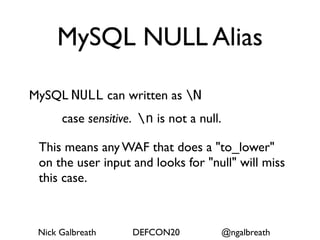
MySQL NULL Alias

MySQL NULL can written as N
      case sensitive. n is not a null.

 This means any WAF that does a "to_lower"
 on the user input and looks for "null" will miss
 this case.


 Nick Galbreath     DEFCON20              @ngalbreath
NULL PGSQL

• ISNULL, NOTNULL (same as IS       NULL),
   this is a function in MSSQL
• "IS     [NOT] UNKNOWN"
• "IS     [NOT] DISTINCT"


Nick Galbreath   DEFCON20        @ngalbreath
Numbers
Floating Point
•   digits                       •   digits[.]digits[eE]digits

•   digits[.]                    •   digits[.]digits[eE][+-]digits

•   digits[.]digits              •   [.]digits

•   digits[eE]digits             •   [.]digits[eE]digits

•   digits[eE][+-]digits         •   [.]digits[eE][+-]digits

•   digits[.][eE]digits

                  Optional starts with [+-]
             Optional ending with [dDfF] (Oracle)
Exceptions

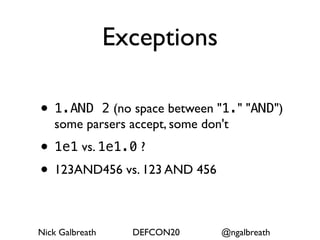
• 1.AND    2 (no space between "1." "AND")
   some parsers accept, some don't
• 1e1 vs. 1e1.0 ?
• 123AND456 vs. 123 AND 456

Nick Galbreath     DEFCON20    @ngalbreath
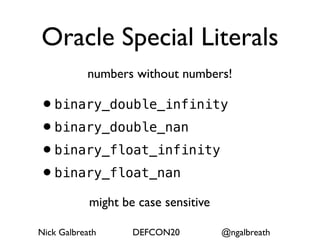
Oracle Special Literals
           numbers without numbers!

•binary_double_infinity
•binary_double_nan
•binary_float_infinity
•binary_float_nan
            might be case sensitive

Nick Galbreath      DEFCON20          @ngalbreath
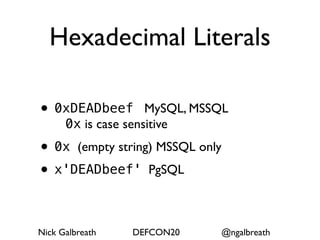
Hexadecimal Literals

• 0xDEADbeef         MySQL, MSSQL
      0x is case sensitive
• 0x (empty string) MSSQL only
• x'DEADbeef' PgSQL

Nick Galbreath   DEFCON20      @ngalbreath
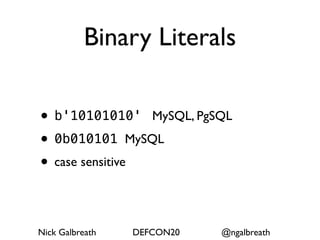
Binary Literals

• b'10101010' MySQL, PgSQL
• 0b010101 MySQL
• case sensitive

Nick Galbreath   DEFCON20   @ngalbreath
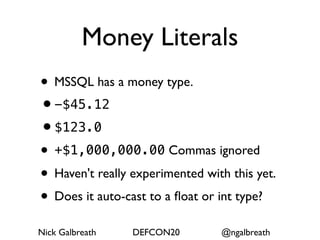
Money Literals
• MSSQL has a money type.
•-$45.12
•$123.0
• +$1,000,000.00 Commas ignored
• Haven't really experimented with this yet.
• Does it auto-cast to a float or int type?
Nick Galbreath   DEFCON20        @ngalbreath
Comments
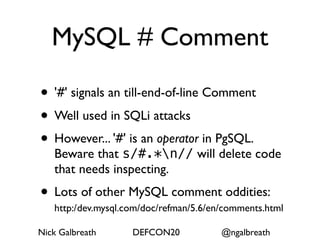
MySQL # Comment

• '#' signals an till-end-of-line Comment
• Well used in SQLi attacks
• However... '#' is an operator in PgSQL.
   Beware that s/#.*n// will delete code
   that needs inspecting.
• Lots of other MySQL comment oddities:
   http:/ dev.mysql.com/doc/refman/5.6/en/comments.html
         /


Nick Galbreath      DEFCON20            @ngalbreath
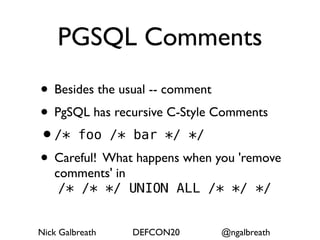
PGSQL Comments
• Besides the usual -- comment
• PgSQL has recursive C-Style Comments
•/* foo /* bar */ */
• Careful! What happens when you 'remove
   comments' in
    /* /* */ UNION ALL /* */ */


Nick Galbreath   DEFCON20     @ngalbreath
Strings
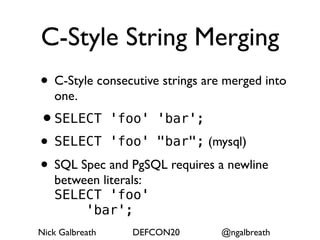
C-Style String Merging
• C-Style consecutive strings are merged into
   one.
•SELECT 'foo' 'bar';
• SELECT 'foo' "bar"; (mysql)
• SQL Spec and PgSQL requires a newline
   between literals:
   SELECT 'foo'
        'bar';
Nick Galbreath   DEFCON20        @ngalbreath
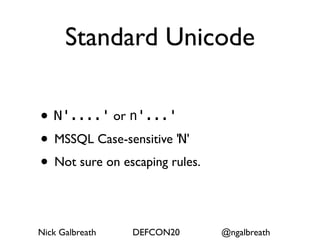
Standard Unicode

• N'....' or n'...'
• MSSQL Case-sensitive 'N'
• Not sure on escaping rules.

Nick Galbreath   DEFCON20       @ngalbreath
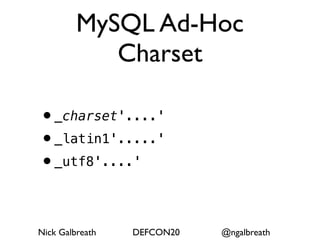
MySQL Ad-Hoc
            Charset

•_charset'....'
•_latin1'.....'
•_utf8'....'

Nick Galbreath   DEFCON20   @ngalbreath
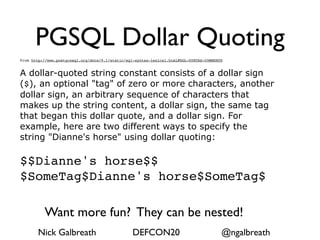
PGSQL Dollar Quoting
From http://www.postgresql.org/docs/9.1/static/sql-syntax-lexical.html#SQL-SYNTAX-COMMENTS


A dollar-quoted string constant consists of a dollar sign
($), an optional "tag" of zero or more characters, another
dollar sign, an arbitrary sequence of characters that
makes up the string content, a dollar sign, the same tag
that began this dollar quote, and a dollar sign. For
example, here are two different ways to specify the
string "Dianne's horse" using dollar quoting:

$$Dianne's horse$$
$SomeTag$Dianne's horse$SomeTag$

          Want more fun? They can be nested!
        Nick Galbreath                            DEFCON20                               @ngalbreath
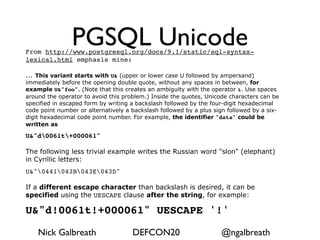
PGSQL Unicode
From http://www.postgresql.org/docs/9.1/static/sql-syntax-
lexical.html emphasis mine:

... This variant starts with U& (upper or lower case U followed by ampersand)
immediately before the opening double quote, without any spaces in between, for
example U&"foo". (Note that this creates an ambiguity with the operator &. Use spaces
around the operator to avoid this problem.) Inside the quotes, Unicode characters can be
specified in escaped form by writing a backslash followed by the four-digit hexadecimal
code point number or alternatively a backslash followed by a plus sign followed by a six-
digit hexadecimal code point number. For example, the identifier "data" could be
written as

U&"d0061t+000061"

The following less trivial example writes the Russian word "slon" (elephant)
in Cyrillic letters:
U&"0441043B043E043D"

If a different escape character than backslash is desired, it can be
specified using the UESCAPE clause after the string, for example:

U&"d!0061t!+000061" UESCAPE '!'

    Nick Galbreath                   DEFCON20                       @ngalbreath
Oracle Q String
http://docs.oracle.com/cd/B28359_01/appdev.111/b28370/
fundamentals.htm#autoId6


q'!...!' notation allows use of single quotes inside literal

string_var := q'!I'm a string!';

You can use delimiters [, {, <, and (, pair them with ], }, >, and ),
pass a string literal representing a SQL statement to a
subprogram, without doubling the quotation marks around
'INVALID' as follows:
func_call(q'[SELECT index_name FROM user_indexes
  WHERE status ='INVALID']');

 Nick Galbreath             DEFCON20                 @ngalbreath
Operators
   and
Expressions
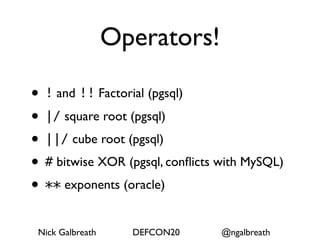
Operators!

• ! and !! Factorial (pgsql)
• |/ square root (pgsql)
• ||/ cube root (pgsql)
• # bitwise XOR (pgsql, conflicts with MySQL)
• ** exponents (oracle)
 Nick Galbreath     DEFCON20     @ngalbreath
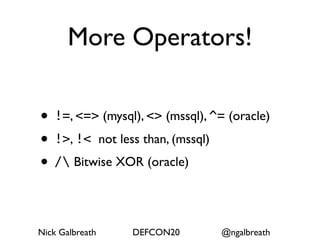
More Operators!

• !=, <=> (mysql), <> (mssql), ^= (oracle)
• !>, !< not less than, (mssql)
• / Bitwise XOR (oracle)

Nick Galbreath   DEFCON20        @ngalbreath
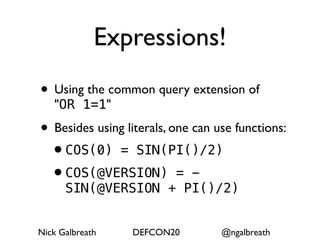
Expressions!
• Using the common query extension of
   "OR 1=1"

• Besides using literals, one can use functions:
 •COS(0) = SIN(PI()/2)
 •COS(@VERSION) = -
      SIN(@VERSION + PI()/2)


Nick Galbreath    DEFCON20         @ngalbreath
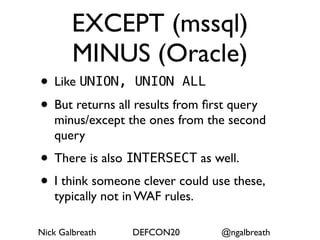
EXCEPT (mssql)
        MINUS (Oracle)
• Like UNION, UNION ALL
• But returns all results from first query
   minus/except the ones from the second
   query
• There is also INTERSECT as well.
• I think someone clever could use these,
   typically not in WAF rules.

Nick Galbreath    DEFCON20        @ngalbreath
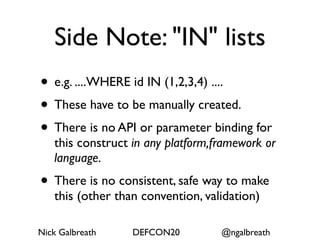
Side Note: "IN" lists
• e.g. ....WHERE id IN (1,2,3,4) ....
• These have to be manually created.
• There is no API or parameter binding for
   this construct in any platform,framework or
   language.
• There is no consistent, safe way to make
   this (other than convention, validation)

Nick Galbreath    DEFCON20         @ngalbreath
Why don't we see
     more attacks using
     these techniques?
• Dumb attacks work (for now)
• I don't get to see the more advanced
   attacks?


Nick Galbreath   DEFCON20       @ngalbreath
What's Next?
• Add more parsing rules to libinjection
• More testing frameworks
• Investigate BIGINT types
• pgsql has a regexp engine, and various
   other datatypes
• Worry about various character encodings
Nick Galbreath   DEFCON20      @ngalbreath
Primary References
• http://dev.mysql.com/doc/refman/5.6/en/
   func-op-summary-ref.html
• http://www.postgresql.org/docs/9.1/static/
   functions.html
• http://msdn.microsoft.com/en-us/library/
   bb510741
• http://docs.oracle.com/cd/B28359_01/
Nick Galbreath      DEFCON20     @ngalbreath
Thanks!
Nick Galbreath
  @ngalbreath         nickg@client9.com
This Talk:

   http://www.client9.com/20120727/
Libinjection Home:
   http://www.client9.com/libinjection/
 Nick Galbreath    DEFCON20    @ngalbreath
Epilogue
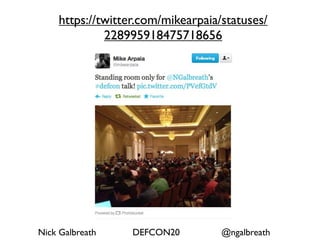
https://twitter.com/mikearpaia/statuses/
             228995918475718656


Nick Galbreath    DEFCON20         @ngalbreath
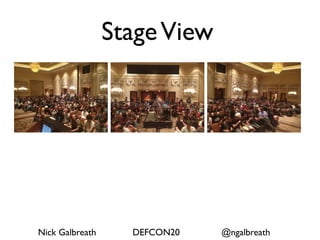
Stage View


                 Audience View
     Courtesy @Kennysan http://flic.kr/s/aHsjBbEnz1


Nick Galbreath       DEFCON20             @ngalbreath

New techniques in sql obfuscation, from DEFCON 20

  • 1.
    New Techniques in SQLiObfuscation SQL never before used in SQL Injection Nick Galbreath @ngalbreath nick@client9.com nickg@etsy.com DEFCON 20 at the Rio in sunny Las Vegas 2012-07-27 Friday 4:20 pm!
  • 2.
    Follow along orget the latest version: http:// www.client9.com/ 20120727/ Nick Galbreath DEFCON20 @ngalbreath
  • 3.
    whoami • Nick Galbreath •Director of Engineering at Etsy • Security, Fraud, Enterprise Features • Published book on Cryptography (Wiley, 2002) • Fixing broken authentication systems and password storage for the last 15 years. Nick Galbreath DEFCON20 @ngalbreath
  • 4.
    SQL Specification • http://www.contrib.andrew.cmu.edu/ ~shadow/sql/sql1992.txt • 625 pages of plain text • http://savage.net.au/SQL/sql-2003-2.bnf • 119 pages of pure BNF • No one implements exactly • Everyone has extensions, exceptions, bugs Nick Galbreath DEFCON20 @ngalbreath
  • 5.
    Regexp Based WAF (?:)s*whens*d+s*then)|(?:"s*(?:#|--|{))|(?:/*!s?d+)|(?:ch(?:a)?rs*(s*d)|(?:(?:(n?and|x?or|not)s+||||&&)s*w+() (?:[s()]cases*()|(?:)s*likes*()|(?:havings*[^s]+s*[^ws])|(?:ifs?([dw]s*[=<>~]) (?:"s*ors*"?d)|(?:x(?:23|27|3d))|(?:^.?"$)|(?:(?:^["]*(?:[d"]+|[^"]+"))+s*(?:n?and|x?or|not||||&&)s*[w"[+&!@(),.-])|(?:[^ws]w+s*[|-] s*"s*w)|(?:@w+s+(and|or)s*["d]+)|(?:@[w-]+s(and|or)s*[^ws])|(?:[^ws:]s*dW+[^ws]s*".)|(?:Winformation_schema|table_nameW) (?:"s**.+(?:or|id)W*"d)|(?:^")|(?:^[ws"-]+(?<=ands)(?<=ors)(?<=xors)(?<=nands)(?<=nots)(?<=||)(?<=&&)w+()|(?:"[sd]*[^ws]+W*d W*.*["d])|(?:"s*[^ws?]+s*[^ws]+s*")|(?:"s*[^ws]+s*[Wd].*(?:#|--))|(?:".**s*d)|(?:"s*ors[^d]+[w-]+.*d)|(?:[()*<>%+-][w-]+[^ws] +"[^,]) (?:d"s+"s+d)|(?:^admins*"|(/*)+"+s?(?:--|#|/*|{)?)|(?:"s*or[ws-]+s*[+<>=(),-]s*[d"])|(?:"s*[^ws]?=s*")|(?:"W*[+=]+W*")|(?:"s*[!=|] [ds!=+-]+.*["(].*$)|(?:"s*[!=|][ds!=]+.*d+$)|(?:"s*likeW+[w"(])|(?:siss*0W)|(?:wheres[sw.,-]+s=)|(?:"[<>~]+") (?:unions*(?:all|distinct|[(!@]*)?s*[([]*s*select)|(?:w+s+likes+")|(?:likes*"%)|(?:"s*likeW*["d])|(?:"s*(?:n?and|x?or|not||||&&)s+[s w]+=s*w+s*having)|(?:"s**s*w+W+")|(?:"s*[^?ws=.,;)(]+s*[(@"]*s*w+W+w)|(?:selects*[[]()sw.,"-]+from)|(?:find_in_sets*() (?:ins*(+s*select)|(?:(?:n?and|x?or|not ||||&&)s+[sw+]+(?:regexps*(|soundss+likes*"|[=d]+x))|("s*ds*(?:--|#))|(?:"[%&<>^=]+ds*(=| or))|(?:"W+[w+-]+s*=s*dW+")|(?:"s*iss*d.+"?w)|(?:"|?[w-]{3,}[^ws.,]+")|(?:"s*iss*[d.]+s*W.*") (?:[dW]s+ass*["w]+s*from)|(?:^[Wd]+s*(?:union|select|create|rename|truncate|load|alter|delete|update|insert|desc))|(?:(?:select|create|rename| truncate|load|alter|delete|update|insert|desc)s+(?:(?:group_)concat|char|load_file)s?(?)|(?:ends*);)|("s+regexpW)|(?:[s(]load_files*() (?:@.+=s*(s*select)|(?:d+s*ors*d+s*[-+])|(?:/w+;?s+(?:having|and|or|select)W)|(?:ds+groups+by.+()|(?:(?:;|#|--)s*(?:drop|alter))|(?: (?:;|#|--)s*(?:update|insert)s*w{2,})|(?:[^w]SETs*@w+)|(?:(?:n?and|x?or|not ||||&&)[s(]+w+[s)]*[!=+]+[sd]*["=()]) (?:"s+ands*=W)|(?:(s*selects*w+s*()|(?:*/from)|(?:+s*d+s*+s*@)|(?:w"s*(?:[-+=|@]+s*)+[d(])|(?:coalesces*(|@@w+s*[^ws])|(?:W! +"w)|(?:";s*(?:if|while|begin))|(?:"[sd]+=s*d)|(?:orders+bys+ifw*s*()|(?:[s(]+cased*W.+[tw]hen[s(]) (?:(select|;)s+(?:benchmark|if|sleep)s*?(s*(?s*w+) (?:creates+functions+w+s+returns)|(?:;s*(?:select|create|rename|truncate|load|alter|delete|update|insert|desc)s*[[(]?w{2,}) (?:alters*w+.*characters+sets+w+)|(";s*waitfors+times+")|(?:";.*:s*goto) (?:procedures+analyses*()|(?:;s*(declare|open)s+[w-]+)|(?:creates+(procedure|function)s*w+s*(s*)s*-)|(?:declare[^w]+[@#]s*w+)|(execs* (s*@) (?:selects*pg_sleep)|(?:waitfors*delays?"+s?d)|(?:;s*shutdowns*(?:;|--|#|/*|{)) (?:sexecs+xp_cmdshell)|(?:"s*!s*["w])|(?:fromW+information_schemaW)|(?:(?:(?:current_)?user|database|schema|connection_id)s*([^)]*)|(?:";? s*(?:select|union|having)s*[^s])|(?:wiifs*()|(?:execs+master.)|(?:union select @)|(?:union[w(s]*select)|(?:select.*w?user()|(?:into[s+]+ (?:dump|out)files*") (?:merge.*usings*()|(executes*immediates*")|(?:W+d*s*havings*[^s-])|(?:matchs*[w(),+-]+s*againsts*() (?:,.*[)da-f"]"(?:".*"|Z|[^"]+))|(?:Wselect.+W*from)|((?:select|create|rename|truncate|load|alter|delete|update|insert|desc)s*(s*spaces*() (?:[$(?:ne|eq|lte?|gte?|n?in|mod|all|size|exists|type|slice|or)]) (?:(sleep((s*)(d*)(s*))|benchmark((.*),(.*)))) (?:(union(.*)select(.*)from)) (?:^(-0000023456|4294967295|4294967296|2147483648|2147483647|0000012345|-2147483648|-2147483649|0000023456|2.2250738585072007e-308|1e309)$) Some of the regular expressions used by PHPIDS 0.7 Nick Galbreath DEFCON20 @ngalbreath
  • 6.
    libinjection • libinjection isa quasi-SQL tokenizer, parser to detect SQli • Released at BlackHat 2012 • http://www.client9.com/20120725/ • http://www.client9.com/libinjection/ Nick Galbreath DEFCON20 @ngalbreath
  • 7.
    Sources Tensof thousands attacks of varying quality • Output from SQLi vulnerability scanners against dummy sites • Published attacks • SQLi How-to guides • Stuff we see at Etsy Nick Galbreath DEFCON20 @ngalbreath
  • 8.
    Analysis • Ran all32,000 SQLi attacks through libinjection (which detects all as SQLi) • Used gcov code coverage to see what paths weren't being used. • That plus SQL syntax not implemented is SQL never before used in SQLi Nick Galbreath DEFCON20 @ngalbreath
  • 9.
    Lots of DarkCorners • We'll review many of the SQL oddities that aren't actively being used or are interesting enough to re-review. • Great for new fuzzers, vulnerability scanners, WAF builders and validators. Nick Galbreath DEFCON20 @ngalbreath
  • 10.
  • 11.
    MySQL NULL Alias MySQLNULL can written as N case sensitive. n is not a null. This means any WAF that does a "to_lower" on the user input and looks for "null" will miss this case. Nick Galbreath DEFCON20 @ngalbreath
  • 12.
    NULL PGSQL • ISNULL,NOTNULL (same as IS NULL), this is a function in MSSQL • "IS [NOT] UNKNOWN" • "IS [NOT] DISTINCT" Nick Galbreath DEFCON20 @ngalbreath
  • 13.
  • 14.
    Floating Point • digits • digits[.]digits[eE]digits • digits[.] • digits[.]digits[eE][+-]digits • digits[.]digits • [.]digits • digits[eE]digits • [.]digits[eE]digits • digits[eE][+-]digits • [.]digits[eE][+-]digits • digits[.][eE]digits Optional starts with [+-] Optional ending with [dDfF] (Oracle)
  • 15.
    Exceptions • 1.AND 2 (no space between "1." "AND") some parsers accept, some don't • 1e1 vs. 1e1.0 ? • 123AND456 vs. 123 AND 456 Nick Galbreath DEFCON20 @ngalbreath
  • 16.
    Oracle Special Literals numbers without numbers! •binary_double_infinity •binary_double_nan •binary_float_infinity •binary_float_nan might be case sensitive Nick Galbreath DEFCON20 @ngalbreath
  • 17.
    Hexadecimal Literals • 0xDEADbeef MySQL, MSSQL 0x is case sensitive • 0x (empty string) MSSQL only • x'DEADbeef' PgSQL Nick Galbreath DEFCON20 @ngalbreath
  • 18.
    Binary Literals • b'10101010'MySQL, PgSQL • 0b010101 MySQL • case sensitive Nick Galbreath DEFCON20 @ngalbreath
  • 19.
    Money Literals • MSSQLhas a money type. •-$45.12 •$123.0 • +$1,000,000.00 Commas ignored • Haven't really experimented with this yet. • Does it auto-cast to a float or int type? Nick Galbreath DEFCON20 @ngalbreath
  • 20.
  • 21.
    MySQL # Comment •'#' signals an till-end-of-line Comment • Well used in SQLi attacks • However... '#' is an operator in PgSQL. Beware that s/#.*n// will delete code that needs inspecting. • Lots of other MySQL comment oddities: http:/ dev.mysql.com/doc/refman/5.6/en/comments.html / Nick Galbreath DEFCON20 @ngalbreath
  • 22.
    PGSQL Comments • Besidesthe usual -- comment • PgSQL has recursive C-Style Comments •/* foo /* bar */ */ • Careful! What happens when you 'remove comments' in /* /* */ UNION ALL /* */ */ Nick Galbreath DEFCON20 @ngalbreath
  • 23.
  • 24.
    C-Style String Merging •C-Style consecutive strings are merged into one. •SELECT 'foo' 'bar'; • SELECT 'foo' "bar"; (mysql) • SQL Spec and PgSQL requires a newline between literals: SELECT 'foo' 'bar'; Nick Galbreath DEFCON20 @ngalbreath
  • 25.
    Standard Unicode • N'....'or n'...' • MSSQL Case-sensitive 'N' • Not sure on escaping rules. Nick Galbreath DEFCON20 @ngalbreath
  • 26.
    MySQL Ad-Hoc Charset •_charset'....' •_latin1'.....' •_utf8'....' Nick Galbreath DEFCON20 @ngalbreath
  • 27.
    PGSQL Dollar Quoting Fromhttp://www.postgresql.org/docs/9.1/static/sql-syntax-lexical.html#SQL-SYNTAX-COMMENTS A dollar-quoted string constant consists of a dollar sign ($), an optional "tag" of zero or more characters, another dollar sign, an arbitrary sequence of characters that makes up the string content, a dollar sign, the same tag that began this dollar quote, and a dollar sign. For example, here are two different ways to specify the string "Dianne's horse" using dollar quoting: $$Dianne's horse$$ $SomeTag$Dianne's horse$SomeTag$ Want more fun? They can be nested! Nick Galbreath DEFCON20 @ngalbreath
  • 28.
    PGSQL Unicode From http://www.postgresql.org/docs/9.1/static/sql-syntax- lexical.htmlemphasis mine: ... This variant starts with U& (upper or lower case U followed by ampersand) immediately before the opening double quote, without any spaces in between, for example U&"foo". (Note that this creates an ambiguity with the operator &. Use spaces around the operator to avoid this problem.) Inside the quotes, Unicode characters can be specified in escaped form by writing a backslash followed by the four-digit hexadecimal code point number or alternatively a backslash followed by a plus sign followed by a six- digit hexadecimal code point number. For example, the identifier "data" could be written as U&"d0061t+000061" The following less trivial example writes the Russian word "slon" (elephant) in Cyrillic letters: U&"0441043B043E043D" If a different escape character than backslash is desired, it can be specified using the UESCAPE clause after the string, for example: U&"d!0061t!+000061" UESCAPE '!' Nick Galbreath DEFCON20 @ngalbreath
  • 29.
    Oracle Q String http://docs.oracle.com/cd/B28359_01/appdev.111/b28370/ fundamentals.htm#autoId6 q'!...!'notation allows use of single quotes inside literal string_var := q'!I'm a string!'; You can use delimiters [, {, <, and (, pair them with ], }, >, and ), pass a string literal representing a SQL statement to a subprogram, without doubling the quotation marks around 'INVALID' as follows: func_call(q'[SELECT index_name FROM user_indexes WHERE status ='INVALID']'); Nick Galbreath DEFCON20 @ngalbreath
  • 30.
    Operators and Expressions
  • 31.
    Operators! • ! and!! Factorial (pgsql) • |/ square root (pgsql) • ||/ cube root (pgsql) • # bitwise XOR (pgsql, conflicts with MySQL) • ** exponents (oracle) Nick Galbreath DEFCON20 @ngalbreath
  • 32.
    More Operators! • !=,<=> (mysql), <> (mssql), ^= (oracle) • !>, !< not less than, (mssql) • / Bitwise XOR (oracle) Nick Galbreath DEFCON20 @ngalbreath
  • 33.
    Expressions! • Using thecommon query extension of "OR 1=1" • Besides using literals, one can use functions: •COS(0) = SIN(PI()/2) •COS(@VERSION) = - SIN(@VERSION + PI()/2) Nick Galbreath DEFCON20 @ngalbreath
  • 34.
    EXCEPT (mssql) MINUS (Oracle) • Like UNION, UNION ALL • But returns all results from first query minus/except the ones from the second query • There is also INTERSECT as well. • I think someone clever could use these, typically not in WAF rules. Nick Galbreath DEFCON20 @ngalbreath
  • 35.
    Side Note: "IN"lists • e.g. ....WHERE id IN (1,2,3,4) .... • These have to be manually created. • There is no API or parameter binding for this construct in any platform,framework or language. • There is no consistent, safe way to make this (other than convention, validation) Nick Galbreath DEFCON20 @ngalbreath
  • 36.
    Why don't wesee more attacks using these techniques? • Dumb attacks work (for now) • I don't get to see the more advanced attacks? Nick Galbreath DEFCON20 @ngalbreath
  • 37.
    What's Next? • Addmore parsing rules to libinjection • More testing frameworks • Investigate BIGINT types • pgsql has a regexp engine, and various other datatypes • Worry about various character encodings Nick Galbreath DEFCON20 @ngalbreath
  • 38.
    Primary References • http://dev.mysql.com/doc/refman/5.6/en/ func-op-summary-ref.html • http://www.postgresql.org/docs/9.1/static/ functions.html • http://msdn.microsoft.com/en-us/library/ bb510741 • http://docs.oracle.com/cd/B28359_01/ Nick Galbreath DEFCON20 @ngalbreath
  • 39.
    Thanks! Nick Galbreath @ngalbreath nickg@client9.com This Talk: http://www.client9.com/20120727/ Libinjection Home: http://www.client9.com/libinjection/ Nick Galbreath DEFCON20 @ngalbreath
  • 40.
  • 41.
    https://twitter.com/mikearpaia/statuses/ 228995918475718656 Nick Galbreath DEFCON20 @ngalbreath
  • 42.
    Stage View Audience View Courtesy @Kennysan http://flic.kr/s/aHsjBbEnz1 Nick Galbreath DEFCON20 @ngalbreath