Fraud Engineering


         nickg@etsy.com
Introduction and Context
Who is nickg?

 Web Application background
 Software Development background
 Linux/Unix background
 Most everything was either social media and/or
  ecommerce since 1994
 I started at Etsy two years ago. There was no one
  dedicated on fraud and security in engineering.
 A lot of this was learned the hard way
 My perspective on fraud is probably a bit different.
  Season to taste.
Who is Etsy?

 “Online marketplace for creative small businesses”
 No inventory, marketplace. Instead we have both sides
  – Buyer risk
  – Seller risk
 When fraud happens, it‟s not silent. It‟s public.
 We lose trust (and money).
 We are very sensitive to fraud and risk == a lot of R&D
What and Where is Risk?

Many types of risk… but today we‟ll talk about

   Fraud
   Security
   Internal Threats
   Business Continuity
   Physical Security
   Intellectual property
Thinking about Risk and Fraud

 “System working correctly, but with stolen or false
  credentials causing financial loss”
 Constant, always happening.
 More business focused
 Continuous output (“fraud is 1%”)

 Think: stolen credit cards, bogus seller that doesn’t ship
  goods.
Thinking about Risk and Application Security

 “System working incorrectly when given invalid or unexpected
  input, causing financial loss, data loss/theft, system downtime,
  vandalism, or attack on another system.”
 Unexploited problems exists, now.
 Can be costly dealing with compliance, disclosure, legal.
 More technical-focused
 Binary Output (“we are breached, or not”)

 Think: SQLi, XSS, buffer overflow attacks, data breach, etc
 Of course, security flaws can be used to commit fraud
Account Takeover Blurs the Line

 Account takeover crosses the boundaries from
  site security to personal member security.
 Problems can be public
 Fraud and Security two sides of same coin.
Fraud Engineering
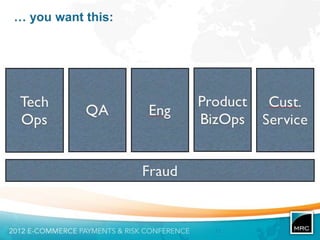
Let’s Leverage the Organization
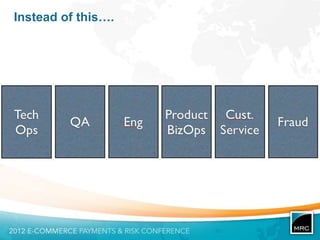
Instead of this….
… you want this:
Let’s go!
Technical Operations
Log It

 Leverage existing centralized logging (if not get it)
 You can index it – lots of 3rd party solutions
 Make new security/fraud/sensitive data log or
  namespace
 Log this:
  –   Password resets
  –   Email changes
  –   Credit card changes
  –   Login failures

  Also great for internal risk monitoring.. Who is doing what
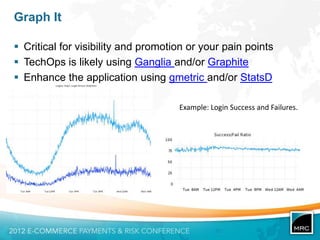
Graph It

 Critical for visibility and promotion or your pain points
 TechOps is likely using Ganglia and/or Graphite
 Enhance the application using gmetric and/or StatsD

                                     Example: Login Success and Failures.
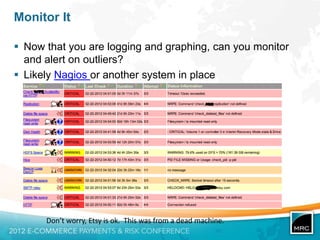
Monitor It

 Now that you are logging and graphing, can you monitor
  and alert on outliers?
 Likely Nagios or another system in place


      Don’t worry, Etsy is ok. This was from a dead machine.
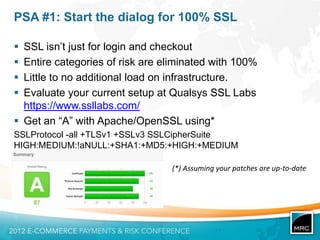
PSA #1: Start the dialog for 100% SSL

 SSL isn‟t just for login and checkout
 Entire categories of risk are eliminated with 100%
 Little to no additional load on infrastructure.
 Evaluate your current setup at Qualsys SSL Labs
  https://www.ssllabs.com/
 Get an “A” with Apache/OpenSSL using*
SSLProtocol -all +TLSv1 +SSLv3 SSLCipherSuite
HIGH:MEDIUM:!aNULL:+SHA1:+MD5:+HIGH:+MEDIUM

                                 (*) Assuming your patches are up-to-date
Quality Assurance
        .
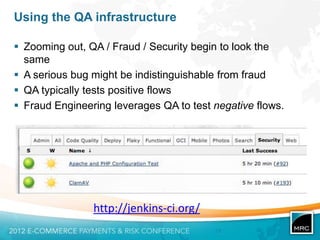
Using the QA infrastructure

 Zooming out, QA / Fraud / Security begin to look the
  same
 A serious bug might be indistinguishable from fraud
 QA typically tests positive flows
 Fraud Engineering leverages QA to test negative flows.


                http://jenkins-ci.org/
Test Your Invariants

Things that should be always true (or false).
Super easy to test

  –   “This page should always be SSL”
  –   “This page should always require login”
  –   “http://..../server-status” doesn‟t display to public”
  –   “http://…/wp-admin” requires a password”
  –   “This page should never displays the full credit card”
  –   “Google never visits this page”


You‟ll be amazed or frightened by the results
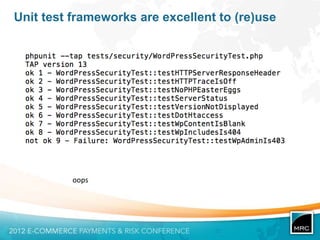
Unit test frameworks are excellent to (re)use


          oops
Use the central log to find…

Syntax errors from the database!
  Certainly a bug, but perhaps SQLi attempts

Uncaught DatabaseException: 42601 7 ERROR:
syntax error at position 2 near "&" in
SELECT COUNT(*) FROM convos
WHERE uid = ? AND names LIKE „?‟
with [895724897,"Ll'or1=1"]
at DBConnection.php

                       based on a true story
        all queries and values changed to protect the guilty
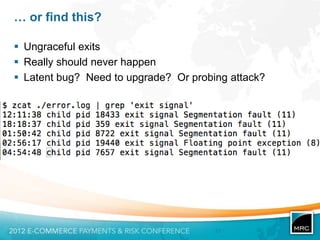
… or find this?

 Ungraceful exits
 Really should never happen
 Latent bug? Need to upgrade? Or probing attack?
Even if you can’t fix it,
establish the base line and
look for deviations from it
Product and BizOps
Product should be helping with


The delicate balance between
easy enough so you don‟t loose customers
vs. hard enough so attackers go elsewhere
vs. the barriers appropriate to risk.
Can you make security a desired feature?

 Can you offer your best customers better security
  solutions so they don‟t have account takeover?
 Has anyone even asked them?
 Not necessarily resulting in more engineering work.
  – Site messaging improvements
  – Outreach
  – Customer education
 How can you make account takeover recovery easier?
 How can you message the user when they their email got
  erased or if they ?
BizOps

 Have you talked to the email marketing and/or online-ad
  targeting groups?
 The work they do is oddly similar to fraud analytics.
  –   Breakdown by sales by country over time
  –   Customer visit frequency by sales
  –   Average purchase price
  –   Basket Analysis
 Helping them make their data more real time/visible
  helps the business and adds additional eyes on fraud
Engineering
Fraud Engineering

 There is certainly pure fraud engineering:
  – Integration with risk management solutions
  – Rule and model building
  – Analysis and reporting
  – Behavior tracking
 And there is certainly security engineering
  – Authentication and Authorization
  – CSRF / SQLi protections
  – Secure coding initiatives https://buildsecurityin.us-cert.gov/
  But there is a lot more you can leverage from the
  organization.
Work on preventing false positives

Eliminating false positives helps your risk management
system work better.

 Disable form submit buttons after being pressed
  (prevents double clicks)
 Add rate limits to just about everything on the site

Does not necessarily stop determined attackers, but…
if someone is breaking or bumping up against your rate
limits, you know they are up to something.
PSA #2: No passwords in plain text!

   I beg of you.
   Also don‟t store them as plain MD5 or SHA1
   Use a “salted hash” system.
   Start the process today!
Here’s a secret

 Your engineers are bored.
 90% of a computer science degree isn‟t used on a day to
  day basis
 This is why open source projects exists: to work on cool
  stuff they can‟t do at work.
 They have side-projects already
 There is a huge cognitive surplus is sitting around.
Here’s another

 This laptop is the equivalent of at least 8 Amazon EC2
  “small” instances and has a terabyte of storage.
 “Hard problems” such as machine learning, natural
  language processing, big data are rapidly being
  commoditized.
 There is a huge computational surplus laying around the
  office.
Now that you know the secret, use it

 Fraud problems are engineer-bait -- it‟s full of fun hard
  problems
 Leverage your employees! Advertise your problems.
 If that fails, find interns! I‟m sure your local schools will
  be happy to help.
Customer Service
Customer Service

 They know more than you on how the site is working and
  performing.
 All fraud ends up being a customer service problem
 Improving customer service == improving fraud
  management.
 Talk to them and build the best #(&^$*# tools that you
  can for them.
 Gains of 4x-5x can occur by eliminating crap out of their
  workflow.
Case Study
Mysterious Data Center Logins – Work In Progress
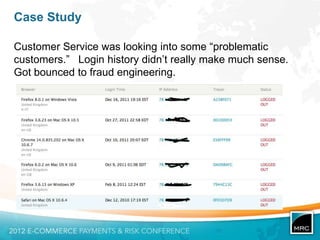
Case Study

Customer Service was looking into some “problematic
customers.” Login history didn‟t really make much sense.
Got bounced to fraud engineering.
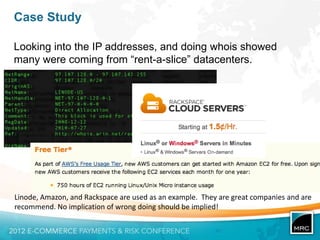
Case Study

Looking into the IP addresses, and doing whois showed
many were coming from “rent-a-slice” datacenters.


Linode, Amazon, and Rackspace are used as an example. They are great companies and are
recommend. No implication of wrong doing should be implied!
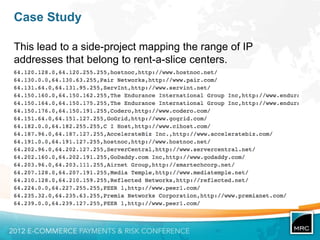
Case Study

This lead to a side-project mapping the range of IP
addresses that belong to rent-a-slice centers.
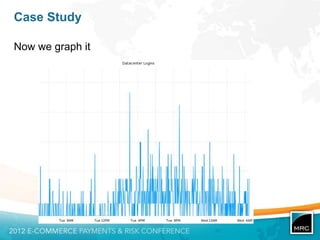
Case Study

Now we graph it
Case Study

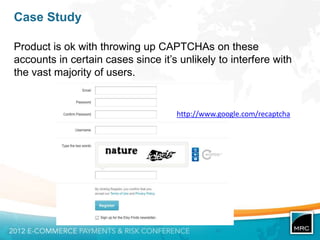
Product is ok with throwing up CAPTCHAs on these
accounts in certain cases since it‟s unlikely to interfere with
the vast majority of users.


                                    http://www.google.com/recaptcha
Case Study

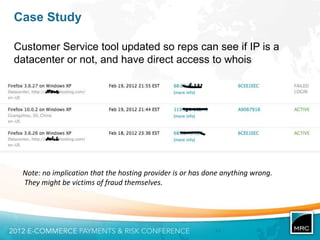
Customer Service tool updated so reps can see if IP is a
datacenter or not, and have direct access to whois


 Note: no implication that the hosting provider is or has done anything wrong.
 They might be victims of fraud themselves.
Case Study

 Oddly many users are legit (privacy nuts? escaping great
  firewall of china?)
 Working on CS/Product strategy to reach out to the legit
  customers on why.
 Rolling out analysis to checkout/purchase.
 Would love your feedback and help, so….
Case Study: Our List is Yours

 Over 25,000,000 total IP addresses
 Over 1700 IP blocks
 Over 350 providers


 https://github.com/client9/ipcat
Nick Galbreath nickg@etsy.com @ngalbreath

                                2012-02-22

Fraud Engineering, from Merchant Risk Council Annual Meeting 2012

  • 1.
    Fraud Engineering nickg@etsy.com
  • 2.
  • 3.
    Who is nickg? Web Application background  Software Development background  Linux/Unix background  Most everything was either social media and/or ecommerce since 1994  I started at Etsy two years ago. There was no one dedicated on fraud and security in engineering.  A lot of this was learned the hard way  My perspective on fraud is probably a bit different. Season to taste.
  • 4.
    Who is Etsy? “Online marketplace for creative small businesses”  No inventory, marketplace. Instead we have both sides – Buyer risk – Seller risk  When fraud happens, it‟s not silent. It‟s public.  We lose trust (and money).  We are very sensitive to fraud and risk == a lot of R&D
  • 5.
    What and Whereis Risk? Many types of risk… but today we‟ll talk about  Fraud  Security  Internal Threats  Business Continuity  Physical Security  Intellectual property
  • 6.
    Thinking about Riskand Fraud  “System working correctly, but with stolen or false credentials causing financial loss”  Constant, always happening.  More business focused  Continuous output (“fraud is 1%”)  Think: stolen credit cards, bogus seller that doesn’t ship goods.
  • 7.
    Thinking about Riskand Application Security  “System working incorrectly when given invalid or unexpected input, causing financial loss, data loss/theft, system downtime, vandalism, or attack on another system.”  Unexploited problems exists, now.  Can be costly dealing with compliance, disclosure, legal.  More technical-focused  Binary Output (“we are breached, or not”)  Think: SQLi, XSS, buffer overflow attacks, data breach, etc  Of course, security flaws can be used to commit fraud
  • 8.
    Account Takeover Blursthe Line  Account takeover crosses the boundaries from site security to personal member security.  Problems can be public  Fraud and Security two sides of same coin.
  • 9.
  • 10.
  • 11.
  • 12.
  • 13.
  • 14.
    Log It  Leverageexisting centralized logging (if not get it)  You can index it – lots of 3rd party solutions  Make new security/fraud/sensitive data log or namespace  Log this: – Password resets – Email changes – Credit card changes – Login failures Also great for internal risk monitoring.. Who is doing what
  • 15.
    Graph It  Criticalfor visibility and promotion or your pain points  TechOps is likely using Ganglia and/or Graphite  Enhance the application using gmetric and/or StatsD Example: Login Success and Failures.
  • 16.
    Monitor It  Nowthat you are logging and graphing, can you monitor and alert on outliers?  Likely Nagios or another system in place Don’t worry, Etsy is ok. This was from a dead machine.
  • 17.
    PSA #1: Startthe dialog for 100% SSL  SSL isn‟t just for login and checkout  Entire categories of risk are eliminated with 100%  Little to no additional load on infrastructure.  Evaluate your current setup at Qualsys SSL Labs https://www.ssllabs.com/  Get an “A” with Apache/OpenSSL using* SSLProtocol -all +TLSv1 +SSLv3 SSLCipherSuite HIGH:MEDIUM:!aNULL:+SHA1:+MD5:+HIGH:+MEDIUM (*) Assuming your patches are up-to-date
  • 18.
  • 19.
    Using the QAinfrastructure  Zooming out, QA / Fraud / Security begin to look the same  A serious bug might be indistinguishable from fraud  QA typically tests positive flows  Fraud Engineering leverages QA to test negative flows. http://jenkins-ci.org/
  • 20.
    Test Your Invariants Thingsthat should be always true (or false). Super easy to test – “This page should always be SSL” – “This page should always require login” – “http://..../server-status” doesn‟t display to public” – “http://…/wp-admin” requires a password” – “This page should never displays the full credit card” – “Google never visits this page” You‟ll be amazed or frightened by the results
  • 21.
    Unit test frameworksare excellent to (re)use oops
  • 22.
    Use the centrallog to find… Syntax errors from the database! Certainly a bug, but perhaps SQLi attempts Uncaught DatabaseException: 42601 7 ERROR: syntax error at position 2 near "&" in SELECT COUNT(*) FROM convos WHERE uid = ? AND names LIKE „?‟ with [895724897,"Ll'or1=1"] at DBConnection.php based on a true story all queries and values changed to protect the guilty
  • 23.
    … or findthis?  Ungraceful exits  Really should never happen  Latent bug? Need to upgrade? Or probing attack?
  • 24.
    Even if youcan’t fix it, establish the base line and look for deviations from it
  • 25.
  • 26.
    Product should behelping with The delicate balance between easy enough so you don‟t loose customers vs. hard enough so attackers go elsewhere vs. the barriers appropriate to risk.
  • 27.
    Can you makesecurity a desired feature?  Can you offer your best customers better security solutions so they don‟t have account takeover?  Has anyone even asked them?  Not necessarily resulting in more engineering work. – Site messaging improvements – Outreach – Customer education  How can you make account takeover recovery easier?  How can you message the user when they their email got erased or if they ?
  • 28.
    BizOps  Have youtalked to the email marketing and/or online-ad targeting groups?  The work they do is oddly similar to fraud analytics. – Breakdown by sales by country over time – Customer visit frequency by sales – Average purchase price – Basket Analysis  Helping them make their data more real time/visible helps the business and adds additional eyes on fraud
  • 29.
  • 30.
    Fraud Engineering  Thereis certainly pure fraud engineering: – Integration with risk management solutions – Rule and model building – Analysis and reporting – Behavior tracking  And there is certainly security engineering – Authentication and Authorization – CSRF / SQLi protections – Secure coding initiatives https://buildsecurityin.us-cert.gov/ But there is a lot more you can leverage from the organization.
  • 31.
    Work on preventingfalse positives Eliminating false positives helps your risk management system work better.  Disable form submit buttons after being pressed (prevents double clicks)  Add rate limits to just about everything on the site Does not necessarily stop determined attackers, but… if someone is breaking or bumping up against your rate limits, you know they are up to something.
  • 32.
    PSA #2: Nopasswords in plain text!  I beg of you.  Also don‟t store them as plain MD5 or SHA1  Use a “salted hash” system.  Start the process today!
  • 33.
    Here’s a secret Your engineers are bored.  90% of a computer science degree isn‟t used on a day to day basis  This is why open source projects exists: to work on cool stuff they can‟t do at work.  They have side-projects already  There is a huge cognitive surplus is sitting around.
  • 34.
    Here’s another  Thislaptop is the equivalent of at least 8 Amazon EC2 “small” instances and has a terabyte of storage.  “Hard problems” such as machine learning, natural language processing, big data are rapidly being commoditized.  There is a huge computational surplus laying around the office.
  • 35.
    Now that youknow the secret, use it  Fraud problems are engineer-bait -- it‟s full of fun hard problems  Leverage your employees! Advertise your problems.  If that fails, find interns! I‟m sure your local schools will be happy to help.
  • 36.
  • 37.
    Customer Service  Theyknow more than you on how the site is working and performing.  All fraud ends up being a customer service problem  Improving customer service == improving fraud management.  Talk to them and build the best #(&^$*# tools that you can for them.  Gains of 4x-5x can occur by eliminating crap out of their workflow.
  • 38.
    Case Study Mysterious DataCenter Logins – Work In Progress
  • 39.
    Case Study Customer Servicewas looking into some “problematic customers.” Login history didn‟t really make much sense. Got bounced to fraud engineering.
  • 40.
    Case Study Looking intothe IP addresses, and doing whois showed many were coming from “rent-a-slice” datacenters. Linode, Amazon, and Rackspace are used as an example. They are great companies and are recommend. No implication of wrong doing should be implied!
  • 41.
    Case Study This leadto a side-project mapping the range of IP addresses that belong to rent-a-slice centers.
  • 42.
  • 43.
    Case Study Product isok with throwing up CAPTCHAs on these accounts in certain cases since it‟s unlikely to interfere with the vast majority of users. http://www.google.com/recaptcha
  • 44.
    Case Study Customer Servicetool updated so reps can see if IP is a datacenter or not, and have direct access to whois Note: no implication that the hosting provider is or has done anything wrong. They might be victims of fraud themselves.
  • 45.
    Case Study  Oddlymany users are legit (privacy nuts? escaping great firewall of china?)  Working on CS/Product strategy to reach out to the legit customers on why.  Rolling out analysis to checkout/purchase.  Would love your feedback and help, so….
  • 46.
    Case Study: OurList is Yours  Over 25,000,000 total IP addresses  Over 1700 IP blocks  Over 350 providers https://github.com/client9/ipcat
  • 47.
    Nick Galbreath nickg@etsy.com@ngalbreath 2012-02-22