Designing for Security Protection with  Laminated Glass
Presented by: This course is worth 1 hour of  Health, Safety and Welfare Credit through  the American Institute of Architects Saflex
About Solutia Inc.   World Headquarters located in St. Louis, MO $3.8 Billion Chemical Company World’s largest producer of polyvinyl butyral  (PVB) used in laminated glass
Solutia Architectural Brands
Course Objectives What you will learn… Glass Options for Security Protection Bomb Blast Basics Additional protective solutions with laminated glass
Providing Security Protection & Glass Options
Safety   vs. Security   Safety  = refers to freedom from the risk OR occurrence of injury/loss from  natural cause Security  = refers to freedom from the risk OR occurrence of injury/loss from the  intentional actions of mankind
What is expected of  security glazing? Glazing: Must provide an element barrier, excellent optical quality and ease of maintenance Must resist impact, forced entry, bomb blasts, accidental explosions, and ballistic attacks according to national consensus standards Must allow for Building Envelope to be maintained Security glazing is not mandated by the model building codes.  The need for security protection and the level of security desired to meet perceived needs are determined by the occupants or owners
Why Design for Security Protection? Burglary, Forced Entry, Ballistic Attacks, and Bomb Blasts and are more and more common A burglary occurs every 11 sec in the US Bomb Blast events are globally on the rise Flying glass shards:  50+% of all injuries from terrorist targeted public building bombings Flying or Falling Glass #1 cause of non-fatal injuries
Types of Security Glazing Burglary/Forced Entry Resistant Barrier/Forced Exit Resistant Bullet Resistant Blast Resistant
Types of Security Glazing  Standard Laminated Architectural Glass (LAG)  (1/4” with 0.060” thickness) provides a significant improvement  in resistance to attack from a variety of hand held weapons in: Residential:  Rock, Hammer, Pry bar, Brick, etc. Commercial: Sledgehammer, Battering Ram, Chisel, Axe LAG cannot be cut from one side deeming glass cutters useless Impact resistance (penetration) is directly related to the % of interlayer in the laminate. Burglary Resistance/Forced Entry
Benefits of Laminated Glass FORCED ENTRY
Barrier/Forced Exit Resistant Standard construction multi-ply glass with 0.060” interlayer  Provides layers of significant barrier to penetration resistance:  Institutional (i.e.: human, furniture impact) Detention Glazing (i.e.: pry tools, safety equipment) LAG provides time to for assessment and action. Impact resistance (penetration) is directly related to the % of interlayer in the laminate and number of layers of glass.
Types of Security Glazing  Bullet-resistant glass is made by laminating multiple layers of glass and thin (0.015”) interlayer to form a single multi-ply unit The glass layers flatten the bullet upon impact to slow penetration through unit The interlayer holds the glass in   place to provide resistance to    additional incoming rounds The interlayer provides flexibility    and absorbs energy through the unit Ballistic Protection
Typical Thickness per Level  Check this versus GANA guide 2” .30-’06 Rifle Level 4  High Power – Rifle 1 ¾” .44 Magnum Revolver Level 3 Super Power – Small Arms 1 ½” .357 Magnum Revolver Level 2 High Power – Small Arms 1 ¼” Super .38 Automatic  / 9mm Level 1 Medium Power – Small Arms Typical Laminate Thickness Typical Weapon UL 752 Test
Types of Security Glazing  Standard LAG (1/4” with 0.030” or 0.060” thick interlayer)  Provides significant air blast protection through glass retention and debris resistance:  Glass Retention:  Interlayer tends to keep broken glass shards adhered in laminate unit Debris Resistance: laminate unit resists penetration from most debris from blast Bomb Blast Resistance
LAG Configurations Single Lite Forced Entry Bomb Blast Hurricane Acoustical Safety Laminated Insulated Same as Single Plus: Energy Conservation Enhanced Acoustical Double Laminated Available Multi-ply Laminated Same as Single Plus: Enhanced Forced Entry Enhanced Forced Exit Bullet Resistance Enhanced Blast Resistance
Bomb Blast Review
Blast Bomb Blast Events are common Glass part of terrorist's arsenal Flying glass shards major contributor to injuries Blast wave damage upon penetrating the building Interlayers in Laminated Glass have been tested for common and extreme blast levels
Bomb Blast Basics Chronology of a blast event 0.0 Time (milliseconds) Overpressure  (psi) Positive Phase Awareness Other Blast Considerations Debris Glass Retention Secondary debris Surrounding buildings…sympathetic damage Negative Phase
Blast Test Methods  and  Standards
Standards/Specifications Test Methods ASTM F 1642  GSA/ISC-TS01-2003 ISO 16933 (arena) Related Documents UFC  –  Unified Facilities Criteria   AAMA  510 -  Voluntary Guide Specification for Blast Hazard Mitigation for Fenestration Systems ASTM F 2248   Specifying an Equivalent 3-second Duration Design Loading For Blast Resistant Glazing Fabricated with Laminated Glass ASTM C 1564   Use of Silicone Sealants for Protective Glazing Systems
Testing Methodology Shock Tube Arena Testing
Testing Methodology Shock Tube Single Lite per test Reproducible Shock Typical for Initial R&D Less Expensive than Arena
LAG Reaction During Blast Lite cracks as static strength is surpassed Laminate deforms inward Interlayer absorbs blast energy as it deflects Laminate deters accompanying debris Energy transferred to frame Laminate reacts with an elastic response Interior & Exterior protected due to Retention
Large Shock Tube Photo Courtesy of Baker Risk – San Antonio, Tx
Testing Methodologies Arena Testing Several lites tested simultaneously True blast event with negative pressure Expensive  Weather Restrictions may apply SOD 100ft (30 m) SOD 50ft (15 m)
Explosive in tube
Specimen Chambers
Blast Detonation
Product Testing Qualifications Hazard Rating Protection Levels Requirements Government Requirements Project Specific (Industry)
Post Blast Analysis Blast Information Glass Crack / Shatter Glass Retention/Opening Location of Shards Damage to Witness Panel
Blast Protection/Hazard Rating HH High Hazard  Zone Blast Window Threshold 2.0 m 1.0 m 0.6 m ISC/GSA No Break No Hazard Minimal Hazard VLH Very Low Hazard  Zone LH Low Hazard Zone Threshold 0.5 m 1 2 3a 3b 4 5
Classification and Performance  GSA Levels Level C Building 4 psi /28 psi*msec Level D Building 10 psi/88 psi*msec Based on 44” x 66” opening Other Government/Private Sector UFC:  6 psi/ 42 psi*msec DoS: 42 psi/260-300 psi*msec ASTM:  Levels not provided
PVB Laminate Response Lite cracks as static strength is surpassed Laminate deforms inward  PVB absorbs blast energy as it deflects Laminate deters accompanying debris Some energy transferred to frame Laminate “vacillates” (neg. phase & elasticity) Interior & Exterior protected due to retention performance
Blast Test with Annealed
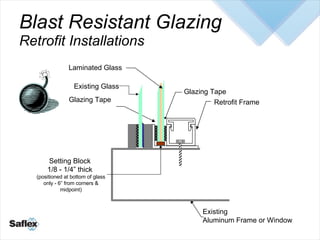
Blast Resistant Glazing Retrofit Installations Glazing Tape Existing Aluminum Frame or Window Glazing Tape Retrofit Frame Laminated Glass Setting Block  1/8 - 1/4” thick  (positioned at bottom of glass only - 6” from corners & midpoint) Existing Glass
Blast Test with Laminated
20 psi ; 78 psi*msec 700 lb. TNT Equivalent From the OUTSIDE!
20 psi ; 78 psi*msec 700 lb. TNT Equivalent From the INSIDE!
Twin Span – Curtain Wall Pre-test:  6 psi  @ 42 psi*msec
Twin Span – Curtain Wall Post-test:  6 psi  @ 42 psi*msec
System Design Importance of Framing Design  Frame must withstand designed and transferred loads Adequate Frame attachment to the structure Anchoring of laminate into frame – sealant, tape minimum 1/4” – at least as thick as Blast Resistant Glazing glass depth bite up to 1”  Laminate Configuration Structural load governs minimum thickness and treatment Interlayer minimum 0.030” (0.76 mm) for AN Recommend 0.060” (1.52 mm) for HS or FT
Security: Blast Trends Government mandates for laminated glass Annealed and Heat Strengthened Glass Standard PVB in 30 or 60 gauge Laminated Insulating Units Double Laminated for Essential Facilities Rational Analysis of Tested Systems
Security: Blast Trends  continued… Multifunctional Units Glazing into Hurricane Approved Systems Specifications following Government Guidelines Social Responsibility of Building Owners Psychological Need for Protection
CONCLUSIONS Laminated Glass with PVB High performer in bomb blast protection Protects building structure, occupants and surroundings Wide Application Range Top choice for New Construction Retrofit capable and feasible  Resists the impact from debris Offers high levels of retention Must Follow Loads from Glass to Building Must consider all design parameters
Additional Protection Safety, Sound and Solar
Benefits of Laminated Glass SAFETY Meets all the Federal and Voluntary safety glazing standards: ANZI Z97.1  CPSC 16 CFR 1201 (Consumer Product Safety Commission) Resist penetration, won’t shatter into dangerous fragments
Benefits of Laminated Glass SOUND Reduces unwanted sound and noise Typical STC ratings between 32-36, specific constructions 40-50. Can reduce perceived noise by up to 50%
Benefits of Laminated Glass SOLAR Screens out 99% of  harmful & damaging UV rays to 380 nm equivalent to  SPF 50+ Protects delicate plants, fabrics, carpets, and furniture from fading Can use tinted PVB to reduce solar heat gain, reduce glare
Benefits of Laminated Glass Aesthetic   1000’s of design possibilities with color For both interiors and exteriors w/ heat & light stable pigments Christian La Croix
Project Showcase
Las Vegas Federal Courthouse  Architect:  Dworsky Associates
Oklahoma City Federal Campus  Architect:  Ross Barney and Jankowski Architects
Eagleton Federal Courthouse  St. Louis, MO  Architect:  HOK
Oasis 21  Nagoya, Japan  Architect:  Obayashi Corporation
South Beach Cinema  Miami, FL  Architect:  Zyscovich, Inc.
Tokyo International Forum  Architect:  Raphael Vinoly Architects
Laminated Glass Protection Summary Application   Safety Glazing Main Force Entry Ballistic Windborne Debris (SM) Windborne Debris (LM) Seismic Bomb Blast Basic Configuration* . . . . . . . . .  Glass / 0.030” interlayer / Glass . . . . . . .  Glass / 0.060” interlayer / Glass . . .. . . . . . . . .  Multi-layer glass with 0.015” interlayer . . . . . .  Glass / 0.060” interlayer / Glass . . . . . . . .  Glass/ 0.090” interlayer, or  0.075” composite interlayer / Glass . . . . . . . . . . . . . . . . .  Glass / 0.030” interlayer/ Glass . . . . . . . . . . . . Glass / 0.030” interlayer / Glass * Minimum interlayer thickness depending upon type with glass designed for appropriate structural load
Information & Support Websites  Product Literature Master Format Specs Spec Reviews Technical Support Custom Samples Architectural Glazing Solutions Centre: 1-877-674-1233  www.Saflex.com
Questions?
This presentation is protected by US and International copyright laws. Reproduction, distribution, display and use of the presentation without written permission of the speaker is prohibited. © Solutia Inc. 2007

New S12 Security Protection

  • 1.
    Designing for SecurityProtection with Laminated Glass
  • 2.
    Presented by: Thiscourse is worth 1 hour of Health, Safety and Welfare Credit through the American Institute of Architects Saflex
  • 3.
    About Solutia Inc. World Headquarters located in St. Louis, MO $3.8 Billion Chemical Company World’s largest producer of polyvinyl butyral (PVB) used in laminated glass
  • 4.
  • 5.
    Course Objectives Whatyou will learn… Glass Options for Security Protection Bomb Blast Basics Additional protective solutions with laminated glass
  • 6.
  • 7.
    Safety vs. Security Safety = refers to freedom from the risk OR occurrence of injury/loss from natural cause Security = refers to freedom from the risk OR occurrence of injury/loss from the intentional actions of mankind
  • 8.
    What is expectedof security glazing? Glazing: Must provide an element barrier, excellent optical quality and ease of maintenance Must resist impact, forced entry, bomb blasts, accidental explosions, and ballistic attacks according to national consensus standards Must allow for Building Envelope to be maintained Security glazing is not mandated by the model building codes. The need for security protection and the level of security desired to meet perceived needs are determined by the occupants or owners
  • 9.
    Why Design forSecurity Protection? Burglary, Forced Entry, Ballistic Attacks, and Bomb Blasts and are more and more common A burglary occurs every 11 sec in the US Bomb Blast events are globally on the rise Flying glass shards: 50+% of all injuries from terrorist targeted public building bombings Flying or Falling Glass #1 cause of non-fatal injuries
  • 10.
    Types of SecurityGlazing Burglary/Forced Entry Resistant Barrier/Forced Exit Resistant Bullet Resistant Blast Resistant
  • 11.
    Types of SecurityGlazing Standard Laminated Architectural Glass (LAG) (1/4” with 0.060” thickness) provides a significant improvement in resistance to attack from a variety of hand held weapons in: Residential: Rock, Hammer, Pry bar, Brick, etc. Commercial: Sledgehammer, Battering Ram, Chisel, Axe LAG cannot be cut from one side deeming glass cutters useless Impact resistance (penetration) is directly related to the % of interlayer in the laminate. Burglary Resistance/Forced Entry
  • 12.
    Benefits of LaminatedGlass FORCED ENTRY
  • 13.
    Barrier/Forced Exit ResistantStandard construction multi-ply glass with 0.060” interlayer Provides layers of significant barrier to penetration resistance: Institutional (i.e.: human, furniture impact) Detention Glazing (i.e.: pry tools, safety equipment) LAG provides time to for assessment and action. Impact resistance (penetration) is directly related to the % of interlayer in the laminate and number of layers of glass.
  • 14.
    Types of SecurityGlazing Bullet-resistant glass is made by laminating multiple layers of glass and thin (0.015”) interlayer to form a single multi-ply unit The glass layers flatten the bullet upon impact to slow penetration through unit The interlayer holds the glass in place to provide resistance to additional incoming rounds The interlayer provides flexibility and absorbs energy through the unit Ballistic Protection
  • 15.
    Typical Thickness perLevel Check this versus GANA guide 2” .30-’06 Rifle Level 4 High Power – Rifle 1 ¾” .44 Magnum Revolver Level 3 Super Power – Small Arms 1 ½” .357 Magnum Revolver Level 2 High Power – Small Arms 1 ¼” Super .38 Automatic / 9mm Level 1 Medium Power – Small Arms Typical Laminate Thickness Typical Weapon UL 752 Test
  • 16.
    Types of SecurityGlazing Standard LAG (1/4” with 0.030” or 0.060” thick interlayer) Provides significant air blast protection through glass retention and debris resistance: Glass Retention: Interlayer tends to keep broken glass shards adhered in laminate unit Debris Resistance: laminate unit resists penetration from most debris from blast Bomb Blast Resistance
  • 17.
    LAG Configurations SingleLite Forced Entry Bomb Blast Hurricane Acoustical Safety Laminated Insulated Same as Single Plus: Energy Conservation Enhanced Acoustical Double Laminated Available Multi-ply Laminated Same as Single Plus: Enhanced Forced Entry Enhanced Forced Exit Bullet Resistance Enhanced Blast Resistance
  • 18.
  • 19.
    Blast Bomb BlastEvents are common Glass part of terrorist's arsenal Flying glass shards major contributor to injuries Blast wave damage upon penetrating the building Interlayers in Laminated Glass have been tested for common and extreme blast levels
  • 20.
    Bomb Blast BasicsChronology of a blast event 0.0 Time (milliseconds) Overpressure (psi) Positive Phase Awareness Other Blast Considerations Debris Glass Retention Secondary debris Surrounding buildings…sympathetic damage Negative Phase
  • 21.
    Blast Test Methods and Standards
  • 22.
    Standards/Specifications Test MethodsASTM F 1642 GSA/ISC-TS01-2003 ISO 16933 (arena) Related Documents UFC – Unified Facilities Criteria AAMA 510 - Voluntary Guide Specification for Blast Hazard Mitigation for Fenestration Systems ASTM F 2248 Specifying an Equivalent 3-second Duration Design Loading For Blast Resistant Glazing Fabricated with Laminated Glass ASTM C 1564 Use of Silicone Sealants for Protective Glazing Systems
  • 23.
    Testing Methodology ShockTube Arena Testing
  • 24.
    Testing Methodology ShockTube Single Lite per test Reproducible Shock Typical for Initial R&D Less Expensive than Arena
  • 25.
    LAG Reaction DuringBlast Lite cracks as static strength is surpassed Laminate deforms inward Interlayer absorbs blast energy as it deflects Laminate deters accompanying debris Energy transferred to frame Laminate reacts with an elastic response Interior & Exterior protected due to Retention
  • 26.
    Large Shock TubePhoto Courtesy of Baker Risk – San Antonio, Tx
  • 27.
    Testing Methodologies ArenaTesting Several lites tested simultaneously True blast event with negative pressure Expensive Weather Restrictions may apply SOD 100ft (30 m) SOD 50ft (15 m)
  • 28.
  • 29.
  • 30.
  • 31.
    Product Testing QualificationsHazard Rating Protection Levels Requirements Government Requirements Project Specific (Industry)
  • 32.
    Post Blast AnalysisBlast Information Glass Crack / Shatter Glass Retention/Opening Location of Shards Damage to Witness Panel
  • 33.
    Blast Protection/Hazard RatingHH High Hazard Zone Blast Window Threshold 2.0 m 1.0 m 0.6 m ISC/GSA No Break No Hazard Minimal Hazard VLH Very Low Hazard Zone LH Low Hazard Zone Threshold 0.5 m 1 2 3a 3b 4 5
  • 34.
    Classification and Performance GSA Levels Level C Building 4 psi /28 psi*msec Level D Building 10 psi/88 psi*msec Based on 44” x 66” opening Other Government/Private Sector UFC: 6 psi/ 42 psi*msec DoS: 42 psi/260-300 psi*msec ASTM: Levels not provided
  • 35.
    PVB Laminate ResponseLite cracks as static strength is surpassed Laminate deforms inward PVB absorbs blast energy as it deflects Laminate deters accompanying debris Some energy transferred to frame Laminate “vacillates” (neg. phase & elasticity) Interior & Exterior protected due to retention performance
  • 36.
  • 37.
    Blast Resistant GlazingRetrofit Installations Glazing Tape Existing Aluminum Frame or Window Glazing Tape Retrofit Frame Laminated Glass Setting Block 1/8 - 1/4” thick (positioned at bottom of glass only - 6” from corners & midpoint) Existing Glass
  • 38.
    Blast Test withLaminated
  • 39.
    20 psi ;78 psi*msec 700 lb. TNT Equivalent From the OUTSIDE!
  • 40.
    20 psi ;78 psi*msec 700 lb. TNT Equivalent From the INSIDE!
  • 41.
    Twin Span –Curtain Wall Pre-test: 6 psi @ 42 psi*msec
  • 42.
    Twin Span –Curtain Wall Post-test: 6 psi @ 42 psi*msec
  • 43.
    System Design Importanceof Framing Design Frame must withstand designed and transferred loads Adequate Frame attachment to the structure Anchoring of laminate into frame – sealant, tape minimum 1/4” – at least as thick as Blast Resistant Glazing glass depth bite up to 1” Laminate Configuration Structural load governs minimum thickness and treatment Interlayer minimum 0.030” (0.76 mm) for AN Recommend 0.060” (1.52 mm) for HS or FT
  • 44.
    Security: Blast TrendsGovernment mandates for laminated glass Annealed and Heat Strengthened Glass Standard PVB in 30 or 60 gauge Laminated Insulating Units Double Laminated for Essential Facilities Rational Analysis of Tested Systems
  • 45.
    Security: Blast Trends continued… Multifunctional Units Glazing into Hurricane Approved Systems Specifications following Government Guidelines Social Responsibility of Building Owners Psychological Need for Protection
  • 46.
    CONCLUSIONS Laminated Glasswith PVB High performer in bomb blast protection Protects building structure, occupants and surroundings Wide Application Range Top choice for New Construction Retrofit capable and feasible Resists the impact from debris Offers high levels of retention Must Follow Loads from Glass to Building Must consider all design parameters
  • 47.
  • 48.
    Benefits of LaminatedGlass SAFETY Meets all the Federal and Voluntary safety glazing standards: ANZI Z97.1 CPSC 16 CFR 1201 (Consumer Product Safety Commission) Resist penetration, won’t shatter into dangerous fragments
  • 49.
    Benefits of LaminatedGlass SOUND Reduces unwanted sound and noise Typical STC ratings between 32-36, specific constructions 40-50. Can reduce perceived noise by up to 50%
  • 50.
    Benefits of LaminatedGlass SOLAR Screens out 99% of harmful & damaging UV rays to 380 nm equivalent to SPF 50+ Protects delicate plants, fabrics, carpets, and furniture from fading Can use tinted PVB to reduce solar heat gain, reduce glare
  • 51.
    Benefits of LaminatedGlass Aesthetic 1000’s of design possibilities with color For both interiors and exteriors w/ heat & light stable pigments Christian La Croix
  • 52.
  • 53.
    Las Vegas FederalCourthouse Architect: Dworsky Associates
  • 54.
    Oklahoma City FederalCampus Architect: Ross Barney and Jankowski Architects
  • 55.
    Eagleton Federal Courthouse St. Louis, MO Architect: HOK
  • 56.
    Oasis 21 Nagoya, Japan Architect: Obayashi Corporation
  • 57.
    South Beach Cinema Miami, FL Architect: Zyscovich, Inc.
  • 58.
    Tokyo International Forum Architect: Raphael Vinoly Architects
  • 59.
    Laminated Glass ProtectionSummary Application Safety Glazing Main Force Entry Ballistic Windborne Debris (SM) Windborne Debris (LM) Seismic Bomb Blast Basic Configuration* . . . . . . . . . Glass / 0.030” interlayer / Glass . . . . . . . Glass / 0.060” interlayer / Glass . . .. . . . . . . . . Multi-layer glass with 0.015” interlayer . . . . . . Glass / 0.060” interlayer / Glass . . . . . . . . Glass/ 0.090” interlayer, or 0.075” composite interlayer / Glass . . . . . . . . . . . . . . . . . Glass / 0.030” interlayer/ Glass . . . . . . . . . . . . Glass / 0.030” interlayer / Glass * Minimum interlayer thickness depending upon type with glass designed for appropriate structural load
  • 60.
    Information & SupportWebsites Product Literature Master Format Specs Spec Reviews Technical Support Custom Samples Architectural Glazing Solutions Centre: 1-877-674-1233 www.Saflex.com
  • 61.
  • 62.
    This presentation isprotected by US and International copyright laws. Reproduction, distribution, display and use of the presentation without written permission of the speaker is prohibited. © Solutia Inc. 2007