“MANAGEMENT OF R&D
FUNCTION, CRITERION FOR
THE SELECTION OF R&D
PROJECTS AND TECHNOLOGY
DEVELOPMENT PROCESS.”
SUBMITTED BY,
SHAHNAZ MOL.A
RESEARCH AND
DEVELOPMENT (R&D)
DEFINITION
“SYSTEMATIC ACTIVITY COMBINING
BOTH BASIC AND APPLIED RESEARCH
AIMED AT DISCOVERING NEW
PRODUCTS OR DISCOVERING NEW
KNOWLEDGE FOR IMPROVING THE
EFFECTIVENESS OF EXISTING PRODUCTS
FOR THE INNOVATION OF BUSINESS
ENTERPRISE.”
● R&D is considered as a product's conception.
● R&D strategy depends on the size of the business or
industry.
● In smaller business R&D trends to focus more on
product improvement because of budjet and cost
limitation.
● Larger business can able to dedicate more time and
resources to R&D to introduce new products as well
as improving existing ones.
Contd..
● R&D differs from company to company, but there are
two primary models.
● R&D department being either
staffed by engineers and tasked
with directly developing new
products.
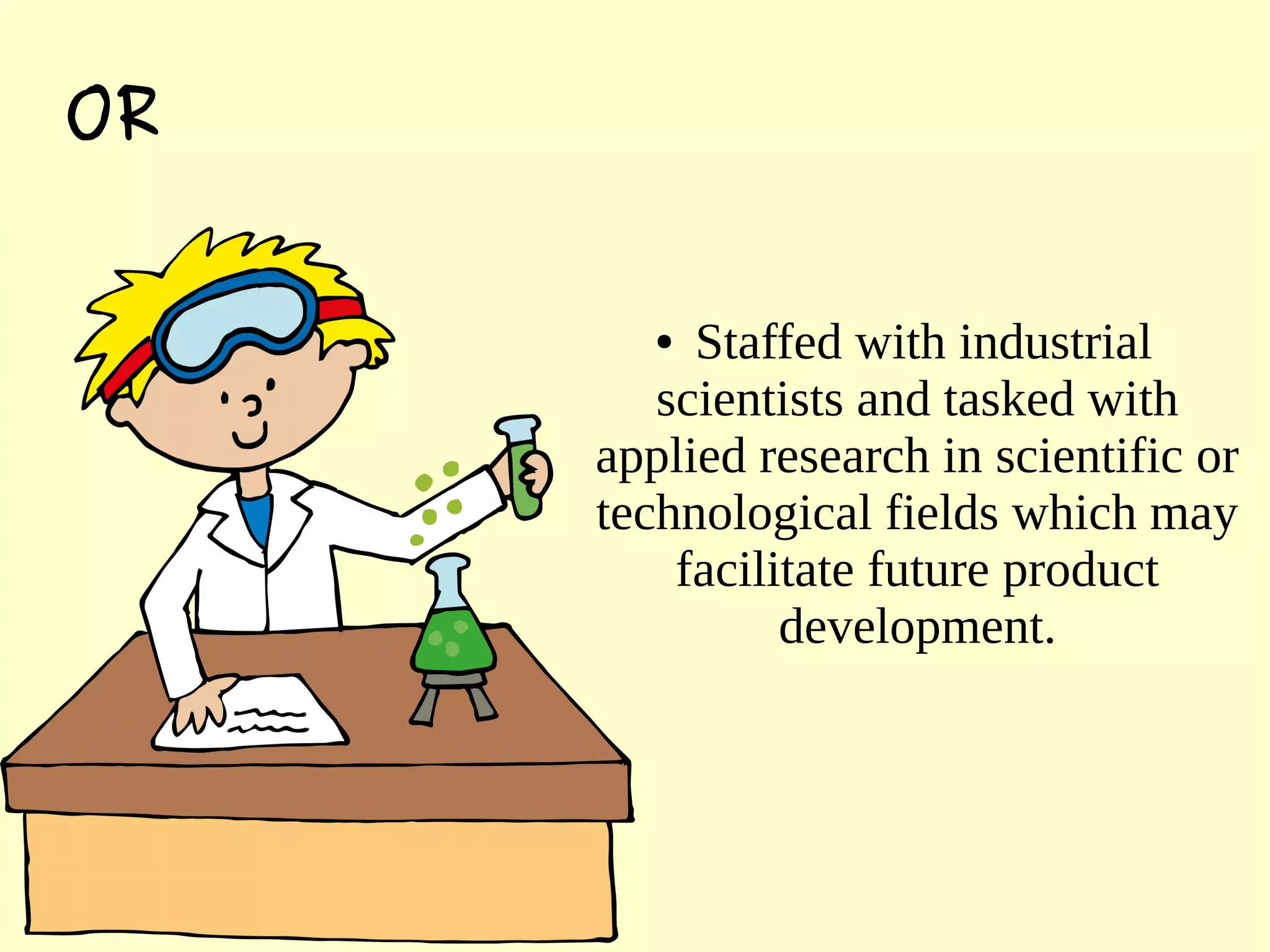
OR
● Staffed with industrial
scientists and tasked with
applied research in scientific or
technological fields which may
facilitate future product
development.
CONTD..
● In general, R&D activities are conducted by
specialized units or centers belonging to a industry.
● It can be also out-sourced to a contract research
organization, universities, or state agencies.
● Universities provide the fundamental and basic
research which tend to be more general.
● Universities concentrate on pursuit of knowledge.
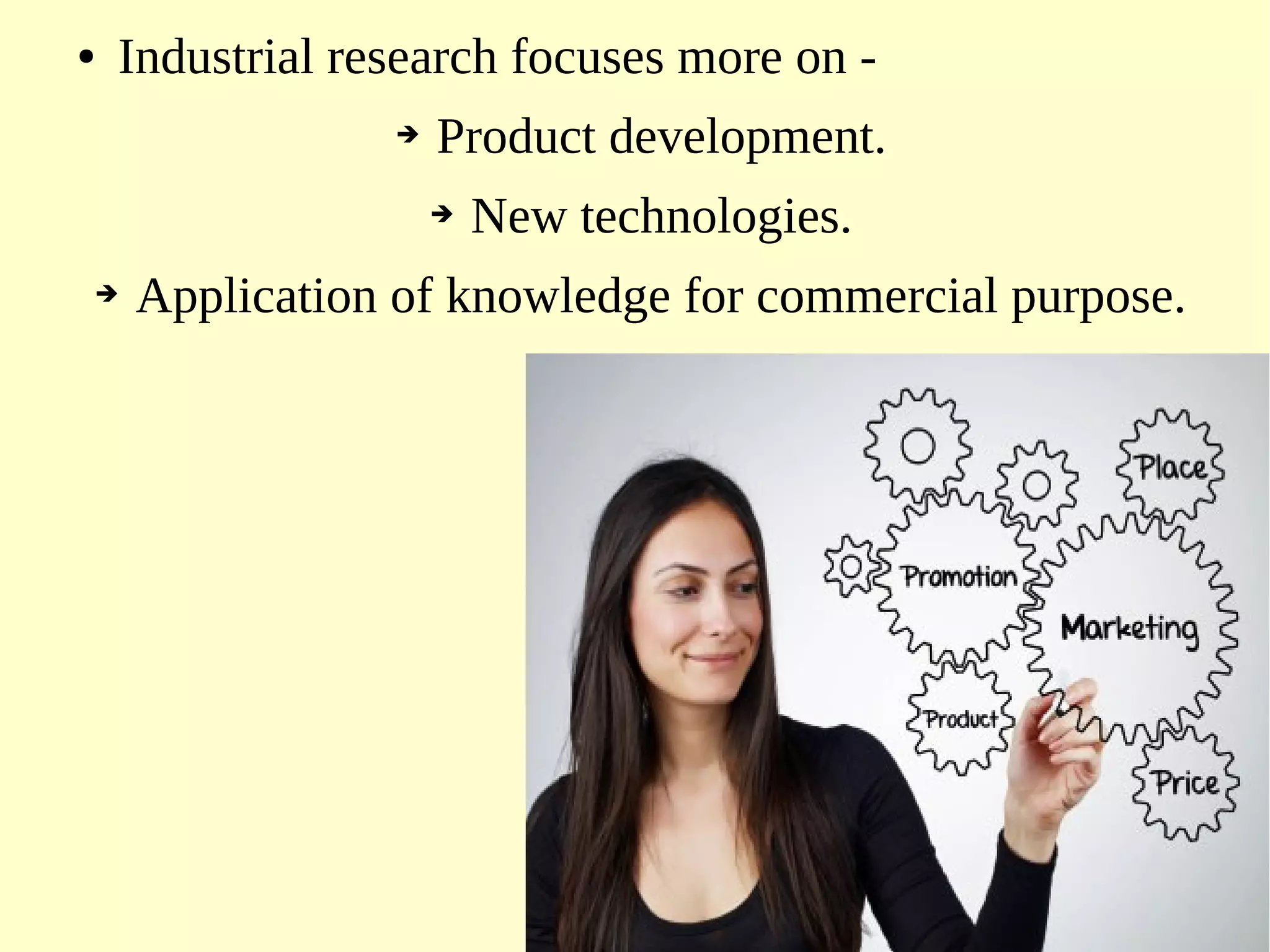
● Industrial research focuses more on -
➔ Product development.
➔ New technologies.
➔ Application of knowledge for commercial purpose.
“R&D DIFFER FROM THE VAST
MAJORITY OF CORPORATE
ACTIVITIES
BECAUSE..”
“IT IS NOT OFTEN
YIELD IMMEDIATE
PROFIT!!”
“IT CARRIES
GREATER RISK & AN
UNCERTAIN RETURN
OF INVESTMENT”
RETURN OF INVESTMENT
● It is the rate of return of money invested.
● Return of money invested (%) =
NET PROFIT * 100
INVESTMENT
R&D AND BUSINESS
● Present day R&D is a core part of the modern business
world.
● R&D is of greater importance in business as the level
of competition,production processes and methods are
rapidly increasing.
“R&D HAVE GREATER IMPORTANCE
AS THE LEVEL OF COMPETITION
IN BUSINESS INCREASES!!!”
● The key to sucessful R&D is to identify the needs
and desires of the customer.
● The researchers will need to revisit their research
activity regularly as customer preference frequently
change.
“THE KEY TO SUCESSFUL
R&D IS TO IDENTIFY
THE NEEDS AND DESIRES
OF THE CUSTOMER.”
● Statistics on organizations devoted to "R&D" may
express the state of an industry, the degree of
competition or the lure of progress.
● New product design and development is a crucial
factor in the survival of a company.
● This is necessary due to continuous technology
change and development as well as other competitors
and the changing preference of customers.
● R&D can be very expensive and the chances of
success can be slim, with a relatively low rate of
commercially successful ideas. However, in many
industries, a committed programme of R&D is
absolutely essential in order for firms to maintain
their competitiveness.
“R&D EXPENDITURE
(MEAN)
ACROSS INDUSTRIES”
R&D EXPENDITURE AS% 0F SALES
= R&D EXPENDITURE * 100
TOTAL SALES INCOME
PHARMACEUTICALS
COMPUTERS
CHEMICALS
ELECTRICALS
FOOD & DAIRY
“R&D AND FOOD”
● Food and dairy industry rarely appreciate the value of
R&D.
● In food,beverage and dairy industry, however, almost
all senior business managers have a background in
marketing with little knowledge of or experience in
dealing with the research and development arm of the
company.
● R&D managers in food-processing companies
therefore may need to spend much more time than
their counterparts in other industries do in justifying
the R&D function.
● In addition, they may have to spend much more time
encouraging their R&D staff to take the initiative—
and to create technical advances for their companies.
● A study on 38 R&D organizations in food-processing
and beverage companies revealed that, the major
challenge they are facing is -
“MANAGEMENT OF R&D
FUNCTION”
“FUNCTIONS OF R&D”
“DEVELOPMENT OF NEW
PRODUCTS”
● The primary function of R&D is to develop new
products, which are essential if the company is to
generate profits in the medium and long term. All
products have a finite commercial life where new
technological developments are occuring
continuously.
“MAINTENANCE OF EXISTING
PRODUCTS”
● Existing products must be maintained to ensure that they
can be produced to specification. For eg: a component
required for an existing product may become obsolete.
When this happens R&D are expected to find an
alternative quickly so that production of the product will
not be delayed.
“ENHANCEMENT OF EXISTING
PRODUCTS”
● The commercial life of a product may be increased by
enhancing it in some way, giving it extra features,
improving its perfomance, changing its appearence or
making it cheaper to produce.
● Many companies enhance their products to keep their
product ahead of the competition and yield large
capital.
“INTERFACING WITH
PRODUCTION”
● While a new product is being developed, developmental
staff and production staff interact to ensure that the
product is manufacturable. The intention is to ensure
low cost production and short production times, while
maintaining quality standards.
● The R&D production interface is vital not only it ensure
low production costs, but by reducing production times.
● It should be possible to increase output and therefore
income on a monthly basis.
TECHNOLOGY ASPECTS OF
REGULATORY COMPLIANCE.
● It is a legal requirement that products used in the
community must comply with the relavent directives.
● The R&D department is primarily responsible for
ensuring this case.
“QUALITY”
● A product quality plan is produced for new products as
they are developed, principally by R&D and the
quality department.
● The quality plan may allow the customer to return a
whole batch of products as a result of a small number
of samples failing the customers quality tests.
And also..
● Major role of R&D is the development of fundamental
knowledge or enabling technologies.
● R&D provides support to manufacturing, customers and
business management.
● R&D development and implement technology.
“MANAGEMENT OF R&D
FUNCTION..”
● Research and development are difficult to manage;
researchers do not knowin advance exactly how to
accompolish the desired result.
● Proper R&D management is essential for getting -
➔ More creativity.
➔ Higher profit
DEFINITION..
“R&D management is the discipline
of designing and leading R&D
processes, managing R&D
organizations, and ensuring smooth
transfer of new know-how and
technology to other groups or
departments involved in innovation.”
● R&D management can be defined as where the tasks of
innovation management meet the tasks of technology
management.
● R&D management covers activities such as basic
research, fundamental research, technology
development, advanced development, concept
development, new product development, process
development, prototyping, R&D portfolio management,
technology transfer etc.
Three key practices that can
play critical role in R&D
Management are :
● Talk to the customer
● Nurture a project
culture,
● Keep it focused.
“HOW TO STRENGTHEN
R&D MANAGEMENT IN
FOOD,DAIRY & BEVERAGE
INDUSTRY..”
● World-class practices related to strengthening the
management of R&D concern four areas:
Improving the selection of R&D projects.
Strengthening the R&D management processes.
Establishing productive relationships with outside
groups.
Improving the infrastructure of the R&D organization.
1)IMPROVING THE SELECTION
OF R&D PROJECTS
● The key to improving the selection of R&D projects is
developing a discipline or framework within the R&D
organization for how R&D projects are selected.
● A number of R&D organizations have successfully
implemented formal project selection processes that
help ensure that the best ideas are pursued.
● For example, one food-processing R&D organization
uses a graph to highlight the relative risks and rewards
of possible R&D projects.
● In a food industry the R&D organization has
developed an R&D project selection process that
consists of evaluating all R&D proposals first in
terms of one of four categories -
➔ Product quality improvements.
➔ Productivity improvements in manufacturing.
➔ New product or market developments.
➔ Exploratory R&D.
And also..
● The review teams also evaluate all of the R&D
proposals in terms of:
➔ Whether they involve low, medium, or high risk.
➔ Whether they could be completed in the short,
medium, or long term.
➔ Whether they would have low, medium, or high
impact.
STRENGTHENING THE R&D
MANAGEMENT PROCESSES
● Strengthening the R&D management processes can
include improving R&D project planning, identifying the
long-term technical capabilities needed within an R&D
organization, improving the design of products, and
setting higher standards related to carrying out technical
work.
ESTABLISHING PRODUCTIVE
RELATIONSHIPS WITH OUTSIDE
GROUPS
● Most R&D organizations in food-processing and
beverage companies are still learning how to work
effectively with groups outside the R&D
organization as well as outside the company itself.
● Working productively with outside groups, however,
depends only partially on being able to recognize
one’s technical limitations.
● To work productively with outside groups also
requires such other abilities as being able to build
trust, to listen to and accept alternative viewpoints,
and to work cooperatively over an extended period of
time with groups that have different goals.
● An R&D organization of a food-processing company
has a well-defined practice of using another type of
outside expert—a technical consultant—to solve
practical problems.
IMPROVING THE
INFRASTRUCTURE OF THE R&D
ORGANIZATION
● The infrastructure of an R&D organization involves the
various systems that support the day-to-day work.
● A common element in many of these systems is the
creation and transfer of information within an R&D
organization.
● For example, an R&D project management system can
help everyone in an R&D organization gain a better
understanding of what is being done.
● A computer information system, on the other hand,
provides a way in which all R&D people—particularly
R&D people at a variety of sites—can exchange
information.
“CRITERION FOR THE
SELECTION OF R&D
PROJECTS”
● There has been considerable work on systems for
selecting R&D projects.
● Such approaches generally evaluate existing project
in order to recommend supporting the best projects
and downscaling the rest.
● The R&D management evaluate project based on the
criteria such as ;
“QUANTIFYING THE
PROBABILITY OF A PROJECT
BEING TECHNICALLY AND
COMMERCIALLY SUCCESSFUL.”
“IF THE PROJECT WERE
TECHNICALLY SUCCESSFUL, ARE
THE RESULTS LIKELY
TO BE USED?”
“IF THE RESULTS OF THE
PROJECT ARE SUCCESSFULLY
IMPLEMENTED, HOW
MANY EXTERNAL (PAYING)
CUSTOMERS ARE LIKELY TO USE
IT?”
“WHAT ARE THE KEY
DIMENSIONS ON WHICH THE
TECHNOLOGY PROMISES
TO DELIVER VALUE TO THE
COMPANY?”
“QUANTIFYING THE BENEFITS
OF THE PROJECT IF IT IS
SUCCESSFUL..”
“IF THIS PROJECT IS NOT
IMPLEMENTED, WHAT OTHER
TECHNOLOGIES, IF
ANY, WILL THE COMPANY IMPLEMENT
INSTEAD?
HOW WILL THIS LIKELY
ALTERNATIVE PERFORM ON THE KEY
DIMENSIONS?”
● Several studies on `best practices’ in R&D, all of
which indicated that project-selection is one of the
key factors associated with good R&D management.
● “Today, there is a growing recognition that project-
selection models should be used to ask questions of
the entire organization” and that project-selection
models are “decision aids” to facilitate
communication.
● Senior research management now assumed a much
greater responsibility for interacting with
implementers and strategic management and
ensuring that the needs of implementation and
strategy were consistent both with the technical
projects being pursued as well as with how those
projects were executed.
“TECHNOLOGY
DEVELOPMENT PROCESS”
● It is the process by which technology is generated or
developed by various entities.
● In some countries technology is mainly generated by
government owned research institution, universities and
other bodies with a lesser contribution coming from
private sector.
● In some technology is mainly developed by private
sector.
● Technology development depends upon the
technology strategy of the organisation or enterprise.
● The technology strategy of the organization sets the
direction of technology development in the
organization and to some extent also influence
technological strategies of competitors as well.
● At organizational or enterprise level, generation of
technology is both individual and group activity, but
its management is solely on organizational
responsibility.
● Technology through a process of creativity, innovation
and invention.
● Research and Development- wikipedia
● R&D management – wikipedia
● R&D project selection vs.R&D project generation
by Dr.Robert F. Bordley
● World-Class R&D Management In Food - Robert
Szakonyi
REFERENCE

Research and Development in Food Industry

  • 1.
    “MANAGEMENT OF R&D FUNCTION,CRITERION FOR THE SELECTION OF R&D PROJECTS AND TECHNOLOGY DEVELOPMENT PROCESS.” SUBMITTED BY, SHAHNAZ MOL.A
  • 2.
  • 3.
    DEFINITION “SYSTEMATIC ACTIVITY COMBINING BOTHBASIC AND APPLIED RESEARCH AIMED AT DISCOVERING NEW PRODUCTS OR DISCOVERING NEW KNOWLEDGE FOR IMPROVING THE EFFECTIVENESS OF EXISTING PRODUCTS FOR THE INNOVATION OF BUSINESS ENTERPRISE.”
  • 4.
    ● R&D isconsidered as a product's conception. ● R&D strategy depends on the size of the business or industry. ● In smaller business R&D trends to focus more on product improvement because of budjet and cost limitation. ● Larger business can able to dedicate more time and resources to R&D to introduce new products as well as improving existing ones.
  • 5.
    Contd.. ● R&D differsfrom company to company, but there are two primary models.
  • 6.
    ● R&D departmentbeing either staffed by engineers and tasked with directly developing new products.
  • 7.
    OR ● Staffed withindustrial scientists and tasked with applied research in scientific or technological fields which may facilitate future product development.
  • 8.
    CONTD.. ● In general,R&D activities are conducted by specialized units or centers belonging to a industry. ● It can be also out-sourced to a contract research organization, universities, or state agencies. ● Universities provide the fundamental and basic research which tend to be more general. ● Universities concentrate on pursuit of knowledge.
  • 9.
    ● Industrial researchfocuses more on - ➔ Product development. ➔ New technologies. ➔ Application of knowledge for commercial purpose.
  • 10.
    “R&D DIFFER FROMTHE VAST MAJORITY OF CORPORATE ACTIVITIES BECAUSE..”
  • 11.
    “IT IS NOTOFTEN YIELD IMMEDIATE PROFIT!!”
  • 12.
    “IT CARRIES GREATER RISK& AN UNCERTAIN RETURN OF INVESTMENT”
  • 13.
    RETURN OF INVESTMENT ●It is the rate of return of money invested. ● Return of money invested (%) = NET PROFIT * 100 INVESTMENT
  • 14.
    R&D AND BUSINESS ●Present day R&D is a core part of the modern business world. ● R&D is of greater importance in business as the level of competition,production processes and methods are rapidly increasing.
  • 15.
    “R&D HAVE GREATERIMPORTANCE AS THE LEVEL OF COMPETITION IN BUSINESS INCREASES!!!”
  • 16.
    ● The keyto sucessful R&D is to identify the needs and desires of the customer. ● The researchers will need to revisit their research activity regularly as customer preference frequently change.
  • 17.
    “THE KEY TOSUCESSFUL R&D IS TO IDENTIFY THE NEEDS AND DESIRES OF THE CUSTOMER.”
  • 18.
    ● Statistics onorganizations devoted to "R&D" may express the state of an industry, the degree of competition or the lure of progress. ● New product design and development is a crucial factor in the survival of a company. ● This is necessary due to continuous technology change and development as well as other competitors and the changing preference of customers. ● R&D can be very expensive and the chances of success can be slim, with a relatively low rate of commercially successful ideas. However, in many industries, a committed programme of R&D is absolutely essential in order for firms to maintain their competitiveness.
  • 19.
  • 20.
    R&D EXPENDITURE AS%0F SALES = R&D EXPENDITURE * 100 TOTAL SALES INCOME
  • 21.
  • 22.
  • 23.
    ● Food anddairy industry rarely appreciate the value of R&D. ● In food,beverage and dairy industry, however, almost all senior business managers have a background in marketing with little knowledge of or experience in dealing with the research and development arm of the company. ● R&D managers in food-processing companies therefore may need to spend much more time than their counterparts in other industries do in justifying the R&D function.
  • 24.
    ● In addition,they may have to spend much more time encouraging their R&D staff to take the initiative— and to create technical advances for their companies. ● A study on 38 R&D organizations in food-processing and beverage companies revealed that, the major challenge they are facing is - “MANAGEMENT OF R&D FUNCTION”
  • 25.
  • 26.
  • 27.
    ● The primaryfunction of R&D is to develop new products, which are essential if the company is to generate profits in the medium and long term. All products have a finite commercial life where new technological developments are occuring continuously.
  • 28.
  • 29.
    ● Existing productsmust be maintained to ensure that they can be produced to specification. For eg: a component required for an existing product may become obsolete. When this happens R&D are expected to find an alternative quickly so that production of the product will not be delayed.
  • 30.
  • 31.
    ● The commerciallife of a product may be increased by enhancing it in some way, giving it extra features, improving its perfomance, changing its appearence or making it cheaper to produce. ● Many companies enhance their products to keep their product ahead of the competition and yield large capital.
  • 32.
  • 33.
    ● While anew product is being developed, developmental staff and production staff interact to ensure that the product is manufacturable. The intention is to ensure low cost production and short production times, while maintaining quality standards. ● The R&D production interface is vital not only it ensure low production costs, but by reducing production times. ● It should be possible to increase output and therefore income on a monthly basis.
  • 34.
    TECHNOLOGY ASPECTS OF REGULATORYCOMPLIANCE. ● It is a legal requirement that products used in the community must comply with the relavent directives. ● The R&D department is primarily responsible for ensuring this case.
  • 35.
  • 36.
    ● A productquality plan is produced for new products as they are developed, principally by R&D and the quality department. ● The quality plan may allow the customer to return a whole batch of products as a result of a small number of samples failing the customers quality tests.
  • 37.
    And also.. ● Majorrole of R&D is the development of fundamental knowledge or enabling technologies. ● R&D provides support to manufacturing, customers and business management. ● R&D development and implement technology.
  • 38.
  • 39.
    ● Research anddevelopment are difficult to manage; researchers do not knowin advance exactly how to accompolish the desired result. ● Proper R&D management is essential for getting - ➔ More creativity. ➔ Higher profit
  • 40.
    DEFINITION.. “R&D management isthe discipline of designing and leading R&D processes, managing R&D organizations, and ensuring smooth transfer of new know-how and technology to other groups or departments involved in innovation.”
  • 41.
    ● R&D managementcan be defined as where the tasks of innovation management meet the tasks of technology management. ● R&D management covers activities such as basic research, fundamental research, technology development, advanced development, concept development, new product development, process development, prototyping, R&D portfolio management, technology transfer etc.
  • 42.
    Three key practicesthat can play critical role in R&D Management are :
  • 43.
    ● Talk tothe customer ● Nurture a project culture, ● Keep it focused.
  • 44.
    “HOW TO STRENGTHEN R&DMANAGEMENT IN FOOD,DAIRY & BEVERAGE INDUSTRY..”
  • 45.
    ● World-class practicesrelated to strengthening the management of R&D concern four areas: Improving the selection of R&D projects. Strengthening the R&D management processes. Establishing productive relationships with outside groups. Improving the infrastructure of the R&D organization.
  • 46.
  • 47.
    ● The keyto improving the selection of R&D projects is developing a discipline or framework within the R&D organization for how R&D projects are selected. ● A number of R&D organizations have successfully implemented formal project selection processes that help ensure that the best ideas are pursued. ● For example, one food-processing R&D organization uses a graph to highlight the relative risks and rewards of possible R&D projects.
  • 48.
    ● In afood industry the R&D organization has developed an R&D project selection process that consists of evaluating all R&D proposals first in terms of one of four categories - ➔ Product quality improvements. ➔ Productivity improvements in manufacturing. ➔ New product or market developments. ➔ Exploratory R&D.
  • 49.
    And also.. ● Thereview teams also evaluate all of the R&D proposals in terms of: ➔ Whether they involve low, medium, or high risk. ➔ Whether they could be completed in the short, medium, or long term. ➔ Whether they would have low, medium, or high impact.
  • 50.
    STRENGTHENING THE R&D MANAGEMENTPROCESSES ● Strengthening the R&D management processes can include improving R&D project planning, identifying the long-term technical capabilities needed within an R&D organization, improving the design of products, and setting higher standards related to carrying out technical work.
  • 51.
  • 52.
    ● Most R&Dorganizations in food-processing and beverage companies are still learning how to work effectively with groups outside the R&D organization as well as outside the company itself. ● Working productively with outside groups, however, depends only partially on being able to recognize one’s technical limitations.
  • 53.
    ● To workproductively with outside groups also requires such other abilities as being able to build trust, to listen to and accept alternative viewpoints, and to work cooperatively over an extended period of time with groups that have different goals. ● An R&D organization of a food-processing company has a well-defined practice of using another type of outside expert—a technical consultant—to solve practical problems.
  • 54.
    IMPROVING THE INFRASTRUCTURE OFTHE R&D ORGANIZATION
  • 55.
    ● The infrastructureof an R&D organization involves the various systems that support the day-to-day work. ● A common element in many of these systems is the creation and transfer of information within an R&D organization. ● For example, an R&D project management system can help everyone in an R&D organization gain a better understanding of what is being done.
  • 56.
    ● A computerinformation system, on the other hand, provides a way in which all R&D people—particularly R&D people at a variety of sites—can exchange information.
  • 57.
  • 58.
    ● There hasbeen considerable work on systems for selecting R&D projects. ● Such approaches generally evaluate existing project in order to recommend supporting the best projects and downscaling the rest. ● The R&D management evaluate project based on the criteria such as ;
  • 59.
    “QUANTIFYING THE PROBABILITY OFA PROJECT BEING TECHNICALLY AND COMMERCIALLY SUCCESSFUL.”
  • 60.
    “IF THE PROJECTWERE TECHNICALLY SUCCESSFUL, ARE THE RESULTS LIKELY TO BE USED?”
  • 61.
    “IF THE RESULTSOF THE PROJECT ARE SUCCESSFULLY IMPLEMENTED, HOW MANY EXTERNAL (PAYING) CUSTOMERS ARE LIKELY TO USE IT?”
  • 62.
    “WHAT ARE THEKEY DIMENSIONS ON WHICH THE TECHNOLOGY PROMISES TO DELIVER VALUE TO THE COMPANY?”
  • 63.
    “QUANTIFYING THE BENEFITS OFTHE PROJECT IF IT IS SUCCESSFUL..”
  • 64.
    “IF THIS PROJECTIS NOT IMPLEMENTED, WHAT OTHER TECHNOLOGIES, IF ANY, WILL THE COMPANY IMPLEMENT INSTEAD? HOW WILL THIS LIKELY ALTERNATIVE PERFORM ON THE KEY DIMENSIONS?”
  • 65.
    ● Several studieson `best practices’ in R&D, all of which indicated that project-selection is one of the key factors associated with good R&D management. ● “Today, there is a growing recognition that project- selection models should be used to ask questions of the entire organization” and that project-selection models are “decision aids” to facilitate communication.
  • 66.
    ● Senior researchmanagement now assumed a much greater responsibility for interacting with implementers and strategic management and ensuring that the needs of implementation and strategy were consistent both with the technical projects being pursued as well as with how those projects were executed.
  • 67.
  • 68.
    ● It isthe process by which technology is generated or developed by various entities. ● In some countries technology is mainly generated by government owned research institution, universities and other bodies with a lesser contribution coming from private sector. ● In some technology is mainly developed by private sector.
  • 69.
    ● Technology developmentdepends upon the technology strategy of the organisation or enterprise. ● The technology strategy of the organization sets the direction of technology development in the organization and to some extent also influence technological strategies of competitors as well. ● At organizational or enterprise level, generation of technology is both individual and group activity, but its management is solely on organizational responsibility. ● Technology through a process of creativity, innovation and invention.
  • 70.
    ● Research andDevelopment- wikipedia ● R&D management – wikipedia ● R&D project selection vs.R&D project generation by Dr.Robert F. Bordley ● World-Class R&D Management In Food - Robert Szakonyi REFERENCE