FINANCIAL SECTOR 
REFORMS
Deficiencies in the System 
2 
 Decline in productivity and effeciency 
 Erosion of profitability 
 Directed lending – depleting profits 
 SLR and CRR hindered income eeaarrnniinngg ccaappaabbiilliittyy 
 Political and administrative interference 
 Technological backwardness 
 Low capital adequacy ratio 
 Delinked from sound international banking
Objectives 
3 
 Policy framework – rate of interest, directed credit 
 Prudential norms – recapitalisation and 
restructuring of weaker banks 
 Financial structure relating to supervision, audit, 
technology aanndd lleeggaall ffrraammeewwoorrkk 
 Upgrading level of managerial competence and 
quality of human resources
Financial Sector Reforms (1st Phase) 
1st Narasimham Committee (Nov 1991) 
4 
 Reduction of SLR (25%) and CRR (10%) 
 Interest rate on CRR Balances – at Bank rate 
 Phasing out of priority lending – 10% (However Govt 
has not reduced it from 40%) 
 Interest rate deregulation – Market driven 
 Capital adequacy norms – minimum 9% 
 Asset Classification
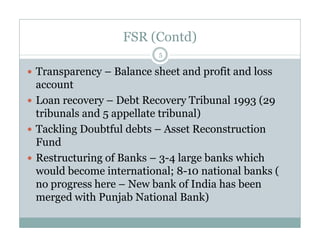
FSR (Contd) 
5 
 Transparency – Balance sheet and profit and loss 
account 
 Loan recovery – Debt Recovery Tribunal 1993 (29 
tribunals and 5 appellate tribunal) 
Tackling Doubtful debts – Asset  RReeccoonnssttrruuccttiioonn 
Fund 
 Restructuring of Banks – 3-4 large banks which 
would become international; 8-10 national banks ( 
no progress here – New bank of India has been 
merged with Punjab National Bank)
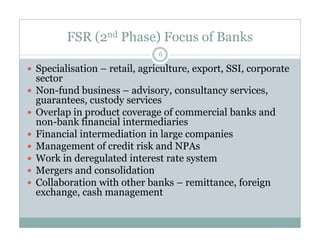
FSR (2nd Phase) Focus of Banks 
6 
 Specialisation – retail, agriculture, export, SSI, corporate 
sector 
 Non-fund business – advisory, consultancy services, 
guarantees, custody services 
 Overlap in product coverage of commercial banks and 
non-bank financial iinntteerrmmeeddiiaarriieess 
 Financial intermediation in large companies 
 Management of credit risk and NPAs 
 Work in deregulated interest rate system 
 Mergers and consolidation 
 Collaboration with other banks – remittance, foreign 
exchange, cash management
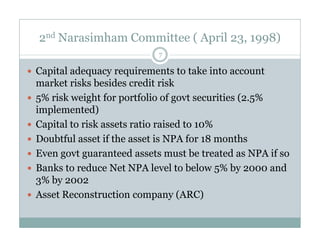
2nd Narasimham Committee ( April 23, 1998) 
7 
 Capital adequacy requirements to take into account 
market risks besides credit risk 
 5% risk weight for portfolio of govt securities (2.5% 
implemented) 
 Capital to risk assets rraattiioo rraaiisseedd ttoo 1100%% 
 Doubtful asset if the asset is NPA for 18 months 
 Even govt guaranteed assets must be treated as NPA if so 
 Banks to reduce Net NPA level to below 5% by 2000 and 
3% by 2002 
 Asset Reconstruction company (ARC)
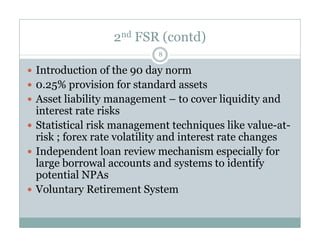
2nd FSR (contd) 
8 
 Introduction of the 90 day norm 
 0.25% provision for standard assets 
 Asset liability management – to cover liquidity and 
interest rate risks 
 Statistical risk management techniques lliikkee vvaalluuee--aatt-- 
risk ; forex rate volatility and interest rate changes 
 Independent loan review mechanism especially for 
large borrowal accounts and systems to identify 
potential NPAs 
 Voluntary Retirement System
2nd FSR (Contd) 
9 
 DFIs to convert themselves into banks (initiated) 
 Minimum shareholding by govt/RBI in nationalised 
banks to 33% (Govt introduced a bill in 2000, no 
progress so far) 
 Minimum net worth of NBFCs to be enhanced to Rs. 200 
Lakhs 
 Inter-bank call and notice money market and inter-bank 
term money market should be restricted strictly to banks 
and primary dealers 
 The RRBs and Co-operative Banks should reach a 
minimum of 8% capital to risk weighted assets over 5 
years

Financial sector reforms

  • 1.
  • 2.
    Deficiencies in theSystem 2 Decline in productivity and effeciency Erosion of profitability Directed lending – depleting profits SLR and CRR hindered income eeaarrnniinngg ccaappaabbiilliittyy Political and administrative interference Technological backwardness Low capital adequacy ratio Delinked from sound international banking
  • 3.
    Objectives 3 Policy framework – rate of interest, directed credit Prudential norms – recapitalisation and restructuring of weaker banks Financial structure relating to supervision, audit, technology aanndd lleeggaall ffrraammeewwoorrkk Upgrading level of managerial competence and quality of human resources
  • 4.
    Financial Sector Reforms(1st Phase) 1st Narasimham Committee (Nov 1991) 4 Reduction of SLR (25%) and CRR (10%) Interest rate on CRR Balances – at Bank rate Phasing out of priority lending – 10% (However Govt has not reduced it from 40%) Interest rate deregulation – Market driven Capital adequacy norms – minimum 9% Asset Classification
  • 5.
    FSR (Contd) 5 Transparency – Balance sheet and profit and loss account Loan recovery – Debt Recovery Tribunal 1993 (29 tribunals and 5 appellate tribunal) Tackling Doubtful debts – Asset RReeccoonnssttrruuccttiioonn Fund Restructuring of Banks – 3-4 large banks which would become international; 8-10 national banks ( no progress here – New bank of India has been merged with Punjab National Bank)
  • 6.
    FSR (2nd Phase)Focus of Banks 6 Specialisation – retail, agriculture, export, SSI, corporate sector Non-fund business – advisory, consultancy services, guarantees, custody services Overlap in product coverage of commercial banks and non-bank financial iinntteerrmmeeddiiaarriieess Financial intermediation in large companies Management of credit risk and NPAs Work in deregulated interest rate system Mergers and consolidation Collaboration with other banks – remittance, foreign exchange, cash management
  • 7.
    2nd Narasimham Committee( April 23, 1998) 7 Capital adequacy requirements to take into account market risks besides credit risk 5% risk weight for portfolio of govt securities (2.5% implemented) Capital to risk assets rraattiioo rraaiisseedd ttoo 1100%% Doubtful asset if the asset is NPA for 18 months Even govt guaranteed assets must be treated as NPA if so Banks to reduce Net NPA level to below 5% by 2000 and 3% by 2002 Asset Reconstruction company (ARC)
  • 8.
    2nd FSR (contd) 8 Introduction of the 90 day norm 0.25% provision for standard assets Asset liability management – to cover liquidity and interest rate risks Statistical risk management techniques lliikkee vvaalluuee--aatt-- risk ; forex rate volatility and interest rate changes Independent loan review mechanism especially for large borrowal accounts and systems to identify potential NPAs Voluntary Retirement System
  • 9.
    2nd FSR (Contd) 9 DFIs to convert themselves into banks (initiated) Minimum shareholding by govt/RBI in nationalised banks to 33% (Govt introduced a bill in 2000, no progress so far) Minimum net worth of NBFCs to be enhanced to Rs. 200 Lakhs Inter-bank call and notice money market and inter-bank term money market should be restricted strictly to banks and primary dealers The RRBs and Co-operative Banks should reach a minimum of 8% capital to risk weighted assets over 5 years