

Pension Plan
        Presented By:
Pension Fund Regulatory and
      Development Authority
 PFRDA was established by Government of
  India on 23rd August, 2003.
 It acts as a regulator for the pension
  sector.
Introduction

 Pension plans (also referred to as retirement plans)
  are offered by insurance companies to help
  individuals build a retirement corpus. On maturity
  this corpus is invested for generating a regular
  income stream, which is referred to as pension or
  annuity.
 It is pension plans that provide individuals with a
  regular income in their golden years.
 It will provide the financial security to pursue
  unfulfilled dreams.
History

 Traditionally, employers provided for
  employees' retirement through pension plans.
  Today, many companies have switched to
  defined contribution plans, requiring
  employees to provide for their own
  retirement                           needs.
The components to be taken into account
      when calculating your retirement corpus
                        are:
 ~ Your current age
  ~ Expected age of retirement
  ~ Life expectancy
  ~ Years after retirement
  ~ Current earnings
  ~ Expected annual growth (in percentage) in income
  ~ Annual income at retirement age
  ~ Rate of return on retirement corpus (in percentage)
  ~ Inflation rate (percentage)
  ~ Inflation adjusted rate of return/Real rate of return
  (in percentage)
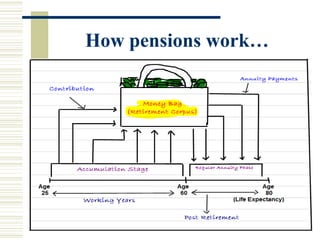
How pensions work…
How pensions work…
PENSION PLANS CLASSIFICATIONS


 Immediate Annuity plans, It start paying you the
  annuity right from day one once you make a lump
  sum payment. It’s a simple product which is not so
  much popular in India like deferred annuity plans.
 Deferred Annuity, In this a policyholder needs to
  pay a regular premium for a certain number of
  years. Once he/she retire, then start getting pension
  income.
Options available to
     individuals on pension plans
 Annuity payable for life: The annuitant is paid a
  fixed sum at pre-decided intervals throughout his
  life. The pension ceases as the annuitant dies. The
  quantum of pension payable here is the highest. It
  can also be known as 'life annuity' and is suitable
  for someone who does not have any family
  obligation to provide income after his death.
 Life annuity with fixed period guarantees: Also
  known as guaranteed pension, this type of annuity
  ensures that the pension is payable for a certain
  period and thereafter as long as the annuitant is
  alive. Shorter the guarantee period, higher is the
  pension. The pension payable under the five-year
  guaranteed option is higher than the pension
  payable under 20 years.
 Joint life & last survivor annuity: This option
  ensures that the annuity is paid till either of the
  annuitant or his/her spouse is alive. Some insurers
  have capped the amount at 50% payable to the
  survivor, when the annuitant dies. This type of
  pension is ideal when the annuitant intends to
  provide for a regular income to the spouse. Joint
  life pension is determined after taking into account
  the age of both the annuitant and the spouse.
 Annuity with return of purchase price: This is an
  extension of annuity payable for life. The annuitant
  enjoys the pension till he dies. The pension ceases
  as the annuitant dies and the purchase price is paid
  to the nominee of the deceased annuitant. However,
  the pension payable under this option is less than
  the pension payable under the first option.
 Life annuity increasing at a fixed rate: This
  option is also an extension of the life annuity. The
  annuitant is paid a sum which is revised upwards by
  a certain percentage throughout his life. For
  example, the annuity is increased at a simple rate of
  5% each year. This is good for those who retire
  early and expect to live a long retired life and prefer
  an adjustment for inflation.
ICICI                STAR UNION            HDFC Life     LIC            SBI Life –
                   Prudential           Dai-ichi              Pension       (Pension Plus) (Lifelong
                                        (New Dhruv            Super Plus                   Pension Plus)
                                        Tara)
Product type       Regular Plan         Unit Linked           Unit-Linked   Unit Linked    non
                                                                                           participating
                                                                                           traditional
Minimum            6000                 12000                 24000         15000          7500
annual
premium(Rs)

Minimum            50000                150000                500000        100,000        50000
Cover (Rs)
Min-Max            5yrs-30yrs           10-52 years           10-65 yrs     10 yrs         5-40 yrs
Tenure(Yrs)

Min –Max           50-70 years          40-65 years           55-75 yrs     40-85 years    40-70 yrs
Vesting age(yrs)

Riders             Critical Illness      Accidental death &   Death rider                  Accident &
                   Benefit Rider        permanent
Available          Accident and         disability and
                                                                                           Sickness
                   Disability Benefit   critical illness
                   Ride


Life Cover         Yes                  Yes                   Yes           Yes            NO

Pension plan

  • 1.
    Pension Plan Presented By:
  • 2.
    Pension Fund Regulatoryand Development Authority  PFRDA was established by Government of India on 23rd August, 2003.  It acts as a regulator for the pension sector.
  • 3.
    Introduction  Pension plans(also referred to as retirement plans) are offered by insurance companies to help individuals build a retirement corpus. On maturity this corpus is invested for generating a regular income stream, which is referred to as pension or annuity.  It is pension plans that provide individuals with a regular income in their golden years.  It will provide the financial security to pursue unfulfilled dreams.
  • 4.
    History  Traditionally, employersprovided for employees' retirement through pension plans. Today, many companies have switched to defined contribution plans, requiring employees to provide for their own retirement needs.
  • 5.
    The components tobe taken into account when calculating your retirement corpus are:  ~ Your current age ~ Expected age of retirement ~ Life expectancy ~ Years after retirement ~ Current earnings ~ Expected annual growth (in percentage) in income ~ Annual income at retirement age ~ Rate of return on retirement corpus (in percentage) ~ Inflation rate (percentage) ~ Inflation adjusted rate of return/Real rate of return (in percentage)
  • 6.
  • 7.
  • 8.
    PENSION PLANS CLASSIFICATIONS Immediate Annuity plans, It start paying you the annuity right from day one once you make a lump sum payment. It’s a simple product which is not so much popular in India like deferred annuity plans.  Deferred Annuity, In this a policyholder needs to pay a regular premium for a certain number of years. Once he/she retire, then start getting pension income.
  • 9.
    Options available to individuals on pension plans  Annuity payable for life: The annuitant is paid a fixed sum at pre-decided intervals throughout his life. The pension ceases as the annuitant dies. The quantum of pension payable here is the highest. It can also be known as 'life annuity' and is suitable for someone who does not have any family obligation to provide income after his death.
  • 10.
     Life annuitywith fixed period guarantees: Also known as guaranteed pension, this type of annuity ensures that the pension is payable for a certain period and thereafter as long as the annuitant is alive. Shorter the guarantee period, higher is the pension. The pension payable under the five-year guaranteed option is higher than the pension payable under 20 years.
  • 11.
     Joint life& last survivor annuity: This option ensures that the annuity is paid till either of the annuitant or his/her spouse is alive. Some insurers have capped the amount at 50% payable to the survivor, when the annuitant dies. This type of pension is ideal when the annuitant intends to provide for a regular income to the spouse. Joint life pension is determined after taking into account the age of both the annuitant and the spouse.
  • 12.
     Annuity withreturn of purchase price: This is an extension of annuity payable for life. The annuitant enjoys the pension till he dies. The pension ceases as the annuitant dies and the purchase price is paid to the nominee of the deceased annuitant. However, the pension payable under this option is less than the pension payable under the first option.
  • 13.
     Life annuityincreasing at a fixed rate: This option is also an extension of the life annuity. The annuitant is paid a sum which is revised upwards by a certain percentage throughout his life. For example, the annuity is increased at a simple rate of 5% each year. This is good for those who retire early and expect to live a long retired life and prefer an adjustment for inflation.
  • 15.
    ICICI STAR UNION HDFC Life LIC SBI Life – Prudential Dai-ichi Pension (Pension Plus) (Lifelong (New Dhruv Super Plus Pension Plus) Tara) Product type Regular Plan Unit Linked Unit-Linked Unit Linked non participating traditional Minimum 6000 12000 24000 15000 7500 annual premium(Rs) Minimum 50000 150000 500000 100,000 50000 Cover (Rs) Min-Max 5yrs-30yrs 10-52 years 10-65 yrs 10 yrs 5-40 yrs Tenure(Yrs) Min –Max 50-70 years 40-65 years 55-75 yrs 40-85 years 40-70 yrs Vesting age(yrs) Riders Critical Illness Accidental death & Death rider Accident & Benefit Rider permanent Available Accident and disability and Sickness Disability Benefit critical illness Ride Life Cover Yes Yes Yes Yes NO