Nucleophilic Reaction
of Carbonyl group
By
S.A.Olivia Muthamil
XII-A
Chemistry Art integrated project
Introduction:
•A carbonyl group is a chemically organic functional group
composed of a carbon atom double-bonded to an oxygen
atom --> [C=O] The simplest carbonyl groups
are aldehydes and ketones usually attached to another carbon
compound. These structures can be found in many aromatic
compounds contributing to smell and taste.
The Carbonyl Group
• C=O is prone to additions and nucleophillic attack because or carbon's positive
charge and oxygen's negative charge. The resonance of the carbon partial
positive charge allows the negative charge on the nucleophile to attack the
Carbonyl group and become a part of the structure and a positive charge
(usually a proton hydrogen) attacks the oxygen. Just a reminder, the nucleophile
is a good acid therefore "likes protons" so it will attack the side with a positive
charge.
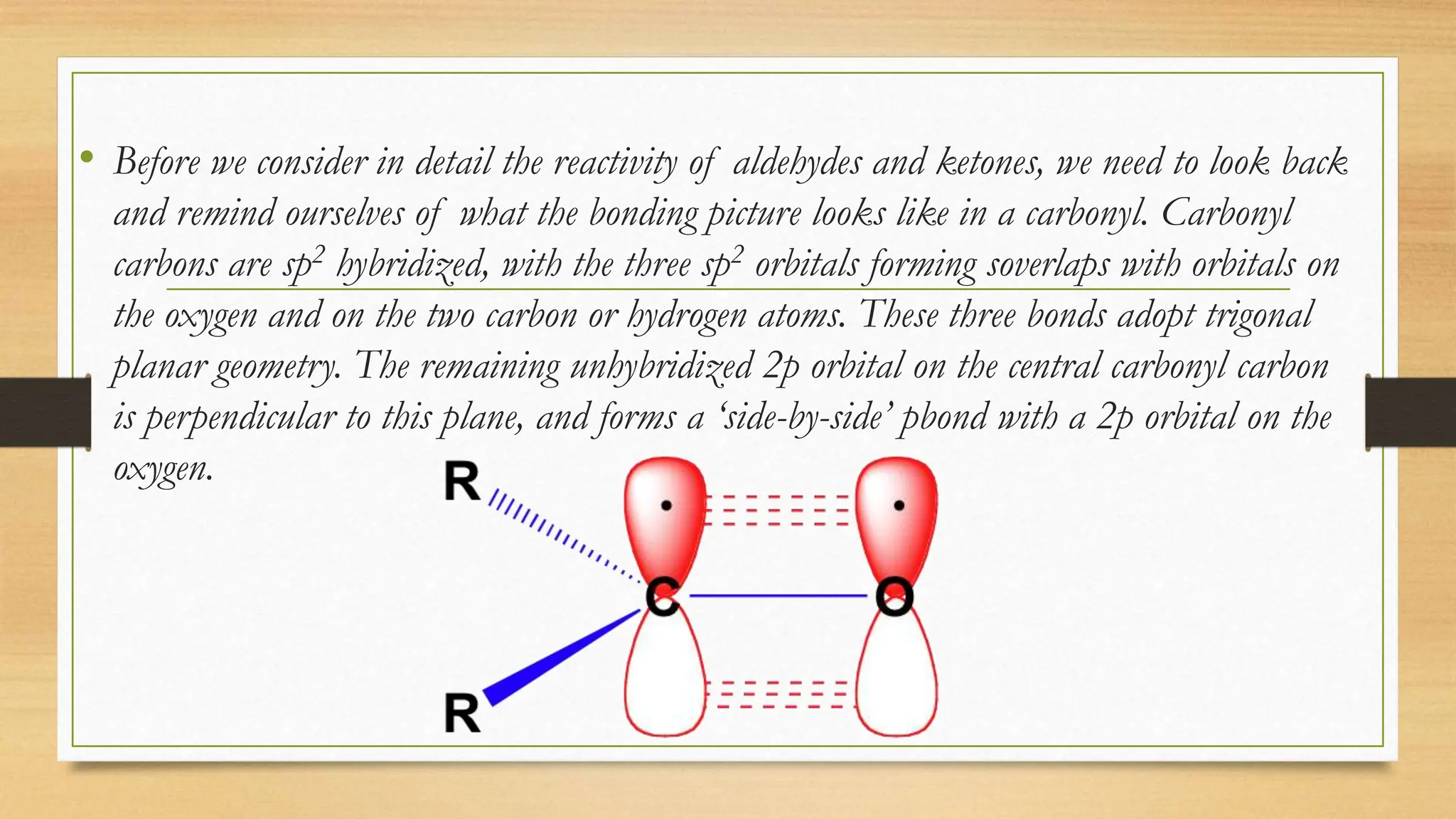
• Before we consider in detail the reactivity of aldehydes and ketones, we need to look back
and remind ourselves of what the bonding picture looks like in a carbonyl. Carbonyl
carbons are sp2 hybridized, with the three sp2 orbitals forming soverlaps with orbitals on
the oxygen and on the two carbon or hydrogen atoms. These three bonds adopt trigonal
planar geometry. The remaining unhybridized 2p orbital on the central carbonyl carbon
is perpendicular to this plane, and forms a ‘side-by-side’ pbond with a 2p orbital on the
oxygen.
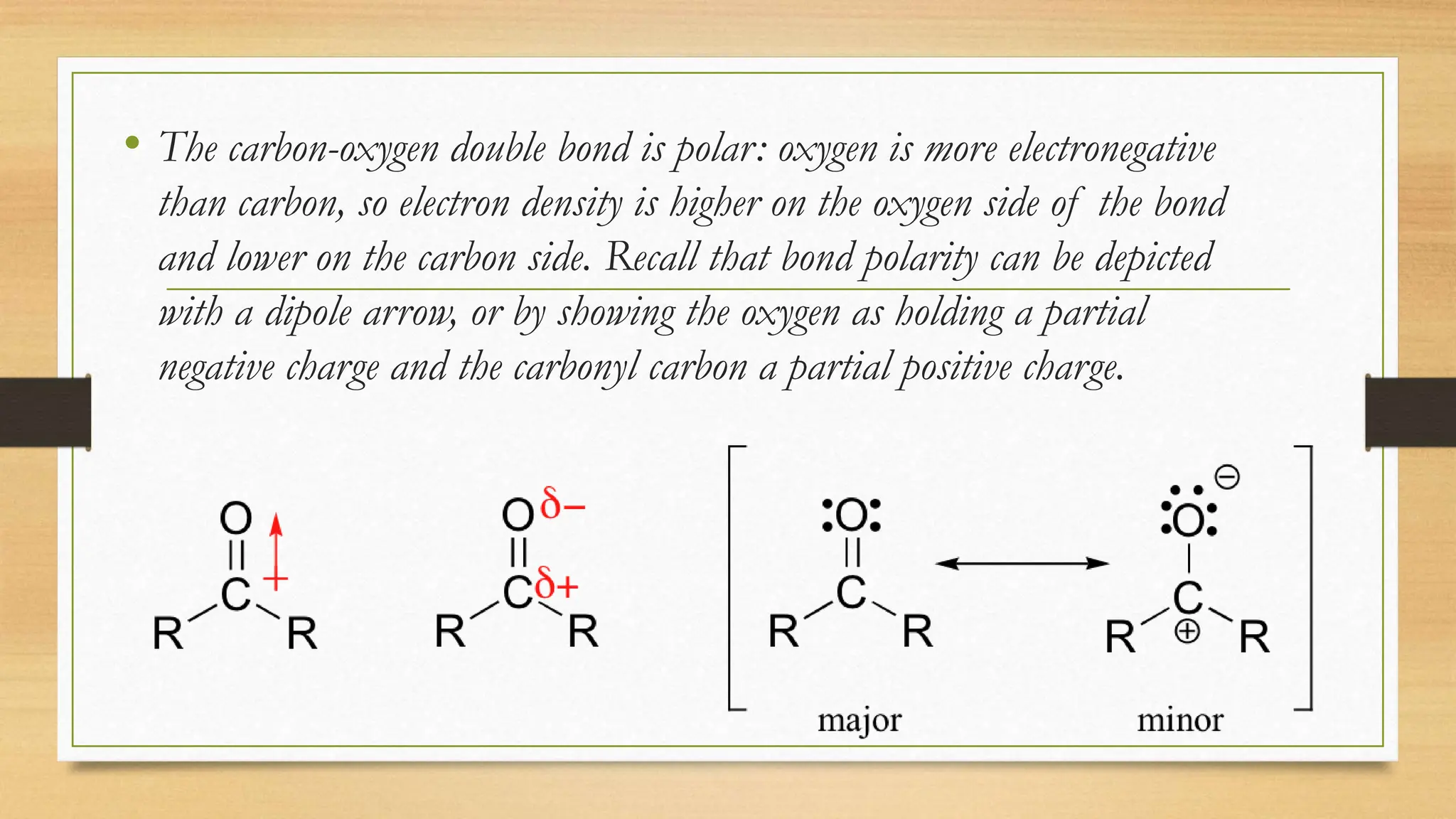
• The carbon-oxygen double bond is polar: oxygen is more electronegative
than carbon, so electron density is higher on the oxygen side of the bond
and lower on the carbon side. Recall that bond polarity can be depicted
with a dipole arrow, or by showing the oxygen as holding a partial
negative charge and the carbonyl carbon a partial positive charge.
• A third way to illustrate the carbon-oxygen dipole is to consider the
two main resonance contributors of a carbonyl group: the major
form, which is what you typically see drawn in Lewis structures,
and a minor but very important contributor in which both electrons
in the pbond are localized on the oxygen, giving it a full negative
charge. The latter depiction shows the carbon with an empty 2p
orbital and a full positive charge.
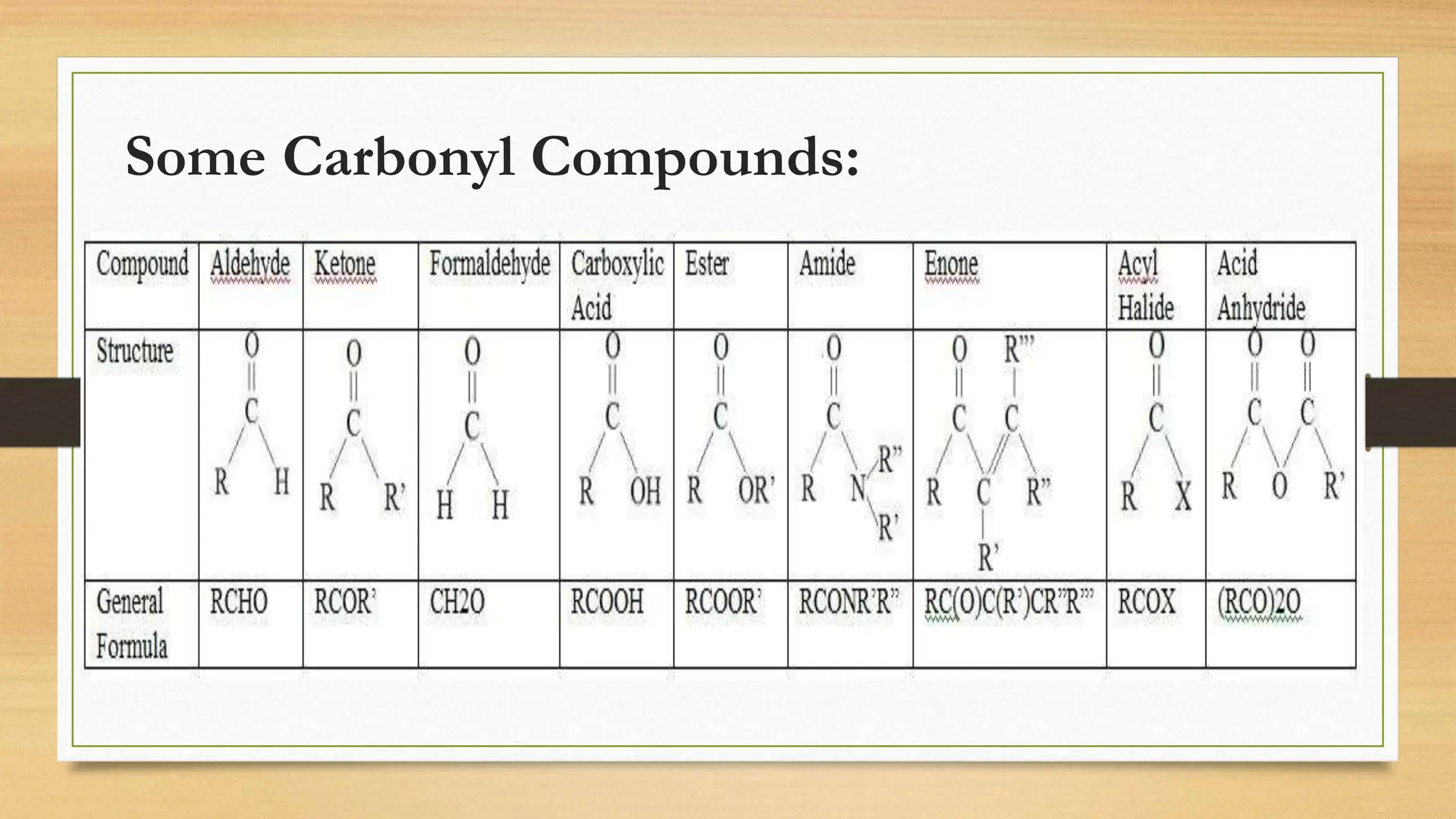
Some Carbonyl Compounds:
Thank You

New Microsoft PowerPoint Presentation.pptx

  • 1.
    Nucleophilic Reaction of Carbonylgroup By S.A.Olivia Muthamil XII-A Chemistry Art integrated project
  • 2.
    Introduction: •A carbonyl groupis a chemically organic functional group composed of a carbon atom double-bonded to an oxygen atom --> [C=O] The simplest carbonyl groups are aldehydes and ketones usually attached to another carbon compound. These structures can be found in many aromatic compounds contributing to smell and taste.
  • 3.
    The Carbonyl Group •C=O is prone to additions and nucleophillic attack because or carbon's positive charge and oxygen's negative charge. The resonance of the carbon partial positive charge allows the negative charge on the nucleophile to attack the Carbonyl group and become a part of the structure and a positive charge (usually a proton hydrogen) attacks the oxygen. Just a reminder, the nucleophile is a good acid therefore "likes protons" so it will attack the side with a positive charge.
  • 4.
    • Before weconsider in detail the reactivity of aldehydes and ketones, we need to look back and remind ourselves of what the bonding picture looks like in a carbonyl. Carbonyl carbons are sp2 hybridized, with the three sp2 orbitals forming soverlaps with orbitals on the oxygen and on the two carbon or hydrogen atoms. These three bonds adopt trigonal planar geometry. The remaining unhybridized 2p orbital on the central carbonyl carbon is perpendicular to this plane, and forms a ‘side-by-side’ pbond with a 2p orbital on the oxygen.
  • 5.
    • The carbon-oxygendouble bond is polar: oxygen is more electronegative than carbon, so electron density is higher on the oxygen side of the bond and lower on the carbon side. Recall that bond polarity can be depicted with a dipole arrow, or by showing the oxygen as holding a partial negative charge and the carbonyl carbon a partial positive charge.
  • 6.
    • A thirdway to illustrate the carbon-oxygen dipole is to consider the two main resonance contributors of a carbonyl group: the major form, which is what you typically see drawn in Lewis structures, and a minor but very important contributor in which both electrons in the pbond are localized on the oxygen, giving it a full negative charge. The latter depiction shows the carbon with an empty 2p orbital and a full positive charge.
  • 7.
  • 8.