New Manager Bootcamp
Managing and inspiring TC teams
Leah Guren
Cow TC
© 2016 Leah Guren
Agenda
 Why are we here?
 Finding people
 The training cycle
 Teamwork and morale
 Reviews and evaluations
 Project management tips and
tricks
 Conclusion and discussion
This is a full
participation
workshop,
baby!
 First, who are you? What are your
goals?
Why are we here?
Soft skills are so… squishy!
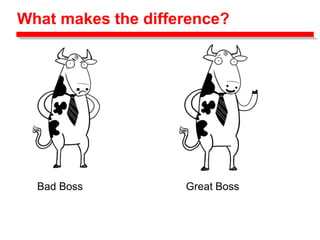
What makes the difference?
Bad Boss Great Boss
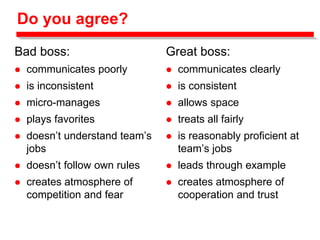
Do you agree?
Bad boss:
 communicates poorly
 is inconsistent
 micro-manages
 plays favorites
 doesn’t understand team’s
jobs
 doesn’t follow own rules
 creates atmosphere of
competition and fear
Great boss:
 communicates clearly
 is consistent
 allows space
 treats all fairly
 is reasonably proficient at
team’s jobs
 leads through example
 creates atmosphere of
cooperation and trust
Few of us formally learn to lead.
Did you know…?
 In TC, virtually every team leader or
small-group manager started that
position with zero management
training.
 The best TCs are often promoted,
but:
 us left brain, techie geeks don’t always
make good leaders
 academic programs don’t cover these soft
skills
Lack of soft skills causes stress.
 Interpersonal management
issues cause more stress than
technical problems.
 In-house P&P only address
extreme cases.
 But there is hope!
Finding People
It starts with recruiting and
interviewing.
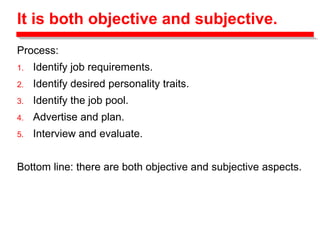
It is both objective and subjective.
Process:
1. Identify job requirements.
2. Identify desired personality traits.
3. Identify the job pool.
4. Advertise and plan.
5. Interview and evaluate.
Bottom line: there are both objective and subjective aspects.
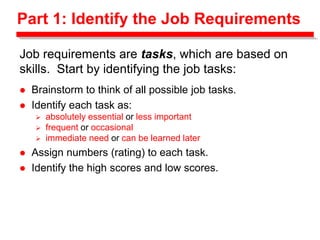
Part 1: Identify the Job Requirements
 Brainstorm to think of all possible job tasks.
 Identify each task as:
 absolutely essential or less important
 frequent or occasional
 immediate need or can be learned later
 Assign numbers (rating) to each task.
 Identify the high scores and low scores.
Job requirements are tasks, which are based on
skills. Start by identifying the job tasks:
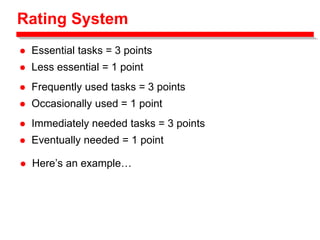
Rating System
 Essential tasks = 3 points
 Less essential = 1 point
 Frequently used tasks = 3 points
 Occasionally used = 1 point
 Immediately needed tasks = 3 points
 Eventually needed = 1 point
 Here’s an example…
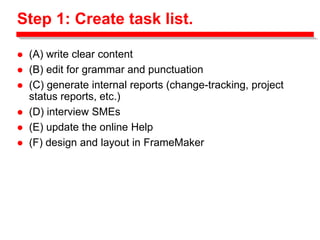
Step 1: Create task list.
 (A) write clear content
 (B) edit for grammar and punctuation
 (C) generate internal reports (change-tracking, project
status reports, etc.)
 (D) interview SMEs
 (E) update the online Help
 (F) design and layout in FrameMaker
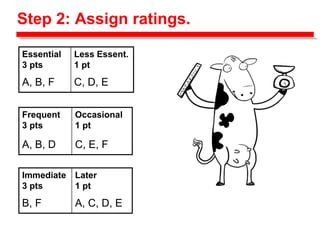
Step 2: Assign ratings.
Essential
3 pts
Less Essent.
1 pt
A, B, F C, D, E
Frequent
3 pts
Occasional
1 pt
A, B, D C, E, F
Immediate
3 pts
Later
1 pt
B, F A, C, D, E
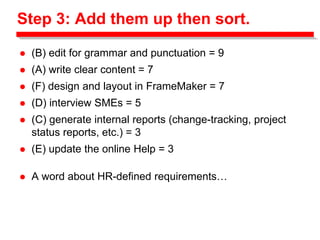
Step 3: Add them up then sort.
 (B) edit for grammar and punctuation = 9
 (A) write clear content = 7
 (F) design and layout in FrameMaker = 7
 (D) interview SMEs = 5
 (C) generate internal reports (change-tracking, project
status reports, etc.) = 3
 (E) update the online Help = 3
 A word about HR-defined requirements…
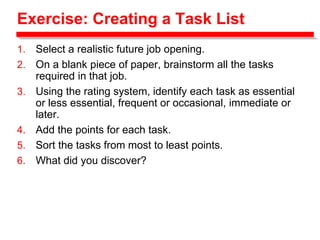
Exercise: Creating a Task List
1. Select a realistic future job opening.
2. On a blank piece of paper, brainstorm all the tasks
required in that job.
3. Using the rating system, identify each task as essential
or less essential, frequent or occasional, immediate or
later.
4. Add the points for each task.
5. Sort the tasks from most to least points.
6. What did you discover?
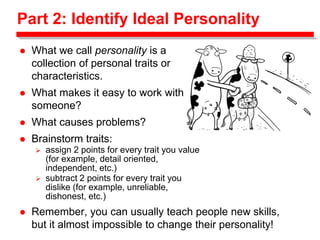
Part 2: Identify Ideal Personality
 What we call personality is a
collection of personal traits or
characteristics.
 What makes it easy to work with
someone?
 What causes problems?
 Brainstorm traits:
 assign 2 points for every trait you value
(for example, detail oriented,
independent, etc.)
 subtract 2 points for every trait you
dislike (for example, unreliable,
dishonest, etc.)
 Remember, you can usually teach people new skills,
but it almost impossible to change their personality!
Exercise: Self-assessment
1. Think of someone with whom you had a very good
working relationship.
2. Think about that person’s personality traits which you
most appreciated.
3. Now think of someone who was a real nightmare!
4. What were the most annoying or problematic
personality traits?
5. What did you discover?
Part 3: Identify the Job Pool
 Is there a shortage or surplus? This affects your strategy:
 shortage: more difficult to find people
 surplus: more difficult to screen people
 Are there existing employees who can be promoted?
 existing knowledge of work or organization
 already a “known factor” re: personality
 If there is a shortage, think in terms of related skills. For
example:
 a teacher can become a trainer or coach
 planning and management of any complex project or process
requires similar skills
Part 4: Advertise and Plan
 How and where do you advertise?
 Are there formal rules about applications?
 Do you want resumes or application forms?
 How will people contact you?
 How many candidates will you need before you start to
interview?
 How long will the entire process be?
 Do you actually have any control over this at all? (This
may be an HR function.)
Part 5: Interview and Evaluate
 Prepare for the interview:
 Make sure applicants know details.
 Decide who needs to be there.
 Set the amount of time to spend on each applicant.
 Create a list of questions.
 Create a test.
 Review resume thoroughly.
 The test:
 On-site tests of basic skills are more accurate.
 Make tests short but comprehensive.
 Don’t use tricks or traps.
 Don’t do “secret” stress tests!
Conduct the Interviews
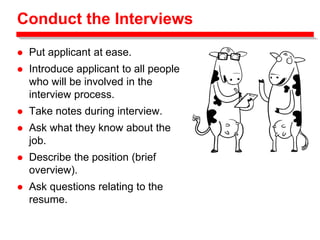
 Put applicant at ease.
 Introduce applicant to all people
who will be involved in the
interview process.
 Take notes during interview.
 Ask what they know about the
job.
 Describe the position (brief
overview).
 Ask questions relating to the
resume.
Conduct the Interviews, cont.
 Allow applicants to explain discrepancies or unusual
items on the resume/application form.
 Ask about strengths and weaknesses.
 Ask preference questions.
 Ask if they have any concerns about the requirements of
the job.
 Allow applicants to ask questions.
 Explain follow-up.
 Throughout, pay attention to personality and work habits:
 Is the applicant friendly and outgoing, or shy?
 Does the applicant work well with others?
 Is the applicant punctual?
 Does the applicant keep a tidy work area?
 Will the applicant take directions well?
Exercise: Practice Interviews
Conduct an interview as follows:
1. The interviewer briefly states the job and the job
requirements to the group.
2. The applicant briefly states his or her background and
history to the group.
3. Take notes during the interview (max. 3 min.).
4. Change to a new interviewer and applicant.
Evaluate the Results
 After the interviews, rank the candidates by choice.
 Involve other people in the decision-making process.
 Consider the number scores (tasks and personality).
 Also consider your intuition.
 Always check references!
The Training Cycle
New employees need training to do their jobs
effectively.
The Purpose of Training
 The leading cause of poor job performance is unclear
objectives:
 manager didn’t make expectations clear
 manager didn’t set priorities
 there are unspoken rules
 there are no standards (P&P, etc.)
 Clear objectives and expectations give employees
confidence:
 prevents misunderstandings and wasted time
 improves employee motivation and job satisfaction
 A word about P&P manuals:
 adding to…
 what can’t you write down?
 A word about in-house style guides…
Exercise: Identifying Training Needs
 How to log in to the network
 The best way to get review feedback from the SMEs
 Which office printer is the slowest
 How to write effective overviews and introductions
 Expected attire during business hours
 How to check documents in an out of SourceSafe
 What topics to never mention to Mr. Smith
Write down what you think is the best way to train each
of these items:
Set Training Goals
 Good training uses concepts of ID (Instructional Design):
 broken into units
 each unit has a clearly stated goal
 goal (objective) must be measurable
 include practice and review
 provide immediate and positive feedback
 Start with a unit goal. For example, interviewing SMEs:
 Objective: By the end of the session, the employee should be
able to conduct an interview with an SME.
 Goal: To familiarize the employee with the interview techniques
and with the individual SMEs.
 Process: Discuss concepts, walk through the prep and a mock
interview, have employee do it with assistance and feedback, then
alone.
 Reinforcement: Repeat.
 Assessment: Was the correct information obtained? How long did
this take the employee?
Ongoing Training & Mentoring
 Make time for continual, ongoing training:
 short, frequent sessions are more effective than longer,
occasional sessions
 provide feedback to employees (how are they progressing,
what do they need to work on, etc.)
 solicit feedback from them (what do they want to learn, what
are they having trouble with, etc.)
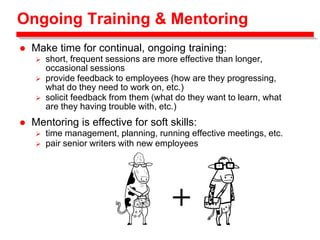
 Mentoring is effective for soft skills:
 time management, planning, running effective meetings, etc.
 pair senior writers with new employees
+
Exercise: Setting Training Goals
1. Select a job task from the same job description you
used in exercises 1 and 2.
2. Identify a training objective and goal.
3. Describe the steps you would include in the process.
4. Describe how you would reinforce the training.
5. Describe how you would assess the training.
Teamwork and Morale
It’s more than just warm fuzzies!
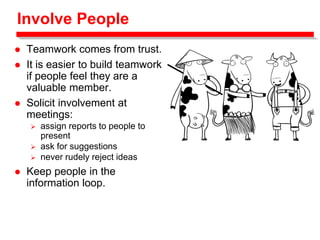
Involve People
 Teamwork comes from trust.
 It is easier to build teamwork
if people feel they are a
valuable member.
 Solicit involvement at
meetings:
 assign reports to people to
present
 ask for suggestions
 never rudely reject ideas
 Keep people in the
information loop.
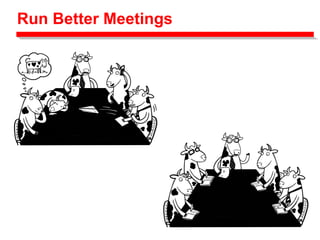
Run Better Meetings
Create a Positive Environment
 Encourage people to get to know each other through
social events:
 during business hours, such as lunch gatherings or birthday
celebrations
 outside of work (but don’t force attendance)
 Announce and celebrate successes as a group.
 Praise publicly, reprimand privately.
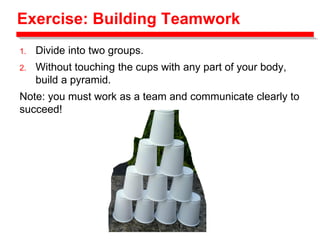
Exercise: Building Teamwork
1. Divide into two groups.
2. Without touching the cups with any part of your body,
build a pyramid.
Note: you must work as a team and communicate clearly to
succeed!
Reviews and Evaluations
Learn to love the dreaded feedback cycle.
Formal Reviews
 Casual feedback vs. formal reviews:
 casual feedback does not take the place of a formal review
process
 a formal review process doesn’t mean that you no longer need
casual feedback!
 Conduct formal reviews every year (or twice a year).
 Explain process, in writing, to all employees.
 Allow employee to see blank form in advance, to know
what is being measured, etc.
 Fill out your review:
 always consider change (improvement, etc.)
 find positive as well as negative things
 have clear directive for the employee (how to improve)
Formal Reviews, cont.
 Look at trends in employee performance over time:
 is employee repeating the same mistakes?
 is the employee now able to handle new tasks and
responsibilities?
 Conduct the review:
 after, give employee time to digest information and respond
 response, as well as original review form, go into employee’s file
 For a fair process, allow employee to review you as a
boss:
 what do they like about your management style?
 how can you improve?
 Don’t be afraid to promote people!
Exercise: Constructive Criticism
Fix the following phrases:
 “You made a very stupid mistake. Don’t you understand
anything?”
 “This report was very sloppy.”
 “OK, this looks better.”
 “You need to learn to dress more appropriately for the
office.”
 “You turned in your work late.”
Additional Discussion Topics
 Handling difficult employees
 Dealing with conflict between employees
 Firing
 Giving references
 ??
 Resources:
 www.gamesforgroups.com
 Training and Development Journal
 What Every Supervisor Should Know, Dr. John Newstrom and
Lester Bittel
Project Management Tips and
Tricks
You have to manage the process, too.
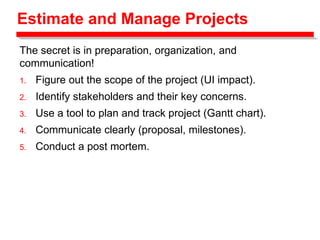
Estimate and Manage Projects
The secret is in preparation, organization, and
communication!
1. Figure out the scope of the project (UI impact).
2. Identify stakeholders and their key concerns.
3. Use a tool to plan and track project (Gantt chart).
4. Communicate clearly (proposal, milestones).
5. Conduct a post mortem.
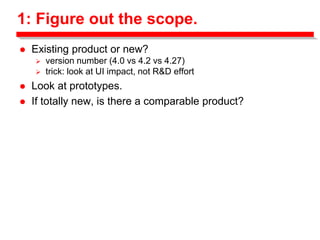
1: Figure out the scope.
 Existing product or new?
 version number (4.0 vs 4.2 vs 4.27)
 trick: look at UI impact, not R&D effort
 Look at prototypes.
 If totally new, is there a comparable product?
2: Identify stakeholders.
 Who is involved?
 product manager, key R&D
 marketing
 regulatory
 ???
 Find out their key concerns.
 Your project proposal has to address those!
 what you can deliver (UG, online Help, etc.)
 approximate scope of what is covered
 why this focus solves key concerns XYZ, etc.
3: Use a tool to track.
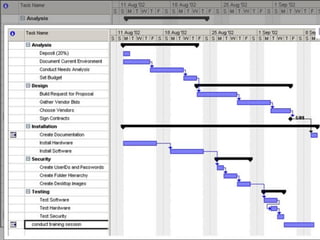
 Get to love the Gantt chart!
 Identify:
 resources (writers, editors, other content developers, etc.)
 tasks (break project down into manageable tasks)
 timeline
 task dependencies
 who does what, etc.
 Identify resource problems before you start:
 over- or under-use
 conflicts
 Track as you go (keep it up-do-date).
46
Exercise: Brainstorm Gantt.
 Work in groups of three.
 Scenario: shared apartment (Bob, Sarah, and Jo).
 Brainstorm tasks for weekly housework blitz.
 Who does what?
 What are some of the task dependencies?
 How can you make the workload efficient and equitable?
4: Communicate clearly.
 Think of every critical milestone, handoff, etc.
 Always take the responsibility of communication:
 what do you need the reviewer to do?
 how?
 when?
 Communicate clearly and frequently with your team:
 project status
 (think “daily scrum”)
5: Conduct a post mortem.
 At the end of a project, review the process.
 Identify:
 what went wrong and how can you fix it
 what went right and how can you repeat it
 Talk about the process rather than blaming people.
 Get full inputs from everyone (meeting).
 Learn and improve!
Conclusion
 Managing people takes some practice.
 Everyone can learn and improve!
 People will be loyal to a good boss more
than to a company.
 Some effort on your part can make your
work environment better.
Thank you!
Leah Guren
Cow TC
technical communication
training & consulting
tel: (+972) 54-485-3473
email: leah@cowtc.com
website: www.cowtc.com
A butter
approach to
TC…
LavaCon wants your feedback!

New Manager Bootcamp

  • 1.
    New Manager Bootcamp Managingand inspiring TC teams Leah Guren Cow TC © 2016 Leah Guren
  • 2.
    Agenda  Why arewe here?  Finding people  The training cycle  Teamwork and morale  Reviews and evaluations  Project management tips and tricks  Conclusion and discussion This is a full participation workshop, baby!  First, who are you? What are your goals?
  • 3.
    Why are wehere? Soft skills are so… squishy!
  • 4.
    What makes thedifference? Bad Boss Great Boss
  • 5.
    Do you agree? Badboss:  communicates poorly  is inconsistent  micro-manages  plays favorites  doesn’t understand team’s jobs  doesn’t follow own rules  creates atmosphere of competition and fear Great boss:  communicates clearly  is consistent  allows space  treats all fairly  is reasonably proficient at team’s jobs  leads through example  creates atmosphere of cooperation and trust
  • 6.
    Few of usformally learn to lead. Did you know…?  In TC, virtually every team leader or small-group manager started that position with zero management training.  The best TCs are often promoted, but:  us left brain, techie geeks don’t always make good leaders  academic programs don’t cover these soft skills
  • 7.
    Lack of softskills causes stress.  Interpersonal management issues cause more stress than technical problems.  In-house P&P only address extreme cases.  But there is hope!
  • 8.
    Finding People It startswith recruiting and interviewing.
  • 9.
    It is bothobjective and subjective. Process: 1. Identify job requirements. 2. Identify desired personality traits. 3. Identify the job pool. 4. Advertise and plan. 5. Interview and evaluate. Bottom line: there are both objective and subjective aspects.
  • 10.
    Part 1: Identifythe Job Requirements  Brainstorm to think of all possible job tasks.  Identify each task as:  absolutely essential or less important  frequent or occasional  immediate need or can be learned later  Assign numbers (rating) to each task.  Identify the high scores and low scores. Job requirements are tasks, which are based on skills. Start by identifying the job tasks:
  • 11.
    Rating System  Essentialtasks = 3 points  Less essential = 1 point  Frequently used tasks = 3 points  Occasionally used = 1 point  Immediately needed tasks = 3 points  Eventually needed = 1 point  Here’s an example…
  • 12.
    Step 1: Createtask list.  (A) write clear content  (B) edit for grammar and punctuation  (C) generate internal reports (change-tracking, project status reports, etc.)  (D) interview SMEs  (E) update the online Help  (F) design and layout in FrameMaker
  • 13.
    Step 2: Assignratings. Essential 3 pts Less Essent. 1 pt A, B, F C, D, E Frequent 3 pts Occasional 1 pt A, B, D C, E, F Immediate 3 pts Later 1 pt B, F A, C, D, E
  • 14.
    Step 3: Addthem up then sort.  (B) edit for grammar and punctuation = 9  (A) write clear content = 7  (F) design and layout in FrameMaker = 7  (D) interview SMEs = 5  (C) generate internal reports (change-tracking, project status reports, etc.) = 3  (E) update the online Help = 3  A word about HR-defined requirements…
  • 15.
    Exercise: Creating aTask List 1. Select a realistic future job opening. 2. On a blank piece of paper, brainstorm all the tasks required in that job. 3. Using the rating system, identify each task as essential or less essential, frequent or occasional, immediate or later. 4. Add the points for each task. 5. Sort the tasks from most to least points. 6. What did you discover?
  • 16.
    Part 2: IdentifyIdeal Personality  What we call personality is a collection of personal traits or characteristics.  What makes it easy to work with someone?  What causes problems?  Brainstorm traits:  assign 2 points for every trait you value (for example, detail oriented, independent, etc.)  subtract 2 points for every trait you dislike (for example, unreliable, dishonest, etc.)  Remember, you can usually teach people new skills, but it almost impossible to change their personality!
  • 17.
    Exercise: Self-assessment 1. Thinkof someone with whom you had a very good working relationship. 2. Think about that person’s personality traits which you most appreciated. 3. Now think of someone who was a real nightmare! 4. What were the most annoying or problematic personality traits? 5. What did you discover?
  • 18.
    Part 3: Identifythe Job Pool  Is there a shortage or surplus? This affects your strategy:  shortage: more difficult to find people  surplus: more difficult to screen people  Are there existing employees who can be promoted?  existing knowledge of work or organization  already a “known factor” re: personality  If there is a shortage, think in terms of related skills. For example:  a teacher can become a trainer or coach  planning and management of any complex project or process requires similar skills
  • 19.
    Part 4: Advertiseand Plan  How and where do you advertise?  Are there formal rules about applications?  Do you want resumes or application forms?  How will people contact you?  How many candidates will you need before you start to interview?  How long will the entire process be?  Do you actually have any control over this at all? (This may be an HR function.)
  • 20.
    Part 5: Interviewand Evaluate  Prepare for the interview:  Make sure applicants know details.  Decide who needs to be there.  Set the amount of time to spend on each applicant.  Create a list of questions.  Create a test.  Review resume thoroughly.  The test:  On-site tests of basic skills are more accurate.  Make tests short but comprehensive.  Don’t use tricks or traps.  Don’t do “secret” stress tests!
  • 21.
    Conduct the Interviews Put applicant at ease.  Introduce applicant to all people who will be involved in the interview process.  Take notes during interview.  Ask what they know about the job.  Describe the position (brief overview).  Ask questions relating to the resume.
  • 22.
    Conduct the Interviews,cont.  Allow applicants to explain discrepancies or unusual items on the resume/application form.  Ask about strengths and weaknesses.  Ask preference questions.  Ask if they have any concerns about the requirements of the job.  Allow applicants to ask questions.  Explain follow-up.  Throughout, pay attention to personality and work habits:  Is the applicant friendly and outgoing, or shy?  Does the applicant work well with others?  Is the applicant punctual?  Does the applicant keep a tidy work area?  Will the applicant take directions well?
  • 23.
    Exercise: Practice Interviews Conductan interview as follows: 1. The interviewer briefly states the job and the job requirements to the group. 2. The applicant briefly states his or her background and history to the group. 3. Take notes during the interview (max. 3 min.). 4. Change to a new interviewer and applicant.
  • 24.
    Evaluate the Results After the interviews, rank the candidates by choice.  Involve other people in the decision-making process.  Consider the number scores (tasks and personality).  Also consider your intuition.  Always check references!
  • 25.
    The Training Cycle Newemployees need training to do their jobs effectively.
  • 26.
    The Purpose ofTraining  The leading cause of poor job performance is unclear objectives:  manager didn’t make expectations clear  manager didn’t set priorities  there are unspoken rules  there are no standards (P&P, etc.)  Clear objectives and expectations give employees confidence:  prevents misunderstandings and wasted time  improves employee motivation and job satisfaction  A word about P&P manuals:  adding to…  what can’t you write down?  A word about in-house style guides…
  • 27.
    Exercise: Identifying TrainingNeeds  How to log in to the network  The best way to get review feedback from the SMEs  Which office printer is the slowest  How to write effective overviews and introductions  Expected attire during business hours  How to check documents in an out of SourceSafe  What topics to never mention to Mr. Smith Write down what you think is the best way to train each of these items:
  • 28.
    Set Training Goals Good training uses concepts of ID (Instructional Design):  broken into units  each unit has a clearly stated goal  goal (objective) must be measurable  include practice and review  provide immediate and positive feedback  Start with a unit goal. For example, interviewing SMEs:  Objective: By the end of the session, the employee should be able to conduct an interview with an SME.  Goal: To familiarize the employee with the interview techniques and with the individual SMEs.  Process: Discuss concepts, walk through the prep and a mock interview, have employee do it with assistance and feedback, then alone.  Reinforcement: Repeat.  Assessment: Was the correct information obtained? How long did this take the employee?
  • 29.
    Ongoing Training &Mentoring  Make time for continual, ongoing training:  short, frequent sessions are more effective than longer, occasional sessions  provide feedback to employees (how are they progressing, what do they need to work on, etc.)  solicit feedback from them (what do they want to learn, what are they having trouble with, etc.)  Mentoring is effective for soft skills:  time management, planning, running effective meetings, etc.  pair senior writers with new employees +
  • 30.
    Exercise: Setting TrainingGoals 1. Select a job task from the same job description you used in exercises 1 and 2. 2. Identify a training objective and goal. 3. Describe the steps you would include in the process. 4. Describe how you would reinforce the training. 5. Describe how you would assess the training.
  • 31.
    Teamwork and Morale It’smore than just warm fuzzies!
  • 32.
    Involve People  Teamworkcomes from trust.  It is easier to build teamwork if people feel they are a valuable member.  Solicit involvement at meetings:  assign reports to people to present  ask for suggestions  never rudely reject ideas  Keep people in the information loop.
  • 33.
  • 34.
    Create a PositiveEnvironment  Encourage people to get to know each other through social events:  during business hours, such as lunch gatherings or birthday celebrations  outside of work (but don’t force attendance)  Announce and celebrate successes as a group.  Praise publicly, reprimand privately.
  • 35.
    Exercise: Building Teamwork 1.Divide into two groups. 2. Without touching the cups with any part of your body, build a pyramid. Note: you must work as a team and communicate clearly to succeed!
  • 36.
    Reviews and Evaluations Learnto love the dreaded feedback cycle.
  • 37.
    Formal Reviews  Casualfeedback vs. formal reviews:  casual feedback does not take the place of a formal review process  a formal review process doesn’t mean that you no longer need casual feedback!  Conduct formal reviews every year (or twice a year).  Explain process, in writing, to all employees.  Allow employee to see blank form in advance, to know what is being measured, etc.  Fill out your review:  always consider change (improvement, etc.)  find positive as well as negative things  have clear directive for the employee (how to improve)
  • 38.
    Formal Reviews, cont. Look at trends in employee performance over time:  is employee repeating the same mistakes?  is the employee now able to handle new tasks and responsibilities?  Conduct the review:  after, give employee time to digest information and respond  response, as well as original review form, go into employee’s file  For a fair process, allow employee to review you as a boss:  what do they like about your management style?  how can you improve?  Don’t be afraid to promote people!
  • 39.
    Exercise: Constructive Criticism Fixthe following phrases:  “You made a very stupid mistake. Don’t you understand anything?”  “This report was very sloppy.”  “OK, this looks better.”  “You need to learn to dress more appropriately for the office.”  “You turned in your work late.”
  • 40.
    Additional Discussion Topics Handling difficult employees  Dealing with conflict between employees  Firing  Giving references  ??  Resources:  www.gamesforgroups.com  Training and Development Journal  What Every Supervisor Should Know, Dr. John Newstrom and Lester Bittel
  • 41.
    Project Management Tipsand Tricks You have to manage the process, too.
  • 42.
    Estimate and ManageProjects The secret is in preparation, organization, and communication! 1. Figure out the scope of the project (UI impact). 2. Identify stakeholders and their key concerns. 3. Use a tool to plan and track project (Gantt chart). 4. Communicate clearly (proposal, milestones). 5. Conduct a post mortem.
  • 43.
    1: Figure outthe scope.  Existing product or new?  version number (4.0 vs 4.2 vs 4.27)  trick: look at UI impact, not R&D effort  Look at prototypes.  If totally new, is there a comparable product?
  • 44.
    2: Identify stakeholders. Who is involved?  product manager, key R&D  marketing  regulatory  ???  Find out their key concerns.  Your project proposal has to address those!  what you can deliver (UG, online Help, etc.)  approximate scope of what is covered  why this focus solves key concerns XYZ, etc.
  • 45.
    3: Use atool to track.  Get to love the Gantt chart!  Identify:  resources (writers, editors, other content developers, etc.)  tasks (break project down into manageable tasks)  timeline  task dependencies  who does what, etc.  Identify resource problems before you start:  over- or under-use  conflicts  Track as you go (keep it up-do-date).
  • 46.
  • 47.
    Exercise: Brainstorm Gantt. Work in groups of three.  Scenario: shared apartment (Bob, Sarah, and Jo).  Brainstorm tasks for weekly housework blitz.  Who does what?  What are some of the task dependencies?  How can you make the workload efficient and equitable?
  • 48.
    4: Communicate clearly. Think of every critical milestone, handoff, etc.  Always take the responsibility of communication:  what do you need the reviewer to do?  how?  when?  Communicate clearly and frequently with your team:  project status  (think “daily scrum”)
  • 49.
    5: Conduct apost mortem.  At the end of a project, review the process.  Identify:  what went wrong and how can you fix it  what went right and how can you repeat it  Talk about the process rather than blaming people.  Get full inputs from everyone (meeting).  Learn and improve!
  • 50.
    Conclusion  Managing peopletakes some practice.  Everyone can learn and improve!  People will be loyal to a good boss more than to a company.  Some effort on your part can make your work environment better.
  • 51.
    Thank you! Leah Guren CowTC technical communication training & consulting tel: (+972) 54-485-3473 email: leah@cowtc.com website: www.cowtc.com A butter approach to TC… LavaCon wants your feedback!