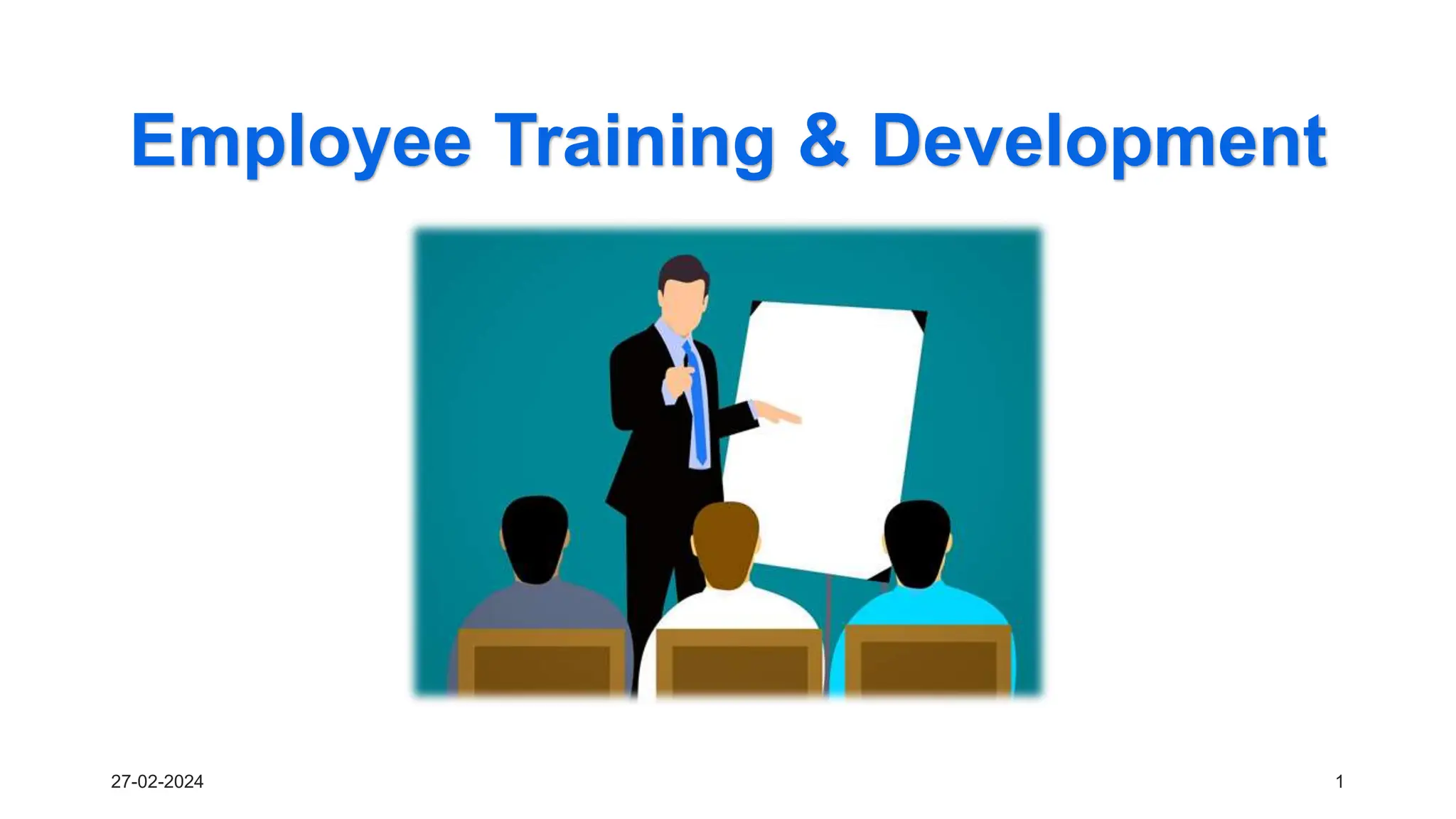
Employee Training & Development
27-02-2024 1
Opening Case: Sweet Delights
Once upon a time, in a small but bustling town, there was a family-owned
bakery called "Sweet Delights." The bakery had been a beloved establishment
for generations, famous for its delicious pastries and cakes. However, in
recent years, competition had grown fierce, and the bakery's sales had started
to decline. The owner, Mr. Baker, knew he had to take action to turn things
around.
Mr. Baker believed that the key to revitalizing Sweet Delights was to improve
the quality of the baked goods and the customer service. To achieve this, he
realized that his employees needed training and development.
27-02-2024 2
He decided to hire a talented and experienced pastry chef named Claire to
help him lead the transformation. Claire was not only skilled in baking but
was also passionate about teaching. She believed that investing in the
development of the bakery's employees was crucial to their success.
Claire started by assessing the skills and knowledge of the existing staff. She
quickly noticed areas where they could improve, from creating new recipes to
enhancing their customer service skills. Mr. Baker supported her every step of
the way, allocating a budget for training programs and workshops.
27-02-2024 3
The first thing Claire did was organize a training session on new baking
techniques. She taught the team how to make pastries that were not only
delicious but visually appealing. The employees embraced the new
knowledge with enthusiasm, and their confidence soared as they saw the
positive reactions of their customers.
Next, Claire focused on customer service. She understood that a friendly and
attentive staff was essential to creating a positive experience for Sweet
Delights' customers. She conducted workshops on communication, problem-
solving, and dealing with difficult customers. The employees learned to listen
to feedback and respond with empathy, turning unhappy customers into loyal
ones.
27-02-2024 4
As the training and development continued, Sweet Delights underwent a
remarkable transformation. The pastries and cakes now looked and tasted
even better than before, and the staff's customer service skills had
significantly improved. Word began to spread about the positive changes
happening at the bakery.
Customers returned, bringing new ones with them. Sweet Delights' sales
started to increase steadily, and the bakery regained its reputation as a top
destination for delicious treats. Mr. Baker was delighted by the turnaround
and the impact of training and development.
27-02-2024 5
But the story doesn't end there. Claire knew that continuous learning
was essential to maintaining their success. She encouraged the staff to
stay updated on the latest trends in baking and customer service. Sweet
Delights became known not just for their pastries but for their
innovative approach to customer satisfaction.
27-02-2024 6
27-02-2024 HRM Session 9 & 10 (Section C) 7
What’s the need of employee training in the
organization?
Need of Employee Training
 Align skills with industry requirements.
 Personal and career growth of each employee, Increase their
career options.
 Connecting theory with the practice.
 Develop specific industry skills for better results.
 To increase employee engagement.
27-02-2024 8
Need & Importance of Employee Training
 Organizations are experiencing great change due to new technologies, rapid
development of knowledge, globalization of business, development of e-
commerce, etc.
 Training equips individuals with necessary knowledge, skills, and abilities.
 Training serves to attract employees to companies, engages, them, and
promotes retention.
 Training helps to create a competitive advantage.
27-02-2024 9
27-02-2024 HRM Session 9 & 10 (Section C) 10
Let’s watch videos and reflect from the lenses
of Employee Training
Video 1
27-02-2024 11
Video 2
27-02-2024 12
27-02-2024 13
27-02-2024 14
Orienting & Onboarding
Employee Orientation
27-02-2024 15
A procedure for providing new employees
with basic background information about the
firm
Purpose of Employee Orientation
Welcome
Basic information
Understanding the organization
Socialization
27-02-2024 16
27-02-2024 17
The Training Process
Training Process (The ADDIE Model)
Analyze the
training need
Design overall
training
program
Develop the
course
Implement
training
Evaluate the
effectiveness
27-02-2024 18
Conducting Training Need Analysis
Strategic training
analysis
• Need for training
based on
strategic goals
Task analysis
• Study of the job
to determine
what specific
skills the job
requires.
Performance
analysis
• The process of
verifying that
there is a
performance
deficiency or skill
deficiency.
27-02-2024 19
27-02-2024 20
Designing the Training Program
Setting Learning Objectives
 Instructional objectives should specify in measurable terms
what the trainee should be able to do after successfully
completing the training program.
 Learning objective should clearly specify the performance
deficiencies identified through need analysis.
27-02-2024 21
Creating Motivational Learning
Environment
27-02-2024 22
 Ability – the trainee needs the required reading, writing, and mathematics
skills.
 Motivation – the learner must also be motivated for training.
 The trainees need to know that they have an ability to succeed in the
program and that the value to them of completing the program is very high.
 Self-efficacy is crucial – trainees must believe they have the capacity to
succeed.
Make the Learning Meaningful
 Create a perceived training need in trainees’ minds.
 Provide a bird’s-eye view of the training material.
 Use familiar examples.
 Organize the information to present it logically.
 Use terms and concepts that are familiar to trainees.
 Use visual aids.
27-02-2024 23
Make Skills Transfer Easy
Similarity
Practice
Label
Attention
“Heads-
up”
Pace
27-02-2024 24
Reinforce the Learning
 Trainees learn best when the trainers immediately reinforce
correct responses.
 The learning curve goes down late in the day.
 Provide follow-up assignments at the close of training.
 Incentivize the training.
27-02-2024 25
Program Development
27-02-2024 26
Assembling the program’s training content and
material, choosing the specific content the
program will present, designing/choosing the
specific instructional methods
27-02-2024 27
Implementing the Training Program
Types of Training Programs
On-the-job
training
Apprenticeship
training
Informal
learning
Job
instructional
training
Lectures
Programed
learning
Behavioral
modelling
Vestibule
training
Electronic
performance
support system
Video
conferencing
Computer-
based training
Simulated
learning
Lifelong
learning
Team training
Internet-based
learning
27-02-2024 28
On-The-Job Training
•An experienced worker or the trainee’s
supervisor trains the employee
Coaching
•An employee moves from job to job at
planned intervals
Job rotation
•Give lower-level executives firsthand
experience in working on actual problems
Special assignments
27-02-2024 29
Shadow Learning
 ‘Shadow Learners’ seek out opportunities to learn and practice
their jobs in non-traditional way.
27-02-2024 30
Apprenticeship Training
27-02-2024 31
A structured process by which people become
skilled workers through a combination of
formal learning and long-term on-the-job
training, often under the tutelage of a master
craftsperson
Informal Learning
 It refers to learning that is learner initiated, involves action and doing, is
motivated by an intent to develop, and does not occur in a formal setting.
 Informal learning occurs without a trainer or instructor, and its breadth, depth and
timing is controlled by the employee.
 Informal learning can occur through unplanned interactions with peers, emails,
informal mentoring, or company-developed or publicly available social
networking websites.
 Informal learning may account for up to 75 percent of learning within
organizations.
27-02-2024 32
Job Instruction Training
 Many jobs consist of a sequence of steps best learned step-by-step.
 A step-by-step training is called as ‘Job Instruction Training (JIT).
 List the job’s requires steps each in its proper sequence.
 Then list a corresponding point besides each step.
 The steps in such a job instructional training sheet show trainees
what to do and the key points show how it is to be done.
27-02-2024 33
Lectures
 Don’t start out on the wrong foot.
 Speak only about what you know
well.
 Give your listeners signals.
 Use anecdotes and stories.
 Be alert to your audience.
 Maintain eye contact with the
audience.
 Talk from notes or PowerPoint
slides.
 Break a long talk into a series of
short talks.
27-02-2024 34
Programmed Learning
 Programmed learning is a step-by-step, self-learning method
consisting three parts.
 Presenting questions, facts, or problems to the learner.
 Allowing the person to respond.
 Providing feedback on the accuracy of answers, with
instructions on what to do next.
27-02-2024 35
Behavior Modeling
27-02-2024 36
A training technique in which trainees are first
shown good management techniques in a firm, are
asked to play roles in a simulated situation, and are
then given feedback by their supervisor
Behavior Modeling
Transfer of
training
Social
reinforcement
Role-playing
Modeling
27-02-2024 37
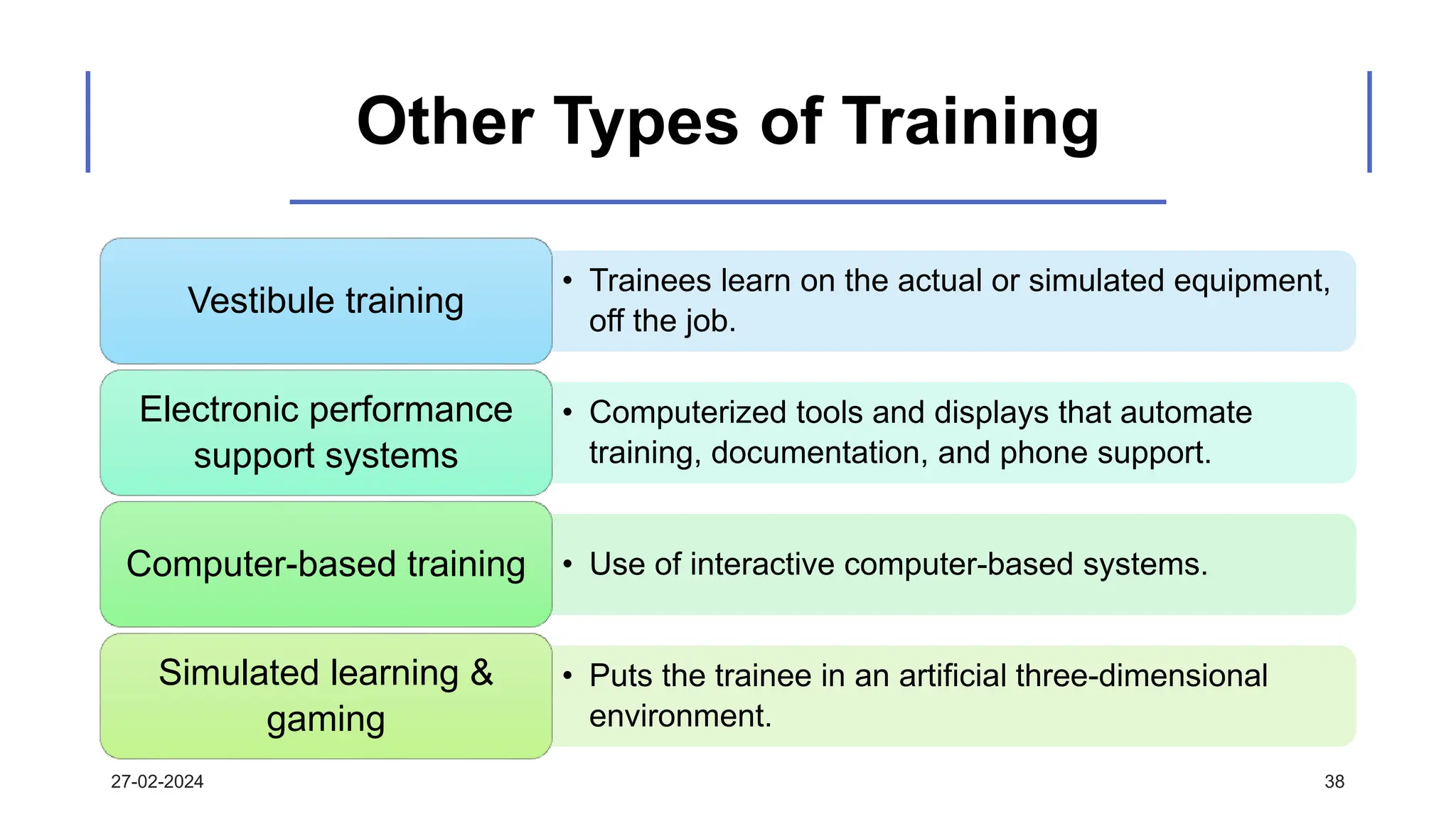
Other Types of Training
• Trainees learn on the actual or simulated equipment,
off the job.
Vestibule training
• Computerized tools and displays that automate
training, documentation, and phone support.
Electronic performance
support systems
• Use of interactive computer-based systems.
Computer-based training
• Puts the trainee in an artificial three-dimensional
environment.
Simulated learning &
gaming
27-02-2024 38
Other Types of Training
• Providing employees with continuing learning
experiences over their tenure
Lifelong learning
• Management encourages team employees to learn
each other’s jobs
Team training
• Offering online courses to employees, learning
management systems (LMS)
Internet-based training
• Uses collaboration software to enable multiple
remote learners using their pcs, laptops, tablets
Virtual classroom
27-02-2024 39
Learning Management System
27-02-2024 40
Virtual Reality Training
27-02-2024 41
27-02-2024 42
Evaluation of Training & Development
Cost-Benefit Analysis
 Cost-benefit analysis generally is quite feasible technique for
evaluating training & development.
 Costs include direct costs (training material, lost productivity,
etc.) and indirect costs (administrative overheads).
 Benefits include evaluation of whether training objectives are
achieved, other performance results and other evaluation
criteria.
27-02-2024 43
Criteria for Evaluation
27-02-2024 44
Participants’ reaction
Learning
Behavior
Results
27-02-2024 45
Guess the training method from the
videos!
Video 1
27-02-2024 46
Video 2
27-02-2024 47
Quick learnings
You’re the supervisor of a group of employees whose task is to
assemble disk drives that go into computers. You find that quality
is not what it should be and that many of your group’s devices have
to be brought back and reworked; your boss says that “You’d better
start doing a better job of training your workers.” A) What are
some of the “staffing factors” that could be contributing to this
problem? B) Explain how you would go about assessing whether it
is in fact a training problem.
27-02-2024 48
Quick learnings
Find three or four actual examples of employers using social media
for training purposes. At what levels of managers are the offerings
aimed? What seem to be the most popular types of programs? Why
do you think that’s the case?
27-02-2024 49
Thank You
27-02-2024 50

people management(employee training .pptx

  • 1.
    Employee Training &Development 27-02-2024 1
  • 2.
    Opening Case: SweetDelights Once upon a time, in a small but bustling town, there was a family-owned bakery called "Sweet Delights." The bakery had been a beloved establishment for generations, famous for its delicious pastries and cakes. However, in recent years, competition had grown fierce, and the bakery's sales had started to decline. The owner, Mr. Baker, knew he had to take action to turn things around. Mr. Baker believed that the key to revitalizing Sweet Delights was to improve the quality of the baked goods and the customer service. To achieve this, he realized that his employees needed training and development. 27-02-2024 2
  • 3.
    He decided tohire a talented and experienced pastry chef named Claire to help him lead the transformation. Claire was not only skilled in baking but was also passionate about teaching. She believed that investing in the development of the bakery's employees was crucial to their success. Claire started by assessing the skills and knowledge of the existing staff. She quickly noticed areas where they could improve, from creating new recipes to enhancing their customer service skills. Mr. Baker supported her every step of the way, allocating a budget for training programs and workshops. 27-02-2024 3
  • 4.
    The first thingClaire did was organize a training session on new baking techniques. She taught the team how to make pastries that were not only delicious but visually appealing. The employees embraced the new knowledge with enthusiasm, and their confidence soared as they saw the positive reactions of their customers. Next, Claire focused on customer service. She understood that a friendly and attentive staff was essential to creating a positive experience for Sweet Delights' customers. She conducted workshops on communication, problem- solving, and dealing with difficult customers. The employees learned to listen to feedback and respond with empathy, turning unhappy customers into loyal ones. 27-02-2024 4
  • 5.
    As the trainingand development continued, Sweet Delights underwent a remarkable transformation. The pastries and cakes now looked and tasted even better than before, and the staff's customer service skills had significantly improved. Word began to spread about the positive changes happening at the bakery. Customers returned, bringing new ones with them. Sweet Delights' sales started to increase steadily, and the bakery regained its reputation as a top destination for delicious treats. Mr. Baker was delighted by the turnaround and the impact of training and development. 27-02-2024 5
  • 6.
    But the storydoesn't end there. Claire knew that continuous learning was essential to maintaining their success. She encouraged the staff to stay updated on the latest trends in baking and customer service. Sweet Delights became known not just for their pastries but for their innovative approach to customer satisfaction. 27-02-2024 6
  • 7.
    27-02-2024 HRM Session9 & 10 (Section C) 7 What’s the need of employee training in the organization?
  • 8.
    Need of EmployeeTraining  Align skills with industry requirements.  Personal and career growth of each employee, Increase their career options.  Connecting theory with the practice.  Develop specific industry skills for better results.  To increase employee engagement. 27-02-2024 8
  • 9.
    Need & Importanceof Employee Training  Organizations are experiencing great change due to new technologies, rapid development of knowledge, globalization of business, development of e- commerce, etc.  Training equips individuals with necessary knowledge, skills, and abilities.  Training serves to attract employees to companies, engages, them, and promotes retention.  Training helps to create a competitive advantage. 27-02-2024 9
  • 10.
    27-02-2024 HRM Session9 & 10 (Section C) 10 Let’s watch videos and reflect from the lenses of Employee Training
  • 11.
  • 12.
  • 13.
  • 14.
  • 15.
    Employee Orientation 27-02-2024 15 Aprocedure for providing new employees with basic background information about the firm
  • 16.
    Purpose of EmployeeOrientation Welcome Basic information Understanding the organization Socialization 27-02-2024 16
  • 17.
  • 18.
    Training Process (TheADDIE Model) Analyze the training need Design overall training program Develop the course Implement training Evaluate the effectiveness 27-02-2024 18
  • 19.
    Conducting Training NeedAnalysis Strategic training analysis • Need for training based on strategic goals Task analysis • Study of the job to determine what specific skills the job requires. Performance analysis • The process of verifying that there is a performance deficiency or skill deficiency. 27-02-2024 19
  • 20.
  • 21.
    Setting Learning Objectives Instructional objectives should specify in measurable terms what the trainee should be able to do after successfully completing the training program.  Learning objective should clearly specify the performance deficiencies identified through need analysis. 27-02-2024 21
  • 22.
    Creating Motivational Learning Environment 27-02-202422  Ability – the trainee needs the required reading, writing, and mathematics skills.  Motivation – the learner must also be motivated for training.  The trainees need to know that they have an ability to succeed in the program and that the value to them of completing the program is very high.  Self-efficacy is crucial – trainees must believe they have the capacity to succeed.
  • 23.
    Make the LearningMeaningful  Create a perceived training need in trainees’ minds.  Provide a bird’s-eye view of the training material.  Use familiar examples.  Organize the information to present it logically.  Use terms and concepts that are familiar to trainees.  Use visual aids. 27-02-2024 23
  • 24.
    Make Skills TransferEasy Similarity Practice Label Attention “Heads- up” Pace 27-02-2024 24
  • 25.
    Reinforce the Learning Trainees learn best when the trainers immediately reinforce correct responses.  The learning curve goes down late in the day.  Provide follow-up assignments at the close of training.  Incentivize the training. 27-02-2024 25
  • 26.
    Program Development 27-02-2024 26 Assemblingthe program’s training content and material, choosing the specific content the program will present, designing/choosing the specific instructional methods
  • 27.
  • 28.
    Types of TrainingPrograms On-the-job training Apprenticeship training Informal learning Job instructional training Lectures Programed learning Behavioral modelling Vestibule training Electronic performance support system Video conferencing Computer- based training Simulated learning Lifelong learning Team training Internet-based learning 27-02-2024 28
  • 29.
    On-The-Job Training •An experiencedworker or the trainee’s supervisor trains the employee Coaching •An employee moves from job to job at planned intervals Job rotation •Give lower-level executives firsthand experience in working on actual problems Special assignments 27-02-2024 29
  • 30.
    Shadow Learning  ‘ShadowLearners’ seek out opportunities to learn and practice their jobs in non-traditional way. 27-02-2024 30
  • 31.
    Apprenticeship Training 27-02-2024 31 Astructured process by which people become skilled workers through a combination of formal learning and long-term on-the-job training, often under the tutelage of a master craftsperson
  • 32.
    Informal Learning  Itrefers to learning that is learner initiated, involves action and doing, is motivated by an intent to develop, and does not occur in a formal setting.  Informal learning occurs without a trainer or instructor, and its breadth, depth and timing is controlled by the employee.  Informal learning can occur through unplanned interactions with peers, emails, informal mentoring, or company-developed or publicly available social networking websites.  Informal learning may account for up to 75 percent of learning within organizations. 27-02-2024 32
  • 33.
    Job Instruction Training Many jobs consist of a sequence of steps best learned step-by-step.  A step-by-step training is called as ‘Job Instruction Training (JIT).  List the job’s requires steps each in its proper sequence.  Then list a corresponding point besides each step.  The steps in such a job instructional training sheet show trainees what to do and the key points show how it is to be done. 27-02-2024 33
  • 34.
    Lectures  Don’t startout on the wrong foot.  Speak only about what you know well.  Give your listeners signals.  Use anecdotes and stories.  Be alert to your audience.  Maintain eye contact with the audience.  Talk from notes or PowerPoint slides.  Break a long talk into a series of short talks. 27-02-2024 34
  • 35.
    Programmed Learning  Programmedlearning is a step-by-step, self-learning method consisting three parts.  Presenting questions, facts, or problems to the learner.  Allowing the person to respond.  Providing feedback on the accuracy of answers, with instructions on what to do next. 27-02-2024 35
  • 36.
    Behavior Modeling 27-02-2024 36 Atraining technique in which trainees are first shown good management techniques in a firm, are asked to play roles in a simulated situation, and are then given feedback by their supervisor
  • 37.
  • 38.
    Other Types ofTraining • Trainees learn on the actual or simulated equipment, off the job. Vestibule training • Computerized tools and displays that automate training, documentation, and phone support. Electronic performance support systems • Use of interactive computer-based systems. Computer-based training • Puts the trainee in an artificial three-dimensional environment. Simulated learning & gaming 27-02-2024 38
  • 39.
    Other Types ofTraining • Providing employees with continuing learning experiences over their tenure Lifelong learning • Management encourages team employees to learn each other’s jobs Team training • Offering online courses to employees, learning management systems (LMS) Internet-based training • Uses collaboration software to enable multiple remote learners using their pcs, laptops, tablets Virtual classroom 27-02-2024 39
  • 40.
  • 41.
  • 42.
    27-02-2024 42 Evaluation ofTraining & Development
  • 43.
    Cost-Benefit Analysis  Cost-benefitanalysis generally is quite feasible technique for evaluating training & development.  Costs include direct costs (training material, lost productivity, etc.) and indirect costs (administrative overheads).  Benefits include evaluation of whether training objectives are achieved, other performance results and other evaluation criteria. 27-02-2024 43
  • 44.
    Criteria for Evaluation 27-02-202444 Participants’ reaction Learning Behavior Results
  • 45.
    27-02-2024 45 Guess thetraining method from the videos!
  • 46.
  • 47.
  • 48.
    Quick learnings You’re thesupervisor of a group of employees whose task is to assemble disk drives that go into computers. You find that quality is not what it should be and that many of your group’s devices have to be brought back and reworked; your boss says that “You’d better start doing a better job of training your workers.” A) What are some of the “staffing factors” that could be contributing to this problem? B) Explain how you would go about assessing whether it is in fact a training problem. 27-02-2024 48
  • 49.
    Quick learnings Find threeor four actual examples of employers using social media for training purposes. At what levels of managers are the offerings aimed? What seem to be the most popular types of programs? Why do you think that’s the case? 27-02-2024 49
  • 50.