THE FIRST
AMENDMENT: BASIC
FREEDOMS
Chapter 6
Introduction


You know more constitutional law than you
think you do!


Thanks to the media, they are able to present
information about the law that the general public
can develop a sense of the basics
1st Amendment


“Prohibits Congress from making any laws that
restrict freedom of religion, freedom of speech,
freedom of the press or the right to gather or
assemble peaceably and to request the
government to respond to complaints from its
citizens”
Freedom of Religion





The first right set forth in the Bill of Rights
The founding fathers wanted to guarantee
every individual religious freedom
It forbids the government constraint on
people’s choices of beliefs




Requires that people be free to act on their beliefs

An important legal issue is to keep church and
state separate


To truly accomplish this is challenging
Freedom of Religion



Establishment Clause



Free Exercise Clause
Establishment Clause


“Congress shall make no law respecting
an establishment of religion”




Cannot create a national church or proscribed
religion

The government cannot show preference
to any particular religion
Establishment Clause


Ha m ilto n v. Re g e nts o f the Unive rs ity o f
Ca lifo rnia (1934)






Required all freshmen and sophomores to
complete 6 units of military training to attain full
academic standing as a junior
Taking these courses did not obligate the
students to serve in or in any way become a part
of the U.S. military establishment
No constitutional violation in making students take
these military courses
Establishment Clause




Eve rs o n v. Bo a rd o f Ed uc a tio n- separation of
church and state (1947)
Supreme Courts ruling:


Allowing reimbursements to parents for the
transportation of their children to parochial
schools on the public bus system did not
constitute an establishment of religion
Establishment Clause


Eng le v. Vita le (1962) - school prayer


Courts ruling:
 Voluntary

or otherwise conducted in public school
classrooms, was unconstitutional



Wa lla c e v. Je ffrie s (1985) – moment of
silence


Courts ruling:
 Moment

of silence for mediation or voluntary prayer
to be used to encourage religious values, was
unconstitutional
How to challenge the
Establishment Clause?


Must meet three standards
1.
2.
3.

Have a primary secular purpose
Have a principle effect that neither advances
nor inhibits religion and
Not generate excessive entanglement between
government and religion, as set forth in Lemon
v. Kurtzman
Establishment Clause






1980- Court struck down a Kentucky law
requiring the posting of the 10 Commandments
in all classrooms
1984- “Equal Access” law gave students the
right to hold religious meetings in public high
schools outside class hours
2003- Alabama Supreme Court Justice, Roy
Moore, refused to remove a statute of the 10
Commandments from the judicial building. He
refused and was eventually removed from his
position
Free Exercise Clause




“Congress shall make no law…prohibiting
the free exercise [of religion]”
It involves both the freedom to believe
and the freedom to act
Free Exercise Clause


Ca ntwe ll v. Co nne c tic ut (1940)




Religious beliefs cannot be regulated by
government and delineated how beliefs and acts
differ

Courts have had to balance the requirements
of the free exercise clause against society’s
legal, social, and religious needs.


St. Paul, MN




Ordinance prohibiting people from hiding their identity “by
means of a robe, mask or other disguise”
Muslim woman got ticket for wearing a veil


The court ruled that the ordinance was unconstitutional
Free Exercise Clause


More examples:



Autopsies- affected some religious practices
We s t Virg inia Sta te Bo a rd o f Ed uc a tio n v .
Ba rne tte (1943)
 States

could not require kids to pledge allegiance
each school day



Wo o le y v. M y na rd (1977)
a
 State

could not punish someone for blacking out their
license plate’s state motto where it says “Live Free or
Die”
Free Exercise Clause


To balance this assertion, in the Wooley
case, the court held that printing “In God We
Trust” on money did not violate the
Constitution




Money is passed among people, therefore, it
does not indicate that a particular individual
agrees with a religious or government belief, but
a motto on a license plate would
Also, money is transported in such a manner as
not to be a public display
Free Exercise Clause


Dec. 1993-Supreme ruled that the Boy Scouts
could require applicants to promise to “love Gd” and to “do my duty to G-d and my country”


1990- Mark Welsh was denied membership in the
Tiger Cub Group because he refused to sign the
required pledge
 Court

said that this was not a violation of the 1 st
Amendment
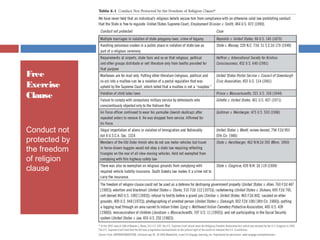
Free
Exercise
Clause

Conduct not
protected by
the freedom
of religion
clause
Interpretations


Some argue that the courts need to discover
the original intent of the Constitution and the
amendments




There should be no deviation

Some believe that judges should be allowed to
interpret the Constitution and its amendments




Judicial activism- allows judges to interpret the
Constitution and its Amends.
Should be able to apply the ideals of the founding
fathers to more current times
Freedom of Speech






Is the liberty to speak openly without fear of
government restraint
Closely linked to the freedom of the press
because this freedom includes both the right
to speak and the right to be heard
Commonly called the freedom of expression
Freedom of Speech


Strict Scrutiny








Legal standard applied to due process analysis of
fundamental rights
The state must establish that it has a compelling
government interest that justifies the law in
question
The law must be narrowly tailored to fit that
interest
High standard and difficult to defend
Restrictions on Freedom of Speech



Constitutional rights are NOT absolute
There are reasonable limits, when the
government has a legitimate interest, are
placed on where things can be said and, on
what can be said


Mostly occur in time of war
Restrictions on Freedom of Speech




Espionage Act 1917- made illegal interference
with recruiting or drafting soldiers or any act
that adversely affected military moral
Sc he nc k v . Unite d Sta te s (1919)




Was charged with espionage for distributing flyers
that encouraged young men to resist the draft
This is an example when the good of the greater
whole outweighs the rights of the individual
Restrictions on Freedom of Speech


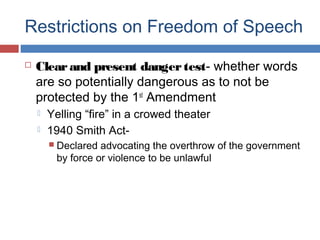
Clear and present danger test- whether words
are so potentially dangerous as to not be
protected by the 1st Amendment



Yelling “fire” in a crowed theater
1940 Smith Act Declared

advocating the overthrow of the government
by force or violence to be unlawful
Restrictions on Freedom of Speech




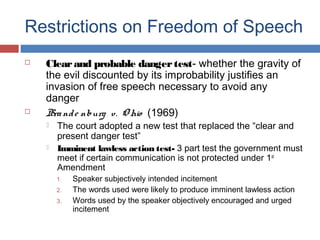
Clear and probable danger test- whether the gravity of
the evil discounted by its improbability justifies an
invasion of free speech necessary to avoid any
danger
Bra nd e nburg v. O hio (1969)



The court adopted a new test that replaced the “clear and
present danger test”
Imminent lawless action test- 3 part test the government must
meet if certain communication is not protected under 1 st
Amendment

1.
2.
3.

Speaker subjectively intended incitement
The words used were likely to produce imminent lawless action
Words used by the speaker objectively encouraged and urged
incitement
Restrictions on Freedom of Speech




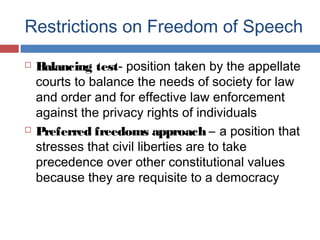
Balancing test- position taken by the appellate
courts to balance the needs of society for law
and order and for effective law enforcement
against the privacy rights of individuals
Preferred freedoms approach – a position that
stresses that civil liberties are to take
precedence over other constitutional values
because they are requisite to a democracy
First Expression Rights of
Public Employees


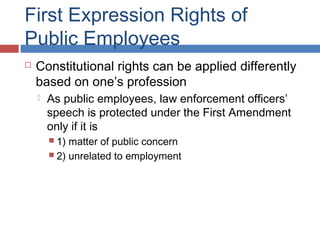
Constitutional rights can be applied differently
based on one’s profession


As public employees, law enforcement officers’
speech is protected under the First Amendment
only if it is
 1)

matter of public concern
 2) unrelated to employment
Symbolic Expression


Symbolic speech is





A form of speech that expresses an idea or
emotion without the use of words
Fall within the protection of the First Amendment
Examples of symbolic speech include
 Flag

burning
 Cross Burning
 Nude Dancing
 Yard Signs
Flag Burning




1969 Stre e t v. N w Yo rk- a flag was burned in
e
protest and was arrested for malicious
mischief. In NY, the law made acting out
verbally or symbolically a crime
1989 Te x a s v. Jo hns o n


Set American Flag on fire
 Supreme

Court said not guilty under 1st Amendment
Flag Burning




1989 Congress pass a flag protection act
1990 declared it unconstitutional as an
unwarranted restriction on symbolic
expression
Cross Burning


St. Paul, MN
 Teenager arrested for burning a cross in yard of a
black family
 County district judge said ordinance was
unconstitutional
 State supreme court reversed decision
 Supreme Court held ordinance was unconstitutional
because it prohibits permitted speech solely on the
basis of the subjects the speech addresses.


Cross burning is deemed a protected form of speech
Nude Dancing






In 1991 the Supreme Court took up the
question of nude dancing as a form of
symbolic speech
An Indiana law requiring dancers to wear
pasties and a g-string did not violate the
dancers freedom of speech
There can be restrictions of totally nude
entertainment
Yard Signs



1994- Supreme Court ruled that cities may not
prohibit residents from putting political or
personal signs in their yards
Freedom of Speech and the
Internet






In 1997 the Supreme Court struck down a law
banning computer generated child
pornography
Currently Congress is considering legislation
to address the problem of Internet spam
In another case the Court held that Congress
can limit funding to libraries that did not filter
Internet access to block obscene material and
child pornography without violating the First
Amendment
The Right to Photograph




As a result of terrorist activities law
enforcement agencies have become vigilant
against those people who are taking pictures
of government properties
Videotaping law enforcement officers in the
line of duty




Prosecutors across the country claim that
videotaping police officers violates wiretap laws
No cases look at by the Supreme Court yet
Freedom of the Press





Is related to freedom of speech because
speech is not considered only spoken words,
but any means of conveying information
Right to publish is not absolute
Government has restricted the right to publish
in 2 ways:
1.
2.

Publishing certain materials (prior restraint)
Punishing those who publish matter considered
seditious, libelous or obscene
Freedom of the Press


N a r v. M
e
inne s o ta (1931)




ruled that no newspaper could be banned
because of its contents, regardless of how
scandalous they might be

M r v. Ca lifo rnia (1941)
ille


court clarified thee standards to define obscenity
by establishing a 3 part test:
 Whether

the average person, applying contemporary
community standards, the dominant theme of the
material, taken as a whole, appeals to prurient
interest, that is, having a tendency to excite lustful
thoughts
Freedom of the Press


Restrictions of the press often occur during
national emergencies







WWI- led to first clear articulation of the limits to
freedom of speech
WWII- press was curtailed for security reasons
In 1971, the government attempted to stop the
publication of the Pe nta g o n Pa p e rs saying that it
could endanger national security
Other than wartime, censorship for national
security reasons has been carefully limited
Balancing Freedom of the Press
with the Right to Fair Trial






A free press, vital to the functioning of a
democracy, keeps citizens fully informed and
able to discharge their civic responsibilities
Defendants in criminal cases are guaranteed
due process of law and a fair and impartial trial
These guarantees are jeopardized when the
media publish detailed information before a
defendant is tried.
Balancing Freedom of the Press
with the Right to Fair Trial






The court has a duty to protect those who come
before it from undue adverse publicity
Failure to do so may result in a higher court
declaring that the trial was unfair and overturning
the conviction
The Media and Coverage on Criminal Investigations
 At times reporters’ First Amendment rights of
freedom of the press can come into conflict with
law enforcement’s responsibility to investigate
crimes without violating a suspect’s Sixth
Amendment right to a fair trial.
Right to Peaceful Assembly






People do have an expectation they can gather to
interact, speak among themselves and make their
thoughts and ideas known
The right to assemble does not necessarily require
an intent to engage in some specific activity,
although when it does, the activity cannot be illegal
The right to peaceful assembly was made
applicable to the states via incorporation in
DeJonge v. Oregon (1937)
Freedom of Association


Freedom of association was extended to
the states in N A v. A ba m a (1958)
A CP
la
First Amendment Rights of
Prisoners






Prisoners are using this “due process
revolution” to have the courts rule on First
Amendment issues related to correctional
clients
The courts have used the Rational Basis test
to uphold prison regulations that are
“reasonably related to legitimate penological
interests.”
Issues where the courts have ruled involve:


censorship of mail, expression within the
institution, association within the institution,

Ch06

  • 1.
  • 2.
    Introduction  You know moreconstitutional law than you think you do!  Thanks to the media, they are able to present information about the law that the general public can develop a sense of the basics
  • 3.
    1st Amendment  “Prohibits Congressfrom making any laws that restrict freedom of religion, freedom of speech, freedom of the press or the right to gather or assemble peaceably and to request the government to respond to complaints from its citizens”
  • 4.
    Freedom of Religion    Thefirst right set forth in the Bill of Rights The founding fathers wanted to guarantee every individual religious freedom It forbids the government constraint on people’s choices of beliefs   Requires that people be free to act on their beliefs An important legal issue is to keep church and state separate  To truly accomplish this is challenging
  • 5.
    Freedom of Religion  EstablishmentClause  Free Exercise Clause
  • 6.
    Establishment Clause  “Congress shallmake no law respecting an establishment of religion”   Cannot create a national church or proscribed religion The government cannot show preference to any particular religion
  • 7.
    Establishment Clause  Ha milto n v. Re g e nts o f the Unive rs ity o f Ca lifo rnia (1934)    Required all freshmen and sophomores to complete 6 units of military training to attain full academic standing as a junior Taking these courses did not obligate the students to serve in or in any way become a part of the U.S. military establishment No constitutional violation in making students take these military courses
  • 8.
    Establishment Clause   Eve rso n v. Bo a rd o f Ed uc a tio n- separation of church and state (1947) Supreme Courts ruling:  Allowing reimbursements to parents for the transportation of their children to parochial schools on the public bus system did not constitute an establishment of religion
  • 9.
    Establishment Clause  Eng lev. Vita le (1962) - school prayer  Courts ruling:  Voluntary or otherwise conducted in public school classrooms, was unconstitutional  Wa lla c e v. Je ffrie s (1985) – moment of silence  Courts ruling:  Moment of silence for mediation or voluntary prayer to be used to encourage religious values, was unconstitutional
  • 10.
    How to challengethe Establishment Clause?  Must meet three standards 1. 2. 3. Have a primary secular purpose Have a principle effect that neither advances nor inhibits religion and Not generate excessive entanglement between government and religion, as set forth in Lemon v. Kurtzman
  • 11.
    Establishment Clause    1980- Courtstruck down a Kentucky law requiring the posting of the 10 Commandments in all classrooms 1984- “Equal Access” law gave students the right to hold religious meetings in public high schools outside class hours 2003- Alabama Supreme Court Justice, Roy Moore, refused to remove a statute of the 10 Commandments from the judicial building. He refused and was eventually removed from his position
  • 12.
    Free Exercise Clause   “Congressshall make no law…prohibiting the free exercise [of religion]” It involves both the freedom to believe and the freedom to act
  • 13.
    Free Exercise Clause  Cantwe ll v. Co nne c tic ut (1940)   Religious beliefs cannot be regulated by government and delineated how beliefs and acts differ Courts have had to balance the requirements of the free exercise clause against society’s legal, social, and religious needs.  St. Paul, MN   Ordinance prohibiting people from hiding their identity “by means of a robe, mask or other disguise” Muslim woman got ticket for wearing a veil  The court ruled that the ordinance was unconstitutional
  • 14.
    Free Exercise Clause  Moreexamples:   Autopsies- affected some religious practices We s t Virg inia Sta te Bo a rd o f Ed uc a tio n v . Ba rne tte (1943)  States could not require kids to pledge allegiance each school day  Wo o le y v. M y na rd (1977) a  State could not punish someone for blacking out their license plate’s state motto where it says “Live Free or Die”
  • 15.
    Free Exercise Clause  Tobalance this assertion, in the Wooley case, the court held that printing “In God We Trust” on money did not violate the Constitution   Money is passed among people, therefore, it does not indicate that a particular individual agrees with a religious or government belief, but a motto on a license plate would Also, money is transported in such a manner as not to be a public display
  • 16.
    Free Exercise Clause  Dec.1993-Supreme ruled that the Boy Scouts could require applicants to promise to “love Gd” and to “do my duty to G-d and my country”  1990- Mark Welsh was denied membership in the Tiger Cub Group because he refused to sign the required pledge  Court said that this was not a violation of the 1 st Amendment
  • 17.
  • 18.
    Interpretations  Some argue thatthe courts need to discover the original intent of the Constitution and the amendments   There should be no deviation Some believe that judges should be allowed to interpret the Constitution and its amendments   Judicial activism- allows judges to interpret the Constitution and its Amends. Should be able to apply the ideals of the founding fathers to more current times
  • 19.
    Freedom of Speech    Isthe liberty to speak openly without fear of government restraint Closely linked to the freedom of the press because this freedom includes both the right to speak and the right to be heard Commonly called the freedom of expression
  • 20.
    Freedom of Speech  StrictScrutiny     Legal standard applied to due process analysis of fundamental rights The state must establish that it has a compelling government interest that justifies the law in question The law must be narrowly tailored to fit that interest High standard and difficult to defend
  • 21.
    Restrictions on Freedomof Speech   Constitutional rights are NOT absolute There are reasonable limits, when the government has a legitimate interest, are placed on where things can be said and, on what can be said  Mostly occur in time of war
  • 22.
    Restrictions on Freedomof Speech   Espionage Act 1917- made illegal interference with recruiting or drafting soldiers or any act that adversely affected military moral Sc he nc k v . Unite d Sta te s (1919)   Was charged with espionage for distributing flyers that encouraged young men to resist the draft This is an example when the good of the greater whole outweighs the rights of the individual
  • 23.
    Restrictions on Freedomof Speech  Clear and present danger test- whether words are so potentially dangerous as to not be protected by the 1st Amendment   Yelling “fire” in a crowed theater 1940 Smith Act Declared advocating the overthrow of the government by force or violence to be unlawful
  • 24.
    Restrictions on Freedomof Speech   Clear and probable danger test- whether the gravity of the evil discounted by its improbability justifies an invasion of free speech necessary to avoid any danger Bra nd e nburg v. O hio (1969)   The court adopted a new test that replaced the “clear and present danger test” Imminent lawless action test- 3 part test the government must meet if certain communication is not protected under 1 st Amendment 1. 2. 3. Speaker subjectively intended incitement The words used were likely to produce imminent lawless action Words used by the speaker objectively encouraged and urged incitement
  • 25.
    Restrictions on Freedomof Speech   Balancing test- position taken by the appellate courts to balance the needs of society for law and order and for effective law enforcement against the privacy rights of individuals Preferred freedoms approach – a position that stresses that civil liberties are to take precedence over other constitutional values because they are requisite to a democracy
  • 26.
    First Expression Rightsof Public Employees  Constitutional rights can be applied differently based on one’s profession  As public employees, law enforcement officers’ speech is protected under the First Amendment only if it is  1) matter of public concern  2) unrelated to employment
  • 27.
    Symbolic Expression  Symbolic speechis    A form of speech that expresses an idea or emotion without the use of words Fall within the protection of the First Amendment Examples of symbolic speech include  Flag burning  Cross Burning  Nude Dancing  Yard Signs
  • 28.
    Flag Burning   1969 Stree t v. N w Yo rk- a flag was burned in e protest and was arrested for malicious mischief. In NY, the law made acting out verbally or symbolically a crime 1989 Te x a s v. Jo hns o n  Set American Flag on fire  Supreme Court said not guilty under 1st Amendment
  • 29.
    Flag Burning   1989 Congresspass a flag protection act 1990 declared it unconstitutional as an unwarranted restriction on symbolic expression
  • 30.
    Cross Burning  St. Paul,MN  Teenager arrested for burning a cross in yard of a black family  County district judge said ordinance was unconstitutional  State supreme court reversed decision  Supreme Court held ordinance was unconstitutional because it prohibits permitted speech solely on the basis of the subjects the speech addresses.  Cross burning is deemed a protected form of speech
  • 31.
    Nude Dancing    In 1991the Supreme Court took up the question of nude dancing as a form of symbolic speech An Indiana law requiring dancers to wear pasties and a g-string did not violate the dancers freedom of speech There can be restrictions of totally nude entertainment
  • 32.
    Yard Signs  1994- SupremeCourt ruled that cities may not prohibit residents from putting political or personal signs in their yards
  • 33.
    Freedom of Speechand the Internet    In 1997 the Supreme Court struck down a law banning computer generated child pornography Currently Congress is considering legislation to address the problem of Internet spam In another case the Court held that Congress can limit funding to libraries that did not filter Internet access to block obscene material and child pornography without violating the First Amendment
  • 34.
    The Right toPhotograph   As a result of terrorist activities law enforcement agencies have become vigilant against those people who are taking pictures of government properties Videotaping law enforcement officers in the line of duty   Prosecutors across the country claim that videotaping police officers violates wiretap laws No cases look at by the Supreme Court yet
  • 35.
    Freedom of thePress    Is related to freedom of speech because speech is not considered only spoken words, but any means of conveying information Right to publish is not absolute Government has restricted the right to publish in 2 ways: 1. 2. Publishing certain materials (prior restraint) Punishing those who publish matter considered seditious, libelous or obscene
  • 36.
    Freedom of thePress  N a r v. M e inne s o ta (1931)   ruled that no newspaper could be banned because of its contents, regardless of how scandalous they might be M r v. Ca lifo rnia (1941) ille  court clarified thee standards to define obscenity by establishing a 3 part test:  Whether the average person, applying contemporary community standards, the dominant theme of the material, taken as a whole, appeals to prurient interest, that is, having a tendency to excite lustful thoughts
  • 37.
    Freedom of thePress  Restrictions of the press often occur during national emergencies     WWI- led to first clear articulation of the limits to freedom of speech WWII- press was curtailed for security reasons In 1971, the government attempted to stop the publication of the Pe nta g o n Pa p e rs saying that it could endanger national security Other than wartime, censorship for national security reasons has been carefully limited
  • 38.
    Balancing Freedom ofthe Press with the Right to Fair Trial    A free press, vital to the functioning of a democracy, keeps citizens fully informed and able to discharge their civic responsibilities Defendants in criminal cases are guaranteed due process of law and a fair and impartial trial These guarantees are jeopardized when the media publish detailed information before a defendant is tried.
  • 39.
    Balancing Freedom ofthe Press with the Right to Fair Trial    The court has a duty to protect those who come before it from undue adverse publicity Failure to do so may result in a higher court declaring that the trial was unfair and overturning the conviction The Media and Coverage on Criminal Investigations  At times reporters’ First Amendment rights of freedom of the press can come into conflict with law enforcement’s responsibility to investigate crimes without violating a suspect’s Sixth Amendment right to a fair trial.
  • 40.
    Right to PeacefulAssembly    People do have an expectation they can gather to interact, speak among themselves and make their thoughts and ideas known The right to assemble does not necessarily require an intent to engage in some specific activity, although when it does, the activity cannot be illegal The right to peaceful assembly was made applicable to the states via incorporation in DeJonge v. Oregon (1937)
  • 41.
    Freedom of Association  Freedomof association was extended to the states in N A v. A ba m a (1958) A CP la
  • 42.
    First Amendment Rightsof Prisoners    Prisoners are using this “due process revolution” to have the courts rule on First Amendment issues related to correctional clients The courts have used the Rational Basis test to uphold prison regulations that are “reasonably related to legitimate penological interests.” Issues where the courts have ruled involve:  censorship of mail, expression within the institution, association within the institution,