Dr. Praveen Goonathilake
Registrar in Psychiatry
Teaching Hospital- Jaffna
 A severe disorder associated with
1. Introduction/Increase in dose of dopamine
receptor antagonists. (mostly antipsychotics)
OR
2. Rapid withdrawal of dopaminergic agents.
 Unpredictable
 Potentially life-threatening.
 1956 - First case reported.
 1960 – Current name was introduced in a
French study.
 Rare.
• 1960-1997: Incidence 0.2-3.2%
• Current incidence : 0.01 – 0.02%
 Mortality rate – 10%.
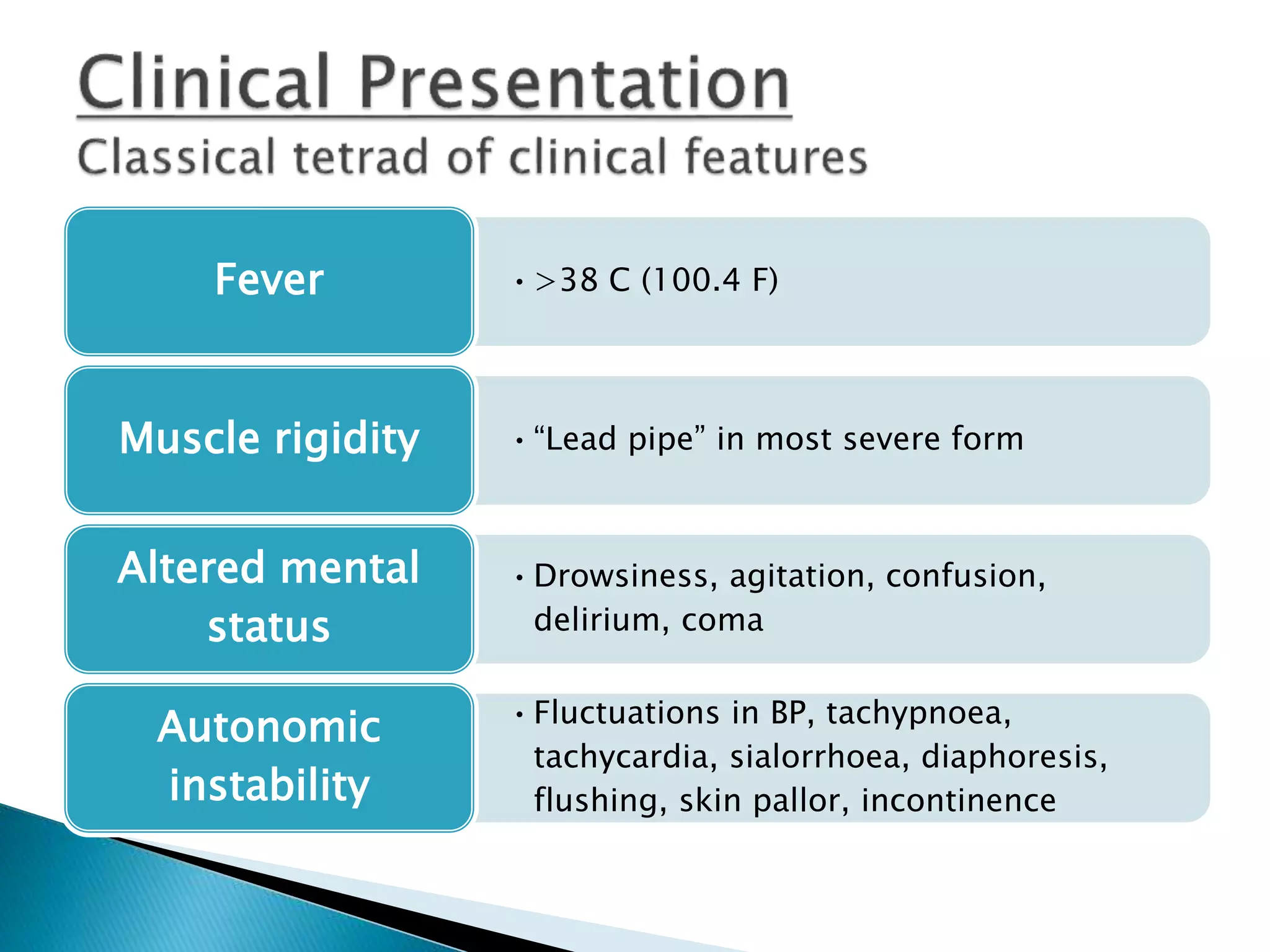
•>38 C (100.4 F)Fever
•“Lead pipe” in most severe formMuscle rigidity
•Drowsiness, agitation, confusion,
delirium, coma
Altered mental
status
•Fluctuations in BP, tachypnoea,
tachycardia, sialorrhoea, diaphoresis,
flushing, skin pallor, incontinence
Autonomic
instability
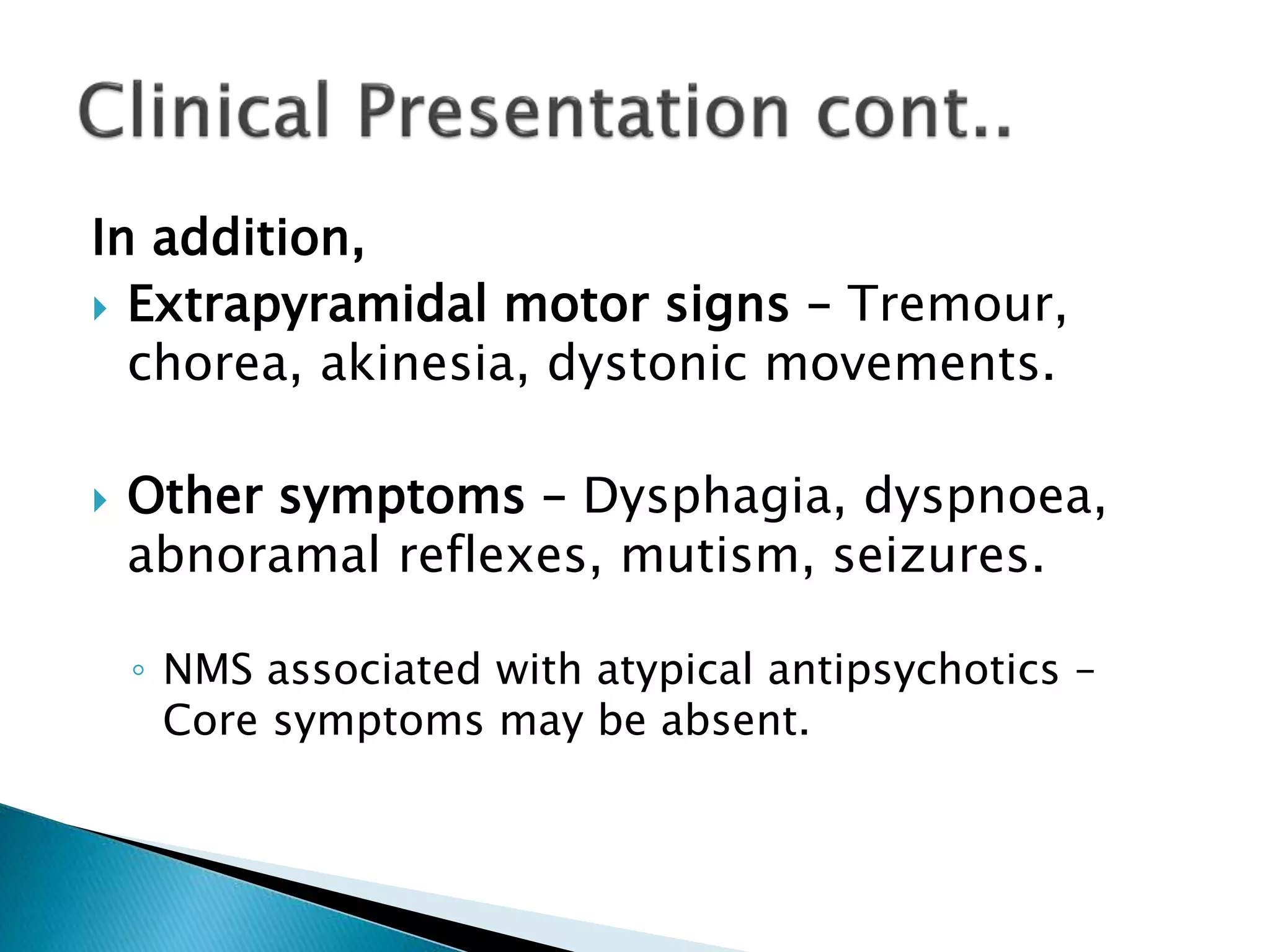
In addition,
 Extrapyramidal motor signs – Tremour,
chorea, akinesia, dystonic movements.
 Other symptoms – Dysphagia, dyspnoea,
abnoramal reflexes, mutism, seizures.
◦ NMS associated with atypical antipsychotics –
Core symptoms may be absent.
 Heterogeneous in onset, presentation,
progression and outcome.
 Onset – from hours to days.
◦ 16% : within 24hrs.
◦ 66% : within 1 week.
◦ Virtually all cases : within 30 days.
 Alteration in mental status and other
neurological signs typically precede systemic
signs. (>80%)
 Self-limited in most cases.
 Mean recovery time : 7-10 days.
◦ 63% : within 1 week.
◦ Nearly all : within 30 days.
 Mortality results from :
◦ respiratory failure
◦ cardiovascular collapse
◦ myoglobinuric renal failure
◦ arrhythmias
◦ DIC
 Age, sex, time of year – not correlated with
the risk.
 Not specific to any neuropsychiatric
diagnosis.
 Catatonia – risk of progressing to NMS with
antipsychotics.
 Agitation
 Dehydration
 Restraint
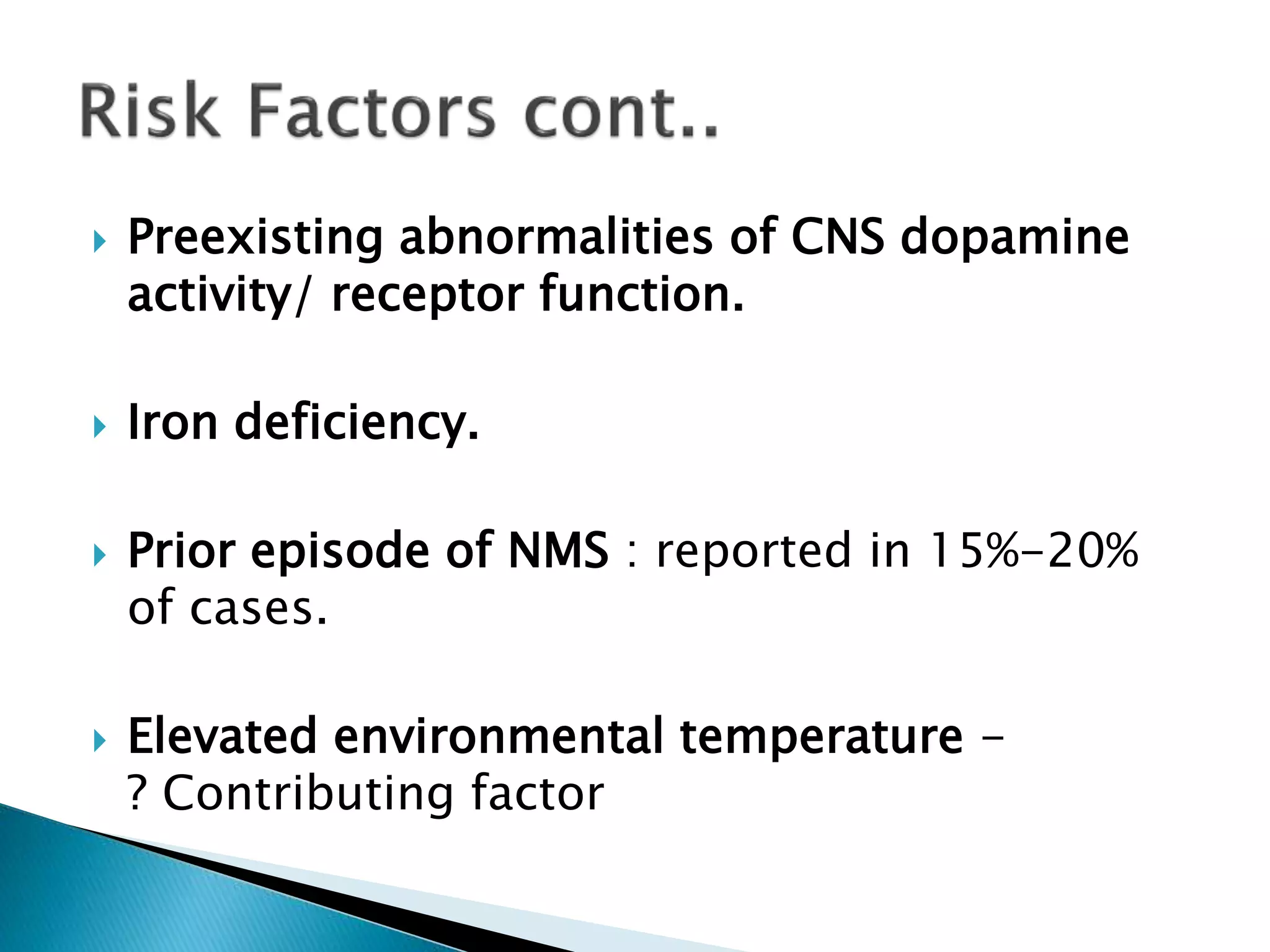
 Preexisting abnormalities of CNS dopamine
activity/ receptor function.
 Iron deficiency.
 Prior episode of NMS : reported in 15%-20%
of cases.
 Elevated environmental temperature -
? Contributing factor
 High potency conventional antipsychotics –
higher risk
◦ Atypical antipsychotics: Less incidence.
 Parental routes
 Higher titration rates
 Higher total doses
 Precise mechanisms are unproven.
 Antipsychotic-induced dopamine blockade
Sudden drop in CNS dopaminergic activity
 Supportive evidence for this hypothesis:
1) Withdrawal of dopaminergic drugs can
precipitate an NMS-like syndrome.
2) All drugs associated are dopamine receptor
blockers.
3) Risk of NMS appears to be correlated with the
dopamine receptor binding affinity of drugs.
4) Dopaminergic drugs are used in the treatment of
NMS.
5) Patients with central dopamine tract lesions
develop similar syndromes.
6) Low levels of homovanillic acid (dopamine
metabolite) detected in patients with acute NMS.
 FBC – Leucocytosis (WBC 10000-40000)
 CK – elevated (> 1000 IU/L)
 Urine analysis – myoglobinuria indicate poor prognosis.
 ABG – Metabolic acidosis
 Serum iron – reduced ( ? An acute phase response)
 Serum catecholamine - elevated
 CSF – 95% normal.
 Brain imaging – usually normal.
 EEG – generalized slowing.(metabolic encephalopathy)
 Based on history, physical symptoms and
laboratory findings.
 Diagnosis by exclusion – Need to exclude
other possible medical conditions.
 Different sets of diagnostic criteria are used
without satisfactory consensus.
 2011 – diagnostic criteria by an International
consensus study introduced.
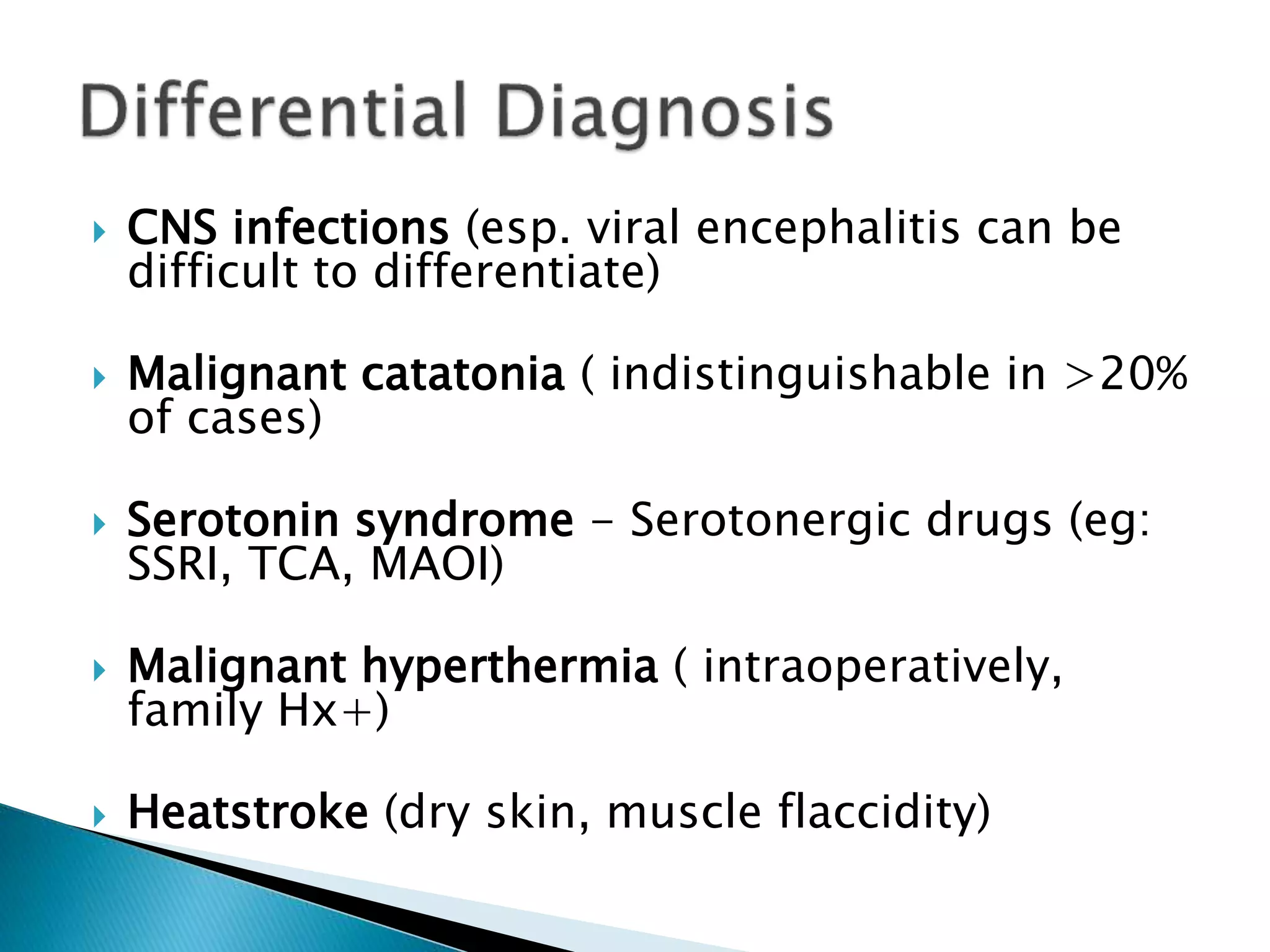
 CNS infections (esp. viral encephalitis can be
difficult to differentiate)
 Malignant catatonia ( indistinguishable in >20%
of cases)
 Serotonin syndrome - Serotonergic drugs (eg:
SSRI, TCA, MAOI)
 Malignant hyperthermia ( intraoperatively,
family Hx+)
 Heatstroke (dry skin, muscle flaccidity)
 Substances – Cocaine, amphetamine (esp.
ecstasy) , hallucinogens (eg: Phencyclindine)
 Alcohol/Hypnotic withdrawal
 Nonconvulsive status epilepticus
 Anatomic lesions in brainstem
 Immediate withdrawal of the offending agent.
 Reinstitution of abruptly withdrawn
dopaminergic agents.
 Supportive care – mainstay of management
 Aggressive fluid resuscitation
 Monitoring and correction of electrolyte imbalances.
 Cooling measures (eg: cooling blankets, ice packs)
– in extreme hyperthermia.
 Monitoring for complications – cardioresp. failure,
renal failure, aspiration pneumonia, coagulopathies.
 Dialysis – renal failure
 Ventilator support – respiratory failure
 Pharmacological management
◦ No general consensus on use of pharmacological
therapies in uncomplicated cases.
◦ Numerous anecdotal reports and meta-analyses
support the use of several empiric pharmacological
therapies in more severe cases.
◦ May shorten the course and reduce mortality.
 Dopaminergic agents
1. Bromocriptine
 Starting dose - 2.5mg bd/tds oral/NG
 Increase dose by 2.5mg every 24hrs.
 Max. dose – 45mg/day
 At least for 10 days (oral antipsychotics) or 2-3 weeks
(depot antipsychotics)
 May worsen psychosis and hypotension
2. Amantadine
 200-400mg/day in divided doses oral/NG
 Levadopa
have been used in some cases.
 apomorphine
 Dantrolene
 Muscle relaxant
 Started with 1-2.5mg/kg initial IV bolus
 1mg/kg every 6hrly up to a max. dose of
10mg/kg/day.
 Tapering down or switching to oral form
after first few days.
 Discontinued once symptoms begins to
resolve. (Risk of hepatotoxicity)
 Benzodiazepines
 May hasten the recovery in milder cases.
 May control agitation.
 Lorazepam
 Starting dose 1-2mg IM/IV
 Carbamazepine
Reported to have some effect.
 Clonidine
 ECT
 can be effective in,
1. Poor response to supportive care and
pharmacological management.
2. When idiopathic malignant catatonia cannot
be excluded.
3. Persistent residual catatonia and
parkinsonism after the resolution of acute
symptoms.
 Estimated risk of 30% of developing NMS
again with re-introduction of antipsychotics.
 Precautions:
◦ At least 2 weeks should be allowed from recovery
before rechallenge.
◦ Low potency conventional antipsychotics/ atypical
antipsychotics.
◦ Start with a low dose and titrate gradually.
◦ Careful monitoring for early signs of NMS.
 Conservative use of antipsychotics.
 Reduction of risk factors.
 Early diagnosis.
 Prompt discontinuation of offending agents.
 Early supportive care and medical
management.
1. Strawn JR, Keck Jr PE, Caroff SN: Neuroleptic Malignant Syndrome. Am J Psychiatry 2007,
164:870-876.
2. Berman BD: Neuroleptic Malignant Syndrome: A Review for Neurohospitalists. The
Neurohospitalist 2011, 1:41-47.
3. Karagianis JL, Phillips LC, Hogan KP, LeDrew KK: Clozapine-Associated Neuroleptic Malignant
Syndrome:Two New Cases and a Review of the Literature. The Annals of Pharmacotherapy 1999,
33: 623-630.
4. American Psychiatric Association: Diagnostic and statistical manual of mental disorders: DSM-
V. Washington DC: American Psychiatric Association; 2013.
5. Sadock BJ, Sadock VA, Ruiz P: Kaplan & Sadock’s comprehensive textbook of psychiatry: 9th ed.
Philadelphia: Lippincott Williams & Wilkins;2009.

Neuroleptic malignant syndrome

  • 1.
    Dr. Praveen Goonathilake Registrarin Psychiatry Teaching Hospital- Jaffna
  • 2.
     A severedisorder associated with 1. Introduction/Increase in dose of dopamine receptor antagonists. (mostly antipsychotics) OR 2. Rapid withdrawal of dopaminergic agents.  Unpredictable  Potentially life-threatening.
  • 3.
     1956 -First case reported.  1960 – Current name was introduced in a French study.  Rare. • 1960-1997: Incidence 0.2-3.2% • Current incidence : 0.01 – 0.02%  Mortality rate – 10%.
  • 4.
    •>38 C (100.4F)Fever •“Lead pipe” in most severe formMuscle rigidity •Drowsiness, agitation, confusion, delirium, coma Altered mental status •Fluctuations in BP, tachypnoea, tachycardia, sialorrhoea, diaphoresis, flushing, skin pallor, incontinence Autonomic instability
  • 5.
    In addition,  Extrapyramidalmotor signs – Tremour, chorea, akinesia, dystonic movements.  Other symptoms – Dysphagia, dyspnoea, abnoramal reflexes, mutism, seizures. ◦ NMS associated with atypical antipsychotics – Core symptoms may be absent.
  • 6.
     Heterogeneous inonset, presentation, progression and outcome.  Onset – from hours to days. ◦ 16% : within 24hrs. ◦ 66% : within 1 week. ◦ Virtually all cases : within 30 days.  Alteration in mental status and other neurological signs typically precede systemic signs. (>80%)
  • 7.
     Self-limited inmost cases.  Mean recovery time : 7-10 days. ◦ 63% : within 1 week. ◦ Nearly all : within 30 days.  Mortality results from : ◦ respiratory failure ◦ cardiovascular collapse ◦ myoglobinuric renal failure ◦ arrhythmias ◦ DIC
  • 8.
     Age, sex,time of year – not correlated with the risk.  Not specific to any neuropsychiatric diagnosis.  Catatonia – risk of progressing to NMS with antipsychotics.  Agitation  Dehydration  Restraint
  • 9.
     Preexisting abnormalitiesof CNS dopamine activity/ receptor function.  Iron deficiency.  Prior episode of NMS : reported in 15%-20% of cases.  Elevated environmental temperature - ? Contributing factor
  • 10.
     High potencyconventional antipsychotics – higher risk ◦ Atypical antipsychotics: Less incidence.  Parental routes  Higher titration rates  Higher total doses
  • 11.
     Precise mechanismsare unproven.  Antipsychotic-induced dopamine blockade Sudden drop in CNS dopaminergic activity
  • 12.
     Supportive evidencefor this hypothesis: 1) Withdrawal of dopaminergic drugs can precipitate an NMS-like syndrome. 2) All drugs associated are dopamine receptor blockers. 3) Risk of NMS appears to be correlated with the dopamine receptor binding affinity of drugs. 4) Dopaminergic drugs are used in the treatment of NMS. 5) Patients with central dopamine tract lesions develop similar syndromes. 6) Low levels of homovanillic acid (dopamine metabolite) detected in patients with acute NMS.
  • 13.
     FBC –Leucocytosis (WBC 10000-40000)  CK – elevated (> 1000 IU/L)  Urine analysis – myoglobinuria indicate poor prognosis.  ABG – Metabolic acidosis  Serum iron – reduced ( ? An acute phase response)  Serum catecholamine - elevated  CSF – 95% normal.  Brain imaging – usually normal.  EEG – generalized slowing.(metabolic encephalopathy)
  • 14.
     Based onhistory, physical symptoms and laboratory findings.  Diagnosis by exclusion – Need to exclude other possible medical conditions.  Different sets of diagnostic criteria are used without satisfactory consensus.  2011 – diagnostic criteria by an International consensus study introduced.
  • 16.
     CNS infections(esp. viral encephalitis can be difficult to differentiate)  Malignant catatonia ( indistinguishable in >20% of cases)  Serotonin syndrome - Serotonergic drugs (eg: SSRI, TCA, MAOI)  Malignant hyperthermia ( intraoperatively, family Hx+)  Heatstroke (dry skin, muscle flaccidity)
  • 17.
     Substances –Cocaine, amphetamine (esp. ecstasy) , hallucinogens (eg: Phencyclindine)  Alcohol/Hypnotic withdrawal  Nonconvulsive status epilepticus  Anatomic lesions in brainstem
  • 18.
     Immediate withdrawalof the offending agent.  Reinstitution of abruptly withdrawn dopaminergic agents.  Supportive care – mainstay of management  Aggressive fluid resuscitation  Monitoring and correction of electrolyte imbalances.  Cooling measures (eg: cooling blankets, ice packs) – in extreme hyperthermia.  Monitoring for complications – cardioresp. failure, renal failure, aspiration pneumonia, coagulopathies.  Dialysis – renal failure  Ventilator support – respiratory failure
  • 19.
     Pharmacological management ◦No general consensus on use of pharmacological therapies in uncomplicated cases. ◦ Numerous anecdotal reports and meta-analyses support the use of several empiric pharmacological therapies in more severe cases. ◦ May shorten the course and reduce mortality.
  • 20.
     Dopaminergic agents 1.Bromocriptine  Starting dose - 2.5mg bd/tds oral/NG  Increase dose by 2.5mg every 24hrs.  Max. dose – 45mg/day  At least for 10 days (oral antipsychotics) or 2-3 weeks (depot antipsychotics)  May worsen psychosis and hypotension 2. Amantadine  200-400mg/day in divided doses oral/NG  Levadopa have been used in some cases.  apomorphine
  • 21.
     Dantrolene  Musclerelaxant  Started with 1-2.5mg/kg initial IV bolus  1mg/kg every 6hrly up to a max. dose of 10mg/kg/day.  Tapering down or switching to oral form after first few days.  Discontinued once symptoms begins to resolve. (Risk of hepatotoxicity)
  • 22.
     Benzodiazepines  Mayhasten the recovery in milder cases.  May control agitation.  Lorazepam  Starting dose 1-2mg IM/IV  Carbamazepine Reported to have some effect.  Clonidine
  • 23.
     ECT  canbe effective in, 1. Poor response to supportive care and pharmacological management. 2. When idiopathic malignant catatonia cannot be excluded. 3. Persistent residual catatonia and parkinsonism after the resolution of acute symptoms.
  • 24.
     Estimated riskof 30% of developing NMS again with re-introduction of antipsychotics.  Precautions: ◦ At least 2 weeks should be allowed from recovery before rechallenge. ◦ Low potency conventional antipsychotics/ atypical antipsychotics. ◦ Start with a low dose and titrate gradually. ◦ Careful monitoring for early signs of NMS.
  • 25.
     Conservative useof antipsychotics.  Reduction of risk factors.  Early diagnosis.  Prompt discontinuation of offending agents.  Early supportive care and medical management.
  • 26.
    1. Strawn JR,Keck Jr PE, Caroff SN: Neuroleptic Malignant Syndrome. Am J Psychiatry 2007, 164:870-876. 2. Berman BD: Neuroleptic Malignant Syndrome: A Review for Neurohospitalists. The Neurohospitalist 2011, 1:41-47. 3. Karagianis JL, Phillips LC, Hogan KP, LeDrew KK: Clozapine-Associated Neuroleptic Malignant Syndrome:Two New Cases and a Review of the Literature. The Annals of Pharmacotherapy 1999, 33: 623-630. 4. American Psychiatric Association: Diagnostic and statistical manual of mental disorders: DSM- V. Washington DC: American Psychiatric Association; 2013. 5. Sadock BJ, Sadock VA, Ruiz P: Kaplan & Sadock’s comprehensive textbook of psychiatry: 9th ed. Philadelphia: Lippincott Williams & Wilkins;2009.