BLOOD BRAIN
BARRIER-
Characteristics,
function,transport &
similarities between
BBB and blood CSF
barrier
P. MEENALOKSHINI
II MSc Biochemistry
Introduction
– Blood brain barrier (BBB)- cerebral endothelium- absent - CVO.
– Limited exchange- passive diffusion.
– Capillaries-carrier mediated and active transport.
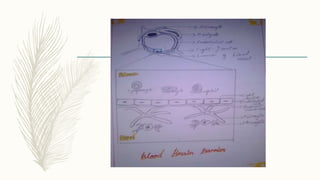
Characteristics of BBB
– Cerebral capillaries-birth-more permeable. BBB-early life.
– Endothelial cells- tight junction.
– Pores.
– A dense protein matrix.
– Capillaries- astrocytes.
Penetration of substances into the
brain
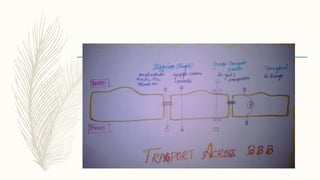
– CO2,O2, H2O-pass easily H+ & HCO3– slowly.
– Plasma proteins, organic molecules-cannot cross. Dyes, substance
bound to protein- can pass.
– Lipid soluble substances-cross more easily than water soluble
substances.
– Glucose- brain metabolism- glucose transporters.
– Ions – pass slowly.
– Bile salts & catechol- do not.
– Drugs( sulphonamides and erthromycin )-enter, penicillin&
chloromycetin-limited entry, anti-depressent & psychotropic
drugs-easily enter. Amines-limited entry- L-DOPA & 5-hydroxy
tryptophan – enter rapidly.
– Absence of specific transporter- limited entry.
Functions Of BBB
– Maintain constancy of environment-neurons- CNS- homeostatic
mechanism.
– Protection – endogenous and exogenous toxins, prevention-
neurotransmitters.
– Regulated transcellular penetration- H+ & HCO3-.
– Prevents – chemicals, permits-metabolic materials.
– O2,CO2,Glucose, aminoacids, electrolytes, drugs, lipid soluble
anesthetic gas-ether,NO-pass.
– Injurious chemical agents, Pathogens- cannot pass.
– Bile pigments- cannot enter,Jaundice-enter-damage basal ganglia-
Kernicterus.
– BBB dysfunction-abnormal neuronal activity-seizures.
– Sensor motor neurological dysfunction-reduced metabolic efficacy,
cellular damage.
– Changes in blood flow-key determinant- patho-physiology of brain
injuries.
– BBB.mp4
Transport of glucose & aminoacid
glu,aa.mp4
– Endothelial cells- insulin dependent glucose transporter-GLU1-
glycoprotein.
– GLU1-uptake of glucose. Regulation- cell surface GLU1 levels.
– Neuroactive substances-Aspartate & Glutamate-impermeable.
– Limited transport-paracellular barrier.
– Specific solute carriers(SLC)- glucose and aminoacids and other
nutrients.
Transport of Ions
– Synaptic and neuronal function-ion channels & transporters.
Water – ion channels.
– Eg- regulated ionic movement-potassium concentration- 2.5 to
2.9mM.
– If increase in conc-change in neuronal activity.
– Neuronal firing & synaptic transmission- influx of ca2+ and Na+ &
eflux of K+, neurotransmitters.
Transport of macromolecules
alter[Mute].mp4
– Endocytic vesicles- proteins and peptides.
– Vesicular mechanisms-RMT or AMT- transport diverse large
molecules.
Steps involved in transport
1. Internalization
2. Exocytosis
3. Interaction
Peptide specific transporter-facilitate transport.
Function- signaling cascade.
Transport of drugs
drugs.mp4
– Transcranial drug delivery-carrier mediated and receptor mediated
transport- facilitate transport of drugs- CNS pathologies.
– Currently- reengineering of drugs-enables BBB transport.
Similarities between BBB & blood
CSF barrier
– Formed –epithelium cells of brain capillaries
– Prevents & blocks -harmful chemicals- toxins- BBB & CSF.
– Substance regulation-substance transport-blood to CSF & BBB.
BBB- oxygen,CO2,glucose & aminoacids.
Chloroid plexus-calcium & endocrine substances.
Thank you

Neurochemistry

  • 1.
    BLOOD BRAIN BARRIER- Characteristics, function,transport & similaritiesbetween BBB and blood CSF barrier P. MEENALOKSHINI II MSc Biochemistry
  • 2.
    Introduction – Blood brainbarrier (BBB)- cerebral endothelium- absent - CVO. – Limited exchange- passive diffusion. – Capillaries-carrier mediated and active transport.
  • 4.
    Characteristics of BBB –Cerebral capillaries-birth-more permeable. BBB-early life. – Endothelial cells- tight junction. – Pores. – A dense protein matrix. – Capillaries- astrocytes.
  • 5.
    Penetration of substancesinto the brain – CO2,O2, H2O-pass easily H+ & HCO3– slowly. – Plasma proteins, organic molecules-cannot cross. Dyes, substance bound to protein- can pass. – Lipid soluble substances-cross more easily than water soluble substances. – Glucose- brain metabolism- glucose transporters. – Ions – pass slowly. – Bile salts & catechol- do not.
  • 6.
    – Drugs( sulphonamidesand erthromycin )-enter, penicillin& chloromycetin-limited entry, anti-depressent & psychotropic drugs-easily enter. Amines-limited entry- L-DOPA & 5-hydroxy tryptophan – enter rapidly. – Absence of specific transporter- limited entry.
  • 7.
    Functions Of BBB –Maintain constancy of environment-neurons- CNS- homeostatic mechanism. – Protection – endogenous and exogenous toxins, prevention- neurotransmitters. – Regulated transcellular penetration- H+ & HCO3-. – Prevents – chemicals, permits-metabolic materials.
  • 8.
    – O2,CO2,Glucose, aminoacids,electrolytes, drugs, lipid soluble anesthetic gas-ether,NO-pass. – Injurious chemical agents, Pathogens- cannot pass. – Bile pigments- cannot enter,Jaundice-enter-damage basal ganglia- Kernicterus.
  • 9.
    – BBB dysfunction-abnormalneuronal activity-seizures. – Sensor motor neurological dysfunction-reduced metabolic efficacy, cellular damage. – Changes in blood flow-key determinant- patho-physiology of brain injuries. – BBB.mp4
  • 11.
    Transport of glucose& aminoacid glu,aa.mp4 – Endothelial cells- insulin dependent glucose transporter-GLU1- glycoprotein. – GLU1-uptake of glucose. Regulation- cell surface GLU1 levels. – Neuroactive substances-Aspartate & Glutamate-impermeable. – Limited transport-paracellular barrier. – Specific solute carriers(SLC)- glucose and aminoacids and other nutrients.
  • 12.
    Transport of Ions –Synaptic and neuronal function-ion channels & transporters. Water – ion channels. – Eg- regulated ionic movement-potassium concentration- 2.5 to 2.9mM. – If increase in conc-change in neuronal activity. – Neuronal firing & synaptic transmission- influx of ca2+ and Na+ & eflux of K+, neurotransmitters.
  • 13.
    Transport of macromolecules alter[Mute].mp4 –Endocytic vesicles- proteins and peptides. – Vesicular mechanisms-RMT or AMT- transport diverse large molecules. Steps involved in transport 1. Internalization 2. Exocytosis 3. Interaction Peptide specific transporter-facilitate transport. Function- signaling cascade.
  • 14.
    Transport of drugs drugs.mp4 –Transcranial drug delivery-carrier mediated and receptor mediated transport- facilitate transport of drugs- CNS pathologies. – Currently- reengineering of drugs-enables BBB transport.
  • 15.
    Similarities between BBB& blood CSF barrier – Formed –epithelium cells of brain capillaries – Prevents & blocks -harmful chemicals- toxins- BBB & CSF. – Substance regulation-substance transport-blood to CSF & BBB. BBB- oxygen,CO2,glucose & aminoacids. Chloroid plexus-calcium & endocrine substances.
  • 16.