Vertigo
AN EXAMPLE OF EVERYDAY NEUROBIOLOGY
 Vertigo is the sensation that you spinning are or that the environment around
you is whirling even though you are stationary.
 Vertigo is a result of the vestibular system disrupted
 Symptoms include puking, nausea, and difficulty standing or walking due to
balance disorder
 There are three types of vertigo:
A. Objective vertigo: the feeling that environment is spinning
B. Subjective vertigo: the feeling that you are spinning
C. Pseudovertigo: the feeling of spinning inside your head
Last year my mom began having nystagmus and about two weeks later she had a
vertigo attack her first vertigo attack as she was turning in bed on her left side. It
lasted for a minute and then she felt okay, but as she tried to get out of bed she felt
dizzy again. So she spent most of the day in bed and was careful not to turn her head
to the left and bend over whenever she was up walking, since that would cause her to
have a vertigo attack. A week later another attack occurred that was more severe,
triggering imbalance and vomiting. Fortunately, she never had another attack so
severe after that, but she still experienced dizziness as she was improving little by
little as the days went by. What she did to ease the dizziness, was get some motion
sickness pills and rubbed ginger essential oil behind the ears whenever she felt any
dizziness. She was completely healed after five months. This past month she started
to have some symptoms of nystagmus of the eyes, but has no need of the pill or the
ginger oil anymore. Hopefully she won’t have another vertigo attack again. We think
she has BPPV type of vertigo.
Inner ear
The inner ear consist of structures that are
responsible for hearing and balance.
Cochlea is the snail like structure that
converts sound waves from the outer ear
into electrochemical signals through the
auditory nerve.
“The auditory nerve carries impulses from
the cochlea to a relay station in the mid-
brain…” (http://www.asha.org/public/hearing/Inner-Ear/)
Vestibular system
“It drives our motor system, it enables us to
do two important things. One is: to keep
our balance, another thing it enables us to
do is to keep our gaze steady.” (Prof. Mason, week
6, Introduction to the Vestibular sense video)
It consist of two elements: otoliths which
sense the linear acceleration and the
semicircular canals which sense the
rotational movements.
Making 2 ½ turns on its axis into a spiral
shape is the bony labyrinth called the
cochlea, which is the auditory component
of the inner ear. Inside the cochlea is the
organ of Corti made of sensory cells known
as hair cells and it is positioned on the
basilar membrane.
The incoming sound waves move the stapes
that pushes on the oval window of the
cochlea which causes two fluids in the
cochlea to stimulate the hair cells. The
fibers cells near the oval window respond to
the higher frequencies while fibers near the
cochlea apex respond to the lower
frequencies. Signals from the hair cells are
converted into nerve impulses.
The eighth cranial nerve also known as
vestibulocochlear nerve splits in two main
divisions: the cochlea nerve and the vestibular
nerve.
The cochlea nerve is made up of bipolar neurons.
Bipolar neurons are exclusive to sensory nerves,
having one central axon and one peripheral axon
coming out from the sides of the cell body. Because
both axons are myelinated thus action potential
travels faster. “Unlike the typical dendrite, the
peripheral process generates and conducts action
potential, which then "jump" across the cell body
(or soma) and continue to propagate along the
central axon. In this respect, auditory nerve fibers
are somewhat unique in that action potentials pass
through the soma.”
“The peripheral axons of auditory nerve fibers form
synaptic connections with the hair cells of
the cochlea via ribbon synapse using the
neurotransmitter glutamate.”
(http://en.wikipedia.org/wiki/Cochlear_nerve)
Photo source: http://legacy.owensboro.kctcs.edu/gcaplan/anat/notes/api%20notes%20m%20%20peripheral%20nerves.htm
The semicircular canals are responsible for
our balance. Each of the three semicircular
canals provide a sense of directional balance.
The posterior and anterior canals are at right
angles of each other and the lateral is around
30 degrees to the horizontal plane. The
lateral canal responds to rotation in the
transverse plane, the anterior responds to
movement in the sagittal plane, and the
posterior responds to the rotation of the head
such as a cartwheel.
“They are lined with cilia (microscopic hairs)
and filled with a liquid substance, known as
endolymph. Every time the head moves, the
endolymph moves the cilia. This works as a
type of motion sensor, as the movements of
the cilia are communicated to the brain. As a
result, the brain knows how to keep the body
balanced, regardless of the posture.”
(Written and medically reviewed by the Healthline Editorial Team,
http://www.healthline.com/human-body-maps/semicircular-canals)
Photo source: http://www.audiologysingapore.org/how-do-we-hear/
Along with the semicircular canals,
balance depends on input from the
eyes, muscles, and joints.
The VOR prevents me from
messing up my gaze even before I
have a chance to. It keeps my gaze
steady, immediately as all these
head accelerations are occurring.”
(Prof. Mason, week 6, The VOR is fast video)
As the head moves the eyes move in opposition keeping the world
around us in focus and
The utricle and saccule are found in
both ears, they are responsible for
detecting gravity (vertical
orientation)
Photo source:: http://www.britannica.com/EBchecked/topic/626968/vestibular-system/images-
 BPPV is the most common vestibular disorder and it is caused when calcium
carbonate fragments fall from the otoconial membrane. These fragments
enter the semicircular canals and trigging the hair cells. “It’s stimulating
those hair cells only when you are in a certain position. But the moment it
stimulates them you have perception of your head accelerating.” (Prof. Mason, week
6, Otoconial disorders video)
 Some of the symptoms include dizziness, nausea, imbalance, nystygmus, and
difficulty concentrating. These sympotms occur when position is changed,
and can last up to a minute. It usually affects either the left or right ear and
but it can be bileateeral meaning both ears.
 Meniere’s disease is thought to be cause by fluid built up or change in
pressure in the inner ear. “Too much fluid may accumulate either due to
excess production or inadequate absorption.” (http://www.entnet.org/content/menieres-disease)
It usually affects people in there 40s or 50s mostly, but it can sometimes
occur in children as well.
 The symptoms vary a bit form that of BPPV, the person can feel fluctuating
hearing loss, ringing in the ears aka tinnitus, and pressure in the ear. Attacks
of vertigo can be spontaneous and recurrent and severe. The attack can last
from 20 mins to 4 hours. And as disease worsens heaing loss will advance.
 Vestibular neuritis is an infection (usually viral) that causes inflammation to
the 8th cranial nerve, which is essential to balance. “This inflammation
disrupts the transmission of sensory information from the ear to the brain.”
(http://vestibular.org/labyrinthitis-and-vestibular-neuritis)
 Neuritis is the inflammation of the branch of the nerve that is responsible for
balance. The inflammations causes vertigo, imbalance, and nausea, but no
hearing problems.
 Labyrinthitis is the inflammation of both branches of the cranial nerve,
because this causes vertigo, nausea, and hearing problems.
 This course was really intriguing and
amazing at the same time! It has help me
open my eyes to the intricacies of the
human brain.
 I’m seriously considering a career in
Neurobiology!
 It was a wonderful introduction to the
subject covering it as a whole and not
getting too difficult
 Professor Mason is a very smart lady that
knows her subject well. She is also
dynamic and easy to follow.
 This course has inspired me to research
different brain disorders and be
compassionate to the people who suffer
with brain disorders
 This course has helped me to appreciate
how blessed I am with health and do
everything possible to maintain it. I also
want to help those around me.
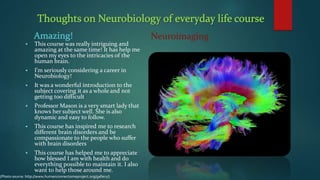
Neuroimaging
(Photo source: http://www.humanconnectomeproject.org/gallery/)

Understanding the Brain: Neurobiology of everyday life-Final project

  • 1.
    Vertigo AN EXAMPLE OFEVERYDAY NEUROBIOLOGY
  • 2.
     Vertigo isthe sensation that you spinning are or that the environment around you is whirling even though you are stationary.  Vertigo is a result of the vestibular system disrupted  Symptoms include puking, nausea, and difficulty standing or walking due to balance disorder  There are three types of vertigo: A. Objective vertigo: the feeling that environment is spinning B. Subjective vertigo: the feeling that you are spinning C. Pseudovertigo: the feeling of spinning inside your head
  • 3.
    Last year mymom began having nystagmus and about two weeks later she had a vertigo attack her first vertigo attack as she was turning in bed on her left side. It lasted for a minute and then she felt okay, but as she tried to get out of bed she felt dizzy again. So she spent most of the day in bed and was careful not to turn her head to the left and bend over whenever she was up walking, since that would cause her to have a vertigo attack. A week later another attack occurred that was more severe, triggering imbalance and vomiting. Fortunately, she never had another attack so severe after that, but she still experienced dizziness as she was improving little by little as the days went by. What she did to ease the dizziness, was get some motion sickness pills and rubbed ginger essential oil behind the ears whenever she felt any dizziness. She was completely healed after five months. This past month she started to have some symptoms of nystagmus of the eyes, but has no need of the pill or the ginger oil anymore. Hopefully she won’t have another vertigo attack again. We think she has BPPV type of vertigo.
  • 4.
    Inner ear The innerear consist of structures that are responsible for hearing and balance. Cochlea is the snail like structure that converts sound waves from the outer ear into electrochemical signals through the auditory nerve. “The auditory nerve carries impulses from the cochlea to a relay station in the mid- brain…” (http://www.asha.org/public/hearing/Inner-Ear/) Vestibular system “It drives our motor system, it enables us to do two important things. One is: to keep our balance, another thing it enables us to do is to keep our gaze steady.” (Prof. Mason, week 6, Introduction to the Vestibular sense video) It consist of two elements: otoliths which sense the linear acceleration and the semicircular canals which sense the rotational movements.
  • 5.
    Making 2 ½turns on its axis into a spiral shape is the bony labyrinth called the cochlea, which is the auditory component of the inner ear. Inside the cochlea is the organ of Corti made of sensory cells known as hair cells and it is positioned on the basilar membrane. The incoming sound waves move the stapes that pushes on the oval window of the cochlea which causes two fluids in the cochlea to stimulate the hair cells. The fibers cells near the oval window respond to the higher frequencies while fibers near the cochlea apex respond to the lower frequencies. Signals from the hair cells are converted into nerve impulses.
  • 6.
    The eighth cranialnerve also known as vestibulocochlear nerve splits in two main divisions: the cochlea nerve and the vestibular nerve. The cochlea nerve is made up of bipolar neurons. Bipolar neurons are exclusive to sensory nerves, having one central axon and one peripheral axon coming out from the sides of the cell body. Because both axons are myelinated thus action potential travels faster. “Unlike the typical dendrite, the peripheral process generates and conducts action potential, which then "jump" across the cell body (or soma) and continue to propagate along the central axon. In this respect, auditory nerve fibers are somewhat unique in that action potentials pass through the soma.” “The peripheral axons of auditory nerve fibers form synaptic connections with the hair cells of the cochlea via ribbon synapse using the neurotransmitter glutamate.” (http://en.wikipedia.org/wiki/Cochlear_nerve) Photo source: http://legacy.owensboro.kctcs.edu/gcaplan/anat/notes/api%20notes%20m%20%20peripheral%20nerves.htm
  • 7.
    The semicircular canalsare responsible for our balance. Each of the three semicircular canals provide a sense of directional balance. The posterior and anterior canals are at right angles of each other and the lateral is around 30 degrees to the horizontal plane. The lateral canal responds to rotation in the transverse plane, the anterior responds to movement in the sagittal plane, and the posterior responds to the rotation of the head such as a cartwheel. “They are lined with cilia (microscopic hairs) and filled with a liquid substance, known as endolymph. Every time the head moves, the endolymph moves the cilia. This works as a type of motion sensor, as the movements of the cilia are communicated to the brain. As a result, the brain knows how to keep the body balanced, regardless of the posture.” (Written and medically reviewed by the Healthline Editorial Team, http://www.healthline.com/human-body-maps/semicircular-canals) Photo source: http://www.audiologysingapore.org/how-do-we-hear/
  • 8.
    Along with thesemicircular canals, balance depends on input from the eyes, muscles, and joints. The VOR prevents me from messing up my gaze even before I have a chance to. It keeps my gaze steady, immediately as all these head accelerations are occurring.” (Prof. Mason, week 6, The VOR is fast video) As the head moves the eyes move in opposition keeping the world around us in focus and The utricle and saccule are found in both ears, they are responsible for detecting gravity (vertical orientation) Photo source:: http://www.britannica.com/EBchecked/topic/626968/vestibular-system/images-
  • 9.
     BPPV isthe most common vestibular disorder and it is caused when calcium carbonate fragments fall from the otoconial membrane. These fragments enter the semicircular canals and trigging the hair cells. “It’s stimulating those hair cells only when you are in a certain position. But the moment it stimulates them you have perception of your head accelerating.” (Prof. Mason, week 6, Otoconial disorders video)  Some of the symptoms include dizziness, nausea, imbalance, nystygmus, and difficulty concentrating. These sympotms occur when position is changed, and can last up to a minute. It usually affects either the left or right ear and but it can be bileateeral meaning both ears.
  • 10.
     Meniere’s diseaseis thought to be cause by fluid built up or change in pressure in the inner ear. “Too much fluid may accumulate either due to excess production or inadequate absorption.” (http://www.entnet.org/content/menieres-disease) It usually affects people in there 40s or 50s mostly, but it can sometimes occur in children as well.  The symptoms vary a bit form that of BPPV, the person can feel fluctuating hearing loss, ringing in the ears aka tinnitus, and pressure in the ear. Attacks of vertigo can be spontaneous and recurrent and severe. The attack can last from 20 mins to 4 hours. And as disease worsens heaing loss will advance.
  • 11.
     Vestibular neuritisis an infection (usually viral) that causes inflammation to the 8th cranial nerve, which is essential to balance. “This inflammation disrupts the transmission of sensory information from the ear to the brain.” (http://vestibular.org/labyrinthitis-and-vestibular-neuritis)  Neuritis is the inflammation of the branch of the nerve that is responsible for balance. The inflammations causes vertigo, imbalance, and nausea, but no hearing problems.  Labyrinthitis is the inflammation of both branches of the cranial nerve, because this causes vertigo, nausea, and hearing problems.
  • 12.
     This coursewas really intriguing and amazing at the same time! It has help me open my eyes to the intricacies of the human brain.  I’m seriously considering a career in Neurobiology!  It was a wonderful introduction to the subject covering it as a whole and not getting too difficult  Professor Mason is a very smart lady that knows her subject well. She is also dynamic and easy to follow.  This course has inspired me to research different brain disorders and be compassionate to the people who suffer with brain disorders  This course has helped me to appreciate how blessed I am with health and do everything possible to maintain it. I also want to help those around me. Neuroimaging (Photo source: http://www.humanconnectomeproject.org/gallery/)