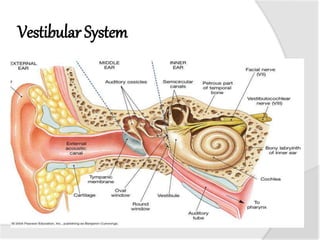
Vestibular System
Introduction
 The vestibular system includes the parts of the inner ear
and brain that help control balance and eye movements. If
the system is damaged by disease, aging, or
injury, vestibular disorders can result, and are often
associated with one or more of these symptoms, among
others:
 Vertigo and dizziness.
 Imbalance and spatial disorientation
 Vision disturbance
 Hearing changes
 Cognitive and psychological changes
The most commonly diagnosed vestibular disorders include
benign paroxysmal positional vertigo (BPPV), labyrinthitis or
vestibular neuritis.
Role of vestibular system
Operate in conjunction with visual & proprioceptive
information to
• Sense and perceive position and motion
• Orientate to vertical
• Stabilize eye/ head position
• Control the center of mass
Specific role is
• Relative position of head in relation to moving surface
• To stabilize visual images during head movement
• To maintain postural stability during movement of head
• Information for spatial orientation (natural ability to maintain our
body orientation and/or posture in relation to the surrounding
environment (physical space) at rest and during motion.
Clinical Manifestation
• Spinning or whirling sensation; an illusion
of movement of self or the world (vertigo)
• Lightheaded, floating, or rocking sensation
(dizziness)
vertigo and
dizziness
• Imbalance, stumbling, difficulty walking
straight or turning a corner
• Clumsiness or difficulty with coordination
• Difficulty maintaining straight posture;
tendency to look downward to confirm the
location of the ground
BALANCE
AND SPATIAL
ORIENTATION
Head may be held in a tilted
position
Tendency to touch or hold onto
something when standing
Muscle and joint pain (due to
struggling with balance)
Difficulty finding stability in
crowds
HEARING CHANGES
• Hearing loss; distorted or fluctuating
hearing
• Tinnitus (ringing, roaring, whooshing, or
other noises in the ear)
• Sensitivity to loud noises or environments
• Sudden loud sounds may increase
symptoms of vertigo, dizziness, or
imbalance
VISION
disturbance
• Trouble focusing or tracking objects with
the eyes; objects or words on a page
seem to jump, bounce, float, or blur or may
appear doubled
• Discomfort from busy visual environments
such as traffic, crowds and stores
• Sensitivity to light, glare, and moving or
flickering lights; fluorescent lights may be
especially troublesome
• Sensitivity to certain types of computer
monitors and digital televisions
• Tendency to focus on nearby objects;
increased discomfort when focusing at a
distance
• Increased night blindness; difficulty
walking in the dark
• Poor depth perception
COGNITIVE changes
• Difficulty concentrating and paying attention;
easily distracted
• Forgetfulness and short-term memory lapses
• Confusion, disorientation, difficulty in
understanding directions or instructions
• Difficulty following speakers in conversations,
meetings, etc., especially when there is
background noise or movement
• Mental and/or physical fatigue out of proportion to
activity
PSYCHOLOGICAL changes
• Loss of self-reliance, self-confidence, self-esteem
• Anxiety, panic, social isolation
• Depression
OTHERs
• Nausea or vomiting
• "Hangover" or "seasick" feeling in the
head
• Motion sickness
• Sensation of fullness in the ears
• Headaches
• Slurred speech
• Sensitivity to pressure or temperature
changes
• Pain, pressure, or other symptoms
with certain dietary changes (e.g.,
high sodium)
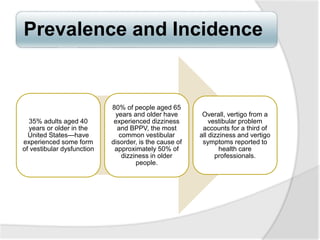
Prevalence and Incidence
35% adults aged 40
years or older in the
United States—have
experienced some form
of vestibular dysfunction
80% of people aged 65
years and older have
experienced dizziness
and BPPV, the most
common vestibular
disorder, is the cause of
approximately 50% of
dizziness in older
people.
Overall, vertigo from a
vestibular problem
accounts for a third of
all dizziness and vertigo
symptoms reported to
health care
professionals.
Etiology
Whiplash and blows to the head
Ear infections
Advancing age
Exposure to sudden or significant pressure changes, as occur during
scuba diving or rapid descent or ascent in an aircraft, can injure the ear.
High doses or long-term use of certain antibiotics can be ototoxic,
meaning that they cause permanent damage to the inner ear
Migraine or stroke can affect the vestibular system by reducing or
blocking the flow of blood to the inner ear or brain.
Vestibulo-ocular Reflex
The vestibulo-ocular reflex (VOR) is a reflex eye movement that
stabilizes images on the retina during head movement by producing
an eye movement in the direction opposite to head movement, thus
preserving the image on the center of the visual field.
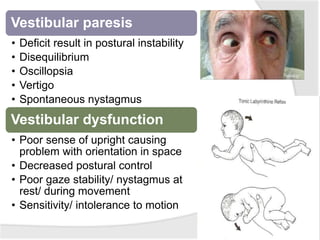
Vestibular paresis
• Deficit result in postural instability
• Disequilibrium
• Oscillopsia
• Vertigo
• Spontaneous nystagmus
Vestibular dysfunction
• Poor sense of upright causing
problem with orientation in space
• Decreased postural control
• Poor gaze stability/ nystagmus at
rest/ during movement
• Sensitivity/ intolerance to motion
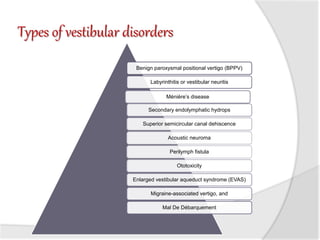
Types of vestibular disorders
Benign paroxysmal positional vertigo (BPPV)
Labyrinthitis or vestibular neuritis
Ménière’s disease
Secondary endolymphatic hydrops
Superior semicircular canal dehiscence
Acoustic neuroma
Perilymph fistula
Ototoxicity
Enlarged vestibular aqueduct syndrome (EVAS)
Migraine-associated vertigo, and
Mal De Débarquement
BPPV
 Is a mechanical problem in inner ear that occur when
some of the CaCo3 crystals (otoconia) that are normally
embedded in gel in the utricle (vestibule) become
dislodged and migrate into one or more of 3 fluid filled
semicircular canals, where they are not supposed to be.
 Symptoms related with BPPV
○ Postural instability
○ difficulty concentration
○ Spinning or dizziness
○ Disequilibrium
○ Unsteady gait
○ Sensitivity to head movement
○ Nausea
Labyrinthitis or vestibular neuritis
 Labyrinthitis or vestibular neuritis
are disorder resulting from an
infection that inflames the inner ear
or the nerves connecting the Inner
ear to the brain.
 The inflammation disrupts the
transmission of sensory information
from the ear to the brain.
 Symptoms:
 Dizziness or vertigo, disequilibrium
or imbalance and nausea
Ménière’s disease
 Meniere’s disease is a disorder of the
inner ear that causes episodes in which
you feel as if you’re spinning (vertigo),
hearing loss, tinnitus, feeling of fullness
in ear.
Secondary endolymphatic hydrops
 Appears to occur in response to an
event or underlying condition.
 For example: It can follow head trauma
or ear surgery or inner ear disorder,
allergies or systemic disorder (such as
diabetes)
 Symptoms:
 Tinnitus, hearing loss, dizziness, imbalance,
fullness in ear
Superior semicircular canal dehiscence
 Vestibular and auditory sign and symptoms
can result from a dehiscence (opening) in
the bone overlying the superior
semicircular canal of the inner ear.
 Symptoms:
 Vertigo, oscillopsia (the apparent motion of
objects that are known to be stationary),
evoked by loud noises and coughing,
sneezing or straining)
 Auditory manifestation: Autophony
(increased resonance of one’s own voice)
Acoustic neuroma
 Is an uncommon non-cancerous
(benign) and usually slow growing tumor
that develops on the main nerve leading
from your inner ear to your brain.
 This effects balance and hearing
 Pressure from acoustic neuroma can
cause hearing loss, tinnitus and
unsteadiness.
Perilymphatic Fistula
 A perilymph fistula is an abnormal
opening between the air filled middle ear
and the fluid filled inner ear.
 Symptoms:
 Dizziness, hearing loss, tinnitus,
pressure sensitivity, Tullio’s phenomena
(sensitivity to loud noises)
Ototoxicity
 Refers to drug or chemical related
damage to the inner ear, resulting in
damage to the organs responsible for
hearing and balance.
 Such damage can lead to temporary or
permanent hearing loss, loss of balance.
Enlarged vestibular Aqueduct
 EVAS is a syndromic form of hearing
loss caused by enlargement of the
vestibular aqueduct in the inner ear.
 It is one of the most common inner ear
deformity which results in hearing loss
during childhood
 Symptoms progress slowly
Migraine associated vertigo
 MAV is dizziness that is associated with
a migraine headache condition
 Migraine patients have some
accompanying vestibular syndrome
involving disruption in their balance,
dizziness.
Mal De Debarquement
 Is an imbalance or rocking sensation often both
“felt” or “seen” by the sufferer that occurs after
exposure to motion (most commonly after a
sea cruise or a flight). Although other forms of
travel have been known to trigger it.
 Caused by exposure to an unfamiliar
movement
 Symptoms:
 Rocking, swaying, disequilibrium, nausea,
vomiting
Assessment of vestibular function
Subjective
• History of presenting problem
• Type, onset, intensity, frequency and duration
• Relevant past history
• Concurrent significant problems
• Premorbid and current level of function
• ADLs, domestic tasks, community mobility,
recreational and vocational
• Review of relevant senses
• Vision, somato-sensory, hearing
• Dizziness profile
• Patient Goals
Assessment of vestibular function
Objective
• Vision
• Musculoskeletal evaluation
• Neurological assessment
• Balance assessment
• Sensory organization
• Motor coordination
• Motion-provoked symptoms
• Vestibular function tests
Musculoskeletal evaluation
Movement control/selectivity
Muscle power
Coordination
Strength evaluation of the trunk and lower extremities
Assessment of asymmetries in center of body mass and postural
alignment - determines the strength necessary to maintain balance
Assessment of cervical and trunk strength and ROM
Vision
 Vestibuloocular function: normal eye
function requires a combination of smooth
and saccadic pursuit eye movements
 Smooth pursuit: is elicited to closely follow
moving targets while the head is stationary, slow
tracking movements of eye
 Saccadic pursuit: primarily directed towards
stationary targets, rapid ballistic tracking of eyes
 Vestibuloocular reflex (VOR) - Is tested by moving
the patient's head vertically and horizontally while the
patient fixates vision on a target; normally eyes
remain fixed in the target, the presence of saccades is
abnormal.
 Head movements are present all time, the VOR is
important for stabilizing vision, subjects whose
VOR is impaired find difficult to read and result in
oscillopsia.
 Nystagmus: involuntary, rhythmic oscillations of the
eyes, is indicative of disruption of brainstem
oculomotor system
 Types are horizontal, vertical, rotatory, and mixed
 VOR suppression test:
this test assesses the
ability of
vestibulocerebellar
system to suppress a
vestibular signal.
 It is assessed by asking
patients to follow with
the head in the same
direction an object that
rotates; for example the
patient looks at their
outstretched hands held
together while seated in a
chair that rotates.
Neurological Assessment
Coordination tests, such as finger-to-nose and heel-to-shin, assess
dysmetria
RAM to assess dysdiadochokinesia
Inspection or observation of voluntary movements to assess
movement disorders, such as tics, tremors, athetosis, ballismus, and
chorea
Sensation tests such as light touch of underused areas, pinprick,
and proprioception
Vibration tests with tuning forks to assess posterior column
function, in which the duration of the vibration is tested
Spasticity assessment, with the 5-point
Ashworth scale and Brunstrom classification,
e.g. to assess the presence or absence of
velocity-dependent resistance to passive
stretch
Reflex examination to assess abnormalities,
such as hyperreflexia or hyporeflexia and
pathologic reflexes, including the Babinski,
Hoffman's sign, snout reflex, rooting reflex,
glabellar, or tonic neck reflexes that may
indicate nervous system abnormalities
Balance Assessment
 Romberg test
 Stand-on-one-leg-eyes-closed (SOLEC) test
 Singleton test to assess unilateral vestibular deficits;
instability when turning toward one side indicates a
unilateral lesion in that side
 Berg Balance Scale
 Fukuda stepping test to identify labyrinth deficit
 Alignment in sitting/standing
 Measure base of support in standing
 Weight shift in sitting/standing
THANKS

Vestibular disorder 1 (1).pptx

  • 2.
  • 3.
    Introduction  The vestibularsystem includes the parts of the inner ear and brain that help control balance and eye movements. If the system is damaged by disease, aging, or injury, vestibular disorders can result, and are often associated with one or more of these symptoms, among others:  Vertigo and dizziness.  Imbalance and spatial disorientation  Vision disturbance  Hearing changes  Cognitive and psychological changes The most commonly diagnosed vestibular disorders include benign paroxysmal positional vertigo (BPPV), labyrinthitis or vestibular neuritis.
  • 4.
    Role of vestibularsystem Operate in conjunction with visual & proprioceptive information to • Sense and perceive position and motion • Orientate to vertical • Stabilize eye/ head position • Control the center of mass Specific role is • Relative position of head in relation to moving surface • To stabilize visual images during head movement • To maintain postural stability during movement of head • Information for spatial orientation (natural ability to maintain our body orientation and/or posture in relation to the surrounding environment (physical space) at rest and during motion.
  • 5.
    Clinical Manifestation • Spinningor whirling sensation; an illusion of movement of self or the world (vertigo) • Lightheaded, floating, or rocking sensation (dizziness) vertigo and dizziness • Imbalance, stumbling, difficulty walking straight or turning a corner • Clumsiness or difficulty with coordination • Difficulty maintaining straight posture; tendency to look downward to confirm the location of the ground BALANCE AND SPATIAL ORIENTATION
  • 6.
    Head may beheld in a tilted position Tendency to touch or hold onto something when standing Muscle and joint pain (due to struggling with balance) Difficulty finding stability in crowds
  • 7.
    HEARING CHANGES • Hearingloss; distorted or fluctuating hearing • Tinnitus (ringing, roaring, whooshing, or other noises in the ear) • Sensitivity to loud noises or environments • Sudden loud sounds may increase symptoms of vertigo, dizziness, or imbalance
  • 8.
    VISION disturbance • Trouble focusingor tracking objects with the eyes; objects or words on a page seem to jump, bounce, float, or blur or may appear doubled • Discomfort from busy visual environments such as traffic, crowds and stores • Sensitivity to light, glare, and moving or flickering lights; fluorescent lights may be especially troublesome • Sensitivity to certain types of computer monitors and digital televisions • Tendency to focus on nearby objects; increased discomfort when focusing at a distance • Increased night blindness; difficulty walking in the dark • Poor depth perception
  • 9.
    COGNITIVE changes • Difficultyconcentrating and paying attention; easily distracted • Forgetfulness and short-term memory lapses • Confusion, disorientation, difficulty in understanding directions or instructions • Difficulty following speakers in conversations, meetings, etc., especially when there is background noise or movement • Mental and/or physical fatigue out of proportion to activity PSYCHOLOGICAL changes • Loss of self-reliance, self-confidence, self-esteem • Anxiety, panic, social isolation • Depression
  • 10.
    OTHERs • Nausea orvomiting • "Hangover" or "seasick" feeling in the head • Motion sickness • Sensation of fullness in the ears • Headaches • Slurred speech • Sensitivity to pressure or temperature changes • Pain, pressure, or other symptoms with certain dietary changes (e.g., high sodium)
  • 11.
    Prevalence and Incidence 35%adults aged 40 years or older in the United States—have experienced some form of vestibular dysfunction 80% of people aged 65 years and older have experienced dizziness and BPPV, the most common vestibular disorder, is the cause of approximately 50% of dizziness in older people. Overall, vertigo from a vestibular problem accounts for a third of all dizziness and vertigo symptoms reported to health care professionals.
  • 12.
    Etiology Whiplash and blowsto the head Ear infections Advancing age Exposure to sudden or significant pressure changes, as occur during scuba diving or rapid descent or ascent in an aircraft, can injure the ear. High doses or long-term use of certain antibiotics can be ototoxic, meaning that they cause permanent damage to the inner ear Migraine or stroke can affect the vestibular system by reducing or blocking the flow of blood to the inner ear or brain.
  • 13.
    Vestibulo-ocular Reflex The vestibulo-ocularreflex (VOR) is a reflex eye movement that stabilizes images on the retina during head movement by producing an eye movement in the direction opposite to head movement, thus preserving the image on the center of the visual field.
  • 14.
    Vestibular paresis • Deficitresult in postural instability • Disequilibrium • Oscillopsia • Vertigo • Spontaneous nystagmus Vestibular dysfunction • Poor sense of upright causing problem with orientation in space • Decreased postural control • Poor gaze stability/ nystagmus at rest/ during movement • Sensitivity/ intolerance to motion
  • 15.
    Types of vestibulardisorders Benign paroxysmal positional vertigo (BPPV) Labyrinthitis or vestibular neuritis Ménière’s disease Secondary endolymphatic hydrops Superior semicircular canal dehiscence Acoustic neuroma Perilymph fistula Ototoxicity Enlarged vestibular aqueduct syndrome (EVAS) Migraine-associated vertigo, and Mal De Débarquement
  • 16.
    BPPV  Is amechanical problem in inner ear that occur when some of the CaCo3 crystals (otoconia) that are normally embedded in gel in the utricle (vestibule) become dislodged and migrate into one or more of 3 fluid filled semicircular canals, where they are not supposed to be.  Symptoms related with BPPV ○ Postural instability ○ difficulty concentration ○ Spinning or dizziness ○ Disequilibrium ○ Unsteady gait ○ Sensitivity to head movement ○ Nausea
  • 17.
    Labyrinthitis or vestibularneuritis  Labyrinthitis or vestibular neuritis are disorder resulting from an infection that inflames the inner ear or the nerves connecting the Inner ear to the brain.  The inflammation disrupts the transmission of sensory information from the ear to the brain.  Symptoms:  Dizziness or vertigo, disequilibrium or imbalance and nausea
  • 18.
    Ménière’s disease  Meniere’sdisease is a disorder of the inner ear that causes episodes in which you feel as if you’re spinning (vertigo), hearing loss, tinnitus, feeling of fullness in ear.
  • 19.
    Secondary endolymphatic hydrops Appears to occur in response to an event or underlying condition.  For example: It can follow head trauma or ear surgery or inner ear disorder, allergies or systemic disorder (such as diabetes)  Symptoms:  Tinnitus, hearing loss, dizziness, imbalance, fullness in ear
  • 20.
    Superior semicircular canaldehiscence  Vestibular and auditory sign and symptoms can result from a dehiscence (opening) in the bone overlying the superior semicircular canal of the inner ear.  Symptoms:  Vertigo, oscillopsia (the apparent motion of objects that are known to be stationary), evoked by loud noises and coughing, sneezing or straining)  Auditory manifestation: Autophony (increased resonance of one’s own voice)
  • 21.
    Acoustic neuroma  Isan uncommon non-cancerous (benign) and usually slow growing tumor that develops on the main nerve leading from your inner ear to your brain.  This effects balance and hearing  Pressure from acoustic neuroma can cause hearing loss, tinnitus and unsteadiness.
  • 22.
    Perilymphatic Fistula  Aperilymph fistula is an abnormal opening between the air filled middle ear and the fluid filled inner ear.  Symptoms:  Dizziness, hearing loss, tinnitus, pressure sensitivity, Tullio’s phenomena (sensitivity to loud noises)
  • 23.
    Ototoxicity  Refers todrug or chemical related damage to the inner ear, resulting in damage to the organs responsible for hearing and balance.  Such damage can lead to temporary or permanent hearing loss, loss of balance.
  • 24.
    Enlarged vestibular Aqueduct EVAS is a syndromic form of hearing loss caused by enlargement of the vestibular aqueduct in the inner ear.  It is one of the most common inner ear deformity which results in hearing loss during childhood  Symptoms progress slowly
  • 25.
    Migraine associated vertigo MAV is dizziness that is associated with a migraine headache condition  Migraine patients have some accompanying vestibular syndrome involving disruption in their balance, dizziness.
  • 26.
    Mal De Debarquement Is an imbalance or rocking sensation often both “felt” or “seen” by the sufferer that occurs after exposure to motion (most commonly after a sea cruise or a flight). Although other forms of travel have been known to trigger it.  Caused by exposure to an unfamiliar movement  Symptoms:  Rocking, swaying, disequilibrium, nausea, vomiting
  • 27.
    Assessment of vestibularfunction Subjective • History of presenting problem • Type, onset, intensity, frequency and duration • Relevant past history • Concurrent significant problems • Premorbid and current level of function • ADLs, domestic tasks, community mobility, recreational and vocational • Review of relevant senses • Vision, somato-sensory, hearing • Dizziness profile • Patient Goals
  • 28.
    Assessment of vestibularfunction Objective • Vision • Musculoskeletal evaluation • Neurological assessment • Balance assessment • Sensory organization • Motor coordination • Motion-provoked symptoms • Vestibular function tests
  • 29.
    Musculoskeletal evaluation Movement control/selectivity Musclepower Coordination Strength evaluation of the trunk and lower extremities Assessment of asymmetries in center of body mass and postural alignment - determines the strength necessary to maintain balance Assessment of cervical and trunk strength and ROM
  • 30.
    Vision  Vestibuloocular function:normal eye function requires a combination of smooth and saccadic pursuit eye movements  Smooth pursuit: is elicited to closely follow moving targets while the head is stationary, slow tracking movements of eye  Saccadic pursuit: primarily directed towards stationary targets, rapid ballistic tracking of eyes
  • 31.
     Vestibuloocular reflex(VOR) - Is tested by moving the patient's head vertically and horizontally while the patient fixates vision on a target; normally eyes remain fixed in the target, the presence of saccades is abnormal.  Head movements are present all time, the VOR is important for stabilizing vision, subjects whose VOR is impaired find difficult to read and result in oscillopsia.  Nystagmus: involuntary, rhythmic oscillations of the eyes, is indicative of disruption of brainstem oculomotor system  Types are horizontal, vertical, rotatory, and mixed
  • 32.
     VOR suppressiontest: this test assesses the ability of vestibulocerebellar system to suppress a vestibular signal.  It is assessed by asking patients to follow with the head in the same direction an object that rotates; for example the patient looks at their outstretched hands held together while seated in a chair that rotates.
  • 33.
    Neurological Assessment Coordination tests,such as finger-to-nose and heel-to-shin, assess dysmetria RAM to assess dysdiadochokinesia Inspection or observation of voluntary movements to assess movement disorders, such as tics, tremors, athetosis, ballismus, and chorea Sensation tests such as light touch of underused areas, pinprick, and proprioception Vibration tests with tuning forks to assess posterior column function, in which the duration of the vibration is tested
  • 34.
    Spasticity assessment, withthe 5-point Ashworth scale and Brunstrom classification, e.g. to assess the presence or absence of velocity-dependent resistance to passive stretch Reflex examination to assess abnormalities, such as hyperreflexia or hyporeflexia and pathologic reflexes, including the Babinski, Hoffman's sign, snout reflex, rooting reflex, glabellar, or tonic neck reflexes that may indicate nervous system abnormalities
  • 35.
    Balance Assessment  Rombergtest  Stand-on-one-leg-eyes-closed (SOLEC) test  Singleton test to assess unilateral vestibular deficits; instability when turning toward one side indicates a unilateral lesion in that side  Berg Balance Scale  Fukuda stepping test to identify labyrinth deficit  Alignment in sitting/standing  Measure base of support in standing  Weight shift in sitting/standing
  • 36.

Editor's Notes

  • #4 Labyrinthitis is an inner ear disorder. The two vestibular nerves in your inner ear send your brain information about your spatial navigation and balance control. When one of these nerves becomes inflamed, it creates a condition known as labyrinthitis. Symptoms include dizziness, nausea, and loss of hearing.
  • #5 Sensory information about motion, equilibrium, and spatial orientation is provided by the vestibular apparatus, which in each ear includes the utricle, saccule, and three semicircular canals. The utricle and saccule detect gravity (information in a vertical orientation) and linear movement.
  • #14 The vestibulo-ocular reflex. A rotation of the head is detected, which triggers an inhibitory signal to the extraocular muscles on one side and an excitatory signal to the muscles on the other side. The result is a compensatory movement of the eyes. Vestibulo-ocular reflex (VOR), eye movement that functions to stabilize gaze by countering movement of the head. In VOR the semicircular canals of the inner ear measure rotation of the head and provide a signal for the oculomotor nuclei of the brainstem, which innervate the eye muscles.