NEURAL NETWORK BASED MPPT CONTROL OF HYBRID
POWER GENERATION SYSTEM
BATCH MEMBERS
ARUNKUMAR.T 420112105304
UNDER THE GUIDANCE OF
Mr. K.S.PANDIYAN, M.E.,
Asst. Professor / EEE
DEPARTMENT OF ELECTRICAL AND ELECTRONICS ENGINEERING
A.K.T. MEMORIAL COLLEGE OF ENGINEERING AND TECHNOLOGY
KALLAKURICHI-606202
1
12/02./2016
ABSTRACT
• This paper describes the modeling of integrated hybrid renewable energy
system. The wind and solar are used as input sources for the hybrid system.
• The proposed system involves the design of photovoltaic (PV) and wind energy
conversion system (WECS).The system is designed for constant wind speed and
varying solar irradiation and isolation.
• Maximum power point tracking (MPPT) algorithm is used to extract the
maximum power from PV array.
• The integration of two input sources is done by current-source-interface
multiple-input (MI) cuk converter.
• Neural network controller is used to control the duty cycle of one of the
converter switch thereby extracting the maximum power from solar array.
• The system consists of photovoltaic (PV) array, wind energy conversion system
(WECS), multiple input current- source-interface cuk converter, voltage source
inverter (VSI), LC filter and single phase load.
• The entire proposed system will be verified with experimental results.
212/02/16
OBJECTIVE
• Main objective of this project is to design a Neural network based
MPPT controlled power generation in hybrid model.(wind and solar).
• Another objective is to obtain continues power generation and increase the
load stability at the time of alternative power source by using multiple
input cuk converter and PWM controller.
312/02/16
METHODOLOGY
• MPPT design of proposed converter and control methods.
• Neural network based result analysis.
• Hardware implementation rated with 25watts.
• Experimental results analysis.
412/02/16
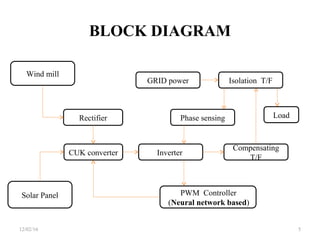
BLOCK DIAGRAM
12/02/16 5
GRID power Isolation T/F
Load
Compensating
T/F
Phase sensing
Inverter
PWM Controller
(Neural network based)
CUK converter
Wind mill
Solar Panel
Rectifier
REFERENCE
1. C.Liu, K.T.Chau and Z.Xiaodong, “An efficient wind-photovoltaic hybrid generation system using doubly excited
permanent-magnet brushless machine,” IEEE Trans.Ind.Electron., vol.57, no.3, pp.831-839, Mar.2010.
2. S.-K. Kim, J.-H. Jeon, C.-H. Cho, J.-B. Ahn, and S.-H. Kwon, “Dynamic modelling and control of a grid-connected
hybrid generation system with versatile power transfer,” IEEE Trans. Ind. Electron., vol.
55, no. 4, pp. 1677–1688, Apr. 2008
3. E. Muljadi and J. T. Bialasiewicz, “Hybrid power system with a controlled energy storage,” in Proc. IEEE 29th
IECON, 2003, vol. 2, pp.1296–1301
4. G. R.Walker and P. C. Senia, “Cascaded DC-DC converter connection of photovoltaic modules,” IEEE Trans.
Power Electron., vol. 19, no. 4,pp. 1130–1139, Jul. 2004
5. B. M. T. Ho and S.-H. Cheng, “An integrated inverter with maximum power tracking for grid-connected PV
systems,” IEEE Trans. Power Electron., vol. 20, no. 4, pp. 953–962, Jul. 2005.
6. P. M. Anderson and A. Bose, “Stability simulation of wind turbine systems,” IEEE Trans. Power Appl. Syst., vol.
PAS-102, no. 12, pp.3791–3795, Dec. 1983.
7. S. Arul Daniel and N. AmmasaiGounden“A Novel Hybrid Isolated Generating System Based on PV Fed Inverter-
Assisted Wind-Driven InductionGenerators,” IEEE Transactions On Energy Conversion, Vol. 19, no. 2, June 2004
8. W. Xiao, W. G. Dunford, and A. Capel, “A novel modeling method for photovoltaic cells”, in Proc. IEEE 35th Annu.
Power Electron. Spec. Conf. (PESC), 2004, vol. 3, pp. 1950–1956.
9. K.H. Hussein, I. Muta, T. Hoshino, M. Osakada, "Maximum photovoltaic power tracking: an algorithm for rapidly
changing atmospheric conditions", IEE Proc.-Gener. Trans. Distrib., Vol. 142, No. 1, January 1995.
10. B. G. Dobbs and P. L. Chapman, “A multiple-input DC-DC converter topology,” IEEE Power Electron. Lett., vol.
1, no. 1, pp. 6–9, Mar.2003.
12/02/16 6
12/02/16 7
THANK
YOU…

Neural network base power generation

  • 1.
    NEURAL NETWORK BASEDMPPT CONTROL OF HYBRID POWER GENERATION SYSTEM BATCH MEMBERS ARUNKUMAR.T 420112105304 UNDER THE GUIDANCE OF Mr. K.S.PANDIYAN, M.E., Asst. Professor / EEE DEPARTMENT OF ELECTRICAL AND ELECTRONICS ENGINEERING A.K.T. MEMORIAL COLLEGE OF ENGINEERING AND TECHNOLOGY KALLAKURICHI-606202 1 12/02./2016
  • 2.
    ABSTRACT • This paperdescribes the modeling of integrated hybrid renewable energy system. The wind and solar are used as input sources for the hybrid system. • The proposed system involves the design of photovoltaic (PV) and wind energy conversion system (WECS).The system is designed for constant wind speed and varying solar irradiation and isolation. • Maximum power point tracking (MPPT) algorithm is used to extract the maximum power from PV array. • The integration of two input sources is done by current-source-interface multiple-input (MI) cuk converter. • Neural network controller is used to control the duty cycle of one of the converter switch thereby extracting the maximum power from solar array. • The system consists of photovoltaic (PV) array, wind energy conversion system (WECS), multiple input current- source-interface cuk converter, voltage source inverter (VSI), LC filter and single phase load. • The entire proposed system will be verified with experimental results. 212/02/16
  • 3.
    OBJECTIVE • Main objectiveof this project is to design a Neural network based MPPT controlled power generation in hybrid model.(wind and solar). • Another objective is to obtain continues power generation and increase the load stability at the time of alternative power source by using multiple input cuk converter and PWM controller. 312/02/16
  • 4.
    METHODOLOGY • MPPT designof proposed converter and control methods. • Neural network based result analysis. • Hardware implementation rated with 25watts. • Experimental results analysis. 412/02/16
  • 5.
    BLOCK DIAGRAM 12/02/16 5 GRIDpower Isolation T/F Load Compensating T/F Phase sensing Inverter PWM Controller (Neural network based) CUK converter Wind mill Solar Panel Rectifier
  • 6.
    REFERENCE 1. C.Liu, K.T.Chauand Z.Xiaodong, “An efficient wind-photovoltaic hybrid generation system using doubly excited permanent-magnet brushless machine,” IEEE Trans.Ind.Electron., vol.57, no.3, pp.831-839, Mar.2010. 2. S.-K. Kim, J.-H. Jeon, C.-H. Cho, J.-B. Ahn, and S.-H. Kwon, “Dynamic modelling and control of a grid-connected hybrid generation system with versatile power transfer,” IEEE Trans. Ind. Electron., vol. 55, no. 4, pp. 1677–1688, Apr. 2008 3. E. Muljadi and J. T. Bialasiewicz, “Hybrid power system with a controlled energy storage,” in Proc. IEEE 29th IECON, 2003, vol. 2, pp.1296–1301 4. G. R.Walker and P. C. Senia, “Cascaded DC-DC converter connection of photovoltaic modules,” IEEE Trans. Power Electron., vol. 19, no. 4,pp. 1130–1139, Jul. 2004 5. B. M. T. Ho and S.-H. Cheng, “An integrated inverter with maximum power tracking for grid-connected PV systems,” IEEE Trans. Power Electron., vol. 20, no. 4, pp. 953–962, Jul. 2005. 6. P. M. Anderson and A. Bose, “Stability simulation of wind turbine systems,” IEEE Trans. Power Appl. Syst., vol. PAS-102, no. 12, pp.3791–3795, Dec. 1983. 7. S. Arul Daniel and N. AmmasaiGounden“A Novel Hybrid Isolated Generating System Based on PV Fed Inverter- Assisted Wind-Driven InductionGenerators,” IEEE Transactions On Energy Conversion, Vol. 19, no. 2, June 2004 8. W. Xiao, W. G. Dunford, and A. Capel, “A novel modeling method for photovoltaic cells”, in Proc. IEEE 35th Annu. Power Electron. Spec. Conf. (PESC), 2004, vol. 3, pp. 1950–1956. 9. K.H. Hussein, I. Muta, T. Hoshino, M. Osakada, "Maximum photovoltaic power tracking: an algorithm for rapidly changing atmospheric conditions", IEE Proc.-Gener. Trans. Distrib., Vol. 142, No. 1, January 1995. 10. B. G. Dobbs and P. L. Chapman, “A multiple-input DC-DC converter topology,” IEEE Power Electron. Lett., vol. 1, no. 1, pp. 6–9, Mar.2003. 12/02/16 6
  • 7.