Today’s IABC


       Free Web Seminar
               Creating & Maintaining Your
               Personal Brand: and
               Rocking Your Network
               Presented by Heather Huhman
               7 March 2012

                              With an 80% discounted IABC student
                              membership:
                              • Enhance your knowledge and skills with the
                                 highest quality research, articles and best
                                 practices.
    @IABCstudents             • Access professional development
                                 resources used by top communicators.
                              • Add value to your resume, connect with
                                 professionals and gain experience.
                              • Discover the hidden job market.
     Learn more at

           students.iabc.com
Creating & Maintaining
  Your Personal Brand
  and Rocking Your Network
          Presented by:
        Heather R. Huhman
Step 1:
 Determine Your Differentiation
 What do you bring to the table they can’t?
  – Write down every skill, characteristic, and interest
    you have – this becomes your “unique you”
 What collateral material will you need to
  communicate your unique you?
  – Business cards
  – Online portfolio


                                                       3
Step 2:
    Create an Online Portfolio
 Find out if your personal domain name is for
  sale (firstnamelastname.com). If it is,
  purchase it!
 Don’t forget to purchase hosting
 I recommend building and designing your
  online portfolio using a free content
  management system, such as WordPress
  – BlueHost.com specializes in hosting WordPress
    Web sites
                                                    4
Online Portfolios, Cont.

 WordPress alternatives:
  – About.me
  – Flavors.me
  – Wix.com
  – Weebly.com
  – Webs.com
  – VisualCV
  – Carbonmade
  – DoYouBuzz (U.S. version)
                                 5
Online Portfolios, Cont.

 On the homepage, include a welcome
  message to visitors – this can be a similar,
  more generic version of your cover letter
 Create a page/tab:
  – Where visitors can download your résumé in PDF
    format (iPaper is a good app for this)
  – For your actual portfolio
  – Linking to your professional blog
  – With your contact information
                                                     6
Online Portfolios, Cont.

 What to include in your online portfolio:
  – Case studies (problem, solution, results)
  – Class projects
  – Volunteer/internship work
  – Professional testimonials/recommendations


                                                7
Online Portfolios, Cont.


http://www.kaitlyndennihy.com
                                8
Online Portfolios, Cont.


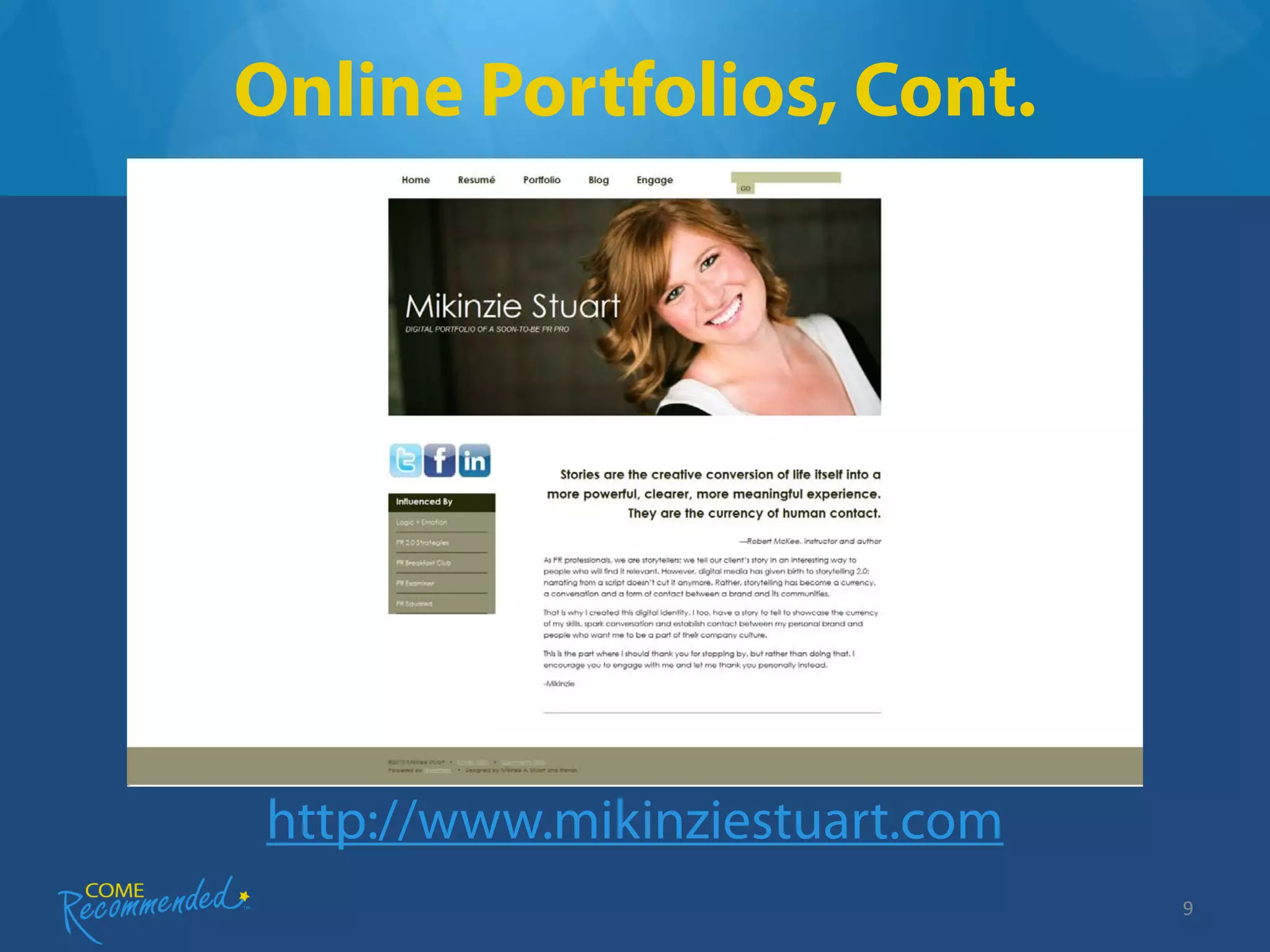
http://www.mikinziestuart.com
                                9
Step 3:
    Create a Professional Blog
 Select a topic or niche
 Decide on your posting frequency, and stay
  with it
 Admit upfront you are not an expert
 Write interesting content – and write it well
 Follow and comment on other blogs
 Promote your blog
 Don’t be afraid to be wrong
                                                  10
Step 4: Develop Your Core
     Message / Elevator Pitch
 Elevator pitch = a short sound bite where you
  explain who you are and what you’re seeking
 Typically 30-60 seconds or 150-200 words
 Keep it short & concise in order to hold your
  listener’s attention but still get enough
  information out to them


                                              11
Step 4: Develop Your Core
         Message / Elevator Pitch
 In general, your elevator pitch should consist
  of:
  – Your name (if meeting for the first time)
  – Current status (student, etc.)
  – What you seek (internship, entry-level job)
  – Your unique selling points
  – Qualifications
  – Passions
  – Call to action
                                                  12
Step 4: Develop Your Core
     Message / Elevator Pitch
 Comes in handy at networking events or
  when meeting hiring managers and
  recruiters
 Helps you answer the interview question “Tell
  me about yourself”
 Share a story
  – Mention past accomplishments and goals you’ve
    reached (but be concise!)

                                                13
Step 5: Evaluate Your Current
        Online Presence
 If you Google your name, what comes up?
  What can you edit? What should be public
  information, and what should not?
 Decide what you want those who search for
  you to know about you and how much
  specific information you want to share
 Knowing what’s already out there will help
  you create and maintain a consistent online
  brand
                                                14
Step 6:
      Get on Social Networks
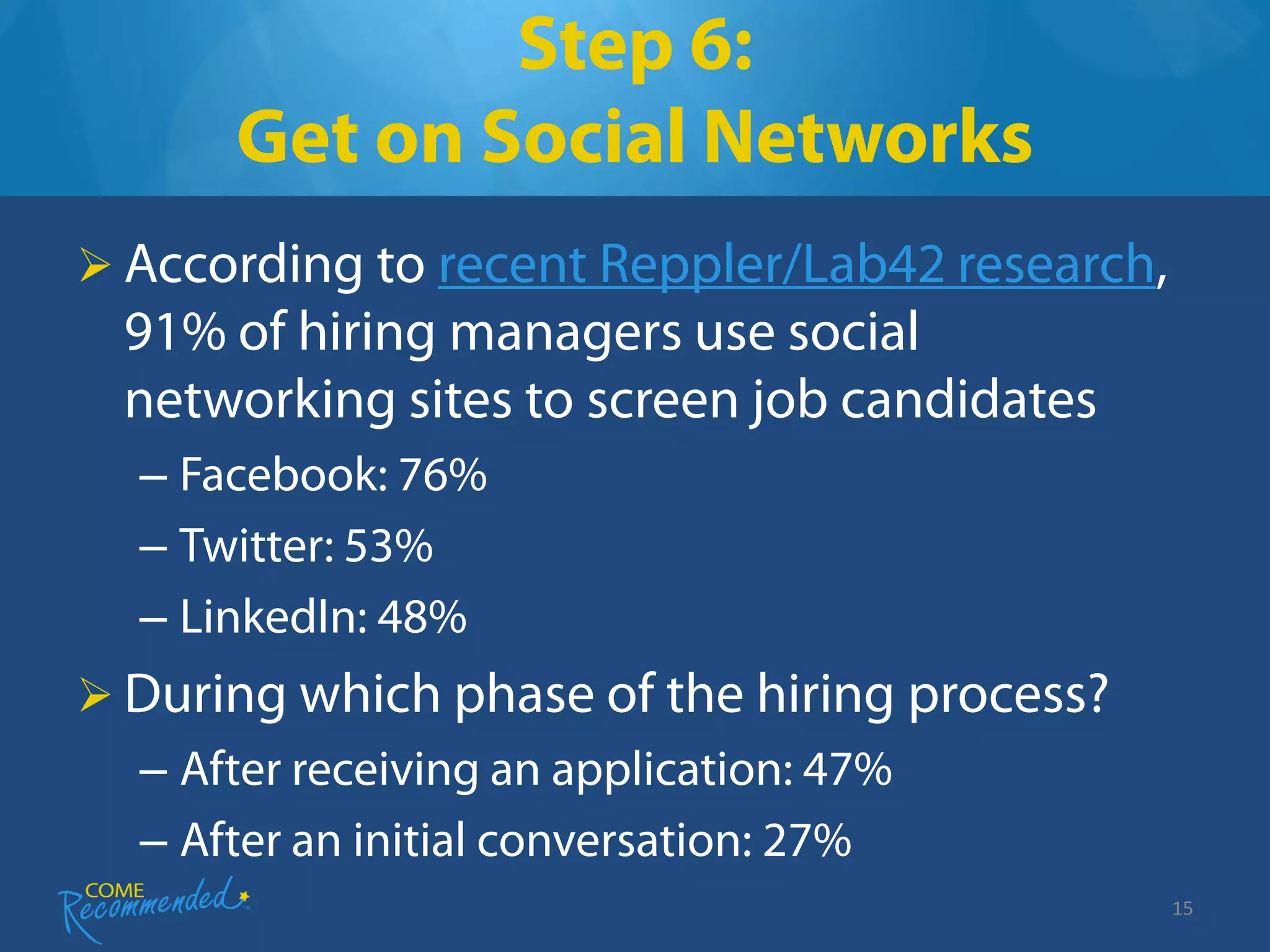
 According to recent Reppler/Lab42 research,
 91% of hiring managers use social
 networking sites to screen job candidates
  – Facebook: 76%
  – Twitter: 53%
  – LinkedIn: 48%
 During which phase of the hiring process?
  – After receiving an application: 47%
  – After an initial conversation: 27%
                                                15
Social Networking, Cont.

 Etiquette:
  – Listen
  – Be relevant
  – Mind your brand
  – Engage
  – Give more than get


                                16
Social Networking, Cont.

 Twitter
 LinkedIn
 Facebook
 Niche networks


                                17
Step 7: Become a Networking
            Rockstar
 Networking is creating a two-way,
  mutually beneficial relationship between
  yourself and a connection
 70-80% of jobs are filled through networking
  – Employee referrals
  – Unadvertised openings
  – Connections with hiring managers/CEOs


                                             18
Networking, Cont.

 Attend lots of events
  – Make sure people know who you are
     • If an organization you are really interested in is
       holding an open event, make sure to go
     • Make face time, so they know who you are
     • While you cannot ask for a job, be sure to tell them
       about your future plans
  – Don’t just attend events within your industry
     • Attend events that interest you


                                                              19
Networking, Cont.

 Find ways to bring up parts of your online
  portfolio in face-to-face conversations
  – At networking events, think of ways to weave
    some of the work you have done into the
    conversation
  – Kick off the discussion by asking about their job
    and what their day to day is like
  – At appropriate moments, mention your interests
    and accomplishments

                                                        20
Networking, Cont.

 Ping with a purpose
  – Pinging refers to communicating in useful ways
    with new contacts so you stay fresh in their
    minds
     • Make sure to follow-up with the people you
       connected with in-person by e-mailing them
       interesting articles of a common interest, or simply
       notifying a hiring manager of any changes in your
       résumé or contact information
  – Staying top-of-mind is key

                                                              21
Networking, Cont.

 Stay organized
  – When you meet someone & get their business
    card, take a few notes on the back to remember
    important parts of your conversation
  – Create social networking lists or Excel/Google
    spreadsheets of important contacts to remember
    key information (such as title/position, company,
    things in common, etc.)
  – Resource: Gist.com

                                                    22
Networking, Cont.

 Become a follower
  – Seek out recruiters and hiring managers on
    Twitter and follow them
     • Make sure you contribute to the conversation and
       demonstrate your qualifications -- because any
       opportunity to converse is an opportunity to impress
  – If you constantly pop up on people’s Twitter
    feeds, you will continue to stay top-of-mind


                                                              23
Networking, Cont.

 No matter where you meet someone, the
  only real way to bring them into your
  network is by keeping in contact with them
 After your first meeting, follow-up with them
  by:
  – Asking him/her out to lunch or coffee
  – Sending an e-mail
  – Engaging with him/her on social networking
    sites
                                                 24
Networking, Cont.

 Leverage your network
 Master the “art of the ask”
  – Smart networkers know the strategies for
    determining what to ask for, who to ask, and how
    to ask for any goal they want to achieve
  – Help can come almost immediately if you’ve laid
    the groundwork correctly


                                                   25
Networking, Cont.

 Don’t just send an e-mail saying, “Hey, I’d like
  to meet to talk about job opportunities at
  your company. Are you free tomorrow?”
 Instead, say, “I’m really interested in taking my
  paralegal degree into the nonprofit world.
  Would you be open to a quick phone call or a
  brief meeting sometime to share insights on
  how you did it?”

                                                     26
Networking, Cont.

 Take cues from your contacts
  – If you ask for a meeting and they’re more
    comfortable with a short phone call, take it
 Come prepared with good questions


                                                   27
Step 8:
              Create a Plan
 Set goals
 Research your social community
 Select your brand ambassadors
 Manage your reputation
 Establish yourself as a thought leader


                                           28
Questions?

       Heather R. Huhman
       Founder & President
      Come Recommended
 www.comerecommended.com
heather@comerecommended.com
    Twitter: @heatherhuhman


                              29

Creating & Maintaining Your Personal Brand -- and Rocking Your Network

  • 1.
    Today’s IABC Free Web Seminar Creating & Maintaining Your Personal Brand: and Rocking Your Network Presented by Heather Huhman 7 March 2012 With an 80% discounted IABC student membership: • Enhance your knowledge and skills with the highest quality research, articles and best practices. @IABCstudents • Access professional development resources used by top communicators. • Add value to your resume, connect with professionals and gain experience. • Discover the hidden job market. Learn more at students.iabc.com
  • 2.
    Creating & Maintaining Your Personal Brand and Rocking Your Network Presented by: Heather R. Huhman
  • 3.
    Step 1: DetermineYour Differentiation  What do you bring to the table they can’t? – Write down every skill, characteristic, and interest you have – this becomes your “unique you”  What collateral material will you need to communicate your unique you? – Business cards – Online portfolio 3
  • 4.
    Step 2: Create an Online Portfolio  Find out if your personal domain name is for sale (firstnamelastname.com). If it is, purchase it!  Don’t forget to purchase hosting  I recommend building and designing your online portfolio using a free content management system, such as WordPress – BlueHost.com specializes in hosting WordPress Web sites 4
  • 5.
    Online Portfolios, Cont. WordPress alternatives: – About.me – Flavors.me – Wix.com – Weebly.com – Webs.com – VisualCV – Carbonmade – DoYouBuzz (U.S. version) 5
  • 6.
    Online Portfolios, Cont. On the homepage, include a welcome message to visitors – this can be a similar, more generic version of your cover letter  Create a page/tab: – Where visitors can download your résumé in PDF format (iPaper is a good app for this) – For your actual portfolio – Linking to your professional blog – With your contact information 6
  • 7.
    Online Portfolios, Cont. What to include in your online portfolio: – Case studies (problem, solution, results) – Class projects – Volunteer/internship work – Professional testimonials/recommendations 7
  • 8.
  • 9.
  • 10.
    Step 3: Create a Professional Blog  Select a topic or niche  Decide on your posting frequency, and stay with it  Admit upfront you are not an expert  Write interesting content – and write it well  Follow and comment on other blogs  Promote your blog  Don’t be afraid to be wrong 10
  • 11.
    Step 4: DevelopYour Core Message / Elevator Pitch  Elevator pitch = a short sound bite where you explain who you are and what you’re seeking  Typically 30-60 seconds or 150-200 words  Keep it short & concise in order to hold your listener’s attention but still get enough information out to them 11
  • 12.
    Step 4: DevelopYour Core Message / Elevator Pitch  In general, your elevator pitch should consist of: – Your name (if meeting for the first time) – Current status (student, etc.) – What you seek (internship, entry-level job) – Your unique selling points – Qualifications – Passions – Call to action 12
  • 13.
    Step 4: DevelopYour Core Message / Elevator Pitch  Comes in handy at networking events or when meeting hiring managers and recruiters  Helps you answer the interview question “Tell me about yourself”  Share a story – Mention past accomplishments and goals you’ve reached (but be concise!) 13
  • 14.
    Step 5: EvaluateYour Current Online Presence  If you Google your name, what comes up? What can you edit? What should be public information, and what should not?  Decide what you want those who search for you to know about you and how much specific information you want to share  Knowing what’s already out there will help you create and maintain a consistent online brand 14
  • 15.
    Step 6: Get on Social Networks  According to recent Reppler/Lab42 research, 91% of hiring managers use social networking sites to screen job candidates – Facebook: 76% – Twitter: 53% – LinkedIn: 48%  During which phase of the hiring process? – After receiving an application: 47% – After an initial conversation: 27% 15
  • 16.
    Social Networking, Cont. Etiquette: – Listen – Be relevant – Mind your brand – Engage – Give more than get 16
  • 17.
    Social Networking, Cont. Twitter  LinkedIn  Facebook  Niche networks 17
  • 18.
    Step 7: Becomea Networking Rockstar  Networking is creating a two-way, mutually beneficial relationship between yourself and a connection  70-80% of jobs are filled through networking – Employee referrals – Unadvertised openings – Connections with hiring managers/CEOs 18
  • 19.
    Networking, Cont.  Attendlots of events – Make sure people know who you are • If an organization you are really interested in is holding an open event, make sure to go • Make face time, so they know who you are • While you cannot ask for a job, be sure to tell them about your future plans – Don’t just attend events within your industry • Attend events that interest you 19
  • 20.
    Networking, Cont.  Findways to bring up parts of your online portfolio in face-to-face conversations – At networking events, think of ways to weave some of the work you have done into the conversation – Kick off the discussion by asking about their job and what their day to day is like – At appropriate moments, mention your interests and accomplishments 20
  • 21.
    Networking, Cont.  Pingwith a purpose – Pinging refers to communicating in useful ways with new contacts so you stay fresh in their minds • Make sure to follow-up with the people you connected with in-person by e-mailing them interesting articles of a common interest, or simply notifying a hiring manager of any changes in your résumé or contact information – Staying top-of-mind is key 21
  • 22.
    Networking, Cont.  Stayorganized – When you meet someone & get their business card, take a few notes on the back to remember important parts of your conversation – Create social networking lists or Excel/Google spreadsheets of important contacts to remember key information (such as title/position, company, things in common, etc.) – Resource: Gist.com 22
  • 23.
    Networking, Cont.  Becomea follower – Seek out recruiters and hiring managers on Twitter and follow them • Make sure you contribute to the conversation and demonstrate your qualifications -- because any opportunity to converse is an opportunity to impress – If you constantly pop up on people’s Twitter feeds, you will continue to stay top-of-mind 23
  • 24.
    Networking, Cont.  Nomatter where you meet someone, the only real way to bring them into your network is by keeping in contact with them  After your first meeting, follow-up with them by: – Asking him/her out to lunch or coffee – Sending an e-mail – Engaging with him/her on social networking sites 24
  • 25.
    Networking, Cont.  Leverageyour network  Master the “art of the ask” – Smart networkers know the strategies for determining what to ask for, who to ask, and how to ask for any goal they want to achieve – Help can come almost immediately if you’ve laid the groundwork correctly 25
  • 26.
    Networking, Cont.  Don’tjust send an e-mail saying, “Hey, I’d like to meet to talk about job opportunities at your company. Are you free tomorrow?”  Instead, say, “I’m really interested in taking my paralegal degree into the nonprofit world. Would you be open to a quick phone call or a brief meeting sometime to share insights on how you did it?” 26
  • 27.
    Networking, Cont.  Takecues from your contacts – If you ask for a meeting and they’re more comfortable with a short phone call, take it  Come prepared with good questions 27
  • 28.
    Step 8: Create a Plan  Set goals  Research your social community  Select your brand ambassadors  Manage your reputation  Establish yourself as a thought leader 28
  • 29.
    Questions? Heather R. Huhman Founder & President Come Recommended www.comerecommended.com heather@comerecommended.com Twitter: @heatherhuhman 29