NetworkLayered Models(CCNA1-Exploration)Rob Roosendaal, LecturerINHolland UniversityRegional Cisco Networking Academy
Reasons to use LayersEasier to understand the different tasks of data communicationEasier to replace only one part of the whole data communication task stack (BNC / UTP / Fiber / Radio)Easier to study all the roles of data communication (Cisco says)rroosend@xs4all.nl2
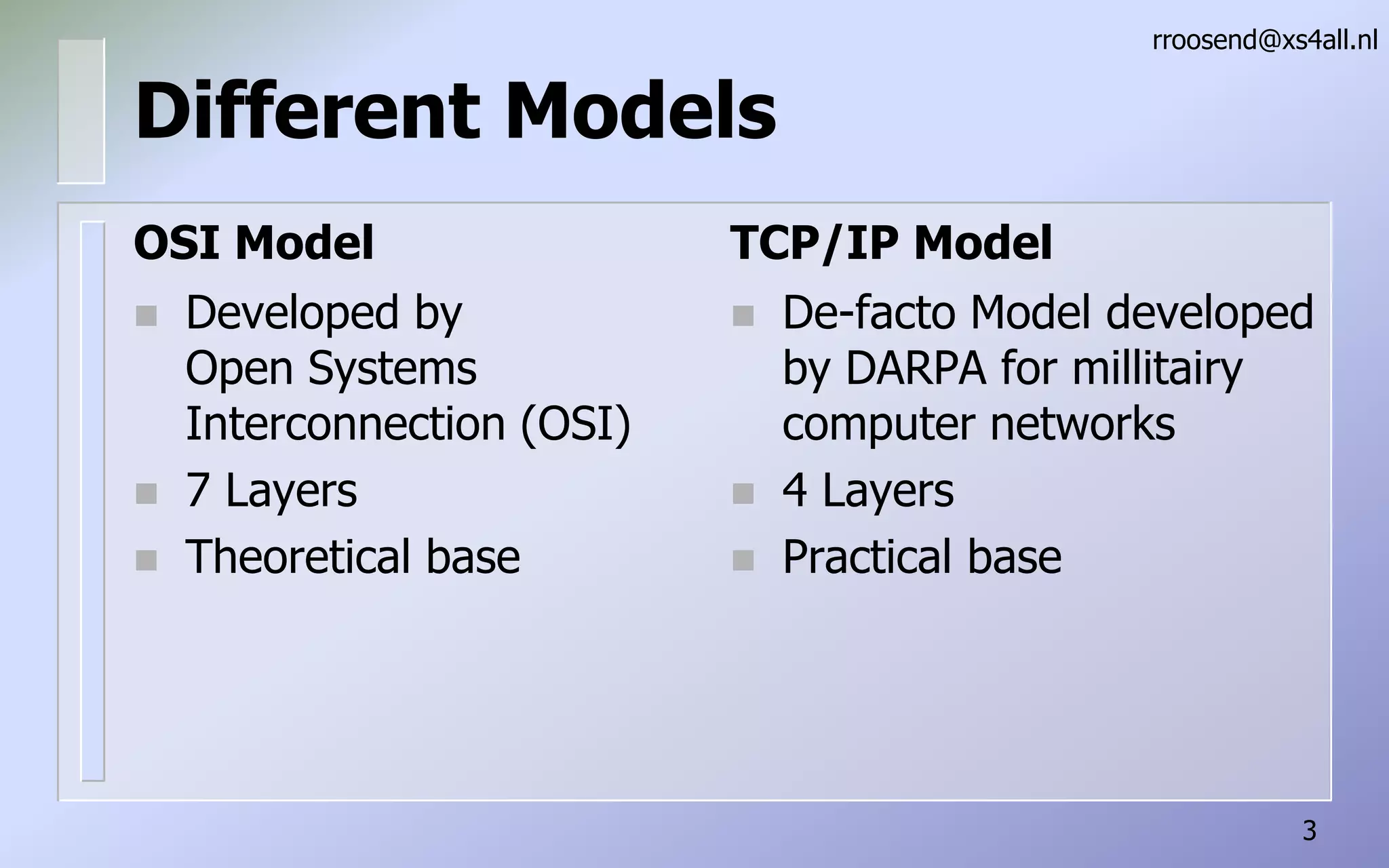
Different ModelsOSI ModelDeveloped by Open Systems Interconnection (OSI)7 LayersTheoretical baserroosend@xs4all.nl3TCP/IP ModelDe-facto Model developed by DARPA for millitairy computer networks4 LayersPractical base
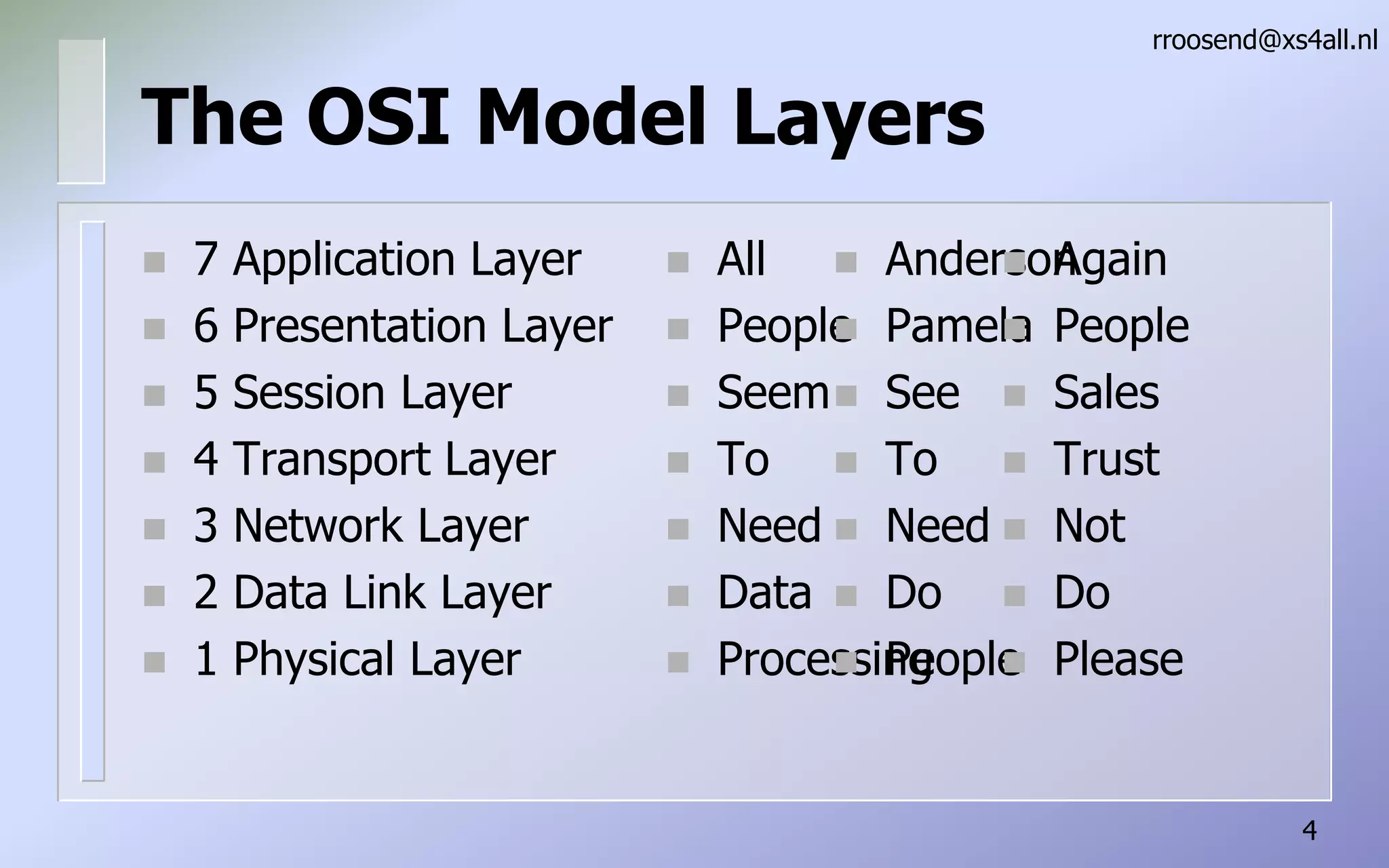
The OSI Model Layers7 Application Layer6 Presentation Layer5 Session Layer4 Transport Layer3 Network Layer2 Data Link Layer1 Physical LayerAllPeopleSeemToNeedDataProcessingrroosend@xs4all.nl4Anderson
Pamela
See
To
Need
Do
People
Again
People
Sales
Trust
Not
Do
PleaseThe Application Layer (OSI)Closest to the end userApplication layers interact directly with applicationUsers interact directly with applicationApplication layer functions:communication partnersdetermining resource availabilitysynchronizing communicationExamples: HTTP, FTP, SMTPrroosend@xs4all.nl5

Network Layered Models Rroosend

  • 1.
    NetworkLayered Models(CCNA1-Exploration)Rob Roosendaal,LecturerINHolland UniversityRegional Cisco Networking Academy
  • 2.
    Reasons to useLayersEasier to understand the different tasks of data communicationEasier to replace only one part of the whole data communication task stack (BNC / UTP / Fiber / Radio)Easier to study all the roles of data communication (Cisco says)rroosend@xs4all.nl2
  • 3.
    Different ModelsOSI ModelDevelopedby Open Systems Interconnection (OSI)7 LayersTheoretical baserroosend@xs4all.nl3TCP/IP ModelDe-facto Model developed by DARPA for millitairy computer networks4 LayersPractical base
  • 4.
    The OSI ModelLayers7 Application Layer6 Presentation Layer5 Session Layer4 Transport Layer3 Network Layer2 Data Link Layer1 Physical LayerAllPeopleSeemToNeedDataProcessingrroosend@xs4all.nl4Anderson
  • 5.
  • 6.
  • 7.
  • 8.
  • 9.
  • 10.
  • 11.
  • 12.
  • 13.
  • 14.
  • 15.
  • 16.
  • 17.
    PleaseThe Application Layer(OSI)Closest to the end userApplication layers interact directly with applicationUsers interact directly with applicationApplication layer functions:communication partnersdetermining resource availabilitysynchronizing communicationExamples: HTTP, FTP, SMTPrroosend@xs4all.nl5
  • 18.
    The Presentation Layer(OSI)Establishes context between Application Layer entitiesDifferent syntax and semanticsIndependence from differences in data representationTransforms data into form that application layer acceptExamples: Convert EBCDIC-coded file to ASCII-coded fileSerializes objects and other data structures from and to XMLrroosend@xs4all.nl6
  • 19.
    The Session Layer(OSI)Controls the connections between computersFull-duplex, half-duplex, or simplex operationCheckpointing, adjournment, termination, and restart proceduresGraceful close of sessionsImplemented explicitly in application environments that use remote procedure callsrroosend@xs4all.nl7
  • 20.
    The Transport Layer(OSI)Reliable data transfer services to the upper layers using flow control, segmentation/desegmentation, error control, windowingFive classes of connection-mode transport protocolsClass/TP 0 for less reliable to class/TP 4 for most reliablerroosend@xs4all.nl8
  • 21.
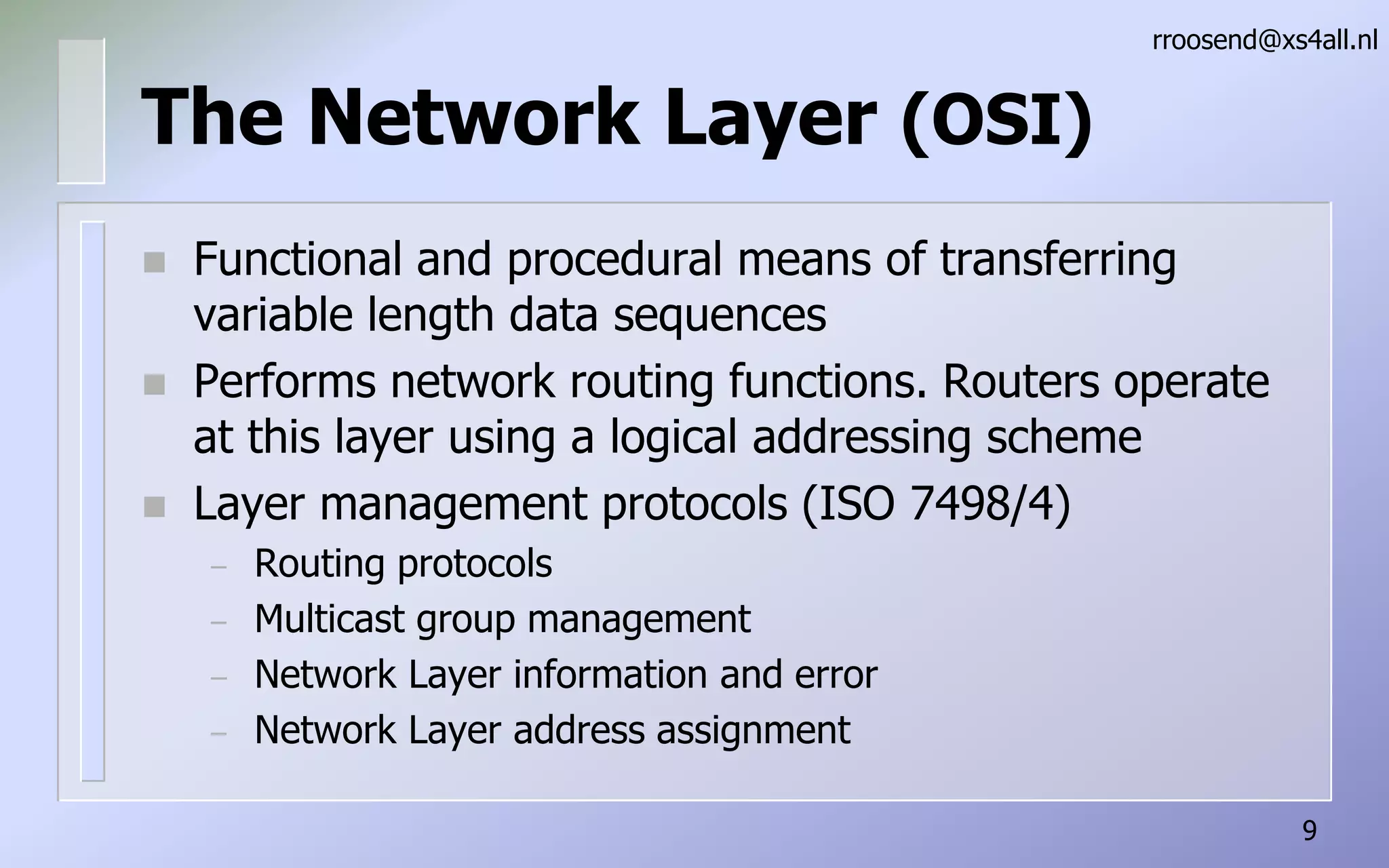
    The Network Layer(OSI)Functional and procedural means of transferring variable length data sequencesPerforms network routing functions. Routers operate at this layer using a logical addressing schemeLayer management protocols (ISO 7498/4)Routing protocolsMulticast group managementNetwork Layer information and errorNetwork Layer address assignmentrroosend@xs4all.nl9
  • 22.
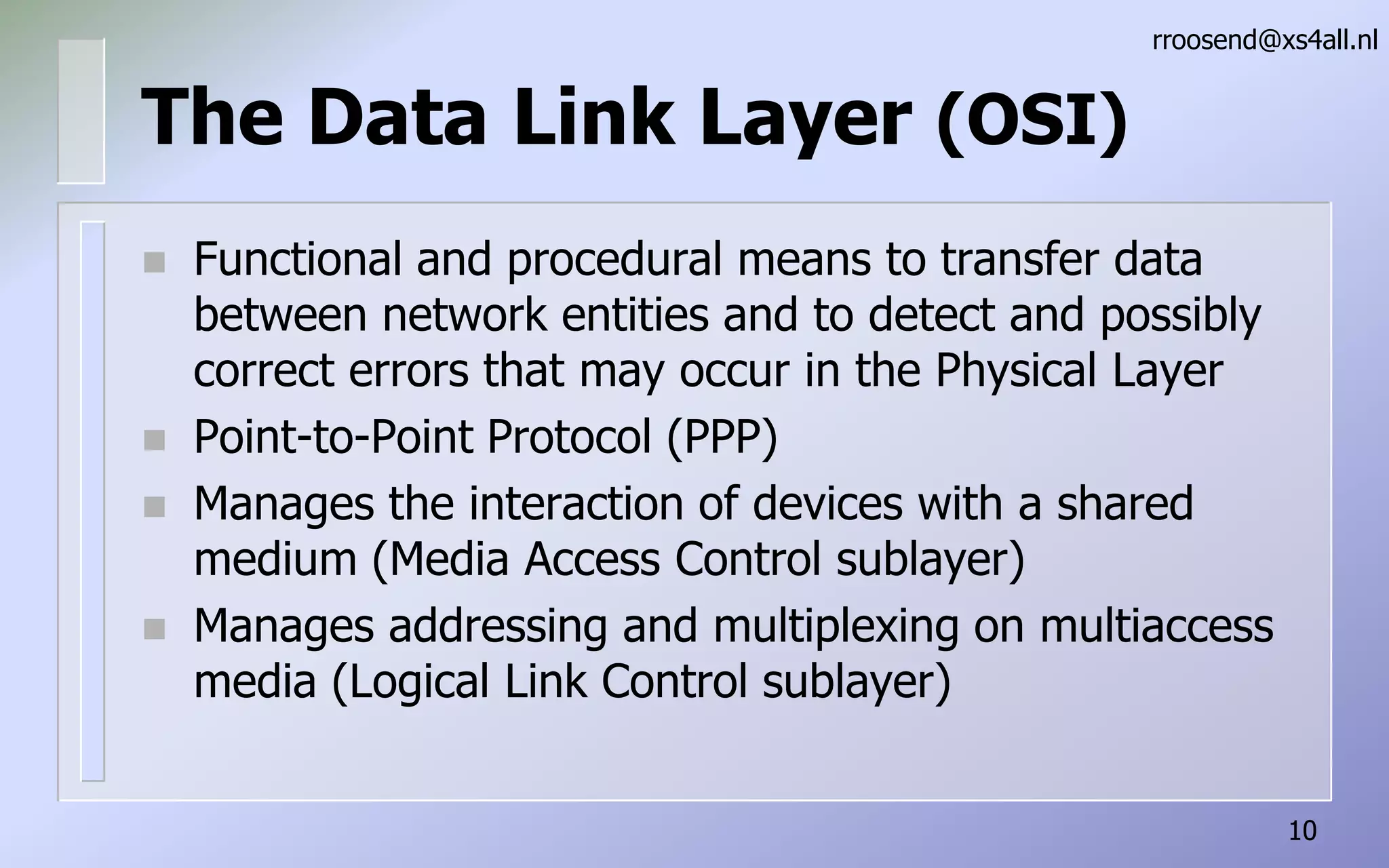
    The Data LinkLayer (OSI)Functional and procedural means to transfer data between network entities and to detect and possibly correct errors that may occur in the Physical LayerPoint-to-Point Protocol (PPP)Manages the interaction of devices with a shared medium (Media Access Control sublayer)Manages addressing and multiplexing on multiaccess media (Logical Link Control sublayer)rroosend@xs4all.nl10
  • 23.
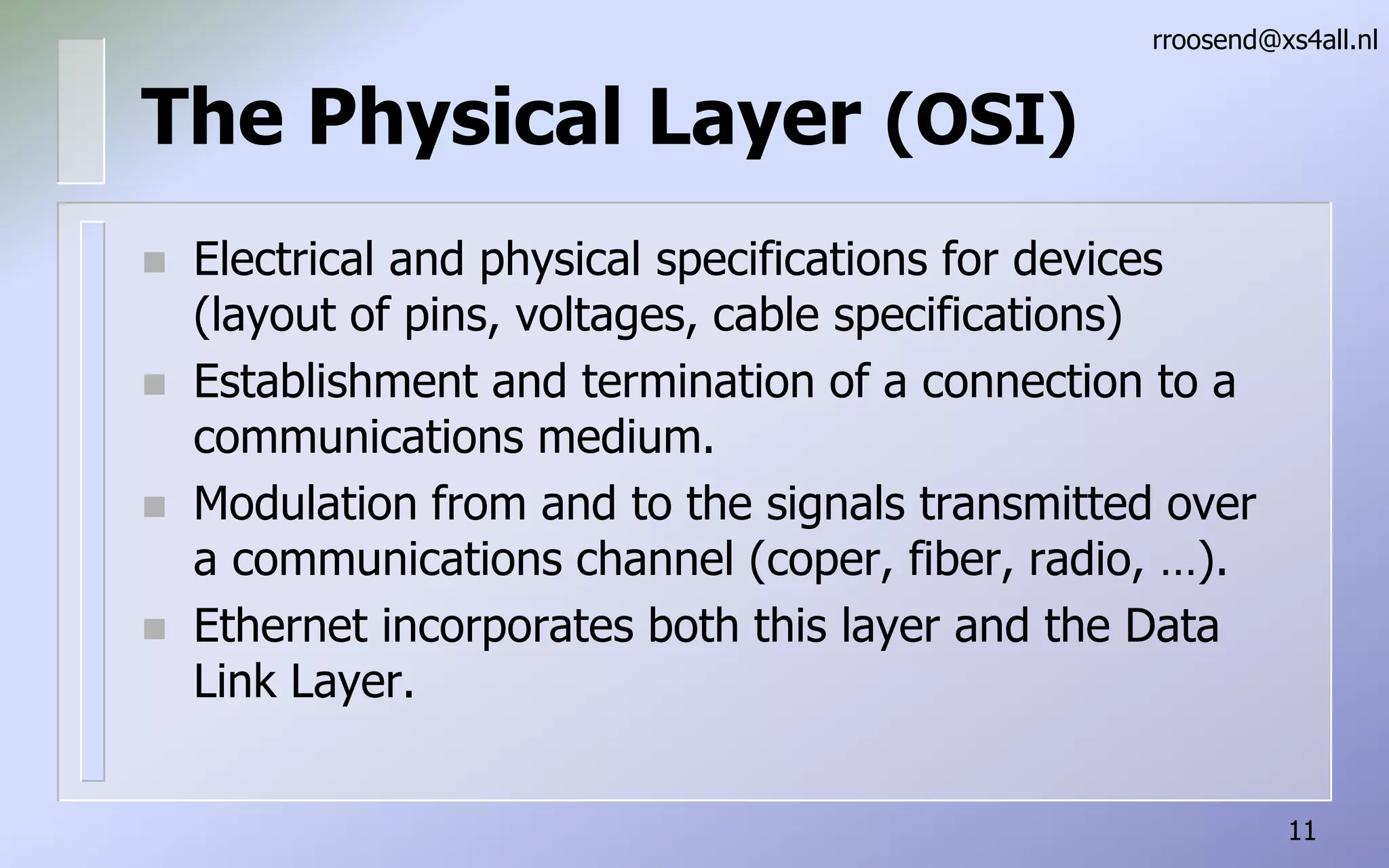
    The Physical Layer(OSI)Electrical and physical specifications for devices (layout of pins, voltages, cable specifications)Establishment and termination of a connection to a communications medium.Modulation from and to the signals transmitted over a communications channel (coper, fiber, radio, …). Ethernet incorporates both this layer and the Data Link Layer.rroosend@xs4all.nl11
  • 24.
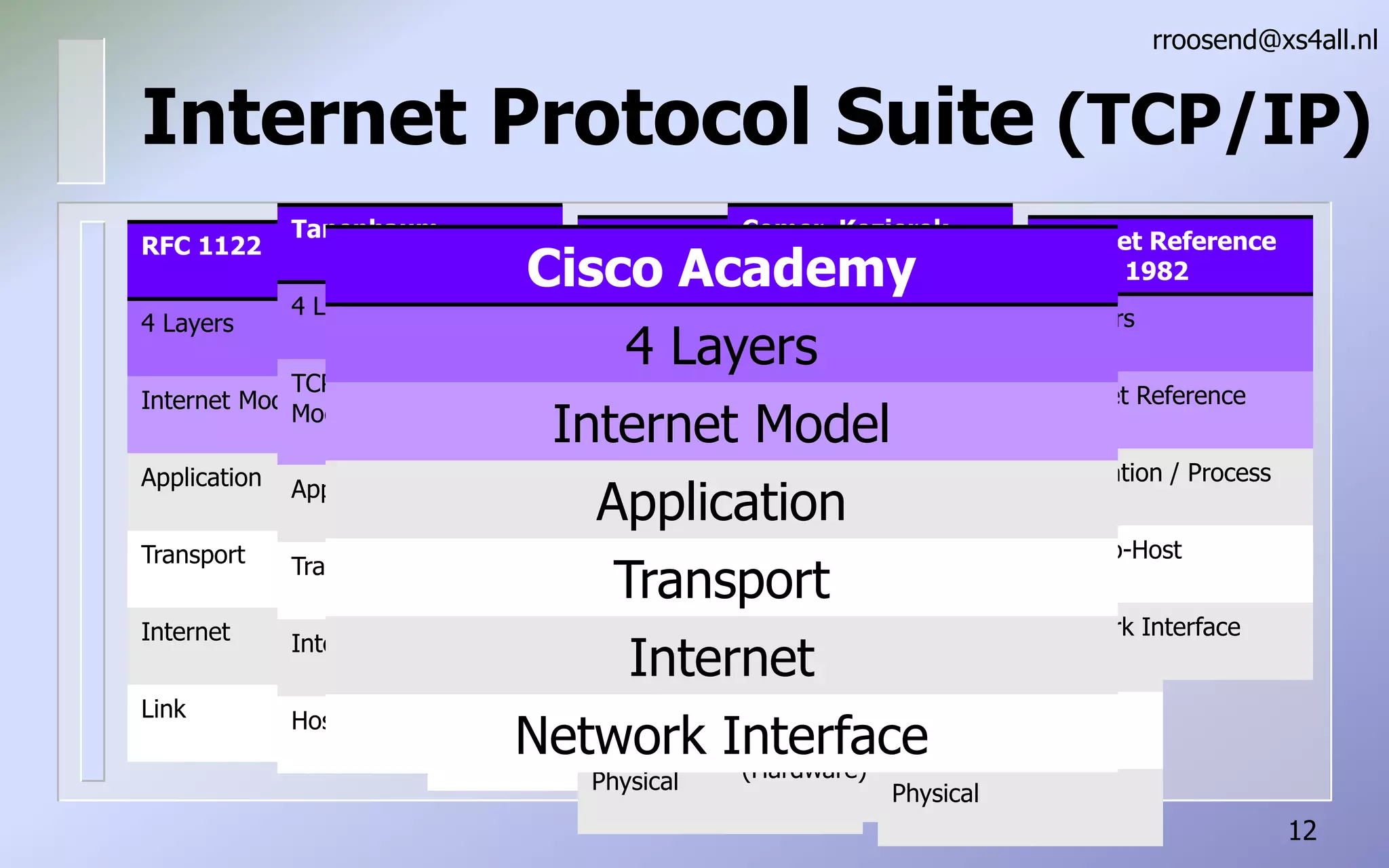
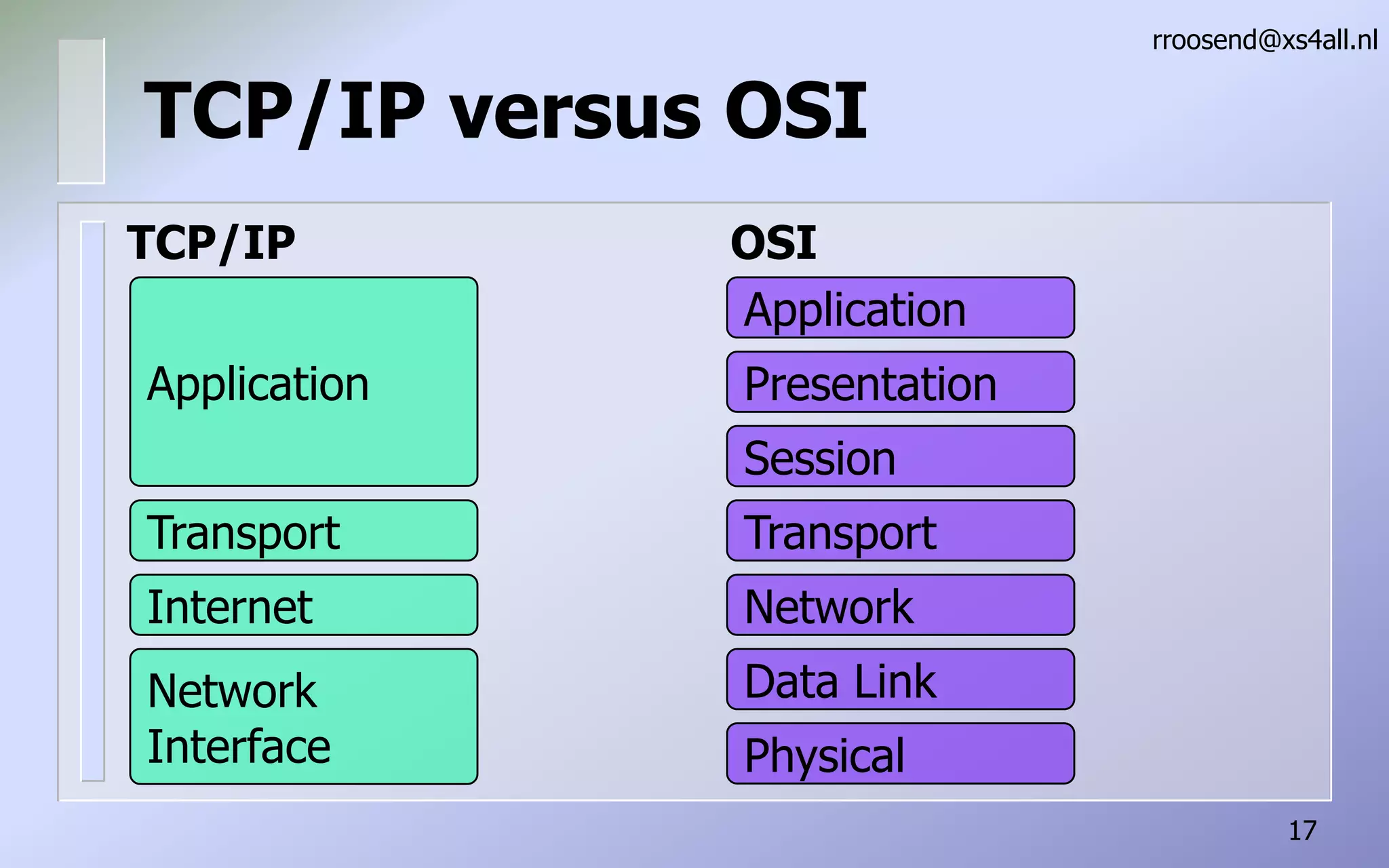
    Internet Protocol Suite(TCP/IP)rroosend@xs4all.nl12
  • 25.
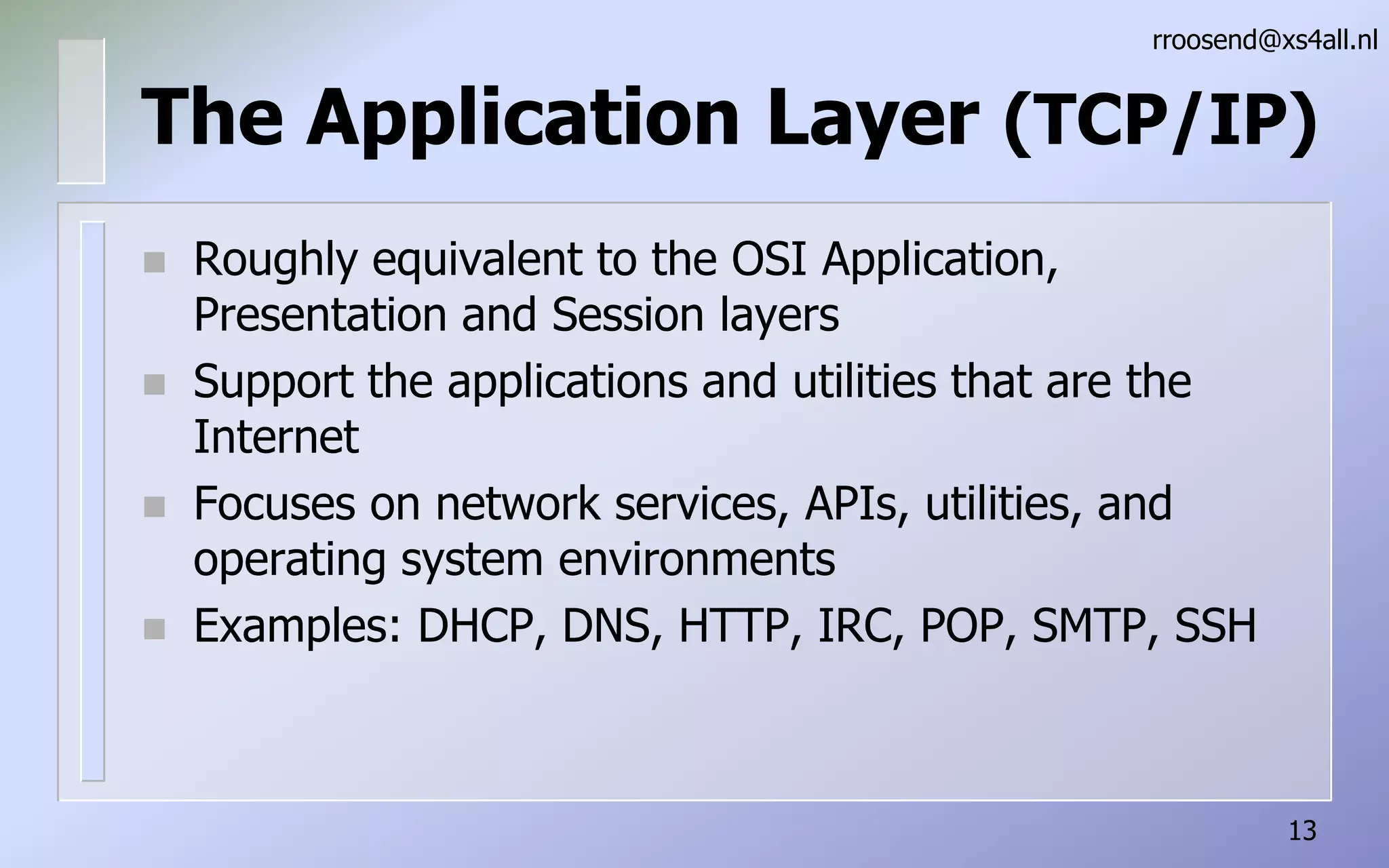
    The Application Layer(TCP/IP)Roughly equivalent to the OSI Application, Presentation and Session layersSupport the applications and utilities that are the InternetFocuses on network services, APIs, utilities, and operating system environmentsExamples: DHCP, DNS, HTTP, IRC, POP, SMTP, SSH rroosend@xs4all.nl13
  • 26.
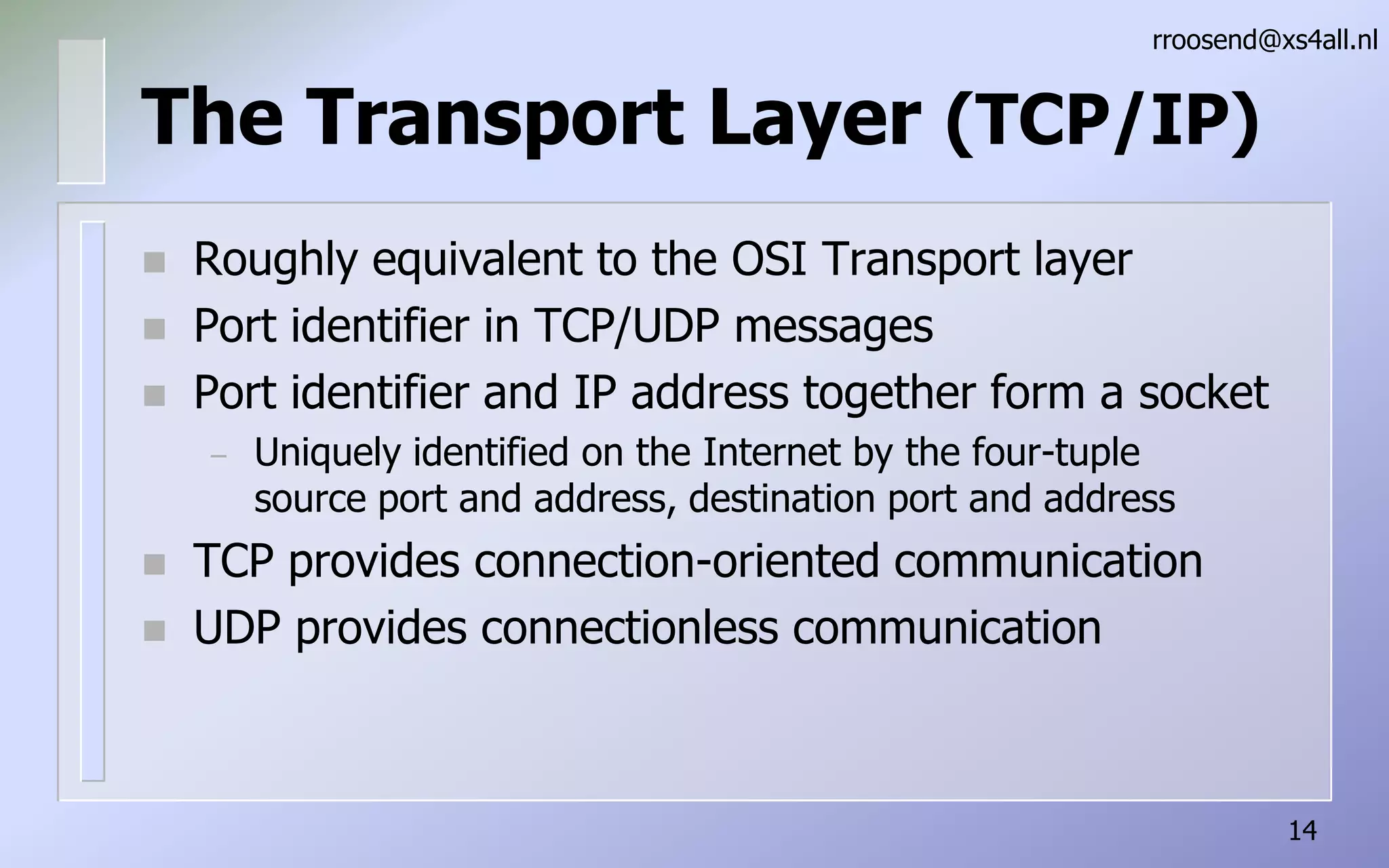
    The Transport Layer(TCP/IP)Roughly equivalent to the OSI Transport layerPort identifier in TCP/UDP messagesPort identifier and IP address together form a socketUniquely identified on the Internet by the four-tuplesource port and address, destination port and addressTCP provides connection-oriented communicationUDP provides connectionless communicationrroosend@xs4all.nl14
  • 27.
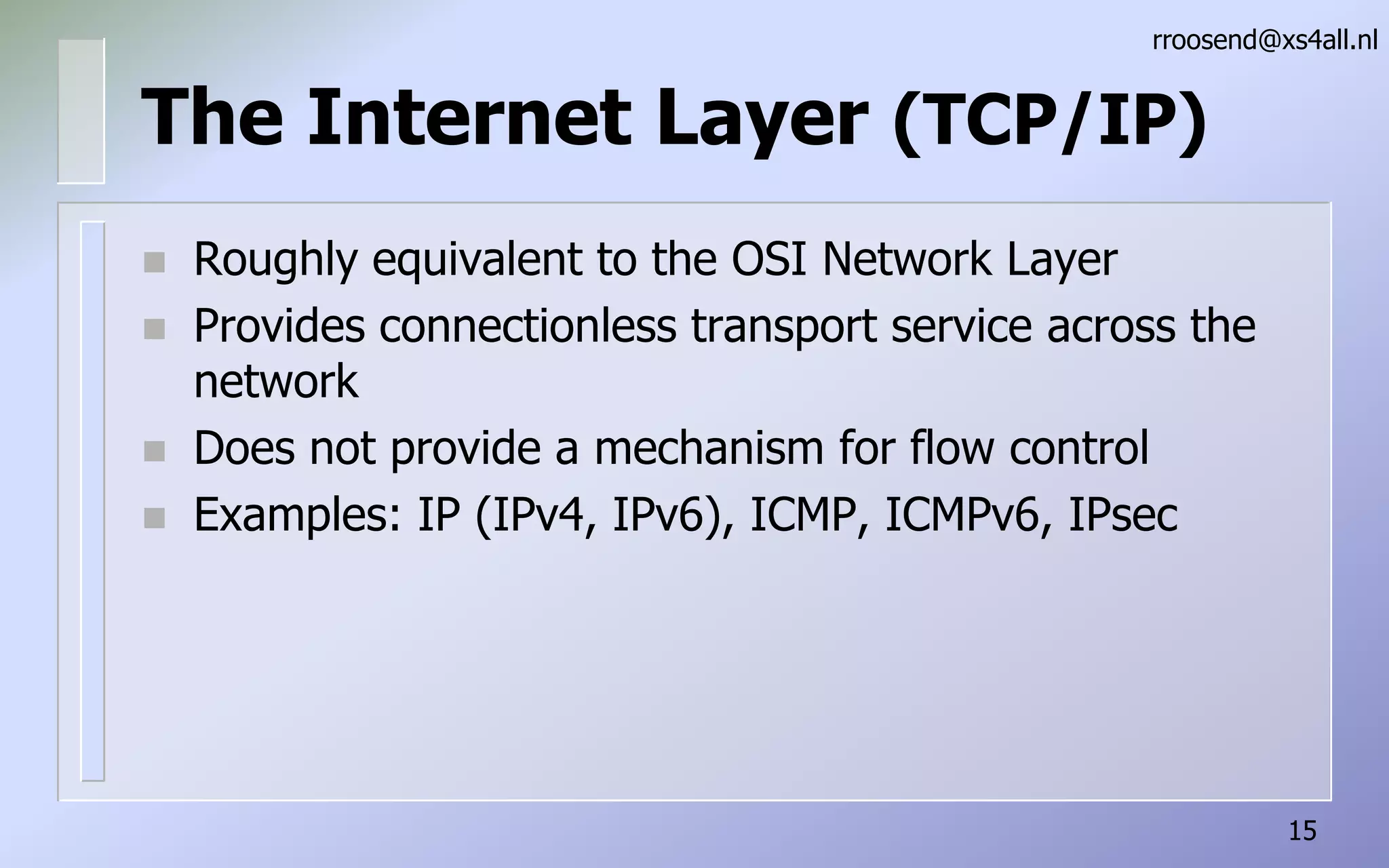
    The Internet Layer(TCP/IP)Roughly equivalent to the OSI Network LayerProvides connectionless transport service across the networkDoes not provide a mechanism for flow controlExamples: IP (IPv4, IPv6), ICMP, ICMPv6, IPsecrroosend@xs4all.nl15
  • 28.
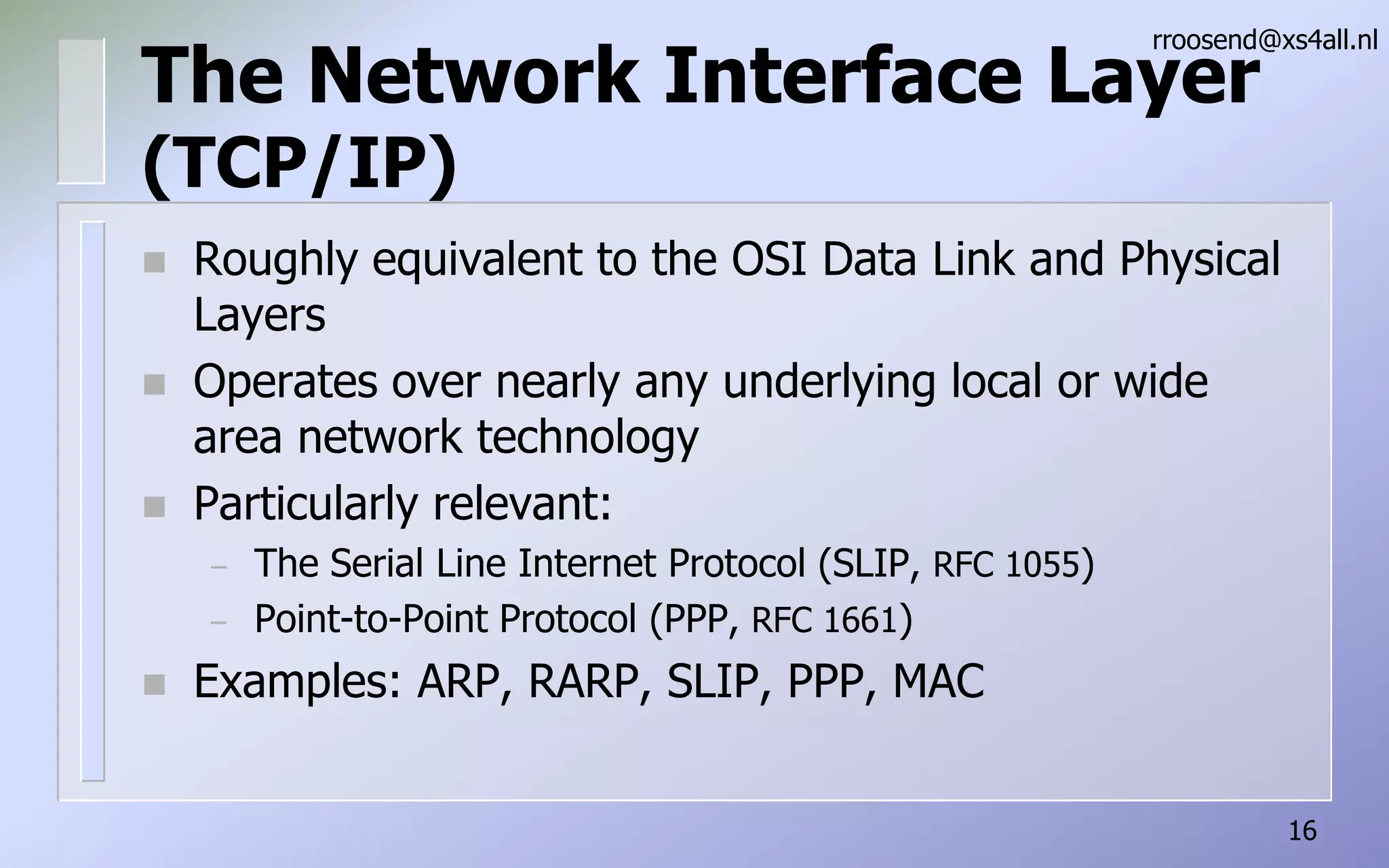
    The Network InterfaceLayer (TCP/IP)Roughly equivalent to the OSI Data Link and Physical LayersOperates over nearly any underlying local or wide area network technologyParticularly relevant: The Serial Line Internet Protocol (SLIP, RFC 1055) Point-to-Point Protocol (PPP, RFC 1661)Examples: ARP, RARP, SLIP, PPP, MACrroosend@xs4all.nl16
  • 29.