T3: Wide-Area
LAN Interconnection
TUTORIAL
 Network design considerations
 Building blocks of a LAN/WAN network
 Intelligent hub
 Bridge
 LAN Switch
 Router
 Telephone Company Service Options
Leased Lines
Switched 56
ISDN
Frame Relay
ATM
Sequence
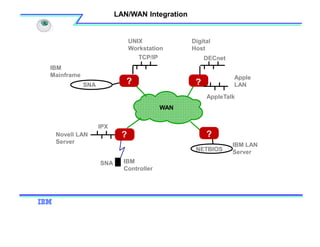
TCP/IP
SNA
IPX
DECnet
WAN
Novell LAN
Server
NETBIOS
IBM LAN
Server
IBM
Mainframe
UNIX
Workstation
Digital
Host
SNA IBM
Controller
AppleTalk
Apple
LAN
?
? ?
?
LAN/WAN Integration
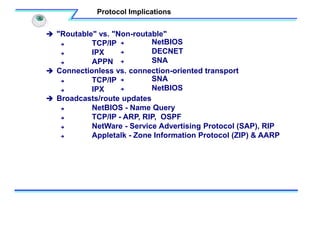
 "Routable" vs. "Non-routable"
 TCP/IP
 IPX
 APPN
 Connectionless vs. connection-oriented transport
 TCP/IP
 IPX
 Broadcasts/route updates
 NetBIOS - Name Query
 TCP/IP - ARP, RIP, OSPF
 NetWare - Service Advertising Protocol (SAP), RIP
 Appletalk - Zone Information Protocol (ZIP) & AARP
 NetBIOS
 DECNET
 SNA
 SNA
 NetBIOS
Protocol Implications
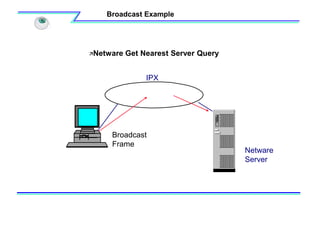
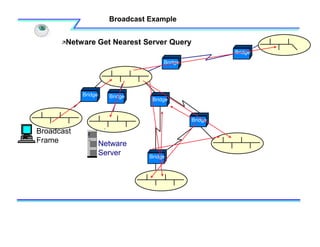
Broadcast
Frame
Netware Get Nearest Server Query
Netware
Server
IPX
Broadcast Example
 Network design considerations
 Building blocks of a LAN/WAN network
 Intelligent hub
 Bridge
 LAN Switch
 Router
 Telco WAN Options
 Leased Lines
 Switched 56
 ISDN
 Frame Relay
 ATM
Agenda
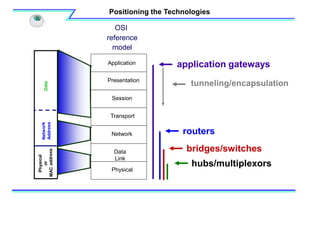
application gateways
Presentation
Session
Transport
Network
Data
Link
Physical
Application
OSI
reference
model
hubs/multiplexors
bridges/switches
routers
tunneling/encapsulation
Positioning the Technologies
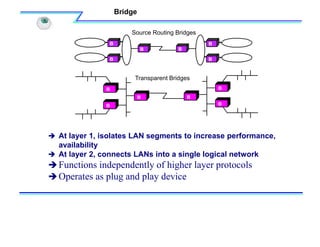
Source Routing Bridges
 At layer 1, isolates LAN segments to increase performance,
availability
 At layer 2, connects LANs into a single logical network
Functions independently of higher layer protocols
Operates as plug and play device
B
B
B
B
B
B
B
B
B
B
B
B
Transparent Bridges
Bridge
Bridge
Bridge
Bridge
Bridge
Bridge
Broadcast
Frame
Bridge
Bridge
Netware
Server
Netware Get Nearest Server Query
Broadcast Example
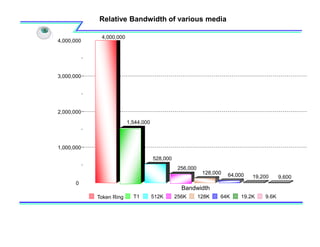
Token Ring
Bandwidth
0
1,000,000
2,000,000
3,000,000
4,000,000
4,000,000
1,544,000
528,000
256,000
128,000 64,000 19,200 9,600
T1 512K 256K 128K 64K 19.2K 9.6K
Relative Bandwidth of various media
Net A
Net C
Net D
Net E
Net 2
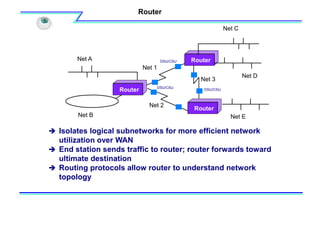
 Isolates logical subnetworks for more efficient network
utilization over WAN
 End station sends traffic to router; router forwards toward
ultimate destination
 Routing protocols allow router to understand network
topology
DSU/CSU
DSU/CSU
DSU/CSU Router
Router
Router
Net B
Net 3
Net 1
Router
Router
Router
Router
Router
Router
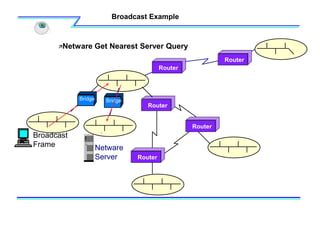
Broadcast
Frame
Bridge
Bridge
Netware
Server
Netware Get Nearest Server Query
Broadcast Example
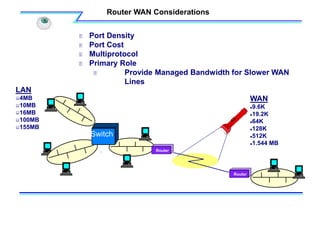
Router WAN Considerations
 Port Density
 Port Cost
 Multiprotocol
 Primary Role
 Provide Managed Bandwidth for Slower WAN
Lines
Switch
Router
Router
WAN
9.6K
19.2K
64K
128K
512K
1.544 MB
LAN
4MB
10MB
16MB
100MB
155MB
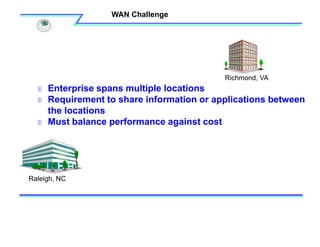
WAN Challenge
 Enterprise spans multiple locations
 Requirement to share information or applications between
the locations
 Must balance performance against cost
Raleigh, NC
Richmond, VA
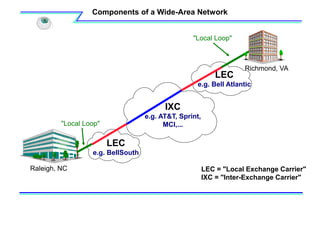
Components of a Wide-Area Network
Raleigh, NC
LEC
e.g. BellSouth
LEC
e.g. Bell Atlantic
IXC
e.g. AT&T, Sprint,
MCI,...
LEC = "Local Exchange Carrier"
IXC = "Inter-Exchange Carrier"
"Local Loop"
"Local Loop"
Richmond, VA
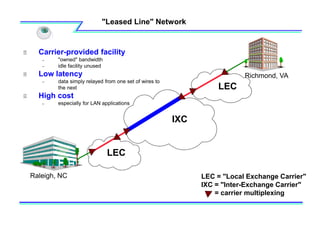
"Leased Line" Network
Raleigh, NC
LEC
LEC
IXC
LEC = "Local Exchange Carrier"
IXC = "Inter-Exchange Carrier"
= carrier multiplexing
Richmond, VA
 Carrier-provided facility
– "owned" bandwidth
– idle facility unused
 Low latency
– data simply relayed from one set of wires to
the next
 High cost
– especially for LAN applications
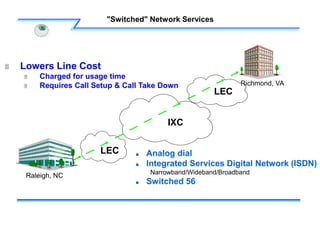
"Switched" Network Services
Raleigh, NC
LEC
LEC
IXC
 Analog dial
 Integrated Services Digital Network (ISDN)
Narrowband/Wideband/Broadband
 Switched 56
Richmond, VA
 Lowers Line Cost
 Charged for usage time
 Requires Call Setup & Call Take Down
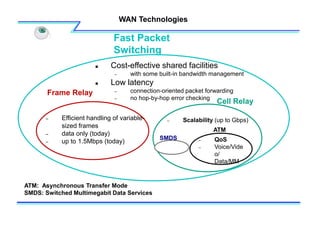
WAN Technologies
Fast Packet
Switching
Frame Relay
Cell Relay
ATM
SMDS
– Efficient handling of variable-
sized frames
– data only (today)
– up to 1.5Mbps (today)
– Scalability (up to Gbps)
– QoS
– Voice/Vide
o/
Data/MM
 Cost-effective shared facilities
– with some built-in bandwidth management
 Low latency
– connection-oriented packet forwarding
– no hop-by-hop error checking
ATM: Asynchronous Transfer Mode
SMDS: Switched Multimegabit Data Services
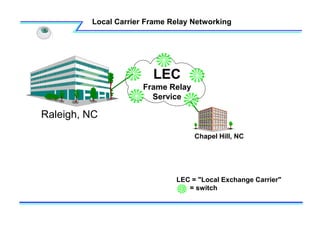
Local Carrier Frame Relay Networking
Raleigh, NC
LEC
Frame Relay
Service
LEC = "Local Exchange Carrier"
= switch
Chapel Hill, NC
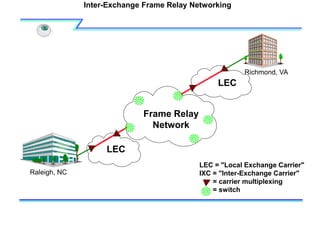
Inter-Exchange Frame Relay Networking
Raleigh, NC
LEC
LEC
Frame Relay
Network
LEC = "Local Exchange Carrier"
IXC = "Inter-Exchange Carrier"
= carrier multiplexing
= switch
Richmond, VA
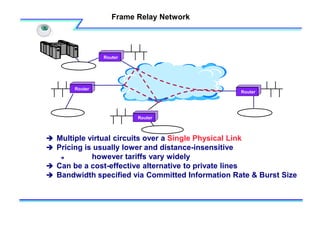
Frame Relay Network
ROUTER
 Multiple virtual circuits over a Single Physical Link
 Pricing is usually lower and distance-insensitive
 however tariffs vary widely
 Can be a cost-effective alternative to private lines
 Bandwidth specified via Committed Information Rate & Burst Size
Router
Router
Router
Router
Cell Relay: Asynchronous Transfer Mode (ATM)
 Digital service starting at 45Mbps
 Fixed length "cells" of data
 Voice, video, data, multimedia
 Bandwidth Management
 ITU-T Q.2931
 Quality of Service
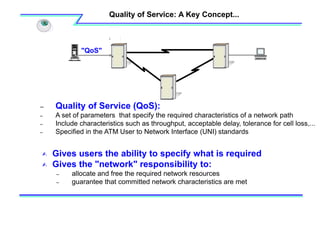
Quality of Service: A Key Concept...
– Quality of Service (QoS):
– A set of parameters that specify the required characteristics of a network path
– Include characteristics such as throughput, acceptable delay, tolerance for cell loss,...
– Specified in the ATM User to Network Interface (UNI) standards
 Gives users the ability to specify what is required
 Gives the "network" responsibility to:
– allocate and free the required network resources
– guarantee that committed network characteristics are met
"QoS"
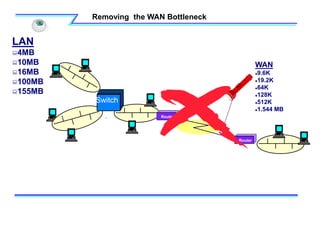
Removing the WAN Bottleneck
Switch
Router
Router
LAN
4MB
10MB
16MB
100MB
155MB
WAN
9.6K
19.2K
64K
128K
512K
1.544 MB
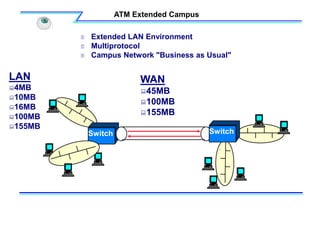
ATM Extended Campus
Switch
 Extended LAN Environment
 Multiprotocol
 Campus Network "Business as Usual"
LAN
4MB
10MB
16MB
100MB
155MB
WAN
45MB
100MB
155MB
Switch
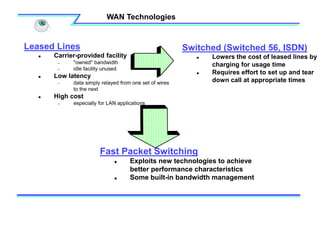
WAN Technologies
Fast Packet Switching
 Exploits new technologies to achieve
better performance characteristics
 Some built-in bandwidth management
Leased Lines
 Carrier-provided facility
– "owned" bandwidth
– idle facility unused
 Low latency
– data simply relayed from one set of wires
to the next
 High cost
– especially for LAN applications
Switched (Switched 56, ISDN)
 Lowers the cost of leased lines by
charging for usage time
 Requires effort to set up and tear
down call at appropriate times
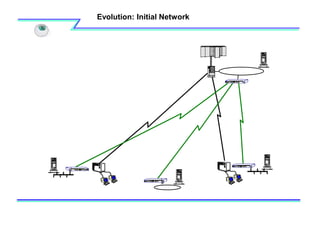
Evolution: Initial Network
OKReset
OKReset
OK
Reset
OK
Reset
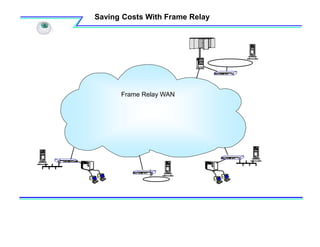
Saving Costs With Frame Relay
OKReset
OKReset
OK
Reset
OK
Reset
Frame Relay WAN
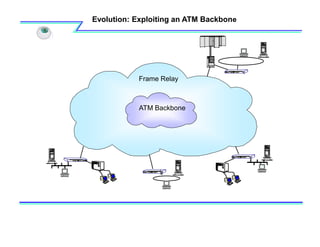
Evolution: Exploiting an ATM Backbone
OK
Reset
OKReset
OKReset
Frame Relay
ATM Backbone
OK
Reset
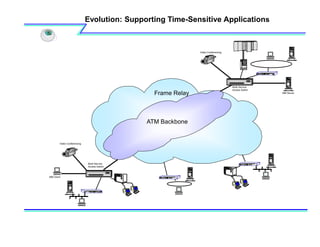
Evolution: Supporting Time-Sensitive Applications
OK
Reset
OK
Reset
OK
Reset
Frame Relay
ATM Backbone
MM Server
MM Client
Multi-Service
Access Switch
Multi-Service
Access Switch
Video Conferencing
Video Conferencing
OK
Reset
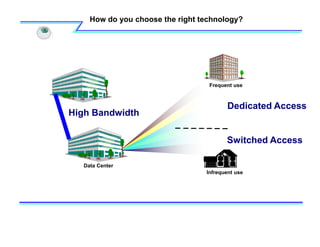
How do you choose the right technology?
Data Center
Infrequent use
Frequent use
Dedicated Access
Switched Access
High Bandwidth
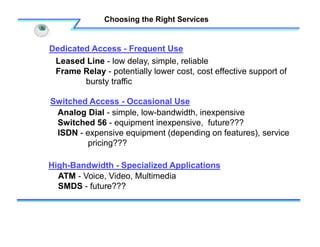
Choosing the Right Services
Switched Access - Occasional Use
Dedicated Access - Frequent Use
High-Bandwidth - Specialized Applications
Leased Line - low delay, simple, reliable
Frame Relay - potentially lower cost, cost effective support of
bursty traffic
Analog Dial - simple, low-bandwidth, inexpensive
Switched 56 - equipment inexpensive, future???
ISDN - expensive equipment (depending on features), service
pricing???
ATM - Voice, Video, Multimedia
SMDS - future???

NET6.PPT

  • 1.
  • 2.
     Network designconsiderations  Building blocks of a LAN/WAN network  Intelligent hub  Bridge  LAN Switch  Router  Telephone Company Service Options Leased Lines Switched 56 ISDN Frame Relay ATM Sequence
  • 3.
  • 4.
     "Routable" vs."Non-routable"  TCP/IP  IPX  APPN  Connectionless vs. connection-oriented transport  TCP/IP  IPX  Broadcasts/route updates  NetBIOS - Name Query  TCP/IP - ARP, RIP, OSPF  NetWare - Service Advertising Protocol (SAP), RIP  Appletalk - Zone Information Protocol (ZIP) & AARP  NetBIOS  DECNET  SNA  SNA  NetBIOS Protocol Implications
  • 5.
    Broadcast Frame Netware Get NearestServer Query Netware Server IPX Broadcast Example
  • 6.
     Network designconsiderations  Building blocks of a LAN/WAN network  Intelligent hub  Bridge  LAN Switch  Router  Telco WAN Options  Leased Lines  Switched 56  ISDN  Frame Relay  ATM Agenda
  • 7.
  • 8.
    Source Routing Bridges At layer 1, isolates LAN segments to increase performance, availability  At layer 2, connects LANs into a single logical network Functions independently of higher layer protocols Operates as plug and play device B B B B B B B B B B B B Transparent Bridges Bridge
  • 9.
  • 10.
    Token Ring Bandwidth 0 1,000,000 2,000,000 3,000,000 4,000,000 4,000,000 1,544,000 528,000 256,000 128,000 64,00019,200 9,600 T1 512K 256K 128K 64K 19.2K 9.6K Relative Bandwidth of various media
  • 11.
    Net A Net C NetD Net E Net 2  Isolates logical subnetworks for more efficient network utilization over WAN  End station sends traffic to router; router forwards toward ultimate destination  Routing protocols allow router to understand network topology DSU/CSU DSU/CSU DSU/CSU Router Router Router Net B Net 3 Net 1 Router
  • 12.
  • 13.
    Router WAN Considerations Port Density  Port Cost  Multiprotocol  Primary Role  Provide Managed Bandwidth for Slower WAN Lines Switch Router Router WAN 9.6K 19.2K 64K 128K 512K 1.544 MB LAN 4MB 10MB 16MB 100MB 155MB
  • 14.
    WAN Challenge  Enterprisespans multiple locations  Requirement to share information or applications between the locations  Must balance performance against cost Raleigh, NC Richmond, VA
  • 15.
    Components of aWide-Area Network Raleigh, NC LEC e.g. BellSouth LEC e.g. Bell Atlantic IXC e.g. AT&T, Sprint, MCI,... LEC = "Local Exchange Carrier" IXC = "Inter-Exchange Carrier" "Local Loop" "Local Loop" Richmond, VA
  • 16.
    "Leased Line" Network Raleigh,NC LEC LEC IXC LEC = "Local Exchange Carrier" IXC = "Inter-Exchange Carrier" = carrier multiplexing Richmond, VA  Carrier-provided facility – "owned" bandwidth – idle facility unused  Low latency – data simply relayed from one set of wires to the next  High cost – especially for LAN applications
  • 17.
    "Switched" Network Services Raleigh,NC LEC LEC IXC  Analog dial  Integrated Services Digital Network (ISDN) Narrowband/Wideband/Broadband  Switched 56 Richmond, VA  Lowers Line Cost  Charged for usage time  Requires Call Setup & Call Take Down
  • 18.
    WAN Technologies Fast Packet Switching FrameRelay Cell Relay ATM SMDS – Efficient handling of variable- sized frames – data only (today) – up to 1.5Mbps (today) – Scalability (up to Gbps) – QoS – Voice/Vide o/ Data/MM  Cost-effective shared facilities – with some built-in bandwidth management  Low latency – connection-oriented packet forwarding – no hop-by-hop error checking ATM: Asynchronous Transfer Mode SMDS: Switched Multimegabit Data Services
  • 19.
    Local Carrier FrameRelay Networking Raleigh, NC LEC Frame Relay Service LEC = "Local Exchange Carrier" = switch Chapel Hill, NC
  • 20.
    Inter-Exchange Frame RelayNetworking Raleigh, NC LEC LEC Frame Relay Network LEC = "Local Exchange Carrier" IXC = "Inter-Exchange Carrier" = carrier multiplexing = switch Richmond, VA
  • 21.
    Frame Relay Network ROUTER Multiple virtual circuits over a Single Physical Link  Pricing is usually lower and distance-insensitive  however tariffs vary widely  Can be a cost-effective alternative to private lines  Bandwidth specified via Committed Information Rate & Burst Size Router Router Router Router
  • 22.
    Cell Relay: AsynchronousTransfer Mode (ATM)  Digital service starting at 45Mbps  Fixed length "cells" of data  Voice, video, data, multimedia  Bandwidth Management  ITU-T Q.2931  Quality of Service
  • 23.
    Quality of Service:A Key Concept... – Quality of Service (QoS): – A set of parameters that specify the required characteristics of a network path – Include characteristics such as throughput, acceptable delay, tolerance for cell loss,... – Specified in the ATM User to Network Interface (UNI) standards  Gives users the ability to specify what is required  Gives the "network" responsibility to: – allocate and free the required network resources – guarantee that committed network characteristics are met "QoS"
  • 24.
    Removing the WANBottleneck Switch Router Router LAN 4MB 10MB 16MB 100MB 155MB WAN 9.6K 19.2K 64K 128K 512K 1.544 MB
  • 25.
    ATM Extended Campus Switch Extended LAN Environment  Multiprotocol  Campus Network "Business as Usual" LAN 4MB 10MB 16MB 100MB 155MB WAN 45MB 100MB 155MB Switch
  • 26.
    WAN Technologies Fast PacketSwitching  Exploits new technologies to achieve better performance characteristics  Some built-in bandwidth management Leased Lines  Carrier-provided facility – "owned" bandwidth – idle facility unused  Low latency – data simply relayed from one set of wires to the next  High cost – especially for LAN applications Switched (Switched 56, ISDN)  Lowers the cost of leased lines by charging for usage time  Requires effort to set up and tear down call at appropriate times
  • 27.
  • 28.
    Saving Costs WithFrame Relay OKReset OKReset OK Reset OK Reset Frame Relay WAN
  • 29.
    Evolution: Exploiting anATM Backbone OK Reset OKReset OKReset Frame Relay ATM Backbone OK Reset
  • 30.
    Evolution: Supporting Time-SensitiveApplications OK Reset OK Reset OK Reset Frame Relay ATM Backbone MM Server MM Client Multi-Service Access Switch Multi-Service Access Switch Video Conferencing Video Conferencing OK Reset
  • 31.
    How do youchoose the right technology? Data Center Infrequent use Frequent use Dedicated Access Switched Access High Bandwidth
  • 32.
    Choosing the RightServices Switched Access - Occasional Use Dedicated Access - Frequent Use High-Bandwidth - Specialized Applications Leased Line - low delay, simple, reliable Frame Relay - potentially lower cost, cost effective support of bursty traffic Analog Dial - simple, low-bandwidth, inexpensive Switched 56 - equipment inexpensive, future??? ISDN - expensive equipment (depending on features), service pricing??? ATM - Voice, Video, Multimedia SMDS - future???