Introduction to .net
What is .Net framework?
.Net framework is a software development platform designed by Microsoft.
The framework was meant to create applications, which would run on the
Windows Platform. The first version of the .Net framework was released in
the year 2000.
The version was Named .Net framework 1.0. The .Net framework has
travelled a lot way since then, and the latest version is 4.6.1.
The .Net framework can be used to create both windows based and Web
based applications. Web services can also be enhanced using the .Net
framework.
.NET Framework Objective
1. Create a environment for Object Oriented Programming.
2. To create for environment for making Form based application and web based
application .
3. To see to it that coding of .net framework should integrate with every other code
.NET Framework
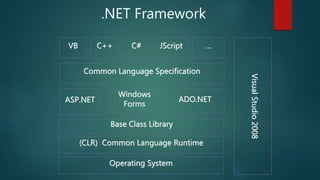
Common Language Specification
(CLR) Common Language Runtime
ADO.NET
C#
VisualStudio2008
ASP.NET
JScript …
Windows
Forms
VB C++
Operating System
Base Class Library
.NET Framework contains:
The Common Language Specification (CLS)
It contains set of rules, that language should follow so that they can contact with
other .NET languages. It is also leads for Type matching.
The Framework Base Class Libraries (BCL)
A persistent, object-oriented library of prepacked functionality and Applications.
The Common Language Runtime (CLR)
A language-neutral development & execution environment that provides common
runtime for application run .
CLS performs the following functions:
1. Establishes a framework that helps enable cross-language integration, type
safety, and high performance code execution
2. Provides an object-oriented model that supports the complete implementation
many programming languages
3. Defines rules that languages must follow, which helps ensure that objects
in different languages can interact with each other
.NET Framework Base Class Library
• The Class Library is a comprehensive, object-oriented collection of reusable types
• These class library can be used to develop applications that include:
– Traditional command-line applications
– Graphical user interface (GUI) applications
– Applications based on the latest innovations provided by ASP.NET
• Web Forms
• XML Web services
Common Language Runtime (CLR)
CLR:
1. Common runtime environment for all .NET languages
2. Use Common Type System
3. Memory allocation and Bin collection
4. Intermediate Language to local code compiler. Which Compiles MSIL code
into local executable code
5. Security and inner compilation of the code with other languages
There are over 36 language which are supported here are few:
1. C#, VB, Jscript, Visual C++ from Microsoft
2. Perl, Python, Smalltalk, Cobol, Haskell, Mercury, Eiffel, Oberon, Oz, Pascal,
APL, CAML, Scheme, etc.

.Net the begining

  • 1.
  • 2.
    What is .Netframework? .Net framework is a software development platform designed by Microsoft. The framework was meant to create applications, which would run on the Windows Platform. The first version of the .Net framework was released in the year 2000. The version was Named .Net framework 1.0. The .Net framework has travelled a lot way since then, and the latest version is 4.6.1. The .Net framework can be used to create both windows based and Web based applications. Web services can also be enhanced using the .Net framework.
  • 3.
    .NET Framework Objective 1.Create a environment for Object Oriented Programming. 2. To create for environment for making Form based application and web based application . 3. To see to it that coding of .net framework should integrate with every other code
  • 4.
    .NET Framework Common LanguageSpecification (CLR) Common Language Runtime ADO.NET C# VisualStudio2008 ASP.NET JScript … Windows Forms VB C++ Operating System Base Class Library
  • 5.
    .NET Framework contains: TheCommon Language Specification (CLS) It contains set of rules, that language should follow so that they can contact with other .NET languages. It is also leads for Type matching. The Framework Base Class Libraries (BCL) A persistent, object-oriented library of prepacked functionality and Applications. The Common Language Runtime (CLR) A language-neutral development & execution environment that provides common runtime for application run .
  • 6.
    CLS performs thefollowing functions: 1. Establishes a framework that helps enable cross-language integration, type safety, and high performance code execution 2. Provides an object-oriented model that supports the complete implementation many programming languages 3. Defines rules that languages must follow, which helps ensure that objects in different languages can interact with each other
  • 7.
    .NET Framework BaseClass Library • The Class Library is a comprehensive, object-oriented collection of reusable types • These class library can be used to develop applications that include: – Traditional command-line applications – Graphical user interface (GUI) applications – Applications based on the latest innovations provided by ASP.NET • Web Forms • XML Web services
  • 8.
    Common Language Runtime(CLR) CLR: 1. Common runtime environment for all .NET languages 2. Use Common Type System 3. Memory allocation and Bin collection 4. Intermediate Language to local code compiler. Which Compiles MSIL code into local executable code 5. Security and inner compilation of the code with other languages There are over 36 language which are supported here are few: 1. C#, VB, Jscript, Visual C++ from Microsoft 2. Perl, Python, Smalltalk, Cobol, Haskell, Mercury, Eiffel, Oberon, Oz, Pascal, APL, CAML, Scheme, etc.