Basics of .NET
Gowarthini Bhuvaneshraja
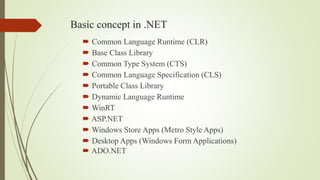
Basic concept in .NET
 Common Language Runtime (CLR)
 Base Class Library
 Common Type System (CTS)
 Common Language Specification (CLS)
 Portable Class Library
 Dynamic Language Runtime
 WinRT
 ASP.NET
 Windows Store Apps (Metro Style Apps)
 Desktop Apps (Windows Form Applications)
 ADO.NET
What is .NET ?
 The .NET Framework is a software framework for developing and
implementing software for personal computer, web etc.
 It was designed and is maintained by Microsoft Corporation.
 It came out around the year 2000, even though Microsoft started
its development in early 90s.
 .NET is a free, cross-platform, open source developer platform for
building many different types of applications.
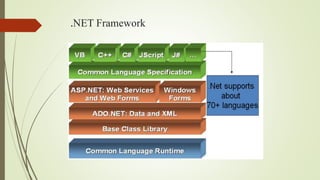
.NET Framework
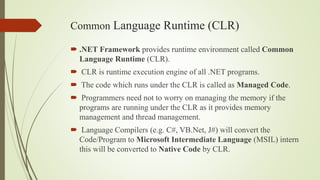
Common Language Runtime (CLR)
 .NET Framework provides runtime environment called Common
Language Runtime (CLR).
 CLR is runtime execution engine of all .NET programs.
 The code which runs under the CLR is called as Managed Code.
 Programmers need not to worry on managing the memory if the
programs are running under the CLR as it provides memory
management and thread management.
 Language Compilers (e.g. C#, VB.Net, J#) will convert the
Code/Program to Microsoft Intermediate Language (MSIL) intern
this will be converted to Native Code by CLR.
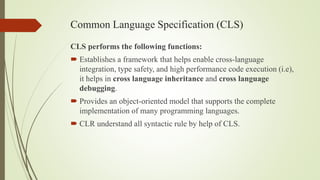
Common Language Specification (CLS)
CLS performs the following functions:
 Establishes a framework that helps enable cross-language
integration, type safety, and high performance code execution (i.e),
it helps in cross language inheritance and cross language
debugging.
 Provides an object-oriented model that supports the complete
implementation of many programming languages.
 CLR understand all syntactic rule by help of CLS.
Common Type System(CTS)
 CTS is deals with the data types.
 It describes set of data types that can be used in different .NET
languages in common.
 The common type system supports two general categories of types:
* Value types
* Reference types
 CLR can understand all language datatype because it follow the
CTS.
Base Class Library (BCL)
 BCL is also called FCL (Framework Class Library).
 Base class library is divided into two part that
* Userdefine Class Library
* Predefine Class Library
 Userdefine Class Library is the way you access the Library Classes
and Methods in VB.NET will be the same in C#, and it is common
for all other languages in .NET.
 Developers just need to import the BCL in their language code and
use its predefined methods
Portable Class Library
 The Portable Class Library project enables you to write and build
managed assemblies that work on more than one .NET Framework
platform.
 the Portable Class Library (PCL) allows the targeting of a set of
platforms.
 For example WPF is a Windows application, it's a Desktop based
application.
 All these applications run on the .NET framework but a different
environment and platform but they all can easily use the Portable
Class Library.
Dynamic Language Runtime
 The dynamic language runtime (DLR) is a runtime environment
that adds a set of services for dynamic languages to the common
language runtime (CLR).
 The DLR makes it easier to develop dynamic languages to run on
the .NET Framework and to add dynamic features to statically typed
languages.
 Dynamic languages can identify the type of an object at run time,
whereas in statically typed languages such as C# and Visual Basic
you must specify object types at design time.
WinRt
 Windows Runtime (WinRT) is a platform-agnostic application
architecture first introduced in Windows 8 and Windows Server
2012 in 2012.
 WinRT supports development in C++/WinRT (standard
C++), C++/CX (Component Extensions, a language based
on C++), JavaScriptTypeScript, and the managedcode
languages C# and Visual Basic .NET (VB.NET)
 WinRT components are designed with interoperability between
multiple languages and APIs in mind, including native, managed
and scripting languages.
ASP.NET
 ASP.NET is a part of Microsoft .NET platform.
 ASP.NET is an open-source server-side web
application framework designed for web development to produce
dynamic web pages.
 ASP.NET is built on the Common Language Runtime (CLR),
allowing programmers to write ASP.NET code using any supported
.NET language.
 ASP.NET applications are compiled codes, written using the
extensible and reusable components or objects present in
.NET framework.
Windows store Apps (Metro Style Apps)
 Metro style apps are designed to leverage special hardware
capabilities and context information to create an experience that is
tailored for the user.
 Metro style apps are full screen apps tailored to your users’ needs,
tailored to the device they run on, tailored for touch interaction, and
tailored to the Windows user interface.
 Windows helps you interact with your users, and your users interact
with your app. R
Desktop Apps (Windows Form Apps)
 An application that runs stand-alone in a desktop or laptop
computer.
 The term may be used to contrast desktop applications with
mobile applications that run in smartphones and tablets.
 Examples of some applications: Windows File Explorer (to find
files on your computer) Microsoft Office applications (Word, Excel,
etc.)
ADO .NET
 ADO.NET is a set of computer software components that
programmers can use to access data and data services from a
database
 It is a part of the base class library that is included with the
Microsoft .NET Framework.
 It is commonly used by programmers to access and modify data
stored in relational database systems, though it can also access data
in non-relational data sources.
Feature of .NET
 Good design.
 OOP- Object Oriented Programming Language
without class we are not create the single application in .NET.
 Language independent.
 Platform independent.
 Flexible data access.
 Web services.
 Code security(CAS).
.Net

.Net

  • 1.
  • 2.
    Basic concept in.NET  Common Language Runtime (CLR)  Base Class Library  Common Type System (CTS)  Common Language Specification (CLS)  Portable Class Library  Dynamic Language Runtime  WinRT  ASP.NET  Windows Store Apps (Metro Style Apps)  Desktop Apps (Windows Form Applications)  ADO.NET
  • 3.
    What is .NET?  The .NET Framework is a software framework for developing and implementing software for personal computer, web etc.  It was designed and is maintained by Microsoft Corporation.  It came out around the year 2000, even though Microsoft started its development in early 90s.  .NET is a free, cross-platform, open source developer platform for building many different types of applications.
  • 4.
  • 5.
    Common Language Runtime(CLR)  .NET Framework provides runtime environment called Common Language Runtime (CLR).  CLR is runtime execution engine of all .NET programs.  The code which runs under the CLR is called as Managed Code.  Programmers need not to worry on managing the memory if the programs are running under the CLR as it provides memory management and thread management.  Language Compilers (e.g. C#, VB.Net, J#) will convert the Code/Program to Microsoft Intermediate Language (MSIL) intern this will be converted to Native Code by CLR.
  • 6.
    Common Language Specification(CLS) CLS performs the following functions:  Establishes a framework that helps enable cross-language integration, type safety, and high performance code execution (i.e), it helps in cross language inheritance and cross language debugging.  Provides an object-oriented model that supports the complete implementation of many programming languages.  CLR understand all syntactic rule by help of CLS.
  • 7.
    Common Type System(CTS) CTS is deals with the data types.  It describes set of data types that can be used in different .NET languages in common.  The common type system supports two general categories of types: * Value types * Reference types  CLR can understand all language datatype because it follow the CTS.
  • 8.
    Base Class Library(BCL)  BCL is also called FCL (Framework Class Library).  Base class library is divided into two part that * Userdefine Class Library * Predefine Class Library  Userdefine Class Library is the way you access the Library Classes and Methods in VB.NET will be the same in C#, and it is common for all other languages in .NET.  Developers just need to import the BCL in their language code and use its predefined methods
  • 9.
    Portable Class Library The Portable Class Library project enables you to write and build managed assemblies that work on more than one .NET Framework platform.  the Portable Class Library (PCL) allows the targeting of a set of platforms.  For example WPF is a Windows application, it's a Desktop based application.  All these applications run on the .NET framework but a different environment and platform but they all can easily use the Portable Class Library.
  • 10.
    Dynamic Language Runtime The dynamic language runtime (DLR) is a runtime environment that adds a set of services for dynamic languages to the common language runtime (CLR).  The DLR makes it easier to develop dynamic languages to run on the .NET Framework and to add dynamic features to statically typed languages.  Dynamic languages can identify the type of an object at run time, whereas in statically typed languages such as C# and Visual Basic you must specify object types at design time.
  • 11.
    WinRt  Windows Runtime(WinRT) is a platform-agnostic application architecture first introduced in Windows 8 and Windows Server 2012 in 2012.  WinRT supports development in C++/WinRT (standard C++), C++/CX (Component Extensions, a language based on C++), JavaScriptTypeScript, and the managedcode languages C# and Visual Basic .NET (VB.NET)  WinRT components are designed with interoperability between multiple languages and APIs in mind, including native, managed and scripting languages.
  • 12.
    ASP.NET  ASP.NET isa part of Microsoft .NET platform.  ASP.NET is an open-source server-side web application framework designed for web development to produce dynamic web pages.  ASP.NET is built on the Common Language Runtime (CLR), allowing programmers to write ASP.NET code using any supported .NET language.  ASP.NET applications are compiled codes, written using the extensible and reusable components or objects present in .NET framework.
  • 13.
    Windows store Apps(Metro Style Apps)  Metro style apps are designed to leverage special hardware capabilities and context information to create an experience that is tailored for the user.  Metro style apps are full screen apps tailored to your users’ needs, tailored to the device they run on, tailored for touch interaction, and tailored to the Windows user interface.  Windows helps you interact with your users, and your users interact with your app. R
  • 14.
    Desktop Apps (WindowsForm Apps)  An application that runs stand-alone in a desktop or laptop computer.  The term may be used to contrast desktop applications with mobile applications that run in smartphones and tablets.  Examples of some applications: Windows File Explorer (to find files on your computer) Microsoft Office applications (Word, Excel, etc.)
  • 15.
    ADO .NET  ADO.NETis a set of computer software components that programmers can use to access data and data services from a database  It is a part of the base class library that is included with the Microsoft .NET Framework.  It is commonly used by programmers to access and modify data stored in relational database systems, though it can also access data in non-relational data sources.
  • 16.
    Feature of .NET Good design.  OOP- Object Oriented Programming Language without class we are not create the single application in .NET.  Language independent.  Platform independent.  Flexible data access.  Web services.  Code security(CAS).