Unit 1
Microsoft .Net Technology
History
• Late 1990’s – Next generation windows services
(NGWS)
• Late 2000 the first beta versions of .NET 1.0 released
• Version 3.0 of .Net framework is included with
windows server 2008 and windows vista
• Version 3.5 is included with windows 7
• On April 12, 2010 .NET Framework 4 was released
along side Visual Studio 2010
• .NET Micro Framework released for mobile and
embedded devices.
History
.Net based Web standards
• UDDI : is a standard on which .NET is based in order to
discover and search various Web services.(universal
Description, Discovery and Interoperability)
• SOAP:defines the standard format to be used when
requesting any web service (Simple Object Access
protocols)
• HTTP: Commincation protocol between various
Internet Applications
• XML: Defines the format to be used for exchanging
data between various Internet applications
What is .NET?
• It is a new environment for developing and
running software applications
• It provides the framework for an internet-
centric industry standard that makes it
possible to implement a service oriented
architecture by tying together applications,
information and data sources using web
services.
What is .NET?
• It enables software to become platform and
device independent
• It employs many standard run time services
available to components written ina variety of
programming languages
• It has inter language and inter machine
operability
.Net
• It not a language
• It is not an operating system
• It is not any network device
Microsoft Vision
• All devices will some day be connected by a
global broadband network(Internet) and that
software will become service provided over
this network.
• .NET has been applied to everything from next
version of the Windows operating system to
development tools.
Problems before .NET
• Registration of COM components: Before
installing any application, COM compoenets
had to be registered, The window registry
becomes more heavy and increase the time of
booting process.
Problems before .NET
• Unloading COM components: COM objects
also required a special logic for freeing up the
objects from memory. This method is known
as reference counting of COM objects.
• Circular reference exist between two COM
componets. So deadlock will occur
Problems before .NET
• Versioning Problem (DLL hell): DLL would
overwritten when some other applications
were installed on the same computer. It would
refer to wrong DLL. This caused a major
problem when an application was referring to
particular version of a DLL – dynamic link
library
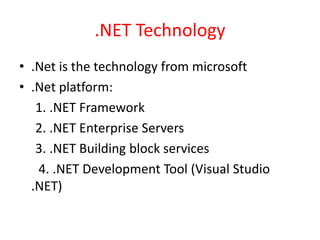
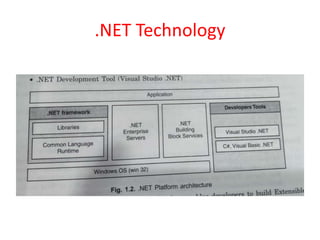
.NET Technology
• .Net is the technology from microsoft
• .Net platform:
1. .NET Framework
2. .NET Enterprise Servers
3. .NET Building block services
4. .NET Development Tool (Visual Studio
.NET)
.NET Technology
Features of .Net Platform
• Single Programming Model
• Distributed Systems
• Richer User Interface
• Support for multiple Languages
• Extendibility
• Portability
• Intergrity
.NET Framework
• To provide a consistent object oriented
programming environment
• To provide a code-execution environment that
minimize software deployment and versioning
conflicts
• To provide a code execution environment that
promotes safe execution of code and
eliminates the performance of the problem
.NET Framework
• .Net framework provides the necessary
compile time and run time foundation to build
and run .NET based applications
• Two main components
1.Common language runtime
2..NET Framework class library
1.Common language runtime
• Foundation of .Net Framework
• It is an agent that manages code at execution
time and providing services like memory
management, thread management. Also
provide safety and code accuracy.
• Code that targets the runtime is known as
managed code
• Code that does not targets the runtime is
known as unmanaged code
2..NET Framework class library
• Develop applications from traditional
command line or graphical user interface
(GUI) applications such as web forms and
XML web services
Visual studio .NET
• Microsoft visual studio is an integrated
development environment (IDE) from Microsoft.
• It helps programmers create standalone
applications, Web applications, Web services and
web sites that run on microsoft windows, smart
devices and the web
• Visual Basic .NET
• Visual C++.NET
• Visual C#. NET
• Visual j#
.NET LANGUAGES
• It has the ability to support multiple languages
is one of the primary benefits of the .NET
framework.
• Enterprises can feel confident investing in the
.NET platform
• It supports languages in two different ways
1.native language support (VB.NET, C#.NET,
VC++.NET, J#.NET)
2.non native or third party language

Microsoft .Net Technology

  • 1.
  • 2.
    History • Late 1990’s– Next generation windows services (NGWS) • Late 2000 the first beta versions of .NET 1.0 released • Version 3.0 of .Net framework is included with windows server 2008 and windows vista • Version 3.5 is included with windows 7 • On April 12, 2010 .NET Framework 4 was released along side Visual Studio 2010 • .NET Micro Framework released for mobile and embedded devices.
  • 3.
  • 4.
    .Net based Webstandards • UDDI : is a standard on which .NET is based in order to discover and search various Web services.(universal Description, Discovery and Interoperability) • SOAP:defines the standard format to be used when requesting any web service (Simple Object Access protocols) • HTTP: Commincation protocol between various Internet Applications • XML: Defines the format to be used for exchanging data between various Internet applications
  • 5.
    What is .NET? •It is a new environment for developing and running software applications • It provides the framework for an internet- centric industry standard that makes it possible to implement a service oriented architecture by tying together applications, information and data sources using web services.
  • 6.
    What is .NET? •It enables software to become platform and device independent • It employs many standard run time services available to components written ina variety of programming languages • It has inter language and inter machine operability
  • 7.
    .Net • It nota language • It is not an operating system • It is not any network device
  • 8.
    Microsoft Vision • Alldevices will some day be connected by a global broadband network(Internet) and that software will become service provided over this network. • .NET has been applied to everything from next version of the Windows operating system to development tools.
  • 9.
    Problems before .NET •Registration of COM components: Before installing any application, COM compoenets had to be registered, The window registry becomes more heavy and increase the time of booting process.
  • 10.
    Problems before .NET •Unloading COM components: COM objects also required a special logic for freeing up the objects from memory. This method is known as reference counting of COM objects. • Circular reference exist between two COM componets. So deadlock will occur
  • 11.
    Problems before .NET •Versioning Problem (DLL hell): DLL would overwritten when some other applications were installed on the same computer. It would refer to wrong DLL. This caused a major problem when an application was referring to particular version of a DLL – dynamic link library
  • 12.
    .NET Technology • .Netis the technology from microsoft • .Net platform: 1. .NET Framework 2. .NET Enterprise Servers 3. .NET Building block services 4. .NET Development Tool (Visual Studio .NET)
  • 13.
  • 14.
    Features of .NetPlatform • Single Programming Model • Distributed Systems • Richer User Interface • Support for multiple Languages • Extendibility • Portability • Intergrity
  • 15.
    .NET Framework • Toprovide a consistent object oriented programming environment • To provide a code-execution environment that minimize software deployment and versioning conflicts • To provide a code execution environment that promotes safe execution of code and eliminates the performance of the problem
  • 16.
    .NET Framework • .Netframework provides the necessary compile time and run time foundation to build and run .NET based applications • Two main components 1.Common language runtime 2..NET Framework class library
  • 17.
    1.Common language runtime •Foundation of .Net Framework • It is an agent that manages code at execution time and providing services like memory management, thread management. Also provide safety and code accuracy. • Code that targets the runtime is known as managed code • Code that does not targets the runtime is known as unmanaged code
  • 18.
    2..NET Framework classlibrary • Develop applications from traditional command line or graphical user interface (GUI) applications such as web forms and XML web services
  • 19.
    Visual studio .NET •Microsoft visual studio is an integrated development environment (IDE) from Microsoft. • It helps programmers create standalone applications, Web applications, Web services and web sites that run on microsoft windows, smart devices and the web • Visual Basic .NET • Visual C++.NET • Visual C#. NET • Visual j#
  • 20.
    .NET LANGUAGES • Ithas the ability to support multiple languages is one of the primary benefits of the .NET framework. • Enterprises can feel confident investing in the .NET platform • It supports languages in two different ways 1.native language support (VB.NET, C#.NET, VC++.NET, J#.NET) 2.non native or third party language