NERVOUS SYSTEM
By K.chitra
Nervous system
The nervous system is a complex collection
of nerves and specialized cells known as
neurons that transmit signals between
different parts of the body. It is essentially
the body's electrical wiring. Structurally,
the nervous system has two components:
the central nervous system and the
peripheral nervous system.
COMPONENTS OF NERVOUS SYSTEM
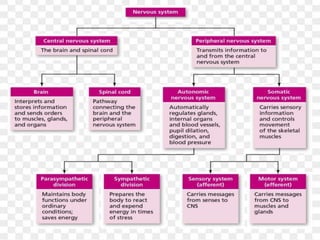
NERVOUS SYSTEM
Structure
Function
CENTRAL NERVOUS SYSTEM
BRAIN AND SPINAL CORD
Integrative and control centres.
PERIPHERAL NERVOUS SYSTEM
Cranial Nerves and spinal Nervous
Communication lines between the CNS
and the rest of the body.
Sensory nerves (Afferent nerves)
Somatic and visceral sensory nerve fibers
Conducts impulses from receptor to CNS
Motor nerves(efferent nerves)
Motor nerve fibers
Conducts impulses from CNS to effectors
(Muscles and glands)
Sympathetic nerves
Mobilizes body systems during activity
(“Fight or flight’’ response)
Parasympathetic nerves
Conserves energy
Promotes “house keeping’’ functions
during rest.
Autonomic nerve
system(ANS)
Visceral motor
(involuntary)
Conducts impulses from
the CNS to cardiac
muscles ,smooth muscles
and glands
Somatic nervous
system
Somatic motor
{voluntary)
Conducts impulses
from the CNS to
skeletal muscles.
CENTRAL NERVOUS
SYSTEM
CNS
CONSIST OF:
• Brain
• Spinal Cord
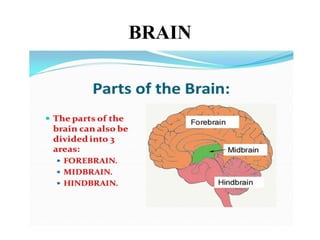
BRAIN
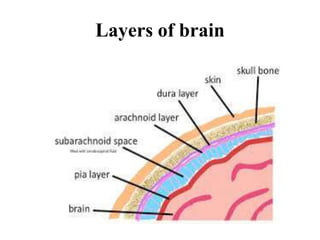
COVERING OF BRAIN AND
SPINAL CORD
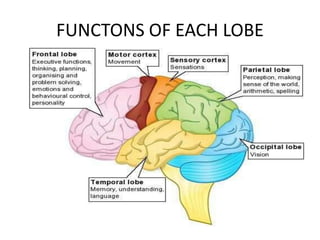
EACH BRAIN CONSIST OF 4 LOBES
LOBES
Each brain consist of:
• 1 Frontal
• 2 Parietal
• 2 Temporal
• 1 Occipital
FUNCTONS OF EACH LOBE
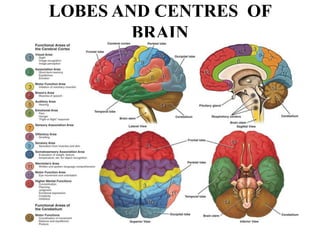
LOBES AND CENTRES OF
BRAIN
Layers of brain
EMBRIONIC BRAIN
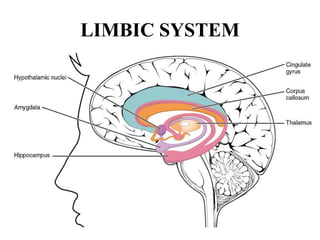
LIMBIC SYSTEM
• The limbic system is composed of numerous
structures, including the amygdala, thalamus,
hypothalamus, hippocampus, corpus callosum
(callus), and several other brain segments. The
limbic lobe manages psychological responses
to emotional stimuli.
• It is associated with memory, attention,
emotions, sexual urges, character, and
behavior.
LIMBIC SYSTEM

Nervous system

  • 1.
  • 2.
    Nervous system The nervoussystem is a complex collection of nerves and specialized cells known as neurons that transmit signals between different parts of the body. It is essentially the body's electrical wiring. Structurally, the nervous system has two components: the central nervous system and the peripheral nervous system.
  • 3.
  • 5.
    NERVOUS SYSTEM Structure Function CENTRAL NERVOUSSYSTEM BRAIN AND SPINAL CORD Integrative and control centres. PERIPHERAL NERVOUS SYSTEM Cranial Nerves and spinal Nervous Communication lines between the CNS and the rest of the body. Sensory nerves (Afferent nerves) Somatic and visceral sensory nerve fibers Conducts impulses from receptor to CNS Motor nerves(efferent nerves) Motor nerve fibers Conducts impulses from CNS to effectors (Muscles and glands) Sympathetic nerves Mobilizes body systems during activity (“Fight or flight’’ response) Parasympathetic nerves Conserves energy Promotes “house keeping’’ functions during rest. Autonomic nerve system(ANS) Visceral motor (involuntary) Conducts impulses from the CNS to cardiac muscles ,smooth muscles and glands Somatic nervous system Somatic motor {voluntary) Conducts impulses from the CNS to skeletal muscles.
  • 6.
  • 7.
  • 8.
  • 10.
    COVERING OF BRAINAND SPINAL CORD
  • 11.
  • 12.
    LOBES Each brain consistof: • 1 Frontal • 2 Parietal • 2 Temporal • 1 Occipital
  • 13.
  • 14.
  • 15.
  • 16.
  • 17.
    LIMBIC SYSTEM • Thelimbic system is composed of numerous structures, including the amygdala, thalamus, hypothalamus, hippocampus, corpus callosum (callus), and several other brain segments. The limbic lobe manages psychological responses to emotional stimuli. • It is associated with memory, attention, emotions, sexual urges, character, and behavior.
  • 18.