Homeostasis
and the nervous
system
Homeostasis
• The body is designed in such a
way that all the organs and organ
systems work together in order
to maintain homeostasis or
maintaining the internal
environment in equilibrium
• All organ systems are controlled
by the nervous system while the
endocrine system secretes
hormones that regulate all the
body’s activities.
The Nervous System
• The nervous system coordinates
and regulates the body’s
feedback mechanisms to
maintain homeostasis.
• It is highly organized and
complex collection of nerves (a
collection of neurons) and
neurons, specialized cells that
transmit messages to and from
the brain and spinal cord to
other parts of the body.
• Neurons that receive
messages from the senses
and send them to the Central
Nervous System (CNS) are
called afferent neurons.
• Efferent neurons send
messages from the Central
Nervous System (CNS) to
the different parts of the
body.
The Nervous System
Parts of a Neuron
Cell body – the support center of the
neuron. If the outgoing message is to
be sent away, it passes from the cell
body to the axon, which passes those
messages away from the cell body to
the axon terminal and onto other
neurons or other body parts.
Dendrites – receive signals from other
neurons or from the body, and pass
those messages along to the cell body.
Myelin sheath – a protective layer around some axons and helps
speed up the signal messages
The signal messages travel as electric signals, and as they reach the
end of a neuron, chemical called neurotransmitters are stimulated.
These chemicals travel through the space in between neurons/ other
body cells called synapses. It is through neurotransmitters that the
nervous system can regulate the body’s activities.
• The Nervous system is divided
into 2:
1. The Central Nervous System
(CNS) – consists of the brain and
spinal cord
2. Peripheral Nervous System (PNS)
– made up of nerves and sensory
organs
The Nervous System
Part of the
Brain
Description and Function
Cerebrum The major outer part of the brain. It is divided
into two hemispheres: the left and the right.
The left hemisphere controls the right side of
the body and vice versa. These two hemispheres
are connected by the corpus callosum. Each
hemisphere is further divided into sections
called lobes. It is responsible for sensing,
thinking, learning emotions, and voluntary
movement. It also controls the five senses.
The central Nervous System
4 LOBES FUNCTIONS
Frontal Lobe Responsible for cognitive functions and
movements
Parietal lobe Responsible for processing touch, pain,
temperature, and movement
Occipital
lobe
Responsible for vision
Temporal
lobe
Responsible for speech, learning and memory
The central Nervous System
Part of the
Brain
Description and Function
Cerebellum At the back part of the brain. It controls
balance and fine muscle movement.
The central Nervous System
Part of the Brain Description and Function
Brain Stem At the bottom of the brain. This connects
the cerebrum to the spinal cord. It is
divided into 3 parts: midbrain, the pons,
and medulla. The brain stem controls
bodily functions like breathing, circulation
and sleep.
The central Nervous System
Part of the Brain Description and Function
Limbic System Under the cerebrum and inside the temporal
lobe, it is composed of several structures: the
amygdala, hippocampus, thalamus, and
hypothalamus. These structures are responsible
for basic biological needs like hunger, thirst,
and temperature control, higher mental
functions like memories, and emotional
responses.
The thalamus also serves as the relay center,
where incoming and outgoing messages are
The central Nervous System
• The brain is very important but
fragile. It is protected by the
skull, the meninges, and
cerebrospinal fluid.
• The skull is like a bony helmet,
while the meninges are layers of
tissue. Cerebrospinal fluid is
watery fluid that flows in and
around the brain and the spinal
cord that cushions both parts.
The central Nervous System
• The spinal cord is an
elongated bundle of neurons
connected to the brain via
the brain stem. It goes all
the way down to the
tailbone at our lower back.
• It is protected by bones
and is divided into five
sections: cervical, thoracic,
lumbar, sacral, and
coccygeal.
The central Nervous System
•Made up of the rest of
the body’s nerves and
sensory organs.
•Subdivided into: somatic
nervous system and
autonomic nervous system
The peripheral Nervous System
• Is in charge of voluntary body movements and transmits sensory
messages to the CNS
• Also controls involuntary movements called reflexes. A reflex is an
involuntary muscle response to a stimulus (something that causes
an action) without input from the brain.
• The pathway a reflex takes is called a reflex arc. This means the
reflex arc connects to the spinal cord, bypassing the brain so that
the reflex arc is not delayed.
• The pathway of the reflex arc is:
stimulus sensory neuron motor neuron reflex-made movement
The somatic Nervous System
•Examples of reflexes:
1. Pulling your hand when you touch something hot
2. Jumping when you hear a loud sound
3. A knee-jerk reflex
•Reflect arcs that affect inner organs are called
autonomic reflex arcs, while those that affect
muscles are called somatic reflex arc.
somatic Nervous System
• In charge of involuntary body
functions like breathing and
heartbeat.
• Subdivided into: Sympathetic
and Parasympathetic nervous
systems
• Sympathetic division is
responsible for the “fight or
flight” response stimulating
the body to use energy.
Autonomic Nervous System
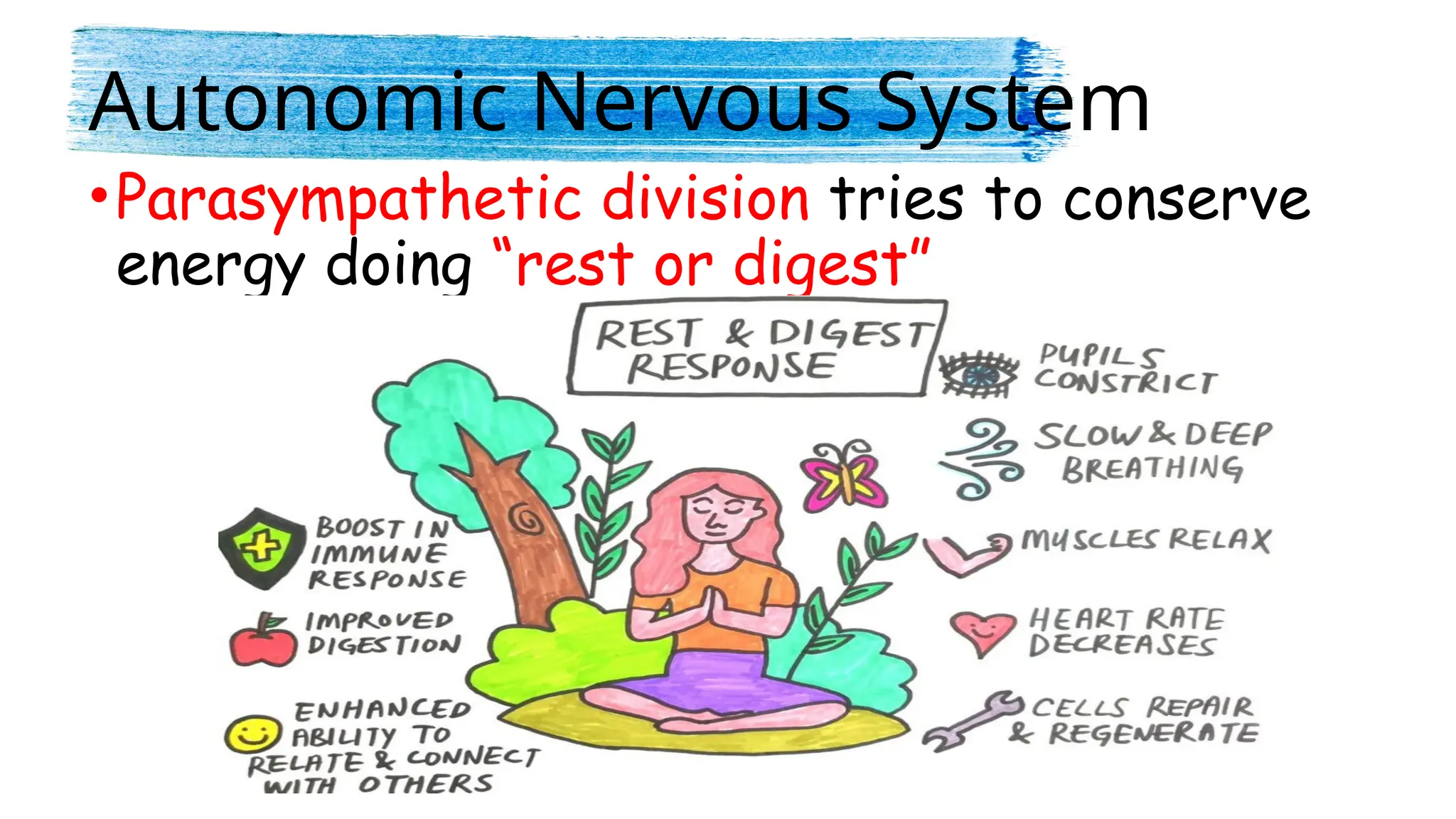
•Parasympathetic division tries to conserve
energy doing “rest or digest”
Autonomic Nervous System
Sympathetic vs. parasympathetic

Homeostasis and the Nervous Systems.pptx

  • 1.
  • 2.
    Homeostasis • The bodyis designed in such a way that all the organs and organ systems work together in order to maintain homeostasis or maintaining the internal environment in equilibrium • All organ systems are controlled by the nervous system while the endocrine system secretes hormones that regulate all the body’s activities.
  • 3.
    The Nervous System •The nervous system coordinates and regulates the body’s feedback mechanisms to maintain homeostasis. • It is highly organized and complex collection of nerves (a collection of neurons) and neurons, specialized cells that transmit messages to and from the brain and spinal cord to other parts of the body.
  • 4.
    • Neurons thatreceive messages from the senses and send them to the Central Nervous System (CNS) are called afferent neurons. • Efferent neurons send messages from the Central Nervous System (CNS) to the different parts of the body. The Nervous System
  • 5.
    Parts of aNeuron
  • 6.
    Cell body –the support center of the neuron. If the outgoing message is to be sent away, it passes from the cell body to the axon, which passes those messages away from the cell body to the axon terminal and onto other neurons or other body parts. Dendrites – receive signals from other neurons or from the body, and pass those messages along to the cell body. Myelin sheath – a protective layer around some axons and helps speed up the signal messages The signal messages travel as electric signals, and as they reach the end of a neuron, chemical called neurotransmitters are stimulated. These chemicals travel through the space in between neurons/ other body cells called synapses. It is through neurotransmitters that the nervous system can regulate the body’s activities.
  • 7.
    • The Nervoussystem is divided into 2: 1. The Central Nervous System (CNS) – consists of the brain and spinal cord 2. Peripheral Nervous System (PNS) – made up of nerves and sensory organs The Nervous System
  • 8.
    Part of the Brain Descriptionand Function Cerebrum The major outer part of the brain. It is divided into two hemispheres: the left and the right. The left hemisphere controls the right side of the body and vice versa. These two hemispheres are connected by the corpus callosum. Each hemisphere is further divided into sections called lobes. It is responsible for sensing, thinking, learning emotions, and voluntary movement. It also controls the five senses. The central Nervous System
  • 9.
    4 LOBES FUNCTIONS FrontalLobe Responsible for cognitive functions and movements Parietal lobe Responsible for processing touch, pain, temperature, and movement Occipital lobe Responsible for vision Temporal lobe Responsible for speech, learning and memory The central Nervous System
  • 10.
    Part of the Brain Descriptionand Function Cerebellum At the back part of the brain. It controls balance and fine muscle movement. The central Nervous System
  • 11.
    Part of theBrain Description and Function Brain Stem At the bottom of the brain. This connects the cerebrum to the spinal cord. It is divided into 3 parts: midbrain, the pons, and medulla. The brain stem controls bodily functions like breathing, circulation and sleep. The central Nervous System
  • 12.
    Part of theBrain Description and Function Limbic System Under the cerebrum and inside the temporal lobe, it is composed of several structures: the amygdala, hippocampus, thalamus, and hypothalamus. These structures are responsible for basic biological needs like hunger, thirst, and temperature control, higher mental functions like memories, and emotional responses. The thalamus also serves as the relay center, where incoming and outgoing messages are The central Nervous System
  • 13.
    • The brainis very important but fragile. It is protected by the skull, the meninges, and cerebrospinal fluid. • The skull is like a bony helmet, while the meninges are layers of tissue. Cerebrospinal fluid is watery fluid that flows in and around the brain and the spinal cord that cushions both parts. The central Nervous System
  • 14.
    • The spinalcord is an elongated bundle of neurons connected to the brain via the brain stem. It goes all the way down to the tailbone at our lower back. • It is protected by bones and is divided into five sections: cervical, thoracic, lumbar, sacral, and coccygeal. The central Nervous System
  • 15.
    •Made up ofthe rest of the body’s nerves and sensory organs. •Subdivided into: somatic nervous system and autonomic nervous system The peripheral Nervous System
  • 16.
    • Is incharge of voluntary body movements and transmits sensory messages to the CNS • Also controls involuntary movements called reflexes. A reflex is an involuntary muscle response to a stimulus (something that causes an action) without input from the brain. • The pathway a reflex takes is called a reflex arc. This means the reflex arc connects to the spinal cord, bypassing the brain so that the reflex arc is not delayed. • The pathway of the reflex arc is: stimulus sensory neuron motor neuron reflex-made movement The somatic Nervous System
  • 17.
    •Examples of reflexes: 1.Pulling your hand when you touch something hot 2. Jumping when you hear a loud sound 3. A knee-jerk reflex •Reflect arcs that affect inner organs are called autonomic reflex arcs, while those that affect muscles are called somatic reflex arc. somatic Nervous System
  • 18.
    • In chargeof involuntary body functions like breathing and heartbeat. • Subdivided into: Sympathetic and Parasympathetic nervous systems • Sympathetic division is responsible for the “fight or flight” response stimulating the body to use energy. Autonomic Nervous System
  • 19.
  • 20.
    •Parasympathetic division triesto conserve energy doing “rest or digest” Autonomic Nervous System
  • 21.