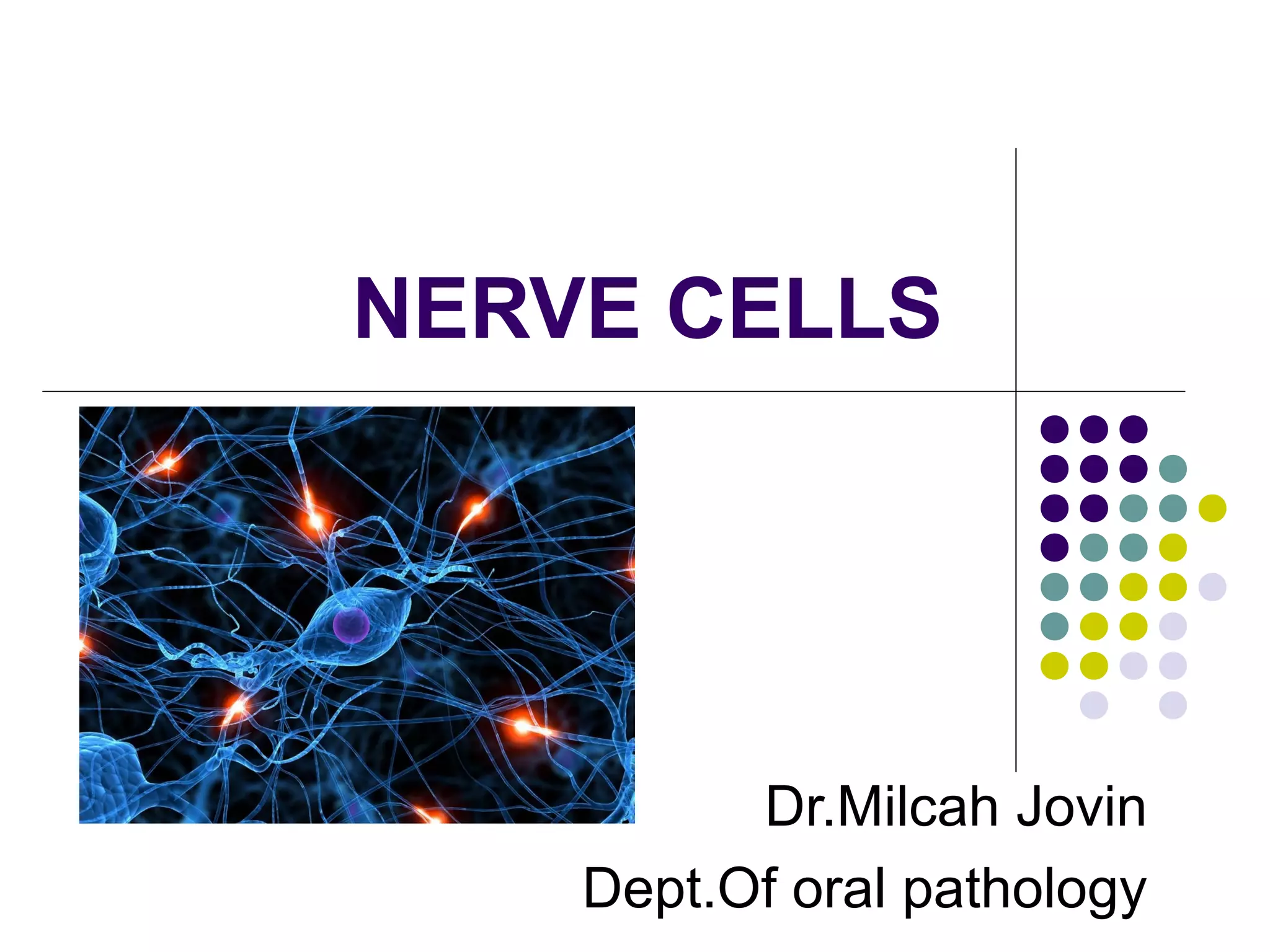
NERVE CELLS
Dr.Milcah Jovin
Dept.Of oral pathology
Introduction
Interesting facts
Structure
Classification
Function
Relevance in dentistry and clinical application
Major neurologic disorders
Advances in nerve management
CONTENTS
Introduction
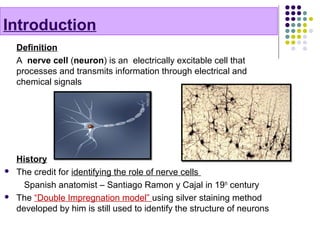
Definition
A nerve cell (neuron) is an electrically excitable cell that
processes and transmits information through electrical and
chemical signals
History
 The credit for identifying the role of nerve cells
Spanish anatomist – Santiago Ramon y Cajal in 19th
century
 The “Double Impregnation model” using silver staining method
developed by him is still used to identify the structure of neurons
Interesting facts about Nerve cells
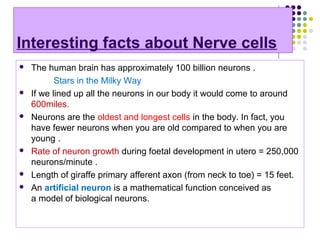
 The human brain has approximately 100 billion neurons .
Stars in the Milky Way
 If we lined up all the neurons in our body it would come to around
600miles.
 Neurons are the oldest and longest cells in the body. In fact, you
have fewer neurons when you are old compared to when you are
young .
 Rate of neuron growth during foetal development in utero = 250,000
neurons/minute .
 Length of giraffe primary afferent axon (from neck to toe) = 15 feet.
 An artificial neuron is a mathematical function conceived as
a model of biological neurons.
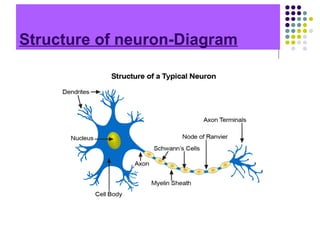
Structure of neuron-Diagram
Structure
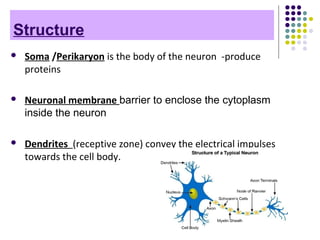
 Soma /Perikaryon is the body of the neuron -produce
proteins
 Neuronal membrane barrier to enclose the cytoplasm
inside the neuron
 Dendrites (receptive zone) convey the electrical impulses
towards the cell body.
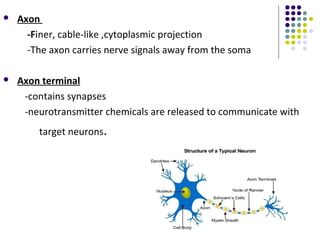
 Axon
-Finer, cable-like ,cytoplasmic projection
-The axon carries nerve signals away from the soma
 Axon terminal
-contains synapses
-neurotransmitter chemicals are released to communicate with
target neurons.
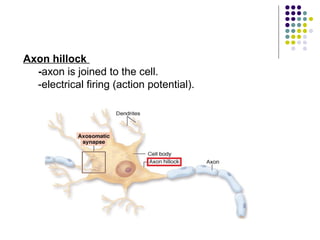
Axon hillock
-axon is joined to the cell.
-electrical firing (action potential).
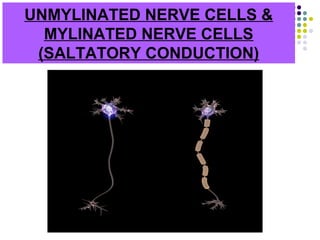
UNMYLINATED NERVE CELLS &
MYLINATED NERVE CELLS
(SALTATORY CONDUCTION)
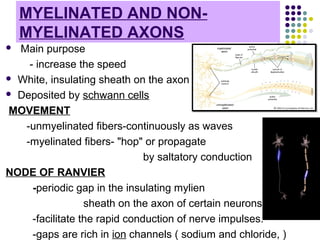
MYELINATED AND NON-
MYELINATED AXONS
 Main purpose
- increase the speed
 White, insulating sheath on the axon
 Deposited by schwann cells
MOVEMENT
-unmyelinated fibers-continuously as waves
-myelinated fibers- "hop" or propagate
by saltatory conduction
NODE OF RANVIER
-periodic gap in the insulating mylien
sheath on the axon of certain neurons
-facilitate the rapid conduction of nerve impulses.
-gaps are rich in ion channels ( sodium and chloride, )
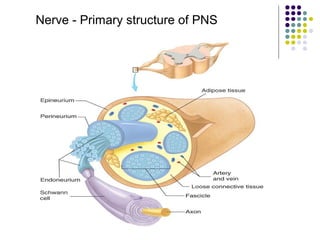
Nerve - Primary structure of PNS
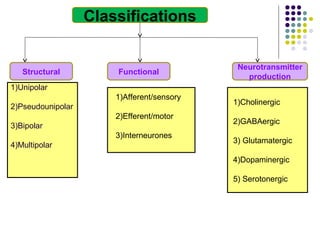
Classifications
Structural Functional
Neurotransmitter
production
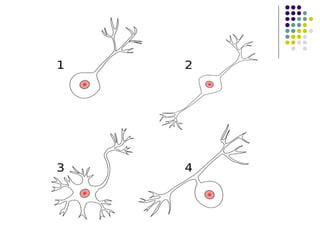
1)Unipolar
2)Pseudounipolar
3)Bipolar
4)Multipolar
1)Afferent/sensory
2)Efferent/motor
3)Interneurones
1)Cholinergic
2)GABAergic
3) Glutamatergic
4)Dopaminergic
5) Serotonergic
Classifications
1)Unipolar
2)Pseudounipolar
3)Bipolar
4)Multipolar
Functioning
Functioning
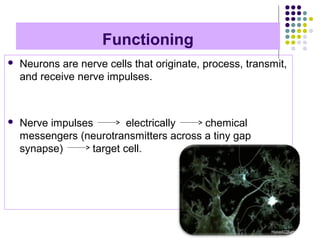
 Neurons are nerve cells that originate, process, transmit,
and receive nerve impulses.
 Nerve impulses electrically chemical
messengers (neurotransmitters across a tiny gap
synapse) target cell.
Functioning
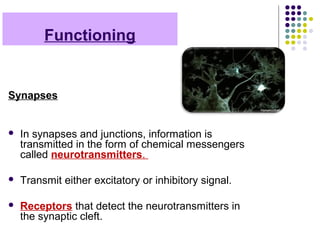
Synapses
 In synapses and junctions, information is
transmitted in the form of chemical messengers
called neurotransmitters.
 Transmit either excitatory or inhibitory signal.
 Receptors that detect the neurotransmitters in
the synaptic cleft.
SIGNAL TRANSMISSION
WITHIN NERVE CELLS
•Voltage differences (ie; Potentials) that exist between
inside and the outside of the cell.
• Ions enter and exit the cell through specific protein channels in
the cell’s membrane.
• Channels “open” or “close” in response to neurotransmitters or to
changes in the cell’s membrane potential.
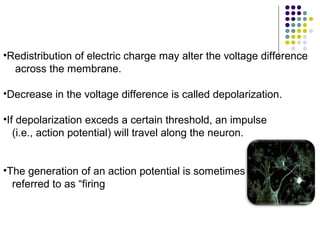
•Redistribution of electric charge may alter the voltage difference
across the membrane.
•Decrease in the voltage difference is called depolarization.
•If depolarization exceds a certain threshold, an impulse
(i.e., action potential) will travel along the neuron.
•The generation of an action potential is sometimes
referred to as “firing
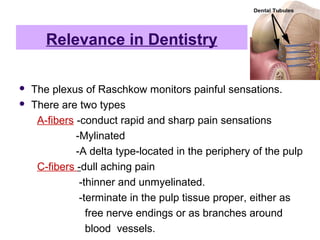
Relevance in Dentistry
 The plexus of Raschkow monitors painful sensations.
 There are two types
A-fibers -conduct rapid and sharp pain sensations
-Mylinated
-A delta type-located in the periphery of the pulp
C-fibers -dull aching pain
-thinner and unmyelinated.
-terminate in the pulp tissue proper, either as
free nerve endings or as branches around
blood vessels.
CLINICAL RELAVENCE
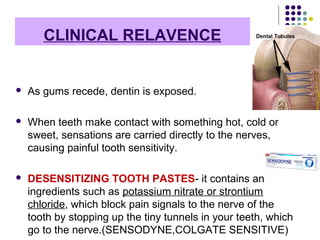
 As gums recede, dentin is exposed.
 When teeth make contact with something hot, cold or
sweet, sensations are carried directly to the nerves,
causing painful tooth sensitivity.
 DESENSITIZING TOOTH PASTES- it contains an
ingredients such as potassium nitrate or strontium
chloride, which block pain signals to the nerve of the
tooth by stopping up the tiny tunnels in your teeth, which
go to the nerve.(SENSODYNE,COLGATE SENSITIVE)
MAJOR NEUROLOGICAL DISORDERS
Charcot–Marie–Tooth disease
 Heterogeneous inherited disorder of nerves
 Loss of muscle tissue and touch sensation
 Presently incurable
 One of the most common inherited
neurological disorders
 37 in 100,000 affected
 Famous persons - George J. Donahue –
World famous poet
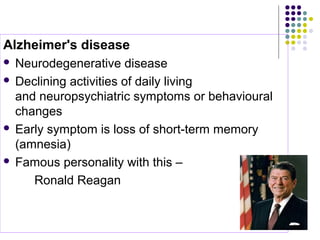
Alzheimer's disease  
 Neurodegenerative disease 
 Declining activities of daily living 
and neuropsychiatric symptoms or behavioural 
changes 
 Early symptom is loss of short-term memory 
(amnesia) 
 Famous personality with this – 
         Ronald Reagan 
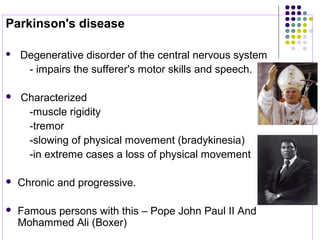
Parkinson's disease 
  Degenerative disorder of the central nervous system
        - impairs the sufferer's motor skills and speech.
  Characterized 
        -muscle rigidity
        -tremor
        -slowing of physical movement (bradykinesia)      
        -in extreme cases a loss of physical movement 
 
 Chronic and progressive.  
 Famous persons with this – Pope John Paul II And 
Mohammed Ali (Boxer)
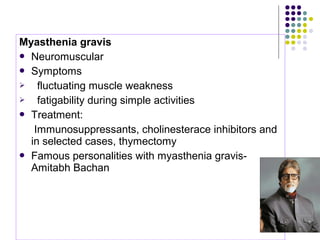
Myasthenia gravis  
 Neuromuscular 
 Symptoms
   fluctuating muscle weakness 
   fatigability during simple activities 
 Treatment:
     Immunosuppressants, cholinesterace inhibitors and 
in selected cases, thymectomy
 Famous personalities with myasthenia gravis- 
Amitabh Bachan
Advances in nerve cells management
 Nerve damage from neurodegenerative disease and spinal 
cord injury has largely been considered irreversible, but 
Dartmouth researchers report progress in the effort to 
synthesize rare natural products that promote
regeneration and growth of injured nerve cells 
 The use of nanotechnology to improve the design of nerve 
conduits and to enhance nerve regeneration.
CARBON NANOTUBES
Consisting of biological tissue and synthetic material -- planned 
to re-establish connections between nerve cells, for instance at 
spinal level, lost on account of lesions or trauma. 
(This is the result of a piece of research published on the 
scientific journal Nanomedicine: Nanotechnology, Biology, and
Medicine conducted )
TRANSCRIPTION FACTOR
Help certain neurons regenerate, while simultaneously killing
  others.
Unravelling exactly which signals can help or hinder axon 
    regeneration may eventually lead to new and precise
    treatment strategies for restoring vision or repairing injury.
(In a new study published in Neuron, Bei, Michael Norsworthy in 
Zhigang He's lab at Boston Children's Hospital and colleagues)
Nerve cells  ,Dr.MJ

Nerve cells ,Dr.MJ

  • 1.
  • 2.
    Introduction Interesting facts Structure Classification Function Relevance indentistry and clinical application Major neurologic disorders Advances in nerve management CONTENTS
  • 3.
    Introduction Definition A nerve cell(neuron) is an electrically excitable cell that processes and transmits information through electrical and chemical signals History  The credit for identifying the role of nerve cells Spanish anatomist – Santiago Ramon y Cajal in 19th century  The “Double Impregnation model” using silver staining method developed by him is still used to identify the structure of neurons
  • 4.
    Interesting facts aboutNerve cells  The human brain has approximately 100 billion neurons . Stars in the Milky Way  If we lined up all the neurons in our body it would come to around 600miles.  Neurons are the oldest and longest cells in the body. In fact, you have fewer neurons when you are old compared to when you are young .  Rate of neuron growth during foetal development in utero = 250,000 neurons/minute .  Length of giraffe primary afferent axon (from neck to toe) = 15 feet.  An artificial neuron is a mathematical function conceived as a model of biological neurons.
  • 5.
  • 6.
    Structure  Soma /Perikaryonis the body of the neuron -produce proteins  Neuronal membrane barrier to enclose the cytoplasm inside the neuron  Dendrites (receptive zone) convey the electrical impulses towards the cell body.
  • 7.
     Axon -Finer, cable-like,cytoplasmic projection -The axon carries nerve signals away from the soma  Axon terminal -contains synapses -neurotransmitter chemicals are released to communicate with target neurons.
  • 8.
    Axon hillock -axon isjoined to the cell. -electrical firing (action potential).
  • 9.
    UNMYLINATED NERVE CELLS& MYLINATED NERVE CELLS (SALTATORY CONDUCTION)
  • 10.
    MYELINATED AND NON- MYELINATEDAXONS  Main purpose - increase the speed  White, insulating sheath on the axon  Deposited by schwann cells MOVEMENT -unmyelinated fibers-continuously as waves -myelinated fibers- "hop" or propagate by saltatory conduction NODE OF RANVIER -periodic gap in the insulating mylien sheath on the axon of certain neurons -facilitate the rapid conduction of nerve impulses. -gaps are rich in ion channels ( sodium and chloride, )
  • 11.
    Nerve - Primarystructure of PNS
  • 12.
  • 14.
  • 15.
    Functioning  Neurons arenerve cells that originate, process, transmit, and receive nerve impulses.  Nerve impulses electrically chemical messengers (neurotransmitters across a tiny gap synapse) target cell.
  • 16.
    Functioning Synapses  In synapsesand junctions, information is transmitted in the form of chemical messengers called neurotransmitters.  Transmit either excitatory or inhibitory signal.  Receptors that detect the neurotransmitters in the synaptic cleft.
  • 17.
    SIGNAL TRANSMISSION WITHIN NERVECELLS •Voltage differences (ie; Potentials) that exist between inside and the outside of the cell. • Ions enter and exit the cell through specific protein channels in the cell’s membrane. • Channels “open” or “close” in response to neurotransmitters or to changes in the cell’s membrane potential.
  • 18.
    •Redistribution of electriccharge may alter the voltage difference across the membrane. •Decrease in the voltage difference is called depolarization. •If depolarization exceds a certain threshold, an impulse (i.e., action potential) will travel along the neuron. •The generation of an action potential is sometimes referred to as “firing
  • 19.
    Relevance in Dentistry The plexus of Raschkow monitors painful sensations.  There are two types A-fibers -conduct rapid and sharp pain sensations -Mylinated -A delta type-located in the periphery of the pulp C-fibers -dull aching pain -thinner and unmyelinated. -terminate in the pulp tissue proper, either as free nerve endings or as branches around blood vessels.
  • 20.
    CLINICAL RELAVENCE  Asgums recede, dentin is exposed.  When teeth make contact with something hot, cold or sweet, sensations are carried directly to the nerves, causing painful tooth sensitivity.  DESENSITIZING TOOTH PASTES- it contains an ingredients such as potassium nitrate or strontium chloride, which block pain signals to the nerve of the tooth by stopping up the tiny tunnels in your teeth, which go to the nerve.(SENSODYNE,COLGATE SENSITIVE)
  • 21.
    MAJOR NEUROLOGICAL DISORDERS Charcot–Marie–Toothdisease  Heterogeneous inherited disorder of nerves  Loss of muscle tissue and touch sensation  Presently incurable  One of the most common inherited neurological disorders  37 in 100,000 affected  Famous persons - George J. Donahue – World famous poet
  • 22.
    Alzheimer's disease    Neurodegenerative disease  Declining activities of daily living  and neuropsychiatric symptoms or behavioural  changes   Early symptom is loss of short-term memory  (amnesia)   Famous personality with this –           Ronald Reagan 
  • 23.
    Parkinson's disease    Degenerative disorder of the central nervous system         - impairs the sufferer's motor skills and speech.  Characterized          -muscle rigidity         -tremor         -slowing of physical movement (bradykinesia)               -in extreme cases a loss of physical movement     Chronic and progressive.    Famous persons with this – Pope John Paul II And  Mohammed Ali (Boxer)
  • 24.
    Myasthenia gravis    Neuromuscular  Symptoms    fluctuating muscle weakness     fatigability during simple activities   Treatment:      Immunosuppressants, cholinesterace inhibitors and  in selected cases, thymectomy  Famous personalities with myasthenia gravis-  Amitabh Bachan
  • 25.
    Advances in nervecells management  Nerve damage from neurodegenerative disease and spinal  cord injury has largely been considered irreversible, but  Dartmouth researchers report progress in the effort to  synthesize rare natural products that promote regeneration and growth of injured nerve cells   The use of nanotechnology to improve the design of nerve  conduits and to enhance nerve regeneration.
  • 26.
    CARBON NANOTUBES Consisting of biological tissue and synthetic material -- planned  to re-establish connections between nerve cells, for instance at  spinal level, lost on account of lesions or trauma.  (This is the result of a piece of research published on the  scientific journal Nanomedicine: Nanotechnology,Biology, and Medicine conducted ) TRANSCRIPTION FACTOR Help certain neurons regenerate, while simultaneously killing   others. Unravelling exactly which signals can help or hinder axon      regeneration may eventually lead to new and precise     treatment strategies for restoring vision or repairing injury. (In a new study published in Neuron, Bei, Michael Norsworthy in  Zhigang He's lab at Boston Children's Hospital and colleagues)