Downloaded 39 times
![Balancing and Frequency Control
23
Bias beyond their natural response. This causes their units to do more regulating (or a
decline in CPS1 for the same amount of regulating) as a trade-off for getting larger L10
limits. (The size of CPS2’s L10 is related to Bias.)
Unless the process is automated, there is a fair amount of effort required in objectively
calculating Frequency Response.
Calculating Frequency Response is not a new requirement. Many Balancing Authorities do this
in order to calculate and set their bias. Those that do this manual task understand the challenges
involved.
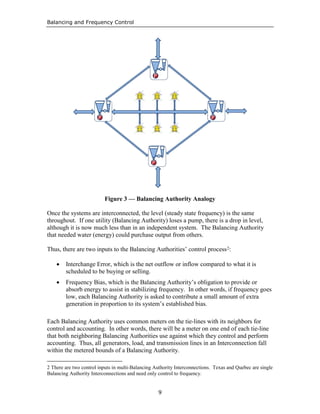
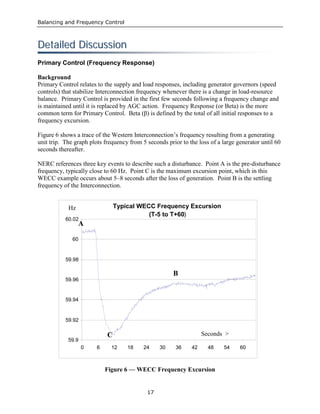
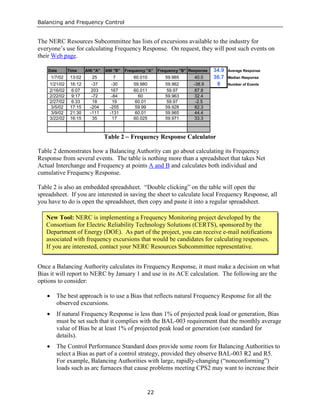
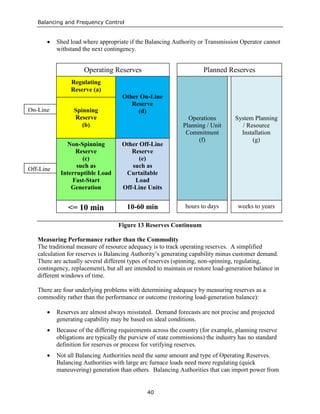
Figure 5 shows actual scan rate response for a medium-sized Balancing Authority for five events
in 1998. The chart is a graph of the Balancing Authority’s “Tie Deviation” in MWs plotted
against time. The chart shows the Tie Deviation from 60 seconds before a frequency excursion
until 60 seconds after the excursion.
Figure 9 − Frequency Response for 5 Events
For the time being, assume all five frequency excursions were 33 mHz. The reader can refer to
the Frequency Response Characteristic Survey Training Document for the actual calculation, but
Frequency Response is simply:
[MWs deployed /0.1 Hz of frequency deviation]
Since 33 mHz is one-third of 0.1 Hz, it seems all we have to do is multiply the change in
Balancing Authority output by 3. For those familiar with the process, two problems immediately
arise.
First, the Frequency Response Characteristic Survey Training Document says to use the
interchange values “immediately before” and “immediately after” the disturbance to derive a
Disturbance](https://image.slidesharecdn.com/nercbalancingandfrequencycontrol040520111-140310001908-phpapp02/85/Nerc-balancing-and-frequency-control-040520111-23-320.jpg)
![Balancing and Frequency Control
28
59.80
59.82
59.84
59.86
59.88
59.90
59.92
59.94
59.96
59.98
60.00
60.02
60.04
60.06
60.08
60.10
15:40 15:45 15:50 15:55 16:00 16:05 16:10 16:15 16:20 16:25 16:30 16:35 16:40
61000
61100
61200
61300
61400
61500
61600
61700
61800
61900
62000
62100
62200
62300
62400
62500
HZ Load Total Generation ERCOT 60 HZ Calculated Load
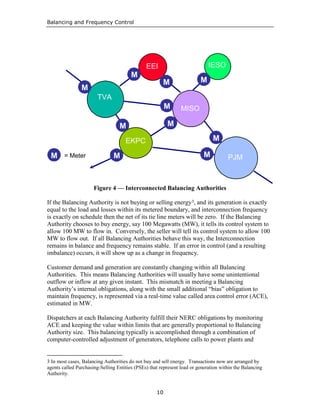
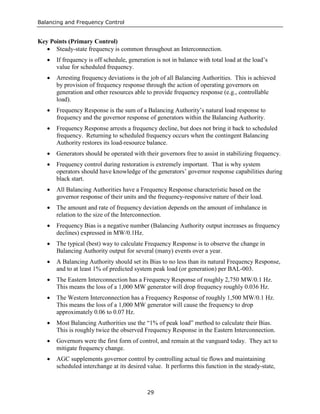
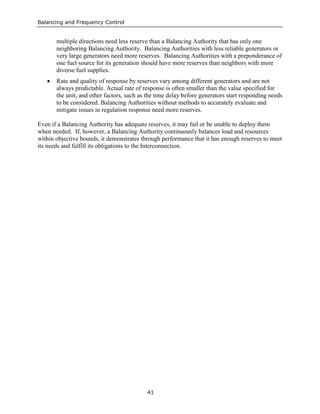
Frequency, Load, & Generation
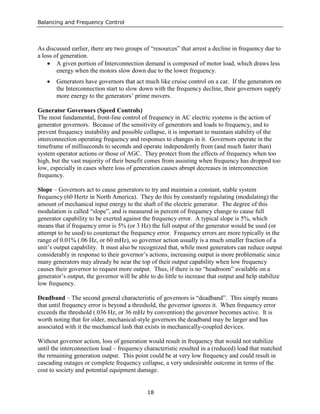
0.0244 Load Frequency Response Factor
Load Frequency response = Measured Load * Load Frequency Response
Factor.
Load Frequency Response =61,900 MW *0.0244 = 1,510.36 MW/Hz or
151.036 MW/0.1 Hz.
60 Hz Calculated Load = Load - [(Freqactual - 60.00) * Load * Load Frequency
Response Factor]
The difference between the Load and the 60 Hz
Calculated Load is the frequency response of the load
for each frequency deviation from 60 Hz.
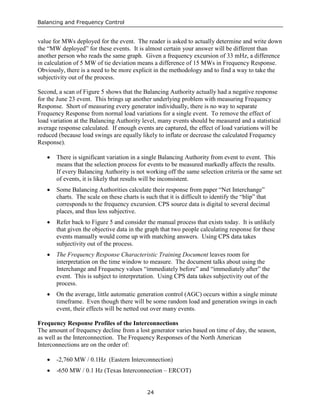
Figure 12 Observing Frequency Response of Load
The cyan trend in Figure 12 above represents how much load would exist if frequency could be
controlled to exactly 60.000 Hz all the time. The difference between the measured load, blue
trend and the cyan trend is the frequency response of load. For this event, a 759 MW resource
was lost producing a frequency deviation of -0.118 Hz. This calculates to be 759/(0.118*10) =
643 MW/0.1 Hz of frequency response. Of this response, 151.036 MW/0.1 Hz was provided by
the load (by multiplying the load by .00244) which leaves the remainder, 492.184 MW/0.1 Hz,
provided by resource governor response. The post contingency total generation settled at 61,510
MW a difference of 178.222 MW below the pre contingency generation. The generation to load
mismatch post-event is 178.222 MW plus replacing the 580.777 MW of governor response
(492.184 * 1.18 = 580.777) that will be withdrawn as frequency returns to 60.00 Hz. If this
BA’s Bias in the ACE equation had been set exactly at 643 MW/0.1 Hz, ACE would equal -
759MW at the B point of this event. AGC would dispatch 759 MW to replace the frequency
response of the governors and load which would return the Interconnection to balance at 60.00
Hz. This example is of a “single” Balancing Authority Interconnection but the math works for
multiple BA Interconnections as well.
By observing multiple events and adjusting the factor to produce a “60 Hz Load” value that
maintains the pre and post event slope of load, a proper value can be determined. Larger
deviation frequency events are beneficial to get a clear observation as well as looking at many
events. A factor between 0.010 and 0.025 would be reasonable depending on the ratio of motor
load vs. non-motor load within the BA boundaries.](https://image.slidesharecdn.com/nercbalancingandfrequencycontrol040520111-140310001908-phpapp02/85/Nerc-balancing-and-frequency-control-040520111-28-320.jpg)
![Balancing and Frequency Control
33
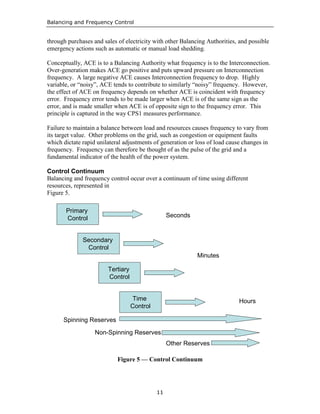
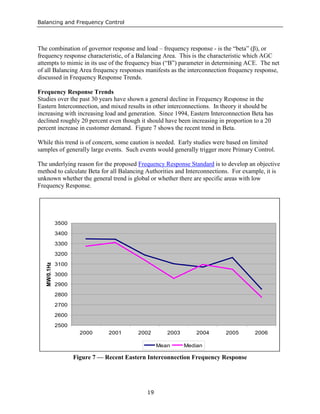
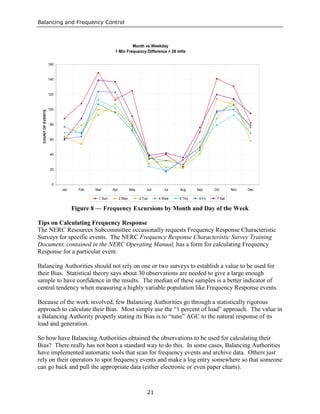
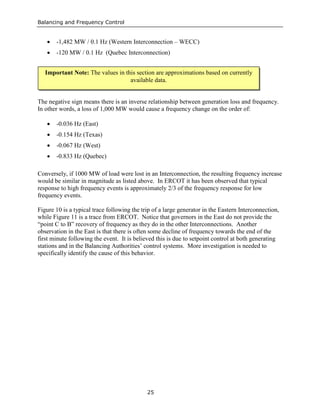
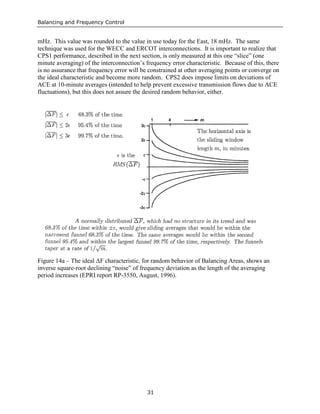
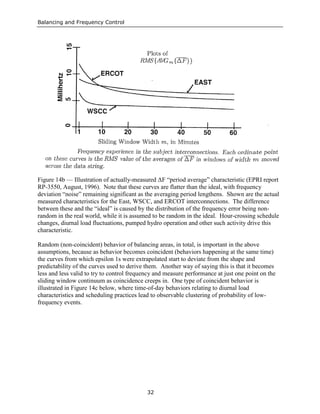
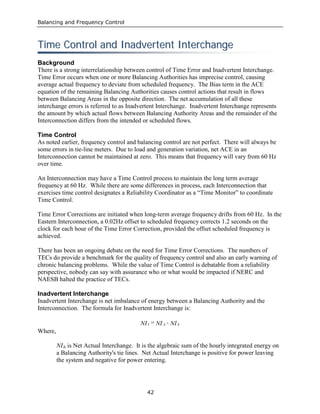
Figure 14c – Probability Distribution for Low-Frequency Events vs. Time of Day
Control Performance Standard 1 (CPS1)
In simple terms, CPS1 assigns each Balancing Authority a share of the responsibility for control
of steady-state Interconnection frequency. The amount of responsibility is directly related to
Balancing Authority Frequency Bias.
ACE is to a Balancing Authority what frequency is to the Interconnection. Over-generation
makes ACE go positive and frequency increase. Negative ACE “drags” on interconnection
frequency. “Noisy” ACE tends to cause “noisy” frequency. CPS1 captures these relationships
using statistical measures to determine each Balancing Authority’s contribution to such “noise”
relative to what is deemed permissible.
The CPS1 equation can be simplified as follows:
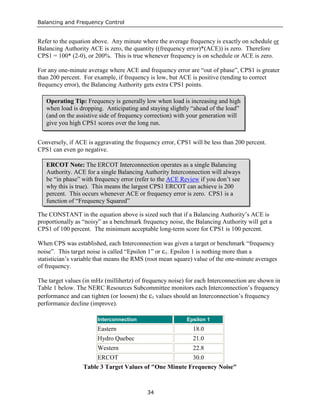
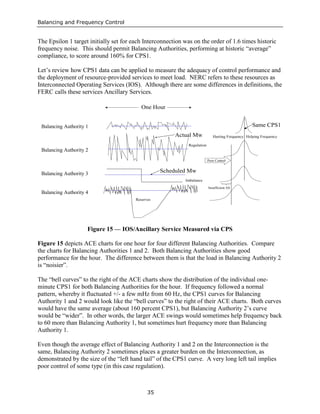
CPS1 (in percent) = 100* [2 – (a Constant10)* (frequency error)*(ACE)]
Frequency error is deviation from scheduled frequency. Normally this is deviation from 60Hz.
Scheduled frequency is different during a time correction, but for the purposes of this discussion,
assume scheduled frequency is 60 Hz.
10 The size of this constant changes over time for Balancing Authorities with variable bias, but the effect can be
ignored when considering minute-to-minute operation. It is equal to -10 * B / ε1
2](https://image.slidesharecdn.com/nercbalancingandfrequencycontrol040520111-140310001908-phpapp02/85/Nerc-balancing-and-frequency-control-040520111-33-320.jpg)


1) Balancing and frequency control occur over time using different resources and controls. Primary control uses generator governors and load response to stabilize frequency in seconds after a disturbance. Secondary control uses reserves and automatic generation control to restore frequency to scheduled values within minutes. Tertiary control deploys reserves for current and future contingencies over hours. 2) Balancing authorities balance generation and load within their areas and contribute to interconnection frequency control. Their control performance is measured by an area control error metric. 3) Frequency control is critical to maintaining reliability across North American interconnections. A variety of mechanisms work together over different timescales to balance the grid and keep interconnection frequency stable.


