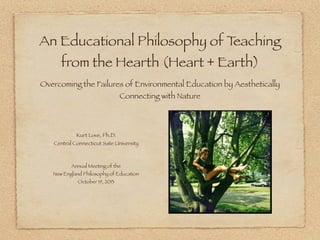
An Educational Philosophy of T
eaching
from the Hearth (Heart + Earth)
Overcoming the Failures of Environmental Education by Aesthetically
Connecting with Nature

Kurt Love, Ph.D.

Central Connecticut Sate University

Annual Meeting of the
New England Philosophy of Education
October 19, 2013
Far Side

John Larson
The Problems: Environmentally

Melting of the ice caps which provides thermoregulation for the planet
Increase in globals water levels
Mass extinction
Increased severity of storms, droughts, floods
400 ppm of CO2, where 350 ppm is ideal maximum
100 billion tons of methane (CH4)(or 333 times the mass of all humans or 270 times the current
rate of emissions) trapped in the tundra/ice caps can escape if they melt -- 23 times stronger
than carbon dioxide (CO2). Methane release ended an ice age 635 million years ago.

Shutting down the jet stream and ocean currents, which control oceanic nutrition cycles
The Problems: Societally

Source: The Guardian
The Problems: Societally

Source: The Guardian
The Problems: Educationally

Public schools created so that rich people could have workers.
Environmental Education has failed.
Anti-sustainable textbooks, focus on consumers rather than producers, downplaying
global warming (Love, 2012)
Science creates an objectified, atomized nature that is without life.
Nature-nihilism, ego-centric, anthropocentric, humans over nature, “land management”
T
raditional Science Pedagogy
Earth/nature is here for inquiry-driven instruction
Isolate variables (decontextualize an objectified nature)
Form and function
Mechanization of nature
Decontextualized lab activities
Decontextualized contexts for learning and developing skills

Results:

Humans see themselves as disconnected from nature
& practice unsustainable living
Science’s Limited View of Sustainability

Far Side

John Larson

T
raditional environmental education based on the process of objectifying nature...
Continues the relationship of separation, human-domination, and mechanization
of nature

Often reduced to a behavior of closing loops or energy efficiency
Anthropocentrism of science will not call into question the anthropocentrism of
capitalism
A Society Separated from Nature

Modern religions (especially Christianity) colonize and dismiss earth-based
spiritualities in place for a human spiritual figure meant to be taken literally, led to the
removal of nature as an aesthetic context for joy, meaning, and fulfillment.
Colonization of indigenous peoples globally via capitalistic, technocentric mindsets
Industrial elitism = Egocentrism + Anthropocentrism + Capitalism (hyper-greed)
(See John Dewey)
European Colonizers &
American Indians

Clash of two peoples with two different
religious interactions with nature &
“ecological/technological selves”

Europeans often claimed that God favored
the death of the “savages.” Europeans
viewed nature as the source of evil.

European Colonizers: Christian, Nature for

profit, land ownership, enclosure, capitalist
mindset/values

American Indians: Nurturance, reciprocity,
sustainable mindset/values

Genocide: From up to 18 million in 1490’s to
190,000 in 1890, up to 200 million Indians
died in the Americas
Land Domination
European Colonizers &
West Africans

Clash of two peoples with two different
religious interactions with nature &
“ecological/technological selves”

Europeans built slave castles that included a
chapel, usually adjacent to the commander’s
quarters.

European Colonizers: Nature for profit, land
ownership, enclosure, capitalist mindset/
values

West Africans: Nurturance, reciprocity,
sustainable mindset/values

Slavery: About 12 million captured and/or

killed, 645,000 brought to the U.S., nearly 4
million slaves in the 1860 census

Domination for profit via capitalism
Christians &

Earth-Based Spiritualities
Movement out of nature and into

“Human” as separate from nature
Nature is where Satan resides
T
echnology is Godly & righteous
Christian missionaries with indigenous
peoples globally, views on nudity

Killing of at least tens of thousands of
“witches” from 1400s-1600s

Continued persecution of paganism,
neopaganism, and Wicca
Some Common Aesthetic Connections
Retaining of indigenous/pagan symbols in
modern religions and holidays
“Getaway” vacations to places focused on
the beauty of nature (Hawaii, Grand
Canyon, Caribbean Islands, Vermont, etc.)
Hiking, Skiing, Boating, Flying, Mountain
Climbing
Art
Equinoxes/Solstices
Autumn Fairs
Groundhog’s Day
Foodies & Farm-to-T
able Restaurants
“Leaf Peepers”
Nude beaches, resorts
Resurgence of earth-based religions,
neopaganism, individual spiritualities
A Pedagogy of Heart & Earth (Hearth)

T
raditional hearths are where there is a fireplace, but more and more, it is a special place
in one’s living space where one can display items of deep meaning and connection
Hearth is the symbolic connection representing place, emotion, and relationship.
The hearth in a home is often a semi-sacred space to display pictures of loved ones,
significant art work, etc.
Hearth is also often decorative in connection with the cycle of the year.
Where heat was used to protect against winter’s harsh conditions, as well as provide a
space for cooking (nourishment)
An Aesthetic Nature Leads to A
Mindset of Sustainability
An Aesthetic Nature Leads to a
Mindset of Sustainability

An aesthetic: A context that fulfills us, connects us to our higher selves
Sustainability: More than just the conservation of materials (“land
management” mindset); a balanced, holistic engagement with
interconnections of nature
An Aesthetic of Sustainability

At the Hearth:

A social, cultural, ecological, creative being in the context
of a social, cultural, ecological, and creative environment
Sustainable Farm School:
A Pedagogy of the Hearth
Sustainable Farm School:
A Pedagogy of the Hearth
Sustainable Farm School:
A Pedagogy of the Hearth
Sustainable Farm School:
A Pedagogy of the Hearth
Sustainable Farm School:
A Pedagogy of the Hearth
Sustainable Farm School:
A Pedagogy of the Hearth
Sustainable Farm School:
A Pedagogy of the Hearth
Little Sprouts (3-5)
Saplings (5-7)
Explorers (7-10)
Visionaries (10-13)
Solutionaries (13-18)
After School (13-18)
Sustainable Farm School:
A Pedagogy of the Hearth
Little Sprouts (3-5)
The Little Sprouts’ morning begins with farm
chores and creative free play. Circle time involves
music, verse, and movement. They learn to care
for the natural world by exploring local plants
and wildlife and working in their own garden. In
this stage, the curriculum is a gentle exposure to
understanding our relationships with each other
and the earth with authentic, natural contexts for
learning that enhance imaginations and build
excitement for learning. The instructor’s goals are
to provide a climate for exploration, cooperation,
and creativity. This is a 2.5 hour program that
meets up to 5 days/week.
Sustainable Farm School:
A Pedagogy of the Hearth
Saplings (5-7)
A supportive environment for the introduction of
academic concepts such as reading, writing, science,
math, and art often in the context of gardening and
farming when appropriate. Here, students begin to
investigate patterns and functions in nature, explore
introductory reading and writing skills, use mathematics
as a way to understand and observe patterns and
relationships, and use art as a medium for exploration of
and integration with these introductory academic skills.
The Saplings instructor’s goals are to provide a
supportive and curious environment with some selfguided, scaffolded learning experiences that lay a
strong foundation for independence and empowered
interdependence and a genuine excitement for lifelong
learning.
Sustainable Farm School:
A Pedagogy of the Hearth
Explorers (7-10)
Students explore the relationships of their content
area classes with relationships to the real world,
focusing especially on empowerment. Gardening and

farming experiences remain present, and act as an

important intellectual and aesthetic “anchor” for the

curriculum at this stage. To do so, instructors

continuously provide learning experiences that
involve students in connecting academic skills with
real world possibilities and first-hand experiences
that create a real sense of confidence with abilities
to work with others. The curriculum is deeply

contextualized to allow for meaningful work that has

a purpose because it is seen immediately in our
communities.
Sustainable Farm School:
A Pedagogy of the Hearth
Visionaries (10-13)
Support students in developing their visions of
communities of sustainability and wellness. As
students become more comfortable with critical
issues that affect sustainability and wellness
within these communities (local, as well as global),
they are encouraged to examine potential
solutions. Develop ever-growing visions of
healthy, happy communities that are working to
become more and more sustainable. There is an
increased focus on academic subjects within real
world, first-hand learning contexts such as farms,
gardens, and democratic experiences with local
municipalities.
Sustainable Farm School:
A Pedagogy of the Hearth
Solutionaries (13-18)
Students build their visions so that they can develop
skills and strategies for solutions that are sustainable,
peaceful, and democratic. Students intensify their work
in academics like literature, mathematics, art, history,
and science, but with a goal to use these as a base for
critical examinations and experimentations with creating
practices of sustainability in their own lives and working
with local and global communities. They learn public
speaking, debating, critical forms of analysis of social
and ecological issues, volunteering, and connecting with
public officials to share experiences and opinions.
Instructors in this program focus on developing deep
contexts for learning that are immediately connected to
the real world and provide first-hand experiences.
Courses at the Hearth
Sustainable Farm Economics
Geometry of the Natural World
Activism and Writing
T
rickster Myths and Other-World Fantasies
Norse Mythology
Greek Mythology
Permaculture
Herbology
Science, Nature, and Sustainability
Lifefoods Food Prep

Holistic Nutrition
Early Connecticut and American History
Civics
Permaculture
Critical Thinking and Moral Reasoning
Social Justice and Contemporary Oppression
Walking in Joy
Watercolor Painting
Art in Time
Sustainable Farm School:
A Pedagogy of the Hearth
After School (13-18)
A program offered to New Britain
High School Students through
C C S U ’s C o m m u n i t y C e n t r a l
(outreach) with a course developed
in partnership with the Sustainable
Farm School focusing on urban
gardening, sustainability, garden-totable cooking, and food security.
Sustainability Education
at the Hearth
Need for truly
transformational thinking
for public schooling
Sustainability as something
that we connect to
holistically
Sustainability education as
connected to aesthetics,
social justice, and ecojustice
References
Love, K. A. (2012). Politics and science textbooks: Behind the curtain of
"objectivity". In H. Hickman & B. Porfilio (Eds.), The new politics of the
textbook: Critical analysis in the core content areas (pp. 133-150).
Rotterdam, The Netherlands: Sense.
Love, K. A., Gill, K., King, A., & Love, K. L. (2013). A framework of Waldorf
philosophy and EcoJustice pedagogy at the Sustainable Farm School. In M.
Mueller & D. Tippens (Eds.), EcoJustice, citizen science, and youth activism:
Situated tensions for science education. New York, NY: Springer.
Saylan, C., & Blumstein, D. T. (2011). The failure of environmental education
(and how we can fix it). Berkeley, CA: University of California Press.
Websites
http://www.theguardian.com/environment/climate-consensus-97-per-cent/2013/
oct/11/climate-change-political-media-ipcc-coverage
http://www.uky.edu/KGS/coal/coal_mining.htm
Photos by Kimberly Gill & Kurt Love

An Educational Philosophy of Teaching from the Hearth (Heart + Earth)

  • 1.
    An Educational Philosophyof T eaching from the Hearth (Heart + Earth) Overcoming the Failures of Environmental Education by Aesthetically Connecting with Nature Kurt Love, Ph.D. Central Connecticut Sate University Annual Meeting of the New England Philosophy of Education October 19, 2013
  • 2.
  • 3.
    The Problems: Environmentally Meltingof the ice caps which provides thermoregulation for the planet Increase in globals water levels Mass extinction Increased severity of storms, droughts, floods 400 ppm of CO2, where 350 ppm is ideal maximum 100 billion tons of methane (CH4)(or 333 times the mass of all humans or 270 times the current rate of emissions) trapped in the tundra/ice caps can escape if they melt -- 23 times stronger than carbon dioxide (CO2). Methane release ended an ice age 635 million years ago. Shutting down the jet stream and ocean currents, which control oceanic nutrition cycles
  • 4.
  • 5.
  • 6.
    The Problems: Educationally Publicschools created so that rich people could have workers. Environmental Education has failed. Anti-sustainable textbooks, focus on consumers rather than producers, downplaying global warming (Love, 2012) Science creates an objectified, atomized nature that is without life. Nature-nihilism, ego-centric, anthropocentric, humans over nature, “land management”
  • 7.
    T raditional Science Pedagogy Earth/natureis here for inquiry-driven instruction Isolate variables (decontextualize an objectified nature) Form and function Mechanization of nature Decontextualized lab activities Decontextualized contexts for learning and developing skills Results: Humans see themselves as disconnected from nature & practice unsustainable living
  • 8.
    Science’s Limited Viewof Sustainability Far Side John Larson T raditional environmental education based on the process of objectifying nature... Continues the relationship of separation, human-domination, and mechanization of nature Often reduced to a behavior of closing loops or energy efficiency Anthropocentrism of science will not call into question the anthropocentrism of capitalism
  • 9.
    A Society Separatedfrom Nature Modern religions (especially Christianity) colonize and dismiss earth-based spiritualities in place for a human spiritual figure meant to be taken literally, led to the removal of nature as an aesthetic context for joy, meaning, and fulfillment. Colonization of indigenous peoples globally via capitalistic, technocentric mindsets Industrial elitism = Egocentrism + Anthropocentrism + Capitalism (hyper-greed) (See John Dewey)
  • 10.
    European Colonizers & AmericanIndians Clash of two peoples with two different religious interactions with nature & “ecological/technological selves” Europeans often claimed that God favored the death of the “savages.” Europeans viewed nature as the source of evil. European Colonizers: Christian, Nature for profit, land ownership, enclosure, capitalist mindset/values American Indians: Nurturance, reciprocity, sustainable mindset/values Genocide: From up to 18 million in 1490’s to 190,000 in 1890, up to 200 million Indians died in the Americas Land Domination
  • 11.
    European Colonizers & WestAfricans Clash of two peoples with two different religious interactions with nature & “ecological/technological selves” Europeans built slave castles that included a chapel, usually adjacent to the commander’s quarters. European Colonizers: Nature for profit, land ownership, enclosure, capitalist mindset/ values West Africans: Nurturance, reciprocity, sustainable mindset/values Slavery: About 12 million captured and/or killed, 645,000 brought to the U.S., nearly 4 million slaves in the 1860 census Domination for profit via capitalism
  • 12.
    Christians & Earth-Based Spiritualities Movementout of nature and into “Human” as separate from nature Nature is where Satan resides T echnology is Godly & righteous Christian missionaries with indigenous peoples globally, views on nudity Killing of at least tens of thousands of “witches” from 1400s-1600s Continued persecution of paganism, neopaganism, and Wicca
  • 13.
    Some Common AestheticConnections Retaining of indigenous/pagan symbols in modern religions and holidays “Getaway” vacations to places focused on the beauty of nature (Hawaii, Grand Canyon, Caribbean Islands, Vermont, etc.) Hiking, Skiing, Boating, Flying, Mountain Climbing Art Equinoxes/Solstices Autumn Fairs Groundhog’s Day Foodies & Farm-to-T able Restaurants “Leaf Peepers” Nude beaches, resorts Resurgence of earth-based religions, neopaganism, individual spiritualities
  • 14.
    A Pedagogy ofHeart & Earth (Hearth) T raditional hearths are where there is a fireplace, but more and more, it is a special place in one’s living space where one can display items of deep meaning and connection Hearth is the symbolic connection representing place, emotion, and relationship. The hearth in a home is often a semi-sacred space to display pictures of loved ones, significant art work, etc. Hearth is also often decorative in connection with the cycle of the year. Where heat was used to protect against winter’s harsh conditions, as well as provide a space for cooking (nourishment)
  • 15.
    An Aesthetic NatureLeads to A Mindset of Sustainability
  • 16.
    An Aesthetic NatureLeads to a Mindset of Sustainability An aesthetic: A context that fulfills us, connects us to our higher selves Sustainability: More than just the conservation of materials (“land management” mindset); a balanced, holistic engagement with interconnections of nature
  • 17.
    An Aesthetic ofSustainability At the Hearth: A social, cultural, ecological, creative being in the context of a social, cultural, ecological, and creative environment
  • 18.
    Sustainable Farm School: APedagogy of the Hearth
  • 19.
    Sustainable Farm School: APedagogy of the Hearth
  • 20.
    Sustainable Farm School: APedagogy of the Hearth
  • 21.
    Sustainable Farm School: APedagogy of the Hearth
  • 22.
    Sustainable Farm School: APedagogy of the Hearth
  • 23.
    Sustainable Farm School: APedagogy of the Hearth
  • 24.
    Sustainable Farm School: APedagogy of the Hearth Little Sprouts (3-5) Saplings (5-7) Explorers (7-10) Visionaries (10-13) Solutionaries (13-18) After School (13-18)
  • 25.
    Sustainable Farm School: APedagogy of the Hearth Little Sprouts (3-5) The Little Sprouts’ morning begins with farm chores and creative free play. Circle time involves music, verse, and movement. They learn to care for the natural world by exploring local plants and wildlife and working in their own garden. In this stage, the curriculum is a gentle exposure to understanding our relationships with each other and the earth with authentic, natural contexts for learning that enhance imaginations and build excitement for learning. The instructor’s goals are to provide a climate for exploration, cooperation, and creativity. This is a 2.5 hour program that meets up to 5 days/week.
  • 26.
    Sustainable Farm School: APedagogy of the Hearth Saplings (5-7) A supportive environment for the introduction of academic concepts such as reading, writing, science, math, and art often in the context of gardening and farming when appropriate. Here, students begin to investigate patterns and functions in nature, explore introductory reading and writing skills, use mathematics as a way to understand and observe patterns and relationships, and use art as a medium for exploration of and integration with these introductory academic skills. The Saplings instructor’s goals are to provide a supportive and curious environment with some selfguided, scaffolded learning experiences that lay a strong foundation for independence and empowered interdependence and a genuine excitement for lifelong learning.
  • 27.
    Sustainable Farm School: APedagogy of the Hearth Explorers (7-10) Students explore the relationships of their content area classes with relationships to the real world, focusing especially on empowerment. Gardening and farming experiences remain present, and act as an important intellectual and aesthetic “anchor” for the curriculum at this stage. To do so, instructors continuously provide learning experiences that involve students in connecting academic skills with real world possibilities and first-hand experiences that create a real sense of confidence with abilities to work with others. The curriculum is deeply contextualized to allow for meaningful work that has a purpose because it is seen immediately in our communities.
  • 28.
    Sustainable Farm School: APedagogy of the Hearth Visionaries (10-13) Support students in developing their visions of communities of sustainability and wellness. As students become more comfortable with critical issues that affect sustainability and wellness within these communities (local, as well as global), they are encouraged to examine potential solutions. Develop ever-growing visions of healthy, happy communities that are working to become more and more sustainable. There is an increased focus on academic subjects within real world, first-hand learning contexts such as farms, gardens, and democratic experiences with local municipalities.
  • 29.
    Sustainable Farm School: APedagogy of the Hearth Solutionaries (13-18) Students build their visions so that they can develop skills and strategies for solutions that are sustainable, peaceful, and democratic. Students intensify their work in academics like literature, mathematics, art, history, and science, but with a goal to use these as a base for critical examinations and experimentations with creating practices of sustainability in their own lives and working with local and global communities. They learn public speaking, debating, critical forms of analysis of social and ecological issues, volunteering, and connecting with public officials to share experiences and opinions. Instructors in this program focus on developing deep contexts for learning that are immediately connected to the real world and provide first-hand experiences.
  • 30.
    Courses at theHearth Sustainable Farm Economics Geometry of the Natural World Activism and Writing T rickster Myths and Other-World Fantasies Norse Mythology Greek Mythology Permaculture Herbology Science, Nature, and Sustainability Lifefoods Food Prep Holistic Nutrition Early Connecticut and American History Civics Permaculture Critical Thinking and Moral Reasoning Social Justice and Contemporary Oppression Walking in Joy Watercolor Painting Art in Time
  • 31.
    Sustainable Farm School: APedagogy of the Hearth After School (13-18) A program offered to New Britain High School Students through C C S U ’s C o m m u n i t y C e n t r a l (outreach) with a course developed in partnership with the Sustainable Farm School focusing on urban gardening, sustainability, garden-totable cooking, and food security.
  • 32.
    Sustainability Education at theHearth Need for truly transformational thinking for public schooling Sustainability as something that we connect to holistically Sustainability education as connected to aesthetics, social justice, and ecojustice
  • 33.
    References Love, K. A.(2012). Politics and science textbooks: Behind the curtain of "objectivity". In H. Hickman & B. Porfilio (Eds.), The new politics of the textbook: Critical analysis in the core content areas (pp. 133-150). Rotterdam, The Netherlands: Sense. Love, K. A., Gill, K., King, A., & Love, K. L. (2013). A framework of Waldorf philosophy and EcoJustice pedagogy at the Sustainable Farm School. In M. Mueller & D. Tippens (Eds.), EcoJustice, citizen science, and youth activism: Situated tensions for science education. New York, NY: Springer. Saylan, C., & Blumstein, D. T. (2011). The failure of environmental education (and how we can fix it). Berkeley, CA: University of California Press. Websites http://www.theguardian.com/environment/climate-consensus-97-per-cent/2013/ oct/11/climate-change-political-media-ipcc-coverage http://www.uky.edu/KGS/coal/coal_mining.htm Photos by Kimberly Gill & Kurt Love