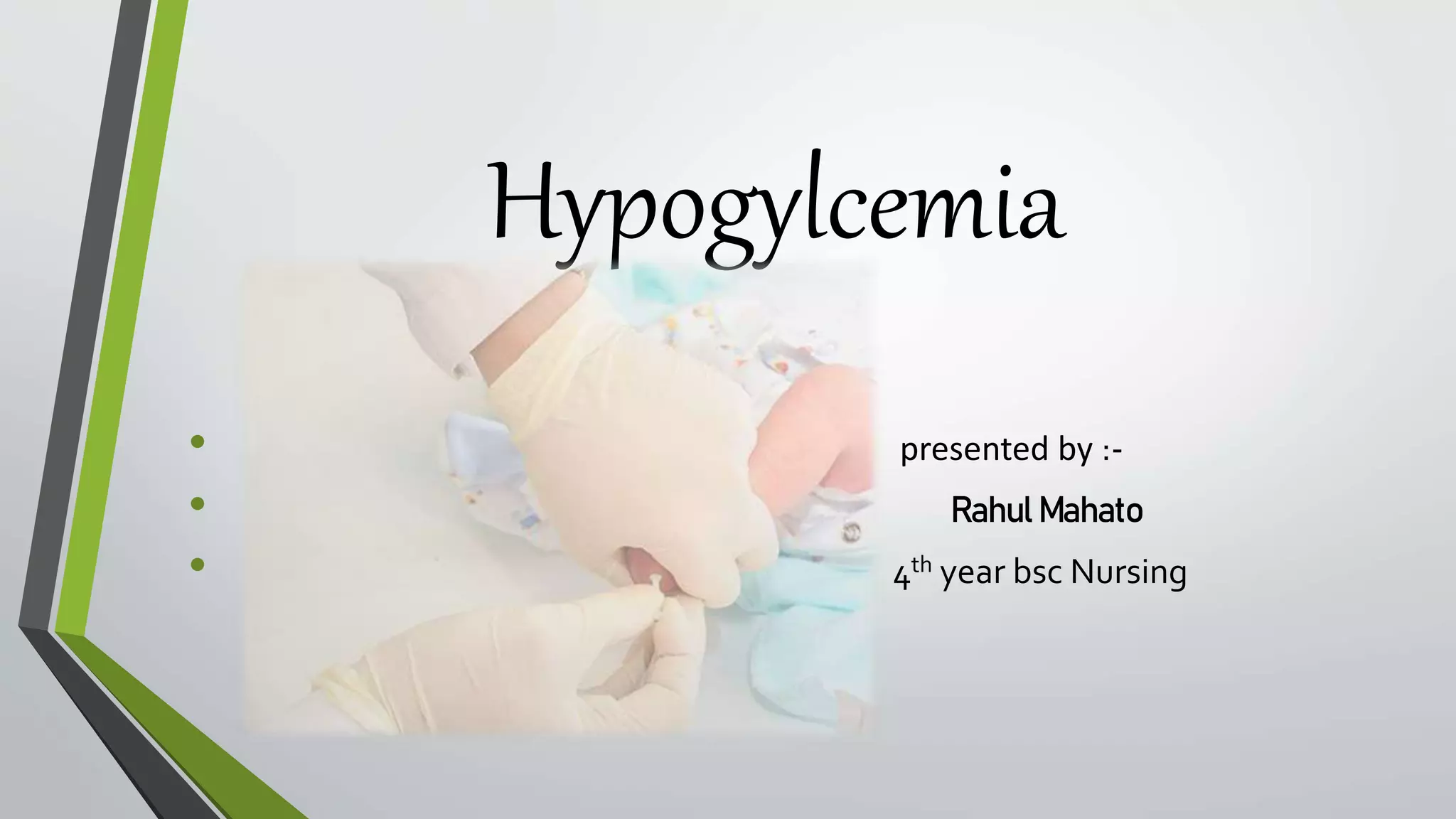
Hypogylcemia
• presented by :-
• Rahul Mahato
• 4th year bsc Nursing
Introduction
• Glucose or dextrose is a vital source of nutrient energy and is required
continuously by the fetus.
• Neonate needs this as either intermittent oral feeds or continuous IV fluids.
• Hypoglycemia can cause long term neurologic sequelae.
• The important steps in preventing and treating hypoglycemia are
• to identify neonates at risk of developing hypoglycemia
• to recognize symptoms of hypoglycemia, early feeding and
• to initiate IV fluid therapy, where ever needed.
Definition of hypoglycemia
• Neonatal hypoglycemia, defined as a plasma glucose level of less than 30
mg/dL (1.65 mmol/L) in the first 24 hours of life and less than 45 mg/dL (2.5
mmol/L) thereafter,
• Neonatal hypoglycemia is the most common metabolic problem in
newborns.
Symptoms of hypoglycemia
• The symptoms of hypoglycemia are very nonspecific
• The common symptoms are:
• Not looking well
• Lethargic
• Weak cry
• Poor feeding
• Temperature instability like hypothermia
• Poor respiratory effort: shallow breathing, apnea orcyanosis
• CNS symptoms like: excessive jitteriness, convulsions or hypotonia
Factors which increase the risk of hypoglycemia
• Various factors which increase the risk of hypoglycemia are hypothermia &
cold Stress, cold environment, wet baby and inadequate feeding.
Neonates at risk of hypoglycemia
• Babies weighing less than 2.0 kg birth weight
• preterm babies
• LGA (large for gestational age) babies especially those weighing more than
3.5 kg
• infants of diabetic mothers
• those with delayed cry at birth, any sick neonate who is not sucking or
accepting feeds are all at risk of developing hypoglycemia
• The other risk factors for hypoglycemia are RDS, polycythemia, shock, and
hypothermia
Etiology
• The causes of neonatal hypoglycemia include the following:
• Persistent hyperinsulinemic hypoglycemia of infancy (PHHI)
• Limited glycogen stores (eg, prematurity, intrauterine growth retardation)
• Increased glucose use (eg, hyperthermia, polycythemia, sepsis, growth
hormone deficiency)
• Decreased glycogenolysis, gluconeogenesis, or use of alternate fuels (eg,
inborn errors of metabolism, adrenal insufficiency)
• Depleted glycogen stores (eg, asphyxia-perinatal stress, starvation)
hypoglycemia ketotic and nonketotic
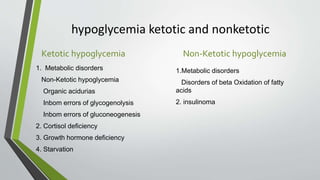
Ketotic hypoglycemia
1. Metabolic disorders
Non-Ketotic hypoglycemia
Organic acidurias
Inbom errors of glycogenolysis
Inbom errors of gluconeogenesis
2. Cortisol deficiency
3. Growth hormone deficiency
4. Starvation
Non-Ketotic hypoglycemia
1.Metabolic disorders
Disorders of beta Oxidation of fatty
acids
2. insulinoma
Treatment
• To raise the blood sugar value to normal range, give 200 mg/kg of dextrose
i.e. 2 ml/kg of 10% dextrose as bolus slowly over 3-5 minutes and start
maintenance fluids with a dextrose infusion rate (DIR) of 6-8 mg/kg/min.
• The maximum strength of dextrose that can be given through a peripheral
vein is 12.5%.
• Repeat Dextrostix after 15-30 minutes, if still low, repeat bolus and increase
(DIR) by 1-2 mg/kg/min or the maintenance fluids by 10-20 ml/kg/day.
• For example in a low birth weight baby on first day of life give 80ml/kg/day
i.e. 80 x wt of the baby
• e.g. 1.8 kg i.e. 144 ml/day. Divide by 24 to obtain fluid per hour (144/24 = 6
ml/hr)
• Take a measured volume set, fill 1/4th or 6 hrs fluid i.e. 24 ml and deliver at a
rate of 6 micro drops/min (number of drops per minute is equal to rate of
fluid/hour)
• The dextrose infusion rate can be calculated by the following formula:
• Fluid rate (ml/kg/day) x % of Dextrose to be used x 0.007 = DIR (mg/kg/min)
• e.g. If a baby is on 100 ml/kg/day of 10% dextrose, the DIR is 7 mg/kg/min.
You may also use the reference charts to calculate the DIR.
How to monitor blood glucose in hypoglycemia
• In asymptomatic babies measure blood glucose within 2 hrs of birth,
preferably before feeds.
• Frequency & duration depends on clinical features and glucose value, initial
frequency may be 2 hrly, and later 4 hrly and finally 8 - 12 hrly.
• Monitoring is usually done for 72 hrs after birth in at risk newborns or till
glucose levels remain normal for 48-72 hrs.
• Symptomatic babies: may require more frequent monitoring.
• Maintain the same DIR till the blood glucose is stable for at least 6- 8hrs and
then decrease the DIR by not greater than 1-2 mg/kg/min every 2 hours with
adequate monitoring
Resistant and Persistent Hypoglycemia
• Resistant or Persistent Hypoglycemia:
• Requirement of a dextrose infusion rate or more than 12 mg/kg/min
suggests resistant hypoglycemia.
• Any hypoglycemia persisting beyond one week despite adequate
management suggests persistent hypoglycemia.
• One should rule out hyperinsulinemic state or inborn errors of metabolism.
• Increase the DIR to 12-15 mg/kg/min, keeping in mind that more than 12.5%
dextrose should not be given through a peripheral vein and a central venous
catheterization is required.
• In resistant or persistent hypoglycemia the following drugs should be
considered:-
• Hydrocortisone: 10 mg/kg/day in two divided doses intravenously
• Glucagon: 100-300 ug/kg/dose IM to a maximum of 3 doses in babies with
adequate glycogen stores
• Diazoxide: 2-5 mg/kg/dose every 8 hrly orally
• Octreotide: Synthetic somatostatin in a dose of 2-10 ug/kg/day
subcutaneously q 8-12 hourly
• Babies with persistent or resistant hypoglycemia should be REFERRED to a
specialize center for farther investigations
Conclusion
• Awareness of risk factors that predispose infants to hypoglycemia allows for
screening of those at risk.
• If detected hypoglycemia can be treated promptly, thereby preventing the
development of severe or symptomatic hypoglycemia, which is associated
with adverse outcome.
• Asymptomatic hypoglycaemia: It is likely that hypoglycemia contributes to
abnormal neurodevelopmental outcome in infants with other risk factors for
brain injury, such as prematurity
T
H
A
N
K
Y
O
U

Hypogylcemia (neonate)

  • 1.
    Hypogylcemia • presented by:- • Rahul Mahato • 4th year bsc Nursing
  • 2.
    Introduction • Glucose ordextrose is a vital source of nutrient energy and is required continuously by the fetus. • Neonate needs this as either intermittent oral feeds or continuous IV fluids. • Hypoglycemia can cause long term neurologic sequelae. • The important steps in preventing and treating hypoglycemia are • to identify neonates at risk of developing hypoglycemia • to recognize symptoms of hypoglycemia, early feeding and • to initiate IV fluid therapy, where ever needed.
  • 3.
    Definition of hypoglycemia •Neonatal hypoglycemia, defined as a plasma glucose level of less than 30 mg/dL (1.65 mmol/L) in the first 24 hours of life and less than 45 mg/dL (2.5 mmol/L) thereafter, • Neonatal hypoglycemia is the most common metabolic problem in newborns.
  • 4.
    Symptoms of hypoglycemia •The symptoms of hypoglycemia are very nonspecific • The common symptoms are: • Not looking well • Lethargic • Weak cry • Poor feeding • Temperature instability like hypothermia • Poor respiratory effort: shallow breathing, apnea orcyanosis • CNS symptoms like: excessive jitteriness, convulsions or hypotonia
  • 5.
    Factors which increasethe risk of hypoglycemia • Various factors which increase the risk of hypoglycemia are hypothermia & cold Stress, cold environment, wet baby and inadequate feeding.
  • 6.
    Neonates at riskof hypoglycemia • Babies weighing less than 2.0 kg birth weight • preterm babies • LGA (large for gestational age) babies especially those weighing more than 3.5 kg • infants of diabetic mothers • those with delayed cry at birth, any sick neonate who is not sucking or accepting feeds are all at risk of developing hypoglycemia • The other risk factors for hypoglycemia are RDS, polycythemia, shock, and hypothermia
  • 7.
    Etiology • The causesof neonatal hypoglycemia include the following: • Persistent hyperinsulinemic hypoglycemia of infancy (PHHI) • Limited glycogen stores (eg, prematurity, intrauterine growth retardation) • Increased glucose use (eg, hyperthermia, polycythemia, sepsis, growth hormone deficiency) • Decreased glycogenolysis, gluconeogenesis, or use of alternate fuels (eg, inborn errors of metabolism, adrenal insufficiency) • Depleted glycogen stores (eg, asphyxia-perinatal stress, starvation)
  • 8.
    hypoglycemia ketotic andnonketotic Ketotic hypoglycemia 1. Metabolic disorders Non-Ketotic hypoglycemia Organic acidurias Inbom errors of glycogenolysis Inbom errors of gluconeogenesis 2. Cortisol deficiency 3. Growth hormone deficiency 4. Starvation Non-Ketotic hypoglycemia 1.Metabolic disorders Disorders of beta Oxidation of fatty acids 2. insulinoma
  • 9.
    Treatment • To raisethe blood sugar value to normal range, give 200 mg/kg of dextrose i.e. 2 ml/kg of 10% dextrose as bolus slowly over 3-5 minutes and start maintenance fluids with a dextrose infusion rate (DIR) of 6-8 mg/kg/min. • The maximum strength of dextrose that can be given through a peripheral vein is 12.5%. • Repeat Dextrostix after 15-30 minutes, if still low, repeat bolus and increase (DIR) by 1-2 mg/kg/min or the maintenance fluids by 10-20 ml/kg/day. • For example in a low birth weight baby on first day of life give 80ml/kg/day i.e. 80 x wt of the baby • e.g. 1.8 kg i.e. 144 ml/day. Divide by 24 to obtain fluid per hour (144/24 = 6 ml/hr)
  • 10.
    • Take ameasured volume set, fill 1/4th or 6 hrs fluid i.e. 24 ml and deliver at a rate of 6 micro drops/min (number of drops per minute is equal to rate of fluid/hour) • The dextrose infusion rate can be calculated by the following formula: • Fluid rate (ml/kg/day) x % of Dextrose to be used x 0.007 = DIR (mg/kg/min) • e.g. If a baby is on 100 ml/kg/day of 10% dextrose, the DIR is 7 mg/kg/min. You may also use the reference charts to calculate the DIR.
  • 11.
    How to monitorblood glucose in hypoglycemia • In asymptomatic babies measure blood glucose within 2 hrs of birth, preferably before feeds. • Frequency & duration depends on clinical features and glucose value, initial frequency may be 2 hrly, and later 4 hrly and finally 8 - 12 hrly. • Monitoring is usually done for 72 hrs after birth in at risk newborns or till glucose levels remain normal for 48-72 hrs. • Symptomatic babies: may require more frequent monitoring. • Maintain the same DIR till the blood glucose is stable for at least 6- 8hrs and then decrease the DIR by not greater than 1-2 mg/kg/min every 2 hours with adequate monitoring
  • 12.
    Resistant and PersistentHypoglycemia • Resistant or Persistent Hypoglycemia: • Requirement of a dextrose infusion rate or more than 12 mg/kg/min suggests resistant hypoglycemia. • Any hypoglycemia persisting beyond one week despite adequate management suggests persistent hypoglycemia. • One should rule out hyperinsulinemic state or inborn errors of metabolism. • Increase the DIR to 12-15 mg/kg/min, keeping in mind that more than 12.5% dextrose should not be given through a peripheral vein and a central venous catheterization is required. • In resistant or persistent hypoglycemia the following drugs should be considered:- • Hydrocortisone: 10 mg/kg/day in two divided doses intravenously
  • 13.
    • Glucagon: 100-300ug/kg/dose IM to a maximum of 3 doses in babies with adequate glycogen stores • Diazoxide: 2-5 mg/kg/dose every 8 hrly orally • Octreotide: Synthetic somatostatin in a dose of 2-10 ug/kg/day subcutaneously q 8-12 hourly • Babies with persistent or resistant hypoglycemia should be REFERRED to a specialize center for farther investigations
  • 14.
    Conclusion • Awareness ofrisk factors that predispose infants to hypoglycemia allows for screening of those at risk. • If detected hypoglycemia can be treated promptly, thereby preventing the development of severe or symptomatic hypoglycemia, which is associated with adverse outcome. • Asymptomatic hypoglycaemia: It is likely that hypoglycemia contributes to abnormal neurodevelopmental outcome in infants with other risk factors for brain injury, such as prematurity
  • 15.