Conventions


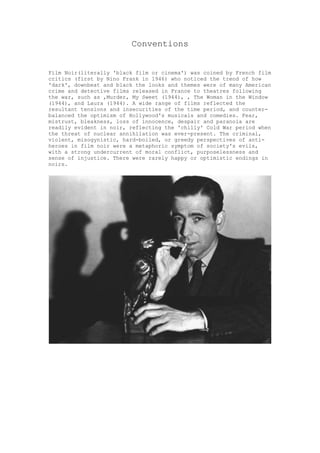
Film Noir(literally 'black film or cinema') was coined by French film
critics (first by Nino Frank in 1946) who noticed the trend of how
'dark', downbeat and black the looks and themes were of many American
crime and detective films released in France to theatres following
the war, such as ,Murder, My Sweet (1944), , The Woman in the Window
(1944), and Laura (1944). A wide range of films reflected the
resultant tensions and insecurities of the time period, and counter-
balanced the optimism of Hollywood's musicals and comedies. Fear,
mistrust, bleakness, loss of innocence, despair and paranoia are
readily evident in noir, reflecting the 'chilly' Cold War period when
the threat of nuclear annihilation was ever-present. The criminal,
violent, misogynistic, hard-boiled, or greedy perspectives of anti-
heroes in film noir were a metaphoric symptom of society's evils,
with a strong undercurrent of moral conflict, purposelessness and
sense of injustice. There were rarely happy or optimistic endings in
noirs.
Classic film noir developed during and after World War II, taking
advantage of the post-war ambience of anxiety, pessimism, and
suspicion. It was a style of black and white American films that
first evolved in the 1940s, became prominent in the post-war era, and
lasted in a classic "Golden Age" period until about 1960 (marked by
the 'last' film of the classic film noir era, Orson Welles).

Important Note: Strictly speaking, film noir is not a genre, but
rather the mood, style, point-of-view, or tone of a film. It is also
helpful to realize that 'film noir' usually refers to a distinct
historical period of film history - the decade of film-making after
World War II, similar to the German Expressionism or the French New
Wave periods. However, it was labelled as such only after the classic
period - early noir film-makers didn't even use the film designation
(as they would the labels "western" or "musical"), and were not
conscious that their films would be labelled noirs.

Characters

Very often, a film noir story was developed around a cynical, hard-
hearted, disillusioned male character [e.g., Robert Mitchum, Fred
MacMurray, or Humphrey Bogart] who encountered a beautiful but
promiscuous, amoral, double-dealing and seductive femme fatale [e.g.,
Mary Astor, Veronica Lake, Jane Greer, Barbara Stanwyck, or Lana
Turner]. She would use her feminine wiles and come-hither sexuality
to manipulate him into becoming the fall guy - often following a
murder. After a betrayal or double-cross, she was frequently
destroyed as well, often at the cost of the hero's life. As women
during the war period were given new-found independence and better
job-earning power in the homeland during the war, they would suffer -
- on the screen -- in these films of the 40s.


A convention of Noire films is a feeling of mistrust. This is because
many directors of films in the genre were Germans, who’d fled their
home countries because they were communists. In the 1950s communists
in America were treat as criminals, and secret communists felt afraid
they’re political identity would put them in prison.

Conventions

  • 1.
    Conventions Film Noir(literally 'blackfilm or cinema') was coined by French film critics (first by Nino Frank in 1946) who noticed the trend of how 'dark', downbeat and black the looks and themes were of many American crime and detective films released in France to theatres following the war, such as ,Murder, My Sweet (1944), , The Woman in the Window (1944), and Laura (1944). A wide range of films reflected the resultant tensions and insecurities of the time period, and counter- balanced the optimism of Hollywood's musicals and comedies. Fear, mistrust, bleakness, loss of innocence, despair and paranoia are readily evident in noir, reflecting the 'chilly' Cold War period when the threat of nuclear annihilation was ever-present. The criminal, violent, misogynistic, hard-boiled, or greedy perspectives of anti- heroes in film noir were a metaphoric symptom of society's evils, with a strong undercurrent of moral conflict, purposelessness and sense of injustice. There were rarely happy or optimistic endings in noirs.
  • 2.
    Classic film noirdeveloped during and after World War II, taking advantage of the post-war ambience of anxiety, pessimism, and suspicion. It was a style of black and white American films that first evolved in the 1940s, became prominent in the post-war era, and lasted in a classic "Golden Age" period until about 1960 (marked by the 'last' film of the classic film noir era, Orson Welles). Important Note: Strictly speaking, film noir is not a genre, but rather the mood, style, point-of-view, or tone of a film. It is also helpful to realize that 'film noir' usually refers to a distinct historical period of film history - the decade of film-making after World War II, similar to the German Expressionism or the French New Wave periods. However, it was labelled as such only after the classic period - early noir film-makers didn't even use the film designation (as they would the labels "western" or "musical"), and were not conscious that their films would be labelled noirs. Characters Very often, a film noir story was developed around a cynical, hard- hearted, disillusioned male character [e.g., Robert Mitchum, Fred MacMurray, or Humphrey Bogart] who encountered a beautiful but promiscuous, amoral, double-dealing and seductive femme fatale [e.g., Mary Astor, Veronica Lake, Jane Greer, Barbara Stanwyck, or Lana Turner]. She would use her feminine wiles and come-hither sexuality to manipulate him into becoming the fall guy - often following a murder. After a betrayal or double-cross, she was frequently destroyed as well, often at the cost of the hero's life. As women during the war period were given new-found independence and better job-earning power in the homeland during the war, they would suffer - - on the screen -- in these films of the 40s. A convention of Noire films is a feeling of mistrust. This is because many directors of films in the genre were Germans, who’d fled their home countries because they were communists. In the 1950s communists in America were treat as criminals, and secret communists felt afraid they’re political identity would put them in prison.