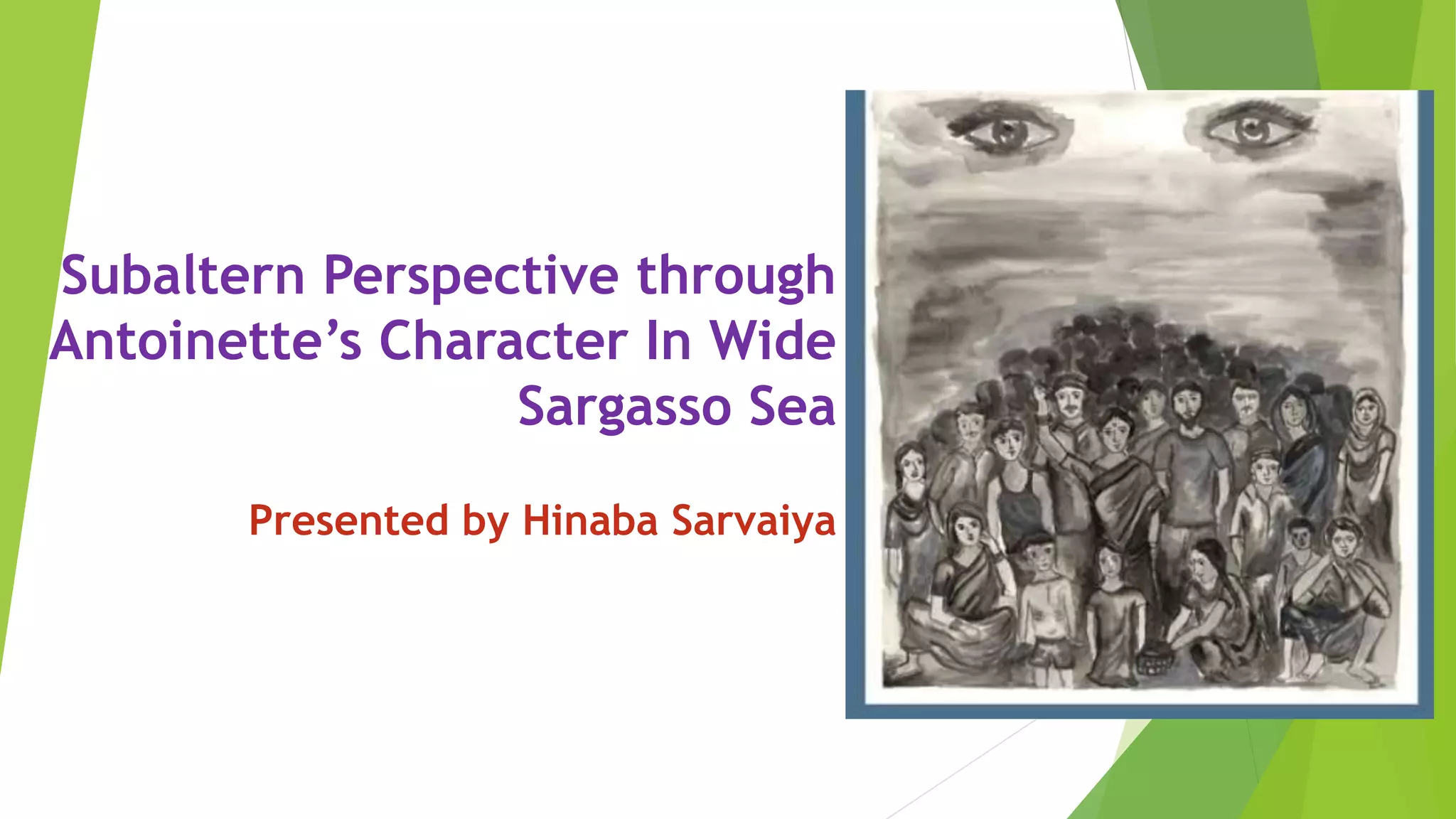
Subaltern Perspective through
Antoinette’s Character In Wide
Sargasso Sea
Presented by Hinaba Sarvaiya
 Paper Name:- The Postcolonial Studies
 Roll number:- 09
 Submission by:- English Department, MKBU.
 Email id:- hinabasarvaiya1711@gmail.com
The Term Subaltern:-
 The term 'Subaltern’ was originally introduced by
the Italian Marxist theorist, Antonio Gramsci to
speak of politically uncoordinated popular mass.
 However, the word now has a greater association
with postcolonial theory through a collective of
Indian writers headed by Ranajit Guha called
‘Subaltern Studies’ and even more so through the
writing of Gaytri Spivak.
 In Postcolonial theory, the term 'Subaltern’ was
used to refer to the socially marginalized and
non-elite groups in the erstelwhile colonies.
 Spivak, who draws on deconstructionism,
Marxism, and feminism, asks the question in a
famous essay of the name: “Can the Subaltern
Speak?”
 Her answer is in the negative since the Subaltern
subject is irretrievably heterogeneous and cannot
invoke a unified voice.
 Further, there are no subject position in English or
Indian discourse that would allow the Subaltern to
know or speak itself.
 This is doubly so for Subaltern women in colonial
contexts who have neither the conceptual
langauge to speak nor the ear of colonial and
indigenous men to listen.
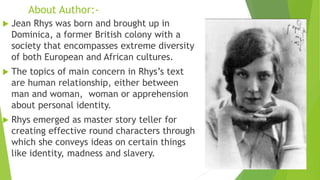
About Author:-
 Jean Rhys was born and brought up in
Dominica, a former British colony with a
society that encompasses extreme diversity
of both European and African cultures.
 The topics of main concern in Rhys’s text
are human relationship, either between
man and woman, woman or apprehension
about personal identity.
 Rhys emerged as master story teller for
creating effective round characters through
which she conveys ideas on certain things
like identity, madness and slavery.
Subaltern Perspective In The Novel :-
 Wide Sargasso Sea’s articulation of race and gender in the
context of a debate that has been waged with in feminist
postcolonial studies around the representation of racial
otherness.
 On the one hand critics like Benita Parry contend that we
need to recover historical repressed knowledges and to
construct ‘the speaking positive’ of the Subaltern.
 On the other hand, Spivak and her followers emphasize
that our very effect at resuscitating the Subaltern’s voice
invoking historical contexts reproduces the 'epistemic
violence’ of imperialism; it imposes on the Subaltern
Western assumptions of embodied subjectivity and not
simply be given his/her voice back.
 Spivak and parry both invoke Wide Sargasso Sea’s
representation of Black Creoles to illustrate their
respective approache.
 The novel exposes the conventional cultural construction
through which Antoinette, like Rochester, represents her
racial others, but it paradoxically alsobresists assigning
the Subaltern the function of a mere 'repository of
eurocentric assumptions”.
 At reading the black subjects as unmediated
representations of historical African Creoles by
foregrounding the complex and shifting cultural
constructions of race, sex and class through which the
black Creoles are perceived in the novel.
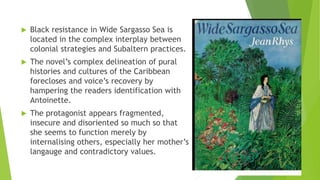
 Black resistance in Wide Sargasso Sea is
located in the complex interplay between
colonial strategies and Subaltern practices.
 The novel’s complex delineation of pural
histories and cultures of the Caribbean
forecloses and voice’s recovery by
hampering the readers identification with
Antoinette.
 The protagonist appears fragmented,
insecure and disoriented so much so that
she seems to function merely by
internalising others, especially her mother’s
langauge and contradictory values.
Subaltern Treatment of Antoinette:-
 In the first section of the novel, the young Antoinette’s
perceptual and psychological point of view is considerably
confused and confusing.
 Antoinette was neither European nor Black but White and
West Indian, a White Creole, a background who is stamped
as an outsider.
 Rhys has brought to life the character of Antoinette from
her childhood impressions of life in Dominica.
 The novel displays Annette and Antoinette confrontation
with traumatic experiences after the reinforcement of
emancipation act when black slaves were freed from the
rule of white plantation owners.
 One incident like, when Antoinette was pushed towards
margin is when she was going to convent from aunt Cora’s
house, a black girl and a boy with Negro’s mouth start
chasing her.
 It was almost half way when they came close to her and
the girl said:
 “Look the crazy girl, you crazy like your mother. Your
aunt frigtened to have you in house. Your mother walk
alone with no shoes and stocking on her feel, she sans
culotte. She try to kill her husband and she try to kill
you too that day you go to see her. She have eyes like
zombie too”
Highlights points of this novel:-
 The novel foregrounds black resistance without, however
offering unmediated access to alternative 'negro traditions’ or
to a counterdiscourse to an imperialist way of knowing.
 The novel neither celebrates an unprovlematical articulation of
the West Indian world from the black Creoles point of view nor
puts the resilient christophine in the role of the self
determining individualist Antoinette failed to become.
 Rather, it highlights tha ways in which black Creole agency was
primarily identified as criminality and affirmed not for its own
sake so much as to justify subjugation and obscure white
domination.
References:-
 Britannica, The Editors of Encyclopaedia. "Jean Rhys". Encyclopedia Britannica,
20 Aug. 2022, https://www.britannica.com/biography/Jean-Rhys. Accessed 5
October 2022.
 Chaudhary, Shweta, and Dr. Pareek. “Subaltern Perspective in Wide Sargasso
Sea: An Insight to the Plight of Antoinette.” New Literaria, vol. 2, no. 2, 2021,
pp. 90–95., https://doi.org/10.48189/nl.2022.v03i1.010.
 Mardorossian, Carine M. “Shutting up the Subaltern: Silences, Stereotypes, and
Double-Entendre in Jean Rhys’s ‘Wide Sargasso Sea.’” Callaloo, vol. 22, no. 4,
1999, pp. 1071–90. JSTOR, http://www.jstor.org/stable/3299872. Accessed 4
Oct. 2022.
 Vallath, Kalyani, editor. “Subaltern .” Dictionary of Literary Terms, by
Chithrakala Babu, Bodhi Tree Books, 2019, pp. 251–253.

Subaltern Perspective through Antoinette Character .pptx

  • 1.
    Subaltern Perspective through Antoinette’sCharacter In Wide Sargasso Sea Presented by Hinaba Sarvaiya
  • 2.
     Paper Name:-The Postcolonial Studies  Roll number:- 09  Submission by:- English Department, MKBU.  Email id:- hinabasarvaiya1711@gmail.com
  • 3.
    The Term Subaltern:- The term 'Subaltern’ was originally introduced by the Italian Marxist theorist, Antonio Gramsci to speak of politically uncoordinated popular mass.  However, the word now has a greater association with postcolonial theory through a collective of Indian writers headed by Ranajit Guha called ‘Subaltern Studies’ and even more so through the writing of Gaytri Spivak.  In Postcolonial theory, the term 'Subaltern’ was used to refer to the socially marginalized and non-elite groups in the erstelwhile colonies.
  • 4.
     Spivak, whodraws on deconstructionism, Marxism, and feminism, asks the question in a famous essay of the name: “Can the Subaltern Speak?”  Her answer is in the negative since the Subaltern subject is irretrievably heterogeneous and cannot invoke a unified voice.  Further, there are no subject position in English or Indian discourse that would allow the Subaltern to know or speak itself.  This is doubly so for Subaltern women in colonial contexts who have neither the conceptual langauge to speak nor the ear of colonial and indigenous men to listen.
  • 5.
    About Author:-  JeanRhys was born and brought up in Dominica, a former British colony with a society that encompasses extreme diversity of both European and African cultures.  The topics of main concern in Rhys’s text are human relationship, either between man and woman, woman or apprehension about personal identity.  Rhys emerged as master story teller for creating effective round characters through which she conveys ideas on certain things like identity, madness and slavery.
  • 6.
    Subaltern Perspective InThe Novel :-  Wide Sargasso Sea’s articulation of race and gender in the context of a debate that has been waged with in feminist postcolonial studies around the representation of racial otherness.  On the one hand critics like Benita Parry contend that we need to recover historical repressed knowledges and to construct ‘the speaking positive’ of the Subaltern.  On the other hand, Spivak and her followers emphasize that our very effect at resuscitating the Subaltern’s voice invoking historical contexts reproduces the 'epistemic violence’ of imperialism; it imposes on the Subaltern Western assumptions of embodied subjectivity and not simply be given his/her voice back.
  • 7.
     Spivak andparry both invoke Wide Sargasso Sea’s representation of Black Creoles to illustrate their respective approache.  The novel exposes the conventional cultural construction through which Antoinette, like Rochester, represents her racial others, but it paradoxically alsobresists assigning the Subaltern the function of a mere 'repository of eurocentric assumptions”.  At reading the black subjects as unmediated representations of historical African Creoles by foregrounding the complex and shifting cultural constructions of race, sex and class through which the black Creoles are perceived in the novel.
  • 8.
     Black resistancein Wide Sargasso Sea is located in the complex interplay between colonial strategies and Subaltern practices.  The novel’s complex delineation of pural histories and cultures of the Caribbean forecloses and voice’s recovery by hampering the readers identification with Antoinette.  The protagonist appears fragmented, insecure and disoriented so much so that she seems to function merely by internalising others, especially her mother’s langauge and contradictory values.
  • 9.
    Subaltern Treatment ofAntoinette:-  In the first section of the novel, the young Antoinette’s perceptual and psychological point of view is considerably confused and confusing.  Antoinette was neither European nor Black but White and West Indian, a White Creole, a background who is stamped as an outsider.  Rhys has brought to life the character of Antoinette from her childhood impressions of life in Dominica.  The novel displays Annette and Antoinette confrontation with traumatic experiences after the reinforcement of emancipation act when black slaves were freed from the rule of white plantation owners.
  • 10.
     One incidentlike, when Antoinette was pushed towards margin is when she was going to convent from aunt Cora’s house, a black girl and a boy with Negro’s mouth start chasing her.  It was almost half way when they came close to her and the girl said:  “Look the crazy girl, you crazy like your mother. Your aunt frigtened to have you in house. Your mother walk alone with no shoes and stocking on her feel, she sans culotte. She try to kill her husband and she try to kill you too that day you go to see her. She have eyes like zombie too”
  • 11.
    Highlights points ofthis novel:-  The novel foregrounds black resistance without, however offering unmediated access to alternative 'negro traditions’ or to a counterdiscourse to an imperialist way of knowing.  The novel neither celebrates an unprovlematical articulation of the West Indian world from the black Creoles point of view nor puts the resilient christophine in the role of the self determining individualist Antoinette failed to become.  Rather, it highlights tha ways in which black Creole agency was primarily identified as criminality and affirmed not for its own sake so much as to justify subjugation and obscure white domination.
  • 12.
    References:-  Britannica, TheEditors of Encyclopaedia. "Jean Rhys". Encyclopedia Britannica, 20 Aug. 2022, https://www.britannica.com/biography/Jean-Rhys. Accessed 5 October 2022.  Chaudhary, Shweta, and Dr. Pareek. “Subaltern Perspective in Wide Sargasso Sea: An Insight to the Plight of Antoinette.” New Literaria, vol. 2, no. 2, 2021, pp. 90–95., https://doi.org/10.48189/nl.2022.v03i1.010.  Mardorossian, Carine M. “Shutting up the Subaltern: Silences, Stereotypes, and Double-Entendre in Jean Rhys’s ‘Wide Sargasso Sea.’” Callaloo, vol. 22, no. 4, 1999, pp. 1071–90. JSTOR, http://www.jstor.org/stable/3299872. Accessed 4 Oct. 2022.  Vallath, Kalyani, editor. “Subaltern .” Dictionary of Literary Terms, by Chithrakala Babu, Bodhi Tree Books, 2019, pp. 251–253.