Re: Nelson Aggregate proposed expansion of
Burlington Quarry
Submitted by Louisette Lanteigne
700 Star Flower Ave.
Waterloo Ontario
N2V 2L2
butterflybluelu@rogers.com
Outline of Contents
• Land Use Planning
• Relevant Planning Legislation
• Planning Issues Not Met
• Issues and Concerns (not conclusive)
• Conclusion
• References
Land-Use Planning
• Land-use planning can be understood as a process to
regulate the private and public use of land and buildings
in order to resolve conflicts between private and public
interests and between present and future generations
(Swaigen, 1993).
Land-Use Planning
• Traditionally, the underlying belief of planning is that
collective rationality can be brought into the way our
cities are built rather than leaving it up to individuals in
the marketplace where inefficiencies may prevail
especially with respect to long-term thinking (Makuch,
2004).
Land-Use Planning and
Political Considerations
• Although decision-makers in land-use planning are still
often kept at a distance from political shifts there is now
considerable consensus that the essence of land-use
planning comes down to politics as more often than not
there is simply no right or wrong answer to planning in
our complex, pluralistic society (Makuch, 2004).
Land-Use Planning and
Political Considerations
• Thus, one large feature of land-use planning is to take
care in providing hearings, access to information, and
developing procedures to make decisions ‘fairer’ and
reconcile competing objectives (Makuch, 2004).
Land Use Planning and
Private Development Bias
• Planning is a highly charged financial process -
development or redevelopment can mean big bucks for
private individuals.
• Private interests may have deleterious implications
despite the benefits they may bring about and thus must
be reconciled with the interests that the public has for
appropriate development that takes into consideration
other values such as environmental protection and not
overburdening municipal services (Swaigen, 1993).
Planning Act
• The Act contains myriad policies in support of strict
prohibition of proposed development on sensitive
environments
• Section1.1 outlines the purpose:
(a) to promote sustainable economic development in a
healthy natural environment within the policy and by the
means provided under this Act
Planning Act cont’d…
Section 2 stipulates the Provincial Interest in broad terms:
(a) the protection of ecological systems, including natural
areas, features and functions
(c) the conservation and management of natural resources
and the mineral resource base
(h) the orderly development of safe and healthy
communities;
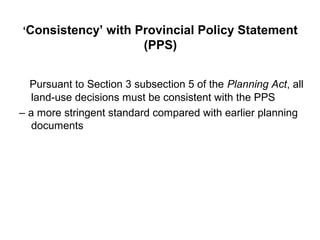
‘Consistency’ with Provincial Policy Statement
(PPS)
Pursuant to Section 3 subsection 5 of the Planning Act, all
land-use decisions must be consistent with the PPS
– a more stringent standard compared with earlier planning
documents
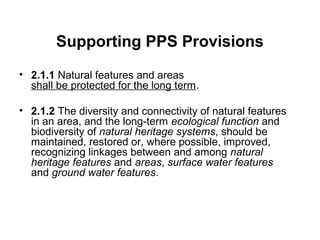
Supporting PPS Provisions
• 2.1.1 Natural features and areas
shall be protected for the long term.
• 2.1.2 The diversity and connectivity of natural features
in an area, and the long-term ecological function and
biodiversity of natural heritage systems, should be
maintained, restored or, where possible, improved,
recognizing linkages between and among natural
heritage features and areas, surface water features
and ground water features.
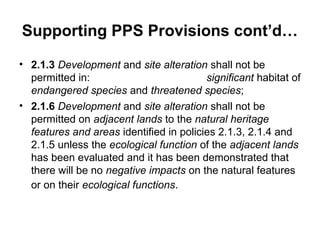
Supporting PPS Provisions cont’d…
• 2.1.3 Development and site alteration shall not be
permitted in: significant habitat of
endangered species and threatened species;
• 2.1.6 Development and site alteration shall not be
permitted on adjacent lands to the natural heritage
features and areas identified in policies 2.1.3, 2.1.4 and
2.1.5 unless the ecological function of the adjacent lands
has been evaluated and it has been demonstrated that
there will be no negative impacts on the natural features
or on their ecological functions.
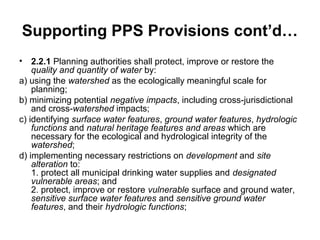
Supporting PPS Provisions cont’d…
• 2.2.1 Planning authorities shall protect, improve or restore the
quality and quantity of water by:
a) using the watershed as the ecologically meaningful scale for
planning;
b) minimizing potential negative impacts, including cross-jurisdictional
and cross-watershed impacts;
c) identifying surface water features, ground water features, hydrologic
functions and natural heritage features and areas which are
necessary for the ecological and hydrological integrity of the
watershed;
d) implementing necessary restrictions on development and site
alteration to:
1. protect all municipal drinking water supplies and designated
vulnerable areas; and
2. protect, improve or restore vulnerable surface and ground water,
sensitive surface water features and sensitive ground water
features, and their hydrologic functions;
Supporting PPS Provisions cont’d…
e) maintaining linkages and related functions among surface water
features, ground water features, hydrologic functions and natural
heritage features and areas;
f) promoting efficient and sustainable use of water resources, including
practices for water conservation and sustaining water quality; and
g) ensuring stormwater management practices minimize stormwater
volumes and contaminant loads, and maintain or increase the
extent of vegetative and pervious surfaces.
2.2.2 Development and site alteration shall be restricted in or near
sensitive surface water features and sensitive ground water
features such that these features and their related hydrologic
functions will be protected, improved or restored.
• The Endangered Species Act, 2007 (ESA), which came
into force on June 30, 2008, identifies species at risk and
protects them and their habitat.
• As well, the Endangered Species Act promotes the
recovery of the species and stewardship activities that
assist in the protection and recovery of species that are
at risk.
• It is the responsibility of the proponent to be compliant
with the ESA or they may be subject to prosecution
under the act.
Endangered Species Act, 2007
Planning criteria not met
Pursuant to Section 51 subsection 24 of the Planning Act,
decision makers must have regard to the following:
a) the effect of the proposed quarry on matters of
provincial interest as referred to in section 2;
b) whether the proposed quarry is premature or in the
public interest;
c) whether the plan conforms to the official plan;
d) the suitability of the land for the purposes for which it is
to be used;
e) conservation of natural resources and flood control;
Summary of Issues and Concerns
(not exhaustive):
Leads to Environmental Degradation of the Community
• Water quantity and quality issues
• Air pollution and incomplete environmental assessments
Does not conform to all necessary Municipal, or
Provincial policy and legislation
• Non-conforming to Municipal Policy
• Non-conforming to Planning Act and March 2005
Provincial Policy Statement
• Non-conforming to Endangered Species Act
Therefore the Nelson Aggregate Quarry expansion
for lots 18 and 19 appears to represent bad planning.
In Conclusion
• In order to comply with Provincial planning laws it is
recommended that the City of Burlington and Halton
Region deny the permit for the Nelson Aggregate Co.
• This conclusion is strongly supported by the JART report
and Conservation Halton.
References
• Ontario Provincial Policy Statement March 2005
• Ontario Planning Act
• Endangered Species Act, 2007
• Makuch, S.M. from Municipal and Planning Law.
Carswell Publishing, 2004.
• Swaigen, John and David Estrin. “Environment
on trial: a guide to Ontario environmental law
and policy”. Canadian Institute for Environmental
Law and Policy. Toronto : E. Montgomery
Publications Ltd., 1993

Nelsonquarrylanteigne 121011161032-phpapp01

  • 1.
    Re: Nelson Aggregateproposed expansion of Burlington Quarry Submitted by Louisette Lanteigne 700 Star Flower Ave. Waterloo Ontario N2V 2L2 butterflybluelu@rogers.com
  • 2.
    Outline of Contents •Land Use Planning • Relevant Planning Legislation • Planning Issues Not Met • Issues and Concerns (not conclusive) • Conclusion • References
  • 3.
    Land-Use Planning • Land-useplanning can be understood as a process to regulate the private and public use of land and buildings in order to resolve conflicts between private and public interests and between present and future generations (Swaigen, 1993).
  • 4.
    Land-Use Planning • Traditionally,the underlying belief of planning is that collective rationality can be brought into the way our cities are built rather than leaving it up to individuals in the marketplace where inefficiencies may prevail especially with respect to long-term thinking (Makuch, 2004).
  • 5.
    Land-Use Planning and PoliticalConsiderations • Although decision-makers in land-use planning are still often kept at a distance from political shifts there is now considerable consensus that the essence of land-use planning comes down to politics as more often than not there is simply no right or wrong answer to planning in our complex, pluralistic society (Makuch, 2004).
  • 6.
    Land-Use Planning and PoliticalConsiderations • Thus, one large feature of land-use planning is to take care in providing hearings, access to information, and developing procedures to make decisions ‘fairer’ and reconcile competing objectives (Makuch, 2004).
  • 7.
    Land Use Planningand Private Development Bias • Planning is a highly charged financial process - development or redevelopment can mean big bucks for private individuals. • Private interests may have deleterious implications despite the benefits they may bring about and thus must be reconciled with the interests that the public has for appropriate development that takes into consideration other values such as environmental protection and not overburdening municipal services (Swaigen, 1993).
  • 8.
    Planning Act • TheAct contains myriad policies in support of strict prohibition of proposed development on sensitive environments • Section1.1 outlines the purpose: (a) to promote sustainable economic development in a healthy natural environment within the policy and by the means provided under this Act
  • 9.
    Planning Act cont’d… Section2 stipulates the Provincial Interest in broad terms: (a) the protection of ecological systems, including natural areas, features and functions (c) the conservation and management of natural resources and the mineral resource base (h) the orderly development of safe and healthy communities;
  • 10.
    ‘Consistency’ with ProvincialPolicy Statement (PPS) Pursuant to Section 3 subsection 5 of the Planning Act, all land-use decisions must be consistent with the PPS – a more stringent standard compared with earlier planning documents
  • 11.
    Supporting PPS Provisions •2.1.1 Natural features and areas shall be protected for the long term. • 2.1.2 The diversity and connectivity of natural features in an area, and the long-term ecological function and biodiversity of natural heritage systems, should be maintained, restored or, where possible, improved, recognizing linkages between and among natural heritage features and areas, surface water features and ground water features.
  • 12.
    Supporting PPS Provisionscont’d… • 2.1.3 Development and site alteration shall not be permitted in: significant habitat of endangered species and threatened species; • 2.1.6 Development and site alteration shall not be permitted on adjacent lands to the natural heritage features and areas identified in policies 2.1.3, 2.1.4 and 2.1.5 unless the ecological function of the adjacent lands has been evaluated and it has been demonstrated that there will be no negative impacts on the natural features or on their ecological functions.
  • 13.
    Supporting PPS Provisionscont’d… • 2.2.1 Planning authorities shall protect, improve or restore the quality and quantity of water by: a) using the watershed as the ecologically meaningful scale for planning; b) minimizing potential negative impacts, including cross-jurisdictional and cross-watershed impacts; c) identifying surface water features, ground water features, hydrologic functions and natural heritage features and areas which are necessary for the ecological and hydrological integrity of the watershed; d) implementing necessary restrictions on development and site alteration to: 1. protect all municipal drinking water supplies and designated vulnerable areas; and 2. protect, improve or restore vulnerable surface and ground water, sensitive surface water features and sensitive ground water features, and their hydrologic functions;
  • 14.
    Supporting PPS Provisionscont’d… e) maintaining linkages and related functions among surface water features, ground water features, hydrologic functions and natural heritage features and areas; f) promoting efficient and sustainable use of water resources, including practices for water conservation and sustaining water quality; and g) ensuring stormwater management practices minimize stormwater volumes and contaminant loads, and maintain or increase the extent of vegetative and pervious surfaces. 2.2.2 Development and site alteration shall be restricted in or near sensitive surface water features and sensitive ground water features such that these features and their related hydrologic functions will be protected, improved or restored.
  • 15.
    • The EndangeredSpecies Act, 2007 (ESA), which came into force on June 30, 2008, identifies species at risk and protects them and their habitat. • As well, the Endangered Species Act promotes the recovery of the species and stewardship activities that assist in the protection and recovery of species that are at risk. • It is the responsibility of the proponent to be compliant with the ESA or they may be subject to prosecution under the act. Endangered Species Act, 2007
  • 16.
    Planning criteria notmet Pursuant to Section 51 subsection 24 of the Planning Act, decision makers must have regard to the following: a) the effect of the proposed quarry on matters of provincial interest as referred to in section 2; b) whether the proposed quarry is premature or in the public interest; c) whether the plan conforms to the official plan; d) the suitability of the land for the purposes for which it is to be used; e) conservation of natural resources and flood control;
  • 17.
    Summary of Issuesand Concerns (not exhaustive): Leads to Environmental Degradation of the Community • Water quantity and quality issues • Air pollution and incomplete environmental assessments Does not conform to all necessary Municipal, or Provincial policy and legislation • Non-conforming to Municipal Policy • Non-conforming to Planning Act and March 2005 Provincial Policy Statement • Non-conforming to Endangered Species Act Therefore the Nelson Aggregate Quarry expansion for lots 18 and 19 appears to represent bad planning.
  • 18.
    In Conclusion • Inorder to comply with Provincial planning laws it is recommended that the City of Burlington and Halton Region deny the permit for the Nelson Aggregate Co. • This conclusion is strongly supported by the JART report and Conservation Halton.
  • 19.
    References • Ontario ProvincialPolicy Statement March 2005 • Ontario Planning Act • Endangered Species Act, 2007 • Makuch, S.M. from Municipal and Planning Law. Carswell Publishing, 2004. • Swaigen, John and David Estrin. “Environment on trial: a guide to Ontario environmental law and policy”. Canadian Institute for Environmental Law and Policy. Toronto : E. Montgomery Publications Ltd., 1993