EFFECTIVE NEGOTIATION November 12, 2016
Student’s ID: 15422747
Page 0
EFFECTIVE
NEGOTIATION
International Business
Negotiation
Ho Chi Minh City, 2016
Submitted to:
Dr. Holger Siemons
MBA Program Cohort 4
Submitted by:
Nguyen Ngoc Huyen Tran
Student ID: 15422747
Words count: 2824
University of Northampton’s
MBA Student
EFFECTIVE NEGOTIATION November 12, 2016
Table of contents
1. Introduction........................................................................................................................................1
2. Literature Review..............................................................................................................................1
2.1. Negotiation In Daily Life ..................................................................................................1
2.2. The Process Of Negotiation ...........................................................................................2
2.3. Negotiation Styles.............................................................................................................3
2.4. The Negotiation Strategy ................................................................................................5
2.5. The Negotiation Versus The Bargaining.....................................................................7
2.6. The Negotiation Across Different Cultures................................................................7
2.7. The Effect Of Gender On Negotiation..........................................................................9
2.8. The Effect Of Emotion On Negotiation......................................................................10
3. Conclusion.......................................................................................................................................11
EFFECTIVE NEGOTIATION November 12, 2016
Student’s ID: 15422747
Page 1
1. Introduction
There are many definitions about "Negotiation" although it has only one meaning. Slocum
and Hellriegel (2011) said, “Negotiation is a process in which two or more interdependent
individuals or group who perceive that they have both common and conflicting goals state
and discuss proposals and preferences for specific terms of a possible agreement.”
Through many years, the world has changed with volatility, uncertainty, complexity, and
ambiguity (VUCA world) (Mack et al., 2016). The economics develops fast and the people
have higher demand (Smirnova, 2013). Consequently, negotiation becomes more
important as well as more complicated. Negotiators are expected to have a well -
preparation with strategy and process before they negotiate.
Negotiation not only happens in business and political circumstances, it also happens in
daily communication, even in the personal life (Lewicki, 2011). Karrass (1996) said, “You
do not get what deserve, you get what you negotiate.” Tracy (2014) had the same idea
that the people who cannot negotiate well will be a victim of people who do it better.
Therefore, negotiation is a necessary everyday skill of each person. The idea in this
assignment is a critical thinking and evaluation of the writer about negotiation theory in
the context of complex multiparty within different cultures, based on the debates and
relevant literature relating to key aspects and processes of negotiation.
2. Literature Review
2.1. Negotiation In Daily Life
People have demands for cooperation, resources, information, and support from others
to achieve their specific purposes (Fox, 2013). Negotiation becomes an important tool to
influence others to get what they want (Lewicki, 2011; Fox, 2013). People can negotiate
to compromise and resolve conflicts or dispute between the parties. It appears in a wide
variety of fields, not only in business, non-profit organization, government, etc. but also in
daily communication (Thompson, Wang and Gunia, 2010). Lewicki (2011) said,
“Negotiation is not a process reserved only for the skilled diplomat, top salesperson, or
ardent advocate for an organized lobby; it is something that everyone does, almost daily.”
Fox (2013) believed that “Life is a series of negotiations. People have to negotiate from
the time they wake up to the time they go to sleep.” The writer also has the same opinion
of almost authors that negotiation appears everywhere and all time in our life, such as a
wife and a husband negotiate about how to bring up their children; teachers negotiate
EFFECTIVE NEGOTIATION November 12, 2016
Student’s ID: 15422747
Page 2
with their students when they have different thinking about the content of the lesson;
friends negotiate each other to make a date; children negotiate with their parents to get
their favorite toys.
Negotiation is not a communication with others only; it is also a compromise with yourself
and called the little voice in your head (Reynolds, 2014) or inner negotiation (Fox, 2013).
It appears when the people think about what they should do between one and more
choices. Stone, Heen and Patton (2010) and R. Cohen (2010) think that there is a
significant connection between internal negotiation and external negotiation. The internal
negotiation maybe changes the approach of external negotiation. Moreover, learning how
to negotiate with the internal conflict will help people have a better life (Wakefield, 2012).
Based on the real situation, the writer thinks the internal negotiation is more difficult than
external negotiation. The negotiators need to control and win themselves to realize what
they want to achieve before they negotiate with others. Moreover, gaining a victory over
themselves will help negotiators have more confidence for preparing external negotiation.
2.2. The Process Of Negotiation
There are many different ways of structuring and thinking about the negotiation process.
Depending on each specific circumstance, people can apply flexible the process of
negotiation with four steps, five steps, six steps, seven steps, or eight steps. In the
author’s opinion, the negotiation process has more steps will show more detail what
negotiators need to implement, and it can be more effective in the difficult situations.
T. Chebet, K. Rotich and Kurgat (2015) said: “The negotiation process is influenced by
many factors such as time, environment, personalities, information, personal issues and
hierarchy.” Consequently, there are no one best formula to create the best negotiation.
Depending on each specific case, the negotiators can apply an appropriate process.
Within the scope of this paper, the writer will analyze the negotiation process with four
steps. The figure below will illustrate four steps to prepare a better negotiation.
Figure 1: Four steps of negotiation process
EFFECTIVE NEGOTIATION November 12, 2016
Student’s ID: 15422747
Page 3
Sources: Adapted from Shell (2006), (Intense School, 2016)
At the first stage - preparation, negotiators need to answer clearly the question what their
objectives of the negotiation and gather all information about other parties as well as what
they will negotiate. With the more information, the more advantages they have. At the
second stage – exchanging information, information is shared among all parties involved
in the negotiation. This stage is the best time to understand other parties is to look at the
deal from their point of view. “Put yourself in their shoes” is so difficult but it is very
important when you want to have a successful negotiation (Fisher, Ury and Patton,
2011).The writer thinks that the third stage - bargaining is the most important stage of
negotiation process to decide the outcome of negotiation. According to Intense School,
(2016): “In the third stage, the deal begins to take shape, parties make compromises, and
all parties try to convince each other to agree to their own terms.” With this last stage, all
parties trust each other, build commitment, and clarify responsibility.
Ghauri and Usunier, (2003) said: “The most important success factor in negotiation is
preparation and planning.”
2.3. Negotiation Styles
Negotiation is described by two components that are a shared interest and matters of a
conflict. In there, the common interests is used to negotiate on the issue (Heiba, 1984).
However, Putnam and Roloff (1992) argued that negotiation focuses on the lack of
agreement to find out a joint agreement. The Thomas-Kilmann Conflict Mode Instrument
(TKI) introduced by Kenneth W. Thomas and Ralph H. Kilmann to define five specific
EFFECTIVE NEGOTIATION November 12, 2016
Student’s ID: 15422747
Page 4
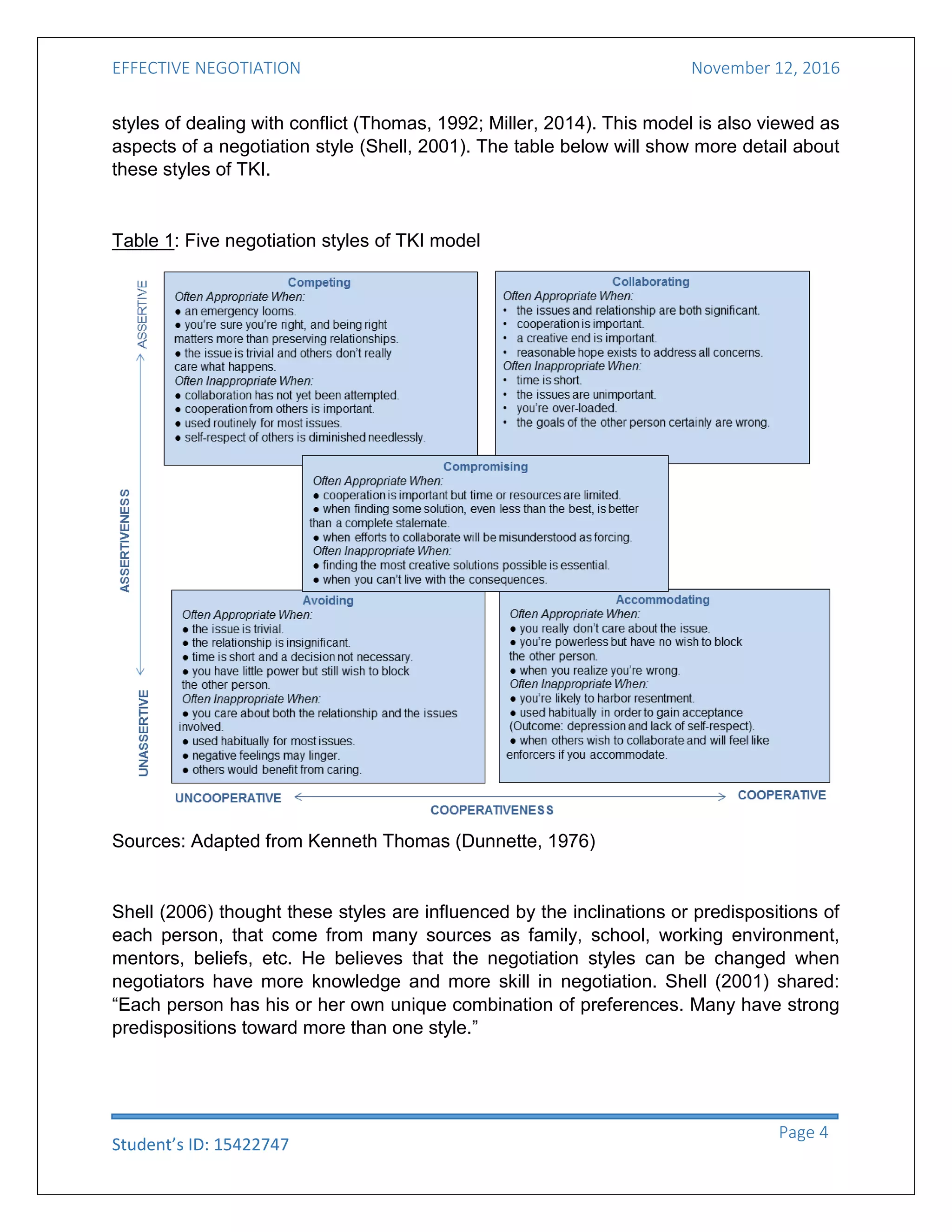
styles of dealing with conflict (Thomas, 1992; Miller, 2014). This model is also viewed as
aspects of a negotiation style (Shell, 2001). The table below will show more detail about
these styles of TKI.
Table 1: Five negotiation styles of TKI model
Sources: Adapted from Kenneth Thomas (Dunnette, 1976)
Shell (2006) thought these styles are influenced by the inclinations or predispositions of
each person, that come from many sources as family, school, working environment,
mentors, beliefs, etc. He believes that the negotiation styles can be changed when
negotiators have more knowledge and more skill in negotiation. Shell (2001) shared:
“Each person has his or her own unique combination of preferences. Many have strong
predispositions toward more than one style.”
EFFECTIVE NEGOTIATION November 12, 2016
Student’s ID: 15422747
Page 5
Besides that, there are many concerns about which negotiation style is the best or the
most useful to negotiate successfully. According to Belli (2016), “Some types of
negotiations are better than others. A compromiser and a competitor will have an easier
time negotiating than a collaborator and a competitor.” However, Coburn (2016) had a
different opinion that all five styles are useful in different situations. Lewicki and Hiam,
(2006) had the same thinking, they said to choose the right style, people need to address
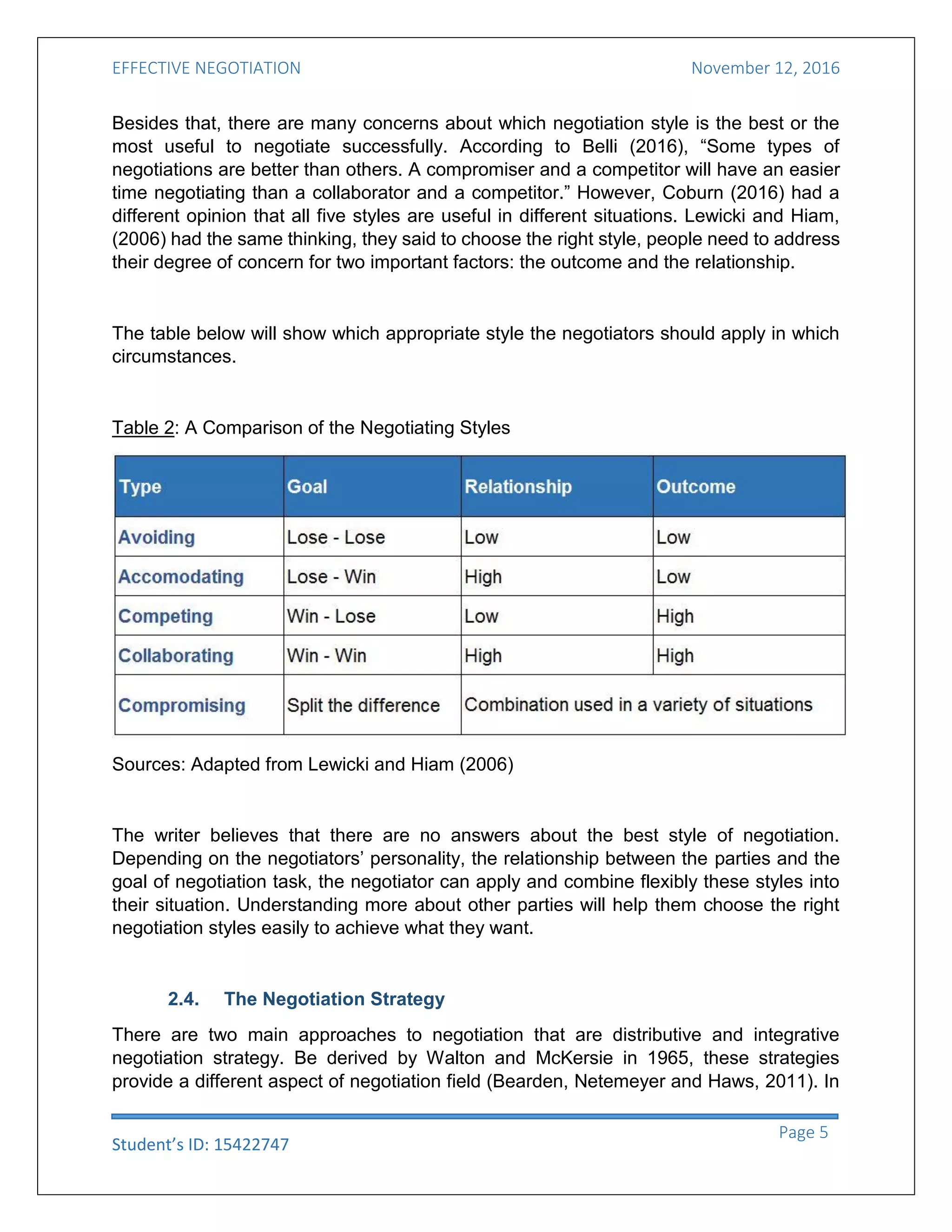
their degree of concern for two important factors: the outcome and the relationship.
The table below will show which appropriate style the negotiators should apply in which
circumstances.
Table 2: A Comparison of the Negotiating Styles
Sources: Adapted from Lewicki and Hiam (2006)
The writer believes that there are no answers about the best style of negotiation.
Depending on the negotiators’ personality, the relationship between the parties and the
goal of negotiation task, the negotiator can apply and combine flexibly these styles into
their situation. Understanding more about other parties will help them choose the right
negotiation styles easily to achieve what they want.
2.4. The Negotiation Strategy
There are two main approaches to negotiation that are distributive and integrative
negotiation strategy. Be derived by Walton and McKersie in 1965, these strategies
provide a different aspect of negotiation field (Bearden, Netemeyer and Haws, 2011). In
EFFECTIVE NEGOTIATION November 12, 2016
Student’s ID: 15422747
Page 6
the distributive strategy, sometimes called positional or hard-bargaining negotiation, the
parties view the negotiations as a zero-sum game with “the fixed pie strategy” (Brighthub
Project Management, 2016). It means if one person wins, the other loses. In contrast, the
integrative strategy, sometimes called interest-based or principled negotiation, is
employed when both sides can win but not at the expense of the other side ( Watkins,
2003; Schneider and Honeyman, 2006; Olekalns and Adair, 2013).
The persons use distributive negotiation focused on their interests, regardless the loss of
the others. Meanwhile, the persons use integrative focus on mutual interests and look for
constructive solutions for all parties (Schneider and Honeyman, 2006; Lewicki, 2011;
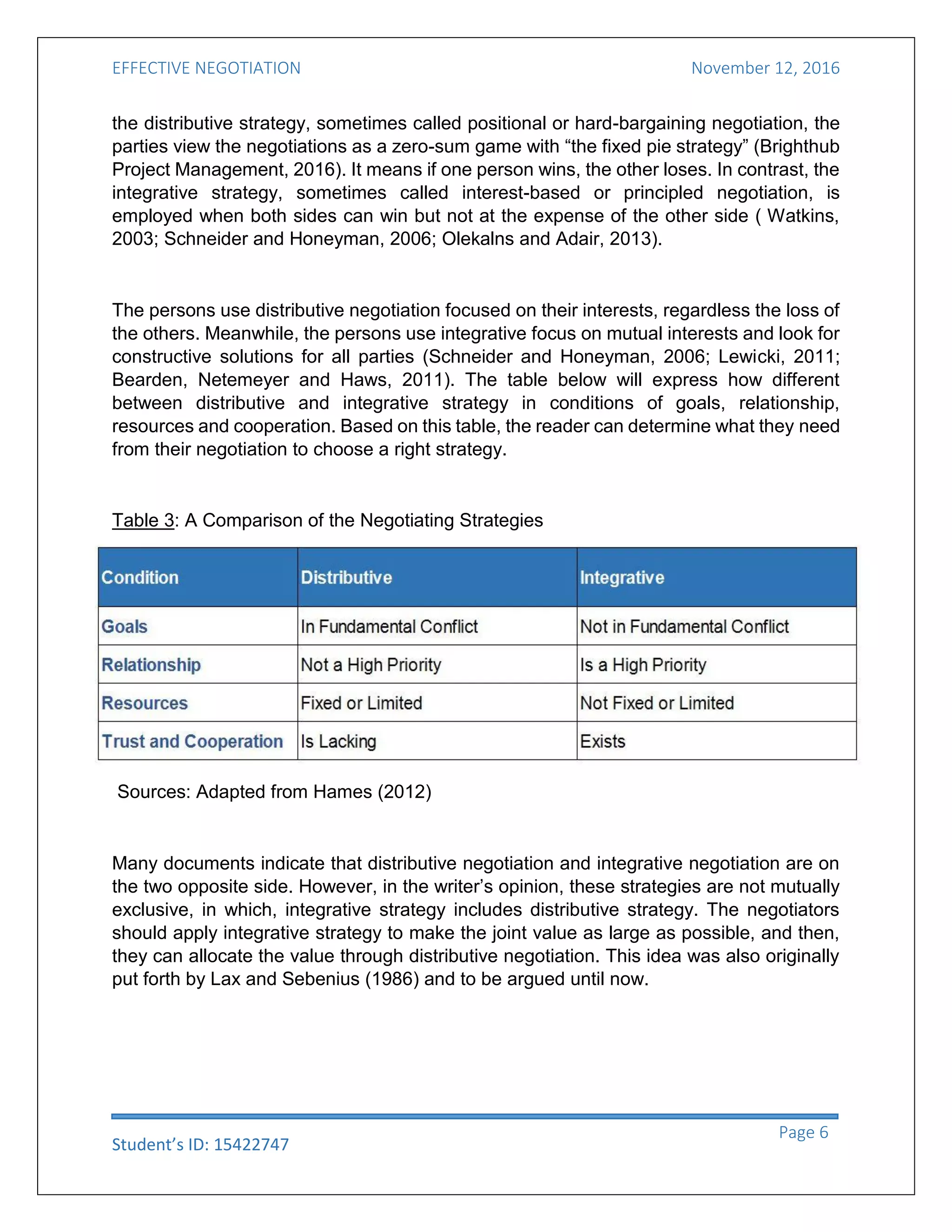
Bearden, Netemeyer and Haws, 2011). The table below will express how different
between distributive and integrative strategy in conditions of goals, relationship,
resources and cooperation. Based on this table, the reader can determine what they need
from their negotiation to choose a right strategy.
Table 3: A Comparison of the Negotiating Strategies
Sources: Adapted from Hames (2012)
Many documents indicate that distributive negotiation and integrative negotiation are on
the two opposite side. However, in the writer’s opinion, these strategies are not mutually
exclusive, in which, integrative strategy includes distributive strategy. The negotiators
should apply integrative strategy to make the joint value as large as possible, and then,
they can allocate the value through distributive negotiation. This idea was also originally
put forth by Lax and Sebenius (1986) and to be argued until now.
EFFECTIVE NEGOTIATION November 12, 2016
Student’s ID: 15422747
Page 7
2.5. The Negotiation Versus The Bargaining
For most people, bargaining and negotiation mean the same thing, nevertheless, these
concepts are completely different. Negotiation is focused on value while bargaining is
focused on price (Hargie, 2006; Carlsnaes, Risse-Kappen and Simmons, 2013).
According to Lewicki (2011): “The bargaining is used to describe the competitive, win-
lose situations such as haggling over the price of that item that happens at a yard sale,
flea market, or used car lot. The negotiation is used to refer to win-win situations such as
those that occur when parties are trying to find a mutually acceptable solution a complex
conflict.”
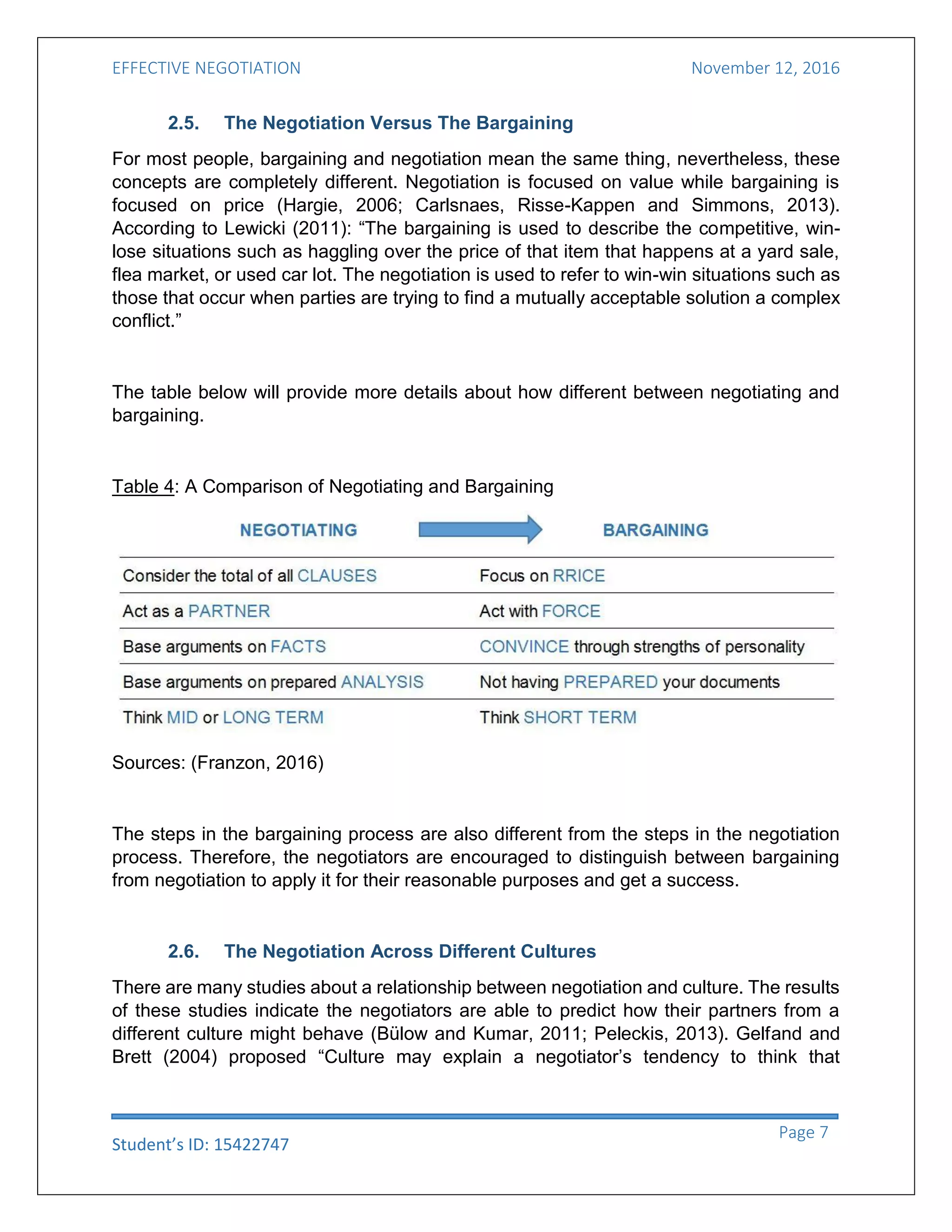
The table below will provide more details about how different between negotiating and
bargaining.
Table 4: A Comparison of Negotiating and Bargaining
Sources: (Franzon, 2016)
The steps in the bargaining process are also different from the steps in the negotiation
process. Therefore, the negotiators are encouraged to distinguish between bargaining
from negotiation to apply it for their reasonable purposes and get a success.
2.6. The Negotiation Across Different Cultures
There are many studies about a relationship between negotiation and culture. The results
of these studies indicate the negotiators are able to predict how their partners from a
different culture might behave (Bülow and Kumar, 2011; Peleckis, 2013). Gelfand and
Brett (2004) proposed “Culture may explain a negotiator’s tendency to think that
EFFECTIVE NEGOTIATION November 12, 2016
Student’s ID: 15422747
Page 8
negotiation is primarily a process of building, reconstructing, and maintaining
relationships or a process of distributing resources.”
The purposes of negotiation are considered on both relationship and outcome elements
(Gelfand and Brett, 2004). Relationship concentrates on social distance by stressing trust
and dominance; while outcome concentrates on individual and joint gains. Different
culture will influence to the priority over relationship element or outcome element due to
how people understand themselves in a social setting (Markus and Kitayama, 1991).
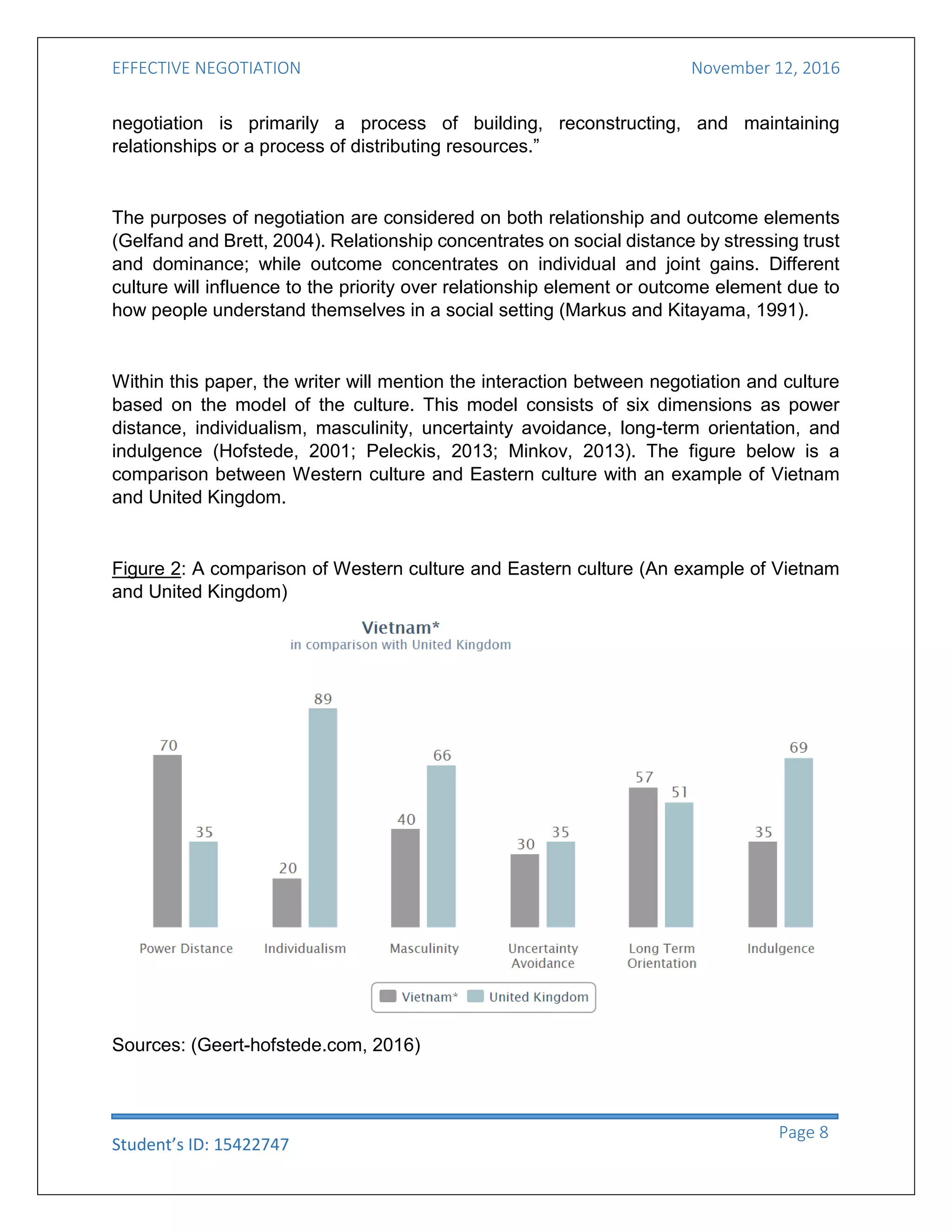
Within this paper, the writer will mention the interaction between negotiation and culture
based on the model of the culture. This model consists of six dimensions as power
distance, individualism, masculinity, uncertainty avoidance, long-term orientation, and
indulgence (Hofstede, 2001; Peleckis, 2013; Minkov, 2013). The figure below is a
comparison between Western culture and Eastern culture with an example of Vietnam
and United Kingdom.
Figure 2: A comparison of Western culture and Eastern culture (An example of Vietnam
and United Kingdom)
Sources: (Geert-hofstede.com, 2016)
EFFECTIVE NEGOTIATION November 12, 2016
Student’s ID: 15422747
Page 9
Western people are independent and individualistic while Eastern people are
interdependent and collectivist (Nader, 2013). Gelfand and Brett (2004) think that
relationship affects Eastern negotiators and outcome affects to Western negotiators.
From this point, their negotiation goals will be influence by their culture. The table below
will be a comparison of culture and negotiation within Western and Eastern culture.
Table 5: The distinction reflected in culture and negotiation processes (Western and
Eastern)
Sources: (Gelfand and Brett, 2004)
The writer thinks that understanding about the parties’ culture will help negotiators
prepare a better strategy for their negotiation.
2.7. The Effect Of Gender On Negotiation
Lewicki (2011) said that the topic of gender differences are appeared on most of
negotiation researches. The results point out that gender will impact on the differences of
approaches, expectations, and outcome of negotiation (L. Barkacs and Standifird, 2007;
Bohnet and Bowles 2008; Kolb 2009). According to Carli (2001) and Eagly and Wood
(2012), men are dominant and assertive while women are passive and accommodating.
Consequently, men usually concentrate on objective facts and women have a tendency
to maintain the relationship.
In the meta-analysis of Mazei et al., (2015), he suggested that men have an advantage
in getting a better outcome negotiation than women. Babcock et al. (2006) and Small et
al. (2007) have the same thinking that men are more prone than women to initiate a
negotiation for higher compensation. However, the influence of gender difference on
EFFECTIVE NEGOTIATION November 12, 2016
Student’s ID: 15422747
Page 10
negotiation behavior also strongly depend on negotiation context (Kray and Thompson
2005; Bohnet and Bowles 2008; Kolb 2009). Additionally, the negotiation of the same-
gender dyads will be more retaliative and competitive than mixed-gender dyads (Sutter
et al., 2009).
Furthermore, Bowles and Flynn (2010) argued that women are more patient when they
are negotiating with men than when they are negotiating with women. In mixed-gender
dyads, men usually have more an advantage because of gender stereotypes (Kray,
Thompson and Galinsky, 2001). Depending on the purpose of negotiation, each party
should have a specific strategy to choose who will representative of their negotiators.
2.8. The Effect Of Emotion On Negotiation
Fisher, Ury and Patton (2011) believed that the negotiators are able to find out their own
way in negotiating in term of three basic categories: perception, communication, and
emotion. Negotiation is often effect to emotions of negotiators, in contrast, emotions as
fear, anxiety, anger, and annoyance (Blanding, 2014) also impact on the result of
negotiation. According to Oleklns and Druckman (2014), emotions are obstacles of
successful negotiation. However, there is argument that emotion plays an important role
in negotiating with positive and negative side (Olekalns and Druckman, 2014; Martinovski,
2015).
Positive emotion not only enhances an ability to reach an agreement but also creates
positive effects with other parties in the future (Kopelman, Rosette, and Thompson 2006).
Oleklns and Druckman (2014) said: “Positive emotions may help negotiators to focus on
the future, facilitating agreements and strengthening ongoing relationships.” Meanwhile,
negative emotion may postpone and prevent solving problems as well as reduce a rate
of achieving agreements (Friedman et al. 2004; Brett et al. 2007).
Nevertheless, having the same opinion of Van Kleef (2009), the writer can not deny that
negative emotion sometimes is helpful when negotiators focus on the task rather than the
person. In order to control emotion efficiently in the negotiation, the writer suggests
applying emotional intelligent appropriately and consider other elements that can affect
emotion.
EFFECTIVE NEGOTIATION November 12, 2016
Student’s ID: 15422747
Page 11
3. Conclusion
The majority of people think negotiation and bargaining have the similar meaning.
Actually, these are two different concepts. Negotiation usually tends to both parties’
benefit while bargaining usually concentrates on benefit for one party. According to some
studies, the writer can say that negotiation finds win - win solution whereas bargaining
looks for win - lose solution. Depending on each situation and circumstance, the
negotiators should have a suitable preparation with their purposes.
In VUCA world, negotiation becomes more and more complicated. Consequently,
negotiators are required to have more skills as well as more well-prepared before they
negotiate. Negotiation is affected by many elements such as culture, gender, perception,
and emotion of negotiators. To negotiate successfully, the negotiators need to clarify their
personality and negotiation style to choose a corresponding negotiation strategy. Besides
that, understanding the other parties’ style and thinking is also a useful step that helps to
solve the issue.
In fact, there are complex negotiation that need advice from the experts. Its results are
not only affect to negotiators but also affect to a community or a country. The negotiation
between Iran and the United States to limit nuclear weapons program at Iran is one of the
examples about complicated negotiation. The United States did not accept this argument.
Consequently, Barack Obama did engage in concessions with the Iranian side and led to
more creative bargaining options for both parties.
The negotiation skill is not the same in every circumstances and it can be improved by
training and practice day by day. Furthermore, when negotiators understand more about
negotiation, they can improve yourself by their experience through different situations.
EFFECTIVE NEGOTIATION November 12, 2016
Student’s ID: 15422747
Page 12
References
Ariel Fox, E. (2013). The Most Important Negotiation in Your Life. Harvard Business
Review.
Babcock, L., M. Gelfand, D. Small, and H. Stayn. 2006. Gender differences in the
propensity to initiate negotiations. In Social psychology and economics, edited by
D. De Cremer, M. Zeelenberg, and J.K. Murnighan. Mahwah, NJ: Lawrance
Erlbaum.
Bearden, W., Netemeyer, R. and Haws, K. (2011). Handbook of marketing scales.
Thousand Oaks, Calif.: SAGE.
Belli, B. (2016). Five Types of Negotiators and What That Means For You. [online] The
Ambulatory M&A Advisor. Available at:
http://www.ambulatoryadvisor.com/breakdown-five-types-negotiators-outlined/
[Accessed 5 Nov. 2016].
Blanding, M. (2014). The Role of Emotions in Effective Negotiations. Harvard Business
School. [online] Available at: http://hbswk.hbs.edu/item/the-role-of-emotions-in-
effective-negotiations [Accessed 11 Nov. 2016].
Bohnet, I. and H.R. Bowles. 2008. Special section: Gender in negotiation (introduction).
Negotiation Journal 24(4): 389-392.
Bowles, H. and Flynn, F. (2010). Gender and Persistence in Negotiation: A Dyadic
Perspective. Academy of Management Journal, 53(4), pp.769-787.
Brett, J., M. Olekalns, R. Friedman, N. Goates, C. Anderson, and C. Lisco. 2007. Sticks
and stones: Language and on-line dispute resolution. Academy of Management
Journal 50(1): 85–99.
EFFECTIVE NEGOTIATION November 12, 2016
Student’s ID: 15422747
Page 13
Brighthub Project Management. (2016). Difference Between Distributive and Integrative
Negotiation Strategies. [online] Available at:
http://www.brighthubpm.com/methods-strategies/114091-comparing-distributive-
and-integrative-negotiation-strategies/ [Accessed 6 Nov. 2016].
Bülow, A. and Kumar, R. (2011). Culture and Negotiation. International Negotiation, 16(3),
pp.349-359.
Carli, L. (2001). Gender and Social Influence. Journal of Social Issues, 57(4), pp.725-
741.
Carlsnaes, W., Risse-Kappen, T. and Simmons, B. (2013). Handbook of international
relations. London: SAGE Publications.
Chen, F. (2015). 4 Stages of Negotiation. [online] Linkedin. Available at:
https://www.linkedin.com/pulse/negotiation-frank-chen [Accessed 11 Nov. 2016].
Coburn, C. (2016). Negotiation Conflict Styles. [online] Available at:
http://www.negotiations.com/ [Accessed 5 Nov. 2016].
Dunnette, M. (1976). Handbook of industrial and organizational psychology. Chicago:
Rand McNally College Pub. Co.
Eagly, A. H., & Wood, W. (2012). Social role theory. In P. A. M. van Lange, A. W.
Kruglanski, & E. T. Higgins (Eds.), Handbook of theories in social psychology (pp.
458 – 476). Thousand Oaks, CA: Sage Publications.
http://dx.doi.org/10.4135/9781446249222.n49.
Fisher, R., Ury, W. and Patton, B. (2011). Getting to yes. 3rd ed. New York: Penguin.
EFFECTIVE NEGOTIATION November 12, 2016
Student’s ID: 15422747
Page 14
Franzon, F. (2016). Negotiation tools & methodology. [online] Slideshare.net. Available
at: http://www.slideshare.net/fredrikfranzon/negotiation-tools-methodology
[Accessed 7 Nov. 2016].
Friedman, R., J. Brett, C. Anderson, M. Olekalns, N. Goates, and C. Lisco. 2004. The
positive and negative effects of anger on disputes: Evidence from electronically-
mediated disputes. Journal of Applied Psychology 89(2): 369–376.
Geert-hofstede.com. (2016). Vietnam - Geert Hofstede. [online] Available at: https://geert-
hofstede.com/vietnam.html [Accessed 7 Nov. 2016].
Gelfand, M. and Brett, J. (2004). The handbook of negotiation and culture. Stanford,
Calif.: Stanford Business Books.
Ghauri, P. and Usunier, J-C. 2003. International Business Negotiations. 2nd Edition.
Elsevier Ltd. UK.
Hames, D. (2012). Negotiation. Thousand Oaks, Calif.: SAGE Publications.
Hargie, O. (2006). The handbook of communication skills. London: Routledge.
Heiba, F. (1984). International Business Negotiations: A Strategic Planning Model.
International Marketing Review, 1(4), pp.5-16.
Hofstede, G. (2001). Culture's consequences. Thousand Oaks, Calif.: Sage Publications.
Intense School. (2016). Effective Negotiation Skills In Project Management - Intense
School. [online] Available at: http://resources.intenseschool.com/effective-
negotiation-skills-in-project-management/ [Accessed 11 Nov. 2016].
Karrass, C. (1996). "In business as in life-- you don't get what you deserve you get what
you negotiate". Los Angeles: Stanford Street Press.
EFFECTIVE NEGOTIATION November 12, 2016
Student’s ID: 15422747
Page 15
Kolb, D.M. 2009. Too bad for the women or does it have to be? Gender and negotiation
research over the past twenty-five years. Negotiation Journal 25(4): 515-531.
Kopelman, S., A. Rosette, and L. Thompson. 2006. The three faces of Eve: Strategic
displays of positive, negative, and neutral emotions in negotiations. Organizational
Behavior and Human Decision Processes 99(1): 81–101.
Kray, L., Thompson, L. and Galinsky, A. (2001). Battle of the sexes: Gender stereotype
confirmation and reactance in negotiations. Journal of Personality and Social
Psychology, 80(6), pp.942-958.
Kray, L. J., & Thompson, L. L. (2005). Gender stereotypes and negotiation performance:
An examination of theory and research. In B. M. Staw & R. M. Kramer (Eds.),
Research in organizational behavior: An annual series of analytical essays and
critical reviews (Vol. 26, pp. 103–182). New York, NY: Elsevier Science/JAI Press.
L. Barkacs, L. and Standifird, S. (2007). Gender Distinctions And Empathy In Negotiation.
Proceedings of the Academy of Organizational Culture, Communications and
Conflict, 12.
Lax, D. and Sebenius, J. (1986). The manager as negotiator. New York: Free Press.
Lewicki, R. (2011). Essentials of negotiation. [Whitby, Ont.]: McGraw-Hill Ryerson.
Lewicki, R. and Hiam, A. (2006). Mastering business negotiation. San Francisco: Jossey-
Bass, a John Wiley & Sons Imprint.
Lytle, A. L., Brett, J. M., Barsness, Z. I., Tinsely, C. H., and M. Janssens. (1995). A
paradigm for confirmatory cross-cultural research in organizational behavior. In
L.L. Cummings and B.M. Staw (Eds.), Research in organizational behavior (pp.
167– 214). Greenwich, CT: JAI Press.
EFFECTIVE NEGOTIATION November 12, 2016
Student’s ID: 15422747
Page 16
Mack, O., Khare, A., Krämer, A. and Burgartz, T. (2016). Managing in a VUCA world.
Markus, H. R., and S. Kitayama. (1991). Culture and the self: Implications for cognition,
emotion, and motivation. Psychological Review, 98, 224–253.
Martinovski, B. (2015). Emotion in group decision and negotiation. Dordrecht: Springer.
Mazei, J., Hüffmeier, J., Freund, P., Stuhlmacher, A., Bilke, L. and Hertel, G. (2015). A
meta-analysis on gender differences in negotiation outcomes and their
moderators. Psychological Bulletin, 141(1), pp.85-104.
Miller, O. (2014). The negotiation style: a comparative study between the stated and in
practice negotiation style. Procedia - Social and Behavioral Sciences, 124, pp.200
- 209.
Minkov, M. (2013). Cross-cultural analysis. Thousand Oaks, Calif.: SAGE Publications.
Nader, L. (2013). Culture and dignity. Chichester, UK: Wiley-Blackwell.
Olekalns, M. and Adair, W. (2013). Handbook of research on negotiation. Norhampton:
Edward Elgar Publishing.
Olekalns, M. and Druckman, D. (2014). With Feeling: How Emotions Shape Negotiation.
Negotiation Journal, 30(4), pp.455-478.
Olekalns, M., Smith, P. and Walsh, T. (1996). The Process of Negotiating: Strategy and
Timing as Predictors of Outcomes. Organizational Behavior and Human Decision
Processes, 68(1), pp.68-77.
Oleklns, M. and Druckman, D. (2014). With Feeling: How EmotionsShape Negotiation.
Negotiation Journal, [online] pp.455 - 478. Available at:
http://file:///C:/Users/HP/Downloads/Olekalns_et_al-2014-
Negotiation_Journal.pdf [Accessed 11 Nov. 2016].
EFFECTIVE NEGOTIATION November 12, 2016
Student’s ID: 15422747
Page 17
Peleckis, K. (2013). International Business Negotiations: Culture, Dimensions, Context.
International Journal of Business, Humanities and Technology, 3(7), pp.91 - 99.
Putnam, L. and Roloff, M. (1992). Communication and negotiation. Newbury Park, Calif.:
Sage.
R. Cohen, J. (2010). The Negotiation Within: Outer Ideas On Inner Dialogues. Harvard
Negotiation Law Review. [online] Available at: http://www.hnlr.org/2010/03/outer-
ideas-on-inner-dialogues/#ref5 [Accessed 31 Oct. 2016].
Reynolds, N. (2014). Huffpost Lifestyle. The Inner Negotiation: Beware the Little Voice in
Your Head.
Schneider, A. and Honeyman, C. (2006). The negotiator's fieldbook. Washington, DC:
American Bar Association, Section of Dispute Resolution.
Shell, G. (2001). Bargaining Styles and Negotiation: The Thomas-Kilmann Conflict Mode
Instrument in Negotiation Training. Negotiation Journal. [online] Available at:
http://file:///C:/Users/HP/Downloads/Shell-2001-Negotiation_Journal.pdf.
Shell, G. (2006). Bargaining for advantage. 2nd ed. New York: Penguin Books.
Small., D., M. Gelfand, L. Babcock, and H. Gettman. 2007. Who goes to the bargaining
table? The influence of gender and framing on the initiation of negotiation. Journal
of Personality and Social Psychology 93(4): 600-613.
Slocum, J. and Hellriegel, D. (2011). Principles of organizational behavior. [Mason, Ohio]:
South-Western.
Stone, D., Heen, S. and Patton, B. (2010). Difficult conversations. 2nd ed.
Sutter, M., Bosman, R., Kocher, M. and van Winden, F. (2009). Gender pairing and
bargaining—Beware the same sex!. Experimental Economics, 12(3), pp.318-331.
EFFECTIVE NEGOTIATION November 12, 2016
Student’s ID: 15422747
Page 18
T. Chebet, W., K. Rotich, J. and Kurgat, A. (2015). Negotiation Skills: Keys To Business
Excellence In The 21st Century?. European Journal of Research and Reflection in
Management Sciences, [online] 3(2056-5992), pp.23 - 31. Available at:
http://www.idpublications.org/wp-content/uploads/2015/04/Negotiation-Skills-
Keys-to-Business-Excellence-in-the-21st-Century.pdf [Accessed 11 Nov. 2016].
Thomas, K. (1992). Conflict and Conflict Management: Reflections and Update. Journal
of Organizational Behavior, [online] 13(3), pp.265 - 274. Available at:
http://file:///C:/Users/HP/Desktop/Internal%20Business%20Negotiation/Ass%201/
Conflict%20and%20Conflict%20management.pdf [Accessed 5 Nov. 2016].
Thompson, L., Wang, J. and Gunia, B. (2010). Negotiation. Annual Review of Psychology,
61(1), pp.491-515.
Tracy, B. (2014). Management. New York: AMACOM.
Wakefield, C. (2012). Negotiating the inner peace treaty. United States of America:
Balboa Press.
Watkins, M. (2003). Analyzing Complex Negotiations. Harvard Business School, 9-903-
088.

Effective Negotiation

  • 1.
    EFFECTIVE NEGOTIATION November12, 2016 Student’s ID: 15422747 Page 0 EFFECTIVE NEGOTIATION International Business Negotiation Ho Chi Minh City, 2016 Submitted to: Dr. Holger Siemons MBA Program Cohort 4 Submitted by: Nguyen Ngoc Huyen Tran Student ID: 15422747 Words count: 2824 University of Northampton’s MBA Student
  • 2.
    EFFECTIVE NEGOTIATION November12, 2016 Table of contents 1. Introduction........................................................................................................................................1 2. Literature Review..............................................................................................................................1 2.1. Negotiation In Daily Life ..................................................................................................1 2.2. The Process Of Negotiation ...........................................................................................2 2.3. Negotiation Styles.............................................................................................................3 2.4. The Negotiation Strategy ................................................................................................5 2.5. The Negotiation Versus The Bargaining.....................................................................7 2.6. The Negotiation Across Different Cultures................................................................7 2.7. The Effect Of Gender On Negotiation..........................................................................9 2.8. The Effect Of Emotion On Negotiation......................................................................10 3. Conclusion.......................................................................................................................................11
  • 3.
    EFFECTIVE NEGOTIATION November12, 2016 Student’s ID: 15422747 Page 1 1. Introduction There are many definitions about "Negotiation" although it has only one meaning. Slocum and Hellriegel (2011) said, “Negotiation is a process in which two or more interdependent individuals or group who perceive that they have both common and conflicting goals state and discuss proposals and preferences for specific terms of a possible agreement.” Through many years, the world has changed with volatility, uncertainty, complexity, and ambiguity (VUCA world) (Mack et al., 2016). The economics develops fast and the people have higher demand (Smirnova, 2013). Consequently, negotiation becomes more important as well as more complicated. Negotiators are expected to have a well - preparation with strategy and process before they negotiate. Negotiation not only happens in business and political circumstances, it also happens in daily communication, even in the personal life (Lewicki, 2011). Karrass (1996) said, “You do not get what deserve, you get what you negotiate.” Tracy (2014) had the same idea that the people who cannot negotiate well will be a victim of people who do it better. Therefore, negotiation is a necessary everyday skill of each person. The idea in this assignment is a critical thinking and evaluation of the writer about negotiation theory in the context of complex multiparty within different cultures, based on the debates and relevant literature relating to key aspects and processes of negotiation. 2. Literature Review 2.1. Negotiation In Daily Life People have demands for cooperation, resources, information, and support from others to achieve their specific purposes (Fox, 2013). Negotiation becomes an important tool to influence others to get what they want (Lewicki, 2011; Fox, 2013). People can negotiate to compromise and resolve conflicts or dispute between the parties. It appears in a wide variety of fields, not only in business, non-profit organization, government, etc. but also in daily communication (Thompson, Wang and Gunia, 2010). Lewicki (2011) said, “Negotiation is not a process reserved only for the skilled diplomat, top salesperson, or ardent advocate for an organized lobby; it is something that everyone does, almost daily.” Fox (2013) believed that “Life is a series of negotiations. People have to negotiate from the time they wake up to the time they go to sleep.” The writer also has the same opinion of almost authors that negotiation appears everywhere and all time in our life, such as a wife and a husband negotiate about how to bring up their children; teachers negotiate
  • 4.
    EFFECTIVE NEGOTIATION November12, 2016 Student’s ID: 15422747 Page 2 with their students when they have different thinking about the content of the lesson; friends negotiate each other to make a date; children negotiate with their parents to get their favorite toys. Negotiation is not a communication with others only; it is also a compromise with yourself and called the little voice in your head (Reynolds, 2014) or inner negotiation (Fox, 2013). It appears when the people think about what they should do between one and more choices. Stone, Heen and Patton (2010) and R. Cohen (2010) think that there is a significant connection between internal negotiation and external negotiation. The internal negotiation maybe changes the approach of external negotiation. Moreover, learning how to negotiate with the internal conflict will help people have a better life (Wakefield, 2012). Based on the real situation, the writer thinks the internal negotiation is more difficult than external negotiation. The negotiators need to control and win themselves to realize what they want to achieve before they negotiate with others. Moreover, gaining a victory over themselves will help negotiators have more confidence for preparing external negotiation. 2.2. The Process Of Negotiation There are many different ways of structuring and thinking about the negotiation process. Depending on each specific circumstance, people can apply flexible the process of negotiation with four steps, five steps, six steps, seven steps, or eight steps. In the author’s opinion, the negotiation process has more steps will show more detail what negotiators need to implement, and it can be more effective in the difficult situations. T. Chebet, K. Rotich and Kurgat (2015) said: “The negotiation process is influenced by many factors such as time, environment, personalities, information, personal issues and hierarchy.” Consequently, there are no one best formula to create the best negotiation. Depending on each specific case, the negotiators can apply an appropriate process. Within the scope of this paper, the writer will analyze the negotiation process with four steps. The figure below will illustrate four steps to prepare a better negotiation. Figure 1: Four steps of negotiation process
  • 5.
    EFFECTIVE NEGOTIATION November12, 2016 Student’s ID: 15422747 Page 3 Sources: Adapted from Shell (2006), (Intense School, 2016) At the first stage - preparation, negotiators need to answer clearly the question what their objectives of the negotiation and gather all information about other parties as well as what they will negotiate. With the more information, the more advantages they have. At the second stage – exchanging information, information is shared among all parties involved in the negotiation. This stage is the best time to understand other parties is to look at the deal from their point of view. “Put yourself in their shoes” is so difficult but it is very important when you want to have a successful negotiation (Fisher, Ury and Patton, 2011).The writer thinks that the third stage - bargaining is the most important stage of negotiation process to decide the outcome of negotiation. According to Intense School, (2016): “In the third stage, the deal begins to take shape, parties make compromises, and all parties try to convince each other to agree to their own terms.” With this last stage, all parties trust each other, build commitment, and clarify responsibility. Ghauri and Usunier, (2003) said: “The most important success factor in negotiation is preparation and planning.” 2.3. Negotiation Styles Negotiation is described by two components that are a shared interest and matters of a conflict. In there, the common interests is used to negotiate on the issue (Heiba, 1984). However, Putnam and Roloff (1992) argued that negotiation focuses on the lack of agreement to find out a joint agreement. The Thomas-Kilmann Conflict Mode Instrument (TKI) introduced by Kenneth W. Thomas and Ralph H. Kilmann to define five specific
  • 6.
    EFFECTIVE NEGOTIATION November12, 2016 Student’s ID: 15422747 Page 4 styles of dealing with conflict (Thomas, 1992; Miller, 2014). This model is also viewed as aspects of a negotiation style (Shell, 2001). The table below will show more detail about these styles of TKI. Table 1: Five negotiation styles of TKI model Sources: Adapted from Kenneth Thomas (Dunnette, 1976) Shell (2006) thought these styles are influenced by the inclinations or predispositions of each person, that come from many sources as family, school, working environment, mentors, beliefs, etc. He believes that the negotiation styles can be changed when negotiators have more knowledge and more skill in negotiation. Shell (2001) shared: “Each person has his or her own unique combination of preferences. Many have strong predispositions toward more than one style.”
  • 7.
    EFFECTIVE NEGOTIATION November12, 2016 Student’s ID: 15422747 Page 5 Besides that, there are many concerns about which negotiation style is the best or the most useful to negotiate successfully. According to Belli (2016), “Some types of negotiations are better than others. A compromiser and a competitor will have an easier time negotiating than a collaborator and a competitor.” However, Coburn (2016) had a different opinion that all five styles are useful in different situations. Lewicki and Hiam, (2006) had the same thinking, they said to choose the right style, people need to address their degree of concern for two important factors: the outcome and the relationship. The table below will show which appropriate style the negotiators should apply in which circumstances. Table 2: A Comparison of the Negotiating Styles Sources: Adapted from Lewicki and Hiam (2006) The writer believes that there are no answers about the best style of negotiation. Depending on the negotiators’ personality, the relationship between the parties and the goal of negotiation task, the negotiator can apply and combine flexibly these styles into their situation. Understanding more about other parties will help them choose the right negotiation styles easily to achieve what they want. 2.4. The Negotiation Strategy There are two main approaches to negotiation that are distributive and integrative negotiation strategy. Be derived by Walton and McKersie in 1965, these strategies provide a different aspect of negotiation field (Bearden, Netemeyer and Haws, 2011). In
  • 8.
    EFFECTIVE NEGOTIATION November12, 2016 Student’s ID: 15422747 Page 6 the distributive strategy, sometimes called positional or hard-bargaining negotiation, the parties view the negotiations as a zero-sum game with “the fixed pie strategy” (Brighthub Project Management, 2016). It means if one person wins, the other loses. In contrast, the integrative strategy, sometimes called interest-based or principled negotiation, is employed when both sides can win but not at the expense of the other side ( Watkins, 2003; Schneider and Honeyman, 2006; Olekalns and Adair, 2013). The persons use distributive negotiation focused on their interests, regardless the loss of the others. Meanwhile, the persons use integrative focus on mutual interests and look for constructive solutions for all parties (Schneider and Honeyman, 2006; Lewicki, 2011; Bearden, Netemeyer and Haws, 2011). The table below will express how different between distributive and integrative strategy in conditions of goals, relationship, resources and cooperation. Based on this table, the reader can determine what they need from their negotiation to choose a right strategy. Table 3: A Comparison of the Negotiating Strategies Sources: Adapted from Hames (2012) Many documents indicate that distributive negotiation and integrative negotiation are on the two opposite side. However, in the writer’s opinion, these strategies are not mutually exclusive, in which, integrative strategy includes distributive strategy. The negotiators should apply integrative strategy to make the joint value as large as possible, and then, they can allocate the value through distributive negotiation. This idea was also originally put forth by Lax and Sebenius (1986) and to be argued until now.
  • 9.
    EFFECTIVE NEGOTIATION November12, 2016 Student’s ID: 15422747 Page 7 2.5. The Negotiation Versus The Bargaining For most people, bargaining and negotiation mean the same thing, nevertheless, these concepts are completely different. Negotiation is focused on value while bargaining is focused on price (Hargie, 2006; Carlsnaes, Risse-Kappen and Simmons, 2013). According to Lewicki (2011): “The bargaining is used to describe the competitive, win- lose situations such as haggling over the price of that item that happens at a yard sale, flea market, or used car lot. The negotiation is used to refer to win-win situations such as those that occur when parties are trying to find a mutually acceptable solution a complex conflict.” The table below will provide more details about how different between negotiating and bargaining. Table 4: A Comparison of Negotiating and Bargaining Sources: (Franzon, 2016) The steps in the bargaining process are also different from the steps in the negotiation process. Therefore, the negotiators are encouraged to distinguish between bargaining from negotiation to apply it for their reasonable purposes and get a success. 2.6. The Negotiation Across Different Cultures There are many studies about a relationship between negotiation and culture. The results of these studies indicate the negotiators are able to predict how their partners from a different culture might behave (Bülow and Kumar, 2011; Peleckis, 2013). Gelfand and Brett (2004) proposed “Culture may explain a negotiator’s tendency to think that
  • 10.
    EFFECTIVE NEGOTIATION November12, 2016 Student’s ID: 15422747 Page 8 negotiation is primarily a process of building, reconstructing, and maintaining relationships or a process of distributing resources.” The purposes of negotiation are considered on both relationship and outcome elements (Gelfand and Brett, 2004). Relationship concentrates on social distance by stressing trust and dominance; while outcome concentrates on individual and joint gains. Different culture will influence to the priority over relationship element or outcome element due to how people understand themselves in a social setting (Markus and Kitayama, 1991). Within this paper, the writer will mention the interaction between negotiation and culture based on the model of the culture. This model consists of six dimensions as power distance, individualism, masculinity, uncertainty avoidance, long-term orientation, and indulgence (Hofstede, 2001; Peleckis, 2013; Minkov, 2013). The figure below is a comparison between Western culture and Eastern culture with an example of Vietnam and United Kingdom. Figure 2: A comparison of Western culture and Eastern culture (An example of Vietnam and United Kingdom) Sources: (Geert-hofstede.com, 2016)
  • 11.
    EFFECTIVE NEGOTIATION November12, 2016 Student’s ID: 15422747 Page 9 Western people are independent and individualistic while Eastern people are interdependent and collectivist (Nader, 2013). Gelfand and Brett (2004) think that relationship affects Eastern negotiators and outcome affects to Western negotiators. From this point, their negotiation goals will be influence by their culture. The table below will be a comparison of culture and negotiation within Western and Eastern culture. Table 5: The distinction reflected in culture and negotiation processes (Western and Eastern) Sources: (Gelfand and Brett, 2004) The writer thinks that understanding about the parties’ culture will help negotiators prepare a better strategy for their negotiation. 2.7. The Effect Of Gender On Negotiation Lewicki (2011) said that the topic of gender differences are appeared on most of negotiation researches. The results point out that gender will impact on the differences of approaches, expectations, and outcome of negotiation (L. Barkacs and Standifird, 2007; Bohnet and Bowles 2008; Kolb 2009). According to Carli (2001) and Eagly and Wood (2012), men are dominant and assertive while women are passive and accommodating. Consequently, men usually concentrate on objective facts and women have a tendency to maintain the relationship. In the meta-analysis of Mazei et al., (2015), he suggested that men have an advantage in getting a better outcome negotiation than women. Babcock et al. (2006) and Small et al. (2007) have the same thinking that men are more prone than women to initiate a negotiation for higher compensation. However, the influence of gender difference on
  • 12.
    EFFECTIVE NEGOTIATION November12, 2016 Student’s ID: 15422747 Page 10 negotiation behavior also strongly depend on negotiation context (Kray and Thompson 2005; Bohnet and Bowles 2008; Kolb 2009). Additionally, the negotiation of the same- gender dyads will be more retaliative and competitive than mixed-gender dyads (Sutter et al., 2009). Furthermore, Bowles and Flynn (2010) argued that women are more patient when they are negotiating with men than when they are negotiating with women. In mixed-gender dyads, men usually have more an advantage because of gender stereotypes (Kray, Thompson and Galinsky, 2001). Depending on the purpose of negotiation, each party should have a specific strategy to choose who will representative of their negotiators. 2.8. The Effect Of Emotion On Negotiation Fisher, Ury and Patton (2011) believed that the negotiators are able to find out their own way in negotiating in term of three basic categories: perception, communication, and emotion. Negotiation is often effect to emotions of negotiators, in contrast, emotions as fear, anxiety, anger, and annoyance (Blanding, 2014) also impact on the result of negotiation. According to Oleklns and Druckman (2014), emotions are obstacles of successful negotiation. However, there is argument that emotion plays an important role in negotiating with positive and negative side (Olekalns and Druckman, 2014; Martinovski, 2015). Positive emotion not only enhances an ability to reach an agreement but also creates positive effects with other parties in the future (Kopelman, Rosette, and Thompson 2006). Oleklns and Druckman (2014) said: “Positive emotions may help negotiators to focus on the future, facilitating agreements and strengthening ongoing relationships.” Meanwhile, negative emotion may postpone and prevent solving problems as well as reduce a rate of achieving agreements (Friedman et al. 2004; Brett et al. 2007). Nevertheless, having the same opinion of Van Kleef (2009), the writer can not deny that negative emotion sometimes is helpful when negotiators focus on the task rather than the person. In order to control emotion efficiently in the negotiation, the writer suggests applying emotional intelligent appropriately and consider other elements that can affect emotion.
  • 13.
    EFFECTIVE NEGOTIATION November12, 2016 Student’s ID: 15422747 Page 11 3. Conclusion The majority of people think negotiation and bargaining have the similar meaning. Actually, these are two different concepts. Negotiation usually tends to both parties’ benefit while bargaining usually concentrates on benefit for one party. According to some studies, the writer can say that negotiation finds win - win solution whereas bargaining looks for win - lose solution. Depending on each situation and circumstance, the negotiators should have a suitable preparation with their purposes. In VUCA world, negotiation becomes more and more complicated. Consequently, negotiators are required to have more skills as well as more well-prepared before they negotiate. Negotiation is affected by many elements such as culture, gender, perception, and emotion of negotiators. To negotiate successfully, the negotiators need to clarify their personality and negotiation style to choose a corresponding negotiation strategy. Besides that, understanding the other parties’ style and thinking is also a useful step that helps to solve the issue. In fact, there are complex negotiation that need advice from the experts. Its results are not only affect to negotiators but also affect to a community or a country. The negotiation between Iran and the United States to limit nuclear weapons program at Iran is one of the examples about complicated negotiation. The United States did not accept this argument. Consequently, Barack Obama did engage in concessions with the Iranian side and led to more creative bargaining options for both parties. The negotiation skill is not the same in every circumstances and it can be improved by training and practice day by day. Furthermore, when negotiators understand more about negotiation, they can improve yourself by their experience through different situations.
  • 14.
    EFFECTIVE NEGOTIATION November12, 2016 Student’s ID: 15422747 Page 12 References Ariel Fox, E. (2013). The Most Important Negotiation in Your Life. Harvard Business Review. Babcock, L., M. Gelfand, D. Small, and H. Stayn. 2006. Gender differences in the propensity to initiate negotiations. In Social psychology and economics, edited by D. De Cremer, M. Zeelenberg, and J.K. Murnighan. Mahwah, NJ: Lawrance Erlbaum. Bearden, W., Netemeyer, R. and Haws, K. (2011). Handbook of marketing scales. Thousand Oaks, Calif.: SAGE. Belli, B. (2016). Five Types of Negotiators and What That Means For You. [online] The Ambulatory M&A Advisor. Available at: http://www.ambulatoryadvisor.com/breakdown-five-types-negotiators-outlined/ [Accessed 5 Nov. 2016]. Blanding, M. (2014). The Role of Emotions in Effective Negotiations. Harvard Business School. [online] Available at: http://hbswk.hbs.edu/item/the-role-of-emotions-in- effective-negotiations [Accessed 11 Nov. 2016]. Bohnet, I. and H.R. Bowles. 2008. Special section: Gender in negotiation (introduction). Negotiation Journal 24(4): 389-392. Bowles, H. and Flynn, F. (2010). Gender and Persistence in Negotiation: A Dyadic Perspective. Academy of Management Journal, 53(4), pp.769-787. Brett, J., M. Olekalns, R. Friedman, N. Goates, C. Anderson, and C. Lisco. 2007. Sticks and stones: Language and on-line dispute resolution. Academy of Management Journal 50(1): 85–99.
  • 15.
    EFFECTIVE NEGOTIATION November12, 2016 Student’s ID: 15422747 Page 13 Brighthub Project Management. (2016). Difference Between Distributive and Integrative Negotiation Strategies. [online] Available at: http://www.brighthubpm.com/methods-strategies/114091-comparing-distributive- and-integrative-negotiation-strategies/ [Accessed 6 Nov. 2016]. Bülow, A. and Kumar, R. (2011). Culture and Negotiation. International Negotiation, 16(3), pp.349-359. Carli, L. (2001). Gender and Social Influence. Journal of Social Issues, 57(4), pp.725- 741. Carlsnaes, W., Risse-Kappen, T. and Simmons, B. (2013). Handbook of international relations. London: SAGE Publications. Chen, F. (2015). 4 Stages of Negotiation. [online] Linkedin. Available at: https://www.linkedin.com/pulse/negotiation-frank-chen [Accessed 11 Nov. 2016]. Coburn, C. (2016). Negotiation Conflict Styles. [online] Available at: http://www.negotiations.com/ [Accessed 5 Nov. 2016]. Dunnette, M. (1976). Handbook of industrial and organizational psychology. Chicago: Rand McNally College Pub. Co. Eagly, A. H., & Wood, W. (2012). Social role theory. In P. A. M. van Lange, A. W. Kruglanski, & E. T. Higgins (Eds.), Handbook of theories in social psychology (pp. 458 – 476). Thousand Oaks, CA: Sage Publications. http://dx.doi.org/10.4135/9781446249222.n49. Fisher, R., Ury, W. and Patton, B. (2011). Getting to yes. 3rd ed. New York: Penguin.
  • 16.
    EFFECTIVE NEGOTIATION November12, 2016 Student’s ID: 15422747 Page 14 Franzon, F. (2016). Negotiation tools & methodology. [online] Slideshare.net. Available at: http://www.slideshare.net/fredrikfranzon/negotiation-tools-methodology [Accessed 7 Nov. 2016]. Friedman, R., J. Brett, C. Anderson, M. Olekalns, N. Goates, and C. Lisco. 2004. The positive and negative effects of anger on disputes: Evidence from electronically- mediated disputes. Journal of Applied Psychology 89(2): 369–376. Geert-hofstede.com. (2016). Vietnam - Geert Hofstede. [online] Available at: https://geert- hofstede.com/vietnam.html [Accessed 7 Nov. 2016]. Gelfand, M. and Brett, J. (2004). The handbook of negotiation and culture. Stanford, Calif.: Stanford Business Books. Ghauri, P. and Usunier, J-C. 2003. International Business Negotiations. 2nd Edition. Elsevier Ltd. UK. Hames, D. (2012). Negotiation. Thousand Oaks, Calif.: SAGE Publications. Hargie, O. (2006). The handbook of communication skills. London: Routledge. Heiba, F. (1984). International Business Negotiations: A Strategic Planning Model. International Marketing Review, 1(4), pp.5-16. Hofstede, G. (2001). Culture's consequences. Thousand Oaks, Calif.: Sage Publications. Intense School. (2016). Effective Negotiation Skills In Project Management - Intense School. [online] Available at: http://resources.intenseschool.com/effective- negotiation-skills-in-project-management/ [Accessed 11 Nov. 2016]. Karrass, C. (1996). "In business as in life-- you don't get what you deserve you get what you negotiate". Los Angeles: Stanford Street Press.
  • 17.
    EFFECTIVE NEGOTIATION November12, 2016 Student’s ID: 15422747 Page 15 Kolb, D.M. 2009. Too bad for the women or does it have to be? Gender and negotiation research over the past twenty-five years. Negotiation Journal 25(4): 515-531. Kopelman, S., A. Rosette, and L. Thompson. 2006. The three faces of Eve: Strategic displays of positive, negative, and neutral emotions in negotiations. Organizational Behavior and Human Decision Processes 99(1): 81–101. Kray, L., Thompson, L. and Galinsky, A. (2001). Battle of the sexes: Gender stereotype confirmation and reactance in negotiations. Journal of Personality and Social Psychology, 80(6), pp.942-958. Kray, L. J., & Thompson, L. L. (2005). Gender stereotypes and negotiation performance: An examination of theory and research. In B. M. Staw & R. M. Kramer (Eds.), Research in organizational behavior: An annual series of analytical essays and critical reviews (Vol. 26, pp. 103–182). New York, NY: Elsevier Science/JAI Press. L. Barkacs, L. and Standifird, S. (2007). Gender Distinctions And Empathy In Negotiation. Proceedings of the Academy of Organizational Culture, Communications and Conflict, 12. Lax, D. and Sebenius, J. (1986). The manager as negotiator. New York: Free Press. Lewicki, R. (2011). Essentials of negotiation. [Whitby, Ont.]: McGraw-Hill Ryerson. Lewicki, R. and Hiam, A. (2006). Mastering business negotiation. San Francisco: Jossey- Bass, a John Wiley & Sons Imprint. Lytle, A. L., Brett, J. M., Barsness, Z. I., Tinsely, C. H., and M. Janssens. (1995). A paradigm for confirmatory cross-cultural research in organizational behavior. In L.L. Cummings and B.M. Staw (Eds.), Research in organizational behavior (pp. 167– 214). Greenwich, CT: JAI Press.
  • 18.
    EFFECTIVE NEGOTIATION November12, 2016 Student’s ID: 15422747 Page 16 Mack, O., Khare, A., Krämer, A. and Burgartz, T. (2016). Managing in a VUCA world. Markus, H. R., and S. Kitayama. (1991). Culture and the self: Implications for cognition, emotion, and motivation. Psychological Review, 98, 224–253. Martinovski, B. (2015). Emotion in group decision and negotiation. Dordrecht: Springer. Mazei, J., Hüffmeier, J., Freund, P., Stuhlmacher, A., Bilke, L. and Hertel, G. (2015). A meta-analysis on gender differences in negotiation outcomes and their moderators. Psychological Bulletin, 141(1), pp.85-104. Miller, O. (2014). The negotiation style: a comparative study between the stated and in practice negotiation style. Procedia - Social and Behavioral Sciences, 124, pp.200 - 209. Minkov, M. (2013). Cross-cultural analysis. Thousand Oaks, Calif.: SAGE Publications. Nader, L. (2013). Culture and dignity. Chichester, UK: Wiley-Blackwell. Olekalns, M. and Adair, W. (2013). Handbook of research on negotiation. Norhampton: Edward Elgar Publishing. Olekalns, M. and Druckman, D. (2014). With Feeling: How Emotions Shape Negotiation. Negotiation Journal, 30(4), pp.455-478. Olekalns, M., Smith, P. and Walsh, T. (1996). The Process of Negotiating: Strategy and Timing as Predictors of Outcomes. Organizational Behavior and Human Decision Processes, 68(1), pp.68-77. Oleklns, M. and Druckman, D. (2014). With Feeling: How EmotionsShape Negotiation. Negotiation Journal, [online] pp.455 - 478. Available at: http://file:///C:/Users/HP/Downloads/Olekalns_et_al-2014- Negotiation_Journal.pdf [Accessed 11 Nov. 2016].
  • 19.
    EFFECTIVE NEGOTIATION November12, 2016 Student’s ID: 15422747 Page 17 Peleckis, K. (2013). International Business Negotiations: Culture, Dimensions, Context. International Journal of Business, Humanities and Technology, 3(7), pp.91 - 99. Putnam, L. and Roloff, M. (1992). Communication and negotiation. Newbury Park, Calif.: Sage. R. Cohen, J. (2010). The Negotiation Within: Outer Ideas On Inner Dialogues. Harvard Negotiation Law Review. [online] Available at: http://www.hnlr.org/2010/03/outer- ideas-on-inner-dialogues/#ref5 [Accessed 31 Oct. 2016]. Reynolds, N. (2014). Huffpost Lifestyle. The Inner Negotiation: Beware the Little Voice in Your Head. Schneider, A. and Honeyman, C. (2006). The negotiator's fieldbook. Washington, DC: American Bar Association, Section of Dispute Resolution. Shell, G. (2001). Bargaining Styles and Negotiation: The Thomas-Kilmann Conflict Mode Instrument in Negotiation Training. Negotiation Journal. [online] Available at: http://file:///C:/Users/HP/Downloads/Shell-2001-Negotiation_Journal.pdf. Shell, G. (2006). Bargaining for advantage. 2nd ed. New York: Penguin Books. Small., D., M. Gelfand, L. Babcock, and H. Gettman. 2007. Who goes to the bargaining table? The influence of gender and framing on the initiation of negotiation. Journal of Personality and Social Psychology 93(4): 600-613. Slocum, J. and Hellriegel, D. (2011). Principles of organizational behavior. [Mason, Ohio]: South-Western. Stone, D., Heen, S. and Patton, B. (2010). Difficult conversations. 2nd ed. Sutter, M., Bosman, R., Kocher, M. and van Winden, F. (2009). Gender pairing and bargaining—Beware the same sex!. Experimental Economics, 12(3), pp.318-331.
  • 20.
    EFFECTIVE NEGOTIATION November12, 2016 Student’s ID: 15422747 Page 18 T. Chebet, W., K. Rotich, J. and Kurgat, A. (2015). Negotiation Skills: Keys To Business Excellence In The 21st Century?. European Journal of Research and Reflection in Management Sciences, [online] 3(2056-5992), pp.23 - 31. Available at: http://www.idpublications.org/wp-content/uploads/2015/04/Negotiation-Skills- Keys-to-Business-Excellence-in-the-21st-Century.pdf [Accessed 11 Nov. 2016]. Thomas, K. (1992). Conflict and Conflict Management: Reflections and Update. Journal of Organizational Behavior, [online] 13(3), pp.265 - 274. Available at: http://file:///C:/Users/HP/Desktop/Internal%20Business%20Negotiation/Ass%201/ Conflict%20and%20Conflict%20management.pdf [Accessed 5 Nov. 2016]. Thompson, L., Wang, J. and Gunia, B. (2010). Negotiation. Annual Review of Psychology, 61(1), pp.491-515. Tracy, B. (2014). Management. New York: AMACOM. Wakefield, C. (2012). Negotiating the inner peace treaty. United States of America: Balboa Press. Watkins, M. (2003). Analyzing Complex Negotiations. Harvard Business School, 9-903- 088.