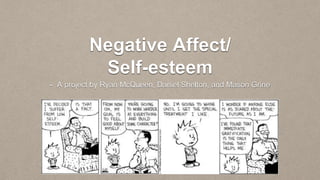
Negative Affect/ 
Self-esteem 
• A project by Ryan McQueen, Daniel Shelton, and Mason Grine
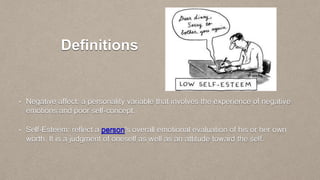
Definitions 
• Negative affect: a personality variable that involves the experience of negative 
emotions and poor self-concept. 
• Self-Esteem: reflect a person's overall emotional evaluation of his or her own 
worth. It is a judgment of oneself as well as an attitude toward the self.
Affect/Esteem and Education 
• Affect, behavior, and cognitive factors. 
• Are these three factors present in education? 
• Does a teacher deal with any of these in a day?
Research 
• Negative Affect Syndrome (NAS): a state of 
psychological difficulty suffering 
characterized by the preponderance of 
negative moods and emotions that impair 
adaptive functioning and well-being. 
• ROSENBERG SELF-ESTEEM SCALE
Circumplex Model of Affect
Connection to Classroom Management 
• Negative outlook, distress, anxiety, dissatisfaction. 
• Negative affectivity subsumes a variety of negative emotions, including anger, 
contempt, disgust, guilt, and fear.
Identifying Students 
• Some traits of negative affect/ low self-esteem: 
• Perfectionism 
• Resignation to failure 
• Defensive when asked for input 
• Poor communication skills
• Verses amotivation 
• Low self-esteem 
Motivation 
• Autonomy—Responsibility 
• Relatedness—Relationships 
• Competence—Belonging
Motivation Continued 
• Optimally challenging 
tasks 
• Self-determination 
• Meeting psychological 
needs (autonomy, 
relatedness, and 
competence)
What can teachers do? 
• Setting goals and 
benchmarks 
• Track growth that students 
can see 
• Curbing “catastrophic 
thinking” 
• Making positive phone calls 
• Turning mistakes into 
learning opportunities
More Strategies for Teachers 
1. Identify triggers for negative affect and the responses and train the individual 
to respond in the opposite manner. Thus, if a stimuli triggers anxiety, train them 
in relaxation. If a situation triggers depressive shutdown, train them in 
behavioral activation. 
2. Address avoidance via exposure; the way new learning emerges is via contact 
with the feared stimuli that produces a more adaptive and habituated response. 
Thus, if an individual is afraid of a bridge, they need to experience being on a 
bridge in a way that fosters mastery rather than panic. This is true of internal 
stimuli as well, which bridges much behavioral and psychodynamic work. 
3. Identify beliefs that over-exaggerate future threat.
Strategies for Teachers 
pg. 224, Teaching Students
Collaboration 
• Work together with the community! Is the 
student involved in a club at school? Does 
the student attend the Boys and Girls Club? 
Does the student attend a local church? How 
is the student’s home life?
BIBLIOGRAPHY 
HTTP: / /WWW.PSYCHOLOGYTODAY.C 
OM/BLOG/THEORY-KNOWLEDGE/ 
201308/NEGATIVE-AFFECT- 
SYNDROME 
HTTP: / /SPL.STANFORD.EDU/PDFS/201 
0%20RAY%20EMOTION.PDF 
Witter, M. (2013). I Can Climb the Mountain. 
Educational Leadership, 71(1), 61-64. 
McLeod, S. A. (2012). Low Self Esteem. 
Retrieved from 
http://www.simplypsychology.org/self-esteem. 
html 
HTTP: / /WWW.FETZER.ORG/SITES/DE 
FAULT/FILES/IMAGES/STORIES/PDF/ 
SELFMEASURES/SELF_MEASURES_F 
OR_SELF-ESTEEM_ 
ROSENBERG_SELF-ESTEEM. 
PDF

Negative affect

  • 1.
    Negative Affect/ Self-esteem • A project by Ryan McQueen, Daniel Shelton, and Mason Grine
  • 2.
    Definitions • Negativeaffect: a personality variable that involves the experience of negative emotions and poor self-concept. • Self-Esteem: reflect a person's overall emotional evaluation of his or her own worth. It is a judgment of oneself as well as an attitude toward the self.
  • 3.
    Affect/Esteem and Education • Affect, behavior, and cognitive factors. • Are these three factors present in education? • Does a teacher deal with any of these in a day?
  • 4.
    Research • NegativeAffect Syndrome (NAS): a state of psychological difficulty suffering characterized by the preponderance of negative moods and emotions that impair adaptive functioning and well-being. • ROSENBERG SELF-ESTEEM SCALE
  • 5.
  • 6.
    Connection to ClassroomManagement • Negative outlook, distress, anxiety, dissatisfaction. • Negative affectivity subsumes a variety of negative emotions, including anger, contempt, disgust, guilt, and fear.
  • 7.
    Identifying Students •Some traits of negative affect/ low self-esteem: • Perfectionism • Resignation to failure • Defensive when asked for input • Poor communication skills
  • 8.
    • Verses amotivation • Low self-esteem Motivation • Autonomy—Responsibility • Relatedness—Relationships • Competence—Belonging
  • 9.
    Motivation Continued •Optimally challenging tasks • Self-determination • Meeting psychological needs (autonomy, relatedness, and competence)
  • 10.
    What can teachersdo? • Setting goals and benchmarks • Track growth that students can see • Curbing “catastrophic thinking” • Making positive phone calls • Turning mistakes into learning opportunities
  • 11.
    More Strategies forTeachers 1. Identify triggers for negative affect and the responses and train the individual to respond in the opposite manner. Thus, if a stimuli triggers anxiety, train them in relaxation. If a situation triggers depressive shutdown, train them in behavioral activation. 2. Address avoidance via exposure; the way new learning emerges is via contact with the feared stimuli that produces a more adaptive and habituated response. Thus, if an individual is afraid of a bridge, they need to experience being on a bridge in a way that fosters mastery rather than panic. This is true of internal stimuli as well, which bridges much behavioral and psychodynamic work. 3. Identify beliefs that over-exaggerate future threat.
  • 12.
    Strategies for Teachers pg. 224, Teaching Students
  • 13.
    Collaboration • Worktogether with the community! Is the student involved in a club at school? Does the student attend the Boys and Girls Club? Does the student attend a local church? How is the student’s home life?
  • 14.
    BIBLIOGRAPHY HTTP: //WWW.PSYCHOLOGYTODAY.C OM/BLOG/THEORY-KNOWLEDGE/ 201308/NEGATIVE-AFFECT- SYNDROME HTTP: / /SPL.STANFORD.EDU/PDFS/201 0%20RAY%20EMOTION.PDF Witter, M. (2013). I Can Climb the Mountain. Educational Leadership, 71(1), 61-64. McLeod, S. A. (2012). Low Self Esteem. Retrieved from http://www.simplypsychology.org/self-esteem. html HTTP: / /WWW.FETZER.ORG/SITES/DE FAULT/FILES/IMAGES/STORIES/PDF/ SELFMEASURES/SELF_MEASURES_F OR_SELF-ESTEEM_ ROSENBERG_SELF-ESTEEM. PDF