Microeconomic Theory
Basic Principles and Extensions, 9e
By

WALTER NICHOLSON
Slides prepared by

Linda Ghent
Eastern Illinois University

1

Copyright ©2005 by South-Western, a division of Thomson Learning. All rights reserved.
Chapter 1
ECONOMIC MODELS

2
Theoretical Models
• Economists use models to describe
economic activities
• While most economic models are
abstractions from reality, they provide
aid in understanding economic behavior

3
Verification of Economic Models
• There are two general methods used to
verify economic models:
– direct approach
• establishes the validity of the model’s
assumptions

– indirect approach
• shows that the model correctly predicts realworld events
4
Verification of Economic Models
• We can use the profit-maximization model
to examine these approaches
– is the basic assumption valid? do firms really
seek to maximize profits?
– can the model predict the behavior of real-world
firms?
5
Features of Economic Models
• Ceteris Paribus assumption
• Optimization assumption
• Distinction between positive and
normative analysis

6
Ceteris Paribus Assumption
• Ceteris Paribus means “other things the
same”
• Economic models attempt to explain
simple relationships
– focus on the effects of only a few forces at a
time
– other variables are assumed to be unchanged
during the period of study
7
Optimization Assumptions
• Many economic models begin with the
assumption that economic actors are
rationally pursuing some goal
– consumers seek to maximize their utility
– firms seek to maximize profits (or minimize
costs)
– government regulators seek to maximize
public welfare
8
Optimization Assumptions
• Optimization assumptions generate
precise, solvable models
• Optimization models appear to be
perform fairly well in explaining reality

9
Positive-Normative Distinction
• Positive economic theories seek to
explain the economic phenomena that
is observed
• Normative economic theories focus on
what “should” be done

10
The Economic Theory of Value
• Early Economic Thought
– “value” was considered to be synonymous
with “importance”
– since prices were determined by humans,
it was possible for the price of an item to
differ from its value
– prices > value were judged to be “unjust”

11
The Economic Theory of Value
• The Founding of Modern Economics
– the publication of Adam Smith’s The Wealth of
Nations is considered the beginning of modern
economics
– distinguishing between “value” and “price”
continued (illustrated by the diamond-water
paradox)
• the value of an item meant its “value in use”
• the price of an item meant its “value in exchange”
12
The Economic Theory of Value
• Labor Theory of Exchange Value
– the exchange values of goods are determined by
what it costs to produce them
• these costs of production were primarily affected by
labor costs
• therefore, the exchange values of goods were
determined by the quantities of labor used to produce
them

– producing diamonds requires more labor than
producing water
13
The Economic Theory of Value
• The Marginalist Revolution
– the exchange value of an item is not determined
by the total usefulness of the item, but rather
the usefulness of the last unit consumed
• because water is plentiful, consuming an additional
unit has a relatively low value to individuals

14
The Economic Theory of Value
• Marshallian Supply-Demand Synthesis
– Alfred Marshall showed that supply and demand
simultaneously operate to determine price
– prices reflect both the marginal evaluation that
consumers place on goods and the marginal
costs of producing the goods
• water has a low marginal value and a low marginal
cost of production Low price
• diamonds have a high marginal value and a high
marginal cost of production High price
15
Supply-Demand Equilibrium
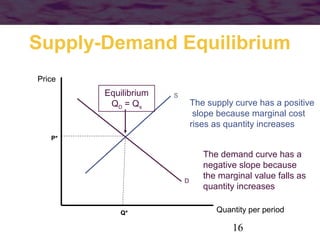
Price

Equilibrium
QD = Q s

S

The supply curve has a positive
slope because marginal cost
rises as quantity increases

P*

D

Q*

The demand curve has a
negative slope because
the marginal value falls as
quantity increases
Quantity per period

16
Supply-Demand Equilibrium
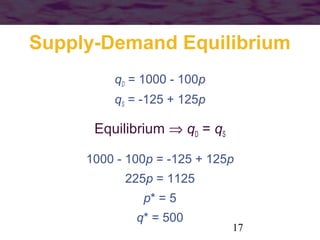
qD = 1000 - 100p
qS = -125 + 125p

Equilibrium ⇒ qD = qS
1000 - 100p = -125 + 125p
225p = 1125
p* = 5
q* = 500

17
Supply-Demand Equilibrium
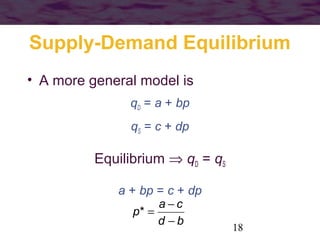
• A more general model is
qD = a + bp
qS = c + dp

Equilibrium ⇒ qD = qS
a + bp = c + dp
a−c
p* =
d −b

18
Supply-Demand Equilibrium
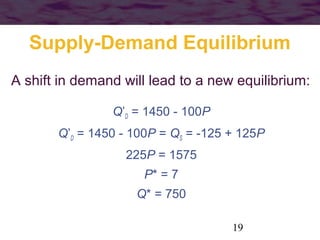
A shift in demand will lead to a new equilibrium:
Q’D = 1450 - 100P
Q’D = 1450 - 100P = QS = -125 + 125P
225P = 1575
P* = 7
Q* = 750
19
Supply-Demand Equilibrium
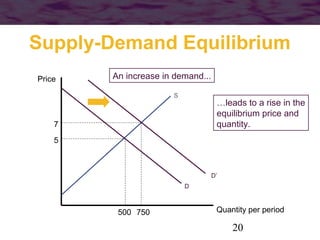
Price

An increase in demand...
S

…leads to a rise in the
equilibrium price and
quantity.

7
5

D’
D

500 750

Quantity per period

20
The Economic Theory of Value
• General Equilibrium Models
– the Marshallian model is a partial
equilibrium model
• focuses only on one market at a time

– to answer more general questions, we
need a model of the entire economy
• need to include the interrelationships between
markets and economic agents
21
The Economic Theory of Value
• The production possibilities frontier can
be used as a basic building block for
general equilibrium models
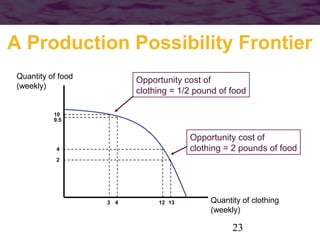
• A production possibilities frontier shows
the combinations of two outputs that
can be produced with an economy’s
resources
22
A Production Possibility Frontier
Quantity of food
(weekly)

Opportunity cost of
clothing = 1/2 pound of food

10
9.5

Opportunity cost of
clothing = 2 pounds of food

4
2

3 4

12 13

Quantity of clothing
(weekly)

23
A Production Possibility Frontier
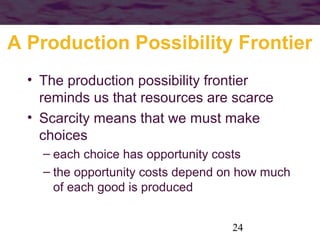
• The production possibility frontier
reminds us that resources are scarce
• Scarcity means that we must make
choices
– each choice has opportunity costs
– the opportunity costs depend on how much
of each good is produced
24
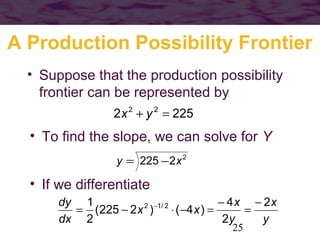
A Production Possibility Frontier
• Suppose that the production possibility
frontier can be represented by
2 x + y = 225
2

2

• To find the slope, we can solve for Y
y = 225 − 2 x 2

• If we differentiate
dy 1
− 4 x − 2x
2 −1 / 2
= (225 − 2 x )
⋅ ( −4 x ) =
=
dx 2
2y
y
25
A Production Possibility Frontier
dy 1
− 4 x − 2x
2 −1/ 2
= (225 − 2 x )
⋅ ( −4 x ) =
=
dx 2
2y
y

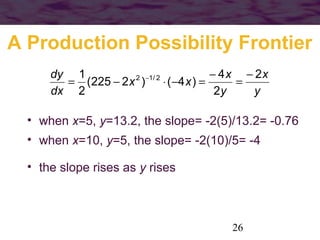
• when x=5, y=13.2, the slope= -2(5)/13.2= -0.76
• when x=10, y=5, the slope= -2(10)/5= -4
• the slope rises as y rises

26
The Economic Theory of Value
• Welfare Economics
– tools used in general equilibrium analysis have
been used for normative analysis concerning
the desirability of various economic outcomes
• economists Francis Edgeworth and Vilfredo Pareto
helped to provide a precise definition of economic
efficiency and demonstrated the conditions under
which markets can attain that goal
27
Modern Tools
• Clarification of the basic behavioral
assumptions about individual and firm
behavior
• Creation of new tools to study markets
• Incorporation of uncertainty and imperfect
information into economic models
• Increasing use of computers to analyze
data
28
Important Points to Note:
• Economics is the study of how scarce
resources are allocated among
alternative uses
– economists use simple models to
understand the process

29
Important Points to Note:
• The most commonly used economic
model is the supply-demand model
– shows how prices serve to balance
production costs and the willingness of
buyers to pay for these costs

30
Important Points to Note:
• The supply-demand model is only a
partial-equilibrium model
– a general equilibrium model is needed to
look at many markets together

31
Important Points to Note:
• Testing the validity of a model is a
difficult task
– are the model’s assumptions
reasonable?
– does the model explain real-world
events?

32

microeconomics necklson book Ch01

  • 1.
    Microeconomic Theory Basic Principlesand Extensions, 9e By WALTER NICHOLSON Slides prepared by Linda Ghent Eastern Illinois University 1 Copyright ©2005 by South-Western, a division of Thomson Learning. All rights reserved.
  • 2.
  • 3.
    Theoretical Models • Economistsuse models to describe economic activities • While most economic models are abstractions from reality, they provide aid in understanding economic behavior 3
  • 4.
    Verification of EconomicModels • There are two general methods used to verify economic models: – direct approach • establishes the validity of the model’s assumptions – indirect approach • shows that the model correctly predicts realworld events 4
  • 5.
    Verification of EconomicModels • We can use the profit-maximization model to examine these approaches – is the basic assumption valid? do firms really seek to maximize profits? – can the model predict the behavior of real-world firms? 5
  • 6.
    Features of EconomicModels • Ceteris Paribus assumption • Optimization assumption • Distinction between positive and normative analysis 6
  • 7.
    Ceteris Paribus Assumption •Ceteris Paribus means “other things the same” • Economic models attempt to explain simple relationships – focus on the effects of only a few forces at a time – other variables are assumed to be unchanged during the period of study 7
  • 8.
    Optimization Assumptions • Manyeconomic models begin with the assumption that economic actors are rationally pursuing some goal – consumers seek to maximize their utility – firms seek to maximize profits (or minimize costs) – government regulators seek to maximize public welfare 8
  • 9.
    Optimization Assumptions • Optimizationassumptions generate precise, solvable models • Optimization models appear to be perform fairly well in explaining reality 9
  • 10.
    Positive-Normative Distinction • Positiveeconomic theories seek to explain the economic phenomena that is observed • Normative economic theories focus on what “should” be done 10
  • 11.
    The Economic Theoryof Value • Early Economic Thought – “value” was considered to be synonymous with “importance” – since prices were determined by humans, it was possible for the price of an item to differ from its value – prices > value were judged to be “unjust” 11
  • 12.
    The Economic Theoryof Value • The Founding of Modern Economics – the publication of Adam Smith’s The Wealth of Nations is considered the beginning of modern economics – distinguishing between “value” and “price” continued (illustrated by the diamond-water paradox) • the value of an item meant its “value in use” • the price of an item meant its “value in exchange” 12
  • 13.
    The Economic Theoryof Value • Labor Theory of Exchange Value – the exchange values of goods are determined by what it costs to produce them • these costs of production were primarily affected by labor costs • therefore, the exchange values of goods were determined by the quantities of labor used to produce them – producing diamonds requires more labor than producing water 13
  • 14.
    The Economic Theoryof Value • The Marginalist Revolution – the exchange value of an item is not determined by the total usefulness of the item, but rather the usefulness of the last unit consumed • because water is plentiful, consuming an additional unit has a relatively low value to individuals 14
  • 15.
    The Economic Theoryof Value • Marshallian Supply-Demand Synthesis – Alfred Marshall showed that supply and demand simultaneously operate to determine price – prices reflect both the marginal evaluation that consumers place on goods and the marginal costs of producing the goods • water has a low marginal value and a low marginal cost of production Low price • diamonds have a high marginal value and a high marginal cost of production High price 15
  • 16.
    Supply-Demand Equilibrium Price Equilibrium QD =Q s S The supply curve has a positive slope because marginal cost rises as quantity increases P* D Q* The demand curve has a negative slope because the marginal value falls as quantity increases Quantity per period 16
  • 17.
    Supply-Demand Equilibrium qD =1000 - 100p qS = -125 + 125p Equilibrium ⇒ qD = qS 1000 - 100p = -125 + 125p 225p = 1125 p* = 5 q* = 500 17
  • 18.
    Supply-Demand Equilibrium • Amore general model is qD = a + bp qS = c + dp Equilibrium ⇒ qD = qS a + bp = c + dp a−c p* = d −b 18
  • 19.
    Supply-Demand Equilibrium A shiftin demand will lead to a new equilibrium: Q’D = 1450 - 100P Q’D = 1450 - 100P = QS = -125 + 125P 225P = 1575 P* = 7 Q* = 750 19
  • 20.
    Supply-Demand Equilibrium Price An increasein demand... S …leads to a rise in the equilibrium price and quantity. 7 5 D’ D 500 750 Quantity per period 20
  • 21.
    The Economic Theoryof Value • General Equilibrium Models – the Marshallian model is a partial equilibrium model • focuses only on one market at a time – to answer more general questions, we need a model of the entire economy • need to include the interrelationships between markets and economic agents 21
  • 22.
    The Economic Theoryof Value • The production possibilities frontier can be used as a basic building block for general equilibrium models • A production possibilities frontier shows the combinations of two outputs that can be produced with an economy’s resources 22
  • 23.
    A Production PossibilityFrontier Quantity of food (weekly) Opportunity cost of clothing = 1/2 pound of food 10 9.5 Opportunity cost of clothing = 2 pounds of food 4 2 3 4 12 13 Quantity of clothing (weekly) 23
  • 24.
    A Production PossibilityFrontier • The production possibility frontier reminds us that resources are scarce • Scarcity means that we must make choices – each choice has opportunity costs – the opportunity costs depend on how much of each good is produced 24
  • 25.
    A Production PossibilityFrontier • Suppose that the production possibility frontier can be represented by 2 x + y = 225 2 2 • To find the slope, we can solve for Y y = 225 − 2 x 2 • If we differentiate dy 1 − 4 x − 2x 2 −1 / 2 = (225 − 2 x ) ⋅ ( −4 x ) = = dx 2 2y y 25
  • 26.
    A Production PossibilityFrontier dy 1 − 4 x − 2x 2 −1/ 2 = (225 − 2 x ) ⋅ ( −4 x ) = = dx 2 2y y • when x=5, y=13.2, the slope= -2(5)/13.2= -0.76 • when x=10, y=5, the slope= -2(10)/5= -4 • the slope rises as y rises 26
  • 27.
    The Economic Theoryof Value • Welfare Economics – tools used in general equilibrium analysis have been used for normative analysis concerning the desirability of various economic outcomes • economists Francis Edgeworth and Vilfredo Pareto helped to provide a precise definition of economic efficiency and demonstrated the conditions under which markets can attain that goal 27
  • 28.
    Modern Tools • Clarificationof the basic behavioral assumptions about individual and firm behavior • Creation of new tools to study markets • Incorporation of uncertainty and imperfect information into economic models • Increasing use of computers to analyze data 28
  • 29.
    Important Points toNote: • Economics is the study of how scarce resources are allocated among alternative uses – economists use simple models to understand the process 29
  • 30.
    Important Points toNote: • The most commonly used economic model is the supply-demand model – shows how prices serve to balance production costs and the willingness of buyers to pay for these costs 30
  • 31.
    Important Points toNote: • The supply-demand model is only a partial-equilibrium model – a general equilibrium model is needed to look at many markets together 31
  • 32.
    Important Points toNote: • Testing the validity of a model is a difficult task – are the model’s assumptions reasonable? – does the model explain real-world events? 32