NECK DISSECTION
PRESENTED BY:
V.RAMYA,
TUTOR.
overview
 Introduction
 Neck dissection
 Radial neck dissection
 Reconstructive techniques
 Complications
 Nursing diagnosis
 Rehabilitation exercises
introduction
 Deaths from malignancies of the head and neck are primarily
attributable to local – regional metastasis to the cervical lymph
nodes in the neck.
 This often occurs by way of the lymphatics before the primary
lesion has been treated.
 This local – regional metastasis is not amenable to surgical
resection and responds poorly to chemotherapy and radiation
therapy.
introduction
 The cervical lymph nodes are classified as anterior and posterior
and divided into regions for classification.
Radial neck dissection
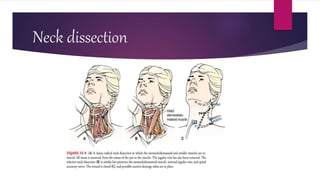
 A radial neck dissection involves removal of all cervical lymph
nodes from the mandible to the clavicle and removal of the
sternocleidomastoid muscle, internal jugular vein, and spinal
accessory muscle on one side of the neck.
 The associated complications include shoulder drop and poor
cosmesis ( visible neck depression).
 Modified radial neck dissection ,which preserve one or more of the
nonlymphatic structures ( internal jugular vein, sternocleidomastoid
muscle ,and the spinal accessory nerve ) is used more often.
Neck dissection
Neck dissection
 A selective neck dissection ( in comparison to radical, or
modified dissection) preserves one or more of the lymph
node groups that are typically removed in a radical neck
dissection.
 The selective neck dissection is the treatment usually used
in oral cavity cancer.
Reconstructive techniques
 Reconstructive techniques may be performed with a variety of
grafts.
 A cutaneous flap ( skin and subcutaneous tissue ) ,such as the
deltopectoral flap, may be used.
 A myocutaneous flap (subcutaneous tissue ,muscle , and skin)is a
more frequently used graft ; the pectoralis major muscle is usually
used.
 For large grafts, a microvascular free flap may be used.
Reconstructive techniques
 This involves the transfer of muscle ,skin or bone with an artery
and vein to the area of reconstruction, using microinstrumentation.
 Areas used for a free flap include the scapula ,the radial area of the
forearm. , or the fibula.
 The fibula ,which provides a larger bone area ,may be used if
mandibular reconstruction is involved.
complications
 Hemorrhage ,
 Chyle fistula
 Nerve injury
Chyle fistula
 A chyle fistula ( milk – like drainage from the thoracic duct into the
thoracic cavity ) may develop as a result of damage to the thoracic
duct during surgery.
 Although not very common (1 % to 2.5% of cases ) , this
complication is serious and life threatening .
 The diagnosis is made if there is excess drainage present in the
chest tube drainage that has a 3% fat content and a specific gravity
1.012 or greater.
Chyle fistula
 Treatment of small leak requires a diet of medium – chain fatty
acids or parenteral nutrition ,although there is emerging support for
the use of IV or subcutaneous administration of octreotide in
conservative management .
 Octreotide , a synthetic analog of the natural hormone somatostatin
, works primarily by decreasing the absorption of triglycerides and
inhibiting gastrointestinal circulation and motility ,thereby reducing
lymph flow and decreasing the chyle flow .
 Surgical intervention may be needed to repair the damaged duct.
NURSING DIAGNOSIS
 Deficient knowledge about preoperative and postoperative
procedures
 Ineffective airway clearance related to obstruction by mucus ,
hemorrhage , or edema.
 Acute pain related to surgical incision
 Impaired tissue integrity secondary to surgery and grafts
 Imbalanced nutrition ; less than body requirements related to
disease process or treatment.
NURSING DIAGNOSIS
 Risk for caregiver role stain related to physical and emotional
effects of disease and related surgical procedures .
 Impaired verbal communication secondary to surgical resection.
 Body image disturbance related to extensive resection and
disfigurement secondary to neck resection.
 Impaired physical mobility secondary to nerve injury.
Rehabilitation exercises
 Three rehabilitation exercises after head and neck surgery.
 The objective is regain maximum shoulder function and neck
motion after neck surgery.
 Adapted from exercise for radial neck surgery patients.
bibliography
 Brunner and Suddarth’s Textbook of Medical- Surgical Nursing ,South Asian
Edition , Volume 1 , Published by Wolters Kluwer . Page reffered to 849 -854.
 Ansari and Kaur, Textbook of Medical – Surgical Nursing 1 . Published by Pee
Vee 2011 Edition, Page reffered to 850 – 852.
 https://www.slideshare.net/DeepikaMalik8/neck-dissection-77566602
 https://www.slideshare.net/SanjayMaharjan10/neck-dissection-92482203
 https://www.slideshare.net/Himesharo/radical-neck-dissection-9680032

Neck dissection.pptx

  • 1.
  • 2.
    overview  Introduction  Neckdissection  Radial neck dissection  Reconstructive techniques  Complications  Nursing diagnosis  Rehabilitation exercises
  • 3.
    introduction  Deaths frommalignancies of the head and neck are primarily attributable to local – regional metastasis to the cervical lymph nodes in the neck.  This often occurs by way of the lymphatics before the primary lesion has been treated.  This local – regional metastasis is not amenable to surgical resection and responds poorly to chemotherapy and radiation therapy.
  • 4.
    introduction  The cervicallymph nodes are classified as anterior and posterior and divided into regions for classification.
  • 5.
    Radial neck dissection A radial neck dissection involves removal of all cervical lymph nodes from the mandible to the clavicle and removal of the sternocleidomastoid muscle, internal jugular vein, and spinal accessory muscle on one side of the neck.  The associated complications include shoulder drop and poor cosmesis ( visible neck depression).  Modified radial neck dissection ,which preserve one or more of the nonlymphatic structures ( internal jugular vein, sternocleidomastoid muscle ,and the spinal accessory nerve ) is used more often.
  • 6.
  • 7.
    Neck dissection  Aselective neck dissection ( in comparison to radical, or modified dissection) preserves one or more of the lymph node groups that are typically removed in a radical neck dissection.  The selective neck dissection is the treatment usually used in oral cavity cancer.
  • 8.
    Reconstructive techniques  Reconstructivetechniques may be performed with a variety of grafts.  A cutaneous flap ( skin and subcutaneous tissue ) ,such as the deltopectoral flap, may be used.  A myocutaneous flap (subcutaneous tissue ,muscle , and skin)is a more frequently used graft ; the pectoralis major muscle is usually used.  For large grafts, a microvascular free flap may be used.
  • 9.
    Reconstructive techniques  Thisinvolves the transfer of muscle ,skin or bone with an artery and vein to the area of reconstruction, using microinstrumentation.  Areas used for a free flap include the scapula ,the radial area of the forearm. , or the fibula.  The fibula ,which provides a larger bone area ,may be used if mandibular reconstruction is involved.
  • 10.
    complications  Hemorrhage , Chyle fistula  Nerve injury
  • 11.
    Chyle fistula  Achyle fistula ( milk – like drainage from the thoracic duct into the thoracic cavity ) may develop as a result of damage to the thoracic duct during surgery.  Although not very common (1 % to 2.5% of cases ) , this complication is serious and life threatening .  The diagnosis is made if there is excess drainage present in the chest tube drainage that has a 3% fat content and a specific gravity 1.012 or greater.
  • 12.
    Chyle fistula  Treatmentof small leak requires a diet of medium – chain fatty acids or parenteral nutrition ,although there is emerging support for the use of IV or subcutaneous administration of octreotide in conservative management .  Octreotide , a synthetic analog of the natural hormone somatostatin , works primarily by decreasing the absorption of triglycerides and inhibiting gastrointestinal circulation and motility ,thereby reducing lymph flow and decreasing the chyle flow .  Surgical intervention may be needed to repair the damaged duct.
  • 13.
    NURSING DIAGNOSIS  Deficientknowledge about preoperative and postoperative procedures  Ineffective airway clearance related to obstruction by mucus , hemorrhage , or edema.  Acute pain related to surgical incision  Impaired tissue integrity secondary to surgery and grafts  Imbalanced nutrition ; less than body requirements related to disease process or treatment.
  • 14.
    NURSING DIAGNOSIS  Riskfor caregiver role stain related to physical and emotional effects of disease and related surgical procedures .  Impaired verbal communication secondary to surgical resection.  Body image disturbance related to extensive resection and disfigurement secondary to neck resection.  Impaired physical mobility secondary to nerve injury.
  • 15.
    Rehabilitation exercises  Threerehabilitation exercises after head and neck surgery.  The objective is regain maximum shoulder function and neck motion after neck surgery.  Adapted from exercise for radial neck surgery patients.
  • 16.
    bibliography  Brunner andSuddarth’s Textbook of Medical- Surgical Nursing ,South Asian Edition , Volume 1 , Published by Wolters Kluwer . Page reffered to 849 -854.  Ansari and Kaur, Textbook of Medical – Surgical Nursing 1 . Published by Pee Vee 2011 Edition, Page reffered to 850 – 852.  https://www.slideshare.net/DeepikaMalik8/neck-dissection-77566602  https://www.slideshare.net/SanjayMaharjan10/neck-dissection-92482203  https://www.slideshare.net/Himesharo/radical-neck-dissection-9680032