9 October 2019
Managing procurement risks
and challenges
Aims and objectives
— Aims (what):
– Increase:
– understanding of pressure points in procurement
processes
– understanding of the risk profile of procurements
– knowledge of risk mitigation strategies
– confidence in dealing with and responding to
procurement challenges (formal or otherwise)
Aims and objectives cont…
— Objectives (how):
– Look at:
– the lifecycle of a procurement process
– how to respond to threatened or actual challenges
– how tactics come into play
– how to deal with immediate steps required by a
challenge without prejudicing your position
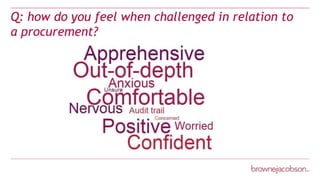
Q: how do you feel when challenged in relation to
a procurement?
Legal framework
— European Directive 2014/24
— Public Contracts Regulations 2015 (PCR)
— National Health Service (Procurement, Patient Choice and
Competition) (No.2) Regulations 2013
— Judicial review proceedings
— Case law
PCR Regulations 85 - 104
— Who can bring a challenge (Regs. 89 -90)
— Time limits:
– general time limits (Reg 92)
– time limits for ineffectiveness (Reg 93)
— Starting proceedings (Reg. 94)
— Automatic suspension (Reg. 95)
— Pre-contract remedies (Reg. 97)
— Post contract remedies (Reg. 98)
And the clock is ticking…
— The time limit for bringing proceedings starts from when the
challenger knew or ought to have known that grounds for a
challenge had arisen
Introduction to case study
— Torquayshire County Council
Procurement of Council’s financial platform
Session 1: pre-market
engagement
Pre-market engagement
— Q: Your procurement is not yet live, you are thinking about
what you want to commission/purchase, you may not go to
the market – nothing can go fundamentally wrong here?
— A: ?
What is it?
— Market engagement is a process which takes place prior to
procurement and which aims to:
– identify potential bidders and/or solutions
– build capacity in the market to meet the requirement(s)
– inform the design of the procurement and contract
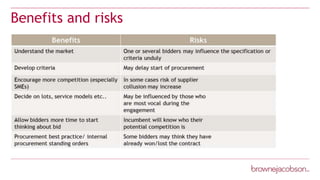
Benefits and risks
Avoiding the risks
— Contract Management (build in time)
— Advertise widely
— Ethical Wall Agreement (Incumbent)
— Give appropriate timescales/ notice for deadlines and bidder
days
— Make it clear this is not formal start of procurement process
— Consider best format
— Keep a record of all market engagement activities
Session 2 – Advert and
selection stage
What is it?
— The official start of the procurement process
– Prior Information Notice (where permitted); or
– Contract Notice
— Published in:
– OJEU; and
– Contracts Finder
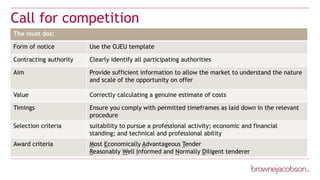
Call for competition
The must dos:
Form of notice Use the OJEU template
Contracting authority Clearly identify all participating authorities
Aim Provide sufficient information to allow the market to understand the nature
and scale of the opportunity on offer
Value Correctly calculating a genuine estimate of costs
Timings Ensure you comply with permitted timeframes as laid down in the relevant
procedure
Selection criteria suitability to pursue a professional activity; economic and financial
standing; and technical and professional ability
Award criteria Most Economically Advantageous Tender
Reasonably Well Informed and Normally Diligent tenderer
Standard Selection Questionnaire (SSQ)
— Crown Commercial Services’ Standard Selection Questionnaire
– must be used as directed by Statutory Guidance
— Parts 1 and 2 cannot be amended
— Part 3:
– should be adopted across all above threshold procurements
as relevant;
– add project specific questions;
– report deviations to CCS
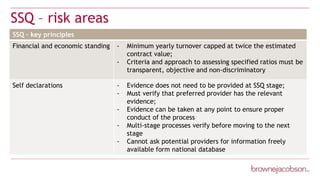
SSQ – risk areas
Note Text:
SSQ – key principles
Financial and economic standing - Minimum yearly turnover capped at twice the estimated
contract value;
- Criteria and approach to assessing specified ratios must be
transparent, objective and non-discriminatory
Self declarations - Evidence does not need to be provided at SSQ stage;
- Must verify that preferred provider has the relevant
evidence;
- Evidence can be taken at any point to ensure proper
conduct of the process
- Multi-stage processes verify before moving to the next
stage
- Cannot ask potential providers for information freely
available form national database
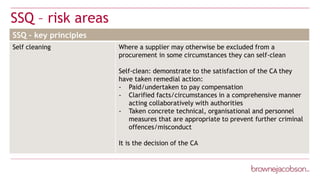
SSQ – risk areas
Note Text:
SSQ – key principles
Self cleaning Where a supplier may otherwise be excluded from a
procurement in some circumstances they can self-clean
Self-clean: demonstrate to the satisfaction of the CA they
have taken remedial action:
- Paid/undertaken to pay compensation
- Clarified facts/circumstances in a comprehensive manner
acting collaboratively with authorities
- Taken concrete technical, organisational and personnel
measures that are appropriate to prevent further criminal
offences/misconduct
It is the decision of the CA
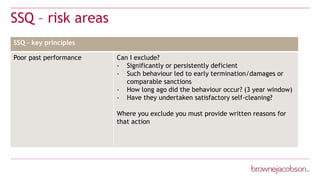
SSQ – risk areas
Note Text:
SSQ – key principles
Poor past performance Can I exclude?
- Significantly or persistently deficient
- Such behaviour led to early termination/damages or
comparable sanctions
- How long ago did the behaviour occur? (3 year window)
- Have they undertaken satisfactory self-cleaning?
Where you exclude you must provide written reasons for
that action
Session 3 - ITT and tender
period
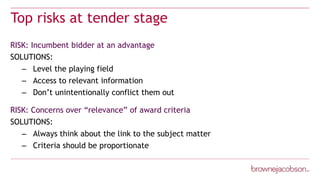
Top risks at tender stage
RISK: Incumbent bidder at an advantage
SOLUTIONS:
– Level the playing field
– Access to relevant information
– Don’t unintentionally conflict them out
RISK: Concerns over “relevance” of award criteria
SOLUTIONS:
– Always think about the link to the subject matter
– Criteria should be proportionate
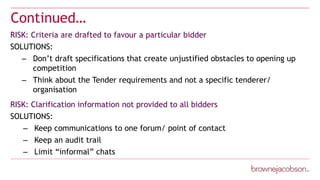
Continued…
RISK: Criteria are drafted to favour a particular bidder
SOLUTIONS:
– Don’t draft specifications that create unjustified obstacles to opening up
competition
– Think about the Tender requirements and not a specific tenderer/
organisation
RISK: Clarification information not provided to all bidders
SOLUTIONS:
– Keep communications to one forum/ point of contact
– Keep an audit trail
– Limit “informal” chats
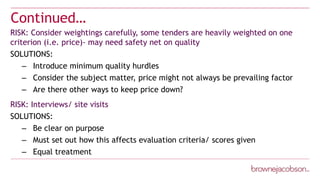
Continued…
RISK: Consider weightings carefully, some tenders are heavily weighted on one
criterion (i.e. price)- may need safety net on quality
SOLUTIONS:
– Introduce minimum quality hurdles
– Consider the subject matter, price might not always be prevailing factor
– Are there other ways to keep price down?
RISK: Interviews/ site visits
SOLUTIONS:
– Be clear on purpose
– Must set out how this affects evaluation criteria/ scores given
– Equal treatment
Continued…
RISK: Evaluation methodology/ Undisclosed evaluation criteria
SOLUTIONS:
– Think about whether your marking scheme is appropriate for each question
– If the evaluation panel want to consider something- write it into methodology
– Balance between “spoon feeding” answers and giving a robust methodology
– If methodology too vague – evaluators feel the need to supplement
– Site visits/ Interviews- common area where undisclosed criteria are used
– Think about composition of evaluation panel- get the right people involved
Continued…
RISK: Qualified tenders- allowing caveats and carve outs- impact on evaluation
and ability to find MEAT
SOLUTIONS:
– If requirements are clear no need for carve outs - price the specification
– Set out in tender how conditions that bidders set will be dealt with
Continued…
RISK: Exercising discretion/ allowing correction of mistakes post tender
SOLUTIONS:
– No general rule to permit corrections, but always check:
– Is it the contracting authority’s fault? Ensure documents are clear and
consistent. Was this issue raised during clarifications?
– Is it proportionate to allow correction?
– Be consistent across all bidders- equal treatment
– Follow what you say in the ITT:
– Reserve right to reject non-compliant tenders- be clear how and when it will be exercised.
– Do not state that you “will” reject non-compliant bids
– Include checklists and set format for tender response- encourages bidder
compliance.
Tactics to mitigate the risks
— Bidders rarely challenge at this point- still in it to win it!
— BUT, if a bidder has concerns it will need to act quickly due to
30 day limitation
– Useful to flush out “risk” situations
– Not a 100% safety net!
– E.g. the application of the scoring model and evaluation
could kick start a new 30 day period
Session 4 - Contract award,
notification of result and
standstill
What is it?
— Formal notification of the outcome of the procedure
— Notification takes two forms:
– Outcome/standstill letters to remaining bidders;
– Contract Award Notice in OJEU and Contracts Finder
Outcome/standstill letters
— Regulation 86:
– identity of the successful bidder
– criteria for the contract award
– reasons for the decision (the characteristics and relative
advantages of the successful tender)
– recipient and successful bidder’s scores
– confirmation of when standstill will end
Contract Award Notice
— Regulation 50
— OJEU standard format
– Send for publication “not later than 30 days after award of
the contract or the conclusion of a framework agreement,
following the decision to award or conclude it, contracting
authorities shall send for publication a contract award
notice on the results of the procurement procedure”
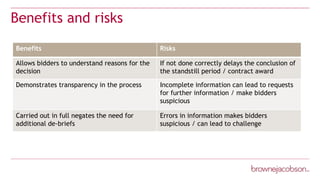
Benefits and risks
Benefits Risks
Allows bidders to understand reasons for the
decision
If not done correctly delays the conclusion of
the standstill period / contract award
Demonstrates transparency in the process Incomplete information can lead to requests
for further information / make bidders
suspicious
Carried out in full negates the need for
additional de-briefs
Errors in information makes bidders
suspicious / can lead to challenge
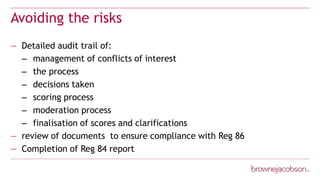
Avoiding the risks
— Detailed audit trail of:
– management of conflicts of interest
– the process
– decisions taken
– scoring process
– moderation process
– finalisation of scores and clarifications
— review of documents to ensure compliance with Reg 86
— Completion of Reg 84 report
Session 5 - Litigation tactics
and FOIA
Patrick Halliday, 11KBW
Litigation tactics
Session 6 - Modifications
Modifications – Regulation 72
— A contract extension or variation that amounts to a
substantial change may result in the creation of a new
contract
— Common examples, extension of scope to new services,
duration of contract, increase in volume, changes to
mandatory specification requirements
— New contracts may require to be re-advertised and re-
tendered
— Failure to comply with this can result in a challenge by an
aggrieved bidder
Substantial Modifications
— List of changes considered substantial in Regulation 72(8)
include changes which:
– render contract materially different in character; or
– had they been present initially would have attracted
different bidders/ winner
– extend scope of contract considerably
– alter economic balance of contract in favour of contractor
Permitted modifications
— Regulation 72 lists circumstances where changes may be
made without the need for a new procurement
procedure- no need to consider whether it is substantial:
– Contract Review Clause: Where modifications have
been provided for in the initial tender documents in
clear, precise and unequivocal review clause/option–
must state scope, nature and conditions under which
clause/option may be used and cannot alter overall
nature of contract/framework agreement
– Recital 111 of Directive 2014/24/EU – review clause must
not give “unlimited discretion”
– Requirement of specificity
Permitted Modification
— Technical/ interoperability:
– Where additional works, services or supplies by original
contractor have become necessary and change in
contractor cannot be made for economic or technical
reasons and would cause significant inconvenience or
substantial duplication of costs for CA (any increase in
price limited to 50% of original contract value – applies to
each successive modification)
Permitted modifications
— Unforeseen circumstances:
– Where modification required due to unforeseen
circumstances provided modification:
– does not alter the overall nature of the contract and any
increase in price limited to 50% of original contract
value
– applies to each successive modification
— Replacement of contractor: Due to exercise or review
clause/option, universal or partial succession following
corporate restructuring providing original SQ criteria still
fulfilled
Insubstantial modifications
— Situations where a change is deemed insubstantial:
– Where the value of the modification is:
– below the EU financial thresholds; and
– below 10% (Services) or 15% (Works) of the original
contract value
– Note that the modification may not alter overall nature of
contract (for successive modifications, value assessed on
basis of net cumulative value)
– Note: Contracting Authorities are allowed to terminate a
contact that has been substantially varied.
Mitigating the risks:
— Future proof documents- allow for future changes
– OJEU
– Specifications and Tender evaluation and pricing
– Contract
— Where available to other contracting authorities, think about
their requirements
— In some circumstances must submit contract variation notice
(unforeseen and technical reasons)
— Use of indemnities
— “VEAT” or not to “VEAT”?
Q&A and wrap up
So where are we now…?
— If we were to ask the same questions again …
– Are you aware of reporting and record keeping obligations?
– Are you clear on the process/timescales for claims?
– How confident do you feel when dealing with a complaint?
– How do you feel when challenged re a procurement
procedure?
– How confident are you on mitigating risks?
Any Questions ?
Thank you
Peter Ware
Partner
t: +44 (0)115 976 6242 / 07899 072682
e: peter.ware@brownejacobson.com
Rachel Whitaker
Senior Associate
t: +44 (0)115 976 6538
m: +44 (0)7920 257 152
e: rachel.whitaker@brownejacobson.com
All information correct at time of production.
The information and opinions expressed within this
document are no substitute for full legal advice. It is for
guidance only and illustrates the law as at the published
date. If in doubt, please telephone us on 0370 270 6000
© Browne Jacobson LLP 2018
The information contained within this document is and
shall remain the property of Browne Jacobson. This
document may not be reproduced without the prior
consent of Browne Jacobson.

Procurement workshop training slides - Birmingham session

  • 1.
    9 October 2019 Managingprocurement risks and challenges
  • 2.
    Aims and objectives —Aims (what): – Increase: – understanding of pressure points in procurement processes – understanding of the risk profile of procurements – knowledge of risk mitigation strategies – confidence in dealing with and responding to procurement challenges (formal or otherwise)
  • 3.
    Aims and objectivescont… — Objectives (how): – Look at: – the lifecycle of a procurement process – how to respond to threatened or actual challenges – how tactics come into play – how to deal with immediate steps required by a challenge without prejudicing your position
  • 4.
    Q: how doyou feel when challenged in relation to a procurement?
  • 5.
    Legal framework — EuropeanDirective 2014/24 — Public Contracts Regulations 2015 (PCR) — National Health Service (Procurement, Patient Choice and Competition) (No.2) Regulations 2013 — Judicial review proceedings — Case law
  • 6.
    PCR Regulations 85- 104 — Who can bring a challenge (Regs. 89 -90) — Time limits: – general time limits (Reg 92) – time limits for ineffectiveness (Reg 93) — Starting proceedings (Reg. 94) — Automatic suspension (Reg. 95) — Pre-contract remedies (Reg. 97) — Post contract remedies (Reg. 98)
  • 7.
    And the clockis ticking… — The time limit for bringing proceedings starts from when the challenger knew or ought to have known that grounds for a challenge had arisen
  • 8.
    Introduction to casestudy — Torquayshire County Council Procurement of Council’s financial platform
  • 9.
  • 10.
    Pre-market engagement — Q:Your procurement is not yet live, you are thinking about what you want to commission/purchase, you may not go to the market – nothing can go fundamentally wrong here? — A: ?
  • 11.
    What is it? —Market engagement is a process which takes place prior to procurement and which aims to: – identify potential bidders and/or solutions – build capacity in the market to meet the requirement(s) – inform the design of the procurement and contract
  • 12.
  • 13.
    Avoiding the risks —Contract Management (build in time) — Advertise widely — Ethical Wall Agreement (Incumbent) — Give appropriate timescales/ notice for deadlines and bidder days — Make it clear this is not formal start of procurement process — Consider best format — Keep a record of all market engagement activities
  • 14.
    Session 2 –Advert and selection stage
  • 15.
    What is it? —The official start of the procurement process – Prior Information Notice (where permitted); or – Contract Notice — Published in: – OJEU; and – Contracts Finder
  • 16.
    Call for competition Themust dos: Form of notice Use the OJEU template Contracting authority Clearly identify all participating authorities Aim Provide sufficient information to allow the market to understand the nature and scale of the opportunity on offer Value Correctly calculating a genuine estimate of costs Timings Ensure you comply with permitted timeframes as laid down in the relevant procedure Selection criteria suitability to pursue a professional activity; economic and financial standing; and technical and professional ability Award criteria Most Economically Advantageous Tender Reasonably Well Informed and Normally Diligent tenderer
  • 17.
    Standard Selection Questionnaire(SSQ) — Crown Commercial Services’ Standard Selection Questionnaire – must be used as directed by Statutory Guidance — Parts 1 and 2 cannot be amended — Part 3: – should be adopted across all above threshold procurements as relevant; – add project specific questions; – report deviations to CCS
  • 18.
    SSQ – riskareas Note Text: SSQ – key principles Financial and economic standing - Minimum yearly turnover capped at twice the estimated contract value; - Criteria and approach to assessing specified ratios must be transparent, objective and non-discriminatory Self declarations - Evidence does not need to be provided at SSQ stage; - Must verify that preferred provider has the relevant evidence; - Evidence can be taken at any point to ensure proper conduct of the process - Multi-stage processes verify before moving to the next stage - Cannot ask potential providers for information freely available form national database
  • 19.
    SSQ – riskareas Note Text: SSQ – key principles Self cleaning Where a supplier may otherwise be excluded from a procurement in some circumstances they can self-clean Self-clean: demonstrate to the satisfaction of the CA they have taken remedial action: - Paid/undertaken to pay compensation - Clarified facts/circumstances in a comprehensive manner acting collaboratively with authorities - Taken concrete technical, organisational and personnel measures that are appropriate to prevent further criminal offences/misconduct It is the decision of the CA
  • 20.
    SSQ – riskareas Note Text: SSQ – key principles Poor past performance Can I exclude? - Significantly or persistently deficient - Such behaviour led to early termination/damages or comparable sanctions - How long ago did the behaviour occur? (3 year window) - Have they undertaken satisfactory self-cleaning? Where you exclude you must provide written reasons for that action
  • 21.
    Session 3 -ITT and tender period
  • 22.
    Top risks attender stage RISK: Incumbent bidder at an advantage SOLUTIONS: – Level the playing field – Access to relevant information – Don’t unintentionally conflict them out RISK: Concerns over “relevance” of award criteria SOLUTIONS: – Always think about the link to the subject matter – Criteria should be proportionate
  • 23.
    Continued… RISK: Criteria aredrafted to favour a particular bidder SOLUTIONS: – Don’t draft specifications that create unjustified obstacles to opening up competition – Think about the Tender requirements and not a specific tenderer/ organisation RISK: Clarification information not provided to all bidders SOLUTIONS: – Keep communications to one forum/ point of contact – Keep an audit trail – Limit “informal” chats
  • 24.
    Continued… RISK: Consider weightingscarefully, some tenders are heavily weighted on one criterion (i.e. price)- may need safety net on quality SOLUTIONS: – Introduce minimum quality hurdles – Consider the subject matter, price might not always be prevailing factor – Are there other ways to keep price down? RISK: Interviews/ site visits SOLUTIONS: – Be clear on purpose – Must set out how this affects evaluation criteria/ scores given – Equal treatment
  • 25.
    Continued… RISK: Evaluation methodology/Undisclosed evaluation criteria SOLUTIONS: – Think about whether your marking scheme is appropriate for each question – If the evaluation panel want to consider something- write it into methodology – Balance between “spoon feeding” answers and giving a robust methodology – If methodology too vague – evaluators feel the need to supplement – Site visits/ Interviews- common area where undisclosed criteria are used – Think about composition of evaluation panel- get the right people involved
  • 26.
    Continued… RISK: Qualified tenders-allowing caveats and carve outs- impact on evaluation and ability to find MEAT SOLUTIONS: – If requirements are clear no need for carve outs - price the specification – Set out in tender how conditions that bidders set will be dealt with
  • 27.
    Continued… RISK: Exercising discretion/allowing correction of mistakes post tender SOLUTIONS: – No general rule to permit corrections, but always check: – Is it the contracting authority’s fault? Ensure documents are clear and consistent. Was this issue raised during clarifications? – Is it proportionate to allow correction? – Be consistent across all bidders- equal treatment – Follow what you say in the ITT: – Reserve right to reject non-compliant tenders- be clear how and when it will be exercised. – Do not state that you “will” reject non-compliant bids – Include checklists and set format for tender response- encourages bidder compliance.
  • 28.
    Tactics to mitigatethe risks — Bidders rarely challenge at this point- still in it to win it! — BUT, if a bidder has concerns it will need to act quickly due to 30 day limitation – Useful to flush out “risk” situations – Not a 100% safety net! – E.g. the application of the scoring model and evaluation could kick start a new 30 day period
  • 29.
    Session 4 -Contract award, notification of result and standstill
  • 30.
    What is it? —Formal notification of the outcome of the procedure — Notification takes two forms: – Outcome/standstill letters to remaining bidders; – Contract Award Notice in OJEU and Contracts Finder
  • 31.
    Outcome/standstill letters — Regulation86: – identity of the successful bidder – criteria for the contract award – reasons for the decision (the characteristics and relative advantages of the successful tender) – recipient and successful bidder’s scores – confirmation of when standstill will end
  • 32.
    Contract Award Notice —Regulation 50 — OJEU standard format – Send for publication “not later than 30 days after award of the contract or the conclusion of a framework agreement, following the decision to award or conclude it, contracting authorities shall send for publication a contract award notice on the results of the procurement procedure”
  • 33.
    Benefits and risks BenefitsRisks Allows bidders to understand reasons for the decision If not done correctly delays the conclusion of the standstill period / contract award Demonstrates transparency in the process Incomplete information can lead to requests for further information / make bidders suspicious Carried out in full negates the need for additional de-briefs Errors in information makes bidders suspicious / can lead to challenge
  • 34.
    Avoiding the risks —Detailed audit trail of: – management of conflicts of interest – the process – decisions taken – scoring process – moderation process – finalisation of scores and clarifications — review of documents to ensure compliance with Reg 86 — Completion of Reg 84 report
  • 35.
    Session 5 -Litigation tactics and FOIA Patrick Halliday, 11KBW
  • 36.
  • 37.
    Session 6 -Modifications
  • 38.
    Modifications – Regulation72 — A contract extension or variation that amounts to a substantial change may result in the creation of a new contract — Common examples, extension of scope to new services, duration of contract, increase in volume, changes to mandatory specification requirements — New contracts may require to be re-advertised and re- tendered — Failure to comply with this can result in a challenge by an aggrieved bidder
  • 39.
    Substantial Modifications — Listof changes considered substantial in Regulation 72(8) include changes which: – render contract materially different in character; or – had they been present initially would have attracted different bidders/ winner – extend scope of contract considerably – alter economic balance of contract in favour of contractor
  • 40.
    Permitted modifications — Regulation72 lists circumstances where changes may be made without the need for a new procurement procedure- no need to consider whether it is substantial: – Contract Review Clause: Where modifications have been provided for in the initial tender documents in clear, precise and unequivocal review clause/option– must state scope, nature and conditions under which clause/option may be used and cannot alter overall nature of contract/framework agreement – Recital 111 of Directive 2014/24/EU – review clause must not give “unlimited discretion” – Requirement of specificity
  • 41.
    Permitted Modification — Technical/interoperability: – Where additional works, services or supplies by original contractor have become necessary and change in contractor cannot be made for economic or technical reasons and would cause significant inconvenience or substantial duplication of costs for CA (any increase in price limited to 50% of original contract value – applies to each successive modification)
  • 42.
    Permitted modifications — Unforeseencircumstances: – Where modification required due to unforeseen circumstances provided modification: – does not alter the overall nature of the contract and any increase in price limited to 50% of original contract value – applies to each successive modification — Replacement of contractor: Due to exercise or review clause/option, universal or partial succession following corporate restructuring providing original SQ criteria still fulfilled
  • 43.
    Insubstantial modifications — Situationswhere a change is deemed insubstantial: – Where the value of the modification is: – below the EU financial thresholds; and – below 10% (Services) or 15% (Works) of the original contract value – Note that the modification may not alter overall nature of contract (for successive modifications, value assessed on basis of net cumulative value) – Note: Contracting Authorities are allowed to terminate a contact that has been substantially varied.
  • 44.
    Mitigating the risks: —Future proof documents- allow for future changes – OJEU – Specifications and Tender evaluation and pricing – Contract — Where available to other contracting authorities, think about their requirements — In some circumstances must submit contract variation notice (unforeseen and technical reasons) — Use of indemnities — “VEAT” or not to “VEAT”?
  • 45.
  • 46.
    So where arewe now…? — If we were to ask the same questions again … – Are you aware of reporting and record keeping obligations? – Are you clear on the process/timescales for claims? – How confident do you feel when dealing with a complaint? – How do you feel when challenged re a procurement procedure? – How confident are you on mitigating risks?
  • 47.
  • 48.
    Thank you Peter Ware Partner t:+44 (0)115 976 6242 / 07899 072682 e: peter.ware@brownejacobson.com Rachel Whitaker Senior Associate t: +44 (0)115 976 6538 m: +44 (0)7920 257 152 e: rachel.whitaker@brownejacobson.com All information correct at time of production. The information and opinions expressed within this document are no substitute for full legal advice. It is for guidance only and illustrates the law as at the published date. If in doubt, please telephone us on 0370 270 6000 © Browne Jacobson LLP 2018 The information contained within this document is and shall remain the property of Browne Jacobson. This document may not be reproduced without the prior consent of Browne Jacobson.