Internal
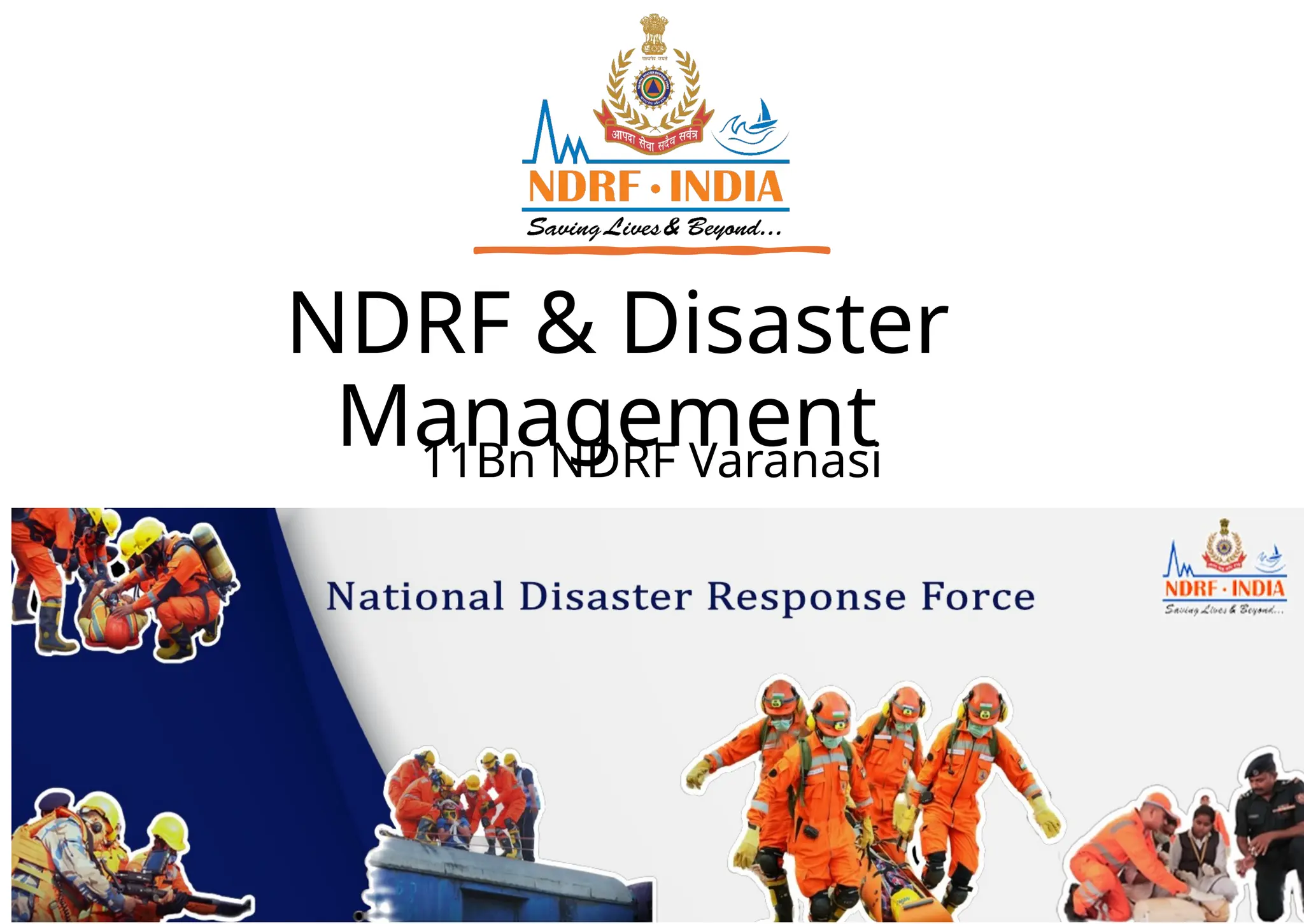
NDRF & Disaster
Management
11Bn NDRF Varanasi
Internal
NDRF
11Bn AOR
DM ACT 2005
DM POLICY 2009
DM PLAN 2016
IRS
ACTION PLAN
CONTENT
PM 10 Points Agenda on DRR
Internal
NDRF
NDRF is a specialized force
constituted “for the purpose of a
special response to a threatening
disaster situation or disaster” under
the disaster management act 2005.
Internal
BACKGROUND
“The Disaster Management Act 2005,
No: 53/2005”
On 23rd Dec 2005. “NDMA” was
established.
And 19 jan 2006 NDRF was raised.
Internal
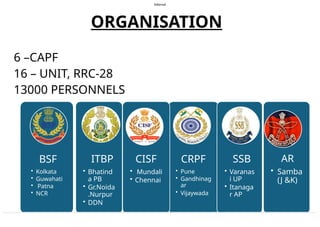
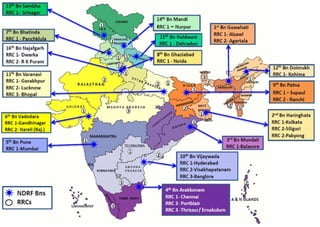
ORGANISATION
6 –CAPF
16 – UNIT, RRC-28
13000 PERSONNELS
BSF
• Kolkata
• Guwahati
• Patna
• NCR
CRPF
• Pune
• Gandhinag
ar
• Vijaywada
CISF
• Mundali
• Chennai
ITBP
• Bhatind
a PB
• Gr.Noida
.Nurpur
• DDN
SSB
• Varanas
i UP
• Itanaga
r AP
AR
• Samba
(J &K)
Internal
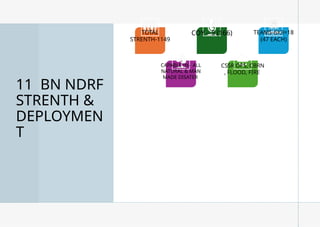
11 BN NDRF
STRENTH &
DEPLOYMEN
T
TOTAL
STRENTH-1149
COY – 6 (166) TEAMS-6X3=18
(47 EACH)
CAPABLE IN- ALL
NATURAL & MAN
MADE DISATER
CSSR OPS, CBRN
, FLOOD, FIRE
Internal
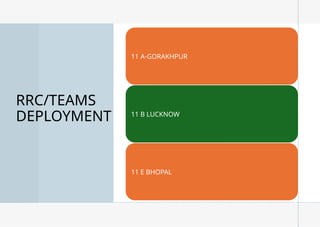
RRC/TEAMS
DEPLOYMENT
11 A-GORAKHPUR
11 B LUCKNOW
11 E BHOPAL
Internal
Internal
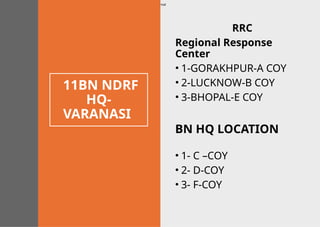
11BN NDRF
HQ-
VARANASI
RRC
Regional Response
Center
• 1-GORAKHPUR-A COY
• 2-LUCKNOW-B COY
• 3-BHOPAL-E COY
BN HQ LOCATION
• 1- C –COY
• 2- D-COY
• 3- F-COY
Internal
Disaster
• “Disaster” means a catastrophe, mishap,
calamity or grave occurrence in any area,
arising from natural or man made causes, or
by accident or negligence which results in
substantial loss of life or human suffering or
damage to, and destruction of, property, or
damage to, or degradation of, environment,
and is of such a nature or magnitude as to be
beyond the coping capacity of the
community of the affected area;
Internal
Natural Disaster
•Earthquake
•Flood
•Tsunami
•Cyclone
•Fire
•Landslide
•Avalanche
•Volcanic
eruption
•Coastal erosions
•Droughts
•Heat waves/
cold waves
Internal
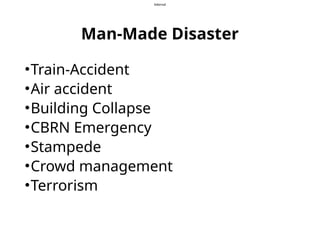
Man-Made Disaster
•Train-Accident
•Air accident
•Building Collapse
•CBRN Emergency
•Stampede
•Crowd management
•Terrorism
Internal
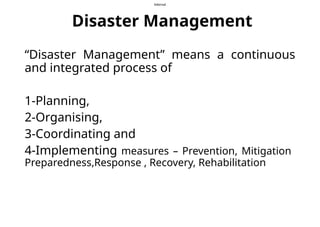
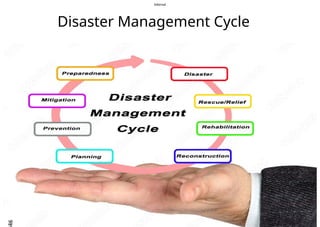
Disaster Management
“Disaster Management” means a continuous
and integrated process of
1-Planning,
2-Organising,
3-Coordinating and
4-Implementing measures – Prevention, Mitigation
Preparedness,Response , Recovery, Rehabilitation
Internal
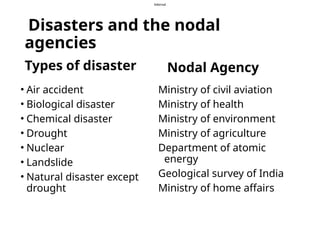
Disasters and the nodal
agencies
Types of disaster
• Air accident
• Biological disaster
• Chemical disaster
• Drought
• Nuclear
• Landslide
• Natural disaster except
drought
Nodal Agency
Ministry of civil aviation
Ministry of health
Ministry of environment
Ministry of agriculture
Department of atomic
energy
Geological survey of India
Ministry of home affairs
Internal
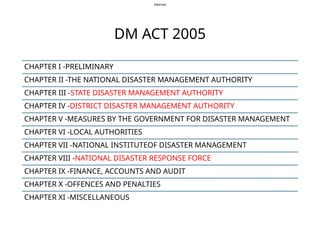
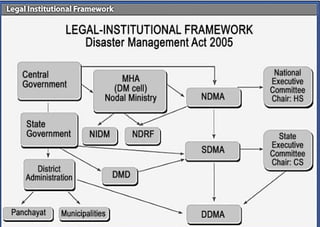
DM ACT 2005
CHAPTER I -PRELIMINARY
CHAPTER II -THE NATIONAL DISASTER MANAGEMENT AUTHORITY
CHAPTER III -STATE DISASTER MANAGEMENT AUTHORITY
CHAPTER IV -DISTRICT DISASTER MANAGEMENT AUTHORITY
CHAPTER V -MEASURES BY THE GOVERNMENT FOR DISASTER MANAGEMENT
CHAPTER VI -LOCAL AUTHORITIES
CHAPTER VII -NATIONAL INSTITUTEOF DISASTER MANAGEMENT
CHAPTER VIII -NATIONAL DISASTER RESPONSE FORCE
CHAPTER IX -FINANCE, ACCOUNTS AND AUDIT
CHAPTER X -OFFENCES AND PENALTIES
CHAPTER XI -MISCELLANEOUS
Internal
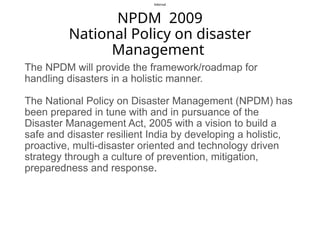
NPDM 2009
National Policy on disaster
Management
The NPDM will provide the framework/roadmap for
handling disasters in a holistic manner.
The National Policy on Disaster Management (NPDM) has
been prepared in tune with and in pursuance of the
Disaster Management Act, 2005 with a vision to build a
safe and disaster resilient India by developing a holistic,
proactive, multi-disaster oriented and technology driven
strategy through a culture of prevention, mitigation,
preparedness and response.
Internal
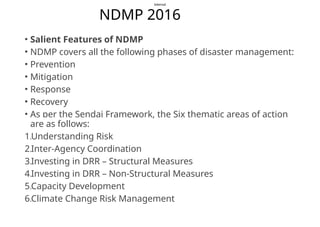
NDMP 2016
• Salient Features of NDMP
• NDMP covers all the following phases of disaster management:
• Prevention
• Mitigation
• Response
• Recovery
• As per the Sendai Framework, the Six thematic areas of action
are as follows:
1.Understanding Risk
2.Inter-Agency Coordination
3.Investing in DRR – Structural Measures
4.Investing in DRR – Non-Structural Measures
5.Capacity Development
6.Climate Change Risk Management
Internal
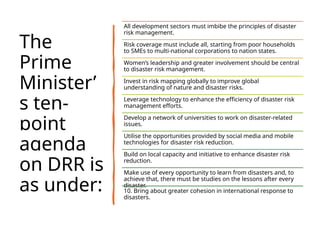
The
Prime
Minister’
s ten-
point
agenda
on DRR is
as under:
All development sectors must imbibe the principles of disaster
risk management.
Risk coverage must include all, starting from poor households
to SMEs to multi-national corporations to nation states.
Women’s leadership and greater involvement should be central
to disaster risk management.
Invest in risk mapping globally to improve global
understanding of nature and disaster risks.
Leverage technology to enhance the efficiency of disaster risk
management efforts.
Develop a network of universities to work on disaster-related
issues.
Utilise the opportunities provided by social media and mobile
technologies for disaster risk reduction.
Build on local capacity and initiative to enhance disaster risk
reduction.
Make use of every opportunity to learn from disasters and, to
achieve that, there must be studies on the lessons after every
disaster.
10. Bring about greater cohesion in international response to
disasters.
Internal
Internal
INCIDENT RESPONSE SYSTEM
U/S-6 OF DM ACT 2005
Internal
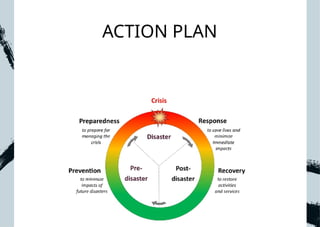
ACTION PLAN
Internal
Disaster Management Cycle
Internal
Thank You

NDRF National Disaster response Force & Disaster management

  • 1.
  • 2.
    Internal NDRF 11Bn AOR DM ACT2005 DM POLICY 2009 DM PLAN 2016 IRS ACTION PLAN CONTENT PM 10 Points Agenda on DRR
  • 3.
    Internal NDRF NDRF is aspecialized force constituted “for the purpose of a special response to a threatening disaster situation or disaster” under the disaster management act 2005.
  • 4.
    Internal BACKGROUND “The Disaster ManagementAct 2005, No: 53/2005” On 23rd Dec 2005. “NDMA” was established. And 19 jan 2006 NDRF was raised.
  • 5.
    Internal ORGANISATION 6 –CAPF 16 –UNIT, RRC-28 13000 PERSONNELS BSF • Kolkata • Guwahati • Patna • NCR CRPF • Pune • Gandhinag ar • Vijaywada CISF • Mundali • Chennai ITBP • Bhatind a PB • Gr.Noida .Nurpur • DDN SSB • Varanas i UP • Itanaga r AP AR • Samba (J &K)
  • 6.
    Internal 11 BN NDRF STRENTH& DEPLOYMEN T TOTAL STRENTH-1149 COY – 6 (166) TEAMS-6X3=18 (47 EACH) CAPABLE IN- ALL NATURAL & MAN MADE DISATER CSSR OPS, CBRN , FLOOD, FIRE
  • 7.
  • 8.
  • 9.
    Internal 11BN NDRF HQ- VARANASI RRC Regional Response Center •1-GORAKHPUR-A COY • 2-LUCKNOW-B COY • 3-BHOPAL-E COY BN HQ LOCATION • 1- C –COY • 2- D-COY • 3- F-COY
  • 10.
    Internal Disaster • “Disaster” meansa catastrophe, mishap, calamity or grave occurrence in any area, arising from natural or man made causes, or by accident or negligence which results in substantial loss of life or human suffering or damage to, and destruction of, property, or damage to, or degradation of, environment, and is of such a nature or magnitude as to be beyond the coping capacity of the community of the affected area;
  • 11.
  • 12.
    Internal Man-Made Disaster •Train-Accident •Air accident •BuildingCollapse •CBRN Emergency •Stampede •Crowd management •Terrorism
  • 13.
    Internal Disaster Management “Disaster Management”means a continuous and integrated process of 1-Planning, 2-Organising, 3-Coordinating and 4-Implementing measures – Prevention, Mitigation Preparedness,Response , Recovery, Rehabilitation
  • 14.
    Internal Disasters and thenodal agencies Types of disaster • Air accident • Biological disaster • Chemical disaster • Drought • Nuclear • Landslide • Natural disaster except drought Nodal Agency Ministry of civil aviation Ministry of health Ministry of environment Ministry of agriculture Department of atomic energy Geological survey of India Ministry of home affairs
  • 15.
    Internal DM ACT 2005 CHAPTERI -PRELIMINARY CHAPTER II -THE NATIONAL DISASTER MANAGEMENT AUTHORITY CHAPTER III -STATE DISASTER MANAGEMENT AUTHORITY CHAPTER IV -DISTRICT DISASTER MANAGEMENT AUTHORITY CHAPTER V -MEASURES BY THE GOVERNMENT FOR DISASTER MANAGEMENT CHAPTER VI -LOCAL AUTHORITIES CHAPTER VII -NATIONAL INSTITUTEOF DISASTER MANAGEMENT CHAPTER VIII -NATIONAL DISASTER RESPONSE FORCE CHAPTER IX -FINANCE, ACCOUNTS AND AUDIT CHAPTER X -OFFENCES AND PENALTIES CHAPTER XI -MISCELLANEOUS
  • 16.
    Internal NPDM 2009 National Policyon disaster Management The NPDM will provide the framework/roadmap for handling disasters in a holistic manner. The National Policy on Disaster Management (NPDM) has been prepared in tune with and in pursuance of the Disaster Management Act, 2005 with a vision to build a safe and disaster resilient India by developing a holistic, proactive, multi-disaster oriented and technology driven strategy through a culture of prevention, mitigation, preparedness and response.
  • 17.
    Internal NDMP 2016 • SalientFeatures of NDMP • NDMP covers all the following phases of disaster management: • Prevention • Mitigation • Response • Recovery • As per the Sendai Framework, the Six thematic areas of action are as follows: 1.Understanding Risk 2.Inter-Agency Coordination 3.Investing in DRR – Structural Measures 4.Investing in DRR – Non-Structural Measures 5.Capacity Development 6.Climate Change Risk Management
  • 18.
    Internal The Prime Minister’ s ten- point agenda on DRRis as under: All development sectors must imbibe the principles of disaster risk management. Risk coverage must include all, starting from poor households to SMEs to multi-national corporations to nation states. Women’s leadership and greater involvement should be central to disaster risk management. Invest in risk mapping globally to improve global understanding of nature and disaster risks. Leverage technology to enhance the efficiency of disaster risk management efforts. Develop a network of universities to work on disaster-related issues. Utilise the opportunities provided by social media and mobile technologies for disaster risk reduction. Build on local capacity and initiative to enhance disaster risk reduction. Make use of every opportunity to learn from disasters and, to achieve that, there must be studies on the lessons after every disaster. 10. Bring about greater cohesion in international response to disasters.
  • 19.
  • 20.
  • 21.
  • 22.
  • 23.

Editor's Notes

  • #16 The Policy covers all aspects of disaster management covering institutional, legal and financial arrangements; disaster prevention, mitigation and preparedness, techno-legal regime; response, relief and rehabilitation; reconstruction and recovery; capacity development; knowledge management and research and development. It focuses on the areas where action is needed and the institutional mechanism through which such action can be channelized. The NPDM addresses the concerns of all the sections of the society including differently abled persons, women, children and other disadvantaged groups. In terms of grant of relief and formulating measures for rehabilitation of the affected persons due to disasters, the issue of equity/inclusiveness has been accorded due consideration. The NPDM aims to bring in transparency and accountability in all aspects of disaster management through involvement of community, community based organizations, Panchayati Raj Institutions (PRIs), local bodies and civil society. The enunciation of this Policy represents merely the first step in the new journey. It is an instrument that hopes to build the overarching framework within which specific actions need to be taken by various stakeholders at all levels.