THE GLOBAL COMMISSION ON THE ECONOMY AND CLIMATE
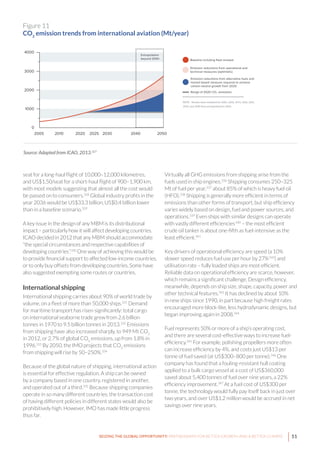
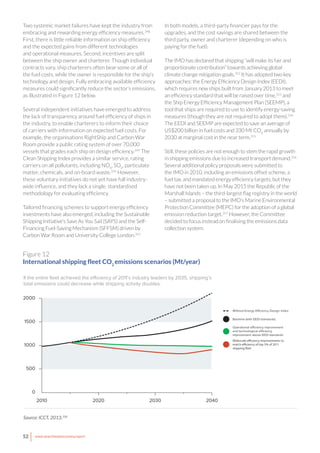
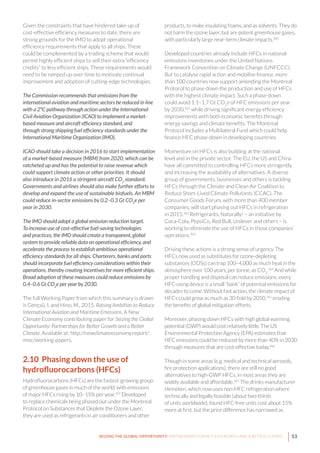
SEIZING THE GLOBAL
OPPORTUNITY
PARTNERSHIPS FOR BETTER GROWTH
AND A BETTER CLIMATE
The 2015 New Climate Economy Report
Managing Partner
PARTNERS
ISBN: 978-0-9906845-9-6
New Climate Economy
c/o World Resources Institute
10 G St NE
Suite 800
Washington, DC 20002, USA
+1 (202) 729-7600
New Climate Economy
c/o Overseas Development Institute
203 Blackfriars Road
London, SE1 8NJ, UK
+44 (0) 20 7922 0300
www.newclimateeconomy.report
www.newclimateeconomy.net
July 2015
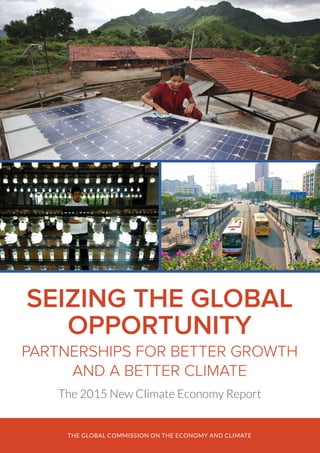
Top photo credit: Flickr: DFID
Bottom left photo credit: Asian Development Bank.
Bottom right photo credit: GuoZhongHua / Shutterstock.com
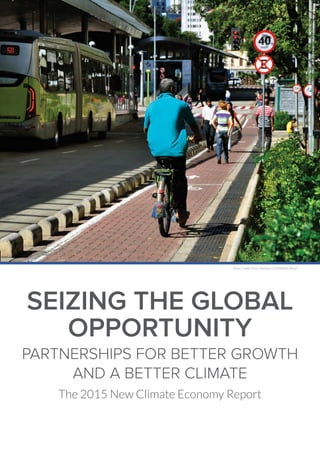
Photo Credit: Flickr: Mariana Gil/EMBARQ Brasil
SEIZING THE GLOBAL
OPPORTUNITY
PARTNERSHIPS FOR BETTER GROWTH
AND A BETTER CLIMATE
The 2015 New Climate Economy Report
The New Climate Economy
The Global Commission on the Economy and Climate, and its flagship project The New Climate Economy, were set up
to help governments, businesses and society make better-informed decisions on how to achieve economic prosperity and
development while also addressing climate change.
The New Climate Economy was commissioned in 2013 by the governments of seven countries: Colombia, Ethiopia,
Indonesia, Norway, South Korea, Sweden and the United Kingdom. The Commission has operated as an independent
body and, while benefiting from the support of the seven governments, has been given full freedom to reach its own
conclusions.
In September 2014, the Commission published Better Growth, Better Climate: The New Climate Economy Report. Since then,
the project has released a series of country reports on the United States, China, India and Ethiopia, and sector reports
on cities, land use, energy and finance. It has disseminated its messages by engaging with heads of governments, finance
ministers, business leaders and other key economic decision-makers in over 30 countries around the world.
The Commission’s programme of work has been conducted by a global partnership of eight leading research institutes:
World Resources Institute (WRI, Managing Partner), Climate Policy Initiative (CPI), Ethiopian Development Research
Institute (EDRI), Global Green Growth Institute (GGGI), Indian Council for Research on International Economic Relations
(ICRIER), Overseas Development Institute (ODI), Stockholm Environment Institute (SEI) and Tsinghua University.
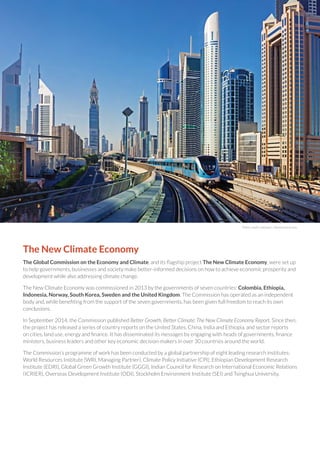
Photo credit: Laborant / Shutterstock.com
The Global Commission on the Economy and Climate
The Global Commission on the Economy and Climate oversees the work of the New Climate Economy project. Chaired
by former President of Mexico Felipe Calderón and co-chaired by Lord Nicholas Stern, the Commission comprises former
heads of government and finance ministers, and leaders in the fields of economics, business and finance.
Members of the Global Commission endorse the general thrust of the arguments, findings, and recommendations
made in this report, but should not be taken as agreeing with every word or number. They serve on the Commission in a
personal capacity. The institutions with which they are affiliated have therefore not been asked formally to endorse the
report and should not be taken as having done so.
Felipe Calderón (Chair), Former President of Mexico
Nicholas Stern (Co-Chair), IG Patel Professor of
Economics and Government, London School of Economics
and Political Science
Ingrid Bonde, Chief Financial Officer and Deputy Chief
Executive Officer, Vattenfall
Sharan Burrow, General Secretary, International Trade
Union Confederation (ITUC)
Suma Chakrabarti, President, European Bank for
Reconstruction and Development (EBRD)
Chen Yuan, Vice-Chair, National Committee of the
Chinese People’s Political Consultative Conference;
former Chairman, China Development Bank
Helen Clark, Administrator, UN Development Programme
(UNDP); former Prime Minister of New Zealand
Luísa Diogo, Former Prime Minister of Mozambique, and
Chairperson of the Board of Directors, Barclays Bank
Mozambique
Dan L. Doctoroff, Former President and Chief Executive
Officer, Bloomberg LP
S. Gopalakrishan, Co-Founder, Infosys
Angel Gurría, Secretary-General, Organisation for
Economic Co-operation and Development (OECD)
Chad Holliday, Chairman, Royal Dutch Shell
Sri Mulyani Indrawati, Managing Director and Chief
Operating Officer, The World Bank; former Finance
Minister of Indonesia
Naina Lal Kidwai, Chairman, HSBC India; Director,
HSBC Asia Pacific
Caio Koch-Weser, Vice Chairman, Deutsche Bank Group;
Chair, European Climate Foundation
Ricardo Lagos, Former President of Chile; Professor at
Large, Watson Institute for International Studies, Brown
University
Michel M. Liès, Chief Executive Officer, Swiss Re Group
Trevor Manuel, Former Minister and Chairperson of
the South African Planning Commission; former Finance
Minister of South Africa
Takehiko Nakao, President, Asian Development Bank
Ngozi Okonjo-Iweala, Former Minister of Finance,
Federal Republic of Nigeria
Eduardo Paes, Mayor, Rio De Janeiro; Chair, C40
Annise Parker, Mayor of Houston, Texas
Paul Polman, Chief Executive Officer, Unilever
Christian Rynning-Tønnesen, President and Chief
Executive Officer, Statkraft
Kristin Skogen Lund, Director-General, Confederation of
Norwegian Enterprise
Jean-Pascal Tricoire, Chief Executive Officer and
Chairman, Schneider Electric
Maria van der Hoeven, Executive Director, International
Energy Agency (IEA)
Zhu Levin, Former President and Chief Executive Officer,
China International Capital Corporation (CICC)
6 www.newclimateeconomy.report
2015 is a year of unprecedented opportunity.
This year’s landmark intergovernmental conferences –
the International Conference on Financing for
Development in Addis Ababa in July, the United
Nations Summit to adopt the post-2015 Sustainable
Development Goals in New York in September, the G20
Summit in Antalya in November, and the UN Climate
Change Conference (COP21) in Paris in December –
have the potential to advance a new era of international
cooperation which can help countries at all income levels
build lasting development and economic growth while
reducing climate risk.
A goal once seen as distant – to end extreme poverty,
achieve broad-based prosperity and secure a safe
climate, all together – is increasingly within reach.
As the Commission’s 2014 report Better Growth, Better
Climate argued, crucial investments will be made over the
next 15 years in the world’s cities, land use and energy
systems. They have the potential to generate multiple
benefits for economic growth, human development and
the environment; or they could lock countries into high-
carbon pathways, with severe economic and climatic
consequences. Through credible, consistent policies to
drive resource efficiency, infrastructure investment and
innovation, both developed and developing countries can
achieve stronger economic performance and climate goals
at the same time. This report shows how such actions
can be scaled up through cooperative, multi-stakeholder
partnerships – not just between governments, but among
businesses, investors, states and regions, cities and
communities.
Technological innovation, new economic trends, and
new political commitments are now combining to
build momentum for change. Renewable energy costs
continue to decline, and energy storage and demand
management technologies are being developed rapidly,
creating new opportunities to build cleaner and more
efficient energy systems and to expand energy access in
developing countries. Carbon pricing has been adopted
or is planned in about 40 countries and more than
20 sub-national jurisdictions, and over 1,000 major
companies and investors have declared their support
for it. In the last two years, 28 countries have launched
efforts to reform fossil fuel subsidies, helped recently by
lower oil prices. Cities are adopting ambitious emission
reduction and air quality targets and plan to track
their progress using common standards. Some 175
governments, companies, indigenous people’s groups
and civil society organisations have committed to halt
deforestation by 2030, and leading consumer goods
and agricultural trading companies are working with
tropical forest countries and communities to eliminate
deforestation from their supply chains. International
finance to support climate resilience and low-carbon
investment continues to grow; issuances of “green bonds”,
for example, more than tripled in the last year. And
companies, investors, governments and financial
regulators are increasingly integrating climate change
into their investment and business strategies, creating
new opportunities and competitive advantage for
market leaders.
At the same time, the costs of continuing the current
fossil fuel-based economic model are becoming ever
clearer. Air pollution primarily related to fossil fuel-
based energy and vehicle emissions leads to an estimated
3.7 million premature deaths globally each year, with
millions more suffering from respiratory illnesses. Growing
traffic congestion is causing serious economic costs in
cities throughout the world, while road traffic accidents
kill around 1.25 million people annually, over 90% of them
in developing countries. Volatile oil prices are likely to
continue, increasing economic uncertainty and delaying
business investment. As low-carbon energy costs fall and
climate policy is tightened, locking in high-carbon assets
increases the risk of future devaluation or stranding.
Yet action is not yet occurring at the scale or speed
necessary for structural transformation toward a new
climate economy. An increasing focus in international
economic forums on infrastructure for growth, the
emergence of new development banks and financing
mechanisms, and historically low interest rates in some
economies, create a significant opportunity to stimulate
low-carbon growth in both developing and developed
countries. But infrastructure investments remain
inadequate almost everywhere. Performance continues
to be constrained by the protracted effects of the
global financial crisis, deeply embedded market failures,
underlying weaknesses in policies and institutions, and the
inertia of a longstanding high-carbon economic model.
While CO2
emissions are beginning to decouple
from growth in both advanced and some emerging
economies, this process needs to accelerate if we are
to avoid the worst impacts of climate change on human
welfare and the global economy. Changes in seasonal
weather patterns, and the rising costs of more frequent
extreme weather events such as floods and droughts, are
already being felt, particularly by the most vulnerable
developing countries. To hold global warming to under
2°C, as agreed by the international community, the
carbon emitted per dollar of GDP in the global economy
is likely to need to decline by an average of nearly 5% a
year between now and 2050, compared with the current
rate of under 1.5%. For developing countries, improving
emissions intensity allows for strong GDP growth while
total emissions peak and then ultimately decline.
Executive Summary and Recommendations
7SEIZING THE GLOBAL OPPORTUNITY: PARTNERSHIPS FOR BETTER GROWTH AND A BETTER CLIMATE
Achieving a new international climate agreement in
Paris would provide a vital foundation for building
a lower-carbon and more resilient global economy,
sending a strong signal to businesses and investors.
The agreement should include a long-term goal for
emissions to reach near-zero or below in the second half
of the century, and a mechanism for regular strengthening
of commitments. A strong and equitable package of
support for developing countries is needed, through which
international public finance mobilises private-sector flows,
complements strong domestic financial resources, and
helps enhance institutional and technological capacities.
The “intended nationally determined contributions”
(INDCs) that countries are submitting for Paris
should be as ambitious as possible this year, but
should be considered as floors rather than ceilings to
national ambition over the coming years. Many INDCs
already reflect historically ambitious commitments, but
collectively it is likely that they will not be enough to
achieve a 2°C path. As technological change, increased
financing and multi-stakeholder action and cooperation
create new low-carbon opportunities at lower cost,
countries should aim to strengthen their commitments.
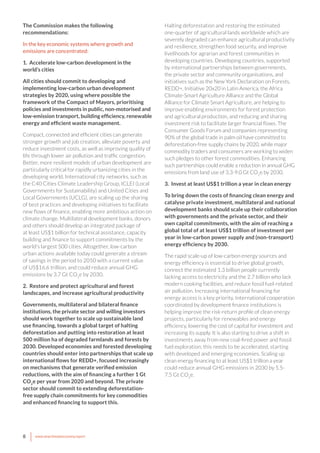
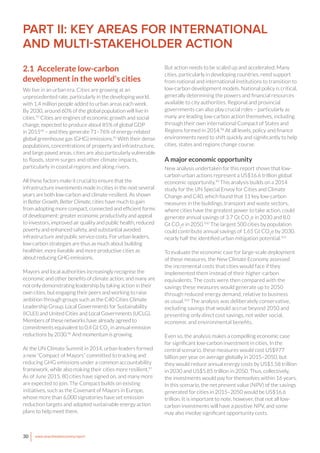
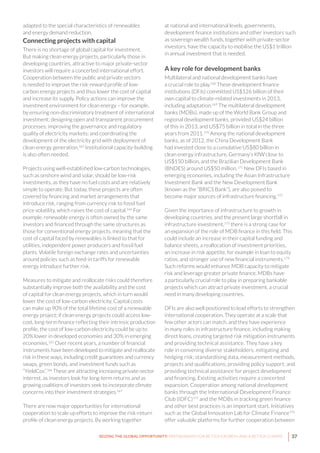
This report identifies 10 key areas of opportunity
for stronger climate action which will also bring
significant economic benefits. Together, these could
achieve at least 59% and potentially as much as 96%
of the emissions reductions needed by 2030 to keep
global warming under 2°C. Cooperation of multiple
kinds between governments, city authorities, businesses,
international organisations and civil society can help
to realise the full economic benefits of these actions.
It can scale up technological change, expand markets,
reduce costs, address concerns about international
competitiveness, spread best practice and increase the
flows of finance.
Multi-stakeholder and international partnerships can
in this way strengthen current momentum, and help
drive further economic growth and climate action
together. The ten areas identified in the report cover the
three key economic systems where economic growth
and greenhouse gas (GHG) emissions are concentrated
– cities, land use and energy; the three key drivers of
growth – resource efficiency, infrastructure investment
and innovation; action by businesses and investors;
and three sectors where international cooperation is
essential – reducing emissions from international aviation
and shipping, and phasing down hydrofluorocarbons
(HFCs). In each area, the report shows how strengthened
partnerships between multiple stakeholders can catalyse
significant economic benefits, as well as global emissions
reductions, and identifies key commitments which can be
made this year or in 2016.
0 20 60 7040 503010 80
IPCC median baseline (“business as usual”)
Cities
Degraded land and forests
Clean energy financing
Carbon pricing
Business
Aviation and maritime
HFCs
Overlap
Total mitigation impact (mean and full range)
IPCC median emissions needed for 2C pathway
UNEP gross emissions gap
Gt CO2
e per year in 2030
69
3.7
5.7 (4.5 to 6.9)
4.2 (2.8 to 5.6)
1.9
0.8 (0.6 to 0.9)
1.4 (1.1 to 1.7)
-9.4 (-7.7 to -11.0)
27
42
21 (16 to 26)
Full implementation of the Commission's recommendations could achieve up to 96% of the emissions reductions in 2030
needed to keep global warming under 2°C.
SOURCE: New Climate Economy, 2015.
NOTE:
6.2 (3.3 to 9.0)
6.5 (5.5 to 7.5)
The emissions reduction potential of the Commission’s recommendations
Note: Bars show mean emissions reduction potential for each field with the full ranges in brackets.
Source: New Climate Economy, 2015. “Estimates of Emissions Reduction Potential for the 2015 Report: Technical Note.” A technical
note for Seizing the Global Opportunity: Partnerships for Better Growth and a Better Climate. Available at: http://newclimateeconomy.
report/misc/working-papers.
8 www.newclimateeconomy.report
The Commission makes the following
recommendations:
In the key economic systems where growth and
emissions are concentrated:
1. Accelerate low-carbon development in the
world’s cities
All cities should commit to developing and
implementing low-carbon urban development
strategies by 2020, using where possible the
framework of the Compact of Mayors, prioritising
policies and investments in public, non-motorised and
low-emission transport, building efficiency, renewable
energy and efficient waste management.
Compact, connected and efficient cities can generate
stronger growth and job creation, alleviate poverty and
reduce investment costs, as well as improving quality of
life through lower air pollution and traffic congestion.
Better, more resilient models of urban development are
particularly critical for rapidly urbanizing cities in the
developing world. International city networks, such as
the C40 Cities Climate Leadership Group, ICLEI (Local
Governments for Sustainability) and United Cities and
Local Governments (UCLG), are scaling up the sharing
of best practices and developing initiatives to facilitate
new flows of finance, enabling more ambitious action on
climate change. Multilateral development banks, donors
and others should develop an integrated package of
at least US$1 billion for technical assistance, capacity
building and finance to support commitments by the
world’s largest 500 cities. Altogether, low-carbon
urban actions available today could generate a stream
of savings in the period to 2050 with a current value
of US$16.6 trillion, and could reduce annual GHG
emissions by 3.7 Gt CO2
e by 2030.
2. Restore and protect agricultural and forest
landscapes, and increase agricultural productivity
Governments, multilateral and bilateral finance
institutions, the private sector and willing investors
should work together to scale up sustainable land
use financing, towards a global target of halting
deforestation and putting into restoration at least
500 million ha of degraded farmlands and forests by
2030. Developed economies and forested developing
countries should enter into partnerships that scale up
international flows for REDD+, focused increasingly
on mechanisms that generate verified emission
reductions, with the aim of financing a further 1 Gt
CO2
e per year from 2020 and beyond. The private
sector should commit to extending deforestation-
free supply chain commitments for key commodities
and enhanced financing to support this.
Halting deforestation and restoring the estimated
one-quarter of agricultural lands worldwide which are
severely degraded can enhance agricultural productivity
and resilience, strengthen food security, and improve
livelihoods for agrarian and forest communities in
developing countries. Developing countries, supported
by international partnerships between governments,
the private sector and community organisations, and
initiatives such as the New York Declaration on Forests,
REDD+, Initiative 20x20 in Latin America, the Africa
Climate-Smart Agriculture Alliance and the Global
Alliance for Climate Smart Agriculture, are helping to
improve enabling environments for forest protection
and agricultural production, and reducing and sharing
investment risk to facilitate larger financial flows. The
Consumer Goods Forum and companies representing
90% of the global trade in palm oil have committed to
deforestation-free supply chains by 2020, while major
commodity traders and consumers are working to widen
such pledges to other forest commodities. Enhancing
such partnerships could enable a reduction in annual GHG
emissions from land use of 3.3-9.0 Gt CO2
e by 2030.
3. Invest at least US$1 trillion a year in clean energy
To bring down the costs of financing clean energy and
catalyse private investment, multilateral and national
development banks should scale up their collaboration
with governments and the private sector, and their
own capital commitments, with the aim of reaching a
global total of at least US$1 trillion of investment per
year in low-carbon power supply and (non-transport)
energy efficiency by 2030.
The rapid scale-up of low-carbon energy sources and
energy efficiency is essential to drive global growth,
connect the estimated 1.3 billion people currently
lacking access to electricity and the 2.7 billion who lack
modern cooking facilities, and reduce fossil fuel-related
air pollution. Increasing international financing for
energy access is a key priority. International cooperation
coordinated by development finance institutions is
helping improve the risk-return profile of clean energy
projects, particularly for renewables and energy
efficiency, lowering the cost of capital for investment and
increasing its supply. It is also starting to drive a shift in
investments away from new coal-fired power and fossil
fuel exploration; this needs to be accelerated, starting
with developed and emerging economies. Scaling up
clean energy financing to at least US$1 trillion a year
could reduce annual GHG emissions in 2030 by 5.5-
7.5 Gt CO2
e.
9SEIZING THE GLOBAL OPPORTUNITY: PARTNERSHIPS FOR BETTER GROWTH AND A BETTER CLIMATE
4. Raise energy efficiency standards to the global best
G20 and other countries should converge their energy
efficiency standards in key sectors and product
fields to the global best by 2025, and the G20 should
establish a global platform for greater alignment and
continuous improvement of standards.
Cooperation to raise energy efficiency standards for
appliances, lighting, vehicles, buildings and industrial
equipment can unlock energy and cost savings,
expand global markets, reduce non-tariff barriers to
trade, and reduce air pollution and GHG emissions.
Cooperation should be facilitated and supported by
the G20, empowering existing sectoral initiatives, and
international organisations such as the International
Energy Agency (IEA), the International Partnership for
Energy Efficiency Cooperation (IPEEC), and Sustainable
Energy for All (SE4All). Globally, enhanced energy
efficiency investments could boost cumulative economic
output by US$18 trillion to 2035, increasing growth
by 0.25–1.1% per year. Aligning and gradually raising
national efficiency standards could reduce annual
GHG emissions in 2030 by 4.5–6.9 Gt CO2
e.
For the key drivers of both economic growth and
emissions reductions:
5. Implement effective carbon pricing
All developed and emerging economies, and others
where possible, should commit to introducing or
strengthening carbon pricing by 2020, and should
phase out fossil fuel subsidies.
Strong, predictable and rising carbon prices send an
important signal to help guide consumption choices and
investments in infrastructure and innovation; the fiscal
revenues generated can be used to support low-income
households, offset reductions in other taxes, or for other
policy objectives. An estimated 12% of annual GHG
emissions are now covered by existing or planned carbon
taxes or trading systems around the world. Businesses
are increasingly calling on governments to implement
carbon pricing, and over 150 now use an internal carbon
price (typically around US$40/t CO2
for oil companies)
to guide investment decisions. International cooperation
on carbon pricing and subsidy reform, including
through the G20 and with the support of the World
Bank, the Organisation for Economic Co-operation
and Development (OECD) and the International
Monetary Fund (IMF), can help mitigate concerns about
competitiveness impacts from unilateral policy measures,
improve knowledge-sharing and transparency, provide
opportunities to link emission trading schemes, and
reduce the costs of action.
6. Ensure new infrastructure is climate-smart
G20 and other countries should adopt key principles
ensuring the integration of climate risk and climate
objectives in national infrastructure policies and plans.
These principles should be included in the G20 Global
Infrastructure Initiative, as well as used to guide the
investment strategies of public and private finance
institutions, particularly multilateral and national
development banks.
About US$90 trillion in infrastructure investment is
needed globally by 2030 to achieve global growth
expectations, most of it in developing countries.
Infrastructure investment has become a core focus of
international economic cooperation through the G20 and
for established and new development finance institutions.
Integrating climate objectives into infrastructure
decisions, often at no or very modest additional cost,
will increase climate resilience and avoid locking in
carbon-intensive and polluting investments. International
finance will have to be significantly scaled up to deliver
the up-front infrastructure investments needed to
achieve development and climate goals, including
increased capitalisation of both national and multilateral
development banks.
7. Galvanise low-carbon innovation
Emerging and developed country governments
should work together, and with the private sector
and developing countries, in strategic partnerships to
accelerate research, development and demonstration
(RD&D) in low-carbon technology areas critical to
post-2030 growth and emissions reduction.
Public funding for low-carbon RD&D is currently too low
to catalyse innovation for long-term growth and cost-
effective emissions reduction beyond 2030. It should be
at least tripled by the major economies by the mid-2020s.
International partnerships enable countries to share the
costs of innovation, and the knowledge generated by
it. This can be of particular benefit to low- and middle-
income countries, enabling them to “leapfrog” to new
technologies and enhance their innovation capacity.
Priority areas for low-carbon cooperative innovation
include agriculture and energy access, particularly in
developing countries; longer-term global solutions such
as bioenergy and carbon capture, utilisation and storage;
and key technologies to avoid lock-in of carbon-intensive
infrastructure, including buildings, electricity networks
and transport systems.
10 www.newclimateeconomy.report
In critical fields of business and finance sector activity:
8. Drive low-carbon growth through business and
investor action
All major businesses should adopt short- and long-
term emissions reduction targets and implement
corresponding action plans, and all major industry
sectors and value chains should agree on market
transformation roadmaps, consistent with the long-
term decarbonisation of the global economy.
Financial sector regulators and shareholders should
actively encourage companies and financial institutions
to disclose critical carbon and environmental, social
and governance factors, and incorporate them in
risk analysis, business models and investment
decision-making.
Businesses are driving a US$5.5 trillion global market
in low-carbon and environmental technologies and
products, and many large companies are now cutting
their emissions, realising significant cost savings and
often enhancing profitability. Business- and finance
sector-led initiatives are setting new norms for corporate
action, including long-term target-setting and the
integration of climate risk into investors’ analysis and
strategy. Initiatives such as the Tropical Forest Alliance
2020 and the Low Carbon Technology Partnerships
Initiative seek to transform markets in key sectors and
value chains, driving innovation and creating global
low-carbon markets. Companies should work with
governments, unions and other stakeholders to ensure a
“just transition” to a low-carbon economy, supporting job
creation, skills development and community renewal.
For key sectors where international action can unlock
low-cost emissions reduction:
9. Raise ambition to reduce international aviation
and maritime emissions
Emissions from the international aviation and
maritime sectors should be reduced in line with a
2°C pathway through action under the International
Civil Aviation Organization (ICAO) to implement a
market-based measure and aircraft efficiency
standard, and through strong shipping fuel efficiency
standards under the International Maritime
Organization (IMO).
Global aviation and shipping together produced about
5% of global CO2
emissions, and by 2050 this is expected
to rise to 10–32%. Yet they offer some of the most cost-
effective emission reductions available today, particularly
through improved fuel efficiency. Two new IMO
standards are expected to save an average of US$200
billion in annual fuel costs by 2030. Adoption by the
ICAO in 2016 of a market-based measure (an emissions
trading or offset scheme) can both cut emissions and
potentially generate finance for climate action or other
purposes. This should be complemented by a new
aircraft standard to ensure emissions reductions within
the sector. The IMO should adopt a global emissions
reduction target and promote fuel saving through
strong operational efficiency standards and a supporting
data-sharing system. These measures could help reduce
annual GHG emissions by 0.6–0.9 Gt CO2
e by 2030.
10. Phase down the use of hydrofluorocarbons (HFCs)
Parties to the Montreal Protocol should approve an
amendment to phase down the production and use
of HFCs.
Hydrofluorocarbons, used as refrigerants, as solvents, in
fire protection and in insulating foams, are the fastest-
growing GHGs in much of the world, increasing at a
rate of 10–15% per year. Replacing HFCs with greener
refrigerants has low upfront costs and can result in
both energy and cost savings. Cooperative initiatives
such as through the Climate and Clean Air Coalition
to Reduce Short-Lived Climate Pollutants (CCAC), the
Consumer Goods Forum, and Refrigerants, Naturally!
are helping countries and companies scale back HFC use.
Incorporating HFCs into the Montreal Protocol could
realise significant near-term gains to slow climate change
and provide support to developing countries, avoiding
1.1–1.7 Gt CO2
e of GHG emissions per year by 2030,
while driving significant energy efficiency improvements.
__________________________________
Implementing these actions will in many cases require
significant investment. International and national public
finance will be needed to catalyse and help leverage
private finance, in particular for low-carbon energy and
urban development; action to halt deforestation and
restore degraded land; to build capacity; and to scale
up research, development and demonstration of clean
technologies and processes. The economic benefits
of such investment will be substantial, even without
consideration of the gains for the climate.
The Global Commission urges the international
community to seize the opportunity of the unique
series of meetings occurring in 2015 to put the world
on a pathway to low-carbon, climate-resilient growth
and development. Cooperative action, between
governments at all levels and with the private sector,
international organisations and civil society, can help
achieve both better growth and a better climate. This
will require strong and sustained political leadership.
But the prize is immense. Together, a secure,
prosperous and sustainable future is within our reach.
11SEIZING THE GLOBAL OPPORTUNITY: PARTNERSHIPS FOR BETTER GROWTH AND A BETTER CLIMATE
Table of Contents
Executive Summary and	 6
Recommendations
Introduction	 12
Part I: New opportunities and	
challenges for low-carbon growth 	 		
and international cooperation	
1.1	 Recent trends and developments	 16
Rapid growth and record low prices for clean	 16	
energy and energy storage technologies
A plunge in oil prices – and a chance to	 17
accelerate energy price reforms
A growing interest in new infrastructure	 19
investment and finance
Heightened attention to climate risks –	 20
and opportunities – in the financial sector
National development strategies are	 21
integrating green growth and climate
resilience
The carbon intensity of the global economy	 22
is falling
1.2	 The potential of international cooperation	 24
A new international climate agreement	 25
Cooperation on climate outside of the	 28
UNFCCC
Part II: Key areas for international and 			
multi-stakeholder action	
2.1	 Accelerate low-carbon development in the	 30
	 world’s cities
	
2.2	 Restore and protect agricultural and forest	 32		
	 landscapes and increase agricultural
	productivity	
2.3	 Invest at least US$1 trillion a year in	 36
	 clean energy
2.4	 Raise energy efficiency standards to the 	 38
	 global best
2.5	 Implement effective carbon pricing	 40
2.6	 Ensure new infrastructure is climate-smart	 43
2.7	 Galvanise low-carbon innovation	 45
2.8	 Drive low-carbon growth through	 47
	 business and investor action
2.9	 Raise ambition to reduce international 	 49
	 aviation and maritime emissions
	International aviation	 50
	International shipping	 51
2.10	 Phase down the use of hydrofluorocarbons	 53
	(HFCs)
Endnotes	 55
Acknowledgements	 73
The Project Team 	 75
12 www.newclimateeconomy.report
This is a time of unprecedented opportunity. In the
second half of 2015, world leaders will agree on new
Sustainable Development Goals and how to finance them,
and negotiate a comprehensive new climate change
treaty. Technology is advancing rapidly, redefining what
is possible. New economic trends and opportunities,
combined with new leadership commitments, have built
real momentum for change. This was already evident when
the Global Commission published Better Growth, Better
Climate last year; it has kept growing since.
A goal once seen as distant – to end extreme poverty,
achieve broad-based prosperity and secure a safe climate
together – is increasingly within reach. More and more
governments, businesses and communities are actively
pursuing it. But significant challenges and obstacles still
stand in the way.
This report focuses on how international and multi-
stakeholder cooperation can accelerate progress and
help overcome key barriers. Such cooperation can
take many different forms: it includes partnerships
between governments, but also among businesses,
investors, states and regions, city and local authorities,
international organisations, civil society organisations
and communities. Over the last few years many such
partnerships have emerged. This report identifies some of
the most promising ones and suggests ways to scale them
up further. It also identifies areas where new initiatives
are needed. As such, it provides a menu of options for
different actors to contribute to delivering both economic
and climate outcomes.
Better Growth, Better Climate shows how countries at
different levels of development can achieve stronger
economic growth, reduce poverty, advance development
goals, and reduce climate risk at the same time. It focuses
on the three major economic systems where growth and
emissions are concentrated – cities, land use and energy –
and calls for consistent and credible policies around three
key drivers of change – resource efficiency, infrastructure
and innovation (see Box 1). It shows that the economic and
social benefits alone would make many low-carbon policies
and approaches worth pursuing. But it also recognises
that the challenges that countries face in tackling these
issues are deeply shaped by their history and their political
and economic circumstances. Low-income countries in
particular need robust international support to make
progress on these fronts – and some actions are difficult
for any country to take on alone.
Introduction
13SEIZING THE GLOBAL OPPORTUNITY: PARTNERSHIPS FOR BETTER GROWTH AND A BETTER CLIMATE
This is why international cooperation is so crucial. It is a key
lever to strengthen and more effectively distribute the flow
of new ideas and technical capacity. It can mobilise and scale
up finance, particularly to developing economies. It can help
overcome concerns about loss of competitiveness, reduce
trade barriers and increase the scale of markets. By working
together, countries, businesses, cities and others can move
faster and achieve greater gains.
Further international and multi-stakeholder cooperation
could also significantly enhance and complement the
ambition of countries’ commitments under the expected
new climate agreement. The pledges made to date
(“intended nationally determined contributions”, or
INDCs) are important steps forward, but it is now clear
that they are unlikely to add up to a level of emissions
reduction consistent with keeping global warming under
the internationally agreed limit of 2°C. The INDCs are
therefore just a starting point; to avoid even more severe
impacts on human well-being and economic growth than
are already expected, ambition will need to rise steadily
over the next 10–15 years. Cooperative action can make
that easier and more cost-effective.
Part 1 of this report outlines some of the major emerging
developments and trends which are creating new
opportunities to achieve stronger growth and climate
action together, as well as continuing challenges. It then
looks at how stronger international and multi-stakeholder
cooperation can advance and accelerate progress and
help tip the balance towards low-carbon global growth. It
discusses these different forms of cooperation, and places
them in the context of the international climate negotiations.
Part 2 then explores 10 areas where there are large,
immediate opportunities to galvanise such partnerships,
summarising in-depth analyses set out in a series of
Working Papers, on which this part is based.
The international meetings taking place in the remainder
of 20151
– in particular the International Conference on
Financing for Development in Addis Ababa in July, the UN
Summit to adopt the post-2015 Sustainable Development
Goals in New York in September, the G20 Summit in
Antalya in November, and the Paris Climate Change
Conference (COP21) in December – are critical moments
for the international community. The world’s leaders must
rise to the challenge. Failure to seize these opportunities
would set back the cause of development and poverty
reduction for years. But success could unleash a new era of
international cooperation for better growth and a better
climate. The Commission hopes this report can contribute
to that success.
14 www.newclimateeconomy.report 14
The Global Commission on the Economy and Climate’s
2014 report, Better Growth, Better Climate, is addressed to
economic decision-makers across the world, in both the
public and private sectors. It examines the large structural
and technological changes already occurring in the global
economy, and shows that through targeted policies and
investments, countries at all levels of development can
build stronger economies while substantially reducing
climate risk.
A key insight of the report is that many of the policy and
institutional reforms needed for revitalising growth,
fostering development and improving well-being are
also crucial to tackle climate risk. The opportunities for
such reforms are increasing, as emerging and developing
economies experience rapid urbanisation and structural
change, innovation reduces the cost of a low-carbon
transition, and the costs of the current economic growth
model become more apparent. Many reforms can generate
multiple economic, social and environmental benefits:
improved economic performance and faster poverty
reduction, as well as cleaner air, more liveable and
vibrant cities, and greater resilience to climate change.
The report examines three key drivers of change:
efficiency of resource use, infrastructure investment, and
innovation. All three offer potential for both improving
growth and reducing climate risk. Progress will be
especially important in three key socio-economic systems
that underpin a large share of the world’s economic
activity and greenhouse gas (GHG) emissions: cities,
land use, and energy. Credible and consistent policies
are needed in each, taking into account the unique
circumstances, varying capacities and differing needs
of countries at different levels of development.
Cities and urban areas are home to half the world’s
population, and account for about 80% of global economic
output and around 70% of global energy use and
energy-related GHG emissions. Nearly all of the world’s
population growth in the next two decades will occur in
urban areas, primarily in developing countries; by 2050,
two-thirds of the global population will be urban. How
cities develop is thus critical to the future path of the
world economy, development and climate. A large share of
urban growth today involves unmanaged sprawl, leading to
congestion, rising air pollution, and high economic, social
and environmental costs overall. As discussed in Section
2.1 of this report, pioneering cities around the world are
demonstrating the benefits of a different approach: more
Box 1
Better Growth, Better Climate – Key Insights
compact, connected and efficient urban forms built around
mass transit. Adopting this model not only leads to more
attractive and competitive cities, but higher quality of life,
sustained resource savings and lower GHG emissions.
Land use is a key development concern, as roughly a quarter
of the world’s agricultural land is severely degraded, and
forests continue to be cleared for conversion to crops and
pasture, and for timber and mining. Key ecosystem services
are being compromised, and the natural resource base is
becoming less productive. Yet by 2050, the world’s farms
will need to produce 70% more calories than in 2006, due to
population growth, rising incomes and changing diets. There
is considerable scope to increase agricultural productivity
and resilience through new methods of crop and livestock
management and the restoration of degraded land, and at
the same time to reduce the estimated 25% of food that is
wasted globally. Better Growth, Better Climate recommends
international cooperation to restore 500 million hectares
of degraded forests and agricultural land through scaled-up
investment and adoption of landscape-level approaches.
It also recommends a scale-up of programmes to protect
and restore forests, including reaching at least US$5 billion
investment in REDD+ financing per year. Section 2.2 of
this report highlights recent initiatives that can help to
deliver this.
Energy use has grown by more than 50% since 1990.
Energy services will need to keep rising rapidly to support
continued development and bring modern energy access
to the 1.3 billion people who lack access to electricity and
the 2.7 billion who lack modern cooking facilities, mostly
in sub-Saharan Africa and South Asia. Energy production
and use already account for two-thirds of global GHG
emissions, so how this new demand is met is a crucial
determinant of climate risk. Better Growth, Better Climate
stresses the need to sharply boost energy efficiency,
encouraging governments to treat it as the “first fuel” –
a topic discussed further in Section 2.4 of this report. It
also urges an expansion of low-carbon energy production,
particularly renewables, noting their falling costs and
the benefits to energy security, air quality and public
health. And it calls for an end to new unabated fossil
fuel power: in developed countries immediately, and in
emerging economies by 2025, while acknowledging the
specific needs of lower-income countries. Energy
markets and financing methods also need to be adapted
to accommodate renewables at scale; this is discussed
in Section 2.3.
15SEIZING THE GLOBAL OPPORTUNITY: PARTNERSHIPS FOR BETTER GROWTH AND A BETTER CLIMATE
Cutting across and shaping these three socio-economic
systems are three major drivers of change:
Resource efficiency is essential for achieving both better
growth and emissions reduction. There are numerous
opportunities to boost efficiency in the use of energy,
water, land, capital and other crucial resources through
reforms to tackle market failures and poor policies. Better
Growth, Better Climate recommends that governments
introduce strong, predictable and rising carbon prices as
part of fiscal reform strategies, prioritising the use of the
revenues to offset impacts on low-income households
or to finance reductions in other, distortionary taxes.
Effective policies will need to be tailored to each country’s
circumstances. As discussed in Section 2.5, there has been
considerable momentum towards both carbon pricing
and fossil fuel subsidy reform in the last two years. In
rural areas water, fertiliser and power subsidy reforms
are likewise needed to encourage more efficient and
sustainable agricultural practices.
Infrastructure investment – in transport networks,
power plants and transmission systems, buildings, water
and telecommunication systems – is a crucial driver
of development, providing critical services and raising
the overall productivity of the economy. The nature of
infrastructure investment will also determine to a great
extent whether economies can shift to a low-carbon
path or are locked into high levels of fossil fuel use and
inefficient, sprawling cities. The global economy will
require about US$90 trillion in infrastructure investments
by 2030 across cities, land use and energy systems, much
of this in developing countries. A low-carbon transition
will require a shift in the allocation of this investment, with
perhaps a 5% increase in upfront capital needs – about
US$270 billion per year. These higher capital costs could
potentially be fully offset by lower operating costs, such
as from reduced expenditure on fuel. Section 2.6 examines
how infrastructure planning can be made both more
resilient to climate impacts and compatible with climate
mitigation goals.
Innovation is central to economic growth and
productivity. Innovation, and the rapid diffusion of
clean technologies between countries, is also essential
to achieve low-carbon development models, making it
possible to continue economic growth in a world of finite
resources. Advances in materials science, digitisation, the
circular economy and business models are now reshaping
industrial production, and creating opportunities for
developing countries to “leapfrog” over less efficient,
more polluting stages of development. Better Growth,
Better Climate argues that public support for energy
research and development (R&D) should be at least
tripled in major economies by the mid-2020s, to well
over US$100 billion per year. It also encourages the use
of pricing mechanisms, regulatory standards and public
procurement to create market “pull” for low-carbon
technologies. Section 2.7 highlights key areas where
international partnerships to share costs and knowledge
could greatly enhance national efforts, particularly to
support growth and emissions reduction in emerging
and developing countries.
By pursuing these approaches, Better Growth, Better
Climate argues that economic growth, development and
climate outcomes can be achieved at the same time:
though some trade-offs may inevitably have to be made,
countries need not choose between them. The multiple
benefits of climate action include reductions in the
health impacts of air pollution, in traffic congestion and
accidents; lower risk of locking in stranded assets; less
vulnerability to volatile fossil fuel prices and potential
fuel supply disruptions; enhanced productivity of
agricultural and forested lands, and associated increases
in rural income; as well as the benefits of reduced climate
impacts. In terms of air pollution, for example, fossil fuel-
related outdoor air pollution leads to an estimated 3.7
million premature deaths globally each year, with millions
more suffering from respiratory illnesses.
Yet Better Growth, Better Climate also stresses that shifting
to a low-carbon, climate-resilient economic pathway will
not be easy, and will entail additional investment in the
short-term. Not all climate policies are win-win, and some
sectors and businesses will lose out, even where there
are overall net gains to the economy. Governments will
need to commit to a “just transition”, providing support
for displaced workers, affected communities and low-
income households. And the mix of policies used will need
to be adjusted to suit different country circumstances.
Strong political leadership and the active engagement
of civil society and business will be crucial. Broad
international cooperation is also vital, particularly to
support developing countries in moving towards a lower-
carbon and more climate-resilient growth model. A new
international climate agreement, including robust financial
commitments, is essential to lay a strong foundation for
ambitious action in countries at all levels of development.
16 www.newclimateeconomy.report
PART I: NEW OPPORTUNITIES AND
CHALLENGES FOR LOW-CARBON GROWTH
AND INTERNATIONAL COOPERATION
1.1 Recent trends and developments
The world is changing before our eyes. As discussed
in Better Growth, Better Climate, new patterns of
international production and trade, demographic change
and technological advances have dramatically altered the
shape of the global economy over the last two decades.
“Business as usual” is no longer an option. Structural
change is inevitable – but that change can be steered to
make economies at all levels of development stronger,
more equitable, more sustainable and more resilient.
Several emerging trends and developments offer new
opportunities to accelerate the transition to low-carbon
growth and prosperity. In this section we highlight six:
rapid innovation and declining costs of clean energy
technologies; the fall in oil prices as an opportunity to
advance carbon pricing and fossil fuel subsidy reform;
growing international attention to infrastructure
investment, particularly in the context of low interest
rates; heightened awareness of climate risks in the
financial sector; rising interest in low-carbon growth
pathways in emerging and developing economies; and
an acceleration of the decline in the carbon intensity of
the global economy.
These trends and developments are happening at all
levels, from the global, to the regional and to the local.
They are being spurred by leading companies, major cities
and enlightened governments. None is decisive in itself,
and in each case, major barriers and challenges still need
to be overcome to achieve large-scale and lasting change.
But as discussed in Section 1.2, international and multi-
stakeholder cooperation can play a key role in helping
overcome these challenges.
Rapid growth and record low prices for clean
energy and energy storage technologies
In November 2014, a new price benchmark for solar
photovoltaics (PV) was set in Dubai: a bid of just under
US$60 per MWh in response to a tender from the state
utility DEWA.2
These are record lows, reflecting a global
fall in the cost of solar power systems by 75% since 2000,
while that of energy storage has fallen by 60% since
2005 alone.3
In a wide range of geographies, utility-scale
solar PV is being procured for about US$80/MWh.4
This
corresponds to natural gas prices in the range of US$7–10
mmbtu – still higher than the US$2–3/mmbtu seen in the
shale-rich US in early 2015, but lower than the US$9–10/
mmbtu prevailing in Germany and US$14–15 mmbtu in
Japan.5
This means that in an ever-growing number of
countries, solar PV is now competitive with fossil fuels.
A similar story can be told for wind power.6
As a result of these falling costs, every dollar invested in
renewables buys more capacity than ever: the US$270
billion invested in 2014 bought 36% more capacity than
the US$279 billion invested in 2011.7
Experts predict that
a further rise in the competitiveness of renewable energy
is now only a few years away as a result of plunging energy
storage costs. The recent emergence of advanced low-
cost batteries for homes, industry and utilities,8
along with
the rapid development of smart systems using digital and
information technologies, is enabling the sophisticated
management of demand at every level from the grid as a
whole to individual homes. Radical new energy business
models are now in prospect, with the potential to lead to
a step-change in overall energy productivity.9
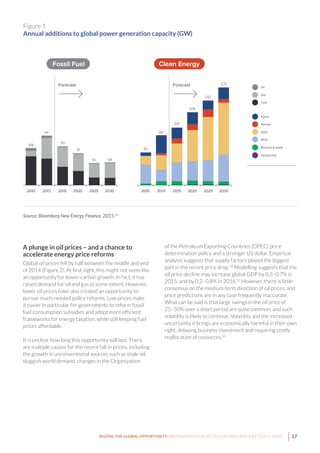
One result of these trends is that the share of new
renewables (excluding hydropower) in electricity
generation worldwide is rising – from 8.5% in 2013 to
9.1% in 2014, when renewables contributed 48% of the
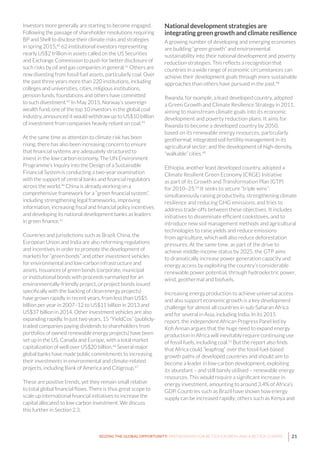
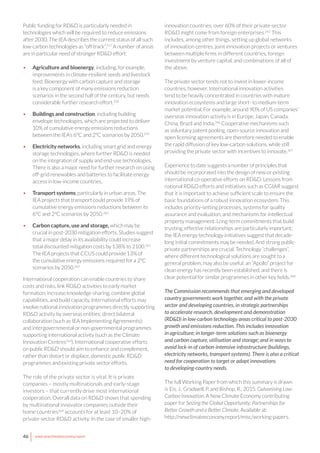
world’s newly-added generating capacity (see Figure 1).10
It is still not enough, but almost everywhere in the world
renewable investment is growing rapidly.
Yet investment in fossil fuels also continues: in 2014, more
than 1,300 GW of coal-fired capacity was in construction
or pre-construction stages around the world, and major
investments are being made in new sources of oil and
gas.11
At the current rate of increase of about 0.6–0.7
percentage points a year, the share of renewables in total
electricity generation would still only reach 20% by 2030
– considerably less than the 41% which the IEA suggests
is needed to hold global warming to under 2°C.12
The
speed of change is inhibited by several factors: continuing
challenges raising the financing needed to invest in
renewables; the difficulty of reforming energy markets
and regulatory arrangements to enable the integration
of intermittent renewables into electricity systems at
scale; and continuing fossil fuel subsidies and weak
or absent carbon prices, which keep fossil fuel energy
prices artificially low. But in turn these challenges are
spurring new efforts at overcoming them, in both national
policymaking in many countries and through various forms
of international cooperation. We discuss these below
and in Section 2.3.
17SEIZING THE GLOBAL OPPORTUNITY: PARTNERSHIPS FOR BETTER GROWTH AND A BETTER CLIMATE
A plunge in oil prices – and a chance to
accelerate energy price reforms
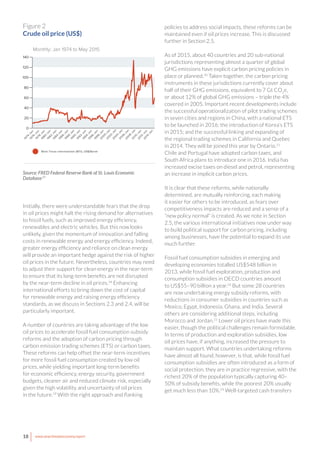
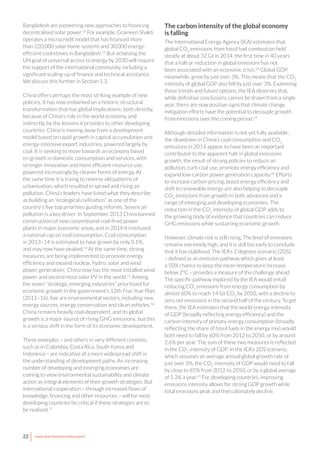
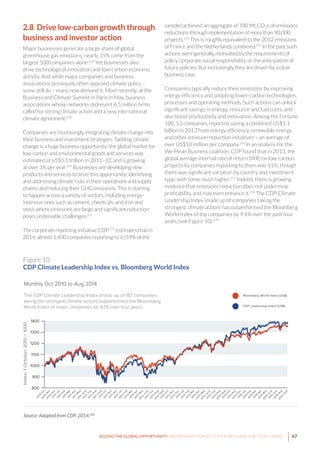
Global oil prices fell by half between the middle and end
of 2014 (Figure 2). At first sight, this might not seem like
an opportunity for lower-carbon growth. In fact, it has
raised demand for oil and gas to some extent. However,
lower oil prices have also created an opportunity to
pursue much-needed policy reforms. Low prices make
it easier in particular for governments to reform fossil
fuel consumption subsidies and adopt more efficient
frameworks for energy taxation, while still keeping fuel
prices affordable.
It is unclear how long this opportunity will last. There
are multiple causes for the recent fall in prices, including
the growth in unconventional sources such as shale oil,
sluggish world demand, changes in the Organization
of the Petroleum Exporting Countries (OPEC) price
determination policy and a stronger US dollar. Empirical
analysis suggests that supply factors played the biggest
part in the recent price drop.14
Modelling suggests that the
oil price decline may increase global GDP by 0.3–0.7% in
2015, and by 0.2–0.8% in 2016.15
However, there is little
consensus on the medium-term direction of oil prices, and
price predictions are in any case frequently inaccurate.
What can be said is that large swings in the oil price of
25–50% over a short period are quite common, and such
volatility is likely to continue. Volatility and the increased
uncertainty it brings are economically harmful in their own
right, delaying business investment and requiring costly
reallocation of resources.16
Hydro
Nuclear
Solar
Wind
Geothermal
Oil
Gas
Coal
Biomass & waste
Forecast
2010
108
141
110
91
62 64
93
143
164
208
242
279
2013 2015 2020 2025 2030
Forecast
2010 2013 2015 2020 2025 2030
Fossil Fuel Clean Energy
Annual additions to global power generation capacity (GW)
Figure 1
Annual additions to global power generation capacity (GW)
Source: Bloomberg New Energy Finance, 2015.13
18 www.newclimateeconomy.report
Initially, there were understandable fears that the drop
in oil prices might halt the rising demand for alternatives
to fossil fuels, such as improved energy efficiency,
renewables and electric vehicles. But this now looks
unlikely, given the momentum of innovation and falling
costs in renewable energy and energy efficiency. Indeed,
greater energy efficiency and reliance on clean energy
will provide an important hedge against the risk of higher
oil prices in the future. Nevertheless, countries may need
to adjust their support for clean energy in the near-term
to ensure that its long-term benefits are not disrupted
by the near-term decline in oil prices.18
Enhancing
international efforts to bring down the cost of capital
for renewable energy and raising energy efficiency
standards, as we discuss in Sections 2.3 and 2.4, will be
particularly important.
A number of countries are taking advantage of the low
oil prices to accelerate fossil fuel consumption subsidy
reforms and the adoption of carbon pricing through
carbon emission trading schemes (ETS) or carbon taxes.
These reforms can help offset the near-term incentives
for more fossil fuel consumption created by low oil
prices, while yielding important long-term benefits
for economic efficiency, energy security, government
budgets, cleaner air and reduced climate risk, especially
given the high volatility and uncertainty of oil prices
in the future.19
With the right approach and flanking
policies to address social impacts, these reforms can be
maintained even if oil prices increase. This is discussed
further in Section 2.5.
As of 2015, about 40 countries and 20 sub-national
jurisdictions representing almost a quarter of global
GHG emissions have explicit carbon pricing policies in
place or planned.20
Taken together, the carbon pricing
instruments in these jurisdictions currently cover about
half of their GHG emissions, equivalent to 7 Gt CO2
e,
or about 12% of global GHG emissions – triple the 4%
covered in 2005. Important recent developments include
the successful operationalization of pilot trading schemes
in seven cities and regions in China, with a national ETS
to be launched in 2016; the introduction of Korea’s ETS
in 2015; and the successful linking and expanding of
the regional trading schemes in California and Quebec
in 2014. They will be joined this year by Ontario.21
Chile and Portugal have adopted carbon taxes, and
South Africa plans to introduce one in 2016. India has
increased excise taxes on diesel and petrol, representing
an increase in implicit carbon prices.
It is clear that these reforms, while nationally
determined, are mutually reinforcing, each making
it easier for others to be introduced, as fears over
competitiveness impacts are reduced and a sense of a
“new policy normal” is created. As we note in Section
2.5, the various international initiatives now under way
to build political support for carbon pricing, including
among businesses, have the potential to expand its use
much further.
Fossil fuel consumption subsidies in emerging and
developing economies totalled US$548 billion in
2013, while fossil fuel exploration, production and
consumption subsidies in OECD countries amount
to US$55–90 billion a year.22
But some 28 countries
are now undertaking energy subsidy reforms, with
reductions in consumer subsidies in countries such as
Mexico, Egypt, Indonesia, Ghana, and India. Several
others are considering additional steps, including
Morocco and Jordan.23
Lower oil prices have made this
easier, though the political challenges remain formidable.
In terms of production and exploration subsidies, low
oil prices have, if anything, increased the pressure to
maintain support. What countries undertaking reforms
have almost all found, however, is that, while fossil fuel
consumption subsidies are often introduced as a form of
social protection, they are in practice regressive, with the
richest 20% of the population typically capturing 40–
50% of subsidy benefits, while the poorest 20% usually
get much less than 10%.24
Well-targeted cash transfers
West Texas Intermediate (WTI), US$/Barrel
20
40
60
80
100
120
140
0
1974-Jan
1976-Jan
1978-Jan
1980-Jan
1982-Jan
1984-Jan
1986-Jan
1988-Jan
1990-Jan
1992-Jan
1994-Jan
1996-Jan
1998-Jan
2000-Jan
2002-Jan
2004-Jan
2006-Jan
2008-Jan
2010-Jan
2012-Jan
2014-Jan
Monthly: Jan 1974 to May 2015
Figure 2
Crude oil price (US$)
Source: FRED Federal Reserve Bank of St. Louis Economic
Database17
19SEIZING THE GLOBAL OPPORTUNITY: PARTNERSHIPS FOR BETTER GROWTH AND A BETTER CLIMATE
provide more effective and efficient social protection
for the poor, and many countries are now benefiting
from the learning of others as policy practice spreads
internationally (see Section 2.5).
A growing interest in new infrastructure
investment and finance
Infrastructure investment has risen to prominence
on the international economic agenda in recent years.
At its Brisbane Summit in 2014 the G20 established
a new Global Infrastructure Initiative, along with
an implementing “Infrastructure Hub”, with the aim
of catalysing both public and private investment.25
Around the same time, the World Bank launched a
Global Infrastructure Facility with other multilateral
development banks and private sector investors to
help deliver major infrastructure projects in low- and
middle-income countries.26
New multilateral and national
development banks are being established with a specific
infrastructure focus, notably the Asian Infrastructure
Investment Bank27
and the New Development Bank.28
There is increasing interest in catalysing private
financing of new infrastructure, particularly among
institutional investors such as pension funds and
insurance companies.29
This is also a growing focus
of the international discussions around Financing for
Development, as we discuss below.30
Better Growth, Better Climate estimates that the world
will need some US$90 trillion of infrastructure
investment in 2015–30 (an average of US$6 trillion
a year), concentrated in cities, energy and land
use systems. But it points out that the choice of
infrastructure is critical. Many forms of infrastructure,
including roads, public transport systems, power plants,
water management systems and urban buildings make
significant contributions to GHG emissions, and they
are also particularly vulnerable to the rising incidence
of extreme weather events. If long-lived investments
are made without attention to wider impacts, such as
on energy security, air pollution, GHG emissions and
resilience to climate damage, the world will become
locked into a carbon-intensive development path with
severe risks to both growth and climate. Building low-
carbon infrastructure would require not much more
capital, perhaps an additional US$4 trillion of investment
(around 5% more), and this could well be largely or
completely offset by longer term operational savings
on fossil fuel costs.
Extremely low long-term real interest rates in many
advanced economies provide an extraordinarily
favourable financing environment for infrastructure
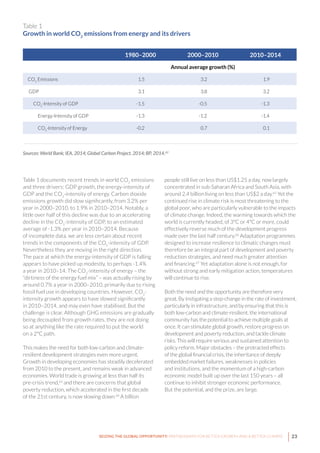
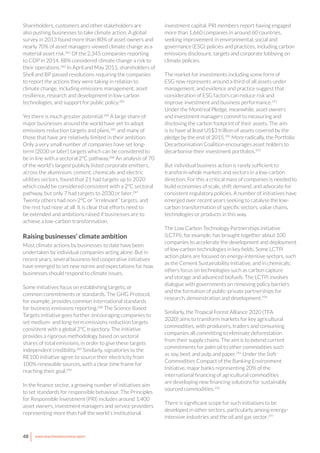
investment. In March 2015 the real interest rate on
10-year US government borrowings was less than 0.3%
(as reflected in yields on inflation protected securities).
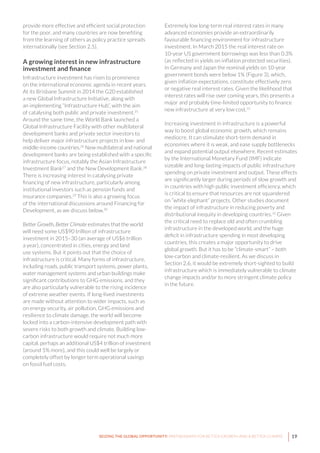
In Germany and Japan the nominal yields on 10-year
government bonds were below 1% (Figure 3), which,
given inflation expectations, constitute effectively zero
or negative real interest rates. Given the likelihood that
interest rates will rise over coming years, this presents a
major and probably time-limited opportunity to finance
new infrastructure at very low cost.31
Increasing investment in infrastructure is a powerful
way to boost global economic growth, which remains
mediocre. It can stimulate short-term demand in
economies where it is weak, and ease supply bottlenecks
and expand potential output elsewhere. Recent estimates
by the International Monetary Fund (IMF) indicate
sizeable and long-lasting impacts of public infrastructure
spending on private investment and output. These effects
are significantly larger during periods of slow growth and
in countries with high public investment efficiency, which
is critical to ensure that resources are not squandered
on “white elephant” projects. Other studies document
the impact of infrastructure in reducing poverty and
distributional inequity in developing countries.32
Given
the critical need to replace old and often crumbling
infrastructure in the developed world, and the huge
deficit in infrastructure spending in most developing
countries, this creates a major opportunity to drive
global growth. But it has to be “climate-smart” – both
low-carbon and climate-resilient. As we discuss in
Section 2.6, it would be extremely short-sighted to build
infrastructure which is immediately vulnerable to climate
change impacts and/or to more stringent climate policy
in the future.
20 www.newclimateeconomy.report
The low real interest rates that advanced economies
are enjoying are not being seen in most developing
countries, which continue to face significantly higher
market borrowing costs or are excluded from international
capital markets altogether. Thus a major priority is to
strengthen international collaboration on expanding the
flow of climate-smart infrastructure finance to developing
countries, as well as to tackle specific institutional and
policy problems and uncertainties that inhibit private
infrastructure investment.34
These efforts should include
technical and other assistance to help low-income
countries strengthen their public investment management
frameworks and capacities.35
Heightened attention to climate risks – and
opportunities – in the financial sector
There is growing interest in climate risk within the
financial sector. This is perhaps unsurprising in the
global insurance industry, where climate risk is now
widely integrated into both underwriting products and
investment strategies. To increase risk transparency, the
industry has embarked on a “1 in 100” initiative to develop
climate risk metrics for one-in-100-year catastrophic
events to be applied across private and public sector
actors.36
In the US, insurance regulators in several major
states are implementing an annual Insurer Climate
Risk Disclosure Survey.37
But action is now spreading.
Central banks, financial sector regulators, capital market
authorities and finance ministries are also now beginning
to include consideration of climate risks in the rules
governing financial systems. The aim is to send clearer
signals to financial markets, better aligning incentives for
private investors with the true social cost of investment
in fossil fuels and the benefits of clean investments.
The Bank of England, for example, is studying the impact
of climate risks on the UK financial system, including
both physical risks (such as catastrophic weather events)
and transitional risks (related to the speed of transition
to a low-carbon economy), while the Bank’s Prudential
Regulation Authority is reviewing the implications
of climate change for the safety and soundness of
insurance companies. Brazil’s Central Bank has issued
requirements for all banks to introduce systems for
assessment of climate and other socio-environmental
risks. A small but growing number of countries now have
legal requirements for institutional investors to report
on how their investment policies and performance are
affected by environmental factors, including South Africa
and, prospectively, the EU.38
Concern about the risks of a
“carbon bubble” – that highly valued fossil fuel assets and
investments could be devalued or “stranded” under future,
more stringent climate policies – prompted G20 Finance
Ministers and Central Bank Governors in April 2015 to
ask the Financial Stability Board in Basel to convene an
inquiry into how the financial sector can take account of
climate-related issues.39
8.0
6.0
4.0
2.0
10.0
0
1990-Jan
1991-Jan
1992-Jan
1993-Jan
1994-Jan
1995-Jan
1996-Jan
1997-Jan
1998-Jan
1999-Jan
2000
-Jan
2001-Jan
2002-Jan
2003-Jan
2004-Jan
2005-Jan
2006-Jan
2007-Jan
2008-Jan
2009-Jan
2011-Jan
2010
-Jan
2013-Jan
2014-Jan
2015-Jan
2012-Jan
Monthly: Jan 1974 to May 2015
Japan
Germany
USA
Figure 3
10 year government bond yields (%)
Source: Federal Reserve Bank of St. Louis Economic Database33
21SEIZING THE GLOBAL OPPORTUNITY: PARTNERSHIPS FOR BETTER GROWTH AND A BETTER CLIMATE
Investors more generally are starting to become engaged.
Following the passage of shareholder resolutions requiring
BP and Shell to disclose their climate risks and strategies
in spring 2015,40
62 institutional investors representing
nearly US$2 trillion in assets called on the US Securities
and Exchange Commission to push for better disclosure of
such risks by oil and gas companies in general.41
Others are
now divesting from fossil fuel assets, particularly coal. Over
the past three years more than 220 institutions, including
colleges and universities, cities, religious institutions,
pension funds, foundations and others have committed
to such divestment.42
In May 2015, Norway’s sovereign
wealth fund, one of the top 10 investors in the global coal
industry, announced it would withdraw up to US$10 billion
of investment from companies heavily reliant on coal.43
At the same time as attention to climate risk has been
rising, there has also been increasing concern to ensure
that financial systems are adequately structured to
invest in the low-carbon economy. The UN Environment
Programme’s Inquiry into the Design of a Sustainable
Financial System is conducting a two-year examination
with the support of central banks and financial regulators
across the world.44
China is already working on a
comprehensive framework for a “green financial system”,
including strengthening legal frameworks, improving
information, increasing fiscal and financial policy incentives
and developing its national development banks as leaders
in green finance.45
Countries and jurisdictions such as Brazil, China, the
European Union and India are also reforming regulations
and incentives in order to promote the development of
markets for “green bonds” and other investment vehicles
for environmental and low-carbon infrastructure and
assets. Issuances of green bonds (corporate, municipal
or institutional bonds with proceeds earmarked for an
environmentally-friendly project, or project bonds issued
specifically with the backing of clean energy projects)
have grown rapidly in recent years, from less than US$5
billion per year in 2007–12 to US$11 billion in 2013 and
US$37 billion in 2014. Other investment vehicles are also
expanding rapidly. In just two years, 15 “YieldCos” (publicly-
traded companies paying dividends to shareholders from
portfolios of owned renewable energy projects) have been
set up in the US, Canada and Europe, with a total market
capitalization of well over US$20 billion.46
Several major
global banks have made public commitments to increasing
their investments in environmental and climate-related
projects, including Bank of America and Citigroup.47
These are positive trends, yet they remain small relative
to total global financial flows. There is thus great scope to
scale up international financial initiatives to increase the
capital allocated to low-carbon investment. We discuss
this further in Section 2.3.
National development strategies are
integrating green growth and climate resilience
A growing number of developing and emerging economies
are building “green growth” and environmental
sustainability into their national development and poverty
reduction strategies. This reflects a recognition that
countries in a wide range of economic circumstances can
achieve their development goals through more sustainable
approaches than others have pursued in the past.48
Rwanda, for example, a least developed country, adopted
a Green Growth and Climate Resilience Strategy in 2011,
aiming to mainstream climate goals into its economic
development and poverty reduction plans. It aims for
Rwanda to become a developed country by 2050,
based on its renewable energy resources, particularly
geothermal; integrated soil fertility management in its
agricultural sector; and the development of high-density,
“walkable” cities.49
Ethiopia, another least developed country, adopted a
Climate Resilient Green Economy (CRGE) Initiative
as part of its Growth and Transformation Plan (GTP)
for 2010–25.50
It seeks to secure “triple wins”:
simultaneously raising productivity, strengthening climate
resilience and reducing GHG emissions, and tries to
address trade-offs between these objectives. It includes
initiatives to disseminate efficient cookstoves, and to
introduce new soil management methods and agricultural
technologies to raise yields and reduce emissions
from agriculture, which will also reduce deforestation
pressures. At the same time, as part of the drive to
achieve middle-income status by 2025, the GTP aims
to dramatically increase power generation capacity and
energy access by exploiting the country’s considerable
renewable power potential, through hydroelectric power,
wind, geothermal and biofuels.
Increasing energy production to achieve universal access
and also support economic growth is a key development
challenge for almost all countries in sub-Saharan Africa
and for several in Asia, including India. In its 2015
report, the independent African Progress Panel led by
Kofi Annan argues that the huge need to expand energy
production in Africa will inevitably require continuing use
of fossil fuels, including coal.51
But the report also finds
that Africa could “leapfrog” over the fossil fuel-based
growth paths of developed countries and should aim to
become a leader in low-carbon development, exploiting
its abundant – and still barely utilised – renewable energy
resources. This would require a significant increase in
energy investment, amounting to around 3.4% of Africa’s
GDP. Countries such as Brazil have shown how energy
supply can be increased rapidly; others such as Kenya and
22 www.newclimateeconomy.report
Bangladesh are pioneering new approaches to financing
decentralised solar power.52
For example, Grameen Shakti
operates a microcredit model that has financed more
than 220,000 solar home systems and 30,000 energy-
efficient cookstoves in Bangladesh.53
But achieving the
UN goal of universal access to energy by 2030 will require
the support of the international community, including a
significant scaling-up of finance and technical assistance.
We discuss this further in Section 1.3.
China offers perhaps the most striking example of new
policies. It has now embarked on a historic structural
transformation that has global implications: both directly,
because of China's role in the world economy, and
indirectly, by the lessons it provides to other developing
countries. China is moving away from a development
model based on rapid growth in capital accumulation and
energy-intensive export industries, powered largely by
coal. It is seeking to move towards an economy based
on growth in domestic consumption and services, with
stronger innovation and more efficient resource use,
powered increasingly by cleaner forms of energy. At
the same time it is trying to reverse old patterns of
urbanisation, which resulted in sprawl and rising air
pollution. China’s leaders have listed what they describe
as building an “ecological civilisation” as one of the
country’s five top priorities guiding reforms. Severe air
pollution is a key driver. In September 2013 China banned
construction of new conventional coal-fired power
plants in major economic areas, and in 2014 it instituted
a national cap on coal consumption. Coal consumption
in 2013–14 is estimated to have grown by only 0.1%,
and may now have peaked.54
At the same time, strong
measures are being implemented to promote energy
efficiency and expand nuclear, hydro, solar and wind
power generation; China now has the most installed wind
power and second most solar PV in the world.55
Among
the seven “strategic emerging industries” prioritised for
economic growth in the government’s 12th Five Year Plan
(2011–16), five are environmental sectors, including new
energy sources, energy conservation and clean vehicles.56
China remains heavily coal-dependent, and its global
growth is a major source of rising GHG emissions, but this
is a serious shift in the form of its economic development.
These examples – and others in very different contexts,
such as in Colombia, Costa Rica, South Korea and
Indonesia – are indicative of a more widespread shift in
the understanding of development paths. An increasing
number of developing and emerging economies are
coming to view environmental sustainability and climate
action as integral elements of their growth strategies. But
international cooperation – through increased flows of
knowledge, financing and other resources – will for most
developing countries be critical if these strategies are to
be realised.57
The carbon intensity of the global economy
is falling
The International Energy Agency (IEA) estimates that
global CO2
emissions from fossil fuel combustion held
steady at about 32 Gt in 2014, the first time in 40 years
that a halt or reduction in global emissions has not
been associated with an economic crisis.58
Global GDP,
meanwhile, grew by just over 3%. This means that the CO2
intensity of global GDP also fell by just over 3%. Examining
these trends and future options, the IEA observes that,
while definitive conclusions cannot be drawn from a single
year, there are now positive signs that climate change
mitigation efforts have the potential to decouple growth
from emissions over the coming period.59
Although detailed information is not yet fully available,
the slowdown in China’s coal consumption and CO2
emissions in 2014 appear to have been an important
contributor to the apparent halt in global emissions
growth, the result of strong policies to reduce air
pollution, curb coal use, promote energy efficiency and
expand low-carbon power generation capacity.60
Efforts
to increase carbon pricing, boost energy efficiency and
shift to renewable energy are also helping to decouple
CO2
emissions from growth in both advanced and a
range of emerging and developing economies. The
reduction in the CO2
intensity of global GDP adds to
the growing body of evidence that countries can reduce
GHG emissions while sustaining economic growth.
However, climate risk is still rising. The level of emissions
remains extremely high, and it is still too early to conclude
that it has stabilised. The IEA’s 2 degrees scenario (2DS)
– defined as an emission pathway which gives at least
a 50% chance to keep the mean temperature increase
below 2°C – provides a measure of the challenge ahead.
The specific pathway explored by the IEA would entail
reducing CO2
emissions from energy consumption by
almost 60% to reach 14 Gt CO2
by 2050, with a decline to
zero net emissions in the second half of the century. To get
there, the IEA estimates that the world energy-intensity
of GDP (broadly reflecting energy efficiency) and the
carbon-intensity of primary energy consumption (broadly
reflecting the share of fossil fuels in the energy mix) would
both need to fall by 60% from 2012 to 2050, or by around
2.6% per year. The sum of these two measures is reflected
in the CO2
-intensity of GDP. In the IEA’s 2DS scenario,
which assumes an average annual global growth rate of
just over 3%, the CO2
-intensity of GDP would need to fall
by close to 85% from 2012 to 2050, or by a global average
of 5.3% a year.61
For developing countries, improving
emissions intensity allows for strong GDP growth while
total emissions peak and then ultimately decline.
23SEIZING THE GLOBAL OPPORTUNITY: PARTNERSHIPS FOR BETTER GROWTH AND A BETTER CLIMATE
Table 1 documents recent trends in world CO2
emissions
and three drivers: GDP growth, the energy-intensity of
GDP and the CO2
-intensity of energy. Carbon dioxide
emissions growth did slow significantly, from 3.2% per
year in 2000–2010, to 1.9% in 2010–2014. Notably, a
little over half of this decline was due to an accelerating
decline in the CO2
-intensity of GDP, to an estimated
average of -1.3% per year in 2010–2014. Because
of incomplete data, we are less certain about recent
trends in the components of the CO2
-intensity of GDP.
Nevertheless they are moving in the right direction.
The pace at which the energy-intensity of GDP is falling
appears to have picked up modestly, to perhaps -1.4%
a year in 2010–14. The CO2
-intensity of energy – the
“dirtiness of the energy fuel mix” – was actually rising by
around 0.7% a year in 2000–2010, primarily due to rising
fossil fuel use in developing countries. However, CO2
-
intensity growth appears to have slowed significantly
in 2010–2014, and may even have stabilised. But the
challenge is clear. Although GHG emissions are gradually
being decoupled from growth rates, they are not doing
so at anything like the rate required to put the world
on a 2°C path.
This makes the need for both low-carbon and climate-
resilient development strategies even more urgent.
Growth in developing economies has steadily decelerated
from 2010 to the present, and remains weak in advanced
economies. World trade is growing at less than half its
pre-crisis trend,63
and there are concerns that global
poverty reduction, which accelerated in the first decade
of the 21st century, is now slowing down.64
A billion
people still live on less than US$1.25 a day, now largely
concentrated in sub-Saharan Africa and South Asia, with
around 2.4 billion living on less than US$2 a day.65
Yet the
continued rise in climate risk is most threatening to the
global poor, who are particularly vulnerable to the impacts
of climate change. Indeed, the warming towards which the
world is currently headed, of 3°C or 4°C or more, could
effectively reverse much of the development progress
made over the last half century.66
Adaptation programmes
designed to increase resilience to climatic changes must
therefore be an integral part of development and poverty
reduction strategies, and need much greater attention
and financing.67
Yet adaptation alone is not enough, for
without strong and early mitigation action, temperatures
will continue to rise.
Both the need and the opportunity are therefore very
great. By instigating a step-change in the rate of investment,
particularly in infrastructure, and by ensuring that this is
both low-carbon and climate-resilient, the international
community has the potential to achieve multiple goals at
once. It can stimulate global growth, restore progress on
development and poverty reduction, and tackle climate
risks. This will require serious and sustained attention to
policy reform. Major obstacles – the protracted effects
of the global financial crisis, the inheritance of deeply
embedded market failures, weaknesses in policies
and institutions, and the momentum of a high-carbon
economic model built up over the last 150 years – all
continue to inhibit stronger economic performance.
But the potential, and the prize, are large.
Table 1
Growth in world CO2
emissions from energy and its drivers
1980–2000 2000–2010 2010–2014
Annual average growth (%)
CO2
Emissions 1.5 3.2 1.9
GDP 3.1 3.8 3.2
CO2
-Intensity of GDP -1.5 -0.5 -1.3
Energy-Intensity of GDP -1.3 -1.2 -1.4
CO2
-Intensity of Energy -0.2 0.7 0.1
Sources: World Bank; IEA, 2014; Global Carbon Project, 2014; BP, 2014.62
24 www.newclimateeconomy.report
1.2 The potential of international
cooperation
These six recent trends and developments are all
encouraging, but it is clear that none is yet occurring
at a scale or pace sufficient to create a decisive shift in
the direction of the global economy. As argued in Better
Growth, Better Climate, national governments need to focus
attention on the policies and institutions which can drive
the necessary reforms: increasing resource efficiency,
raising infrastructure investment and stimulating
innovation, particularly in the three economic systems
of cities, land use and energy. Box 2 summarises lessons
learnt from different countries about best practices in
policy-making for low-carbon growth.
National policy is critical. But the impact of national action
can be greatly amplified when markets become global.
The story of solar power provides an illustration. The
dramatic reduction in the cost of solar PV over the last
decade arose not just from advances in technology, but
from governments’ policy choices. The introduction of a
solar feed-in tariff in Germany in 1991 led to a rapid rise in
demand over the following two decades, while investment
in solar manufacturing in China enabled costs to fall and
supply to be expanded. The result has been the creation
of a global market, expected to be worth around US$75
billion in 2016 (up from just US$40 billion just five years
before),68
with solar power in various uses now affordable
throughout the world.
These and other examples – such as the comparable
reduction in the costs of LED (light emitting diode) lighting
over the last decade, and the rapid spread of mobile
phones in Africa, which are making landlines increasingly
obsolete – show how the creation of global markets
and new business models can help transform individual
technologies and national policies into dramatic agents of
change, reducing costs, driving innovation and catalysing
widespread dissemination.
Many of these processes have occurred without a
deliberate process to drive them. But in many other cases,
cooperation among governments and multiple other
stakeholders – businesses, international organisations and
civil society – has played a crucial role in scaling up and
accelerating transformative change.
Both the World Bank and the OECD have recently
published studies bringing together learning and
experience of successful policy-making for low-carbon
growth.69
The World Bank identifies three core principles.
First, policy-makers need to plan with an eye on the long
term. There are different ways to achieve short-term
emissions reductions. But if the end goal is decarbonisation,
it is vital that decisions now do not lock in high emissions
in the future. Understanding the multiple economic, social
and environmental benefits of low-carbon action, as
Better Growth, Better Climate argues, can help long-term
decision-making.
Second, carbon pricing is important, but has to be part of
a wider policy package that triggers far-reaching changes
in investment patterns, technologies and behaviours.
The OECD shows how better alignment and integration
of national policies and regulatory frameworks across
ministries and sectors offers huge potential to achieve
stronger impacts and reduce costs.70
In many countries,
misaligned policies are common, making policy goals
much harder to achieve. A case in point is the continuing
subsidisation of fossil fuel production and consumption
even in countries with climate change mitigation policies.
But there are many other areas where better alignment
Box 2
National policy-making for growth and emissions reduction
is possible, from financial prudential frameworks that
inadvertently discourage long-term investment, to the
continued decline in funding for energy RD&D as a share of
total RD&D spending. Aligning policies in specific sectors
is also important – for example, in electricity markets and
urban public transport.
Third, managing the political economy of change is critical.
As Better Growth, Better Climate argues, governments need
to ensure that the shift towards a low-carbon economy is
a “just transition”. Not all climate policies are “win-win”:
although many jobs will be created, and there will be larger
markets and profits for many businesses, some jobs will
also be lost or need to evolve, particularly in high-carbon
sectors. The human and economic costs of the transition
should be managed through local economic diversification
plans and support for displaced workers, affected
communities and low-income households. Adequate social
protection will be needed, along with active labour market
policies to assist retraining and redeployment where
necessary. Social dialogue and democratic consultation
of social partners (trade unions and employers) and
communities is important to ensure acceptance and trust.
National transition plans are a valuable first step.71
25SEIZING THE GLOBAL OPPORTUNITY: PARTNERSHIPS FOR BETTER GROWTH AND A BETTER CLIMATE
First, such cooperation can be a powerful way of
expanding markets and reducing costs. For example,
over the last two years, international trade negotiations
have moved towards reducing tariffs on low-carbon
goods and services.72
Convergence of national energy
efficiency standards for appliances and industrial
equipment can equally expand the available markets
for national producers and reduce the transaction costs
of exporting. Collective procurement of low-carbon
goods and services by a number of city authorities
and governments – in fields such as electric buses or
low-carbon construction materials – offers another
cooperative route to scaling up demand and cutting costs.
Second, for countries concerned that standards, carbon
pricing or other climate policies could affect their
international competitiveness, international cooperation
can help overcome these anxieties. If multiple countries –
particularly competitors – act together, this can help keep
the playing field level. The same is true among businesses
in globally traded sectors, which may find it difficult to take
ambitious action alone. In both business and the public
sector, leadership associations and “clubs” have helped
support pioneers to take bolder action, both spurring them
on and protecting them against internal criticism. When
there is public scrutiny, the power of example can begin
to change the norms of behaviour even where action is
voluntary. Yet public policy reinforcement is also needed;
for example, it is notable that the Tropical Forest Alliance
2020, which is working to eliminate deforestation from
commodity supply chains, is not just a business coalition,
but also involves governments in both forest and
importing countries.
A third key benefit of international and multi-stakeholder
cooperation is that it can enable extensive knowledge-
sharing and capacity-building, and help identify and
disseminate best practices. Opportunities for action on
climate change are constantly developing, leading to a
lot of “learning by doing”. Many international cooperative
initiatives are already facilitating the exchange of
information on technologies, standards, policies and
business models for climate action. They have particular
value in scaling up solutions, and in transferring knowledge
across countries and sectors. While historically, this has
mostly involved North-South cooperation, there has been
a rapid rise in South-South cooperation in recent years.
Fourth, and crucially, international cooperation is essential
for expanding finance flows, particularly to the poorest
countries and to sectors and activities that may not, on
their own, attract sufficient private investment. This is
one of the most important forms of intergovernmental
cooperation, and another area where South-South
cooperation is growing.73
The multilateral development
banks, UN agencies and other international organisations
and partnerships are particularly important institutional
vehicles for financial flows and capacity-building, with
their strong capabilities in technical assistance. Achieving
new agreements for future flows of both public and
private finance to support sustainable development is
a vital priority for both the Financing for Development
and COP21 processes in 2015 (see Box 3). As we discuss
in Section 2.7, financial cooperation is also important in
the field of research, development and demonstration
(RD&D), allowing countries and businesses to share the
costs of accelerating and disseminating new technologies.
A new international climate agreement
The foundation of international cooperation on climate
change is the UN Framework Convention on Climate
Change (UNFCCC). Despite slow progress in recent
years, negotiations are now well on the way to achieving
a comprehensive new climate agreement at the Paris
Climate Change Conference (COP21) in December. If
countries can reach an agreement involving universal
participation, it will be historic, as it will mark the first
time that all countries make climate action commitments
under the UNFCCC.
Such an agreement is important to create an equitable,
rules-based system for the global governance of climate
change. But as Better Growth, Better Climate argues,
a strong agreement will also provide a clear signal to
businesses and investors that the global economy is
moving towards a low-carbon pathway. This will help
shape economic expectations, spurring investment and
innovation in low-carbon and climate-resilient economic
activity. It will therefore in itself act to scale up global
markets and reduce costs, while at the same time making
the risks attached to high-carbon investment more
transparent.
26 www.newclimateeconomy.report
The major international meetings being held this
year – the International Conference on Financing for
Development in July, the United Nations Summit to
adopt the post-2015 Sustainable Development Goals
(SDGs) in September, the G20 Summit in November,
and the UN Climate Change Conference (COP21) in
December – provide critical opportunities to scale up
investment to deliver both development and climate
objectives.
In all these arenas it is crucial to take an integrated
approach to building finance frameworks, so they
can deliver both development and climate objectives
together. While there are important differences of
emphasis between the two agendas, the draft SDGs
under discussion recognise significant synergies, and
these need to be fully realised. Key areas in which the
financing framework must be properly integrated include
delivery of low-carbon infrastructure; promoting energy
efficiency; building climate resilience and adaptation;
halting deforestation and reversing land degradation;
and fostering innovation.
Scaling up finance that supports both development
and climate objectives will entail expanding domestic
resource mobilisation, both public and private: this
is an important need in many developing countries.
But it also requires much larger international flows, in
particular to developing countries, from both public and
private sources. The role of multilateral and regional
development banks in infrastructure, climate and
other development financing needs to be significantly
expanded, along with their support for efforts to
establish and strengthen domestic policy frameworks.
This should include increasing their capital base, allowing
greater flexibility in the management of their balance
sheets and streamlining decision procedures, alongside
wider efforts to mainstream both climate change into
investment strategies and development objectives into
climate financing. (This is discussed further in Sections
2.3 and 2.6.)
While clean energy funds and other development
financing vehicles have expanded greatly in recent years,
more can be done. Institutional and policy problems that
inhibit private investment in infrastructure and low-
carbon projects urgently need to be tackled. Developing
Box 3
Better finance for growth and climate
bankable projects that have the right risk-return profile
to attract private-sector finance remains a challenge.
Some of the solutions include more stable policies to
reduce investor uncertainty, as well as development of
risk-sharing instruments, blended finance approaches
and reform of financial sector regulations to increase the
demand for clean infrastructure assets in institutional
investor portfolios.74
(This is discussed further in Section
2.3.) This will require strengthening institutions and
policies for both public revenue and expenditure, as well
as promoting development of local capital markets and
financial systems. The outcomes of the Addis Conference
on Financing for Development, where countries will
agree how to finance delivery of the SDGs, should launch
efforts to deliver on this agenda.
It is within this broader context that countries meeting
at the UN Climate Conference in Paris need to agree on
a new climate finance package. In Copenhagen in 2009,
and confirmed in Cancún in 2010, developed countries
agreed to mobilise US$100 billion per year by 2020 for
developing-country climate action, from both public and
private sources.75
The Green Climate Fund, an important
vehicle for delivering this finance, was operationalised
last year after achieving US$10 billion in (multi-year)
pledges. But a clearly agreed path on how finance will be
increased to US$100 billion per year from these levels
is still needed.76
Public finance flows remain critical,
particularly for adaptation and strengthening resilience.
These funds, in turn, must leverage far greater sums in
private investment, both domestic and international.
Continued efforts are needed to improve definitions of
climate-relevant investment, to measure, report and
verify financial flows and identify mobilised finance, and
to understand and improve the effectiveness of such
investment on adaptation and mitigation on the ground.
A new UNFCCC agreement, as well as collaborative
action agreed in other forums, will be essential to trigger
wider action to deliver more sustainable infrastructure
investment in all countries. For example, it could
reinforce commitments to reduce and rationalise fossil
fuel subsidies, and strengthen the assessment of climate
risks and opportunities in fiscal and financial systems.77
27SEIZING THE GLOBAL OPPORTUNITY: PARTNERSHIPS FOR BETTER GROWTH AND A BETTER CLIMATE
Better Growth, Better Climate identifies key features of an
agreement which would enhance this signalling effect
(see Box 4).
Over the last 18 months, most countries have been
preparing INDCs that set out their national targets, plans
and policies beyond 2020 to be included in the Paris
agreement; several have already been published.78
In most
countries the preparation process for these documents
has required a serious – and in some cases unprecedented
– analysis of how greenhouse gases are related to growth
trends, and how these can be decoupled, absolutely or
relatively. In many this represents an important step
forward for the integration of climate considerations into
mainstream economic planning.
Some INDCs represent historically ambitious
commitments that will require considerable domestic
effort to implement.79
Nevertheless, initial assessments
suggest that it is very unlikely that the mitigation actions
pledged will add up to a global emissions reduction
consistent with a 2°C pathway. Early estimates suggest
that global emissions in 2030, if the current and expected
INDCs are implemented, will be around 55–61.5 Gt
CO2
e (up from 49 Gt CO2
e in 2010).80
This would still be
well above the median level of emissions (estimated to
be around 42 Gt CO2
e) needed to have a more than 50%
chance of putting the world on a 2°C path. Given the huge
costs which would be involved in reducing emissions far
more rapidly after 2030 – likely to involve the writing off of
many assets – it may in effect risk putting 2°C out of reach.81
Thus it is essential that the INDCs submitted in 2015 are
not only as ambitious as possible, but are also seen as the
starting point, rather than the limit, of countries’ climate
ambition over the coming years.82
This would follow the
logic of policy-making: it is evident that policies which
affect emissions a decade or 15 years into the future will
not cease being made in 2015. Indeed, given the trends
discussed in Section 1.1, there are strong reasons to
believe that low-carbon options will become increasingly
affordable and accessible. As they do so, policy-makers
should be encouraged to increase the ambition of their
climate targets and policies.
It is not the Commission’s role to recommend the specific
design of a new international legal agreement. But building
on the conclusions of Better Growth, Better Climate, there
are some core features which would enhance the ability of
an agreement to send a clear signal to businesses, investors
and governments on the future low-carbon and climate-
resilient character of the global economy. These include:83
•	 A long-term goal that annual global emissions should
fall to near zero or below in the second half of the
century as indicated by the Intergovernmental Panel
on Climate Change.
•	 A predictable and synchronised five-yearly cycle of
commitments under which countries would gradually
strengthen their emissions reduction plans over
time. Countries’ “intended nationally determined
contributions” (INDCs) published in 2015 should
be seen as foundations for their climate ambitions
to 2025 or 2030, not limits to them, able to be
strengthened (but not weakened) subsequently.
•	 Encouragement to all major economies to publish long-
term economic development and growth strategies
outlining how they plan to move in a low-carbon
and climate-resilient direction. Though different for
countries at different stages of development, the
domestic political and policy-making processes needed
to draw them up would greatly help businesses,
Box 4
A new international climate agreement
investors and the wider public understand and debate
the possibilities, benefits and costs of the low-carbon
transition.
•	 Strengthened incentives and capacities for countries
to address climate risks and reduce vulnerability
through national adaptation plans. These would ideally
incorporate action by sub-national governments and
city and local government authorities, and set out the
requirements on businesses and others to understand
and take action to address climate risks.
•	 Common rules for measuring, reporting and verifying
national policies and their outcomes. Such rules
will ensure the credibility and transparency of
commitments, and can also play a valuable role in
monitoring and managing domestic policy.
•	 A framework for increased financial flows into
low-carbon and climate-resilient investment and
development. This should include the obligations of
the richest countries to provide support to developing
ones, and mechanisms designed to facilitate increased
flows of private-sector finance.
An international agreement will contain many other
provisions; this is not intended to be a comprehensive
description. But an agreement which included these
elements would provide a major boost to international
economic confidence.
28 www.newclimateeconomy.report
Some have already done this. The EU’s INDC frames
its 2030 target as a cut of “at least” 40% on 1990
levels, leaving room for deeper cuts in the context
of a successful international agreement. Mexico has
explicitly set two targets, one an “unconditional” GHG
emission reduction of 25% below business as usual by
2030, the other a “conditional”’ reduction of 40%, which
could be achieved subject to progress on a variety of
issues such as an international carbon price, technical
cooperation and access to low-cost financial resources
and technology transfer.84
It would be helpful if this
approach could be reflected in the general understanding
that INDCs published in 2015 are “floors, not ceilings”
– lower bounds to ambition which can be strengthened
when circumstances change, either before or after the
Paris conference.
Cooperation on climate outside of the
UNFCCC
International cooperation on climate-related issues
has also blossomed outside the UNFCCC – one of the
most significant developments in recent years. This
includes increased attention to climate action in other
multilateral processes, such as the development of the
SDGs (which include a proposed goal on climate change
as well as others related to it), discussions on Financing
for Development, and under the G7 and G20. But it also
goes well beyond these intergovernmental processes.
Multi-stakeholder initiatives have been launched on
renewable energy, energy efficiency, transport, cities,
agriculture, forests, short-lived climate pollutants,
finance and adaptation, among others.85
Many of these
were showcased at the UN Climate Summit in New York
in September 2014, an unprecedented gathering of
government, business and civil society leaders.86
At the Lima Climate Change Conference in December
2014, the Governments of Peru and France, in association
with the UN Secretary General and UNFCCC Secretariat,
launched the “Lima-Paris Action Agenda”, aiming to
provide a platform for multi-stakeholder climate solutions
at the Paris conference.87
The UNFCCC Secretariat has
established a portal where actions by non-state actors
and international cooperative initiatives are registered
and recognised, backed by an independently compiled
database.88
Serious efforts are now being made to produce
methodologies by which these actions can be properly
measured and assessed.89
Many of these initiatives are relatively new and still
in development, however, and participation remains
relatively narrow. A major expansion of cooperation is
both possible and vital, if the full range of opportunities for
growth-enhancing climate action are to be realised. This
report in particular highlights 10 areas of international and
multi-stakeholder cooperation with significant potential.
In some, there are already initiatives with considerable
momentum, but which need wider participation to have
significant impact. Others represent opportunities that
have yet to be seized. The initiatives fall into four broad
categories:
•	 Common commitments or intentions by
governments for national action, in some cases
supported by programmes of technical assistance,
regular monitoring of progress, and peer review.
In the case of infrastructure investment and
energy efficiency standards, we propose enhanced
cooperation among the countries of the G20, in
association with others; in the fields of carbon pricing,
fossil fuel subsidy reform, and support for low-carbon
innovation, we argue for informal associations of
“coalitions of the willing” and bilateral and plurilateral
partnerships between interested countries.
•	 Common commitments by non-state actors,
supported by standardised methodologies, the
development of rules and norms, and mutual
exchange of best practice. This model applies to
our recommendations for actions by major cities
and leading businesses.
•	 Multi-stakeholder financing partnerships. In a
number of fields, governments can work with the
private sector, international organisations and civil
society to unlock flows of finance. This applies to our
proposals to support degraded land restoration and
forest conservation and to scale up investment in clean
energy and energy access and for urban development.
•	 Multilateral market regulation under a multilateral
treaty. This applies to our recommendations on
reducing emissions in the aviation and maritime sectors
and on phasing down hydrofluorocarbons (HFCs).
The areas identified in this report do not exhaust the
full range of available opportunities for partnership or
cooperation. But in each of them cooperative action could
generate significant economic benefits and emission
reductions – and there is potential for key commitments
to be made this year or next. The first criterion is critical:
in each case, there are powerful reasons for governments,
cities, businesses and others to work together to
implement the proposals, even without consideration of
their climate impact. They will have economic benefits
– both in terms of growth, employment and poverty
reduction, and more broadly through improved air quality
and public health, reduced congestion, improved quality
of life, and more. In short, they can help generate “better
growth” as defined in Better Growth, Better Climate.
The analysis here has also estimated their climate
benefits, where possible. The methodology and numbers
are explained in a separate Technical Note.90
It is of course
29SEIZING THE GLOBAL OPPORTUNITY: PARTNERSHIPS FOR BETTER GROWTH AND A BETTER CLIMATE
not the international cooperation itself which has the
mitigation potential; it is the policies and investments
themselves. But cooperative partnerships can help catalyse
and support that action. Some of the actions overlap with
one another in terms of their impacts on emissions; these
have been subtracted to arrive at the total potential.
Overall, if the recommended actions were implemented,
the analysis suggests that global GHG emissions in 2030
would be 16–26 Gt CO2
e lower than under a “business as
usual” scenario, i.e. if current trends were to continue with
no new policies introduced. This represents between 59%
and 96% of the reductions likely to be needed by 2030 to
put the world on a pathway consistent with holding global
warming to 2°C (see Figure 4).91
This shows that the emissions reductions envisaged in
INDCs are only a fraction of the economically beneficial
options for climate mitigation possible over the next 15
years. This is not surprising, as INDCs generally reflect
what countries believe they can achieve on their own,
“nationally determined”. Enhanced action by a variety of
other stakeholders and through international cooperation
can enable them to do more.
This does not mean that the emissions reduction potential
from these cooperative initiatives would all be “additional”
to the commitments in the INDCs (except in international
aviation and shipping, where emissions are not included
in national inventories). Rather, insofar as countries are
not yet planning to pursue the actions recommended
here, the analysis indicates the potential to raise national
commitments in the future. Multi-stakeholder action and
international cooperation can thus help governments
achieve considerably more mitigation than they now see
as feasible.
In this sense the Paris climate conference, building on the
Financing for Development and Sustainable Development
Goal conferences earlier in the year, creates a much
broader opportunity to promote action for growth and
climate. Nationally determined commitments will be
the bedrock of the new international agreement. But as
this report shows, national action can be supplemented,
in Paris and beyond, by many forms of international
and multi-stakeholder cooperation. In all the fields
outlined in this report, governments, states and regions,
cities, businesses, and international and civil society
organisations have the opportunity to bring forward new
commitments to driving low-carbon and climate-resilient
growth. These have the potential to enable countries to
reduce emissions much further than they can on their
own. They can bring the world as a whole much closer
to the 2°C pathway. And they can bring all countries the
benefits of stronger economic performance, development
and poverty reduction.
0 20 60 7040 503010 80
IPCC median baseline (“business as usual”)
Cities
Degraded land and forests
Clean energy financing
Carbon pricing
Business
Aviation and maritime
HFCs
Overlap
Total mitigation impact (mean and full range)
IPCC median emissions needed for 2C pathway
UNEP gross emissions gap
Gt CO2
e per year in 2030
69
3.7
5.7 (4.5 to 6.9)
4.2 (2.8 to 5.6)
1.9
0.8 (0.6 to 0.9)
1.4 (1.1 to 1.7)
-9.4 (-7.7 to -11.0)
27
42
21 (16 to 26)
Full implementation of the Commission's recommendations could achieve up to 96% of the emissions reductions in 2030
needed to keep global warming under 2°C.
SOURCE: New Climate Economy, 2015.
NOTE:
6.2 (3.3 to 9.0)
6.5 (5.5 to 7.5)
Figure 4
The emissions reduction potential of the Commission’s recommendations
Source: New Climate Economy, 2015.92
30 www.newclimateeconomy.report
PART II: KEY AREAS FOR INTERNATIONAL
AND MULTI-STAKEHOLDER ACTION
2.1 Accelerate low-carbon
development in the world’s cities
We live in an urban era. Cities are growing at an
unprecedented rate, particularly in the developing world,
with 1.4 million people added to urban areas each week.
By 2030, around 60% of the global population will live in
cities.93
Cities are engines of economic growth and social
change, expected to produce about 85% of global GDP
in 201594
– and they generate 71–76% of energy-related
global greenhouse gas (GHG) emissions.95
With their dense
populations, concentrations of property and infrastructure,
and large paved areas, cities are also particularly vulnerable
to floods, storm surges and other climate impacts,
particularly in coastal regions and along rivers.
All these factors make it crucial to ensure that the
infrastructure investments made in cities in the next several
years are both low-carbon and climate-resilient. As shown
in Better Growth, Better Climate, cities have much to gain
from adopting more compact, connected and efficient forms
of development: greater economic productivity and appeal
to investors, improved air quality and public health, reduced
poverty and enhanced safety, and substantial avoided
infrastructure and public service costs. For urban leaders,
low-carbon strategies are thus as much about building
healthier, more liveable and more productive cities as
about reducing GHG emissions.
Mayors and local authorities increasingly recognise the
economic and other benefits of climate action, and many are
not only demonstrating leadership by taking action in their
own cities, but engaging their peers and working to raise
ambition through groups such as the C40 Cities Climate
Leadership Group, Local Governments for Sustainability
(ICLEI) and United Cities and Local Governments (UCLG).
Members of these networks have already agreed to
commitments equivalent to 0.4 Gt CO2
in annual emission
reductions by 2030.96
And momentum is growing.
At the UN Climate Summit in 2014, urban leaders formed
a new “Compact of Mayors” committed to tracking and
reducing GHG emissions under a common accountability
framework, while also making their cities more resilient.97
As of June 2015, 80 cities have signed on, and many more
are expected to join. The Compact builds on existing
initiatives, such as the Covenant of Mayors in Europe,
whose more than 6,000 signatories have set emission
reduction targets and adopted sustainable energy action
plans to help meet them.
But action needs to be scaled up and accelerated. Many
cities, particularly in developing countries, need support
from national and international institutions to transition to
low-carbon development models. National policy is critical,
generally determining the powers and financial resources
available to city authorities. Regional and provincial
governments can also play crucial roles – particularly as
many are leading low-carbon action themselves, including
through their own international Compact of States and
Regions formed in 2014.98
At all levels, policy and finance
environments need to shift quickly and significantly to help
cities, states and regions change course.
A major economic opportunity
New analysis undertaken for this report shows that low-
carbon urban actions represent a US$16.6 trillion global
economic opportunity.99
This analysis builds on a 2014
study for the UN Special Envoy for Cities and Climate
Change and C40, which found that 11 key low-carbon
measures in the buildings, transport and waste sectors,
where cities have the greatest power to take action, could
generate annual savings of 3.7 Gt CO2
e in 2030 and 8.0
Gt CO2
e in 2050.100
The largest 500 cities by population
could contribute annual savings of 1.65 Gt CO2
e by 2030,
nearly half the identified urban mitigation potential.101
To evaluate the economic case for large-scale deployment
of these measures, the New Climate Economy assessed
the incremental costs that cities would face if they
implemented them instead of their higher-carbon
equivalents. The costs were then compared with the
savings these measures would generate up to 2050
through reduced energy demand, relative to business
as usual.102
The analysis was deliberately conservative,
excluding savings that would accrue beyond 2050 and
presenting only direct cost savings, not wider social,
economic and environmental benefits.
Even so, the analysis makes a compelling economic case
for significant low-carbon investment in cities. In the
central scenario, these measures would cost US$977
billion per year on average globally in 2015–2050, but
they would reduce annual energy costs by US$1.58 trillion
in 2030 and US$5.85 trillion in 2050. Thus, collectively,
the investments would pay for themselves within 16 years.
In this scenario, the net present value (NPV) of the savings
generated for cities in 2015–2050 would be US$16.6
trillion. It is important to note, however, that not all low-
carbon investments will have a positive NPV, and some
may also involve significant opportunity costs.
31SEIZING THE GLOBAL OPPORTUNITY: PARTNERSHIPS FOR BETTER GROWTH AND A BETTER CLIMATE
The returns would be even greater with wider policy
action. With higher energy prices through fossil fuel
subsidy reform and carbon pricing, together with enabling
policy interventions, such as support for low-carbon
innovation, the NPV of the stream of savings that the
investments would generate could rise to US$21.86
trillion through 2050 (under a discount rate of 5%),
which offers substantial scope to secure private-sector
investment. In a scenario with lower energy prices and
slower technological learning, this bundle of measures
would still have a positive NPV of US$4.85 trillion with
a real discount rate of 3%.
Success stories around the world – and scope
for much more
Yet the benefits of low-carbon investment go far
beyond direct cost savings. Making cities more compact,
connected and efficient can generate sustained urban
productivity improvements and a wide range of economic,
social and environmental benefits. The goal is to manage
urban expansion to encourage dense, transit-oriented and
liveable urban forms, and to unlock agglomeration effects
and networking advantages. Such an approach could help
to avoid the extensive traffic congestion that is causing
serious social and economic costs in cities throughout
the world, and to reduce the traffic accidents that kill
around 1.25 million people annually, over 90% of them in
developing countries.103
It could also significantly reduce
the cost of providing services and infrastructure for public
transport, energy, water and waste. Analysis for Better
Growth, Better Climate showed that compact, connected
urban growth could reduce global infrastructure
investment requirements by more than US$3 trillion in
2015–2030.104
Case studies of low-carbon urban actions around the
world – in both developed and developing countries –
show they can yield multiple benefits beyond direct energy
and GHG savings. There are a growing number of success
stories involving “green buildings” and energy efficiency
standards for new construction, as well as for retrofits
of existing buildings. Many cities are also expanding and
improving mass transit, embracing bus rapid transit (BRT)
in particular, which costs, on average, one-tenth as much
as metro rail transit.105
Infrastructure that makes cycling
easier and safer improves public health by promoting
NPV(trillionUS$)
Low
Low Med High Low Med High Low Med High
Medium
Energy prices
Discount rate
High
30
20
10
0
40
50
60
70
-10
Transport - freight
Transport - passenger
Buildings - commercial
Buildings - residential
Total net NPV
Waste (all values are less than -0.01)
Total net NPV - high learning
NOTE:
Discount rates:
low 1.4%, medium 3%, high 5%.
Annual increase in real energy prices:
low 1%, medium 2.5%, high 4%
Low-carbon urban actions available today could generate a stream of savings in the period to 2050
with a current value of US$16.6 trillion under a medium discount rate and medium energy price scenario.
Figure 5
The net present value (NPV) of the urban mitigation scenario in the transport, buildings and
waste sectors between 2015 and 2050106
Source: Gouldson et al., 2015.107
32 www.newclimateeconomy.report
physical activity and reducing air pollution and vehicle
accidents.108
Moreover, cycling is a low-cost option that
can enhance mobility for the urban poor.109
Cities are also
discovering the benefits of building distributed energy
systems based on small-scale renewables, particularly as
costs have dropped sharply in recent years.
International cooperation can encourage cities to raise
their ambitions, and enables them to track their progress
towards low-carbon goals. Not enough cities have
prepared credible emission inventories or made firm
emission reduction commitments, and few have long-
term targets, which are crucial to sustaining emission
reductions over time. Through international cooperation,
standardised methodologies are being developed
and implemented that may also help cities to access
technical and financial assistance from international
financial institutions. In turn, new international initiatives
promoting common platforms for action such as the
Compact of Mayors can help to promote a “race to the
top”, with cities competing for capital by using low-carbon
strategies to boost their appeal to investors.
International cooperation can also play a critical role
in equipping cities with the knowledge and skills to
understand the science, economics, policy options and
business models they need to identify and implement
suitable low-carbon measures. Only about 20% of
the world’s 150 largest cities have even the most
basic analytics needed for low-carbon planning.110
International organisations such as UN Habitat and
the international city networks can help to address
skills gaps at the local level by training municipal staff
and political leaders, particularly in emerging and
developing economies. The Habitat III Conference in
October 2016 will be an opportunity to discuss and
learn lessons from cities, towns and villages around
the world on how to achieve sustainable urban
development and to identify emerging challenges.
Moreover, international institutions can help cities
build institutional capacity, for example by helping to
establish integrated municipal authorities to address
cross-cutting challenges such as effective land use and
transport planning.111
They can support national and
provincial as well as local decision-makers by providing
climate-relevant data at the city scale. And they can
help cities overcome the huge financial constraints
many face in identifying, developing and implementing
“investment-ready” programmes or projects that can
attract private investment, and helping them to improve
their creditworthiness. According to the World Bank, only
4% of the 500 largest cities in developing countries are
deemed creditworthy in international financial markets,
and investing US$1 to boost a city’s creditworthiness can
leverage more than US$100 in private finance.112
Finally,
international institutions can help national governments
to recognise the critical role that cities play in a country’s
development, empower them to take action and attract
investment, and support them through national policies.
The economic case for low-carbon urban development is
compelling, and international cooperation, led by nations
and cities and supported by international organisations,
can amplify and accelerate action.
The Commission recommends that all cities commit to
developing and implementing low-carbon development
strategies by 2020, using where possible the framework of
the Compact of Mayors, prioritising policies and investments
in public, non-motorised and low-emissions transport,
building efficiency, renewable energy and efficient waste
management.
Development agencies and other finance institutions, city
networks and organisations, and multilateral and regional
development banks, should help to accelerate and scale
up these efforts by developing an integrated package of
US$1 billion or more113
over five years, to support at least
the world’s largest 500 cities by 2020 in (i) complying
with the Compact of Mayors; (ii) strengthening capacities
for project preparation; (iii) enhancing creditworthiness;
(iv) accessing climate finance more directly to cover the
incremental up front costs of low-carbon options when
agreed in partnership with nation states; and (v) improving
access to platforms for knowledge-sharing and technology
transfer through global city networks.114
The package could
directly mobilise at least US$5-10 billion115
in private
investment through project preparation support and
leverage significant further large-scale capital to support
a low-carbon urban transition. The package should build
on existing leadership and efforts by cities using their
own resources and prioritise filling critical resource gaps
in smaller cities and cities in developing countries.
The full Working Paper from which this summary is drawn
is Gouldson, A., Colenbrander, S., Godfrey, N., Sudmant,
A., Millward-Hopkins, J., Fang, W. and Zhao, X., 2015.
Accelerating Low-Carbon Development in the World’s Cities.
A New Climate Economy contributing paper for Seizing
the Global Opportunity: Partnerships for Better Growth and
a Better Climate. Available at: http://newclimateeconomy.
report/misc/working-papers.
2.2 Restore and protect agricultural
and forest landscapes and increase
agricultural productivity
Global demand for agricultural and forestry commodities
– food, fuel, fibre and timber – is rising rapidly, primarily
in emerging and developing economies. This creates
vital opportunities for economic growth, but it also puts
33SEIZING THE GLOBAL OPPORTUNITY: PARTNERSHIPS FOR BETTER GROWTH AND A BETTER CLIMATE
pressure on natural resources. With the global population
expected to grow by 1.2 billion by 2030 – and the global
middle class to roughly double by 2030 – that pressure
will only increase.116
About 70% more food calories will
need to be produced by 2050, while demand for wood
products will increase three- to fourfold.117
Countries face the simultaneous challenges of raising
agricultural and forest productivity, preventing
deforestation, improving the governance of natural
resource use and strengthening the resilience of land use
systems to climate change and other threats. As argued in
Better Growth, Better Climate, the linkages between these
challenges require a holistic approach. Unless they are
addressed together, fixing problems in one area will just
shift them to others.
Agriculture and land use change, including change
through deforestation, account for roughly a quarter
of global GHG emissions. Both agriculture and forests
are also already feeling the impact of climate change.
Reducing emissions and increasing resilience while
boosting productivity will require strong national policies
and scaled-up international and multi-stakeholder
partnerships to support them.
Better Growth, Better Climate examines multiple
opportunities for public policy and land use practices
to boost productivity and resilience while reducing
emissions. This includes both supply-side measures, such
as the use of new crop varieties and new techniques of
livestock management, and demand-side measures, such
as reducing food loss and waste. This report focuses on
two critical areas that require much greater international
cooperation, involving both public and private actors:
investments to restore degraded agricultural and forest
landscapes, and international finance to halt and reverse
deforestation, supported by commodity supply-chain
commitments.
An urgent challenge
A quarter of the world’s agricultural land is severely
degraded,118
primarily in developing countries, and
another 12 million hectares are lost each year due to
poor soil and water management and other unsustainable
farming practices.119
The UN estimates that degradation
of agricultural landscapes cost US$40 billion worldwide in
2014, not counting the hidden costs of increased fertiliser
use and loss of biodiversity and unique landscapes.120
At the same time, 13 million ha of forest are being cleared
each year.121
About 30% of global forest cover has been
cleared,122
and over a quarter is degraded; only 21%
remains intact.123
The expansion of agriculture has played
a key role in this. Global agricultural land area, including
permanent pastures, grew by about 10% or 477 million
ha in the 50 years up to 2013.124
In the past decade,
most of the forest loss has occurred in the tropics, with
commercial agriculture responsible for 71% of tropical
deforestation worldwide in 2000–2012, much of it
illegal.125
Wood and pulp production and, in some places,
mining have also contributed to natural forest loss and
degradation.
The environmental and economic impact of these trends
is enormous. In 1990–2010, carbon storage equivalent
to about 15% of manmade global GHG emissions was
lost each year.126
Vital ecosystem services have been
compromised. The ecosystem services provided by
forests, including pollination and regulation of water
flows that support nearby agricultural productivity, have
been estimated at US$3,100–6,120 per ha per year. This
implies an additional cost of annual gross deforestation
of US$40–80 billion.127
These trends can be reversed. Brazil has slowed
deforestation by 70% since 2005, through a combination
of economic incentives and law enforcement. Indonesia
has extended its moratorium on new concessions
for the conversion of primary forests. From China to
Niger, landscape restoration projects using a variety
of approaches, including “climate-smart agriculture”
techniques such as no-till farming and agroforestry, are
stopping erosion, re-greening land and restoring tree
cover. These efforts are raising the incomes of agrarian
and forest communities, boosting the productivity
and resilience of land, and cutting net emissions. They
are mutually supportive, making it critical that public
policy reforms by national governments support the
management of landscapes as a whole.
New partnerships
If these successes are to be scaled up, however, national
policy in many countries will need to be supported
by strong international cooperation. There is great
momentum already. More than 175 governments (from
tropical forest-rich countries and elsewhere), companies,
civil society institutions and indigenous peoples’ groups
have endorsed the New York Declaration on Forests
launched at the UN Climate Summit in September 2014.
They pledge to work together to cut natural forest loss in
half by the end of the decade, end it entirely by 2030, and
restore more than 350 million ha of forests by 2030.128
The Global Alliance for Climate-Smart Agriculture
(GACSA) was also launched at the Summit, the result
of three years’ collaboration to increase investment in
agricultural productivity and resilience and help reduce
agriculture’s large carbon footprint.129
The revamped
Consultative Group on International Agricultural
Research (CGIAR) and the new Global Research Alliance
on Agricultural Greenhouse Gases are helping to advance
34 www.newclimateeconomy.report
and accelerate crucial research.130
And other initiatives
are emerging, such as the business-led Low Carbon
Technology Partnership initiatives on forests and on
climate-smart agriculture under the World Business
Council on Sustainable Development (WBCSD).
Prominent regional initiatives are also making an impact.
The Africa Climate-Smart Agriculture Alliance (ACSAA)
aims to see 6 million smallholder farms in Africa practising
CSA within seven years.131
Initiative 20x20 in Latin
America and the Caribbean, launched at the Lima Climate
Change Conference in December 2014, set out to initiate
restoration of 20 million ha of degraded agricultural
and forest land by 2020. So far nine Latin American and
Caribbean countries and two regional programmes have
committed to restoring more than 21 million ha, and more
commitments are expected.
Leading businesses are also now working to ensure more
socially and environmentally sustainable practices.132
Members of the Consumer Goods Forum (CGF), an
industry association representing companies with more
than US$3 trillion in annual revenue, pledged in 2010
to eliminate deforestation from their supply chains
by 2020.133
In 2012, members of the CGF, including
Unilever and Nestlé, partnered with a number of tropical
forest countries and other governments, as well as
environmental and other civil society organisations, to
form the Tropical Forest Alliance 2020 (TFA 2020), a
multi-stakeholder platform to eliminate deforestation
from global commodity markets.134
Several major
commodities traders – including Wilmar and Cargill – have
now joined them. Overall, company commitments now
cover more than 90% of the global palm oil supply chain.135
These efforts are being supported by new technologies
and tools that enable radical transparency in monitoring
progress, for example Global Forest Watch, which
provides near real-time data on tree cover change.
By working together, governments, consumer goods
companies, local producers, civil society organisations
and communities have the potential to achieve change
which would have been beyond any of them working
on their own. The key now is to translate pledges into
effective actions – from economic incentives, to effective
monitoring of suppliers and improved transparency in
supply chains. It is also critical to establish comparable
commitments and partnerships in other commodities
affecting forests, notably soy, beef, and pulp and paper.
Financing land restoration
One of the greatest challenges is how to pay for large-
scale restoration of agricultural land and forests. Human-
caused degradation of whole landscapes today is mainly
a challenge in developing countries.136
Governments
in these countries often lack the resources to stop
degradation, much less to restore land. And while
commercial-scale operations are often the culprits,
smallholders are also involved, and they have limited
capital. Moreover, although farmers can benefit from
restoration and investments in more sustainable
management, through increased crop yields or new
forest products to sell, some of the biggest benefits, such
as better water retention, cleaner and more plentiful
water supply, cleaner air, higher biodiversity and better
pollination, are public goods that cannot be monetised
easily by farmers and landowners.
Current global investment from all sources, public and
private, in restoration and conservation of mixed landscapes
is estimated at US$50 billion per year, of which about half is
in emerging and developing countries.137
On the other hand,
global needs for investment in conservation and restoration
have been independently estimated at US$200–300 billion
per year.138
This leaves an estimated shortfall of about
US$150–250 billion per year. There is a pressing need to
scale up both public and private investment, domestic and
international, to fill this gap.
Official development assistance and existing private
direct foreign investment in agriculture and forest-related
activities in developing countries is currently less than
US$7 billion per year.139
Thus, most of the needed new
investment will have to come from domestic sources
and greatly expanded investment from the international
private sector. The latter is likely to involve “impact
investing” – private (typically internationally active)
investors seeking to achieve social and/or environmental
impacts along with financial returns.140
Impact investing
for landscape conservation and restoration is expected to
reach at least US$6 billion total in 2014–2018, triple the
level of the previous five years.141
But much more finance
is needed, and key barriers need to be overcome to ensure
a good supply of deals with adequate collateral, sufficient
prospects for future cash flow and acceptable risk-reward
profiles. Strong domestic policy frameworks aimed at
addressing the key market and governance failures
which help drive unsustainable land use practises – from
agricultural input subsidies to inadequately defined and
defended property rights – are crucial.
Several further elements will be needed to overcome
financing barriers to scale up private investment: capacity-
building, concessional bridge funding for project start-ups
and catalytic first-loss equity investment, which can all be
funded by targeted multilateral public and philanthropic
cooperation. More public and private impact investment,
and partnerships between them, are required to have
results at scale.
To reduce financial risks, “capital stacking” could play an
important role. This is a common risk-sharing approach
in which institutional or philanthropic investors typically
35SEIZING THE GLOBAL OPPORTUNITY: PARTNERSHIPS FOR BETTER GROWTH AND A BETTER CLIMATE
provide first-loss equity, impact investors provide
preferred equity, and other private investors provide
protected debt equity. Publicly-funded institutional
investors may be able to leverage private capital on
as much as a 10:1 basis by accepting a 10% first-loss
for being the junior equity partner in a stacked capital
deal.142
The evidence suggests that pooling risks across
institutional investors and developing expertise within
one facility can lead to cost savings. Public investments
will also be needed for capacity building and to underwrite
start-up costs, especially in the case of smallholders.
This approach is likely to be most fruitful when it is part
of a broader unified approach, such as land restoration
across a given region.
Making the most of REDD+
Another key area for enhanced cooperation is REDD+:
reducing emissions from deforestation, forest
degradation, conservation, sustainable management
of forests and enhancement of forest carbon stocks.
REDD+ is a system whereby forest countries make
domestic commitments to maintain more forests and are
then supported by developed countries. International
assistance can help forest countries develop strategies
and build capacity to implement national policies and
develop projects to reduce emissions. Those able to
deliver deforestation reductions – and reliably measure,
report and verify them – can enter into carbon finance
agreements with advanced economies and multilateral
development banks, with a “results-based payment” for
emission reductions below the agreed reference level.143
Results-based REDD+ works most efficiently and
equitably when strong governance is in place, including
clear land rights, effective land use planning and strong
law enforcement. Where there is political commitment to
reduce deforestation, early direct investments can help
to build these critical capacities and systems. Results-
based payments are not the only option, and some forest
countries and donors may choose other approaches.
However, results-based REDD+ schemes are inherently
efficient. If they fail to deliver large-scale results, the
amounts paid will be much smaller. Many forest countries
and subnational jurisdictions have started down this path.
Sixty-five developing countries have joined either (or both)
the UN-REDD+ Programme or the World Bank’s Forest
Carbon Partnership Facility (FCPF), 54 of which have had
plans approved for funding.144
Funders are also stepping
up, making funds for REDD+ readiness and results-based-
payments increasingly available. The Green Climate
Fund will be able to provide payments for REDD+ results
through the UNFCCC process (as reflected in the Warsaw
Framework for REDD+). Between 2008 and the end of
2014, US$2.8 billion had been pledged to five multilateral
funds that support REDD+, with an increase of two-thirds
in the value of overall project approvals since November
2013.145
REDD+ agreements can also spur enhanced
national action: a pledge of US$1 billion from Norway to
Indonesia, for example, has supported the moratorium on
clearing forests and a mapping initiative to clarify property
rights that has exposed significant overlapping and illegal
forest holdings. This unprecedented transparency is
helping to pave the way for private sector commitments.146
All these efforts are closely interlinked, and need to be
addressed cooperatively to achieve synergies and avoid
conflicts. For example, boosting agricultural productivity
could lead to increased deforestation on adjoining lands
if protection of forests is not simultaneously enforced.
Similarly, forest protection in one area can simply shift
deforestation to another. Yet at the same time, climate-
smart approaches such as agroforestry can add tree cover
while also boosting food production. Deforestation-free
supply chain efforts combined with REDD+ can also
dramatically change economic incentives for farmers.
Most importantly, a coordinated, integrated national
approach to landscape management is needed which aims
simultaneously to address resource conservation and
restoration, boost the productivity of land, and promote
rural economic development and poverty reduction.
The Commission recommends that governments, multilateral
and bilateral finance institutions, the private sector and
willing investors work together to scale up sustainable
land use financing, towards a global target of halting
deforestation and putting into restoration at least 500
million ha of degraded farmlands and forests by 2030.
Developed economies and forested developing countries
should enter into partnerships that scale up international
flows for REDD+, focused increasingly on mechanisms
that generate verified emission reductions, with the aim
of financing an additional reduction of 1 Gt CO2
e per year
from 2020 and beyond. The private sector should commit to
extending deforestation-free supply chain commitments for
key commodities and enhanced financing to support this.
Collectively, the analysis conducted for the Commission
estimates that these efforts can lead to emission
reductions of 3.3–9.0 Gt CO2
e in 2030 while making
agriculture more productive and resilient, and boosting
the incomes of agrarian and forest communities in
developing countries.
The full Working Paper from which this summary is drawn
is Delgado, C., Wolosin, M. and Purvis, N., 2015. Restoring
and Protecting Agricultural and Forest Landscapes and
Increasing Agricultural Productivity. A New Climate
Economy contributing paper for Seizing the Global
Opportunity: Partnerships for Better Growth and a Better
Climate. Available at: http://newclimateeconomy.report/
misc/working-papers.
36 www.newclimateeconomy.report
compete with fossil fuels with low or no subsidies in more
and more places.157
Thus, while about the same amount
was invested in renewables in 2014 as in 2011 (about
US$270-280 billion), it bought 35% more capacity.158
At the same time, advances in smart grid, information
technology systems, and energy storage technologies are
beginning to make possible new ways of managing demand
instead of increasing supply.159
The modular nature of
solar PV also enables it to bring electricity to populations
far from the grid – a major need in many developing
countries. Decreasing battery costs could allow solar
and other renewables to make an even greater impact,
enabling electricity storage off-grid in rural areas and
more efficient management of grid electricity, balancing
demand and providing backup during blackouts.160
Achieving a major shift towards clean energy investment
will require new policy and finance approaches. Despite
recent progress, there are still technical challenges in
integrating large-scale renewables into electricity grids.
And there is competition from natural gas, a cheaper and
often easier alternative to coal for power generation –
though it also brings problems of its own.161
Fossil fuel
subsidies and the lack of a carbon price in much of the
world boost fossil fuels’ price advantage. And most energy
markets, regulatory frameworks and business models are
still designed for fossil fuel generation, and remain ill-
2.3 Invest at least US$1 trillion a
year in clean energy
Clean energy investment has grown rapidly in recent
years: US$270 billion was invested in renewables in
2014, and at least US$130 billion in energy efficiency. In
2013, for the first time, the world added more low-carbon
electricity capacity than fossil fuel capacity.147
The costs of
low-carbon technologies continue to fall, and new finance
vehicles are starting to take off: issuances of “green
bonds”, for example (which go beyond just clean energy)
tripled within a year, to US$36.6 billion in 2014.148
The case for large-scale clean energy investment is
strong. In the next 15 years, energy demand is projected
to grow by 25–35%, as up to 3 billion people enter the
global middle class and world economic output doubles.149
About 1.3 billion people still lack access to electricity, and
many more have only partial or unreliable service.150
But
the kind of energy supply the world invests in matters a
great deal. Globally, an estimated 3.7 million people die
prematurely each year due to ambient air pollution, much
of it related to fossil fuel combustion.151
CO2
emissions
from fossil fuel use make up about two-thirds of global
GHG emissions. For countries dependent on fossil fuels,
continued oil price volatility poses significant energy
security risks.152
Yet about 40% of the world’s electricity still comes from
coal, one of the most polluting fuels.153
And, despite
rising investment in clean energy, of the US$1.6 trillion
invested in the global energy supply in 2013, nearly 70%
was related to fossil fuels.154
Avoiding the many negative
impacts of fossil fuel use, and meeting the goal of holding
global warming to under 2°C, will require a major shift
in investment.
The International Energy Agency (IEA) estimates that to
achieve a 2°C pathway, annual investment in low-carbon
power supply – solar, wind, hydropower, bioenergy and
nuclear, as well as carbon capture and storage – will need
to grow to an average of about US$520 billion per year
between 2014 and 2035.155
Energy efficiency investment
in buildings and industry also needs to grow, to average
about US$250 billion per year. In total, public- and private-
sector investment in clean energy needs to reach at least
US$1 trillion per year by 2030, while investment in fossil
fuels, particularly coal, declines sharply.156
Such a shift is possible now, in a way that was once
unthinkable, because of a dramatic reduction in the costs
of clean energy technologies. Solar PV modules are about
80% cheaper than in 2008, and the cost of utility-scale
solar PV has halved in four years. Solar and wind can now
0
2004 2005 2006 2007 2008 2009 2010 2011 2012 2013 2014
300
400
200
100
Total Developed
countries
Developing
countries
Figure 6
Global renewable energy investment
(US$billion)
Source: McCrone et al., 2015.162
37SEIZING THE GLOBAL OPPORTUNITY: PARTNERSHIPS FOR BETTER GROWTH AND A BETTER CLIMATE
adapted to the special characteristics of renewables
and energy demand reduction.
Connecting projects with capital
There is no shortage of global capital for investment.
But making clean energy projects, particularly those in
developing countries, attractive to major private-sector
investors will require a concerted international effort.
Cooperation between the public and private sectors
is needed to improve the risk-reward profile of low-
carbon energy projects and thus lower the cost of capital
and increase its supply. Policy actions can improve the
investment environment for clean energy – for example,
by ensuring non-discriminatory treatment of international
investment; designing open and transparent procurement
processes; improving the governance and regulatory
quality of electricity markets; and coordinating the
development of the electricity grid with deployment of
clean energy generation.163
Institutional capacity-building
is also often needed.
Projects using well-established low-carbon technologies,
such as onshore wind and solar, should be low-risk
investments, as they have no fuel costs and are relatively
simple to operate. But today, these projects are often
covered by financing and market arrangements that
introduce risk, ranging from currency risk to fossil fuel
price volatility, which raises the cost of capital.164
For
example, renewable energy is often owned by the same
investors and financed through the same structures as
those for conventional energy projects, meaning that the
cost of capital faced by renewables is linked to that for
utilities, independent power producers and fossil fuel
plants. Volatile foreign exchange rates and uncertainties
around policies such as feed-in tariffs for renewable
energy introduce further risk.
Measures to mitigate and reallocate risks could therefore
substantially improve both the availability and the cost
of capital for clean energy projects, which in turn would
lower the cost of low-carbon electricity. Capital costs
can make up 90% of the total lifetime cost of a renewable
energy project; if clean energy projects could access low-
cost, long-term finance reflecting their intrinsic production
profile, the cost of low-carbon electricity could be up to
20% lower in developed economies and 30% in emerging
economies.165
Over recent years, a number of financial
instruments have been developed to mitigate and reallocate
risk in these ways, including credit guarantees and currency
swaps, green bonds, and investment funds such as
“YieldCos”.166
These are attracting increasing private-sector
interest, as investors look for long-term returns and as
growing coalitions of investors seek to incorporate climate
concerns into their investment strategies.167
There are now major opportunities for international
cooperation to scale up efforts to improve the risk-return
profile of clean energy projects. By working together
at national and international levels, governments,
development finance institutions and other investors such
as sovereign wealth funds, together with private-sector
investors, have the capacity to mobilise the US$1 trillion
in annual investment that is needed.
A key role for development banks
Multilateral and national development banks have
a crucial role to play.168
These development finance
institutions (DFIs) committed US$126 billion of their
own capital to climate-related investments in 2013,
including adaptation.169
The multilateral development
banks (MDBs), made up of the World Bank Group and
regional development banks, provided US$24 billion
of this in 2013, and US$75 billion in total in the three
years from 2011.170
Among the national development
banks, as of 2012, the China Development Bank
had invested close to a cumulative US$80 billion in
clean energy infrastructure, Germany’s KfW close to
US$150 billion, and the Brazilian Development Bank
(BNDES) around US$50 million.171
New DFIs based in
emerging economies, including the Asian Infrastructure
Investment Bank and the New Development Bank
(known as the “BRICS Bank”), are also poised to
become major sources of infrastructure financing.172
Given the importance of infrastructure to growth in
developing countries, and the present large shortfall in
infrastructure investment,173
there is a strong case for
an expansion of the role of MDB finance in this field. This
could include an increase in their capital funding and
balance sheets, a reallocation of investment priorities,
an increase in risk appetite, for example in loan to equity
ratios, and stronger use of new financial instruments.174
Such reforms would enhance MDB capacity to mitigate
risk and leverage greater private finance. MDBs have
a particularly crucial role to play in preparing bankable
projects which can attract private investment, a crucial
need in many developing countries.
DFIs are also well positioned to lead efforts to strengthen
international cooperation. They operate at a scale that
few other actors can match, and they have experience
in many roles in infrastructure finance, including making
direct loans, creating targeted risk mitigation instruments
and providing technical assistance. They have a key
role in convening diverse stakeholders; mitigating and
hedging risk; standardising data, measurement methods,
projects and qualifications; providing policy support; and
providing technical assistance for project development
and financing. Existing activities require a concerted
expansion. Cooperation among national development
banks through the International Development Finance
Club (IDFC)175
and the MDBs in tracking green finance
and other best practices is an important start. Initiatives
such as the Global Innovation Lab for Climate Finance176
offer valuable platforms for further cooperation between
38 www.newclimateeconomy.report
governments and the private sector to scale up investment.
At the same time, governments and regulators have a
critical role to play in improving the risk-return profile for
clean energy projects. The first step is to “level the playing
field” by removing fossil fuel subsidies and implementing
or strengthening carbon pricing policies. Other important
mechanisms include stable clean energy subsidies and
power purchase agreements that provide long-term revenue
certainty for projects; designing electricity markets that
do not expose low-carbon energy to fossil fuel price risk;
reforming energy utilities and improving their credit ratings;
and streamlining permitting and approval processes.177
Making the most of renewables to expand modern
energy access, meanwhile, will require not just scaling up
technologies, but also “scaling out”: financing, policies and
technologies to overcome existing barriers. New finance and
distribution mechanisms need to be tailored to the costs and
risk profiles associated with delivering these technologies
to households, small businesses and other users – from
solar PV to clean cookstoves and fuels, including where
grid extension may be prohibitively costly.178
New players,
such as the Infrastructure Development Company Limited
in Bangladesh are pioneering successful approaches. The
United Nations Environment Programme (UNEP) proposal
for a mini-grid pooling facility is also promising.179
A global
fund for connectivity, as proposed by the African Progress
Panel, could also be an effective vehicle.180
If financing for clean energy were gradually raised to a global
total of US$1 trillion a year in 2030, the analysis conducted
for this report estimates that the additional low-carbon
power supply and investment in energy efficiency could
reduce annual global GHG emissions by around 5.5-7.5 Gt
CO2
e in 2030.
The Commission recommends that, to bring down the costs
of financing clean energy and catalyse private investment,
multilateral and national development banks scale up their
collaboration with governments and the private sector, and
their own capital commitments, with the aim of reaching a
global total of at least US$1 trillion of investment per year in
low-carbon power supply and (non-transport) energy
efficiency by 2030.
Donors and development finance institutions should phase out
the financing of high-carbon energy systems, except where there
is a clear development rationale without viable alternatives.
They should significantly increase financing for energy access,
including a global fund for connectivity. National governments
should commit to clear, stable policy and regulatory frameworks
that properly reward clean energy and reduce risks. The private
sector should work with governments and regulators to scale
up the use of finance and industry models that lower financing
costs for low-carbon energy and energy efficiency investment,
particularly for institutional investors. Private investors should
also consider expanding their own commitments to financing
clean energy and shifting away from coal.
The full Working Paper from which this summary is drawn
is Zuckerman, J., Frejova, J., Granoff, I. and Nelson, D., 2015.
Investing at Least a Trillion Dollars a Year in Clean Energy. A
New Climate Economy contributing paper for Seizing the
Global Opportunity: Partnerships for Better Growth and a
Better Climate. Available at: http://newclimateeconomy.
report/misc/working-papers.
2.4 Raise energy efficiency standards
to the global best
The world’s energy systems have undergone an
unprecedented expansion in the last 25 years, with energy
demand growing by 50% to fuel an economy that has
more than doubled in size.181
Efficiency is an essential
component of any strategy to deliver affordable, reliable
energy systems, with an abundance of opportunities to
reduce demand and improve the use of energy resources at
a lower cost than equivalent supply-side options. It is thus
increasingly referred to as the “first fuel”.182
It can reduce
the need to build new energy production infrastructure
and, by reducing energy demand, it plays a key role in
curbing GHG emissions from the energy sector.
Greater energy efficiency can benefit countries at all stages
of development, but particularly fast-growing economies
trying to achieve universal energy access with limited
resources. Yet many opportunities go untapped because of
misaligned incentives, lack of information and other market
failures. This makes energy efficiency standards particularly
important. As part of a wider policy package, they can be
an effective means of changing consumer and business
behaviour, and driving product innovation. International
cooperation can amplify the benefits by aligning and
gradually raising efficiency standards around the world.
Converging towards “global best” standards in key sectors
such as appliances and lighting, vehicles, buildings and
industrial equipment would unlock energy and cost savings,
expand global markets, reduce non-tariff barriers to trade
and reduce GHG emissions.
Substantial international efforts to improve energy
efficiency are already under way. The International
Partnership for Energy Efficiency Cooperation (IPEEC),
the Clean Energy Ministerial, the UN Sustainable Energy
for All (SE4All) initiative, and the Global Best Practice
Networks, among others, are providing platforms for
collaboration, working to analyse energy efficiency
options, to design model policies and to identify finance
mechanisms. Through the “en.lighten” initiative, led by the
United Nations Environment Programme (UNEP) and the
Global Environment Facility (GEF), more than 60 countries
have committed to reduce inefficient lighting by 2016. The
Global Fuel Economy Initiative is helping more than 20
countries improve vehicle fleet efficiency. The IEA is also
39SEIZING THE GLOBAL OPPORTUNITY: PARTNERSHIPS FOR BETTER GROWTH AND A BETTER CLIMATE
playing a prominent role, through its Energy Efficiency
Working Party and the Energy Technology Network,
which covers all sectors including its Energy Efficient End
Use Equipment (4E) initiative. SE4All has identified 168
institutions and at least 145 initiatives around the world
focused on energy efficiency.183
The G20, in collaboration with these major international
initiatives, could provide a powerful platform for expanding
and accelerating action. In November 2014, the G20
approved a plan for voluntary collaboration on energy
efficiency, and IPEEC and other organisations are helping
identify next steps for implementation.184
The G20 is
strategically important because its members make up 80%
of global energy consumption and dominate manufacturing
and associated knowledge and capital. For example,
94% of vehicles are produced in G20 countries, so G20
action would have a major influence on uptake of efficient
technologies worldwide.185
The G20 is thus particularly
well-placed to enhance the diffusion and stringency of
energy efficiency standards and raise performance in key
markets. The November meeting of the G20 in Turkey
offers a major opportunity to act.
Energy efficiency has huge economic value that is
increasingly recognised. It can reduce fuel and energy bills,
spur economic growth, and lead to reduced air pollution
and GHG emissions. Modelling for the International
Energy Agency (IEA) shows that the global uptake of
economically-viable energy efficiency investments could
boost cumulative economic output by US$18 trillion to
2035. This has been assessed in macroeconomic models
to increase growth by 0.25–1.1% per year, with associated
increases in employment.186
Energy efficiency increases
output because it frees up resources for other, more
productive investments, which is why the IEA estimates
that efficiency measures yield benefits up to 2.5 times the
avoided energy costs.187
Some of these gains can be offset by the “rebound effect”,
whereby consumers use part of the savings to buy more
energy or other energy-using goods and services. Still, the
overall benefits can be substantial. Between 1974 and
2010, energy efficiency saved more energy in IEA member
countries than was provided by any single supply-side
resource.188
While 2010 energy use was 20% higher than
in 1974, it would have doubled without energy efficiency
measures. Energy efficiency is good for energy security as
well. A more energy-efficient economy is less susceptible to
supply disruptions or price shocks associated with volatile
fossil fuel prices, and can serve to drive down energy
prices.189
Finally, energy efficiency can reduce GHGs cost-
effectively;190
in fact, it is crucial for tackling climate change.
To stay on a 2°C path, the IEA shows the energy-intensity
of GDP would need to decline by 64% by 2050,191
meaning
that if economic output triples, there would only be a 20%
increase in primary energy use. Of the total energy-sector
GHG reductions needed by 2050 for a 2°C pathway, the
IEA envisions 38% coming from improved efficiency in
end uses.192
As shown in Figure 7, there is great untapped
Industry
NOTE:
based on theIEA New PoliciesScenario outlined
in theWorld Energy Outlook 201 2. Investments
areclassified as“economically viable” if the
payback period for theup front investment is
equal to or lessthan theamount of timean
investor might bereasonably willing to wait to
recover thecost, using thevalueof undiscounted
fuel savingsas ametric. Thepayback periods
used werein somecaseslonger than current
averagesbut they werealwaysshorter than the
technical lifetimeof individual assets.
Transport Power generation Buildings
80%
60%
40%
20%
100%
0%
IEA projections to 2035 show that as much as two-thirds of energy
efficiency potential will remain untapped unless policies change.
Figure 7
Long-term energy efficiency economic potential by sector
Source: IEA, 2014.193
40 www.newclimateeconomy.report
potential for energy efficiency across sectors.
Public policy has played a role in the reduction of energy-
intensity of GDP observed in the last 10 years, and a clear
picture is emerging of best practices. Key components
of a good “policy package” to overcome market failures
and other barriers include “getting prices right” for
energy (e.g. through carbon pricing and phasing out
fossil fuel subsidies); providing incentives for innovation;
providing information to overcome habitual choices and
ease decision-making; providing effective financing; and
regulation through energy efficiency standards.194
Countries vary significantly in their energy productivity
(GDP per unit of energy used). Some variations are due to
the different sectoral make-up of economies, and levels
of development,195
but the wide divergence between the
stringency of energy efficiency standards is also a key
factor. This means that significant economic savings are
going untapped in those countries where standards are
lower. Unaligned standards also add greatly to transaction
costs for firms trying to sell into different national markets.
There are therefore strong economic grounds for
countries to raise their standards over time, gradually
converging towards the “global best”. This does not mean
that all countries would have the same standards. There
are likely to be differences for countries at different stages
of development. Rather, the goal would be to converge
toward a smaller number of standards.196
Adoption of
these standards would be voluntary, and they could be
applied in different ways. In some cases, countries may
require all products to achieve a minimum performance
level, such as for new buildings. In others, such as for
domestic appliances, minimum energy performance
standards can be set, but labelling products can also be
important, allowing consumers to choose. The US Energy
Star labelling scheme provides an example.197
Vehicle
efficiency standards (such as in the US and EU) are often
applied as an average across the range of models sold
by individual manufacturers. In all cases an important
principle is that standards should be subject to continuous
improvement – the “global best” is not a static concept but
a constantly evolving one. Japan’s “Top Runner” approach
for appliances, for example, achieves this by basing future
minimum standards in a given product class on the
highest level of energy efficiency currently available.198
Any design process for convergence will need to include
strong coordination between relevant governments, best
practice networks, domestic and international regulators,
and industry. And it should be open to the widest possible
membership, as a basis for policy exchange, dialogue
and lesson-learning. Enforcement of standards, which is
essential, is often a challenge for countries with limited
resources; here, exchange of good practice can provide
vital assistance. Lastly, the approach to standards should
be part of a coordinated policy package for energy
efficiency. International efforts should also incorporate
issues such as support for building effective governance
systems, delivering upfront finance for energy efficiency
investments, and providing information to consumers.199
The Commission recommends that G20 and other countries
converge their energy efficiency standards in key sectors
and product fields to the global best by 2025, and that the
G20 establish a global platform for greater alignment and
continuous improvement of standards.
To support further action on energy efficiency, international
organisations, with business and national governments,
should work towards internationally accepted product
definitions, metrics for energy efficiency, test protocols, and
better information provision. Institutions such as IPEEC, IEA
and SE4All can help in the collection of comparable data,
policy analysis, and to advise countries on setting energy
efficiency standards.
A programme of gradual convergence to global best
standards in appliances, lighting, vehicles, buildings
and industrial equipment could save 4.5-6.9 Gt CO2
in
emissions by 2030, with significant financial savings and
benefits to productivity.200
The full Working Paper from which this summary is
drawn is Bishop, R., 2015. Raising Energy Efficiency
Standards to the Global Best. A New Climate Economy
contributing paper for Seizing the Global Opportunity:
Partnerships for Better Growth and a Better Climate.
Available at: http://newclimateeconomy.report/misc/
working-papers.
2.5 Implement effective carbon
pricing
A growing number of countries, sub-national governments
and businesses are recognising the value of putting a price
on carbon and phasing out fossil fuel subsidies. They are
cooperating internationally to overcome barriers to these
reforms and to accelerate progress.
A strong, predictable and rising carbon price – applied
through a carbon tax or a cap-and-trade system – is a
particularly efficient way to advance climate and fiscal
goals.201
It sends important signals across the economy,
helping to guide consumption choices and investments
towards low-carbon and away from carbon-intensive
activities.202
It can also raise fiscal revenues for productive
uses. About 40 national and over 20 sub-national
jurisdictions have now adopted or scheduled a price on
carbon, covering an estimated 7 Gt CO2
e, or about 12%
of annual global greenhouse gas (GHG) emissions.203
This is triple the coverage a decade ago but is far short
41SEIZING THE GLOBAL OPPORTUNITY: PARTNERSHIPS FOR BETTER GROWTH AND A BETTER CLIMATE
of what is required.
In 2014 China launched two pilot regional emissions
trading schemes (ETSs), bringing the total to seven; France
and Mexico implemented carbon taxes; Chile approved a
carbon tax, to start in 2018; and California and Quebec
linked their cap-and-trade programmes. In January 2015,
South Korea launched its ETS – one of the world’s largest
– and Portugal enacted a carbon tax. In April, Ontario
announced it will launch an ETS linked to the California
and Quebec schemes. Next year, China plans to transition
to a national carbon pricing system, and South Africa
plans to introduce a carbon tax. The European Union is
tightening its Emissions Trading System (EU ETS).204
After years of business opposition, many major companies,
including in high-emitting sectors such as oil and gas,
are now endorsing carbon pricing as well.205
They see it
as a way to drive efficiency and profitable new business
opportunities. More than 1,000 businesses and investors
signalled their support for carbon pricing at the UN
Climate Summit in September 2014, including BP, British
Airways, Cemex, Braskem, Royal Dutch Shell, Statkraft,
Unilever, Statoil and DONG Energy.206
In May, at the
Business & Climate Summit 2015 in Paris, 25 global
business networks representing more than 6.5 million
companies called for “robust and effective carbon pricing
mechanisms as a key component to gear investment and
orient consumer behaviour towards low-carbon solutions
and achieve global net emissions reduction at the least
economic costs”.207
In addition, at least 150 companies in
diverse sectors use an internal carbon price in assessing
investments.208
Major oil companies such as Shell, BP,
Exxon-Mobil and ConocoPhillips use a price of US$40
per tonne of CO2
e or more.209
The economic case
The growing support for carbon pricing reflects a
recognition that it is not only good climate policy, but also
a useful way to raise government revenue – one that is
less distorting than many existing taxes such as on labour
and business activities. The Canadian province of British
Columbia has used its carbon tax revenue, around 3% of
the total budget,210
to lower income and corporate taxes
and compensate low-income households. Quebec and
California use their permit auction revenues to fund low-
carbon technology advancement. EU ETS auction revenues
are used by Member States to fund innovation and climate-
and energy-related activities, among other things.211
The evidence on carbon pricing suggests that it is effective
at reducing emissions without harming the economy. In
the US, for example, the nine states that participate in the
Regional Greenhouse Gas Initiative (RGGI) have cut their
UNION
BRITISH
COLUMBIA
ONTARIO
NEW BRUNSWICK
BRAZIL
EUROPEAN
SOUTH
AFRICA
CHINA
KAZAKHSTAN
NEW
ZEALAND
SWITZERLAND
CHILE
UKRAINE
TURKEY
Saitama
Tokyo
Kyoto
Shanghai
Shenzhen
São Paulo
LATVIA
Beijing
Tianjin
Chongqing Shanghai
CALIFORNIA
OREGON
WASHINGTON
MANITOBA
QUÉBEC
PRINCE EDWARD
ISLANDNOVA
SCOTIA
HUBEI
GUANGDONG
FRANCE
MEXICO
THAILAND
JAPAN
ICELAND
IRELAND
NORWAY
SLOVENIA
ETS implemented or scheduled for implementation
Carbon tax implemented or scheduled for implementation
ETS or carbon tax under consideration
ETS and carbon tax implemented or scheduled
ETS implemented or scheduled, carbon tax under consideration
Carbon tax implemented or scheduled, ETS under consideration
KOREA,
REP.
U.K.
DENMARK
SWEDEN
FINLAND
PORTUGAL
ALBERTA
R.G.G.I. [Regional Greenhouse Gas Initiative]
(Connecticut, Delaware, Maine, Maryland,
Massachussets, New Hampshire, New York,
Rhode Island, Vermont)
Rio de Janeiro
Figure 8
Summary of existing, emerging and potential carbon pricing instruments (emissions trading
schemes and tax).
Source: World Bank, 2015.212
42 www.newclimateeconomy.report
emissions by 18% and their GDP has grown by 9.2% in
2009–2013. By comparison, emissions in the other 41 US
states fell by only 4%, and their GDP grew by 8.8% over
this same period.213
British Columbia’s carbon tax was
increased from CD$5 in 2008 to CD$30 in 2012, and over
this period helped to reduce per capita GHG emissions by
about 10% (compared with a 1% reduction in the rest of
Canada), without any adverse impact on GDP.214
Yet concerns that pricing carbon will hurt industrial
competitiveness continue to restrain action. As a result,
most explicit prices are still quite low, less than US$10 per
tonne of CO2
, and often without any mechanism or plan to
increase them. Furthermore, a number of countries have
provided exemptions or special treatment to their most
polluting energy-intensive industries, thus limiting the
effectiveness of the carbon price.
International cooperation can help to overcome this
barrier. Instead of pushing for border carbon adjustments
(BCAs) to try to “level the playing field” between countries
of differing climate ambition, trading partners can
coordinate the introduction of carbon prices of roughly
comparable levels to overcome competitiveness concerns.
By working together, countries can also benefit from
knowledge-sharing on best practice, greater transparency,
and the opportunity to link trading schemes.
Equally important is to phase out fossil fuel subsidies,
which are effectively negative carbon prices. Subsidies
to fossil fuel consumption in emerging and developing
economies totalled US$548 billion in 2013,215
while fossil
fuel exploration, production and consumption support in
OECD countries amount to US$55–90 billion a year.216
Governments increasingly recognise that these subsidies
are harmful to both the economy and the climate, and in
the past two years alone, 28 have attempted reforms. The
International Monetary Fund (IMF) has classified 12 of
these as successes (leading to a permanent and sustained
reduction of subsidies), 11 as partial successes, and five as
unsuccessful.217
International cooperation can help create
a level playing-field across trade partners or in a region. It
can also help disseminate knowledge about what works
best. For example, phasing in reforms over several years, as
part of a broader fiscal reform package, and using in-kind
transfers to more directly support poor and vulnerable
households and to ease the impact of reforms.218
A prime opportunity to act
Conditions are now particularly favourable for both
carbon pricing and fossil fuel consumption subsidy
reform, due to the fall in global oil prices over the last year,
combined with lower gas and coal prices.219
While these
low prices may not last, in the short-term they can help
to offset the energy price increases resulting from these
measures, making it easier for consumers and businesses
to adjust and reducing political resistance.220
It is notable
that a number of countries, including Mexico, India and
Indonesia, have seized the opportunity to advance reform
of fossil fuel subsidies over the last year. Many of these
reforms are expected to be permanent.
G20 countries have already agreed to phase out inefficient
fossil fuel subsidies, and several are now acting with
support of international institutions such as the IMF, the
IEA, the OECD and the World Bank.221
The Asia-Pacific
Economic Cooperation (APEC) economies have made a
similar commitment. Now is the time to build on these
commitments and introduce meaningful explicit carbon
prices across countries at the same time.
Governments that choose to act have considerable support
available. The Carbon Pricing Leadership Coalition, which
brings together leaders from across government, the
private sector and civil society, is working to increase
knowledge on effective carbon pricing systems, and
helping to define the business and economic case for
carbon pricing.222
The World Bank Partnership for Market
Readiness (PMR) has also helped to accelerate action,
supporting countries in the preparation and implementation
of carbon pricing instruments and other climate policies.223
If carbon pricing were widely adopted around the world,
rising to an average of US$50 per tonne of CO2
in 2030
and including partial fossil fuel subsidy phase-out, the
analysis conducted for this report estimates that global
emissions could be reduced by 2.8-5.6 Gt CO2
e. The
economic benefits of these reductions, including the
incentives for innovation and investment and efficiency
from carbon prices, will drive a future of more sustainable
and low-emissions growth.
The Commission recommends that all developed and
emerging economies, and others where possible, commit to
introducing or strengthening carbon pricing by 2020, and
should phase out fossil fuel subsidies.
Governments should integrate these measures into broader
fiscal reform strategies, prioritising the use of resulting
revenues to offset impacts on low-income households and
other productive uses such as financing reductions in other
distortionary taxes. Coalitions of willing governments
should work together to enhance efficiency and minimise
competitiveness impacts, building on existing peer-review
processes to share knowledge, and reporting annually on
progress. All major businesses should adopt internal carbon
prices in their business strategies, and actively support
carbon pricing policy.
The full Working Paper from which this summary is drawn
is Rydge, J., 2015. Implementing Effective Carbon Pricing.
A New Climate Economy contributing paper for Seizing
the Global Opportunity: Partnerships for Better Growth and
a Better Climate. Available at: http://newclimateeconomy.
report/misc/working-papers.
43SEIZING THE GLOBAL OPPORTUNITY: PARTNERSHIPS FOR BETTER GROWTH AND A BETTER CLIMATE
2.6 Ensure new infrastructure is
climate-smart
Infrastructure is a foundation for economic growth.
Robust, efficient power grids, water and sewer systems,
transportation systems and communications networks are
essential to modern economies and societies. They shape
our economies in profound ways, determining whether
people drive, walk, cycle or ride public transit, whether
we remain dependent on fossil-fuelled power or move
towards renewables, and whether heavy downpours
cause devastating floods or landslides, or storm water is
efficiently channelled out to sea.224
Emerging and developing economies face high demand
for new infrastructure to support growing populations,
increased consumption and new industry, and many
also have major maintenance backlogs on existing
infrastructure systems. Even in developed economies,
much infrastructure is outdated and sometimes
decaying due to chronic underinvestment.225
As Better
Growth, Better Climate shows, around US$90 trillion in
infrastructure investment is needed by 2030 to achieve
global growth expectations.226
That is equivalent to
around US$6 trillion per year, but current annual global
investment is estimated at only around US$1.7 trillion.
About 60% of the investment needed is in emerging and
developing countries.
Most infrastructure assets last for 30–50 years or longer,
so the choices made in the next 15 years, particularly
about energy, transport and urban design, will shape the
trajectory of economies for many decades. The challenge
is thus twofold: to mobilise sufficient finance, and to
ensure that infrastructure investments are chosen well
to provide a foundation for sustained growth, prosperity
and resilience. Getting these investments wrong will
waste resources on assets which may not stand up to
future climate change impacts, and exacerbate risks if they
directly or indirectly lock in high emissions for decades.
High-carbon investments may also increase dependence
on price-volatile fossil fuels – and risk being devalued or
stranded under future climate policies.
As shown in Figure 9, global aggregate infrastructure
investment requirements to 2030 are projected to
be around US$89 trillion. Shifting to low-carbon
infrastructure would add about US$4 trillion in
investments, an increase of less than 5%. The reason
for the small increase is that the higher capital costs of
investment in energy efficiency and low-carbon energy
would be largely offset by capital savings from lower
investment in fossil fuels, electricity transmission and
distribution, and from a shift to better-planned and more
compact cities. The additional upfront investment costs
will of course need to be financed. But over their lifetimes,
they could yield substantial savings – particularly from
avoided fuel use – and other benefits that would largely
offset any additional upfront capital investments. The
case for ensuring that new infrastructure and upgrades
alike are “climate-smart” – both climate-resilient and low-
carbon – is thus very strong.
In recent years infrastructure investment has become a
core focus of international economic cooperation, notably
through the G20 and the development finance institutions
(DFIs). The G20 established in 2014 a new Global
Infrastructure Initiative, along with an implementing
“Infrastructure Hub”, with the aim of catalysing both public
and private investment.227
The World Bank now hosts
the Global Infrastructure Facility (GIF), a platform to
facilitate the development of public-private partnerships
(PPPs) to mobilise private-sector and investor capital
for infrastructure projects.228
The African Development
Bank (AfDB) has established the Africa50 Infrastructure
Fund, aiming to accelerate infrastructure development,
and plans to raise US$3 billion in equity capital to begin
operations.229
New multilateral and national development
banks are being established with a specific infrastructure
focus, notably the Asian Infrastructure Investment Bank
(AIIB)230
and the New Development Bank.231
Yet the G20 Global Infrastructure Initiative largely
ignores the close links between infrastructure investment
and climate change, as do many national and local
government planning processes: too often infrastructure
and climate policies exist in separate silos. This creates
potentially costly inconsistencies, sends mixed signals
to investors, and heightens the risk of short-sighted
infrastructure decisions.
The importance of sustainable infrastructure for growth in
developing countries makes it a priority for international
financing, particularly by national and international DFIs.
They can help to tackle market failures in the provision of
private finance, for example by providing guarantees and
other instruments to reduce policy or technical risks, by
providing technical assistance and sharing best practices.
As indicated in Section 2.3, there is a strong case for
expanding the balance sheets and increasing the capital
commitments of the multilateral development banks
(MDBs), enhancing their capacity to mitigate risk and
leverage greater private finance.232
International cooperation can also help mainstream climate
into infrastructure investment, particularly through the
DFIs. For example, several DFIs, including the World Bank,
the European Investment Bank (EIB) and the European
Bank for Reconstruction and Development (EBRD), as well
as a number of bilateral finance institutions, are committing
to halting unabated coal project financing. The MDBs have
worked together for some years on how to shift their own
investments and leverage other finance for climate-smart
infrastructure, and continue to draw out lessons of good
44 www.newclimateeconomy.report
practice, but this effort will need to extend to national
development banks and the newer MDBs. Making best
practices the norm, across all DFIs old and new, national
and multilateral, will help ensure that all capital is deployed
toward low-carbon investments.
Progress is already being made: for example, the MDBs
and the International Development Finance Club (IDFC),
a network of national and sub-regional development
banks, have agreed to work together to track and develop
best practices for greening finance.234
Fully mainstreaming
climate issues into infrastructure investments around
the world will require rethinking policy and planning
processes, overall and for individual projects. Approaches
will need to be tailored to each country and financial
institution, but should follow two high-level principles:
•	 All infrastructure policies, plans, and projects should
build in resilience to the risks of climate changes
projected during their lifetimes.
•	 All infrastructure policies, plans and projects should
be consistent with countries’ adopted climate targets
and policies and long-term ambitions, and able to be
justified in the context of the global long-term goal of
holding average global warming to under 2°C.
In particular, it would be sensible for the G20 to adopt
these principles as part of its Global Infrastructure
Initiative and its other related programmes, such as its
Voluntary High-level Principles of Long-Term Investment
Financing by Institutional Investors and in the work of the
G20 Climate Finance Study Group.235
They would also be
appropriate for adoption by DFIs, national development
banks and sovereign wealth funds. And they could usefully
steer the decisions of private investors, particularly those
considering medium and long-term structural risk to
project assets and portfolios, and those seeking ways to
enhance long-term value creation.236
Integration of climate-smart principles into infrastructure
decision-making needs to happen at three levels: in the
design and alignment of overall strategy and policy, in
the composition and balance of infrastructure plans
and portfolios considered as a whole, and in relation to
individual projects. Alignment of government policy is
particularly crucial, as inconsistency between government
policies inhibits investment and raises the cost of capital.237
Once the overall strategic direction is set, a range of
methods and instruments are available to mainstream
climate at the project level.238
This needs to happen at
the technical assessment stage, where technological and
process options and alternatives are considered that
will achieve the project aim; at the economic assessment
stage, which involves measuring net impacts of the project
on welfare; and at the financial assessment stage, where
costs and revenues of the project are assessed.239
The Commission recommends that the G20 and other
countries adopt key principles ensuring the integration of
climate risk and climate objectives in national infrastructure
policies and plans. These principles should be included in
the G20 Global Infrastructure Initiative, as well as used
to guide the investment strategies of public and private
finance institutions, particularly multilateral and national
development banks.
$89
+$9 +$5 -$6
-$0.3 -$3 $93
BASE
CASE
ADDITIONAL
ENERGY
EFFICIENCY
(BUILDINGS,
INDUSTRY,
TRANSPORT)
ADDITIONAL
LOW-CARBON
TECH FOR
POWER
GENERATION
REDUCED
CAPEX FROM
FOSSIL FUELS
REDUCED
ELECTRICITY
TRANSMISSION
& DISTRIBUTION
REDUCED
CAPEX FROM
COMPACT CITIES
LOW-CARBON
SCENARIO
INCLUDING OPERATING
EXPENDITURES WOULD
MAKE A LOW-CARBON
TRANSITION EVEN MORE
FAVOURABLE LEADING TO
A FURTHER REDUCTION OF
US$5 TRILLION, FOR
OVERALL POTENTIAL
SAVINGS OF US$1 TRILLION
Figure 9
Global investment requirements 2015-2030, US$ trillion, constant 2010 dollars
Source: Global Commission on the Economy and Climate, 2014.233
45SEIZING THE GLOBAL OPPORTUNITY: PARTNERSHIPS FOR BETTER GROWTH AND A BETTER CLIMATE
Governments, development banks and the private sector
should cooperate to share experience and best practice in
mainstreaming climate into infrastructure policies, plans
and projects, including through the G20 Global
Infrastructure Initiative.
The full Working Paper from which this summary is drawn
is Rydge, J., Jacobs, M. and Granoff, I., 2015. Ensuring New
Infrastructure is Climate-Smart. A New Climate Economy
contributing paper for Seizing the Global Opportunity:
Partnerships for Better Growth and a Better Climate. Available
at: http://newclimateeconomy.report/misc/working-papers.
2.7 Galvanise low-carbon innovation
Innovation is a fundamental engine of long-term
productivity and growth,240
and is critical for delivering
low-carbon growth in particular. As Better Growth, Better
Climate highlights, advances in digitisation, materials
science and biotechnology, along with new business
models, have the potential to transform markets and
dramatically cut resource consumption.241
For example, it is
estimated that “circular economy” models, which minimise
resource and energy use and maximise recycling, could add
up to US$1 trillion to the global economy by 2025.242
But
while existing technologies, widely applied, could achieve
medium-term climate goals, more innovation is needed
to support the transition to a 2°C pathway. International
cooperation can help accelerate progress and spread the
benefits of innovation around the world – particularly to
emerging and developing economies.
Important collaborations are already under way. In
November 2014, the US-China Clean Energy Research
Center was expanded to cover joint research on clean
vehicles, building energy efficiency and clean coal.243
The Low Carbon Technology Partnerships Initiative, a
collaborative platform to accelerate diffusion of existing
technologies and develop public–private partnerships
(PPPs), was launched in May 2015.244
And since 1995, the
International Energy Agency has increased the number
of non-IEA members in its energy technology initiatives
sevenfold.245
In agriculture, the Consultative Group for
International Agriculture Research (CGIAR) is channelling
about US$1 billion per year into RD&D to develop more
productive and resilient crop varieties and to test improved
agricultural techniques particularly suited to developing
countries.246
Still, there is scope to do much more.
Innovation occurs through a complex ecosystem of actors,
institutions, interconnecting networks and economic and
social contexts, and at various stages in the life-cycle of
technologies, from basic research to mass deployment.
Within this system, investment in research, development
and demonstration (RD&D) is particularly important for
the development of new technologies and processes.
Public spending support for research has long been
recognised as economically justified, since it generates
knowledge spillovers and benefits to society as a whole.
But current levels of RD&D investment in energy and
agriculture – the main sources of GHG emissions – are
very low.
Public funding for energy-related RD&D in IEA member
countries was US$18.2 billion in 2013 – three-quarters of it
for low-carbon technologies. This is more than 20% higher,
in absolute terms, than in 2008,247
but as a share of GDP,
energy-related RD&D is less than half what it was in the
early 1980s.248
Private investment is similarly low.249
Global
public funding for agriculture RD&D was US$32 billion in
2008, and its share of overall public RD&D expenditure was
only 3% in advanced economies.250
It is in this context that
Better Growth, Better Climate calls for major economies to
triple public energy-related RD&D spending, with the aim
of exceeding 0.1% of GDP, and for a doubling of R&D
in agriculture and agroforestry.251
Most innovation activity has historically been in advanced
economies, which registered about 80% of climate-related
patents in 2000–2011.252
In 2013, they still accounted for
about 74% of total RD&D in renewable energy.253
Activity
in emerging economies is growing, however, particularly in
China, which accounted for about 21% of global renewable
energy R&D spending in 2013.254
India, Brazil, and to a
lesser extent, Russia, Mexico and South Africa are also
making substantial RD&D investments, mostly through
state-owned enterprises.
Not all countries need to be at the frontier of RD&D,
but at the very least, they need to be able to adopt and
adapt innovations developed elsewhere. However,
innovation ecosystems vary widely across countries, with
generally lower absorptive capacity in low- and middle-
income countries.255
This poses significant challenges for
development, particularly for countries wishing to pursue
low-carbon pathways. There is huge potential to “leapfrog”
to new, clean technologies, but it requires sustained effort
over many years to develop the innovation skills, institutions
and knowledge networks to support innovation activities and
technology uptake.256
Investing in climate-related innovation would be particularly
beneficial for emerging and developing economies, where
emissions are growing most rapidly and climate vulnerability
is particularly stark. Rather than belatedly adopting
technologies developed elsewhere, often at significant
expense, countries can seize the opportunity to develop
their own, locally-adapted solutions, which can in turn help
drive industrial production and economic growth, as well as
cutting emissions and improving resilience. These solutions
could also become valuable exports, and be shared with other
developing countries as a form of South-South cooperation.
46 www.newclimateeconomy.report
Public funding for RD&D is particularly needed in
technologies which will be required to reduce emissions
after 2030. The IEA describes the current status of all such
low-carbon technologies as “off track”.257
A number of areas
are in particular need of stronger RD&D effort:
•	 Agriculture and bioenergy, including, for example,
improvements in climate-resilient seeds and livestock
feed. Bioenergy with carbon capture and storage
is a key component of many emissions reduction
scenarios in the second half of the century, but needs
considerable further research effort.258
•	 Buildings and construction, including building
envelope technologies, which are projected to deliver
10% of cumulative energy emissions reductions
between the IEA’s 6°C and 2°C scenarios by 2050.259
•	 Electricity networks, including smart grid and energy
storage technologies, where further RD&D is needed
on the integration of supply and end-use technologies.
There is also a major need for further research on using
off-grid renewables and batteries to facilitate energy
access in low-income countries.
•	 Transport systems, particularly in urban areas. The
IEA projects that transport could provide 19% of
cumulative energy emissions reductions between its
6°C and 2°C scenarios by 2050.260
•	 Carbon capture, use and storage, which may be
crucial in post-2030 mitigation efforts. Studies suggest
that a major delay in its availability could increase
total discounted mitigation costs by 138% to 2100.261
The IEA projects that CCUS could provide 13% of
the cumulative energy emissions required for a 2°C
scenarios by 2050.262
International cooperation can enable countries to share
costs and risks, link RD&D activities to early market
formation, increase knowledge-sharing, combine global
capabilities, and build capacity. International efforts may
involve national innovation programmes directly supporting
RD&D activity by overseas entities; direct bilateral
collaboration (such as IEA Implementing Agreements);
and intergovernmental or non-governmental programmes
supporting international activity (such as the Climate
Innovation Centres263
). International cooperative efforts
on public RD&D should aim to enhance and complement,
rather than distort or displace, domestic public RD&D
programmes and existing private sector efforts.
The role of the private sector is vital. It is private
companies – mostly multinationals and early-stage
investors – that currently drive most international
cooperation. Overall data on RD&D shows that spending
by multinational innovator companies outside their
home countries264
accounts for at least 10–20% of
private-sector RD&D activity. In the case of smaller high-
innovation countries, over 60% of their private-sector
RD&D might come from foreign enterprises.265
This
includes, among other things, setting up global networks
of innovation centres, joint innovation projects or ventures
between multiple firms in different countries, foreign
investment by venture capital, and combinations of all of
the above.
The private sector tends not to invest in lower-income
countries, however. International innovation activities
tend to be heavily concentrated in countries with mature
innovation ecosystems and large short- to medium-term
market potential. For example, around 90% of US companies’
overseas innovation activity is in Europe, Japan, Canada,
China, Brazil and India.266
Cooperative mechanisms such
as voluntary patent pooling, open-source innovation and
open licensing agreements are therefore needed to enable
the rapid diffusion of key low-carbon solutions, while still
providing the private sector with incentives to innovate.267
Experience to date suggests a number of principles that
should be incorporated into the design of new or existing
international co-operative efforts on RD&D. Lessons from
national RD&D efforts and initiatives such as CGIAR suggest
that it is important to achieve sufficient scale to ensure the
basic foundations of a robust innovation ecosystem. This
includes priority-setting processes, systems for quality
assurance and evaluation, and mechanisms for intellectual
property management. Long-term commitments that build
trusting, effective relationships are particularly important;
the IEA energy technology initiatives suggest that decade-
long initial commitments may be needed. And strong public-
private partnerships are crucial. Technology “challenges”,
where different technological solutions are sought to a
general problem, may also be useful: an “Apollo” project for
clean energy has recently been established, and there is
clear potential for similar programmes in other key fields.268
The Commission recommends that emerging and developed
country governments work together, and with the private
sector and developing countries, in strategic partnerships
to accelerate research, development and demonstration
(RD&D) in low-carbon technology areas critical to post-2030
growth and emissions reduction. This includes innovation
in agriculture; in longer-term solutions such as bioenergy
and carbon capture, utilisation and storage; and in ways to
avoid lock-in of carbon-intensive infrastructure (buildings,
electricity networks, transport systems). There is also a critical
need for cooperation to target or adapt innovations
to developing-country needs.
The full Working Paper from which this summary is drawn
is Eis, J., Gradwell, P. and Bishop, R., 2015. Galvanising Low-
Carbon Innovation. A New Climate Economy contributing
paper for Seizing the Global Opportunity: Partnerships for
Better Growth and a Better Climate. Available at:
http://newclimateeconomy.report/misc/working-papers.
47SEIZING THE GLOBAL OPPORTUNITY: PARTNERSHIPS FOR BETTER GROWTH AND A BETTER CLIMATE
2.8 Drive low-carbon growth through
business and investor action
Major businesses generate a large share of global
greenhouse gas emissions: nearly 15% come from the
largest 500 companies alone.269
Yet businesses also
drive technological innovation and low-carbon economic
activity. And while major companies and business
associations previously often opposed climate policy –
some still do – many now demand it. Most recently, at the
Business and Climate Summit in Paris in May, business
associations whose networks represent 6.5 million firms
called for strong climate action and a new international
climate agreement.270
Companies are increasingly integrating climate change into
their business and investment strategies. Tackling climate
change is a huge business opportunity: the global market for
low-carbon and environmental goods and services was
estimated at US$5.5 trillion in 2011–12, and is growing
at over 3% per year.271
Businesses are developing new
products and services to seize this opportunity; identifying
and addressing climate risks in their operations and supply
chains; and reducing their GHG emissions. This is starting
to happen across a variety of sectors, including energy-
intensive ones such as cement, chemicals, and iron and
steel, where emissions are large and significant reduction
poses undeniable challenges.272
The corporate reporting initiative CDP273
estimates that in
2014, almost 1,400 companies reporting to it (59% of the
sample) achieved an aggregate of 700 Mt CO2
e of emissions
reductions through implementation of more than 90,000
projects.274
This is roughly equivalent to the 2012 emissions
of France and the Netherlands combined.275
In the past such
actions were generally motivated by the requirements of
policy, corporate social responsibility, or the anticipation of
future policies. But increasingly they are driven by a clear
business case.
Companies typically reduce their emissions by improving
energy efficiency and adopting lower-carbon technologies,
processes and operating methods. Such actions can unlock
significant savings in energy, resource and fuel costs, and
also boost productivity and innovation. Among the Fortune
100, 53 companies reported saving a combined US$1.1
billion in 2013 from energy efficiency, renewable energy
and other emission reduction initiatives – an average of
over US$10 million per company.276
In an analysis for the
We Mean Business coalition, CDP found that in 2013, the
global average internal rate of return (IRR) on low-carbon
projects by companies reporting to them was 11%, though
there was significant variation by country and investment
type, with some much higher.277
Indeed, there is growing
evidence that emissions reduction does not undermine
profitability, and may even enhance it.278
The CDP Climate
Leadership Index (made up of companies taking the
strongest climate action) has outperformed the Bloomberg
World Index of top companies by 9.1% over the past four
years (see Figure 10).279
CDP Leadership Index (US$)
Bloomberg World Index (US$)
SOURCE: Source: Adapted from CDP, 2014.
900
1000
1100
1200
1300
1400
800
2010-O
ct
2010-N
ov
2010-D
ec
2011-Jan
2011-Feb
2011-M
ar
2011-A
pr
2011-M
ay
2011-June
2011-July
2011-A
ug
2011-Sept
2011-O
ct
2011-N
ov
2011-D
ec
2012-Jan
2012-Feb
2012-M
ar
2012-A
pr
2012-M
ay
2012-July
2012-June
2012-Sept
2012-A
ug
2012-O
ct
2012-N
ov
2012-D
ec
2013-Jan
2013-Feb
2013-M
ar
2013-A
pr
2013-M
ay
2013-June
2013-July
2013-A
ug
2013-Sept
2013-O
ct
2013-N
ov
2013-D
ec
2014-Jan
2014-Feb
2014-M
ar
2014-A
pr
2014-M
ay
2014-July
2014-June
2014-Sept
2014-A
ug
Index:1October2010=1000
Monthly Oct 2010 to Aug 2014
The CDP Climate Leadership Index (made up of 187 companies
taking the strongest climate action) outperformed the Bloomberg
World Index of major companies by 9.1% over four years.
Figure 10
CDP Climate Leadership Index vs. Bloomberg World Index
Source: Adapted from CDP, 2014.280
48 www.newclimateeconomy.report
Shareholders, customers and other stakeholders are
also pushing businesses to take climate action. A global
survey in 2013 found more than 80% of asset owners and
nearly 70% of asset managers viewed climate change as a
material asset risk.281
Of the 2,345 companies reporting
to CDP in 2014, 88% considered climate change a risk to
their operations.282
In April and May 2015, shareholders of
Shell and BP passed resolutions requiring the companies
to report the actions they were taking in relation to
climate change, including emissions management, asset
resilience, research and development in low-carbon
technologies, and support for public policy.283
Yet there is much greater potential.284
A large share of
major businesses around the world have yet to adopt
emissions reduction targets and plans,285
and many of
those that have are relatively limited in their ambition.
Only a very small number of companies have set long-
term (2030 or later) targets which can be considered to
be in line with a sectoral 2°C pathway.286
An analysis of 70
of the world’s largest publicly listed corporate emitters,
across the aluminium, cement, chemicals and electric
utilities sectors, found that 21 had targets up to 2020
which could be considered consistent with a 2°C sectoral
pathway, but only 7 had targets to 2030 or later.287
Twenty others had non-2°C or “irrelevant” targets, and
the rest had none at all. It is clear that efforts need to
be extended and ambitions raised if businesses are to
achieve a low-carbon transformation.
Raising businesses’ climate ambition
Most climate actions by businesses to date have been
undertaken by individual companies acting alone. But in
recent years, several business-led cooperative initiatives
have emerged to set new norms and expectations for how
businesses should respond to climate issues.
Some initiatives focus on establishing targets, or
common commitments or standards. The GHG Protocol,
for example, provides common international standards
for business emissions reporting.288
The Science Based
Targets initiative goes further, encouraging companies to
set medium- and long-term emissions reduction targets
consistent with a global 2°C trajectory. The initiative
provides a rigorous methodology based on sectoral
shares of total emissions, in order to give these targets
independent credibility.289
Similarly, signatories to the
RE100 initiative agree to source their electricity from
100% renewable sources, with a clear time frame for
reaching their goal.290
In the finance sector, a growing number of initiatives aim
to set standards for responsible behaviour. The Principles
for Responsible Investment (PRI) includes around 1,400
asset owners, investment managers and service providers
representing more than half the world’s institutional
investment capital. PRI members report having engaged
more than 1,660 companies in around 60 countries,
seeking improvement in environmental, social and
governance (ESG) policies and practices, including carbon
emissions disclosure, targets and corporate lobbying on
climate policies.
The market for investments including some form of
ESG now represents around a third of all assets under
management, and evidence and practice suggest that
consideration of ESG factors can reduce risk and
improve investment and business performance.291
Under the Montreal Pledge, meanwhile, asset owners
and investment managers commit to measuring and
disclosing the carbon footprint of their assets. The aim
is to have at least US$3 trillion of assets covered by the
pledge by the end of 2015.292
More radically, the Portfolio
Decarbonisation Coalition encourages asset holders to
decarbonise their investment portfolios.293
But individual business action is rarely sufficient to
transform whole markets and sectors in a low-carbon
direction. For this a critical mass of companies is needed to
build economies of scale, shift demand, and advocate for
consistent regulatory policies. A number of initiatives have
emerged over recent years seeking to catalyse the low-
carbon transformation of specific sectors, value chains,
technologies or products in this way.
The Low Carbon Technology Partnerships initiative
(LCTPi), for example, has brought together about 100
companies to accelerate the development and deployment
of low-carbon technologies in key fields. Some LCTPi
action plans are focused on energy-intensive sectors, such
as the Cement Sustainability Initiative, and in chemicals;
others focus on technologies such as carbon capture
and storage and advanced biofuels. The LCTPi involves
dialogue with governments on removing policy barriers
and the formation of public-private partnerships for
research, demonstration and development.294
Similarly, the Tropical Forest Alliance 2020 (TFA
2020) aims to transform markets for key agricultural
commodities, with producers, traders and consuming
companies all committing to eliminate deforestation
from their supply chains. The aim is to extend current
commitments for palm oil to other commodities such
as soy, beef, and pulp and paper.295
Under the Soft
Commodities Compact of the Banking Environment
Initiative, major banks representing 20% of the
international financing of agricultural commodities
are developing new financing solutions for sustainably
sourced commodities.296
There is significant scope for such initiatives to be
developed in other sectors, particularly among energy-
intensive industries and the oil and gas sector.297
49SEIZING THE GLOBAL OPPORTUNITY: PARTNERSHIPS FOR BETTER GROWTH AND A BETTER CLIMATE
Wider attempts to transform the financial sector are also
under way. The United Nations Environment Programme
(UNEP) Inquiry into a Sustainable Financial System is
working with central banks and financial regulators to
examine how the financial system as a whole can help
support the low-carbon transition. It argues for an
expansion of the scope of risk management to include
climate factors, and mechanisms to facilitate the flow
of capital into low-carbon investment. Through the
Focusing Capital on the Long Term initiative, a group of
major investors is proposing ways to reorient investment
practices away from “short-termism”, through changes
in asset manager contracts, benchmarking, evaluation
and incentives and clear statements of investment
beliefs.298
The Climate Bonds Initiative aims to drive the
expansion of new financial instruments for low-carbon
investments.299
These initiatives have been accompanied by a rise in
business-led climate advocacy. New coalitions are calling
for clear, long-term and stable low-carbon policy signals
to guide investment and innovation. Formed in 2014, We
Mean Business brings together seven global associations
to amplify the business voice.300
At the UN Climate Summit
last September, the Global Investor Coalition brought
together 350 investors with combined assets of US$24
trillion to call for stronger climate policy.301
Business
advocacy could also play a crucial role, together with trade
unions and community organisations, in working to ensure
a just and efficient transition to a low-carbon economy, by
helping affected workers and communities, for example in
coal mining and energy-intensive sectors, to shift into new
sectors of employment.
It is too soon to know how successful these initiatives
will be. But they offer the potential to shift the huge
resources of business investment and innovation towards
driving a low-carbon transition. More broadly, there is
a need to engage businesses all around the world, not
just in developed countries. The prize is to align business
interests more closely with the requirements of a 2°C
pathway, to drive deeper emissions reductions and
expand low-carbon markets.
The Commission recommends that all major businesses
adopt short- and long-term emissions reduction targets
and implement corresponding action plans, and all
major industry sectors and value chains agree to market
transformation roadmaps, consistent with the long-term
decarbonisation of the global economy. Financial sector
regulators and shareholders should actively encourage
companies and financial institutions to disclose critical
carbon and environmental, social and governance (ESG)
factors and incorporate them in risk analysis, business
models and investment decision-making.
The finance sector should expand long-term and responsible
ownership and financing practices, and improve its
capabilities, incentives, standards and rules in order to
facilitate the decarbonisation of the global economy.
Businesses should adopt common standards for measuring,
reporting and verifying emissions data using best practice
protocols, and include their results in integrated financial
reports. Businesses should work to ensure that trade
associations and other groups representing them do not act to
block action on climate change, and speak out when they do.
The full Working Paper from which this summary is drawn
is Whittington, E., Bartlett, N., Chessum, C., Reuvers, S.
and Jacobs, M., 2015. Driving Low-Carbon Growth through
Business and Investor Action. A New Climate Economy
contributing paper for Seizing the Global Opportunity:
Partnerships for Better Growth and a Better Climate.
Available at: http://newclimateeconomy.report/misc/
working-papers.
2.9 Raise ambition to reduce
international aviation and maritime
emissions
Global aviation and maritime shipping combined produce
about 5% of global CO2
emissions, and by 2050 their share
is projected to rise to 10–32%.302
While domestic aviation
and shipping are covered under national policies and
emission inventories, emissions from international aviation
and shipping, which make up a majority of emissions in
each sector, are not.303
They need to be addressed through
internationally coordinated policies, in order to ensure
efficiency in these global markets and minimise potential
competitiveness impacts.
The UN governing bodies of these sectors, the
International Maritime Organization (IMO) and the
International Civil Aviation Organization (ICAO),
have both made efforts to adopt policies for reducing
international emissions, for which they are responsible,
since they were directed to do so 17 years ago through the
Kyoto Protocol. But progress has been very slow. In 2013,
the IMO set design efficiency standards for new ships, and
ICAO is due to decide in 2016 on the implementation of a
market-based measure to control emissions from 2020.
Several cost-effective options are available for further
reducing emissions from aviation and shipping, mainly
from more efficient fuel usage. New aircraft technology
and harmonised air traffic management systems also offer
opportunities to continue lowering fuel costs in aviation.
In shipping, it is estimated that taking full advantage of
already available efficiency measures could save over
US$30 billion in fuel costs each year for the industry and
avoid 300 Mt CO2
per year by 2030.304
50 www.newclimateeconomy.report
International aviation
Aviation is a major economic sector, central to trade and
to growth for both developing and developed countries.
Aircraft carry about 35% of world trade by value, although
only 0.5% by volume.305
The airline industry is growing
rapidly: revenue has doubled in the past decade, from
US$379 billion in 2004, to US$733 billion in 2014,306
and
passenger bookings are forecast to double to over 6.5
billion by 2032.307
Aviation is also a major contributor to global greenhouse
gas (GHG) emissions, accounting for 13% of fossil fuel
use in transport and about 2% of global CO2
emissions.308
International aviation consumed 142 Mt of fuel in 2010,
producing about 448 Mt of CO2
emissions, up from 185
Mt CO2
in 1990.309
Given the growing role of aviation in
the global economy, trade and business, ICAO expects
international aviation emissions to rise to 682–755 Mt
CO2
by 2020.310
Further, aviation’s non-CO2
emissions at
high altitudes exacerbate the impact on warming to 2-4
times greater than that of CO2
alone.311
Controlling aviation emissions growth will not be easy, but
it is crucial given the size of the sector’s emissions. On the
demand side, there is a need to provide viable alternatives
to flying – such as high-speed rail and wider use of
communications technologies that reduce travel needs.
Within the sector, the focus needs to be on improving fuel
efficiency and shifting to cleaner fuels.
Both domestic policy and ICAO-led international policy
have a role to play in incentivising such changes. At the
domestic level, several countries including Japan, Brazil
and others have implemented jet fuel taxes for domestic
flights, and Norway has levied a carbon tax on domestic
aviation since 1991.312
In June 2015, the US Environmental
Protection Agency took initial steps toward regulating
aviation emissions.313
Emissions from flights within the EU
are covered by the EU Emissions Trading System (ETS),314
but longstanding legal agreements, including the 1944
Convention on International Civil Aviation and numerous
bilateral agreements, have effectively prevented taxation
of fuel for international aviation.315
Fuel is a major cost for the industry: US$208 billion in
2013, or 30% of total costs,316
so fuel efficiency measures
are economically attractive. And there is considerable
room for improvement: there was a 27% difference in
the fuel efficiency of the least and most fuel-efficient US
airlines in 2013.317
Fuel efficiency can be improved through improved
infrastructure, operational measures such as reducing
the weight of on-board equipment, and improved aircraft
design and materials. “Winglets”, for instance – up-tilted
wingtip devices that reduce aircraft drag – can cost over
US$1 million per aircraft to install, but improve fuel
efficiency by 4% and pay for themselves in about two to
three years (depending on fuel cost).318
Beyond these
types of improvements, however, further emissions
reductions from aviation may be quite costly and options
are limited. Some carriers are also testing specialised
biofuels; as in other sectors, however, there are questions
about biofuels’ life-cycle emissions, sustainability and
cost-effectiveness.
Policy action is needed to accelerate progress. While
regulation through the EU or domestic policy is an
option, acting through ICAO would ensure a harmonised
approach across the sector globally, increasing coverage
and reducing administrative burden. Yet ICAO has moved
slowly since the 1997 Kyoto Protocol suggested it take
action, drawing considerable criticism.319
At the 37th
ICAO Assembly in 2010, governments set aspirational
goals to improve fuel efficiency by 2% per year and make
international aviation’s growth from 2020 onwards
“carbon-neutral”, but these commitments are not binding
and are unlikely to amount to the reductions needed for
a 2°C pathway.320
Through ICAO, governments, civil society and the industry
are also developing a global CO2
standard for new aircraft to
be agreed in 2016.321
The coverage of this standard has not
yet been finalised. If only “new types” of aircraft are included
under the standard, then just 5% of the global fleet would
be covered by 2030. If all “new in-production” aircraft are
included, fleet coverage would rise to 55% in 2030.322
These efforts are unlikely to be sufficient to meet the
industry’s targets, however, so ICAO has also taken steps
to establish a market-based measure (MBM) to “bridge
the gap” (see Figure 11). ICAO is due to take a decision on
the measure in 2016, which would be fully implemented
in 2020.323
Three options are currently being considered:
an offset scheme in which carriers purchase permits or
offsets to cover CO2
emissions above an agreed level; an
offset scheme with revenue, applying a fee per unit traded
and using the funds to assist developing countries with
implementation, for example; or a global emissions trading
scheme, which would cap total emissions from the sector,
issue allowances for this amount, and distribute or sell
them at auction to carriers.324
A simple offset scheme is
favoured by some industry groups, and most discussions
in ICAO are focused on it; but all three options remain on
the table, and the potential to generate revenue makes the
option two options particularly attractive.325
An ICAO study found that an MBM to cap net emissions at
2020 levels could require offsetting 464 Mt CO2
in 2036,
roughly half of projected emissions. ICAO has estimated
that if carbon prices rose from US$30 in 2020 to US$45
in 2035, an MBM would only slow international aviation
growth slightly, to 107% in 2020–2036, against a baseline
of 110%.326
The additional cost to airlines would be US$10/
51SEIZING THE GLOBAL OPPORTUNITY: PARTNERSHIPS FOR BETTER GROWTH AND A BETTER CLIMATE
seat for a long-haul flight of 10,000–12,000 kilometres,
and US$1.50/seat for a short-haul flight of 900–1,900 km,
with most models suggesting that almost all the cost would
be passed on to consumers.328
Global industry profits in the
year 2036 would be US$33.3 billion, US$0.4 billion lower
than in a baseline scenario.329
A key issue in the design of any MBM is its distributional
impact – particularly how it will affect developing countries.
ICAO decided in 2012 that any MBM should accommodate
“the special circumstances and respective capabilities of
developing countries”.330
One way of achieving this would be
to provide financial support to affected low-income countries,
or to only buy offsets from developing countries. Some have
also suggested exempting some routes or countries.
International shipping
International shipping carries about 90% of world trade by
volume, on a fleet of more than 50,000 ships.331
Demand
for maritime transport has risen significantly: total cargo
on international seaborne trade grew from 2.6 billion
tonnes in 1970 to 9.5 billion tonnes in 2013.332
Emissions
from shipping have also increased sharply, to 949 Mt CO2
in 2012, or 2.7% of global CO2
emissions, up from 1.8% in
1996.333
By 2050, the IMO projects that CO2
emissions
from shipping will rise by 50–250%.334
Because of the global nature of shipping, international action
is essential for effective regulation. A ship can be owned
by a company based in one country, registered in another,
and operated out of a third.335
Because shipping companies
operate in so many different countries, the transaction cost
of having different policies in different states would also be
prohibitively high. However, IMO has made little progress
thus far.
Virtually all GHG emissions from shipping arise from the
fuels used in ship engines.336
Shipping consumes 250–325
Mt of fuel per year,337
about 85% of which is heavy fuel oil
(HFO).338
Shipping is generally more efficient in terms of
emissions than other forms of transport, but ship efficiency
varies widely based on design, fuel and power sources, and
operations.339
Even ships with similar designs can operate
with vastly different efficiencies340
– the most efficient
crude oil tanker is about one-fifth as fuel-intensive as the
least efficient.341
Key drivers of operational efficiency are speed (a 10%
slower speed reduces fuel use per hour by 27%342
) and
utilisation rate – fully loaded ships are most efficient.
Reliable data on operational efficiency are scarce, however,
which remains a significant challenge. Design efficiency,
meanwhile, depends on ship size, shape, capacity, power and
other technical features.343
It has declined by about 10%
in new ships since 1990, in part because high freight rates
encouraged more block-like, less hydrodynamic designs, but
began improving again in 2008.344
Fuel represents 50% or more of a ship’s operating cost,
and there are several cost-effective ways to increase fuel-
efficiency.345
For example, polishing propellers more often
can increase efficiency by 4%, and costs just US$13 per
tonne of fuel saved (at US$300–800 per tonne).346
One
company has found that a fouling-resistant hull coating
applied to a bulk cargo vessel at a cost of US$360,000
saved about 5,400 tonnes of fuel over nine years, a 22%
efficiency improvement.347
At a fuel cost of US$300 per
tonne, the technology would fully pay itself back in just over
two years, and over US$1.2 million would be accrued in net
savings over nine years.
2005
CO2
emission trends from international aviation (Mt/year)
2010 2020 20302025 2040 2050
2000
1000
0
3000
4000
Range of 2020 CO emissions2
Emission reductions from operational and
technical measures (optimistic)
Emission reductions from alternative fuels and
market-based measure required to achieve
carbon-neutral growth from 2020
Baseline including fleet renewal
Extrapolation
beyond 2040
NOTE: Results were modeled for 2005, 2006, 2010, 2020, 2025,
SOURCE: ICAO, 2013. Environmental Report 2013.
Available at: http://cfapp.icao.int/Environmental-Report-2013/
files/assets/basic-html/index.html#24
2030, and 2040 then extrapolated to 2050.
Figure 11
CO2
emission trends from international aviation (Mt/year)
Source: Adapted from ICAO, 2013.327
52 www.newclimateeconomy.report
Two systemic market failures have kept the industry from
embracing and rewarding energy efficiency measures.348
First, there is little reliable information on ship efficiency
and the expected gains from different technologies
and operational measures. Second, incentives are split
between the ship owner and charterer. Though individual
contracts vary, ship charterers often bear some or all of
the fuel costs, while the owner is responsible for the ship’s
technology and design. Fully embracing available efficiency
measures could significantly reduce the sector’s emissions,
as illustrated in Figure 12 below.
Several independent initiatives have emerged to address
the lack of transparency around fuel efficiency of ships in
the industry, to enable charterers to inform their choice
of carriers with information on expected fuel costs. For
example, the organisations RightShip and Carbon War
Room provide a public rating system of over 70,000
vessels that grades each ship on design efficiency.349
The
Clean Shipping Index provides a similar service, rating
carriers on all pollutants, including NOX
, SOX
, particulate
matter, chemicals, and on-board waste.350
However,
these voluntary initiatives do not yet have full industry-
wide influence, and they lack a single, standardised
methodology for evaluating efficiency.
Tailored financing schemes to support energy efficiency
investments have also emerged, including the Sustainable
Shipping Initiative’s Save As You Sail (SAYS) and the Self-
Financing Fuel-Saving Mechanism (SFFSM) driven by
Carbon War Room and University College London.351
In both models, a third-party financier pays for the
upgrades, and the cost savings are shared between the
third party, owner and charterer (depending on who is
paying for the fuel).
The IMO has declared that shipping “will make its fair and
proportionate contribution” towards achieving global
climate change mitigation goals.352
It has adopted two key
approaches: the Energy Efficiency Design Index (EEDI),
which requires new ships built from January 2013 to meet
an efficiency standard that will be raised over time,353
and
the Ship Energy Efficiency Management Plan (SEEMP), a
tool that ships are required to use to identify energy-saving
measures (though they are not required to adopt them).354
The EEDI and SEEMP are expected to save an average of
US$200 billion in fuel costs and 330 Mt CO2
annually by
2030 at marginal cost in the near term.355
Still, these policies are not enough to stem the rapid growth
in shipping emissions due to increased transport demand.356
Several additional policy proposals were submitted to
the IMO in 2010, including an emissions offset scheme, a
fuel tax, and mandated energy efficiency targets, but they
have not been taken up. In May 2015 the Republic of the
Marshall Islands – the third-largest flag registry in the world
– submitted a proposal to the IMO’s Marine Environmental
Protection Committee (MEPC) for the adoption of a global
emission reduction target.357
However, the Committee
decided to focus instead on finalising the emissions data
collection system.
1500
1000
500
0
2000
2020 2030 20402010
Without
Baseline (with EEDI standards)
improvement above EEDI standards
If the entire fleet achieved the efficiency of 2011’s industry leaders by 2035, shipping’s
total emissions could decrease while shipping activity doubles.
Figure 12
International shipping fleet CO2
emissions scenarios (Mt/year)
Source: ICCT, 2013.358
53SEIZING THE GLOBAL OPPORTUNITY: PARTNERSHIPS FOR BETTER GROWTH AND A BETTER CLIMATE
Given the constraints that have hindered take-up of
cost-effective efficiency measures to date, there are
strong grounds for the IMO to adopt operational
efficiency requirements that apply to all ships. These
could be complemented by a trading scheme that would
permit highly efficient ships to sell their extra “efficiency
credits” to less efficient ships. These requirements would
need to be ramped up over time to motivate continual
improvement and adoption of cutting-edge technologies.
The Commission recommends that emissions from the
international aviation and maritime sectors be reduced in line
with a 2°C pathway through action under the International
Civil Aviation Organization (ICAO) to implement a market-
based measure and aircraft efficiency standard, and
through strong shipping fuel efficiency standards under the
International Maritime Organization (IMO).
ICAO should take a decision in 2016 to start implementation
of a market-based measure (MBM) from 2020, which can be
ratcheted up and has the potential to raise revenue which
could support climate action or other priorities. It should
also introduce in 2016 a stringent aircraft CO2
 standard.
Governments and airlines should also make further efforts to
develop and expand the use of sustainable biofuels. An MBM
could reduce in-sector emissions by 0.2–0.3 Gt CO2
e per
year in 2030.
The IMO should adopt a global emission reduction target.
To increase use of cost-effective fuel-saving technologies
and practices, the IMO should create a transparent, global
system to provide reliable data on operational efficiency, and
accelerate the process to establish ambitious operational
efficiency standards for all ships. Charterers, banks and ports
should incorporate fuel efficiency considerations within their
operations, thereby creating incentives for more efficient ships.
Broad adoption of these measures could reduce emissions by
0.4–0.6 Gt CO2
e per year by 2030.
The full Working Paper from which this summary is drawn
is Gençsü, I. and Hino, M., 2015. Raising Ambition to Reduce
International Aviation and Maritime Emissions. A New
Climate Economy contributing paper for Seizing the Global
Opportunity: Partnerships for Better Growth and a Better
Climate. Available at: http://newclimateeconomy.report/
misc/working-papers.
2.10 Phasing down the use of
hydrofluorocarbons (HFCs)
Hydrofluorocarbons (HFCs) are the fastest-growing group
of greenhouse gases in much of the world, with emissions
of major HFCs rising by 10–15% per year.359
Developed
to replace chemicals being phased out under the Montreal
Protocol on Substances that Deplete the Ozone Layer,
they are used as refrigerants in air conditioners and other
products, to make insulating foams, and as solvents. They do
not harm the ozone layer, but are potent greenhouse gases,
with particularly large near-term climate impacts.360
Developed countries already include HFCs in national
emissions inventories under the United Nations
Framework Convention on Climate Change (UNFCCC).
But to catalyse rapid action and mobilise finance, more
than 100 countries now support amending the Montreal
Protocol to phase down the production and use of HFCs
with the highest climate impact. Such a phase-down
could avoid 1.1–1.7 Gt CO2
e of HFC emissions per year
by 2030,361
while driving significant energy efficiency
improvements with both economic benefits through
energy savings and climate benefits. The Montreal
Protocol includes a Multilateral Fund which could help
finance HFC phase-down in developing countries.
Momentum on HFCs is also building at the national
level and in the private sector. The EU, the US and China
have all committed to controlling HFCs more stringently
and increasing the availability of alternatives. A diverse
group of governments, businesses and others is tackling
HFCs through the Climate and Clean Air Coalition to
Reduce Short-Lived Climate Pollutants (CCAC). The
Consumer Goods Forum, with more than 400 member
companies, will start phasing out HFCs in refrigeration
in 2015.362
Refrigerants, Naturally! – an initiative by
Coca-Cola, PepsiCo, Red Bull, Unilever and others – is
working to eliminate the use of HFCs in those companies’
operations.363
Driving these actions is a strong sense of urgency. The
HFCs now used as substitutes for ozone-depleting
substances (ODSs) can trap 100–4,000 as much heat in the
atmosphere over 100 years, per tonne, as CO2
.364
And while
proper handling and disposal can reduce emissions, every
HFC-using device is a small “bank” of potential emissions for
decades to come. Without fast action, the climate impact of
HFCs could grow as much as 30-fold by 2050,365
eroding
the benefits of global mitigation efforts.
Moreover, phasing down HFCs with high global warming
potential (GWP) would cost relatively little. The US
Environmental Protection Agency (EPA) estimates that
HFC emissions could be reduced by more than 40% in 2030
through measures that are cost-effective today.366
Though in some areas (e.g. medical and technical aerosols,
fire protection applications), there are still no good
alternatives to high-GWP HFCs, in most areas they are
widely available and affordable.367
The drinks manufacturer
Heineken, which now uses non-HFC refrigeration where
technically and legally feasible (about two-thirds
of units worldwide), found HFC-free units cost about 15%
more at first, but the price difference has narrowed as
54 www.newclimateeconomy.report
larger numbers were purchased. The new units are also
38% more energy-efficient than conventional ones, of which
10–15% is due to the refrigerant (hydrocarbons), and the
rest to technological improvements.368
Coca-Cola, which
had installed 1 million HFC-free coolers as of January 2014,
reports a 40% improvement in its cooling equipment energy
efficiency since 2000.369
Recent low-GWP refrigerant
demonstration projects presented by the CCAC calculated
energy savings of 15–30% and carbon footprint reductions
of up to 60–85% for refrigeration in food stores.370
Overall, about 55% of HFCs used in 2010 were in
residential, commercial and industrial refrigeration and
air conditioning; another 24% were in mobile (vehicle)
air conditioning; 11% in foams; 5% in aerosols; 4% in fire
protection systems; and 1% in solvents.371
As in the food
and beverage industry, HFC-free equipment in other
sectors has been found to be more energy-efficient,
reducing costs and GHG emissions.372
For motor vehicle air conditioning, for example, the
replacement chosen by most automakers supplying EU,
Japanese and North American markets costs about US$100
more per unit initially, and another US$2 each year. But the
units save an estimated US$37–48 in fuel each year, paying
for themselves in less than three years.373
Preliminary
estimates by the Lawrence Berkeley National Laboratory
(LBNL) also suggest that combining technically available
energy efficiency improvements in room AC systems with
a transition to low-GWP refrigerants would yield greater
GHG emissions reductions than either measure alone.374
In
India, the energy savings would be enough to avoid building
120 medium-sized power plants in the next 15 years.375
The Montreal Protocol has several advantages that
would allow Parties to quickly and efficiently implement
effective controls for HFCs, including a well-established
infrastructure, expert panels, institutional experience
phasing down nearly 100 similar chemicals, and dedicated
implementation tools, including the Multilateral Fund.
The idea to bring HFCs under the Montreal Protocol
was first proposed in 2009 by low-lying island states.
Four proposals are now on the table, submitted by the
Federated States of Micronesia, the Philippines, and six
other island states; jointly by Mexico, Canada and the
United States; by the European Union; and most recently
by India, reversing its previous opposition. All focus on
reducing HFC production and consumption under the
Montreal Protocol, and leave accounting and reporting
of HFCs under the UNFCCC.
The 2015 North American proposal suggests a staged
phase-down, with developed countries starting right away
and developing countries being given a 10-year grace
period, as was done with ozone-depleting substances.
This measure could avoid an estimated 94–115 Gt CO2
e
of cumulative HFC emissions by 2050.376
A key strategy for slowing and reversing the growth in
HFCs is to help countries that are currently phasing out
hydrochlorofluorocarbons (HCFCs) under the Montreal
Protocol to “leapfrog” over high-GWP HFCs and move
directly to available low-GWP alternatives where feasible.
Leapfrogging HFCs in the phase-out of HCFCs would
be considerably less expensive than a conversion first
from HCFCs to HFCs and then from HFCs to low-GWP
alternatives. Combining this with energy efficiency
improvements would provide added climate benefits – and
cost savings – from reduced energy use.377
In April 2015, the Open Ended Working Group (OEWG)
of the Montreal Protocol held an extraordinary meeting
on HFCs, where countries agreed “to study the feasibility
and ways of managing HFCs”, with a view to establishing a
Contact Group at the OEWG meeting scheduled for 20–24
July in Paris. If progress continues, an HFC amendment
could be adopted as soon as the Meeting of the Parties in
Dubai in November 2015.
The UNFCCC could further speed the phase-down of
high-GWP HFCs by encouraging Parties to include an
HFC phase-down in their “intended nationally determined
contributions” (INDCs) to the Paris climate agreement.378
The Parties could also extend HFC reporting and
accounting requirements to developing countries.
The Commission recommends that the Parties to the
Montreal Protocol approve an amendment to phase down
the production and use of HFCs.
Countries that do not yet have regulations in place
for phasing down HFCs should begin developing and
implementing such regulations alongside appliance energy
efficiency standards. Major companies should commit to
phasing out HFCs through cost-effective cooperative action
programmes such as those of the Consumer Goods Forum
and Refrigerants, Naturally!. The UNFCCC should encourage
countries to include HFC phase-down in their INDCs and
extend HFC reporting to all countries.
The full Working Paper from which this summary is
drawn is Borgford-Parnell, N., Beaugrand, M., Andersen,
S. and Zaelke, D., 2015. Phasing Down the Use of
Hydrofluorocarbons (HFCs). A New Climate Economy
contributing paper for Seizing the Global Opportunity:
Partnerships for Better Growth and a Better Climate.
Available at: http://newclimateeconomy.report/misc/
working-papers.
55SEIZING THE GLOBAL OPPORTUNITY: PARTNERSHIPS FOR BETTER GROWTH AND A BETTER CLIMATE
Endnotes
1 The full list of major international development meetings in 2015 includes the World Conference on Disaster Risk Reduction, which took place in
Sendai, Japan, in March.
2 Borgmann, M., 2014. Dubai’s DEWA procures the world’s cheapest solar energy ever: Riyadh, start your photocopiers. Apricum GmbH, 27 November.
Available at: http://www.apricum-group.com/dubais-dewa-procures-worlds-cheapest-solar-energy-ever-riyadh-start-photocopiers/.
3 See also: The Economist, 2015. Renewable Energy: Not a Toy. 11 April. Available at: http://www.economist.com/news/international/21647975-
plummeting-prices-are-boosting-renewables-even-subsidies-fall-not-toy.
4 van der Hoeven, M., 2015. Opportunity to act: Making smart decisions in a time of low oil prices. International Energy Agency presentation at the
Oxford Energy Colloquium. Available at: http://www.iea.org/newsroomandevents/speeches/150127_OxfordEnergyColloquiumspeech.pdf.
5 Quandl, n.d. Natural Gas Prices and Charts. Available at: https://www.quandl.com/c/markets/natural-gas [accessed 24 April 2015].
6 IRENA, 2015. Renewable Power Generation Costs in 2014. International Renewable Energy Agency, Masdar City. Available at: http://www.irena.org/
DocumentDownloads/Publications/IRENA_RE_Power_Costs_2014_report.pdf.
7 McCrone, A., Moslener, U., Usher, E., Grüning, C. and Sonntag-O’Brien, V. (eds.), 2015. Global Trends in Renewable Energy Investment 2015. Frankfurt
School-UNEP Collaborating Centre for Climate & Sustainable Energy Finance, United Nations Environment Programme, and Bloomberg New Energy
Finance. Available at: http://fs-unep-centre.org/publications/global-trends-renewable-energy-investment-2015.
8 Tesla Motors, 2015. Tesla Energy press kit. 30 April. Available at: http://www.teslamotors.com/presskit/teslaenergy.
See also: Naam, R., 2015. Why energy storage is about to get big – and cheap. Blog post, 14 April. Available at: http://rameznaam.com/2015/04/14/
energy-storage-about-to-get-big-and-cheap/.
9 Smith, N., 2015. Clean Energy Revolution is Ahead of Schedule. Bloomberg View, 8 April. Available at: http://www.bloombergview.com/
articles/2015-04-08/clean-energy-revolution-is-way-ahead-of-schedule.
10 McCrone et al., 2015. Global Trends in Renewable Energy Investment 2015.
11 Shearer, C., Ghio, N., Myllyvirta. L., and Nace, T., 2015. Boom and Bust: Tracking the Global Coal Plant Pipeline. Sierra Club. Available at: http://action.
sierraclub.org/site/DocServer/Coal_Tracker_report_final_3-9-15.pdf?docID=17381.
12 McCrone et al., 2015. Global Trends in Renewable Energy Investment 2015. IEA, 2014. World Energy Outlook 2014. International Energy Agency, Paris.
Available at: http://www.oecd-ilibrary.org/ content/book/weo-2014-en.
IEA, 2014. World Energy Outlook 2014. International Energy Agency, Paris. Available at: http://www.oecd-ilibrary.org/ content/book/weo-2014-en.
13 Liebreich, M., 2015. State of the Industry Keynote. Presented at the Bloomberg New Energy Finance Annual Summit, New York, 14 April. Available
at: http://about.bnef.com/presentations/liebreich-state-industry-keynote/.
14 Baffes, J., Kose, M.A., Ohnsorge, F. and Stocker, M., 2015. The Great Plunge in Oil Prices: Causes, Consequences and Policy Responses. World Bank Group,
Washington, DC. Available at: http://www.worldbank.org/content/dam/Worldbank/Research/PRN01_Mar2015_Oil_Prices.pdf.
15 Blanchard, O., and Arezki, R., 2014. Seven Questions About the Recent Oil Price Slump. iMFdirect – The IMF Blog. International Monetary Fund, 22
December. Available at: http://blog-imfdirect.imf.org/2014/12/22/seven-questions-about-the-recent-oil-price-slump/.
16 Klevnäs, P., Stern, N. and Frejova, J., 2015. Oil Prices and the New Climate Economy. New Climate Economy briefing paper. Global Commission on the
Economy and Climate and Stockholm Environment Institute, Stockholm. Available at: http://newclimateeconomy.report/misc/working-papers/.
17 Federal Reserve Bank of St. Louis Economic Database (FRED). Available at: http://research.stlouisfed.org/fred2/.
18 Ibid.
19 One estimate finds fossil fuel subsidies to have contributed a staggering 36% of global CO2
emissions in 1980–2010. See Stefanski, R., 2014. Dirty
Little Secrets: Inferring Fossil-Fuel Subsidies from Patterns in Emission Intensities. Laval University and University of Oxford, April 2014. Available at: http://
www.oxcarre.ox.ac.uk/files/OxCarreRP2014134%281%29.pdf.
On health impacts of outdoor air pollution, see WHO, 2014. Ambient (outdoor) Air Quality and Health. Fact Sheet No. 313. World Health Organization,
Geneva. Available at: http://www.who.int/ mediacentre/factsheets/fs313/en/.
20 The World Bank, 2015. Carbon Pricing Watch 2015: An Advance Brief from the State and Trends of Carbon Pricing 2015 Report, to Be Released Late
2015. Washington, DC. Available at: http://documents.worldbank.org/curated/en/2015/05/24528977/carbon-pricing-watch-2015-advance-brief-
state-trends-carbon-pricing-2015-report-released-late-2015.
21 The World Bank, 2015. Carbon Pricing Watch 2015: An Advance Brief from the State and Trends of Carbon Pricing 2015 Report, to Be Released
Late 2015. Washington, DC. Available at: http://documents.worldbank.org/curated/en/2015/05/24528977/carbon-pricing-watch-2015-advance-
brief-state-trends-carbon-pricing-2015-report-released-late-2015.
22 2013 data are from: IEA, 2014, World Energy Outlook 2014.
OECD figures are the estimated range for 2005–2011. See: OECD, 2013. Inventory of Estimated Budgetary Support and Tax Expenditures for Fossil Fuels
2013. Organisation for Economic Co-operation and Development, Paris. Available at: http://dx.doi.org/10.1787/9789264187610-en.
23 IEA, 2014, World Energy Outlook 2014.
56 www.newclimateeconomy.report
24 del Granado, A.J., Coady, D., and Gillingham, R., 2010. The Unequal Benefits of Fuel Subsidies: A Review of Evidence for Developing Countries. International
Monetary Fund, Washington, DC. , Available at: http://www.imf.org/external/pubs/ft/wp/2010/wp10202.pdf.
25 See: https://g20.org/wp-content/uploads/2014/12/g20_note_global_infrastructure_initiative_hub.pdf.
26 The World Bank, 2014. World Bank Group Launches New Global Infrastructure Facility. Press release, 9 October. Available at: http://www.worldbank.
org/en/news/press-release/2014/10/09/world-bank-group-launches-new-global-infrastructure-facility.
27 See: http://www.aiibank.org.
28 See: VI Brics Summit, 2014. Agreement on the New Development Bank. Fortaleza, Brazil, 15 July. Available at: http://brics6.itamaraty.gov.br/media2/
press-releases/219-agreement-on-the-new-development-bank-fortaleza-july-15.
29 Swiss Re, 2014. Infrastructure Investing. It Matters. Swiss Reinsurance Company Ltd, , Zurich. Available at http://media.swissre.com/documents/
Infrastructure_Investment_IIF.pdf.
OECD, 2015. Mapping Channels to Mobilise Institutional Investment in Sustainable Energy. Organisation for Economic Co-operation and Development,
Paris. Available at: http://dx.doi.org/10.1787/9789264224582-en.
OECD, 2015. Policy Guidance for Investment in Clean Energy Infrastructure: Expanding Access to Clean Energy for Green Growth and Development.
Organisation for Economic Co-operation and Development, Paris Available at: http://dx.doi.org/10.1787/9789264212664-en.
30 Bhattacharya, A., Oppenheim, J. and Stern, N., 2015 (forthcoming). Driving Better Growth through Better Infrastructure: Key Elements of a Transformation
Program. New Climate Economy Working Paper. To be available at: http://newclimateeconomy.report/misc/working-papers/.
31 Blanchard, O., Furceri, D. and Pescatori, A., 2014. Chapter 8: A prolonged period of low, real interest rates? In Secular Stagnation: Facts, Causes and
Cures. Teulings, C., and Baldwin, R. (eds). VoxEU and Centre for Economic Policy Research. Available at: http://www.voxeu.org/sites/default/files/Vox_
secular_stagnation.pdf.
See also the book’s introduction, by C. Teulings and R. Baldwin.
32 IMF, 2014. World Economic Outlook April 2014: Recovery Strengthens, Remains Uneven. International Monetary Fund, Washington, DC. Available at:
http://www. imf.org/external/Pubs/ft/weo/2014/01/.
Calderon, C. and Serven, L., 2014. Infrastructure, Growth and Inequality: An Overview. World Bank Group, Washington, DC. Available at: https://
openknowledge.worldbank.org/handle/10986/20365.
33 Federal Reserve Bank of St. Louis Economic Database (FRED). Available at: http://research.stlouisfed.org/fred2/.
34 Bhattacharya et al., 2015 (forthcoming). Driving Better Growth through Better Infrastructure.
35 Dabla-Norris, E., Brumby, J., Kyobe, J., Mills, Z., and Papageorgiou, C. 2012. Investing in Public Investment: An Index of Public Investment Efficiency.
Journal of Economic Growth, 17 (3). 235–266. DOI: 10.1007/s10887-012-9078-5.
Gupta, S., Kangur, A., Papageorgiou, C. and Wane, A., 2014. Efficiency-Adjusted Public Capital and Growth. International Monetary Fund, Washington, DC.
Available at: http://www.imf.org/external/pubs/ft/wp/2011/wp11217.pdf.
Rajaram, A., Kaiser, K., Le, T.M., Kim, J-H. and Frank, J., 2014. The Power of Public Investment Management: Transforming Resources into Assets for Growth.
World Bank Group, Washington, DC. Available at: http://documents.worldbank.org/curated/en/2014/09/20268592/power-public-investment-
management-transforming-resources-assets-growth.
36 See UN Climate Summit, 2014. Resilience: Integrating Risks into the Financial System: The 1-in-100 Initiative Action Statement. Available at:
http://www.un.org/climatechange/summit/wp-content/uploads/sites/2/2014/09/RESILIENCE-1-in-100-initiative.pdf.
Willis, 2014. Willis-Led Disaster Resilience Initiative Receives United Nations Endorsement. Press release, 28 November. Available at: http://investors.
willis.com/phoenix.zhtml?c=129857&p=irol-newsArticle&id=1993789.
37 UNEP, 2015. The Coming Financial Climate: The Inquiry’s 4th Progress Report. Inquiry into the Design of a Sustainable Financial System: Policy
Innovations for a Green Economy. United Nations Environment Programme, Geneva. Available at: http://www.unep.org/inquiry/Portals/50215/
Documents/ES_English.pdf.
38 Ibid.
39 G20, 2015. Communiqué: G20 Finance Ministers and Central Bank Governors Meeting. Available at: https://g20.org/wp-content/uploads/2015/04/
April-G20-FMCBG-Communique-Final.pdf.
40 BP, 2015. Annual General Meeting. Available at: http://www.bp.com/en/global/corporate/investors/annual-general-meeting.html.
Shell, 2015. 2015 Annual General Meeting. Available at: http://www.shell.com/global/aboutshell/investor/shareholder-information/agm/2015.html.
41 Ceres, 2015. Investors push SEC to require stronger climate risk disclosure by fossil fuel companies. Press release, 17 April. Available at: http://www.
ceres.org/press/press-releases/investors-push-sec-to-require-stronger-climate-risk-disclosure-by-fossil-fuel-companies.
42 For a full list, see: http://gofossilfree.org/commitments/.
43 Ministry of Finance of Norway, 2015. New Climate Criterion for the Exclusion of Companies from the Government Pension Fund Global (GPFG).
Press release, 10 April. Available at: https://www.regjeringen.no/en/aktuelt/nytt-klimakriterium-for-utelukkelse-av-selskaper/id2405205/.
44 See: http://www.unep.org/inquiry.
57SEIZING THE GLOBAL OPPORTUNITY: PARTNERSHIPS FOR BETTER GROWTH AND A BETTER CLIMATE
45 Zhang, C., Zadek, S., Chen, N. and Halle, M., 2015. Greening China’s Financial System: Synthesis Report. International Institute for Sustainable
Development and China Development Research Center. Available at: https://www.iisd.org/publications/greening-chinas-financial-system.
46 Zuckerman, J., Nelson, D. and Frejova, J., 2015. Investing at Least a Trillion Dollars a Year in Clean Energy. A New Climate Economy contributing paper
for Seizing the Global Opportunity: Partnerships for Better Growth and a Better Climate. Available at: http://newclimateeconomy.report/misc/working-papers.
47 Bank of America, 2014. Bank of America Announces $10 Billion Catalytic Finance Initiative to Accelerate Clean Energy Investments that Reduce
Carbon Emissions. Press release, 23 September. Available at: http://newsroom.bankofamerica.com/press-releases/corporate-and-investment-banking-
sales-and-trading-treasury-services/bank-america-ann.
Citi, n.d. Environmental Finance. Available at: http://www.citigroup.com/citi/environment/opportunities.htm [accessed 4 June, 2015].
48 The World Bank, 2012. Inclusive Green Growth: The Pathway to Sustainable Development. Washington, DC. Available at: http://siteresources.
worldbank.org/EXTSDNET/Resources/Inclusive_Green_Growth_May_2012.pdf.
See also: Green Growth Knowledge Platform: http://www.greengrowthknowledge.org.
Green Growth Best Practice Network, 2014. Green Growth in Practice: Lessons from Country Experiences. Available at: http://www.
greengrowthknowledge.org/resource/green-growth-practice-lessons-country-experiences.
49 Government of Rwanda, 2011. Green Growth and Climate Resilience: National Strategy for Climate Change and Low Carbon Development. Kigali. Available
at http://cdkn.org/wp-content/uploads/2010/12/Rwanda-Green-Growth-Strategy-FINAL1.pdf
50 Federal Democratic Republic of Ethiopia, 2011. Ethiopia’s Climate-Resilient Green Economy. Available at: http://www.undp.org/content/dam/ethiopia/
docs/Ethiopia%20CRGE.pdf.
Woldeyes, F. and Bishop, R., 2015. Unlocking the Power of Ethiopia’s Cities. Report by Ethiopia’s New Climate Economy Partnership. Ethiopian
Development Research Institute and Global Green Growth Institute, Addis Ababa. Available at: http://static.newclimateeconomy.report/wp-content/
uploads/2015/03/Unlocking-the-Power-of-Cities-in-Ethiopia.pdf
51 Africa Progress Panel, 2015. Power, People, Planet: Seizing Africa’s Energy and Climate Opportunities. Africa Progress Report 2015. Geneva Available at:
http://www.africaprogresspanel.org/publications/policy-papers/2015-africa-progress-report/.
52 Ibid.
53 Cheung, R., Delio, E., Lall, S., Bairiganjan, S., Fuente, D. and Singh, S., 2010. Power to the People: Investing in Clean Energy for the Base of the Pyramid in
India. Centre for Development Finance, Institute for Financial Management & Research, and World Resources Institute, Chennai, India. Available at:
http://www.wri.org/publication/power-people.
54 BP, 2015. BP Statistical Review of World Energy June 2015. Available at: http://www.bp.com/en/global/corporate/about-bp/energy-economics/
statistical-review-of-world-energy.html.
Green, F., and Stern, N., 2015. China’s “New Normal”: Structural Change, Better Growth, and Peak Emissions. Grantham Research Institute on Climate
Change and Environment and Centre for Climate Change Economics and Policy. Available at: http://www.lse.ac.uk/GranthamInstitute/wp-content/
uploads/2015/06/Chinas_new_normal_green_stern_June_2015.pdf.
55 IRENA, 2015. Renewable Energy Capacity Statistics 2015. International Renewable Energy Agency, Masdar City. Available at: http://www.irena.org/
DocumentDownloads/Publications/IRENA_RE_Capacity_Statistics_2015.pdf.
56 China Dialogue, 2011. China’s Green Revolution: Energy, Environment and the 12th Five-Year Plan. Beijing. Available at: https://www.chinadialogue.net/
UserFiles/File/PDF_ebook001.pdf.
57 The Green Growth Knowledge Platform (http://www.greengrowthknowledge.org/), the Low Emissions Development Global Partnership (http://
ledsgp.org/about/how), the Climate and Development Knowledge Network (http://cdkn.org) and the Global Green Growth Institute (http://www.gggi.
org) are among initiatives providing resources for learning and dissemination of best practice in low-carbon development and growth strategies.
58 IEA, 2015. World Energy Outlook 2015 Special Report on Energy and Climate Change. International Energy Agency, Paris. Available at: http://www.
worldenergyoutlook.org.
59 IEA, 2015. World Energy Outlook 2015 Special Report on Energy and Climate Change.
60 Bloomberg Business, 2015. China Carbon Emissions Decline as 2014 Global CO2
Stays Flat. 13 March. Available at: http://www.bloomberg.com/
news/articles/2015-03-13/china-s-carbon-emissions-drop-for-the-first-time-since-2001.
61 IEA, 2015. Energy Technology Perspectives 2015 – Mobilising Innovation to Accelerate Climate Action. International Energy Agency, Paris. Available at:
http://www.iea.org/etp/etp2015/.
The energy intensity of GDP provides a rough index of the efficiency of energy use, although it also reflects a variety of other influences such as
structural change in the economy. The carbon intensity of energy mainly reflects the proportion of fossil fuels in the overall energy fuel mix.
62 Data sources for Table 1 are:
The World Bank, n.d. GDP growth. World Development Indicators. Available at: http://data.worldbank.org/indicator/NY.GDP.MKTP.KD.ZG.
IEA, 2014. World Energy Balances 2014. International Energy Agency, Paris. Available at: http://www.iea.org/statistics/topics/energybalances/.
Global Carbon Project, 2014. Carbon Budget 2014: A Global Update of the Carbon Budget and Trends. Available at: http://www.globalcarbonproject.org/
carbonbudget/.
58 www.newclimateeconomy.report
BP, 2014. BP Statistical Review of World Energy June 2014. London. Available at: http://www.bp.com/statisticalreview.
Where data are incomplete, NCE staff have made calculations and estimates. Growth rates are estimated by regression of log variables on a linear
time trend.
63 See: WTO, 2015. Modest trade recovery to continue in 2015 and 2016 following three years of weak expansion. World Trade Organization press
release, 14 April. Available at: https://www.wto.org/english/news_e/pres15_e/pr739_e.htm.
64 See, e.g.: Inman, P., 2015. World Bank’s Jim Kim global slowdown harm anti-poverty drive. The Guardian, 16 April. Business. Available at: http://www.
theguardian.com/business/2015/apr/16/world-banks-jim-kim-warns-global-slowdown-will-harm-anti-poverty-drive.
65 The World Bank, 2015. Poverty Overview. Available at: http://www.worldbank.org/en/topic/poverty/overview. [Last updated 6 April 2015.]
66 For a discussion of these issues, see: Gutierrez, M., McFarland, W. and Fonua, L., 2014. Zero Poverty … Think Again: Impact of Climate Change on
Development Efforts. Overseas Development Institute, London. Available at: http://www.odi.org/sites/odi.org.uk/files/odi-assets/publications-opinion-
files/8863.pdf.
See also: Granoff, I., Eis, J., Hoy, C., Watson, C., Khan, A., and Grist, N., 2014. Targeting Zero-Zero: Achieving Zero Extreme Poverty on the Path to Zero Net
Emissions. Overseas Development Institute, London. Available at: http://www.developmentprogress.org/sites/developmentprogress.org/files/case-
study-report/zero_zero_discussion_paper_full.pdf.
67 For an overview, see: UNEP, 2014. The Adaptation Gap Report 2014: A Preliminary Assessment Report. United Nations Environment Programme.
Available at: http://www.unep.org/climatechange/adaptation/gapreport2014/.
68 MarketsandMarkets, 2015. Solar Power Market by PV, CSP Technologies by Installations, Price, Cost, Trade Trends & Global Forecasts (2011-2016). Dallas, TX.
Available at: http://www.marketsandmarkets.com/PressReleases/solar-energy.asp.
69 Fay, M. Hallegatte, S., Vogt-Schlib, A., Rozenberg, J., Narloch, U. and Kerr, T., 2015. Decarbonizing Development: Three Steps to a Zero-Carbon Future. The World
Bank, Washington, DC. Available at: http://www.worldbank.org/content/dam/Worldbank/document/Climate/dd/decarbonizing-development-report.pdf.
OECD, IEA, ITF and NEA, 2015. Aligning Policies for a Low-Carbon Economy. Organisation for Economic Co-operation and Development, International
Energy Agency, Nuclear Energy Agency, and International Transport Forum, Paris. Available at: http://www.oecd.org/environment/aligning-policies-for-
a-low-carbon-economy-9789264233294-en.htm.
70 OECD, IEA, ITF and NEA, 2015. Aligning Policies for a Low-Carbon Economy.
71 ITUC, 2009. What’s Just Transition? International Trade Union Confederation, Brussels. Available at: http://www.ituc-csi.org/IMG/pdf/01-Depliant-
Transition5.pdf.
ITUC, 2015. Frontlines Briefing – Climate Justice: Unions4Climate Action. International Trade Union Confederation, Brussels. Available at: http://www.
ituc-csi.org/IMG/pdf/ituc_frontlines_climate_change_report_may_en.pdf.
72 See: The White House, 2014. Promoting Green Goods Trade to Address Climate Change. The White House Blog, 24 January. Available at: http://www.
whitehouse.gov/blog/2014/01/24/promoting-green-goods-trade-address-climate-change. See also Chapter 8 in Better Growth, Better Climate.
73 See Chapter 8 in Better Growth, Better Climate.
74 See: OECD, 2013. OECD Policy Guidance for Investment in Clean Energy Infrastructure, and OECD, 2015, Overcoming Barriers to International Investment in
Clean Energy.
75 Important questions remain to be resolved about what kinds of finance should count towards the US$100 billion commitment, particularly what can
legitimately be counted as “mobilised” by developed countries. See, e.g., Bodnar, P., Brown, J., and Nakhooda, S., 2015 (forthcoming). What Counts? Tools to
Help Define the $100 Billion Commitment. Climate Policy Initiative, Overseas Development Institute and World Resources Institute.
See also the Standing Committee on Finance, 2014. 2014 Biennial Assessment and Overview of Climate Finance Flows Report. United Nations Framework
Convention on Climate Change, Bonn. Available at: http://unfccc.int/cooperation_and_support/financial_mechanism/standing_committee/items/8034.php.
Westphal, M., Canfin, P., Ballesteros, A. and Morgan, J., 2015. Getting to $100 Billion: Climate Finance Scenarios and Projections to 2020. World Resources
Institute, Washington, DC. Available at: http://www.wri.org/publication/getting-100-billion-climate-finance-scenarios-and-projections-2020.
76 Ibid.
77 See the proposal for an “integrated roadmap to finance the low-carbon economy” set out in the report of the “Hollande Commission”: Canfin, P. and
Grandjean, A., 2015. Mobilizing Climate Finance: A Roadmap to Finance a Low-Carbon Economy. Government of France, Paris.
78 For a list of INDCs (and the full documents), see: http://www4.unfccc.int/submissions/indc/Submission%20Pages/submissions.aspx.
79 An assessment of the degree of effort of published INDCs is given at Climate Action Tracker, n.d. Tracking INDCs. Available at:
http://climateactiontracker.org/.
80 Belenky, M., n.d.. Paris Analysis: Mind the Gap. Climate Advisers. Available at: http://www.climateadvisers.com/mindthegap/ [accessed 4 June 2015]. See
also Climate Action Tracker: http://climateactiontracker.org.
2010 emissions estimate is from IPCC, 2014. Summary for Policymakers. In Climate Change 2014: Mitigation of Climate Change. Contribution of Working Group
III to the Fifth Assessment Report of the Intergovernmental Panel on Climate Change. O. Edenhofer, R. Pichs-Madruga, Y. Sokona, E. Farahani, S. Kadner, et al.
(eds.). Cambridge University Press, Cambridge, UK, and New York. Available at: https://www.ipcc.ch/report/ar5/wg3/.
81 New Climate Economy, 2015. Estimates of Emissions Reduction Potential for the 2015 Report: Technical Note. A technical note for Seizing the Global
Opportunity: Partnerships for Better Growth and a Better Climate. Available at: http://newclimateeconomy.report/misc/working-papers.
59SEIZING THE GLOBAL OPPORTUNITY: PARTNERSHIPS FOR BETTER GROWTH AND A BETTER CLIMATE
The estimates for the emissions reduction potential of the actions proposed in this report are from a “business as usual” baseline in which no climate action
is taken after 2010. They therefore include the potential of some actions already being taken or planned, as well as those recommended in the report.
(In many cases it is not yet clear what the precise impact of actions already being taken or planned will be; hence it is difficult to calculate the “additional”
impact of stronger action.)
The estimates made for this report are mostly ranges to allow for various uncertainties, with the median values expressed in Figure 4. The emissions
potential of the actions in each area have been estimated individually; when added together the overlaps between them have been subtracted, using
conservative assumptions.
The baseline is taken from modelling scenarios reviewed by the IPCC and analysed in: UNEP, 2014. The Emissions Gap Report 2014. United Nations
Environment Programme, Nairobi. Available at: http://www.unep.org/publications/ebooks/emissionsgapreport2014/. That report estimates the median
level of emissions in 2030 as 69 Gt CO2
e.
Also using IPCC modelling scenarios, the UNEP report identifies 42 Gt CO2
e as the median of the emissions range (30–44 Gt CO2
e) required in 2030 for
a 50–66% likelihood of holding the rise in average global temperature to 2°C. This is also used in this report. The difference between the baseline of 69 Gt
CO2
e and the “required level” of 42 Gt CO2
e gives a gross “emissions gap” in 2030 (before any action is taken) of 27 Gt CO2
e.
The actions proposed in this report are estimated to have an aggregate emissions reduction potential in 2030 of 16–26 Gt CO2
e once the overlaps
between them have been subtracted. This represents 59–96% of the gross emissions gap. A full description of the methodology used to estimate the
emissions reduction potential in this report is published at http://static.newclimateeconomy.report/wp-content/uploads/2015/07/estimates-of-emissions-
reduction-potential-for-the-2015-report.pdf.
82 The principle of “no backsliding”, which was agreed at the Lima Climate Change Conference in December 2014, is important. Countries should be
allowed to raise the ambition of their INDCs, but not to weaken them.
83 See Chapter 8 in Better Growth, Better Climate.
84 See the UNFCCC listing of INDCs: http://www4.unfccc.int/submissions/indc/Submission%20Pages/submissions.aspx.
85 For a list and survey, see Harrison, N., Bartlett, N., Höhne, N., Braun, N., Day, T., Deng, Y. and Dixson-Declève, S., 2014. Enhancing Ambition through
International Cooperative Initiatives. Nordic Council of Ministers, Copenhagen, Available at: http://norden.diva-portal.org/smash/get/diva2:713496/
FULLTEXT01.pdf.
See also the Climate Initiatives Platform: http://climateinitiativesplatform.org.
86 See: http://www.un.org/climatechange/summit/.
For an analysis of these initiatives, see: Hsu, A., Moffat, A. S., Weinfurter, A. J. and Schwartz, J. D., 2015. Towards a new climate diplomacy. Nature Climate
Change, 5(6). 501–503. DOI:10.1038/nclimate2594.
87 COP20/CMP10 Presidency, 2015. Lima – Paris Action Agenda Statement. Press release, 14 January. Available at: http://www.cop20.pe/en/18732/
comunicado-sobre-la-agenda-de-accion-lima-paris/.
88 See http://climateaction.unfccc.int and http://climateinitiativesplatform.org.
89 See: http://www.ghgprotocol.org.
90 See: http://static.newclimateeconomy.report/wp-content/uploads/2015/07/estimates-of-emissions-reduction-potential-for-the-2015-report.pdf
91 See detailed explanation in note 79 above.
92 New Climate Economy, 2015. Estimates of Emissions Reduction Potential for the 2015 Report: Technical Note. A technical note for Seizing the Global
Opportunity: Partnerships for Better Growth and a Better Climate. Available at: http://newclimateeconomy.report/misc/working-papers.
93 United Nations, 2014. World Urbanization Prospects, the 2014 Revision. UN Department of Economic and Social Affairs, Population Division. Available at:
http://esa.un.org/unpd/wup/. For detailed data, see: http://esa.un.org/unpd/wup/CD-ROM/Default.aspx.
94 New Climate Economy analysis based on data from Oxford Economics and LSE Cities, 2015. See Floater, G., Rode, P., Robert, A., Kennedy, C., Hoornweg,
D., Slavcheva, R. and Godfrey, N., 2014. Cities and the New Climate Economy: the Transformative Role of Global Urban Growth. New Climate Economy
contributing paper. Available at: http://newclimateeconomy.report/misc/working-papers/.
95 The Intergovernmental Panel on Climate Change (IPCC) estimates that in 2010, urban areas accounted for 67–76% of global energy use and 71–76%
of global CO2
emissions from final energy use. See: Seto, K. C. and Dhakal, S., 2014. Chapter 12: Human settlements, infrastructure, and spatial planning.
In Climate Change 2014: Mitigation of Climate Change. Contribution of Working Group III to the Fifth Assessment Report of the Intergovernmental Panel on
Climate Change. O. Edenhofer, R. Pichs-Madruga, Y. Sokona, E. Farahani, S. Kadner, et al. (eds.). Cambridge University Press, Cambridge, UK, and New York.
Available at: https://www.ipcc.ch/report/ar5/wg3/.
96 C40 Cities Climate Leadership Group, Arup, Local Governments for Sustainability (ICLEI), World Resources Institute (WRI), UN Habitat, UN Special
Envoy, United Cities and Local Governments (UCLG), carbonn Climate Registry and CDP, 2014. Global Aggregation of City Climate Commitments. Available
at: http://publications.arup.com/Publications/G/Global_Aggregation_of_City_Climate_Commitments.aspx.
97 See: http://www.compactofmayors.org.
98 The Compact of States and Regions was formed in 2014, bringing together the separate associations of the Climate Group States & Regions Network,
R20 and nrg4SD. See http://www.theclimategroup.org/what-we-do/programs/compact-of-states-and-regions/.
99 We present only a very brief summary of the analysis here. For a detailed description, including assumptions, see Gouldson A., Colenbrander S., Godfrey
N., Sudmant A., Millward-Hopkins J., Fang W. and Zhao, X. 2015. Accelerating Low-Carbon Development in the World’s Cities. A New Climate Economy
contributing paper for Seizing the Global Opportunity: Partnerships for Better Growth and a Better Climate. Available at: http://newclimateeconomy.report/
misc/working-papers.
60 www.newclimateeconomy.report
100 See: Erickson, P. and Tempest, K., 2014. Advancing Climate Ambition: Cities as Partners in Global Climate Action. Produced by SEI in support of the UN
Secretary-General’s Special Envoy for Cities and Climate Change and C40. Stockholm Environment Institute, Seattle, WA, US. Available at: http://sei-
international.org/publications?pid=2577.
For a more detailed discussion, see: Erickson, P. and Tempest, K., 2014. Advancing Climate Ambition: How City-Scale Actions Can Contribute to Global Climate
Goals. SEI Working Paper No. 2014-06. Stockholm Environment Institute, Seattle, WA, US. Available at: http://sei-international.org/publications?pid=2582.
101 Based on data from Erickson and Tempest, 2014. Advancing Climate Ambition.
102 Business-as-usual or baseline energy intensities, energy use and activity levels are based on the 4DS scenario in:
IEA, 2014. Energy Technology Perspectives 2014: Harnessing Electricity’s Potential. International Energy Agency, Paris. Available at: http://www.iea.org/etp/.
IEA, 2012. Energy Technology Perspectives 2012: Pathways to a Clean Energy System. International Energy Agency, Paris. Available at: http://www.iea.org/etp/
publications/etp2012.
Estimates of energy savings and mitigation potential are drawn from Erickson and Tempest, 2014, who base their estimate on scenarios developed by the
IEA, the Global Buildings Performance Network, and the International Council on Clean Transportation.
Data on incremental investment needs for transport sector are drawn from the IEA’s cost database for energy efficiency; see: IEA, 2014. World Energy
Investment Outlook 2014. Special report. International Energy Agency, Paris. Available at: https://www.iea.org/publications/freepublications/publication/
world-energy-investment-outlook---special-report---.html.
Capital, operating and maintenance costs of public transport are drawn from Dulac, J., 2013. Global Land Transport Infrastructure Requirements:
Estimating Road and Railway Infrastructure and Capacity Costs to 2050. International Energy Agency, Paris. Available at: https://www.iea.org/publications/
freepublications/publication/global-land-transport-infrastructure-requirements.html.
Cost data for the buildings sector are drawn from: Ürge-Vorsatz, D., Reith, A., Korytárová, K., Egyed M., and Dollenstein J., 2015. Monetary Benefits of
Ambitious Building Energy Policies. Research report prepared by Advanced Building and Urban Design for the Global Building Performance Network
(GBPN). Available at: http://www.gbpn.org/reports/monetary-benefits-ambitious-building-energy-policies.
Cost data for the waste sector are drawn from: WEC and BNEF, 2013. World Energy Perspective: Cost of Energy Technologies. World Energy
Council and Bloomberg New Energy Finance. Available at: http://www.worldenergy.org/wp-content/uploads/2013/09/WEC_J1143_
CostofTECHNOLOGIES_021013_WEB_Final.pdf.
Full details of the data sources, methods and assumptions behind the analysis, and a comparison with other estimates, are presented in Gouldson et al.,
2015. Accelerating Low-Carbon Development in the World’s Cities.
103 WHO, 2015. Road Traffic Injuries: Fact sheet 358. World Health Organization. Available at http://www.who.int/mediacentre/factsheets/fs358/en/.
104 Global Commission on the Economy and Climate, 2014. New Climate Economy Technical Note: Infrastructure Investment Needs of a Low-Carbon Scenario.
Supporting paper for the New Climate Economy. Available at: http://newclimateeconomy.report/misc/working-papers/.
105 Zhang, M., 2009. Bus versus rail: Meta-analysis of cost characteristics, carrying capacities, and land use impacts. Transportation Research Record: Journal
of the Transportation Research Board, 2110. 87–95. DOI:10.3141/2110-11.
106 Under the “low”, “medium” and “high” scenarios, the real discount rates used are 1.4%, 3% and 5%, and the increases in real energy prices are 1%, 2.5%
and 4%. 1.4% is the discount rate used in the Stern Review on the Economics of Climate Change. 3% is with the real discount rate commonly used by the
public sector in the developed world. 5% is with the real discount rate commonly used by the public sector in the developing world or the private sector in
the developed world. The interest rates used are real interest rates, taking into account inflation. Nominal interest rates would be much higher. Under the
‘low’, ‘medium’ and ‘high’ scenarios, the annual increase in real energy prices is 1%, 2.5%. Learning rates are sector- and technology-specific.
107 Gouldson et al., 2015. Accelerating Low-Carbon Development in the World’s Cities.
108 Pucher, J. and Buehler, R., 2008. Making cycling irresistible: Lessons from The Netherlands, Denmark and Germany. Transport Reviews, 28(4). 495–528.
DOI:10.1080/01441640701806612.
Mahendra, A., Conti, V., Pai, M. and Rajagopalan L., 2014. Integrating Health Benefit into Transportation Planning in Ppolicy in India. World Resources Institute
and EMBARQ. Available at: http://www.wricities.org/sites/default/files/Health-Impact-Assessments-Transport-EMBARQ-India-4.pdf.
109 Pucher, J. and Buehler, R., 2012. City Cycling. Massachusetts Institute of Technology (MIT). Cambridge, USA. 1–2. Available at: http://mitpress.mit.edu/
books/city-cycling-0.
110 The World Bank, 2013. Planning and Financing Low-Carbon, Livable Cities. Washington, DC. Available at: http://www.worldbank.org/en/news/
feature/2013/09/25/planning-financing-low-carbon-cities.
111 OECD, 2015. Governing the City. Organisation for Economic Co-operation and Development, Paris. Available at: http://dx.doi.
org/10.1787/9789264226500-en.
112 The World Bank, 2013. Financing sustainable cities: How we’re helping Africa’s cities raise their credit ratings. Available at: http://www.worldbank.org/
en/news/feature/2013/10/24/financing-sustainable-cities-africa-creditworthy.
113 This consists of at least (i) $500 million to comply with the Compact of Mayors (based on an average cost of technical assistance of $ 1 million per
city); (ii) $US250 million to support project preparation (based on an average cost of technical assistance of $ 0.5 million per city); and (iii) $375 million to
improve creditworthiness (based on an average cost of technical assistance of $0.75 million per city). NCE staff estimates based on consultation with a
range of city focused institutions and the World Bank. It is important to note that many cities - particularly large cities in the OECD - are already investing
voluntarily in developing city inventories, targets and plans. These plans are often more credible than those developed by a third party or consultant.
It is therefore important that external assistance (i) builds on and enhances existing efforts by cities; and (ii) is focused on smaller cities and cities in the
61SEIZING THE GLOBAL OPPORTUNITY: PARTNERSHIPS FOR BETTER GROWTH AND A BETTER CLIMATE
developing world which may have less recourse to domestic resources and have more pronounced skill gaps. On creditworthiness, this is the estimate of
the assistance required per city to improve creditworthiness, not necessarily to reach creditworthiness.
114 We present only a very brief summary of the analysis here. For a detailed description, including assumptions, see Gouldson et al., 2015. Accelerating
Low-Carbon Development in the World’s Cities.
115 Based on the assumption that technical assistance for project preparation would represent 2.5-5% of total project costs after leveraged investments.
NCE estimates based on consultation with a range of city-focused institutions.
116 We assume the population growth rate to 2040 to be 0.86% per year, following the UN’s medium-variant estimate to 2050. Similarly, the urban
population is projected to grow about 1.6% per year over this period, and this can be used as a proxy for growth of the middle class to a lower bound of 3
billion. An upper bound is derived from an OECD estimate of 4.9 billion middle-class people in 2030. The central tendency of 4 billion seems reasonable,
recognising the uncertainties in predicting global household income distribution patterns 15 years in advance.
See: United Nations, 2012. World Population Prospects: The 2012 Revision. UN Department of Economic and Social Affairs, Population Division, New York.
Available at: http://esa.un.org/unpd/wpp/.
For the OECD estimate, see: Pezzini, M., 2012. An emerging middle class. OECD Yearbook 2012. Available at: http://www.oecdobserver.org/news/fullstory.
php/aid/3681/An_emerging_middle_class.html.
117 Searchinger, T., Hanson, C., Ranganathan, J., Lipinski, B., Waite, R., Winterbottom, R., Dinshaw, A. and Heimlich, R., 2013. Creating a Sustainable Food
Future: A Menu of Solutions to Sustainably Feed More than 9 Billion People by 2050. World Resources Report 2013–14: Interim Findings. World Resources
Institute, the World Bank, United Nations Environment Programme, and United Nations Development Programme, Washington, DC. Available at: http://
www.wri.org/publication/creating-sustainable-food-future-interim-findings.
Elias, P. and Boucher, D., 2014. Planting for the Future: How demand for wood products could be friendly to tropical forests. Union of Concerned Scientists,
Cambridge, MA. October. Available at: http://newgenerationplantations.org/multimedia/file/9f447ff6-5935-11e4-a16a-005056986313.
WWF, 2012. Chapter 4: Forests and Wood Products. In WWF Living Forest Report. Washington, DC. Available at: http://wwf.panda.org/about_our_earth/
deforestation/forest_publications_news_and_reports/living_forests_report/.
118 FAO, 2011. The State of the World’s Land and Water Resources for Food and Agriculture (SOLAW) – Managing Systems at Risk. Food and Agriculture
Organization of the United Nations, Rome. Available at: http://www.fao.org/nr/solaw/.
119 UNCCD, 2012. Some global facts & figures. United Nations Convention to Combat Desertification. Available at: http://www.unccd.int/en/programmes/
Event-and-campaigns/WDCD/Documents/DLDD%20Facts.pdf.
120 FAO, n.d. Land degradation assessment. Food and Agriculture Organization of the United Nations, Rome. Available at: http://www.fao.org/nr/land/
degradation/en/ [accessed 4 June 2015].
121 FAO, 2010. Global Forest Resources Assessments 2010. Food and Agriculture Organization of the United Nations, Rome. Available at: www.fao.org/
forestry/fra/en.
122 Minnemeyer, S., Laestadius, L., Sizer, N., Saint-Laurent, C. and Potapov, P., 2011. A World of Opportunity. Global Partnership on Forest Landscape
Restoration. Available at: http://www.wri.org/sites/default/files/world_of_opportunity_brochure_2011-09.pdf.
123 The Prince’s Charities International Sustainability Unit, 2015. Tropical Forests: A Review. London. Available at: http://www.pcfisu.org/wp-content/
uploads/2015/04/Princes-Charities-International-Sustainability-Unit-Tropical-Forests-A-Review.pdf.
124 FAO, n.d. Composition of agricultural area 1962–2012. FAO Stats. Food and Agriculture Organization of the United Nations, Rome. Available at:
http://faostat3.fao.org/faostat-gateway/go/to/browse/R/RL/E [accessed 14 August 2014].
125 Lawson, S., 2014. Consumer Goods and Deforestation: An Analysis of the Extent and Nature of Illegality in Forest Conversion for Agriculture and Timber
Plantations. Forest Trends, Washington, DC. Available at: http://www.forest-trends.org/documents/files/doc_4718.pdf.
126 Houghton, R. A., 2013. The emissions of carbon from deforestation and degradation in the tropics: past trends and future potential. Carbon Management,
4(5). 539–546. DOI:10.4155/cmt.13.41.
127 The per hectare estimates are from: TEEB, 2010. The Economics of Ecosystems and Biodiversity Ecological and Economic Foundations. R. Kumar, ed.
Earthscan, London and Washington. Available at: http://www.teebweb.org/publication/the-economics-of-ecosystems-and-biodiversity-teeb-ecological-
and-economic-foundations.
See also: Costanza, R., de Groot, R., Sutton, P., van der Ploeg, S., Anderson, S.J., Kubiszewski, I., Farber, S. and Turner, R.K., 2014. Changes in the global value
of ecosystem services. Global Environmental Change, 26. 152–158. DOI:10.1016/j.gloenvcha.2014.04.002.
UNEP, 2014. Building Natural Capital – How REDD+ Can Support a Green Economy. Report of the International Resource Panel. United Nations Environment
Programme, Nairobi. Available at: http://www.unep.org/resourcepanel/Publications/BuildingNaturalCapitalHowREDD/tabid/132320/Default.aspx.
128 For the full text of the New York Declaration on Forests, see: http://www.un-redd.org/portals/15/documents/ForestsDeclarationText.pdf. The New York
Declaration built on the Bonn Challenge of 2011, in which governments had pledged to put 150 million ha of forest into restoration by 2020. As of May
2015, 11 countries had made commitments covering 59.2 million ha. See: http://www.bonnchallenge.org.
Forest landscape restoration means re-growing whole forests on a large scale, but very often will involve reforesting tracts of land such as steep slopes, the
tops of hills, and river borders within a broader “mosaic landscape”, in addition to agroforestry. See: Wolosin, M., 2014. Quantifying the Benefits of the New
York Declaration on Forests. Climate Advisers. Available at: http://www.climateadvisers.com/quantifying-the-benefits-of-the-new-york-declaration-on-forests.
129 The Netherlands played a key leadership role in the development of climate-smart agriculture between 2011 and 2014.
See: https://www.wageningenur.nl/en/Dossiers/file/Dossier-Climate-Smart-Agriculture.htm.
62 www.newclimateeconomy.report
130 See: http://www.cgiar.org and http://www.globalresearchalliance.org.
131 Ouya, D., 2014. A new alliance to spread climate smart agriculture among millions of smallholder farmers in Africa. Agroforestry World Blog, 8 December.
Available at: http://blog.worldagroforestry.org/index.php/2014/12/08/a-new-alliance-to-spread-climate-smart-agriculture-among-millions-of-
smallholder-farmers-in-africa/.
132 The global nature of supply chain commitments is critical to ensuring that forest loss and ecosystem destruction is reduced rather than simply displaced.
For example, there is evidence that traders in the EU have successfully eliminated Amazon deforestation from their soy supply in part by substituting soy
produced on newly cleared land in the neighbouring Cerrado.
See: Godar, J., Persson, U.M., Tizado, E.J. and Meyfroidt, P., 2015. Towards more accurate and policy relevant footprint analyses: Tracing fine-scale socio-
environmental impacts of production to consumption. Ecological Economics, 112, 25–35. DOI: 10.1016/j.ecolecon.2015.02.003.
133 Consumer Goods Forum, 2010. Deforestation Resolution. Approved by the Board of Directors in November 2010. Available at: http://www.
theconsumergoodsforum.com/strategic-focus/sustainability/board-resolution-on-deforestation.
134 See: http://www.tfa2020.com.
135 See: World Economic Forum, 2015. World Economic Forum to Host Tropical Forest Alliance 2020 Secretariat. Press release, 23 January.
Available at: http://www.weforum.org/news/world-economic-forum-host-tropical-forest-alliance-2020-secretariat.
136 FAO, 2011. The State of the World’s Land and Water Resources for Food and Agriculture.
A net 260 million ha of forest were eliminated in Africa, Asia, Central and South America combined between 1990 and 2012; a net 10 million ha of forest
were added in Europe and North America combined. See: http://faostat3.fao.org/download/G2/GF/E.
137 Parker, C., Cranford, M., Oakes, N. and Leggett, M. (eds.), 2012. The Little Biodiversity Finance Book. Global Canopy Programme, Oxford. Available at:
http://www.globalcanopy.org/sites/default/files/LittleBiodiversityFinanceBook_3rd%20edition.pdf. This citation gives estimates of “biodiversity finance”,
but this is taken as a good indicator of both conservation and landscape restoration finance.
138 Credit Suisse, WWF, and McKinsey & Co., 2014. Conservation Finance: Moving beyond donor funding toward an investor-driven approach. Available at:
https://www.credit-suisse.com/media/cc/docs/responsibility/conservation-finance-en.pdf.
139 Lowder, S., Carisma, B. and Skoet, J. 2012. Who Invests in Agriculture and How Much? An Empirical Review of the Relative Size of Various Investments in
Agriculture in Low- and Middle-Income Countries. ESA Working Paper No. 12-09. Food and Agriculture Organization of the United Nations, Rome. ESA
Working paper No. 12-09. Available at: http://www.fao.org/3/a-ap854e.pdf.
140 The Global Impact Investing Network (GIIN) is a non-profit organisation dedicated to increasing the effectiveness of impact investing; its website
contains useful definitions and a large amount of relevant information. See: http://www.thegiin.org/cgi-bin/iowa/aboutus/index.html.
A sense of the culture and dynamic of impact investing is also found at: Clark, C., Emerson, J. and Thornley, B., 2012. The Impact Investor: People & Practices
Delivering Exceptional Financial & Social Returns. Special Report. Insight at Pacific Community Ventures, Duke Case Center for the Advancement of Social
Entrepreneurship, and Impact Assets. San Francisco. Available at: http://www.pacificcommunityventures.org/uploads/reports-and-publications/The_Six_
Dynamics_of_Impact_Investing_October_2012_PCV_CASE_at_Duke_ImpactAssets.pdf.
141 From a limited sample of 51 private impact funds. See: NatureVest (an initiative of The Nature Conservancy) and EKO Asset Management Partners,
2014. Investing in Conservation: A landscape assessment of an emerging market. Available at: http://www.naturevesttnc.org/Reports/info.html. The NatureVest
survey was path-breaking, but by its own account skewed to investors based in North America.
142 Institutional or philanthropic investors such as those seeking to reduce poverty or mitigate GHG emissions would typically provide first-loss equity,
start-up capital and capacity-building. Impact investors would provide preferred equity, and private institutional investors more generally would provide
protected debt equity. Publicly funded institutional investors may be able to leverage private capital on a multiple of 4 to 5 for even smallholder investments
basis by accepting as low as a 20–25% first loss for being the junior equity partner in a stacked capital deal. This implies that the first 20–25% of overall
losses are absorbed by the first-loss investors, with a real chance that they will lose all their money before any of the other investors need to share in the
loss. The preferred equity investor is next in line for losses and right behind debt investors for benefits. The debt investor is paid first and is last in line to
lose its stake, but has a fixed and generally lower return.
143 UN-REDD Programme, 2010. Frequently Asked Questions and Answers – the UN-REDD Programme and REDD+. Available at: http://www.unep.org/
forests/Portals/142/docs/UN-REDD%20FAQs%20[11.10].pdf.
144 FCPF, 2015. FCPF Dashboard. Revised 30 April. Forest Carbon Partnership Facility. Available at: http://forestcarbonpartnership.org/sites/fcp/
files/2015/May/FCPF%20Readiness%20Progress__051515.pdf.
145 Höhne, N., Bals, C., Röser, F., Weischer, L., Hagemann, M., El Alaoui, A., Eckstein, D., Thomä, J. and Rossé, M., 2015. Developing Criteria to Align Investments
with 2°C Compatible Pathways. Prepared for the German Federal Environment Agency (UBA). NewClimate Institute, Germanwatch and 2° Investing Initiative.
Available at: http://newclimate.org/2015/06/09/developing-criteria-to-align-investments-with-2c-compatible-pathways/.
146 Norad, 2014. Real-Time Evaluation of Norway’s International Climate and Forest Initiative. Synthesising Report 2007–2013. Norad, Oslo. Available at:
http://www.oecd.org/derec/norway/Real-Time-Evaluation-of-Norway-International-Climate-and-Forest-Initiative-Synthesising-Report-2007-2013.pdf.
147 Liebreich, M., 2015. State of the Industry Keynote.
See also: Randall, T., 2015. Fossil Fuels Just Lost the Race Against Renewables. Bloomberg, 14 April. Available at: http://www.bloomberg.com/news/
articles/2015-04-14/fossil-fuels-just-lost-the-race-against-renewables.
148 Climate Bonds Initiative, 2014. History: Explosive growth in green bonds market. Available at: http://www.climatebonds.net/market/history.
149 IEA, 2014. World Energy Outlook 2014.
63SEIZING THE GLOBAL OPPORTUNITY: PARTNERSHIPS FOR BETTER GROWTH AND A BETTER CLIMATE
150 IEA, n.d. Modern energy for all. Website article. International Energy Agency, Paris. Available at: http://www.worldenergyoutlook.org/resources/
energydevelopment [accessed 19 June 2015].
151 WHO, 2014. 7 million premature deaths annually linked to air pollution. 25 March. World Health Organization. Available at: http://www.who.int/
mediacentre/news/releases/2014/air-pollution/en/.
152 See, e.g., Klevnäs, P., Stern, N. and Frejova, J., 2015. Oil Prices and the New Climate Economy. New Climate Economy briefing paper. Global Commission on
the Economy and Climate and Stockholm Environment Institute, Stockholm. Available at: http://newclimateeconomy.report/misc/working-papers/.
153 IEA, 2014. World Energy Outlook 2014. See also Chapter 4 of Better Growth, Better Climate.
154 IEA, 2014. World Energy Investment Outlook 2014.
155 Ibid. Investment targets for 2030 were estimated based on current investment levels and IEA’s estimate of total investment needs over the period
2014–2035.
156 The IEA uses a slightly different definition of clean energy investment, including transport energy efficiency and biofuels. With this definition, clean
energy investments in the IEA’s 450 Scenario are US$0.9 trillion in 2020 and US$1.8 trillion in 2030. See: IEA, 2014. World Energy Outlook 2014 (p.93).
157 See: IRENA, 2015. Renewable Power Generation Costs in 2014. International Renewable Energy Agency, Abu Dhabi. Available at: http://www.irena.org/
menu/index.aspx?mnu=Subcat&PriMenuID=36&CatID=141&SubcatID=494.
For a detailed discussion, see also Klevnäs et al., 2015. Oil Prices and the New Climate Economy, and Chapter 4 of Better Growth, Better Climate.
158 McCrone et al., 2015. Global Trends in Renewable Energy Investment 2015.
159 Smith, N., 2015. Clean Energy Revolution is Ahead of Schedule. Bloomberg View, 8 April. Available at: http://www.bloombergview.com/
articles/2015-04-08/clean-energy-revolution-is-way-ahead-of-schedule.
160 Alliance for Rural Electrification, 2013. Using Batteries to Ensure Clean, Reliable and Affordable Universal Electricity Access: A Guide for Energy Decision-makers.
Available at: http://www.ruralelec.org/fileadmin/DATA/Documents/06_Publications/Position_papers/2013-06-11_ARE_Energy_Storage_Position_
Paper_2013_FINAL.pdf.
161 Natural gas can provide substantial air quality and GHG benefits when replacing coal in the power sector, but is still a fossil fuel with significant risk of
locking in long-term carbon emissions. For a detailed discussion, see: Lazarus, M., Tempest, K., Klevnäs, P. and Korsbakken, J. I., 2015. Natural Gas: Guardrails
for a Potential Climate Bridge. New Climate Economy contributing paper. Stockholm Environment Institute, Stockholm and Seattle, WA, US. Available at:
http://newclimateeconomy.report/misc/working-papers/.
162 McCrone et al., 2015. Global Trends in Renewable Energy Investment 2015.
163 For examples of supportive measures in the domestic arena, see: OECD, 2015. Policy Guidance for Investment in Clean Energy Infrastructure: Expanding
Access to Clean Energy for Green Growth and Development. Organisation for Economic Co-operation and Development, Paris. Available at: http://dx.doi.
org/10.1787/9789264212664-en.
OECD, 2015. Overcoming Barriers to International Investment in Clean Energy, Green Finance and Investment. Organisation for Economic Co-operation and
Development, Paris. Available at: http://dx.doi.org/10.1787/9789264227064-en.
164 Nelson, D., 2014. Roadmap to a Low Carbon Electricity System in the U.S. and Europe. Climate Policy Initiative, London.
Available at: http://climatepolicyinitiative.org/publication/roadmap-to-a-low-carbon-electricity-system-in-the-u-s-and-europe/.
165 See Chapter 6 in Better Growth, Better Climate.
166 YieldCos are publicly traded companies paying dividends to shareholders from portfolios of owned renewable energy projects. For a detailed discussions,
see Nelson, D., 2014. Roadmap to a Low Carbon Electricity System in the U.S. and Europe.
167 Climate Bonds Initiative, 2014. History: Exploding Growth in Green Bonds Market. Available at: http://www.climatebonds.net/market/history.
Berger, L., 2014. What You Need to Know About How Clean Energy YieldCos Work. Greentech Media, 10 July. Available at: http://www.greentechmedia.
com/articles/read/what-you-need-to-know-about-how-yieldcos-for-clean-energy-work.
168 See IMF, 2015. From Billions to Trillions: Mobilising Development Finance. International Monetary Fund. Press release, April 2015. Available at: http://
www.imf.org/external/np/sec/pr/2015/pr15170.htm
See also World Bank. Financing the post-2015 Development Agenda. April 2015. Available at: http://www.worldbank.org/mdgs/post2015.html
169 Buchner, B., Stadelmann, M., Wilkinson, J., Mazza, F., Rosenberg, A. and Abramskiehn, D., 2014. The Global Landscape of Climate Finance 2014. Climate
Policy Initiative. Available at: http://climatepolicyinitiative.org/publication/global-landscape-of-climate-finance-2012/. Note that this total includes funding for
adaptation, transport, and other climate-related investments not within the scope of this section.
170 AfDB, ADB, EBRD, EIB, IDB, IFC and World Bank, 2014. Joint Report on MDB Climate Finance 2013. African Development Bank, Asian Development
Bank, European Bank for Reconstruction and Development, European Investment Bank, Inter-American Development Bank, International Finance
Corporation and World Bank Group. http://www.afdb.org/fileadmin/uploads/afdb/Documents/Publications/Joint_Report_on_MDB_Climate_
Finance_2013_-_16_09_2014.pdf.
171 BNEF, 2013. Development Banks: Breaking the US$100 billion a year barrier. Bloomberg New Energy Finance, New York. Available at: http://about.bnef.
com/white-papers/development-banks-breaking-the-100bn-a-year-barrier/.
172 Morris, S. and Gleave, M., 2015. The World Bank at 75. CGD Policy Paper 058. Center for Global Development, Washington, DC. Available at: http://www.
cgdev.org/publication/world-bank-75.
64 www.newclimateeconomy.report
173 For an estimate of global infrastructure investment needs, see McKinsey Global Institute, 2013. Infrastructure Productivity: How to Save $1 Trillion a Year.
McKinsey & Company. Available at: file:///C:/Users/Michael/Downloads/MGI_Infrastructure_Full_report_Jan2013.pdf
174 Humphrey, C., 2015 (forthcoming). Challenges and Opportunities for Multilateral Development Banks in 21st Century Infrastructure Finance. Global Green
Growth Institute and G24 special paper series on infrastructure finance and development.
175 IDFC, 2015. Development Banks Adopt Common Standards to Move Climate Finance Forward. Press release, 31 March. International Development
Finance Club, Paris. Available at: https://www.idfc.org/Downloads/Press/02_general/Press_Release_Conclusion_IDFC%20Climate_EN.pdf.
176 See: http://climatefinancelab.org.
177 Varadarajan, U., Nelson, D., Pierpont, B. and Hervé-Mignucci, M., 2011. The Impacts of Policy on the Financing of Renewable Projects: A Case Study Analysis.
Climate Policy Initiative, San Francisco, CA, US. Available at: http://climatepolicyinitiative.org/publication/the-impacts-of-policy-on-the-financing-of-
renewable-projects-a-case-study-analysis/.
See also UNDP, 2015. Derisking Renewable Energy Investment. United Nations Development Programme. Available at: http://www.undp.org/drei.
178 Hogarth, J.R. and Granoff, I., 2015. Speaking Truth to Power: Why Energy Distribution, More than Generation, is Africa’s Poverty Reduction Challenge, Overseas
Development Institute, London. Available at: http://www.odi.org/publications/9406-truth-power-energy-poverty-ambition-Africa.
179 See: UNEP, 2015. Increasing Private Capital Investment into Energy Access: The Case for Mini-Grid Pooling Facilities. United Nations Development
Programme, Nairobi. Available at: http://apps.unep.org/publications/index.php?option=com_pub&task=download&file=011541_en.
180 Africa Progress Panel, 2015. Power, People, Planet.
181 Energy consumption growth estimates vary between 49% to 2011 or 54% to 2012, depending on methodology and data sources. See BP, 2013. BP
Statistical Review of World Energy June 2013. London. Available at: http://www.bp.com/statisticalreview.
See also: IEA, 2013. World Energy Outlook 2013. International Energy Agency, Paris. Available at: http://www.worldenergyoutlook.org/publications/
weo-2013/.
World GDP in 2012 was US$73.3 trillion, up from US$36.3 trillion in 1990, in constant 2005 international dollars, purchasing power parity (PPP). See:
The World Bank, 2014. World Development Indicators 2014. 11 April 2014 release. (An updated release, not including constant 2005 international $ PPP
figures, is available at http://data.worldbank.org/data-catalog/world-development-indicators.)
182 See, e.g., IEA, 2014. Energy Efficiency Market Report 2014 – Market Trends and Medium-Term Prospects. International Energy Agency, Paris. Available at:
http://www.iea.org/bookshop/463-Energy_Efficiency_Market_Report_2014.
183 Copenhagen Centre on Energy Efficiency, n.d. Resources. Available at: http://www.energyefficiencycentre.org/Resources. [accessed 5 June 2015].
184 G20, 2014. G20 Energy Efficiency Action Plan: Voluntary Collaboration on Energy Efficiency. Available at: https://g20.org/wp-content/uploads/2014/12/
g20_energy_efficiency_action_plan.pdf.
185 Analysis based on data from: OICA, n.d. Production Statistics. Organisation Internationale des Constructeurs d’Automobiles. Available at: http://www.
oica.net/category/production-statistics/ [accessed 22 May 2015].
186 IEA, 2014. Capturing the Multiple Benefits of Energy Efficiency. International Energy Agency, Paris. Available at: http://www.iea.org/bookshop/475-
Capturing_the_Multiple_Benefits_of_Energy_Efficiency. The figures here are based on a net present value calculation.
187 Ibid.
188 IEA, 2013. Energy Efficiency Market Report 2013 – Market Trends and Medium-Term Prospects. International Energy Agency, Paris. Available at: https://
www.iea.org/publications/freepublications/publication/energy-efficiency-market-report-2013.html.
189 Klevnäs et al., 2015. Oil Prices and the New Climate Economy.
190 IEA, 2014. World Energy Outlook 2014.
191 IEA, 2015. Energy Technology Perspectives 2015.
192 Ibid.
193 IEA, 2014. Capturing the Multiple Benefits of Energy Efficiency.
194 IEA, 2011. 25 Energy Efficiency Policy Recommendations – 2011 Update. International Energy Agency, Paris. Available at: https://www.iea.org/
publications/freepublications/publication/25-energy-efficiency-policy-recommendations---2011-update.html.
195 A global assessment of energy productivity found the top-performing countries were Hong Kong, Colombia and Singapore. See: Ecofys, 2015. The 2015
Energy Productivity and Economic Prosperity Index. How Efficiency Will Drive Growth, Create Jobs and Spread Wellbeing Throughout Society. Available at: http://
www.ecofys.com/files/files/the-2015-energy-productivity-and-economic-prosperity-index.pdf.
196 There is a particularly strong case for convergence around testing and measurement standards, in order to minimise the regulatory burden on
businesses in meeting differing requirements in different jurisdictions.
197 See: https://www.energystar.gov.
198 Kimuna, O., 2009. Japanese Top Runner Approach for Energy Efficiency Standards, SERC Discussion Paper 09035. Available at: http://criepi.denken.or.jp/jp/
serc/discussion/09035.html.
199 The World Bank, 2011. Energy Efficiency: Lessons Learned from Success Stories. Washington, DC. Available at: https://openknowledge.worldbank.org/
handle/10986/12236.
65SEIZING THE GLOBAL OPPORTUNITY: PARTNERSHIPS FOR BETTER GROWTH AND A BETTER CLIMATE
200 This excludes standards in electricity production where further savings are possible. For example, the UK has implemented standards on electricity
production to improve efficiency.
201 There are no carbon pricing schemes in place with rules that automatically increase the carbon price over time.
202 To be fully effective, a carbon price needs to be part of a well-aligned and integrated package of policies for market failures that hold back low-carbon
investment and change.
See: OECD, 2015. Aligning Policies for a Low-Carbon Economy. Produced in cooperation with the International Energy Agency, International
Transport Forum, and Nuclear Energy Agency. Organisation for Economic Co-operation and Development, Paris. Available at: http://dx.doi.
org/10.1787/9789264233294-en.
See also Chapter 5 in Better Growth, Better Climate.
203 The World Bank, 2015. Carbon Pricing Watch 2015: An advance brief from the State and Trends of Carbon Pricing 2015 report, to be released late 2015.
Washington, DC. Available at: http://documents.worldbank.org/curated/en/2015/05/24528977/carbon-pricing-watch-2015-advance-brief-state-trends-
carbon-pricing-2015-report-released-late-2015.
204 For a survey and analysis of the structure and level of energy taxes in OECD and selected other countries, see: OECD, 2015. Taxing Energy
Use 2015: OECD and Selected Partner Economies. Organisation for Economic Co-operation and Development. Available at: http://dx.doi.
org/10.1787/9789264232334-en.
205 For example, see the 29 May 2015 letter to the United Nations Framework Convention on Climate Change (UNFCCC) Secretariat and the COP21
Presidency: http://s08.static-shell.com/content/dam/shell-new/local/corporate/corporate/downloads/pdf/media/speeches/2015/letter-to-unfccc.pdf.
206 Support for carbon pricing is being expressed publicly in a variety of ways. Ahead of the UN Climate Summit in September 2014, 73 countries, 22
sub-national jurisdictions and more than 1,000 companies and investors expressed their support for a price on carbon. See: The World Bank, 2014.
73 Countries and Over 1,000 Businesses Speak Out in Support of a Price on Carbon. 22 September. Available at: http://www.worldbank.org/en/news/
feature/2014/09/22/governments-businesses-support-carbon-pricing.
In addition, more than 360 investors, representing over US$24 trillion in assets, called on governments to commit to “provide stable, reliable and
economically meaningful carbon pricing that helps redirect investment commensurate with the scale of the climate change challenge”. See: Global Investor
Statement on Climate Change, 2014. Available at: http://investorsonclimatechange.org/.
207 Business & Climate Summit 2015. Business & Climate Summit conclusions: towards a low-carbon society. Press release, 21 May. Paris. Available at:
http://www.businessclimatesummit.com/press-room/
208 CDP, 2014. Global Corporate Use of Carbon Pricing: Disclosures to Investors. New York. Available at: https://www.cdp.net/CDPResults/global-price-on-
carbon-report-2014.pdf.
209 Ibid.
210 See Part II, Enabling a low-carbon transition: prices and more, in: Fay, M., Hallegatte, S., Vogt-Schilb, A., Rozenberg, J., Narloch, U., and Kerr, T., 2015.
Decarbonizing Development: Three Steps to a Zero-Carbon Future. The World Bank, Washington, DC. Available at: http://hdl.handle.net/10986/21842.
211 European Commission, n.d. Auctioning. Available at: http://ec.europa.eu/clima/policies/ets/cap/auctioning/index_en.htm [accessed 15 June 2015].
212 The World Bank, 2015. Carbon Pricing Watch 2015.
213 Fairfield, N., 2014. Best of Both Worlds? Northeast Cut Emissions and Enjoyed Growth. The New York Times. 6 June. Available at: http://www.nytimes.
com/2014/06/06/upshot/best-of-both-worlds-northeast-cut-emissions-and-enjoyed-growth.html.
214 Elgie, S. and McClay, J., 2013. BC’s carbon tax shift is working well after four years. Canadian Public Policy, 39 (Supplement 2). 1–10. DOI:10.3138/
CPP.39.Supplement2.S1.
215 IEA, 2014, World Energy Outlook 2014.
216 This is the estimated range for 2005–2011. See: OECD, 2013. Inventory of Estimated Budgetary Support and Tax Expenditures for Fossil Fuels 2013.
Organisation for Economic Co-operation and Development, Paris. Available at: http://dx.doi.org/10.1787/9789264187610-en.
217 Clements, B.J., Coady, D., Fabrizio, S., Gupta, S., and Serge, T., 2013. Energy Subsidy Reform: Lessons and Implications. International Monetary Fund,
Washington, DC. Available at: http://www.elibrary.imf.org/page/energysubsidylessons.
218 The World Bank, 2014. Transitional Policies to Assist the Poor While Phasing Out Inefficient Fossil Fuel Subsidies that Encourage Wasteful Consumption.
Contribution by the World Bank to G20 Finance Ministers and Central Bank Governors, September. Available at: http://www.oecd.org/site/tadffss/
reports-to-g20-fossil-fuel-subsidies.htm.
219 Lower oil prices have led to stronger calls from industry to increase fossil fuel production subsidies, e.g. in the UK.
220 Klevnäs et al., 2015. Oil Prices and the New Climate Economy.
221 See: G20, 2013. G20 Leaders’ Declaration. St. Petersburg, Russia, September. Available at: https://g20.org/wp-content/uploads/2014/12/Saint_
Petersburg_Declaration_ENG_0.pdf.
See also: G20, 2014. G20 Leaders’ Communiqué. Brisbane, Australia, 15–16 November. Available at: https://g20.org/wp-content/uploads/2014/12/
brisbane_g20_leaders_summit_communique.pdf.
222 See: http://www.carbonpricingleadership.org.
223 See: http://www.thepmr.org/content/supporting-action-climate-change-mitigation [accessed 15 June 2015].
66 www.newclimateeconomy.report
224 See, e.g.: Holeywell, R., 2013. Houston: The Surprising Contender in America’s Urban Revival. Governing, October. Available at: http://www.governing.
com/topics/urban/gov-houston-urban-revival.html.
Revkin, A. C., 2015. In Texas, the Race to Build in Harm’s Way Outpaces Flood-Risk Studies and Warming Impacts. The New York Times, 26 May. Dot Earth.
Available at: http://dotearth.blogs.nytimes.com//2015/05/26/in-texas-the-race-to-develop-in-harms-way-outpaces-flood-risk-studies-and-warming-
impacts/.
Egan, T., 2014. A Mudslide, Foretold. The New York Times, 29 March. Sunday Review. Available at: http://www.nytimes.com/2014/03/30/opinion/sunday/
egan-at-home-when-the-earth-moves.html.
225 See e.g. ASCE, 2013. 2013 Report Card for America’s Infrastructure. American Society of Civil Engineers. Available at: http://www.
infrastructurereportcard.org/.
Llana, S. M., 2015. In precision-driven Germany, crumbling bridges and aging roads. Christian Science Monitor, 12 March. Available at: http://www.csmonitor.
com/World/Europe/2015/0312/In-precision-driven-Germany-crumbling-bridges-and-aging-roads.
226 Global Commission on the Economy and Climate, 2014. Better Growth, Better Climate. See Synthesis Report or, for a more detailed discussion, Chapter 6.
227 See: G20, 2014. The G20 Global Infrastructure Initiative. Note prepared by the Australian Presidency. Available at: http://www.g20australia.org/sites/
default/files/g20_resources/library/g20_note_global_infrastructure_initiative_hub.pdf.
228 See: http://www.worldbank.org/en/topic/publicprivatepartnerships/brief/global-infrastructure-facility.
229 See: http://www.afdb.org/en/topics-and-sectors/initiatives-partnerships/africa50-infrastructure-fund/background/.
230 See: http://www.aiibank.org.
231 See: VI Brics Summit, 2014. Agreement on the New Development Bank. Fortaleza, Brazil, 15 July. Available at: http://brics6.itamaraty.gov.br/media2/
press-releases/219-agreement-on-the-new-development-bank-fortaleza-july-15.
232 Humphrey, C., 2014. Challenges and Opportunities for Multilateral Development Banks in 21st Century Infrastructure Finance. MARGGK Working
Paper 8.
233 See Better Growth, Better Climate Synthesis Report, Figure 2.
234 See https://www.idfc.org/Downloads/Press/02_general/Press_Release_Conclusion_IDFC%20Climate_EN.pdf.
235 G20 Australia, 2014. Report to the Finance Ministers. G20 Climate Finance Study Group, September. Available at: http://www.g20australia.org/sites/
default/files/g20_resources/library/g20_climate_finance_study_group.pdf.
236 See, for example, the Focusing Capital on the Long-Term initiative led by McKinsey & Company: http://www.fclt.org.
237 OECD, IEA, ITF and NEA, 2015. Aligning Policies for a Low-Carbon Economy. Organisation for Economic Co-operation and Development, International
Energy Agency, Nuclear Energy Agency, and International Transport Forum, Paris. Available at: http://www.oecd.org/environment/aligning-policies-for-a-
low-carbon-economy-9789264233294-en.htm.
238 Varma, A., Whitely, S., Schmid, S., Le-Cornu, E., Dodwell, C., Holdaway, E., Agster, R., Steinbach, D. and Caravani, A., 2013. European and International
Financial Institutions: Climate related standards and measures for assessing investments in infrastructure projects. Prepared for the European Commission – DG
Climate Action, by Ricardo-AEA, Adelphi and the Overseas Development Institute. Available at: http://ec.europa.eu/clima/events/docs/0072/study_
standards_mesures_en.pdf.
Cochran, I., Eschalier, C. and Deheza, M., 2015. Mainstreaming Low-Carbon Climate-Resilient Growth Pathways into Investment Decision-Making – Lessons from
Development Financial Institutions on Approaches and Tools. Association pour la promotion de la recherché sur l’économie du climate (APREC), Caisse de
Dépôts (CDC) and Agence Française de Développement (AFD).
Höhne, N., Bals, C., Röser, F., Weischer, L., Hagemann, M., El Alaoui, A., Eckstein, D., Thomä, J. and Rossé, M., 2015. Developing Criteria to Align Investments
with 2°C Compatible Pathways. Prepared for the German Federal Environment Agency (UBA). NewClimate Institute, Germanwatch and 2° Investing
Initiative. Available at: http://newclimate.org/2015/06/09/developing-criteria-to-align-investments-with-2c-compatible-pathways/.
239 This framework was developed by Cochran et al., 2015. Mainstreaming Low-Carbon Climate-Resilient Growth Pathways into Investment Decision-Making.
240 See, e.g. OECD, 2010. The OECD Innovation Strategy: Getting a Head Start on Tomorrow. Organisation for Economic Co-operation and Development, Paris.
Available at: http://www.oecd.org/sti/inno/theoecdinnovationstrategygettingaheadstartontomorrow.htm.
241 See Better Growth, Better Climate, Chapter 7.
242 Ellen MacArthur Foundation, 2012. Towards a Circular Economy. Vol. 1. Cowes, Isle of Wight, UK. Available at: http://www.ellenmacarthurfoundation.
org/business/reports/ce2012.
243 See: http://www.us-china-cerc.org.
244 See: http://lctpi.wbcsdservers.org.
245 IEA, 2015. Participation of governments, private sector, international organisations and non-governmental organisations in IEA energy technology
initiatives. International Energy Agency, Paris. Available at: http://www.iea.org/media/impag/CurrentparticipantsinallIAs.pdf.
246 See: http://www.cgiar.org/press-releases/cgiar-doubles-funding-to-1-billion-in-five-years/.
247 IEA, 2015. IEA Energy Technology RD&D Statistics. International Energy Agency, Paris. Available at: http://wds.iea.org/WDS/ReportFolders/
ReportFolders.aspx.
67SEIZING THE GLOBAL OPPORTUNITY: PARTNERSHIPS FOR BETTER GROWTH AND A BETTER CLIMATE
248 See Better Growth, Better Climate, Chapter 7, Figure 4.
249 Rhodes, A., Skea, J. and Hannon, M., 2014. The Global Surge in Energy Innovation. Energies, 7(9), 5601–5623. DOI:10.3390/en7095601.
250 Beintema, N., Stads, G.-J., Fuglie, K. and Heisey, P., 2012. ASTI Global Assessment of Agricultural R&D Spending. International Food Policy Research Institute,
Washington, DC, and Global Forum on Agricultural Research, Rome. Available at: http://www.ifpri.org/publication/asti-global-assessmentagricultural-
rd-spending.
251 See Better Growth, Better Climate, Chapter 7.
252 OECD, 2014. Measuring Environmental Innovation Using Patent Data: Policy Relevance. Environment Policy Committee, Organisation for Economic
Co-operation and Development, Paris. Available at: http://www.oecd.org/officialdocuments/publicdisplaydocumentpdf/?cote=ENV/EPOC/
WPEI%282014%296/FINAL&docLanguage=En.
253 McCrone, A., Moslener, U., Usher, E., Grüning, C. and Sonntag-O’Brien, V. (eds.), 2015. Global Trends in Renewable Energy Investment 2015. Frankfurt
School-UNEP Collaborating Centre for Climate & Sustainable Energy Finance, United Nations Environment Programme, and Bloomberg New Energy
Finance. http://fs-unep-centre.org/publications/global-trends-renewable-energy-investment-2015.
254 McCrone et al., 2015. Global Trends in Renewable Energy Investment 2015.
255 Dutta, S., Lanvin, B. and Wunsch-Vincent, S., eds., 2014. The Global Innovation Index 2014: The Human Factor in Innovation. 2nd printing. Cornell University,
INSEAD, and World Intellectual Property Organization, Geneva. Available at: https://www.globalinnovationindex.org. .
256 Hultman, N., Sierra, K., Eis, J. and Shapiro, A., 2012. Green Growth Innovation: New Pathways for International Cooperation. Brookings Institution,
Washington DC. Available at: http://www.brookings.edu/research/reports/2012/11/green-growth-innovation.
257 IEA, 2015. Energy Technology Perspectives 2015.
258 IPCC, 2014. Summary for Policymakers. In Climate Change 2014: Mitigation of Climate Change. Contribution of Working Group III to the Fifth Assessment
Report of the Intergovernmental Panel on Climate Change. O. Edenhofer, R. Pichs-Madruga, Y. Sokona, E. Farahani, S. Kadner, et al. (eds.). Cambridge University
Press, Cambridge, UK, and New York. Available at: https://www.ipcc.ch/report/ar5/wg3/.
259 IEA, 2015. Energy Technology Perspectives 2015.
260 Ibid.
261 IPCC, 2014. Summary for Policymakers.
262 IEA, 2015. Energy Technology Perspectives 2015.
263 See: http://www.infodev.org/climate.
264 Treating the EU as a single “home country”.
265 OECD, 2014. Main Science and Technology Indicators. Vol. 2014, Issue 2. Organisation for Economic Co-operation and Development, Paris. Available at:
http://www.oecd-ilibrary.org/science-and-technology/main-science-and-technology-indicators/volume-2014/issue-2_msti-v2014-2-en.
266 National Science Board, 2014. Science and Engineering Indicators 2014. National Science Foundation, Arlington, VA, US. Available at: http://www.nsf.gov/
statistics/seind14/content/etc/nsb1401.pdf.
267 These and similar approaches are discussed in Chapter 7 of Better Growth, Better Climate. See also The World Bank, 2008. Global Economic Prospects
2008: Technology Diffusion in the Developing World. Washington, DC. Available at: http://go.worldbank.org/794O72RHF0.
268 King, D., Browne, J., Layard, R., O’Donnell, G., Rees, M., Stern, N., and Turner, A., 2015. A Global Apollo Programme to Combat Climate Change. Centre
for Economic Performance, London School of Economics and Political Science. Available at: http://cep.lse.ac.uk/pubs/download/special/Global_Apollo_
Programme_Report.pdf.
269 These are the top 500 companies by market capitalisation. See: Thomson Reuters, 2014. Global 500 Greenhouse Gases Performance 2010–2013: 2014
Report on Trends. Available at: http://site.thomsonreuters.com/corporate/pdf/global-500-greenhouse-gases-performance-trends-2010-2013.pdf
270 Business & Climate Summit, 2015. Conclusions: towards a low-carbon society. Press release. Available at: http://www.businessclimatesummit.com/wp-
content/uploads/2015/05/Business-Climate-Summit-Press-release.pdf.
271 UK Department for Business, Innovation & Skills, 2013. Low Carbon Environmental Goods and Services (LCEGS): Report for 2011/12. Available at: https://
www.gov.uk/government/uploads/system/uploads/attachment_data/file/224068/bis-13-p143-low-carbon-and-environmental-goods-and-services-
report-2011-12.pdf
272 See, for example, the Cement Sustainability Initiative: http://www.wbcsdcement.org/index.php/en/key-issues/emissions-reduction.
Also the World Steel Association: http://www.worldsteel.org/publications/position-papers/Steel-s-contribution-to-a-low-carbon-future.html.
European Climate Foundation, 2014. Europe’s Low Carbon Transition: Understanding the Challenges and Opportunities for the Chemical Sector. Available at:
http://europeanclimate.org/europes-low-carbon-transition-understanding-the-chemicals-sector/.
273 CDP (formerly the Carbon Disclosure Project) holds the world’s largest repository of publicly available environmental data and performance information
from companies, cities and other emitting entities, gathered on behalf of 822 institutional investors, representing US$95 trillion of assets. CDP data is
collected from companies, cities and others in over 80 countries.
274 CDP, 2015 (forthcoming). CDP Policy Briefing: Corporate Ambition and Action on Climate Change. Report based on analysis conducted for the New Climate
Economy. To be available at: http://www.cdp.net.
68 www.newclimateeconomy.report
275 EEA, 2014. Annual European Union Greenhouse Gas Inventory 1990–2012 and Inventory Report 2014. European Environment Agency, Copenhagen.
Available at: http://www.eea.europa.eu//publications/european-union-greenhouse-gas-inventory-2014. See Table ES.3, which shows France’s emissions in
2012 were 490.1 Mt CO2
e, and the Netherlands’ were 191.7 Mt CO2
e.
276 Ceres, 2014. Power Forward 2.0: How American Companies Are Setting Clean Energy Targets and Capturing Greater Business Value. Available at: http://www.
ceres.org/resources/reports/power-forward-2.0-how-american-companies-are-setting-clean-energy-targets-and-capturing-greater-business-value/view.
277 For example, the average IRR for low-carbon energy installations was 6% in the EU, where it was the most common project type, 12% in the US, 10%
in South Africa, and 20% in India. Measures to improve energy efficiency in industrial processes, meanwhile, had an average IRR of 19% in the EU, 81% in
the US, 46% in South Africa, and 7% in India. Energy efficiency in buildings had negative returns in the EU and South Africa, -21% and -7%, respectively, but
positive returns in the US and India, averaging 13%.
See: We Mean Business, 2014. The Climate Has Changed: Why Bold, Low Carbon Action Makes Good Business Sense. Report prepared by CDP. Available at:
https://www.cdp.net/Documents/we-mean-business-the-climate-has-changed.pdf.
278 Ambec, S. and Lanoie, P., 2008. Does It Pay to Be Green? A Systematic Overview. The Academy of Management Perspectives, 22(4). 45–62.
DOI:10.5465/AMP.2008.35590353.
Khan, M., Srafeim, G. and Yoon, A., 2015. Corporate Sustainability: First Evidence on Materiality. HBS Working Paper 15-073. Harvard Business School,
Cambridge, MA, US. Available at: http://hbswk.hbs.edu/item/7755.html.
279 CDP, 2014. The A List: The CDP Climate Leadership Performance Index 2014. Available at: https://www.cdp.net/CDPResults/CDP-climate-performance-
leadership-index-2014.pdf. Note that comparing the CDP index against a mainstream index entails differences in index size, sector weighting and regional
allocation. This comparison has not been risk-weighted to capture these factors.
280 CDP, 2014. The A List (see p.14). The CDP Climate Leadership Index includes 187 major companies from around the world in 12 different sectors
taking the strongest action on climate change.
281 Global Investor Coalition on Climate Change, 2013. Global Investor Survey on Climate Change: 3rd annual report on actions and progress. Available at:
http://www.ceres.org/resources/reports/global-investor-survey-on-climate-change-2013/view.
282 CDP, 2015 (forthcoming). CDP Policy Briefing: Corporate Ambition and Action on Climate Change.
283 BP, 2015. Shareholder resolution. Available at: http://www.bp.com/en/global/corporate/investors/annual-general-meeting/notice-of-meeting/
shareholder-resolution.html [accessed 23 April 2015].
284 Carbon Trust, 2015. Titans or Titanics? Understanding the business response to climate change and resource scarcity. Carbon Trust. London. Available
at: http://www.carbontrust.com/resources/reports/advice/titans-or-titanics.
285 Only 70% of the companies reporting to CDP’s climate change program in 2014 had set either an intensity or an absolute target with almost 400
companies setting both. The CDP sample of 2,345 responding companies, including 83% of the Global 500. See: CDP, 2015 (forthcoming). CDP Policy
Briefing: Corporate Ambition and Action on Climate Change.
286 We Mean Business, 2014. The Climate Has Changed.
287 A recent analysis, based on data disclosed to CDP, notes that “No fewer than 81% of the world’s 500 largest companies reported in 2014 as having
emission reduction or energy-specific targets”, but “most of those targets are not of a magnitude to meet the threat posed by climate change. Either they do
not cover a meaningful percentage of the organization’s emissions, or they are insufficiently long-term, or they are simply not ambitious enough.”
See: CDP, 2015. Mind the Science. Report for the We Mean Business coalition, with contributions from WWF, the UN Global Compact and the World
Resources Institute. Paris. See figure on p.7 for a detailed breakdown. Available at: https://www.cdp.net/Documents/technical/2015/mind-the-science-
report-2015.pdf.
288 See: http://www.ghgprotocol.org.
289 CDP, World Resources Institute and WWF, 2015. Sectoral Decarbonization Approach (SDA): A Method for Setting Corporate Emission Reduction Targets in
Line with Climate Science. Version 1, May 2015. A product of the Science Based Targets Initiative. Available at: http://sciencebasedtargets.org/wp-content/
uploads/2015/05/Sectoral-Decarbonization-Approach-Report.pdf.
See also the Science Based Targets Initiative website: http://sciencebasedtargets.org.
290 See: http://there100.org.
291 Clark, G.L., Feiner, A. and Viehs, M., 2014. From the Stockholder to the Stakeholder: How Sustainability Can Drive Financial Outperformance. University
of Oxford, Arabesque Partners. Available at: http://www.smithschool.ox.ac.uk/library/reports/SSEE_Arabesque_Paper_16Sept14.pdf
See also the UN Environment Programme Finance Initiative: http://www.unepfi.org and the Global Sustainable Investment Alliance: http://www.gsi-
alliance.org.
292 See: http://montrealpledge.org.
293 See: http://unepfi.org/pdc/.
294 See: http://lctpi.wbcsdservers.org.
295 See: http://www.tfa2020.com.
296 See: http://www.cisl.cam.ac.uk/business-action/sustainable-finance/banking-environment-initiative/programme/soft-commodities/soft-commodities.
69SEIZING THE GLOBAL OPPORTUNITY: PARTNERSHIPS FOR BETTER GROWTH AND A BETTER CLIMATE
297 Climate-related initiatives in the oil and gas sector include:
The Climate Clean Air Coalition Oil & Gas Initiative: http://www.unep.org/ccac/Initiatives/CCACOilGasInitiative/tabid/794015/Default.aspx.
The Oil and Gas Climate Initiative: http://www.un.org/climatechange/summit/wp-content/uploads/sites/2/2014/07/INDUSTRY-oil-and-gas-climate-
initiative_REV.pdf; see also this May 2015 press release: http://www.eni.com/en_IT/media/press-releases/2015/05/OGCI_tackles_improved_emissions_
management_and_transition_to_lower_carbon_energy.shtml.
The World Bank Zero Flaring by 2030: http://www.worldbank.org/en/programs/zero-routine-flaring-by-2030.
298 See: http://www.fclt.org.
299 See: http://www.climatebonds.net.
300 See: http://www.wemeanbusinesscoalition.org. One of the coalition’s activities is to press for businesses to lobby governments in a transparent and
accountable manner. See: http://www.wemeanbusinesscoalition.org/content/responsible-corporate-engagement-climate-policy.
See also: Metzger, E., Dagnet, Y., Putt del Pino, S., Morgan, J., Karbassi, L., Huusko, H., Castellanos Silveira, F., et al., 2013. Guide for Responsible Corporate
Engagement in Climate Policy. A Caring for Climate Report UN Global Compact, United Nations Framework Convention on Climate Change, United Nations
Environment Programme, World Resources Institute, CDP, WWF, Ceres and The Climate Group. Available at: http://www.wri.org/publication/guide-
responsible-corporate-engagement-climate-policy.
301 UN Climate Summit, 2014. Economic Drivers: Global Investors Action Statement. New York. 23 September. Available at: http://www.un.org/
climatechange/summit/wp-content/uploads/sites/2/2014/09/FINANCING-Global-Investors.pdf.
302 Aviation accounts for approximately 2% of global CO2
emissions from fossil fuel use. See: ICAO, 2013. ICAO Environmental Report 2013: Aviation and
Climate Change. International Civil Aviation Organization, Montreal. Available at: http://cfapp.icao.int/Environmental-Report-2013/
Shipping accounts for approximately 3% of global CO2
emissions from fossil fuel use. See: IMO, 2014. Third IMO GHG Study 2014. International
Maritime Organization, London. Available at: http://www.imo.org/OurWork/Environment/PollutionPrevention/AirPollution/Pages/Greenhouse-Gas-
Studies-2014.aspx.
The IPCC and IEA report slightly different percentages. See: IEA, 2014. CO2
Emissions from Fuel Combustion: Highlights 2014. International Energy Agency,
Paris. Available at: https://www.iea.org/publications/freepublications/publication/co2-emissions-from-fuel-combustion-highlights-2014.html.
Also: Sims, R., Schaeffer, R., Creutzig, F., Cruz-Núñez, X., D’Agosto, M., et al., 2014. Chapter 8: Transport. In Climate Change 2014: Mitigation of Climate
Change. Contribution of Working Group III to the Fifth Assessment Report of the Intergovernmental Panel on Climate Change. O. Edenhofer, R. Pichs-Madruga, Y.
Sokona, E. Farahani, S. Kadner, et al. (eds.). Cambridge University Press, Cambridge, UK, and New York. Available at: https://www.ipcc.ch/report/ar5/wg3/.
One reason why the IPCC estimates differ is that the IPCC includes forestry and land use in its total GHG emissions figure, while the IMO and ICAO do
not. The IEA figures only account for international activity, not domestic, and thus are lower than total global emissions from these two sectors. The IMO
analysis combines IEA data on fuel use with separate, bottom-up data to arrive at its figures.
For the forward-looking estimate, see: UNEP, 2011. Bridging the Emissions Gap: A UNEP Synthesis Report. United Nations Environment Programme, Nairobi.
Available at: http://www.unep.org/pdf/UNEP_bridging_gap.pdf. The 10-32% range depends on the emission reductions achieved elsewhere, as well as the
growth in emissions from international aviation and shipping.
303 The share of international activity was 65% in aviation in 2010, and 84% in shipping in 2012. See: ICAO, 2013. ICAO Environmental Report 2013, and
IMO, 2014. Third IMO GHG Study 2014.
304 ICCT, 2011. Reducing Greenhouse Gas Emissions from Ships. White Paper Number 11. International Council on Clean Transportation. Available at:
http://www.theicct.org/reducing-ghg-emissions-ships.
305 ATAG, 2014. Aviation: Benefits Beyond Borders. Air Transport Action Group, Geneva. Available at: http://aviationbenefits.org/media/26786/ATAG__
AviationBenefits2014_FULL_LowRes.pdf. (Data attributed to Oxford Economics.)
306 IATA, 2015. Fact Sheet: Industry Statistics. Updated June 2015. International Air Transport Association, Montreal. Available at: http://www.iata.org/
pressroom/facts_figures/fact_sheets/Documents/fact-sheet-industry-facts.pdf.
307 ATAG, 2014. Aviation: Benefits Beyond Borders.
308 IPCC, 2014. Kahn Ribeiro, S., S. Kobayashi, M. Beuthe, J. Gasca, D. Greene, D. S. Lee, Y. Muromachi, P. J. Newton, S. Plotkin, D. Sperling, R. Wit, P. J.
Zhou, 2007: Transport and its infrastructure. In Climate Change 2007: Mitigation. Contribution of Working Group III to the Fourth Assessment Report of
the Intergovernmental Panel on Climate Change [B. Metz, O.R. Davidson, P.R. Bosch, R. Dave, L.A. Meyer (eds)], Cambridge University Press, Cambridge,
United Kingdom and New York, NY, USA. Available at: http://www.ipcc.ch/pdf/assessment-report/ar4/wg3/ar4-wg3-chapter5.pdf
ICAO, 2013. ICAO Environmental Report 2013.
Moreover, when its non-CO2
impacts are factored-in, it contributes 4.9% of the Earth’s warming effect. Source: WWF and Vivid Economics, 2012. Aviation
Report: Market Based Mechanisms to Curb Greenhouse Gas Emissions from International Aviation. Available at: http://awsassets.panda.org/downloads/aviation_
main_report_web_simple.pdf.
309 ICAO, 2013. ICAO Environmental Report 2013.
310 Ibid.
311 Jardine, C.N., 2013. A Methodology for Offsetting Aviation Emissions. The Environmental Change Institute, University of Oxford. Available at:
http://www.eci.ox.ac.uk/research/energy/downloads/aviation-climatecare.pdf.
70 www.newclimateeconomy.report
312 European Commission, 2013. Evaluation of Directive 2009/12/EC on airport charges. Final Report. Available at: http://ec.europa.eu/transport/modes/air/
studies/doc/airports/2013-09-evaluation-of-directive-2009-12-ec-on-airport-charges.pdf.
See also: IETA and EDF, 2013. Norway, The World’s Carbon Markets: A Case Study Guide to Emissions Trading. Updated May 2013. International Emissions
Trading Association and Environmental Defense Fund. Available at: http://www.ieta.org/assets/Reports/EmissionsTradingAroundTheWorld/edf_ieta_
norway_case_study_may_2013.pdf.
Keen, M., Parry, I. and Strand, J., 2013. Planes, Ships, and Taxes: Charging for International Aviation and Maritime Emissions. Economic Policy, 28(76). 701-
749. DOI: 10.1111/1468-0327.12019.
313 US EPA, 2015. Proposed Finding that Greenhouse Gas Emissions from Aircraft Cause or Contribute to Air Pollution that May Reasonably Be Anticipated
to Endanger Public Health and Welfare and Advance Notice of Proposed Rulemaking. EPA-HQ-OAR-2014-0828. US Environmental Protection Agency,
Washington, DC. Available at: http://www.epa.gov/otaq/documents/aviation/aircraft-ghg-pr-anprm-2015-06-10.pdf.
314 European Union, 2009. Directive 2008/101/EC of the European Parliament and of the Council. Official Journal of the European Union. Available at:
http://eur-lex.europa.eu/legal-content/EN/TXT/PDF/?uri=CELEX:32008L0101&from=EN.
315 Keen, M., Parry, I. and Strand, J., 2013. Planes, Ships, and Taxes: Charging for International Aviation and Maritime Emissions. Economic Policy, 28(76).
701-749. Available at: http://dx.doi.org/10.1111/1468-0327.12019.
316 Fuel costs’ share in 2014 and 2015 is projected to be lower, 26–28%, due to lower oil prices. See: IATA, 2014. Fuel Fact Sheet, last updated December
2014. Available at: http://www.iata.org/pressroom/facts_figures/fact_sheets/documents/fuel-fact-sheet.pdf.
317 ICCT, 2014. U.S. Domestic Airline Fuel Efficiency Ranking, 2013. White paper. International Council on Clean Transportation, Washington, DC. Available
at: http://www.theicct.org/sites/default/files/publications/ICCT_USairline-ranking_2013.pdf.
318 Karp, G., 2014. Winglets go a long way to give airlines fuel savings. Chicago Tribune. 4 March. Available at: http://articles.chicagotribune.com/2014-03-
04/business/ct-airline-winglets-0302-biz-20140304_1_fuel-savings-jet-fuel-southwest-airlines.
319 European Federation for Transport and Environment, 2010. Grounded: How ICAO Failed to Tackle Aviation and Climate Change and What Should Happen
Now. Available at: http://www.transportenvironment.org/sites/te/files/media/2010_09_icao_grounded.pdf.
The report states: “According to the provisions of Article 2.2 [of the Kyoto Protocol]: ‘Parties included in Annex I shall pursue limitation or reduction of
emissions of greenhouse gases...from aviation and marine bunker fuels, working through the International Civil Aviation Organization and the International Maritime
Organization, respectively’. Unlike other sectors, responsibility for cutting international aviation emissions was not given to individual countries (parties).
Instead reductions should be achieved by Annex 1 Parties working through international bodies that regulate these modes of transport – ICAO for aviation
and IMO for maritime transport.”
320 European Federation for Transport and Environment, 2010. Grounded.
Bows-Larkin, A., 2014. All adrift: aviation, shipping, and climate change policy. Climate Policy, online 6 December. DOI: 10.1080/14693062.2014.965125.
This analysis treats international aviation as an average country to create an emissions pathway that would meet 2°C, then compares it to projected
emissions from international aviation.
321 UN Climate Summit, 2014. Transport Aviation Action Plan. Available at: http://www.un.org/climatechange/summit/wp-content/uploads/
sites/2/2014/09/TRANSPORT-Aviation-Action-plan.pdf.
322 ICCT, 2014. Could ICAO’s CO2
Standard Not Actually Cover Any Aircraft? Yes, If Nobody’s Watching. Blog post, 9 December. International Council on
Clean Transportation, Available at: http://www.theicct.org/blogs/staff/could-icaos-co2-standard-not-cover-any-aircraft.
323 ICAO, 2013. 38th ICAO Assembly meeting press release.
324 ICAO, 2013. Report on the Assessment of Market-based Measures, 2013. Available at: http://www.icao.int/Meetings/GLADs-2015/Documents/10018_
cons_en.pdf (p.2-1).
325 Hemmings, B., 2013. Global deal or no deal? Your free guide to the ICAO Assembly, Transport and Environment, Available at: http://www.
transportenvironment.org/publications/global-deal-or-no-deal-your-free-guide-icao-assembly.
326 ICAO, 2013. ICAO Environmental Report 2013.
327 ICAO, 2013. Report of the Assessment of Market-based Measures. International Civil Aviation Organization, Montreal. Available at: http://www.icao.int/
Meetings/GLADs-2015/Documents/10018_cons_en.pdf.
328 ICAO, 2013. Report of the Assessment of Market-based Measures.
WWF and Vivid Economics, 2012. Aviation Report: Market Based Mechanisms to Curb Greenhouse Gas Emissions from International Aviation. Available at:
http://www.vivideconomics.com/publications/aviation-report-market-based-mechanisms-to-curb-greenhouse-gas-emissions-from-international-aviation.
329 ICAO, 2013. Report of the Assessment of Market-based Measures.
330 Ibid.
331 ICS, n.d. Key Facts. International Chamber of Shipping. Available at: http://www.ics-shipping.org/shipping-facts/key-facts [accessed 5 May 2015].
332 UNCTAD, 2014. Review of Maritime Transport 2014. United Nations Conference on Trade and Development, Geneva. Available at: http://unctad.org/en/
PublicationsLibrary/rmt2014_en.pdf.
333 For the 2012 figures, see: IMO, 2014. Third IMO GHG Study 2014.
For the 1996 figures, see: IMO, 2000. Study of Greenhouse Gas Emissions from Ships. Issue 2. March. International Maritime Organization, London. Available
at: http://cleantech.cnss.no/wp-content/uploads/2011/05/2000-IMO-Study-of-Greenhouse-Gas-Emissions-from-Ships.pdf.
71SEIZING THE GLOBAL OPPORTUNITY: PARTNERSHIPS FOR BETTER GROWTH AND A BETTER CLIMATE
Total CO2
emissions for 2012 are estimated at 34.5 Gt. See: Olivier, J. G. J., Janssens-Maenhout, G., Muntean, M. and Peters, J. A. H. W., 2013. Trends in
Global CO2
Emissions: 2013 Report. PBL Netherlands Environmental Assessment Agency, The Hague. Available at: http://www.pbl.nl/en/publications/
trends-in-global-co2-emissions-2013-report48.pdf. http://www.pbl.nl/sites/default/files/cms/publicaties/pbl-2013-trends-in-global-co2-emissions-2013-
report-1148.pdf
334 IMO, 2014. Third IMO GHG Study, 2014.
335 ICCT, 2014. Another Look Into the Crystal Ball. Blog post, 14 March. International Council on Clean Transportation. Available at: http://www.theicct.
org/blogs/staff/another-look-crystal-ball-imo.
336 According to the Third IMO GHG Study, an additional 15 MtCO2
e come from refrigerant and air conditioning gases on ships.
337 IMO, 2014. Third IMO GHG Study 2014. The discrepancy is due to different estimation methods (top-down vs. bottom-up).
338 The remainder is marine diesel oil (MDO), with marginal usage of liquefied natural gas (LNG). See: IMO, 2014. Third IMO GHG Study 2014.
339 IMO, 2015. The Existing Shipping Fleet’s CO2
Efficiency. International Maritime Organization, London. Available at: ftp://ftp.dpn.minambiente.it/MEPC68/
MEPC%2068-INF.24-Rev.1%20-%20The%20Existing%20Shipping%20Fleet%27s%20CO2%20Efficiency%20%28Secretariat%29.pdf.
ICCT, 2013. Long-term Potential for Increased Shipping Efficiency through the Adoption of Industry-Leading Practices. White paper. International Council on
Clean Transportation., Washington, DC. Available at: http://www.theicct.org/sites/default/files/publications/ICCT_ShipEfficiency_20130723.pdf.
340 Smith, T., O’Keeffe, E., Aldous, L. and Agnolucci, P., 2013. Assessment of Shipping’s Efficiency Using Satellite AIS Data. UCL Energy Institute, University
College London. Prepared for the International Council on Clean Transportation. Available at: http://lowcarbonshipping.co.uk/files/ucl_admin/Smith_et_
al__2013_World_fleet_efficiency.pdf.
341 Smith, T., O’Keeffe, E., Aldous, L. and Agnolucci, P., 2013. Assessment of Shipping’s Efficiency Using Satellite AIS Data.
342 Seas at Risk, 2010. Going Slow to Reduce Emissions. Available at: http://www.seas-at-risk.org/images/pdf/GoingSlowToReduceEmissions_1.pdf.
343 Smith et al., 2013. Assessment of Shipping’s Efficiency Using Satellite AIS Data.
344 Faber, J., and ‘t Hoen, M., 2015. Historical Trends in Ship Design Efficiency. Prepared for Seas At Risk and Transport & Environment. CE Delft, Delft.
Available at: http://www.transportenvironment.org/publications/study-historical-trends-ship-design-efficiency.
345 Actual efficiency gains can vary significantly based on ship type and operating conditions, and independent testing in realistic conditions is relatively
rare. Savings and payback periods also fluctuate with the price of fuel.
346 International Council on Clean Transportation, 2011. Reducing Greenhouse Gas Emissions from Ships. White Paper Number 11. Available at:http://www.
theicct.org/sites/default/files/publications/ICCT_GHGfromships_jun2011.pdf.
347 Corbett, J.J., Winebrake, J.J., Comer, B. and Green, E., 2011. Energy and GHG Emissions Savings Analysis of Fluoropolymer Foul Release Hull Coating. Energy
and Environmental Research Associates, LLC. Available at: http://www.theengineer.co.uk/Journals/1/Files/2011/2/21/20110215b%20International%20
Paint%20Report.pdf.
The incremental cost above traditional coatings is only US$180,000, which would make the payback period even shorter.
348 Stulgis, V., Smith, T., Rehmatulla, N., Powers, J. and Hoppe, J., 2014. Hidden Treasure: Financial Models for Retrofits. Carbon War Room, Washington.
Available at: http://lowcarbonshipping.co.uk/files/ucl_admin/CWR_Shipping_Efficiency_Finance_Report.pdf.
Rehmatulla, N. and Smith, T., forthcoming. Barriers to energy efficiency in shipping: A triangulated approach to investigate the principal agent problem.
Accepted for publication in Energy Policy.
Maddox Consulting, 2012. Analysis of market barriers to cost effective GHG emission reductions in the maritime transport sector. Available at: http://ec.europa.
eu/clima/policies/transport/shipping/docs/market_barriers_2012_en.pdf.
349 Carbon War Room and RightShip, n.d. Shipping Efficiency. Available at: http://www.shippingefficiency.org [accessed 4 June 2015].
350 Clean Shipping Index, n.d. About the Clean Shipping Index. Available at: http://www.cleanshippingindex.com/about/ [accessed 5 May 2015].
351 Stulgis et al., 2014. Hidden Treasure: Financial Models for Retrofits.
352 IMO, 2010. Control of Greenhouse Gas Emissions from Ships Engaged in International Trade. Position note. International Maritime Organization, London.
Available at: http://www.imo.org/OurWork/Environment/PollutionPrevention/AirPollution/Documents/COP%2016%20Submissions/IMO%20note%20
COP%2016.pdf.
353 The EEDI applies to the majority of new ships, but not all. Ships with less than 400 gross tonnage are also exempt. The ships covered by the EEDI
represent approximately 85% of the CO2
emissions from international shipping. For more information, see: IMO, n.d. Energy Efficiency Measures. Available
at: http://www.imo.org/OurWork/Environment/PollutionPrevention/AirPollution/Pages/Technical-and-Operational-Measures.aspx.
354 IMO, 2012. 2012 Guidelines for the Development of a Ship Energy Efficiency Management Plan (SEEMP). Annex 9, Resolution MEPC.213(63).
Marine Environment Protection Committee of the International Maritime Organization. Available at: http://www.imo.org/KnowledgeCentre/
IndexofIMOResolutions/Documents/MEPC%20-%20Marine%20Environment%20Protection/213%2863%29.pdf.
355 Bazari and Longva, 2011. Assessment of IMO Mandated Energy Efficiency Measures for International Shipping.
IMO Secretariat, 2011. UNFCCC Subsidiary Body for Scientific and Technical Advice (SBSTA 35). Agenda item 9(a) – Emissions from fuel used for
international aviation and maritime transport. Submission to the 35th Meeting of the UNFCCC Subsidiary Body for Scientific and Technical Advice (SBSTA
35). Agenda item 9(a). International Maritime Organization Available at: http://www.imo.org/OurWork/Environment/PollutionPrevention/AirPollution/
Documents/COP%2017/Statements/IMO%20SBSTA%2035%20As%20delivered%2029.11.11.pdf.
72 www.newclimateeconomy.report
356 IMO, 2014. Third IMO GHG Study 2014.
357 IMO, 2015. Reduction of GHG Emissions from Ships: Setting a Reduction Target and Agreeing Associated Measures for International Shipping. MEPC 68/5/1.
Marine Environment Protection Committee of the International Maritime Organization. Available at: http://www.lowcarbonshipping.co.uk/files/Ben_
Howett/MEPC_68-5-1_-_Setting_a_reduction_target_and_agreeing_associated_measures_for_international_shipping_28Marshall_Islands29.pdf.
358 ICCT, 2013. Long-term Potential for Increased Shipping Efficiency through the Adoption of Industry-Leading Practices.
359 Overall, HFC emissions are growing at a rate of 8–9% per year, but the focus of mitigation efforts is on widely used HFCs with high global warming
potential (GWP), with the cutoff usually set at 1,000 over 100 years (that is, 1,000 times the warming impact of CO2
over 100 years).
See: Velders, G. J. M., Ravishankara, A. R., Miller, M. K., Molina, M. J., Alcamo, J., Daniel, J. S., Fahey, D. W., Montzka, S. A. and Reimann, S., 2012. Preserving
Montreal Protocol climate benefits by limiting HFCs. Science, 335. 922–923. DOI:10.1126/science.1216414.
See also: WMO, 2010. Scientific Assessment of Ozone Depletion: 2010. Global Ozone Research and Monitoring Project—Report No. 52. World
Meteorological Organization. Available at: http://ozone.unep.org/new_site/en/scientific_assessment_2010.php.
360 Myhre, G., Shindell, D., Bréon, F.-M., Collins, W., Fuglestvedt, J. et al., 2013. Anthropogenic and natural radiative forcing. In Climate Change 2013: The
Physical Science Basis. Contribution of Working Group I to the Fifth Assessment Report of the Intergovernmental Panel on Climate Change. T. F. Stocker, D. Qin, G.-K.
Plattner, M. Tignor, S. K. Allen, et al. (eds.). Cambridge University Press, Cambridge, UK, and New York. Available at: https://www.ipcc.ch/report/ar5/wg1/.
361 New Climate Economy, 2015. Estimates of Emissions Reduction Potential for the 2015 Report: Technical Note. A technical note for Seizing the Global
Opportunity: Partnerships for Better Growth and a Better Climate. Available at: http://newclimateeconomy.report/misc/working-papers.
362 The Consumer Goods Forum, 2012. The CGF Good Practices About HFC-Free Refrigeration and Energy Efficiency. Available at: http://ausref.org.au/
index.php/resources/downloads/category/7-engo-reports?download=17:cgf-refrigeration-progress-report.
363 Refrigerants, Naturally!, n.d. About Us. Available at: http://www.refrigerantsnaturally.com/about-us [accessed 29 April 2015].
364 The numbers given are for HFCs’ 100-year global warming potential (GWP). The average GWP for HFCs currently used as substitutes for ODSs is
1,600, weighted by usage. See: Myhre et al., 2013. Anthropogenic and natural radiative forcing.
365 Velders, G. J. M., Solomon, S. and Daniel, J. S., 2014. Growth of climate change commitments from HFC banks and emissions. Atmospheric Chemistry and
Physics, 14. 4563–4572. DOI:10.5194/acp-14-4563-2014.
See also: UNEP, 2011. HFCs: A Critical Link in Protecting Climate and the Ozone Layer. Synthesis Report, United Nations Environment Programme, Nairobi.
Available at: http://www.unep.org/publications/contents/pub_details_search.asp?ID=6224.
366 Meek, K., 2015. Reducing HFCs in the US would benefit consumers and the climate. WRI blog. World Resources Institute, Washington, DC, 3 March.
Available at: http://www.wri.org/blog/2015/03/reducing-hfcs-us-would-benefit-consumers-and-climate.
367 Carvalho, S., Andersen, S. O., Brack, D. and Sherman, N. J., 2014. Alternatives to High-GWP Hydrofluorocarbons. Institute for Governance & Sustainable
Development. Available at: http://www.igsd.org/documents/HFCSharpeningReport.pdf.
368 See: Hydrocarbons 21, 2013. Heineken’s successful rollout of HC coolers- exclusive interview with Maarten ten Houten. 4 December. Available at:
http://www.hydrocarbons21.com/news/viewprintable/4760.
369 See: The Coca-Cola Company, 2014. Coca-Cola Installs 1 Millionth HFC-Free Cooler Globally, Preventing 5.25MM Metric Tons of CO2
. Press release,
22 January. Available at: http://www.coca-colacompany.com/innovation/coca-cola-installs-1-millionth-hfc-free-cooler-globally-preventing-525mm-
metrics-tons-of-co2.
370 UNEP and CCAC, 2014. Low-GWP Alternatives in Commercial Refrigeration: Propane, CO2
and HFO Case Studies. United Nations Environment Programme
and Climate and Clean Air Coalition to Reduce Short-Lived Climate Pollutants, Paris. Available at: http://www.unep.org/ccac/portals/50162/docs/Low-
GWP_Alternatives_in_Commercial_Refrigeration-Case_Studies-Final.pdf.
371 UNEP, 2011. HFCs: A Critical Link in Protecting Climate and the Ozone Layer.
372 Velders et al., 2012. Preserving Montreal Protocol climate benefits by limiting HFCs.
373 US EPA, 2013. Global Mitigation of Non-CO2
Greenhouse Gases: 2010–2030. Section IV.2.3.3. US Environmental Protection Agency, Washington, DC.
Available at: http://www.epa.gov/climatechange/Downloads/EPAactivities/MAC_Report_2013-IV_Industrial.pdf.
374 Shah, N., Wei, M. and Phadke, A., 2015. Energy Efficiency Benefits in Implementing Low Global Warming Potential Refrigerants in Air Conditioning – Some
Preliminary Results. Presentation before the Open-Ended Working Group of the Montreal Protocol, Bangkok, Thailand, 23 April 2015. Available at:
http://conf.montreal-protocol.org/meeting/oewg/oewg-35/pubs/SitePages/Home.aspx.
375 Phadke, A., Adhyankar, N. and Shah, N., 2013. Avoiding 100 New Power Plants by Increasing Efficiency of Room Air Conditioners in India: Opportunities and
Challenges. Lawrence Berkeley National Laboratory. Available at: http://www.superefficient.org/en/Resources/~/media/Files/EEDAL%20Papers%20-%20
2013/031_Shah_finalpaper_EEDAL13.pdf.
376 US EPA, 2014. Benefits of Addressing HFCs under the Montreal Protocol. EPA 430-R-14-005. US Environmental Protection Agency, Washington, DC.
Available at: http://www.epa.gov/ozone/downloads/Benefits_of_Addressing_HFCs_under_the_Montreal_Protocol-July2014MASTER_REV4.pdf.
377 Velders et al., 2012. Preserving Montreal Protocol climate benefits by limiting HFCs.
378 The CCAC has developed a guidance note to help countries identify specific actions on HFCs and other short-lived climate pollutants (SLCPs) that may
be included in their INDCs. See: CCAC, 2015. Guidance Note on Short-Lived Climate Pollutants for Intended Nationally Determined Contributions. Climate and
Clean Air Coalition to Reduce Short-Lived Climate Pollutants, Paris. Available at: http://www.ccacoalition.org/docs/pdf/Guidance_note_on_SLCPs_for_
INDCs-16march2015.pdf.
73SEIZING THE GLOBAL OPPORTUNITY: PARTNERSHIPS FOR BETTER GROWTH AND A BETTER CLIMATE
Acknowledgements
The Commission is grateful to the many organisations and
individuals that have made substantial contributions to
the Commission’s programme of work. They are, however,
not responsible for the accuracy, content, findings or
recommendations. The findings do not necessarily reflect
their views, or those of the organisations they represent.
African Development Bank (AfDB)
Agricultural Research for Development (CIRAD)
Air Transport Action Group (ATAG)
Althelia Ecosphere
American Council for an Energy Efficiency Economy
(ACEEE)
Asian Development Bank (ADB)
The B Team
Bank of America
Bloomberg Philanthropies
Bristol University
Brookings Institute
BSR
C40 Cities Climate Leadership Group
Carbon Policy Associates Ltd
CDP (formerly Carbon Disclosure Project)
The Carbon Trust
Carbon War Room
CDC Climat
Cities Alliance
Ceres
Citigroup
City of Houston
City of Rio de Janeiro
Clean Energy Ministerial Secretariat
ClimateWorks
Climate Advisors
Climate and Clean Air Coalition (CCAC)
Climate and Land Use Alliance (CLUA)
Climate Bonds Initiative
Climate Policy Initiative (CPI)
Climate Strategy & Partners
Collaborative Labeling and Appliance Standards Program
(CLASP)
Confederation of Norwegian Enterprise
Consumer Goods Forum
Deutsche Bank Group
E3G
Energy Innovation
Environmental Defense Fund (EDF)
ESRC Centre for Climate Change Economics and Policy
European Bank for Reconstruction and Development
(EBRD)
European Commission
European Investment Bank (EIB)
Food and Agriculture Organization of the United Nations
(FAO)
The Forest Carbon Partnership Facility (FCPF)
Global Alliance for Climate-Smart Agriculture (GACSA)
Global Buildings Performance Network (GBPN)
Global Green Growth Institute (GGGI)
Global Reporting Initiative (GRI)
Grantham Research Institute on Climate Change and the
Environment, London School of Economics
ICLEI - Local Governments for Sustainability
Initiative 20x20
Inter-American Development Bank (IADB)
Institute for Governance and Sustainable Development
(IGSD)
Institute for Industrial Productivity (IIP)
Institutional Investors Group on Climate Change (IIGCC)
International Centre for Trade and Sustainable
Development (ICTSD)
International Civil Aviation Organization (ICAO)
International Council on Clean Transportation (ICCT)
International Development Finance Club (IDFC)
74 www.newclimateeconomy.report
International Food Policy Research Institute (IFPRI)
International Energy Agency (IEA)
International Maritime Organization (IMO)
International Monetary Fund (IMF)
International Partnership for Energy Efficiency
Cooperation (IPEEC)
International Renewable Energy Agency (IRENA)
International Trade Union Confederation (ITUC)
International Union for Conservation of Nature (IUCN)
KfW Group
London School of Economics and Political Science (LSE)
LSE Cities
McKinsey & Company
Moringa Partnership
National Renewable Energy Laboratory (NREL)
Organisation for Economic Co-operation and
Development (OECD)
Overseas Development Institute (ODI)
Oxford Economics
Oxford University
Permian Global
PricewaterhouseCoopers
Schneider Electric
Statkraft
Stockholm Environment Institute (SEI)
Sustainable Development Solutions Network (SDSN)
Sustainable Energy for All (SE4All)
Swiss RE
The Climate Group
The Nature Conservancy
The Prince of Wales’s Corporate Leaders Group (CLG)
Time 4 Good
Transport and Environment
Tropical Forest Alliance 2020 (TFA 2020)
Transport Research Laboratory
UCL Energy Institute
UNEP Inquiry into the Design of a Sustainable Financial
System
Unilever
University of Cambridge Institute for Sustainability
Leadership (CISL)
University of East Anglia
University of Leeds
United Nations Collaborative Programme on Reducing
Emissions from Deforestation and Forest Degradation in
Developing Countries (UN-REDD)
United Nations Development Programme (UNDP)
United Nations Environment Programme (UNEP)
United Nations Framework Convention on Climate
Change Secretariat (UNFCCC)
United Nations Human Settlements Programme (UN-
HABITAT)
United Nations Industrial Development Organization
(UNIDO)
United Nations Secretary General’s Climate Change
Support Team
Union of Concerned Scientists (UCS)
Urban Land Institute
Vivid Economics
We Mean Business (WMB)
Willis RE
World Bank Group
World Business Council for Sustainable Development
(WBCSD)
World Economic Forum (WEF)
World Resources Institute (WRI)
World Trade Organization (WTO)
WRI Ross Centre for Sustainable Cities
WWF
2° Investing Initiative (2°ii)
The report has benefited from engagement with government departments and agencies from many countries across the
world, including those which commissioned the report. The Commission is grateful to all of these.
75SEIZING THE GLOBAL OPPORTUNITY: PARTNERSHIPS FOR BETTER GROWTH AND A BETTER CLIMATE
The Project Team
The report has been authored by:
Michael Jacobs (Report Director), Helen Mountford (Global Programme Director), Ipek Gençsü (Report Project
Manager), Stephen Andersen, Nicolette Bartlett, Leyla Basacik, Maxime Beaugrand, Russell Bishop, Nathan
Borgford-Parnell, Milan Brahmbhatt, Cassie Chessum, Sarah Colenbrander, Andreas Dahl-Joergensen, Marion Davis,
Christopher Delgado, Jason Eis, Joel Finkelstein, Jana Frejova, Mona Freundt, Nick Godfrey, Andy Gouldson, Philip
Gradwell, Ilmi Granoff, Craig Hanson, Miyuki Hino, David Nelson, Shirin Reuvers, James Rydge, Shelagh Whitley, Laurie
van der Burg, Nigel Purvis, Paul Simpson, Andrew Sudmant, Eliot Whittington, Michael Wolosin, Durwood Zaelke,
Xiao Zhao, Julia Zuckerman
Research was conducted by the following institutions:
Cambridge Institute for Sustainability Leadership, CDP, Climate Advisers, Climate Policy Initiative, Ecofys, Institute
for Governance and Sustainable Development, Leeds University, Overseas Development Institute, Vivid Economics,
World Resources Institute
The global New Climate Economy team that contributed to this project includes:
Ferzina Banaji, Yvo de Boer, Jill Crenshaw, Ian de Cruz, Alfonso Daniels, Gloria Escobar, Teng Fei, Tom Heller, Donna Lee,
Joel Jaeger, Rajat Kathuria, Per Klevnäs, Johan C.I. Kuylenstierna, Annie Lefebure, Austin Morton, Nathalie Nathe, Måns
Nilsson, Jeremy Oppenheim, Filippo Rodriguez, Andrew Steer, Elizabeth Sullivan, Jeronimo Pastor, Rachel Waddell, Kevin
Watkins, Firew Woldeyes
Editor: Marion Davis
Designers: Jenna Park and Austin Morton
76 www.newclimateeconomy.report
978-0-9906845-9-6
New Climate Economy
c/o World Resources Institute
10 G St NE
Suite 800
Washington, DC 20002, USA
+1 (202) 729-7600
www.newclimateeconomy.net
www.newclimateeconomy.report
New Climate Economy
c/o Overseas Development Institute
203 Blackfriars Road
London, SE1 8NJ, UK
+44 (0) 20 7922 0300
This work is licensed under the Creative Commons Attribution-NonCommercial-NoDerivative
Works 3.0 License. To view a copy of the license, visit http://creativecommons. org/licenses/by-nc-nd/3.0/

Seizing the Global Opportunity: Partnerships for Better Growth and a Better Climate

  • 1.
    THE GLOBAL COMMISSIONON THE ECONOMY AND CLIMATE SEIZING THE GLOBAL OPPORTUNITY PARTNERSHIPS FOR BETTER GROWTH AND A BETTER CLIMATE The 2015 New Climate Economy Report
  • 2.
    Managing Partner PARTNERS ISBN: 978-0-9906845-9-6 NewClimate Economy c/o World Resources Institute 10 G St NE Suite 800 Washington, DC 20002, USA +1 (202) 729-7600 New Climate Economy c/o Overseas Development Institute 203 Blackfriars Road London, SE1 8NJ, UK +44 (0) 20 7922 0300 www.newclimateeconomy.report www.newclimateeconomy.net July 2015 Top photo credit: Flickr: DFID Bottom left photo credit: Asian Development Bank. Bottom right photo credit: GuoZhongHua / Shutterstock.com
  • 3.
    Photo Credit: Flickr:Mariana Gil/EMBARQ Brasil SEIZING THE GLOBAL OPPORTUNITY PARTNERSHIPS FOR BETTER GROWTH AND A BETTER CLIMATE The 2015 New Climate Economy Report
  • 4.
    The New ClimateEconomy The Global Commission on the Economy and Climate, and its flagship project The New Climate Economy, were set up to help governments, businesses and society make better-informed decisions on how to achieve economic prosperity and development while also addressing climate change. The New Climate Economy was commissioned in 2013 by the governments of seven countries: Colombia, Ethiopia, Indonesia, Norway, South Korea, Sweden and the United Kingdom. The Commission has operated as an independent body and, while benefiting from the support of the seven governments, has been given full freedom to reach its own conclusions. In September 2014, the Commission published Better Growth, Better Climate: The New Climate Economy Report. Since then, the project has released a series of country reports on the United States, China, India and Ethiopia, and sector reports on cities, land use, energy and finance. It has disseminated its messages by engaging with heads of governments, finance ministers, business leaders and other key economic decision-makers in over 30 countries around the world. The Commission’s programme of work has been conducted by a global partnership of eight leading research institutes: World Resources Institute (WRI, Managing Partner), Climate Policy Initiative (CPI), Ethiopian Development Research Institute (EDRI), Global Green Growth Institute (GGGI), Indian Council for Research on International Economic Relations (ICRIER), Overseas Development Institute (ODI), Stockholm Environment Institute (SEI) and Tsinghua University. Photo credit: Laborant / Shutterstock.com
  • 5.
    The Global Commissionon the Economy and Climate The Global Commission on the Economy and Climate oversees the work of the New Climate Economy project. Chaired by former President of Mexico Felipe Calderón and co-chaired by Lord Nicholas Stern, the Commission comprises former heads of government and finance ministers, and leaders in the fields of economics, business and finance. Members of the Global Commission endorse the general thrust of the arguments, findings, and recommendations made in this report, but should not be taken as agreeing with every word or number. They serve on the Commission in a personal capacity. The institutions with which they are affiliated have therefore not been asked formally to endorse the report and should not be taken as having done so. Felipe Calderón (Chair), Former President of Mexico Nicholas Stern (Co-Chair), IG Patel Professor of Economics and Government, London School of Economics and Political Science Ingrid Bonde, Chief Financial Officer and Deputy Chief Executive Officer, Vattenfall Sharan Burrow, General Secretary, International Trade Union Confederation (ITUC) Suma Chakrabarti, President, European Bank for Reconstruction and Development (EBRD) Chen Yuan, Vice-Chair, National Committee of the Chinese People’s Political Consultative Conference; former Chairman, China Development Bank Helen Clark, Administrator, UN Development Programme (UNDP); former Prime Minister of New Zealand Luísa Diogo, Former Prime Minister of Mozambique, and Chairperson of the Board of Directors, Barclays Bank Mozambique Dan L. Doctoroff, Former President and Chief Executive Officer, Bloomberg LP S. Gopalakrishan, Co-Founder, Infosys Angel Gurría, Secretary-General, Organisation for Economic Co-operation and Development (OECD) Chad Holliday, Chairman, Royal Dutch Shell Sri Mulyani Indrawati, Managing Director and Chief Operating Officer, The World Bank; former Finance Minister of Indonesia Naina Lal Kidwai, Chairman, HSBC India; Director, HSBC Asia Pacific Caio Koch-Weser, Vice Chairman, Deutsche Bank Group; Chair, European Climate Foundation Ricardo Lagos, Former President of Chile; Professor at Large, Watson Institute for International Studies, Brown University Michel M. Liès, Chief Executive Officer, Swiss Re Group Trevor Manuel, Former Minister and Chairperson of the South African Planning Commission; former Finance Minister of South Africa Takehiko Nakao, President, Asian Development Bank Ngozi Okonjo-Iweala, Former Minister of Finance, Federal Republic of Nigeria Eduardo Paes, Mayor, Rio De Janeiro; Chair, C40 Annise Parker, Mayor of Houston, Texas Paul Polman, Chief Executive Officer, Unilever Christian Rynning-Tønnesen, President and Chief Executive Officer, Statkraft Kristin Skogen Lund, Director-General, Confederation of Norwegian Enterprise Jean-Pascal Tricoire, Chief Executive Officer and Chairman, Schneider Electric Maria van der Hoeven, Executive Director, International Energy Agency (IEA) Zhu Levin, Former President and Chief Executive Officer, China International Capital Corporation (CICC)
  • 6.
    6 www.newclimateeconomy.report 2015 isa year of unprecedented opportunity. This year’s landmark intergovernmental conferences – the International Conference on Financing for Development in Addis Ababa in July, the United Nations Summit to adopt the post-2015 Sustainable Development Goals in New York in September, the G20 Summit in Antalya in November, and the UN Climate Change Conference (COP21) in Paris in December – have the potential to advance a new era of international cooperation which can help countries at all income levels build lasting development and economic growth while reducing climate risk. A goal once seen as distant – to end extreme poverty, achieve broad-based prosperity and secure a safe climate, all together – is increasingly within reach. As the Commission’s 2014 report Better Growth, Better Climate argued, crucial investments will be made over the next 15 years in the world’s cities, land use and energy systems. They have the potential to generate multiple benefits for economic growth, human development and the environment; or they could lock countries into high- carbon pathways, with severe economic and climatic consequences. Through credible, consistent policies to drive resource efficiency, infrastructure investment and innovation, both developed and developing countries can achieve stronger economic performance and climate goals at the same time. This report shows how such actions can be scaled up through cooperative, multi-stakeholder partnerships – not just between governments, but among businesses, investors, states and regions, cities and communities. Technological innovation, new economic trends, and new political commitments are now combining to build momentum for change. Renewable energy costs continue to decline, and energy storage and demand management technologies are being developed rapidly, creating new opportunities to build cleaner and more efficient energy systems and to expand energy access in developing countries. Carbon pricing has been adopted or is planned in about 40 countries and more than 20 sub-national jurisdictions, and over 1,000 major companies and investors have declared their support for it. In the last two years, 28 countries have launched efforts to reform fossil fuel subsidies, helped recently by lower oil prices. Cities are adopting ambitious emission reduction and air quality targets and plan to track their progress using common standards. Some 175 governments, companies, indigenous people’s groups and civil society organisations have committed to halt deforestation by 2030, and leading consumer goods and agricultural trading companies are working with tropical forest countries and communities to eliminate deforestation from their supply chains. International finance to support climate resilience and low-carbon investment continues to grow; issuances of “green bonds”, for example, more than tripled in the last year. And companies, investors, governments and financial regulators are increasingly integrating climate change into their investment and business strategies, creating new opportunities and competitive advantage for market leaders. At the same time, the costs of continuing the current fossil fuel-based economic model are becoming ever clearer. Air pollution primarily related to fossil fuel- based energy and vehicle emissions leads to an estimated 3.7 million premature deaths globally each year, with millions more suffering from respiratory illnesses. Growing traffic congestion is causing serious economic costs in cities throughout the world, while road traffic accidents kill around 1.25 million people annually, over 90% of them in developing countries. Volatile oil prices are likely to continue, increasing economic uncertainty and delaying business investment. As low-carbon energy costs fall and climate policy is tightened, locking in high-carbon assets increases the risk of future devaluation or stranding. Yet action is not yet occurring at the scale or speed necessary for structural transformation toward a new climate economy. An increasing focus in international economic forums on infrastructure for growth, the emergence of new development banks and financing mechanisms, and historically low interest rates in some economies, create a significant opportunity to stimulate low-carbon growth in both developing and developed countries. But infrastructure investments remain inadequate almost everywhere. Performance continues to be constrained by the protracted effects of the global financial crisis, deeply embedded market failures, underlying weaknesses in policies and institutions, and the inertia of a longstanding high-carbon economic model. While CO2 emissions are beginning to decouple from growth in both advanced and some emerging economies, this process needs to accelerate if we are to avoid the worst impacts of climate change on human welfare and the global economy. Changes in seasonal weather patterns, and the rising costs of more frequent extreme weather events such as floods and droughts, are already being felt, particularly by the most vulnerable developing countries. To hold global warming to under 2°C, as agreed by the international community, the carbon emitted per dollar of GDP in the global economy is likely to need to decline by an average of nearly 5% a year between now and 2050, compared with the current rate of under 1.5%. For developing countries, improving emissions intensity allows for strong GDP growth while total emissions peak and then ultimately decline. Executive Summary and Recommendations
  • 7.
    7SEIZING THE GLOBALOPPORTUNITY: PARTNERSHIPS FOR BETTER GROWTH AND A BETTER CLIMATE Achieving a new international climate agreement in Paris would provide a vital foundation for building a lower-carbon and more resilient global economy, sending a strong signal to businesses and investors. The agreement should include a long-term goal for emissions to reach near-zero or below in the second half of the century, and a mechanism for regular strengthening of commitments. A strong and equitable package of support for developing countries is needed, through which international public finance mobilises private-sector flows, complements strong domestic financial resources, and helps enhance institutional and technological capacities. The “intended nationally determined contributions” (INDCs) that countries are submitting for Paris should be as ambitious as possible this year, but should be considered as floors rather than ceilings to national ambition over the coming years. Many INDCs already reflect historically ambitious commitments, but collectively it is likely that they will not be enough to achieve a 2°C path. As technological change, increased financing and multi-stakeholder action and cooperation create new low-carbon opportunities at lower cost, countries should aim to strengthen their commitments. This report identifies 10 key areas of opportunity for stronger climate action which will also bring significant economic benefits. Together, these could achieve at least 59% and potentially as much as 96% of the emissions reductions needed by 2030 to keep global warming under 2°C. Cooperation of multiple kinds between governments, city authorities, businesses, international organisations and civil society can help to realise the full economic benefits of these actions. It can scale up technological change, expand markets, reduce costs, address concerns about international competitiveness, spread best practice and increase the flows of finance. Multi-stakeholder and international partnerships can in this way strengthen current momentum, and help drive further economic growth and climate action together. The ten areas identified in the report cover the three key economic systems where economic growth and greenhouse gas (GHG) emissions are concentrated – cities, land use and energy; the three key drivers of growth – resource efficiency, infrastructure investment and innovation; action by businesses and investors; and three sectors where international cooperation is essential – reducing emissions from international aviation and shipping, and phasing down hydrofluorocarbons (HFCs). In each area, the report shows how strengthened partnerships between multiple stakeholders can catalyse significant economic benefits, as well as global emissions reductions, and identifies key commitments which can be made this year or in 2016. 0 20 60 7040 503010 80 IPCC median baseline (“business as usual”) Cities Degraded land and forests Clean energy financing Carbon pricing Business Aviation and maritime HFCs Overlap Total mitigation impact (mean and full range) IPCC median emissions needed for 2C pathway UNEP gross emissions gap Gt CO2 e per year in 2030 69 3.7 5.7 (4.5 to 6.9) 4.2 (2.8 to 5.6) 1.9 0.8 (0.6 to 0.9) 1.4 (1.1 to 1.7) -9.4 (-7.7 to -11.0) 27 42 21 (16 to 26) Full implementation of the Commission's recommendations could achieve up to 96% of the emissions reductions in 2030 needed to keep global warming under 2°C. SOURCE: New Climate Economy, 2015. NOTE: 6.2 (3.3 to 9.0) 6.5 (5.5 to 7.5) The emissions reduction potential of the Commission’s recommendations Note: Bars show mean emissions reduction potential for each field with the full ranges in brackets. Source: New Climate Economy, 2015. “Estimates of Emissions Reduction Potential for the 2015 Report: Technical Note.” A technical note for Seizing the Global Opportunity: Partnerships for Better Growth and a Better Climate. Available at: http://newclimateeconomy. report/misc/working-papers.
  • 8.
    8 www.newclimateeconomy.report The Commissionmakes the following recommendations: In the key economic systems where growth and emissions are concentrated: 1. Accelerate low-carbon development in the world’s cities All cities should commit to developing and implementing low-carbon urban development strategies by 2020, using where possible the framework of the Compact of Mayors, prioritising policies and investments in public, non-motorised and low-emission transport, building efficiency, renewable energy and efficient waste management. Compact, connected and efficient cities can generate stronger growth and job creation, alleviate poverty and reduce investment costs, as well as improving quality of life through lower air pollution and traffic congestion. Better, more resilient models of urban development are particularly critical for rapidly urbanizing cities in the developing world. International city networks, such as the C40 Cities Climate Leadership Group, ICLEI (Local Governments for Sustainability) and United Cities and Local Governments (UCLG), are scaling up the sharing of best practices and developing initiatives to facilitate new flows of finance, enabling more ambitious action on climate change. Multilateral development banks, donors and others should develop an integrated package of at least US$1 billion for technical assistance, capacity building and finance to support commitments by the world’s largest 500 cities. Altogether, low-carbon urban actions available today could generate a stream of savings in the period to 2050 with a current value of US$16.6 trillion, and could reduce annual GHG emissions by 3.7 Gt CO2 e by 2030. 2. Restore and protect agricultural and forest landscapes, and increase agricultural productivity Governments, multilateral and bilateral finance institutions, the private sector and willing investors should work together to scale up sustainable land use financing, towards a global target of halting deforestation and putting into restoration at least 500 million ha of degraded farmlands and forests by 2030. Developed economies and forested developing countries should enter into partnerships that scale up international flows for REDD+, focused increasingly on mechanisms that generate verified emission reductions, with the aim of financing a further 1 Gt CO2 e per year from 2020 and beyond. The private sector should commit to extending deforestation- free supply chain commitments for key commodities and enhanced financing to support this. Halting deforestation and restoring the estimated one-quarter of agricultural lands worldwide which are severely degraded can enhance agricultural productivity and resilience, strengthen food security, and improve livelihoods for agrarian and forest communities in developing countries. Developing countries, supported by international partnerships between governments, the private sector and community organisations, and initiatives such as the New York Declaration on Forests, REDD+, Initiative 20x20 in Latin America, the Africa Climate-Smart Agriculture Alliance and the Global Alliance for Climate Smart Agriculture, are helping to improve enabling environments for forest protection and agricultural production, and reducing and sharing investment risk to facilitate larger financial flows. The Consumer Goods Forum and companies representing 90% of the global trade in palm oil have committed to deforestation-free supply chains by 2020, while major commodity traders and consumers are working to widen such pledges to other forest commodities. Enhancing such partnerships could enable a reduction in annual GHG emissions from land use of 3.3-9.0 Gt CO2 e by 2030. 3. Invest at least US$1 trillion a year in clean energy To bring down the costs of financing clean energy and catalyse private investment, multilateral and national development banks should scale up their collaboration with governments and the private sector, and their own capital commitments, with the aim of reaching a global total of at least US$1 trillion of investment per year in low-carbon power supply and (non-transport) energy efficiency by 2030. The rapid scale-up of low-carbon energy sources and energy efficiency is essential to drive global growth, connect the estimated 1.3 billion people currently lacking access to electricity and the 2.7 billion who lack modern cooking facilities, and reduce fossil fuel-related air pollution. Increasing international financing for energy access is a key priority. International cooperation coordinated by development finance institutions is helping improve the risk-return profile of clean energy projects, particularly for renewables and energy efficiency, lowering the cost of capital for investment and increasing its supply. It is also starting to drive a shift in investments away from new coal-fired power and fossil fuel exploration; this needs to be accelerated, starting with developed and emerging economies. Scaling up clean energy financing to at least US$1 trillion a year could reduce annual GHG emissions in 2030 by 5.5- 7.5 Gt CO2 e.
  • 9.
    9SEIZING THE GLOBALOPPORTUNITY: PARTNERSHIPS FOR BETTER GROWTH AND A BETTER CLIMATE 4. Raise energy efficiency standards to the global best G20 and other countries should converge their energy efficiency standards in key sectors and product fields to the global best by 2025, and the G20 should establish a global platform for greater alignment and continuous improvement of standards. Cooperation to raise energy efficiency standards for appliances, lighting, vehicles, buildings and industrial equipment can unlock energy and cost savings, expand global markets, reduce non-tariff barriers to trade, and reduce air pollution and GHG emissions. Cooperation should be facilitated and supported by the G20, empowering existing sectoral initiatives, and international organisations such as the International Energy Agency (IEA), the International Partnership for Energy Efficiency Cooperation (IPEEC), and Sustainable Energy for All (SE4All). Globally, enhanced energy efficiency investments could boost cumulative economic output by US$18 trillion to 2035, increasing growth by 0.25–1.1% per year. Aligning and gradually raising national efficiency standards could reduce annual GHG emissions in 2030 by 4.5–6.9 Gt CO2 e. For the key drivers of both economic growth and emissions reductions: 5. Implement effective carbon pricing All developed and emerging economies, and others where possible, should commit to introducing or strengthening carbon pricing by 2020, and should phase out fossil fuel subsidies. Strong, predictable and rising carbon prices send an important signal to help guide consumption choices and investments in infrastructure and innovation; the fiscal revenues generated can be used to support low-income households, offset reductions in other taxes, or for other policy objectives. An estimated 12% of annual GHG emissions are now covered by existing or planned carbon taxes or trading systems around the world. Businesses are increasingly calling on governments to implement carbon pricing, and over 150 now use an internal carbon price (typically around US$40/t CO2 for oil companies) to guide investment decisions. International cooperation on carbon pricing and subsidy reform, including through the G20 and with the support of the World Bank, the Organisation for Economic Co-operation and Development (OECD) and the International Monetary Fund (IMF), can help mitigate concerns about competitiveness impacts from unilateral policy measures, improve knowledge-sharing and transparency, provide opportunities to link emission trading schemes, and reduce the costs of action. 6. Ensure new infrastructure is climate-smart G20 and other countries should adopt key principles ensuring the integration of climate risk and climate objectives in national infrastructure policies and plans. These principles should be included in the G20 Global Infrastructure Initiative, as well as used to guide the investment strategies of public and private finance institutions, particularly multilateral and national development banks. About US$90 trillion in infrastructure investment is needed globally by 2030 to achieve global growth expectations, most of it in developing countries. Infrastructure investment has become a core focus of international economic cooperation through the G20 and for established and new development finance institutions. Integrating climate objectives into infrastructure decisions, often at no or very modest additional cost, will increase climate resilience and avoid locking in carbon-intensive and polluting investments. International finance will have to be significantly scaled up to deliver the up-front infrastructure investments needed to achieve development and climate goals, including increased capitalisation of both national and multilateral development banks. 7. Galvanise low-carbon innovation Emerging and developed country governments should work together, and with the private sector and developing countries, in strategic partnerships to accelerate research, development and demonstration (RD&D) in low-carbon technology areas critical to post-2030 growth and emissions reduction. Public funding for low-carbon RD&D is currently too low to catalyse innovation for long-term growth and cost- effective emissions reduction beyond 2030. It should be at least tripled by the major economies by the mid-2020s. International partnerships enable countries to share the costs of innovation, and the knowledge generated by it. This can be of particular benefit to low- and middle- income countries, enabling them to “leapfrog” to new technologies and enhance their innovation capacity. Priority areas for low-carbon cooperative innovation include agriculture and energy access, particularly in developing countries; longer-term global solutions such as bioenergy and carbon capture, utilisation and storage; and key technologies to avoid lock-in of carbon-intensive infrastructure, including buildings, electricity networks and transport systems.
  • 10.
    10 www.newclimateeconomy.report In criticalfields of business and finance sector activity: 8. Drive low-carbon growth through business and investor action All major businesses should adopt short- and long- term emissions reduction targets and implement corresponding action plans, and all major industry sectors and value chains should agree on market transformation roadmaps, consistent with the long- term decarbonisation of the global economy. Financial sector regulators and shareholders should actively encourage companies and financial institutions to disclose critical carbon and environmental, social and governance factors, and incorporate them in risk analysis, business models and investment decision-making. Businesses are driving a US$5.5 trillion global market in low-carbon and environmental technologies and products, and many large companies are now cutting their emissions, realising significant cost savings and often enhancing profitability. Business- and finance sector-led initiatives are setting new norms for corporate action, including long-term target-setting and the integration of climate risk into investors’ analysis and strategy. Initiatives such as the Tropical Forest Alliance 2020 and the Low Carbon Technology Partnerships Initiative seek to transform markets in key sectors and value chains, driving innovation and creating global low-carbon markets. Companies should work with governments, unions and other stakeholders to ensure a “just transition” to a low-carbon economy, supporting job creation, skills development and community renewal. For key sectors where international action can unlock low-cost emissions reduction: 9. Raise ambition to reduce international aviation and maritime emissions Emissions from the international aviation and maritime sectors should be reduced in line with a 2°C pathway through action under the International Civil Aviation Organization (ICAO) to implement a market-based measure and aircraft efficiency standard, and through strong shipping fuel efficiency standards under the International Maritime Organization (IMO). Global aviation and shipping together produced about 5% of global CO2 emissions, and by 2050 this is expected to rise to 10–32%. Yet they offer some of the most cost- effective emission reductions available today, particularly through improved fuel efficiency. Two new IMO standards are expected to save an average of US$200 billion in annual fuel costs by 2030. Adoption by the ICAO in 2016 of a market-based measure (an emissions trading or offset scheme) can both cut emissions and potentially generate finance for climate action or other purposes. This should be complemented by a new aircraft standard to ensure emissions reductions within the sector. The IMO should adopt a global emissions reduction target and promote fuel saving through strong operational efficiency standards and a supporting data-sharing system. These measures could help reduce annual GHG emissions by 0.6–0.9 Gt CO2 e by 2030. 10. Phase down the use of hydrofluorocarbons (HFCs) Parties to the Montreal Protocol should approve an amendment to phase down the production and use of HFCs. Hydrofluorocarbons, used as refrigerants, as solvents, in fire protection and in insulating foams, are the fastest- growing GHGs in much of the world, increasing at a rate of 10–15% per year. Replacing HFCs with greener refrigerants has low upfront costs and can result in both energy and cost savings. Cooperative initiatives such as through the Climate and Clean Air Coalition to Reduce Short-Lived Climate Pollutants (CCAC), the Consumer Goods Forum, and Refrigerants, Naturally! are helping countries and companies scale back HFC use. Incorporating HFCs into the Montreal Protocol could realise significant near-term gains to slow climate change and provide support to developing countries, avoiding 1.1–1.7 Gt CO2 e of GHG emissions per year by 2030, while driving significant energy efficiency improvements. __________________________________ Implementing these actions will in many cases require significant investment. International and national public finance will be needed to catalyse and help leverage private finance, in particular for low-carbon energy and urban development; action to halt deforestation and restore degraded land; to build capacity; and to scale up research, development and demonstration of clean technologies and processes. The economic benefits of such investment will be substantial, even without consideration of the gains for the climate. The Global Commission urges the international community to seize the opportunity of the unique series of meetings occurring in 2015 to put the world on a pathway to low-carbon, climate-resilient growth and development. Cooperative action, between governments at all levels and with the private sector, international organisations and civil society, can help achieve both better growth and a better climate. This will require strong and sustained political leadership. But the prize is immense. Together, a secure, prosperous and sustainable future is within our reach.
  • 11.
    11SEIZING THE GLOBALOPPORTUNITY: PARTNERSHIPS FOR BETTER GROWTH AND A BETTER CLIMATE Table of Contents Executive Summary and 6 Recommendations Introduction 12 Part I: New opportunities and challenges for low-carbon growth and international cooperation 1.1 Recent trends and developments 16 Rapid growth and record low prices for clean 16 energy and energy storage technologies A plunge in oil prices – and a chance to 17 accelerate energy price reforms A growing interest in new infrastructure 19 investment and finance Heightened attention to climate risks – 20 and opportunities – in the financial sector National development strategies are 21 integrating green growth and climate resilience The carbon intensity of the global economy 22 is falling 1.2 The potential of international cooperation 24 A new international climate agreement 25 Cooperation on climate outside of the 28 UNFCCC Part II: Key areas for international and multi-stakeholder action 2.1 Accelerate low-carbon development in the 30 world’s cities 2.2 Restore and protect agricultural and forest 32 landscapes and increase agricultural productivity 2.3 Invest at least US$1 trillion a year in 36 clean energy 2.4 Raise energy efficiency standards to the 38 global best 2.5 Implement effective carbon pricing 40 2.6 Ensure new infrastructure is climate-smart 43 2.7 Galvanise low-carbon innovation 45 2.8 Drive low-carbon growth through 47 business and investor action 2.9 Raise ambition to reduce international 49 aviation and maritime emissions International aviation 50 International shipping 51 2.10 Phase down the use of hydrofluorocarbons 53 (HFCs) Endnotes 55 Acknowledgements 73 The Project Team 75
  • 12.
    12 www.newclimateeconomy.report This isa time of unprecedented opportunity. In the second half of 2015, world leaders will agree on new Sustainable Development Goals and how to finance them, and negotiate a comprehensive new climate change treaty. Technology is advancing rapidly, redefining what is possible. New economic trends and opportunities, combined with new leadership commitments, have built real momentum for change. This was already evident when the Global Commission published Better Growth, Better Climate last year; it has kept growing since. A goal once seen as distant – to end extreme poverty, achieve broad-based prosperity and secure a safe climate together – is increasingly within reach. More and more governments, businesses and communities are actively pursuing it. But significant challenges and obstacles still stand in the way. This report focuses on how international and multi- stakeholder cooperation can accelerate progress and help overcome key barriers. Such cooperation can take many different forms: it includes partnerships between governments, but also among businesses, investors, states and regions, city and local authorities, international organisations, civil society organisations and communities. Over the last few years many such partnerships have emerged. This report identifies some of the most promising ones and suggests ways to scale them up further. It also identifies areas where new initiatives are needed. As such, it provides a menu of options for different actors to contribute to delivering both economic and climate outcomes. Better Growth, Better Climate shows how countries at different levels of development can achieve stronger economic growth, reduce poverty, advance development goals, and reduce climate risk at the same time. It focuses on the three major economic systems where growth and emissions are concentrated – cities, land use and energy – and calls for consistent and credible policies around three key drivers of change – resource efficiency, infrastructure and innovation (see Box 1). It shows that the economic and social benefits alone would make many low-carbon policies and approaches worth pursuing. But it also recognises that the challenges that countries face in tackling these issues are deeply shaped by their history and their political and economic circumstances. Low-income countries in particular need robust international support to make progress on these fronts – and some actions are difficult for any country to take on alone. Introduction
  • 13.
    13SEIZING THE GLOBALOPPORTUNITY: PARTNERSHIPS FOR BETTER GROWTH AND A BETTER CLIMATE This is why international cooperation is so crucial. It is a key lever to strengthen and more effectively distribute the flow of new ideas and technical capacity. It can mobilise and scale up finance, particularly to developing economies. It can help overcome concerns about loss of competitiveness, reduce trade barriers and increase the scale of markets. By working together, countries, businesses, cities and others can move faster and achieve greater gains. Further international and multi-stakeholder cooperation could also significantly enhance and complement the ambition of countries’ commitments under the expected new climate agreement. The pledges made to date (“intended nationally determined contributions”, or INDCs) are important steps forward, but it is now clear that they are unlikely to add up to a level of emissions reduction consistent with keeping global warming under the internationally agreed limit of 2°C. The INDCs are therefore just a starting point; to avoid even more severe impacts on human well-being and economic growth than are already expected, ambition will need to rise steadily over the next 10–15 years. Cooperative action can make that easier and more cost-effective. Part 1 of this report outlines some of the major emerging developments and trends which are creating new opportunities to achieve stronger growth and climate action together, as well as continuing challenges. It then looks at how stronger international and multi-stakeholder cooperation can advance and accelerate progress and help tip the balance towards low-carbon global growth. It discusses these different forms of cooperation, and places them in the context of the international climate negotiations. Part 2 then explores 10 areas where there are large, immediate opportunities to galvanise such partnerships, summarising in-depth analyses set out in a series of Working Papers, on which this part is based. The international meetings taking place in the remainder of 20151 – in particular the International Conference on Financing for Development in Addis Ababa in July, the UN Summit to adopt the post-2015 Sustainable Development Goals in New York in September, the G20 Summit in Antalya in November, and the Paris Climate Change Conference (COP21) in December – are critical moments for the international community. The world’s leaders must rise to the challenge. Failure to seize these opportunities would set back the cause of development and poverty reduction for years. But success could unleash a new era of international cooperation for better growth and a better climate. The Commission hopes this report can contribute to that success.
  • 14.
    14 www.newclimateeconomy.report 14 TheGlobal Commission on the Economy and Climate’s 2014 report, Better Growth, Better Climate, is addressed to economic decision-makers across the world, in both the public and private sectors. It examines the large structural and technological changes already occurring in the global economy, and shows that through targeted policies and investments, countries at all levels of development can build stronger economies while substantially reducing climate risk. A key insight of the report is that many of the policy and institutional reforms needed for revitalising growth, fostering development and improving well-being are also crucial to tackle climate risk. The opportunities for such reforms are increasing, as emerging and developing economies experience rapid urbanisation and structural change, innovation reduces the cost of a low-carbon transition, and the costs of the current economic growth model become more apparent. Many reforms can generate multiple economic, social and environmental benefits: improved economic performance and faster poverty reduction, as well as cleaner air, more liveable and vibrant cities, and greater resilience to climate change. The report examines three key drivers of change: efficiency of resource use, infrastructure investment, and innovation. All three offer potential for both improving growth and reducing climate risk. Progress will be especially important in three key socio-economic systems that underpin a large share of the world’s economic activity and greenhouse gas (GHG) emissions: cities, land use, and energy. Credible and consistent policies are needed in each, taking into account the unique circumstances, varying capacities and differing needs of countries at different levels of development. Cities and urban areas are home to half the world’s population, and account for about 80% of global economic output and around 70% of global energy use and energy-related GHG emissions. Nearly all of the world’s population growth in the next two decades will occur in urban areas, primarily in developing countries; by 2050, two-thirds of the global population will be urban. How cities develop is thus critical to the future path of the world economy, development and climate. A large share of urban growth today involves unmanaged sprawl, leading to congestion, rising air pollution, and high economic, social and environmental costs overall. As discussed in Section 2.1 of this report, pioneering cities around the world are demonstrating the benefits of a different approach: more Box 1 Better Growth, Better Climate – Key Insights compact, connected and efficient urban forms built around mass transit. Adopting this model not only leads to more attractive and competitive cities, but higher quality of life, sustained resource savings and lower GHG emissions. Land use is a key development concern, as roughly a quarter of the world’s agricultural land is severely degraded, and forests continue to be cleared for conversion to crops and pasture, and for timber and mining. Key ecosystem services are being compromised, and the natural resource base is becoming less productive. Yet by 2050, the world’s farms will need to produce 70% more calories than in 2006, due to population growth, rising incomes and changing diets. There is considerable scope to increase agricultural productivity and resilience through new methods of crop and livestock management and the restoration of degraded land, and at the same time to reduce the estimated 25% of food that is wasted globally. Better Growth, Better Climate recommends international cooperation to restore 500 million hectares of degraded forests and agricultural land through scaled-up investment and adoption of landscape-level approaches. It also recommends a scale-up of programmes to protect and restore forests, including reaching at least US$5 billion investment in REDD+ financing per year. Section 2.2 of this report highlights recent initiatives that can help to deliver this. Energy use has grown by more than 50% since 1990. Energy services will need to keep rising rapidly to support continued development and bring modern energy access to the 1.3 billion people who lack access to electricity and the 2.7 billion who lack modern cooking facilities, mostly in sub-Saharan Africa and South Asia. Energy production and use already account for two-thirds of global GHG emissions, so how this new demand is met is a crucial determinant of climate risk. Better Growth, Better Climate stresses the need to sharply boost energy efficiency, encouraging governments to treat it as the “first fuel” – a topic discussed further in Section 2.4 of this report. It also urges an expansion of low-carbon energy production, particularly renewables, noting their falling costs and the benefits to energy security, air quality and public health. And it calls for an end to new unabated fossil fuel power: in developed countries immediately, and in emerging economies by 2025, while acknowledging the specific needs of lower-income countries. Energy markets and financing methods also need to be adapted to accommodate renewables at scale; this is discussed in Section 2.3.
  • 15.
    15SEIZING THE GLOBALOPPORTUNITY: PARTNERSHIPS FOR BETTER GROWTH AND A BETTER CLIMATE Cutting across and shaping these three socio-economic systems are three major drivers of change: Resource efficiency is essential for achieving both better growth and emissions reduction. There are numerous opportunities to boost efficiency in the use of energy, water, land, capital and other crucial resources through reforms to tackle market failures and poor policies. Better Growth, Better Climate recommends that governments introduce strong, predictable and rising carbon prices as part of fiscal reform strategies, prioritising the use of the revenues to offset impacts on low-income households or to finance reductions in other, distortionary taxes. Effective policies will need to be tailored to each country’s circumstances. As discussed in Section 2.5, there has been considerable momentum towards both carbon pricing and fossil fuel subsidy reform in the last two years. In rural areas water, fertiliser and power subsidy reforms are likewise needed to encourage more efficient and sustainable agricultural practices. Infrastructure investment – in transport networks, power plants and transmission systems, buildings, water and telecommunication systems – is a crucial driver of development, providing critical services and raising the overall productivity of the economy. The nature of infrastructure investment will also determine to a great extent whether economies can shift to a low-carbon path or are locked into high levels of fossil fuel use and inefficient, sprawling cities. The global economy will require about US$90 trillion in infrastructure investments by 2030 across cities, land use and energy systems, much of this in developing countries. A low-carbon transition will require a shift in the allocation of this investment, with perhaps a 5% increase in upfront capital needs – about US$270 billion per year. These higher capital costs could potentially be fully offset by lower operating costs, such as from reduced expenditure on fuel. Section 2.6 examines how infrastructure planning can be made both more resilient to climate impacts and compatible with climate mitigation goals. Innovation is central to economic growth and productivity. Innovation, and the rapid diffusion of clean technologies between countries, is also essential to achieve low-carbon development models, making it possible to continue economic growth in a world of finite resources. Advances in materials science, digitisation, the circular economy and business models are now reshaping industrial production, and creating opportunities for developing countries to “leapfrog” over less efficient, more polluting stages of development. Better Growth, Better Climate argues that public support for energy research and development (R&D) should be at least tripled in major economies by the mid-2020s, to well over US$100 billion per year. It also encourages the use of pricing mechanisms, regulatory standards and public procurement to create market “pull” for low-carbon technologies. Section 2.7 highlights key areas where international partnerships to share costs and knowledge could greatly enhance national efforts, particularly to support growth and emissions reduction in emerging and developing countries. By pursuing these approaches, Better Growth, Better Climate argues that economic growth, development and climate outcomes can be achieved at the same time: though some trade-offs may inevitably have to be made, countries need not choose between them. The multiple benefits of climate action include reductions in the health impacts of air pollution, in traffic congestion and accidents; lower risk of locking in stranded assets; less vulnerability to volatile fossil fuel prices and potential fuel supply disruptions; enhanced productivity of agricultural and forested lands, and associated increases in rural income; as well as the benefits of reduced climate impacts. In terms of air pollution, for example, fossil fuel- related outdoor air pollution leads to an estimated 3.7 million premature deaths globally each year, with millions more suffering from respiratory illnesses. Yet Better Growth, Better Climate also stresses that shifting to a low-carbon, climate-resilient economic pathway will not be easy, and will entail additional investment in the short-term. Not all climate policies are win-win, and some sectors and businesses will lose out, even where there are overall net gains to the economy. Governments will need to commit to a “just transition”, providing support for displaced workers, affected communities and low- income households. And the mix of policies used will need to be adjusted to suit different country circumstances. Strong political leadership and the active engagement of civil society and business will be crucial. Broad international cooperation is also vital, particularly to support developing countries in moving towards a lower- carbon and more climate-resilient growth model. A new international climate agreement, including robust financial commitments, is essential to lay a strong foundation for ambitious action in countries at all levels of development.
  • 16.
    16 www.newclimateeconomy.report PART I:NEW OPPORTUNITIES AND CHALLENGES FOR LOW-CARBON GROWTH AND INTERNATIONAL COOPERATION 1.1 Recent trends and developments The world is changing before our eyes. As discussed in Better Growth, Better Climate, new patterns of international production and trade, demographic change and technological advances have dramatically altered the shape of the global economy over the last two decades. “Business as usual” is no longer an option. Structural change is inevitable – but that change can be steered to make economies at all levels of development stronger, more equitable, more sustainable and more resilient. Several emerging trends and developments offer new opportunities to accelerate the transition to low-carbon growth and prosperity. In this section we highlight six: rapid innovation and declining costs of clean energy technologies; the fall in oil prices as an opportunity to advance carbon pricing and fossil fuel subsidy reform; growing international attention to infrastructure investment, particularly in the context of low interest rates; heightened awareness of climate risks in the financial sector; rising interest in low-carbon growth pathways in emerging and developing economies; and an acceleration of the decline in the carbon intensity of the global economy. These trends and developments are happening at all levels, from the global, to the regional and to the local. They are being spurred by leading companies, major cities and enlightened governments. None is decisive in itself, and in each case, major barriers and challenges still need to be overcome to achieve large-scale and lasting change. But as discussed in Section 1.2, international and multi- stakeholder cooperation can play a key role in helping overcome these challenges. Rapid growth and record low prices for clean energy and energy storage technologies In November 2014, a new price benchmark for solar photovoltaics (PV) was set in Dubai: a bid of just under US$60 per MWh in response to a tender from the state utility DEWA.2 These are record lows, reflecting a global fall in the cost of solar power systems by 75% since 2000, while that of energy storage has fallen by 60% since 2005 alone.3 In a wide range of geographies, utility-scale solar PV is being procured for about US$80/MWh.4 This corresponds to natural gas prices in the range of US$7–10 mmbtu – still higher than the US$2–3/mmbtu seen in the shale-rich US in early 2015, but lower than the US$9–10/ mmbtu prevailing in Germany and US$14–15 mmbtu in Japan.5 This means that in an ever-growing number of countries, solar PV is now competitive with fossil fuels. A similar story can be told for wind power.6 As a result of these falling costs, every dollar invested in renewables buys more capacity than ever: the US$270 billion invested in 2014 bought 36% more capacity than the US$279 billion invested in 2011.7 Experts predict that a further rise in the competitiveness of renewable energy is now only a few years away as a result of plunging energy storage costs. The recent emergence of advanced low- cost batteries for homes, industry and utilities,8 along with the rapid development of smart systems using digital and information technologies, is enabling the sophisticated management of demand at every level from the grid as a whole to individual homes. Radical new energy business models are now in prospect, with the potential to lead to a step-change in overall energy productivity.9 One result of these trends is that the share of new renewables (excluding hydropower) in electricity generation worldwide is rising – from 8.5% in 2013 to 9.1% in 2014, when renewables contributed 48% of the world’s newly-added generating capacity (see Figure 1).10 It is still not enough, but almost everywhere in the world renewable investment is growing rapidly. Yet investment in fossil fuels also continues: in 2014, more than 1,300 GW of coal-fired capacity was in construction or pre-construction stages around the world, and major investments are being made in new sources of oil and gas.11 At the current rate of increase of about 0.6–0.7 percentage points a year, the share of renewables in total electricity generation would still only reach 20% by 2030 – considerably less than the 41% which the IEA suggests is needed to hold global warming to under 2°C.12 The speed of change is inhibited by several factors: continuing challenges raising the financing needed to invest in renewables; the difficulty of reforming energy markets and regulatory arrangements to enable the integration of intermittent renewables into electricity systems at scale; and continuing fossil fuel subsidies and weak or absent carbon prices, which keep fossil fuel energy prices artificially low. But in turn these challenges are spurring new efforts at overcoming them, in both national policymaking in many countries and through various forms of international cooperation. We discuss these below and in Section 2.3.
  • 17.
    17SEIZING THE GLOBALOPPORTUNITY: PARTNERSHIPS FOR BETTER GROWTH AND A BETTER CLIMATE A plunge in oil prices – and a chance to accelerate energy price reforms Global oil prices fell by half between the middle and end of 2014 (Figure 2). At first sight, this might not seem like an opportunity for lower-carbon growth. In fact, it has raised demand for oil and gas to some extent. However, lower oil prices have also created an opportunity to pursue much-needed policy reforms. Low prices make it easier in particular for governments to reform fossil fuel consumption subsidies and adopt more efficient frameworks for energy taxation, while still keeping fuel prices affordable. It is unclear how long this opportunity will last. There are multiple causes for the recent fall in prices, including the growth in unconventional sources such as shale oil, sluggish world demand, changes in the Organization of the Petroleum Exporting Countries (OPEC) price determination policy and a stronger US dollar. Empirical analysis suggests that supply factors played the biggest part in the recent price drop.14 Modelling suggests that the oil price decline may increase global GDP by 0.3–0.7% in 2015, and by 0.2–0.8% in 2016.15 However, there is little consensus on the medium-term direction of oil prices, and price predictions are in any case frequently inaccurate. What can be said is that large swings in the oil price of 25–50% over a short period are quite common, and such volatility is likely to continue. Volatility and the increased uncertainty it brings are economically harmful in their own right, delaying business investment and requiring costly reallocation of resources.16 Hydro Nuclear Solar Wind Geothermal Oil Gas Coal Biomass & waste Forecast 2010 108 141 110 91 62 64 93 143 164 208 242 279 2013 2015 2020 2025 2030 Forecast 2010 2013 2015 2020 2025 2030 Fossil Fuel Clean Energy Annual additions to global power generation capacity (GW) Figure 1 Annual additions to global power generation capacity (GW) Source: Bloomberg New Energy Finance, 2015.13
  • 18.
    18 www.newclimateeconomy.report Initially, therewere understandable fears that the drop in oil prices might halt the rising demand for alternatives to fossil fuels, such as improved energy efficiency, renewables and electric vehicles. But this now looks unlikely, given the momentum of innovation and falling costs in renewable energy and energy efficiency. Indeed, greater energy efficiency and reliance on clean energy will provide an important hedge against the risk of higher oil prices in the future. Nevertheless, countries may need to adjust their support for clean energy in the near-term to ensure that its long-term benefits are not disrupted by the near-term decline in oil prices.18 Enhancing international efforts to bring down the cost of capital for renewable energy and raising energy efficiency standards, as we discuss in Sections 2.3 and 2.4, will be particularly important. A number of countries are taking advantage of the low oil prices to accelerate fossil fuel consumption subsidy reforms and the adoption of carbon pricing through carbon emission trading schemes (ETS) or carbon taxes. These reforms can help offset the near-term incentives for more fossil fuel consumption created by low oil prices, while yielding important long-term benefits for economic efficiency, energy security, government budgets, cleaner air and reduced climate risk, especially given the high volatility and uncertainty of oil prices in the future.19 With the right approach and flanking policies to address social impacts, these reforms can be maintained even if oil prices increase. This is discussed further in Section 2.5. As of 2015, about 40 countries and 20 sub-national jurisdictions representing almost a quarter of global GHG emissions have explicit carbon pricing policies in place or planned.20 Taken together, the carbon pricing instruments in these jurisdictions currently cover about half of their GHG emissions, equivalent to 7 Gt CO2 e, or about 12% of global GHG emissions – triple the 4% covered in 2005. Important recent developments include the successful operationalization of pilot trading schemes in seven cities and regions in China, with a national ETS to be launched in 2016; the introduction of Korea’s ETS in 2015; and the successful linking and expanding of the regional trading schemes in California and Quebec in 2014. They will be joined this year by Ontario.21 Chile and Portugal have adopted carbon taxes, and South Africa plans to introduce one in 2016. India has increased excise taxes on diesel and petrol, representing an increase in implicit carbon prices. It is clear that these reforms, while nationally determined, are mutually reinforcing, each making it easier for others to be introduced, as fears over competitiveness impacts are reduced and a sense of a “new policy normal” is created. As we note in Section 2.5, the various international initiatives now under way to build political support for carbon pricing, including among businesses, have the potential to expand its use much further. Fossil fuel consumption subsidies in emerging and developing economies totalled US$548 billion in 2013, while fossil fuel exploration, production and consumption subsidies in OECD countries amount to US$55–90 billion a year.22 But some 28 countries are now undertaking energy subsidy reforms, with reductions in consumer subsidies in countries such as Mexico, Egypt, Indonesia, Ghana, and India. Several others are considering additional steps, including Morocco and Jordan.23 Lower oil prices have made this easier, though the political challenges remain formidable. In terms of production and exploration subsidies, low oil prices have, if anything, increased the pressure to maintain support. What countries undertaking reforms have almost all found, however, is that, while fossil fuel consumption subsidies are often introduced as a form of social protection, they are in practice regressive, with the richest 20% of the population typically capturing 40– 50% of subsidy benefits, while the poorest 20% usually get much less than 10%.24 Well-targeted cash transfers West Texas Intermediate (WTI), US$/Barrel 20 40 60 80 100 120 140 0 1974-Jan 1976-Jan 1978-Jan 1980-Jan 1982-Jan 1984-Jan 1986-Jan 1988-Jan 1990-Jan 1992-Jan 1994-Jan 1996-Jan 1998-Jan 2000-Jan 2002-Jan 2004-Jan 2006-Jan 2008-Jan 2010-Jan 2012-Jan 2014-Jan Monthly: Jan 1974 to May 2015 Figure 2 Crude oil price (US$) Source: FRED Federal Reserve Bank of St. Louis Economic Database17
  • 19.
    19SEIZING THE GLOBALOPPORTUNITY: PARTNERSHIPS FOR BETTER GROWTH AND A BETTER CLIMATE provide more effective and efficient social protection for the poor, and many countries are now benefiting from the learning of others as policy practice spreads internationally (see Section 2.5). A growing interest in new infrastructure investment and finance Infrastructure investment has risen to prominence on the international economic agenda in recent years. At its Brisbane Summit in 2014 the G20 established a new Global Infrastructure Initiative, along with an implementing “Infrastructure Hub”, with the aim of catalysing both public and private investment.25 Around the same time, the World Bank launched a Global Infrastructure Facility with other multilateral development banks and private sector investors to help deliver major infrastructure projects in low- and middle-income countries.26 New multilateral and national development banks are being established with a specific infrastructure focus, notably the Asian Infrastructure Investment Bank27 and the New Development Bank.28 There is increasing interest in catalysing private financing of new infrastructure, particularly among institutional investors such as pension funds and insurance companies.29 This is also a growing focus of the international discussions around Financing for Development, as we discuss below.30 Better Growth, Better Climate estimates that the world will need some US$90 trillion of infrastructure investment in 2015–30 (an average of US$6 trillion a year), concentrated in cities, energy and land use systems. But it points out that the choice of infrastructure is critical. Many forms of infrastructure, including roads, public transport systems, power plants, water management systems and urban buildings make significant contributions to GHG emissions, and they are also particularly vulnerable to the rising incidence of extreme weather events. If long-lived investments are made without attention to wider impacts, such as on energy security, air pollution, GHG emissions and resilience to climate damage, the world will become locked into a carbon-intensive development path with severe risks to both growth and climate. Building low- carbon infrastructure would require not much more capital, perhaps an additional US$4 trillion of investment (around 5% more), and this could well be largely or completely offset by longer term operational savings on fossil fuel costs. Extremely low long-term real interest rates in many advanced economies provide an extraordinarily favourable financing environment for infrastructure investment. In March 2015 the real interest rate on 10-year US government borrowings was less than 0.3% (as reflected in yields on inflation protected securities). In Germany and Japan the nominal yields on 10-year government bonds were below 1% (Figure 3), which, given inflation expectations, constitute effectively zero or negative real interest rates. Given the likelihood that interest rates will rise over coming years, this presents a major and probably time-limited opportunity to finance new infrastructure at very low cost.31 Increasing investment in infrastructure is a powerful way to boost global economic growth, which remains mediocre. It can stimulate short-term demand in economies where it is weak, and ease supply bottlenecks and expand potential output elsewhere. Recent estimates by the International Monetary Fund (IMF) indicate sizeable and long-lasting impacts of public infrastructure spending on private investment and output. These effects are significantly larger during periods of slow growth and in countries with high public investment efficiency, which is critical to ensure that resources are not squandered on “white elephant” projects. Other studies document the impact of infrastructure in reducing poverty and distributional inequity in developing countries.32 Given the critical need to replace old and often crumbling infrastructure in the developed world, and the huge deficit in infrastructure spending in most developing countries, this creates a major opportunity to drive global growth. But it has to be “climate-smart” – both low-carbon and climate-resilient. As we discuss in Section 2.6, it would be extremely short-sighted to build infrastructure which is immediately vulnerable to climate change impacts and/or to more stringent climate policy in the future.
  • 20.
    20 www.newclimateeconomy.report The lowreal interest rates that advanced economies are enjoying are not being seen in most developing countries, which continue to face significantly higher market borrowing costs or are excluded from international capital markets altogether. Thus a major priority is to strengthen international collaboration on expanding the flow of climate-smart infrastructure finance to developing countries, as well as to tackle specific institutional and policy problems and uncertainties that inhibit private infrastructure investment.34 These efforts should include technical and other assistance to help low-income countries strengthen their public investment management frameworks and capacities.35 Heightened attention to climate risks – and opportunities – in the financial sector There is growing interest in climate risk within the financial sector. This is perhaps unsurprising in the global insurance industry, where climate risk is now widely integrated into both underwriting products and investment strategies. To increase risk transparency, the industry has embarked on a “1 in 100” initiative to develop climate risk metrics for one-in-100-year catastrophic events to be applied across private and public sector actors.36 In the US, insurance regulators in several major states are implementing an annual Insurer Climate Risk Disclosure Survey.37 But action is now spreading. Central banks, financial sector regulators, capital market authorities and finance ministries are also now beginning to include consideration of climate risks in the rules governing financial systems. The aim is to send clearer signals to financial markets, better aligning incentives for private investors with the true social cost of investment in fossil fuels and the benefits of clean investments. The Bank of England, for example, is studying the impact of climate risks on the UK financial system, including both physical risks (such as catastrophic weather events) and transitional risks (related to the speed of transition to a low-carbon economy), while the Bank’s Prudential Regulation Authority is reviewing the implications of climate change for the safety and soundness of insurance companies. Brazil’s Central Bank has issued requirements for all banks to introduce systems for assessment of climate and other socio-environmental risks. A small but growing number of countries now have legal requirements for institutional investors to report on how their investment policies and performance are affected by environmental factors, including South Africa and, prospectively, the EU.38 Concern about the risks of a “carbon bubble” – that highly valued fossil fuel assets and investments could be devalued or “stranded” under future, more stringent climate policies – prompted G20 Finance Ministers and Central Bank Governors in April 2015 to ask the Financial Stability Board in Basel to convene an inquiry into how the financial sector can take account of climate-related issues.39 8.0 6.0 4.0 2.0 10.0 0 1990-Jan 1991-Jan 1992-Jan 1993-Jan 1994-Jan 1995-Jan 1996-Jan 1997-Jan 1998-Jan 1999-Jan 2000 -Jan 2001-Jan 2002-Jan 2003-Jan 2004-Jan 2005-Jan 2006-Jan 2007-Jan 2008-Jan 2009-Jan 2011-Jan 2010 -Jan 2013-Jan 2014-Jan 2015-Jan 2012-Jan Monthly: Jan 1974 to May 2015 Japan Germany USA Figure 3 10 year government bond yields (%) Source: Federal Reserve Bank of St. Louis Economic Database33
  • 21.
    21SEIZING THE GLOBALOPPORTUNITY: PARTNERSHIPS FOR BETTER GROWTH AND A BETTER CLIMATE Investors more generally are starting to become engaged. Following the passage of shareholder resolutions requiring BP and Shell to disclose their climate risks and strategies in spring 2015,40 62 institutional investors representing nearly US$2 trillion in assets called on the US Securities and Exchange Commission to push for better disclosure of such risks by oil and gas companies in general.41 Others are now divesting from fossil fuel assets, particularly coal. Over the past three years more than 220 institutions, including colleges and universities, cities, religious institutions, pension funds, foundations and others have committed to such divestment.42 In May 2015, Norway’s sovereign wealth fund, one of the top 10 investors in the global coal industry, announced it would withdraw up to US$10 billion of investment from companies heavily reliant on coal.43 At the same time as attention to climate risk has been rising, there has also been increasing concern to ensure that financial systems are adequately structured to invest in the low-carbon economy. The UN Environment Programme’s Inquiry into the Design of a Sustainable Financial System is conducting a two-year examination with the support of central banks and financial regulators across the world.44 China is already working on a comprehensive framework for a “green financial system”, including strengthening legal frameworks, improving information, increasing fiscal and financial policy incentives and developing its national development banks as leaders in green finance.45 Countries and jurisdictions such as Brazil, China, the European Union and India are also reforming regulations and incentives in order to promote the development of markets for “green bonds” and other investment vehicles for environmental and low-carbon infrastructure and assets. Issuances of green bonds (corporate, municipal or institutional bonds with proceeds earmarked for an environmentally-friendly project, or project bonds issued specifically with the backing of clean energy projects) have grown rapidly in recent years, from less than US$5 billion per year in 2007–12 to US$11 billion in 2013 and US$37 billion in 2014. Other investment vehicles are also expanding rapidly. In just two years, 15 “YieldCos” (publicly- traded companies paying dividends to shareholders from portfolios of owned renewable energy projects) have been set up in the US, Canada and Europe, with a total market capitalization of well over US$20 billion.46 Several major global banks have made public commitments to increasing their investments in environmental and climate-related projects, including Bank of America and Citigroup.47 These are positive trends, yet they remain small relative to total global financial flows. There is thus great scope to scale up international financial initiatives to increase the capital allocated to low-carbon investment. We discuss this further in Section 2.3. National development strategies are integrating green growth and climate resilience A growing number of developing and emerging economies are building “green growth” and environmental sustainability into their national development and poverty reduction strategies. This reflects a recognition that countries in a wide range of economic circumstances can achieve their development goals through more sustainable approaches than others have pursued in the past.48 Rwanda, for example, a least developed country, adopted a Green Growth and Climate Resilience Strategy in 2011, aiming to mainstream climate goals into its economic development and poverty reduction plans. It aims for Rwanda to become a developed country by 2050, based on its renewable energy resources, particularly geothermal; integrated soil fertility management in its agricultural sector; and the development of high-density, “walkable” cities.49 Ethiopia, another least developed country, adopted a Climate Resilient Green Economy (CRGE) Initiative as part of its Growth and Transformation Plan (GTP) for 2010–25.50 It seeks to secure “triple wins”: simultaneously raising productivity, strengthening climate resilience and reducing GHG emissions, and tries to address trade-offs between these objectives. It includes initiatives to disseminate efficient cookstoves, and to introduce new soil management methods and agricultural technologies to raise yields and reduce emissions from agriculture, which will also reduce deforestation pressures. At the same time, as part of the drive to achieve middle-income status by 2025, the GTP aims to dramatically increase power generation capacity and energy access by exploiting the country’s considerable renewable power potential, through hydroelectric power, wind, geothermal and biofuels. Increasing energy production to achieve universal access and also support economic growth is a key development challenge for almost all countries in sub-Saharan Africa and for several in Asia, including India. In its 2015 report, the independent African Progress Panel led by Kofi Annan argues that the huge need to expand energy production in Africa will inevitably require continuing use of fossil fuels, including coal.51 But the report also finds that Africa could “leapfrog” over the fossil fuel-based growth paths of developed countries and should aim to become a leader in low-carbon development, exploiting its abundant – and still barely utilised – renewable energy resources. This would require a significant increase in energy investment, amounting to around 3.4% of Africa’s GDP. Countries such as Brazil have shown how energy supply can be increased rapidly; others such as Kenya and
  • 22.
    22 www.newclimateeconomy.report Bangladesh arepioneering new approaches to financing decentralised solar power.52 For example, Grameen Shakti operates a microcredit model that has financed more than 220,000 solar home systems and 30,000 energy- efficient cookstoves in Bangladesh.53 But achieving the UN goal of universal access to energy by 2030 will require the support of the international community, including a significant scaling-up of finance and technical assistance. We discuss this further in Section 1.3. China offers perhaps the most striking example of new policies. It has now embarked on a historic structural transformation that has global implications: both directly, because of China's role in the world economy, and indirectly, by the lessons it provides to other developing countries. China is moving away from a development model based on rapid growth in capital accumulation and energy-intensive export industries, powered largely by coal. It is seeking to move towards an economy based on growth in domestic consumption and services, with stronger innovation and more efficient resource use, powered increasingly by cleaner forms of energy. At the same time it is trying to reverse old patterns of urbanisation, which resulted in sprawl and rising air pollution. China’s leaders have listed what they describe as building an “ecological civilisation” as one of the country’s five top priorities guiding reforms. Severe air pollution is a key driver. In September 2013 China banned construction of new conventional coal-fired power plants in major economic areas, and in 2014 it instituted a national cap on coal consumption. Coal consumption in 2013–14 is estimated to have grown by only 0.1%, and may now have peaked.54 At the same time, strong measures are being implemented to promote energy efficiency and expand nuclear, hydro, solar and wind power generation; China now has the most installed wind power and second most solar PV in the world.55 Among the seven “strategic emerging industries” prioritised for economic growth in the government’s 12th Five Year Plan (2011–16), five are environmental sectors, including new energy sources, energy conservation and clean vehicles.56 China remains heavily coal-dependent, and its global growth is a major source of rising GHG emissions, but this is a serious shift in the form of its economic development. These examples – and others in very different contexts, such as in Colombia, Costa Rica, South Korea and Indonesia – are indicative of a more widespread shift in the understanding of development paths. An increasing number of developing and emerging economies are coming to view environmental sustainability and climate action as integral elements of their growth strategies. But international cooperation – through increased flows of knowledge, financing and other resources – will for most developing countries be critical if these strategies are to be realised.57 The carbon intensity of the global economy is falling The International Energy Agency (IEA) estimates that global CO2 emissions from fossil fuel combustion held steady at about 32 Gt in 2014, the first time in 40 years that a halt or reduction in global emissions has not been associated with an economic crisis.58 Global GDP, meanwhile, grew by just over 3%. This means that the CO2 intensity of global GDP also fell by just over 3%. Examining these trends and future options, the IEA observes that, while definitive conclusions cannot be drawn from a single year, there are now positive signs that climate change mitigation efforts have the potential to decouple growth from emissions over the coming period.59 Although detailed information is not yet fully available, the slowdown in China’s coal consumption and CO2 emissions in 2014 appear to have been an important contributor to the apparent halt in global emissions growth, the result of strong policies to reduce air pollution, curb coal use, promote energy efficiency and expand low-carbon power generation capacity.60 Efforts to increase carbon pricing, boost energy efficiency and shift to renewable energy are also helping to decouple CO2 emissions from growth in both advanced and a range of emerging and developing economies. The reduction in the CO2 intensity of global GDP adds to the growing body of evidence that countries can reduce GHG emissions while sustaining economic growth. However, climate risk is still rising. The level of emissions remains extremely high, and it is still too early to conclude that it has stabilised. The IEA’s 2 degrees scenario (2DS) – defined as an emission pathway which gives at least a 50% chance to keep the mean temperature increase below 2°C – provides a measure of the challenge ahead. The specific pathway explored by the IEA would entail reducing CO2 emissions from energy consumption by almost 60% to reach 14 Gt CO2 by 2050, with a decline to zero net emissions in the second half of the century. To get there, the IEA estimates that the world energy-intensity of GDP (broadly reflecting energy efficiency) and the carbon-intensity of primary energy consumption (broadly reflecting the share of fossil fuels in the energy mix) would both need to fall by 60% from 2012 to 2050, or by around 2.6% per year. The sum of these two measures is reflected in the CO2 -intensity of GDP. In the IEA’s 2DS scenario, which assumes an average annual global growth rate of just over 3%, the CO2 -intensity of GDP would need to fall by close to 85% from 2012 to 2050, or by a global average of 5.3% a year.61 For developing countries, improving emissions intensity allows for strong GDP growth while total emissions peak and then ultimately decline.
  • 23.
    23SEIZING THE GLOBALOPPORTUNITY: PARTNERSHIPS FOR BETTER GROWTH AND A BETTER CLIMATE Table 1 documents recent trends in world CO2 emissions and three drivers: GDP growth, the energy-intensity of GDP and the CO2 -intensity of energy. Carbon dioxide emissions growth did slow significantly, from 3.2% per year in 2000–2010, to 1.9% in 2010–2014. Notably, a little over half of this decline was due to an accelerating decline in the CO2 -intensity of GDP, to an estimated average of -1.3% per year in 2010–2014. Because of incomplete data, we are less certain about recent trends in the components of the CO2 -intensity of GDP. Nevertheless they are moving in the right direction. The pace at which the energy-intensity of GDP is falling appears to have picked up modestly, to perhaps -1.4% a year in 2010–14. The CO2 -intensity of energy – the “dirtiness of the energy fuel mix” – was actually rising by around 0.7% a year in 2000–2010, primarily due to rising fossil fuel use in developing countries. However, CO2 - intensity growth appears to have slowed significantly in 2010–2014, and may even have stabilised. But the challenge is clear. Although GHG emissions are gradually being decoupled from growth rates, they are not doing so at anything like the rate required to put the world on a 2°C path. This makes the need for both low-carbon and climate- resilient development strategies even more urgent. Growth in developing economies has steadily decelerated from 2010 to the present, and remains weak in advanced economies. World trade is growing at less than half its pre-crisis trend,63 and there are concerns that global poverty reduction, which accelerated in the first decade of the 21st century, is now slowing down.64 A billion people still live on less than US$1.25 a day, now largely concentrated in sub-Saharan Africa and South Asia, with around 2.4 billion living on less than US$2 a day.65 Yet the continued rise in climate risk is most threatening to the global poor, who are particularly vulnerable to the impacts of climate change. Indeed, the warming towards which the world is currently headed, of 3°C or 4°C or more, could effectively reverse much of the development progress made over the last half century.66 Adaptation programmes designed to increase resilience to climatic changes must therefore be an integral part of development and poverty reduction strategies, and need much greater attention and financing.67 Yet adaptation alone is not enough, for without strong and early mitigation action, temperatures will continue to rise. Both the need and the opportunity are therefore very great. By instigating a step-change in the rate of investment, particularly in infrastructure, and by ensuring that this is both low-carbon and climate-resilient, the international community has the potential to achieve multiple goals at once. It can stimulate global growth, restore progress on development and poverty reduction, and tackle climate risks. This will require serious and sustained attention to policy reform. Major obstacles – the protracted effects of the global financial crisis, the inheritance of deeply embedded market failures, weaknesses in policies and institutions, and the momentum of a high-carbon economic model built up over the last 150 years – all continue to inhibit stronger economic performance. But the potential, and the prize, are large. Table 1 Growth in world CO2 emissions from energy and its drivers 1980–2000 2000–2010 2010–2014 Annual average growth (%) CO2 Emissions 1.5 3.2 1.9 GDP 3.1 3.8 3.2 CO2 -Intensity of GDP -1.5 -0.5 -1.3 Energy-Intensity of GDP -1.3 -1.2 -1.4 CO2 -Intensity of Energy -0.2 0.7 0.1 Sources: World Bank; IEA, 2014; Global Carbon Project, 2014; BP, 2014.62
  • 24.
    24 www.newclimateeconomy.report 1.2 Thepotential of international cooperation These six recent trends and developments are all encouraging, but it is clear that none is yet occurring at a scale or pace sufficient to create a decisive shift in the direction of the global economy. As argued in Better Growth, Better Climate, national governments need to focus attention on the policies and institutions which can drive the necessary reforms: increasing resource efficiency, raising infrastructure investment and stimulating innovation, particularly in the three economic systems of cities, land use and energy. Box 2 summarises lessons learnt from different countries about best practices in policy-making for low-carbon growth. National policy is critical. But the impact of national action can be greatly amplified when markets become global. The story of solar power provides an illustration. The dramatic reduction in the cost of solar PV over the last decade arose not just from advances in technology, but from governments’ policy choices. The introduction of a solar feed-in tariff in Germany in 1991 led to a rapid rise in demand over the following two decades, while investment in solar manufacturing in China enabled costs to fall and supply to be expanded. The result has been the creation of a global market, expected to be worth around US$75 billion in 2016 (up from just US$40 billion just five years before),68 with solar power in various uses now affordable throughout the world. These and other examples – such as the comparable reduction in the costs of LED (light emitting diode) lighting over the last decade, and the rapid spread of mobile phones in Africa, which are making landlines increasingly obsolete – show how the creation of global markets and new business models can help transform individual technologies and national policies into dramatic agents of change, reducing costs, driving innovation and catalysing widespread dissemination. Many of these processes have occurred without a deliberate process to drive them. But in many other cases, cooperation among governments and multiple other stakeholders – businesses, international organisations and civil society – has played a crucial role in scaling up and accelerating transformative change. Both the World Bank and the OECD have recently published studies bringing together learning and experience of successful policy-making for low-carbon growth.69 The World Bank identifies three core principles. First, policy-makers need to plan with an eye on the long term. There are different ways to achieve short-term emissions reductions. But if the end goal is decarbonisation, it is vital that decisions now do not lock in high emissions in the future. Understanding the multiple economic, social and environmental benefits of low-carbon action, as Better Growth, Better Climate argues, can help long-term decision-making. Second, carbon pricing is important, but has to be part of a wider policy package that triggers far-reaching changes in investment patterns, technologies and behaviours. The OECD shows how better alignment and integration of national policies and regulatory frameworks across ministries and sectors offers huge potential to achieve stronger impacts and reduce costs.70 In many countries, misaligned policies are common, making policy goals much harder to achieve. A case in point is the continuing subsidisation of fossil fuel production and consumption even in countries with climate change mitigation policies. But there are many other areas where better alignment Box 2 National policy-making for growth and emissions reduction is possible, from financial prudential frameworks that inadvertently discourage long-term investment, to the continued decline in funding for energy RD&D as a share of total RD&D spending. Aligning policies in specific sectors is also important – for example, in electricity markets and urban public transport. Third, managing the political economy of change is critical. As Better Growth, Better Climate argues, governments need to ensure that the shift towards a low-carbon economy is a “just transition”. Not all climate policies are “win-win”: although many jobs will be created, and there will be larger markets and profits for many businesses, some jobs will also be lost or need to evolve, particularly in high-carbon sectors. The human and economic costs of the transition should be managed through local economic diversification plans and support for displaced workers, affected communities and low-income households. Adequate social protection will be needed, along with active labour market policies to assist retraining and redeployment where necessary. Social dialogue and democratic consultation of social partners (trade unions and employers) and communities is important to ensure acceptance and trust. National transition plans are a valuable first step.71
  • 25.
    25SEIZING THE GLOBALOPPORTUNITY: PARTNERSHIPS FOR BETTER GROWTH AND A BETTER CLIMATE First, such cooperation can be a powerful way of expanding markets and reducing costs. For example, over the last two years, international trade negotiations have moved towards reducing tariffs on low-carbon goods and services.72 Convergence of national energy efficiency standards for appliances and industrial equipment can equally expand the available markets for national producers and reduce the transaction costs of exporting. Collective procurement of low-carbon goods and services by a number of city authorities and governments – in fields such as electric buses or low-carbon construction materials – offers another cooperative route to scaling up demand and cutting costs. Second, for countries concerned that standards, carbon pricing or other climate policies could affect their international competitiveness, international cooperation can help overcome these anxieties. If multiple countries – particularly competitors – act together, this can help keep the playing field level. The same is true among businesses in globally traded sectors, which may find it difficult to take ambitious action alone. In both business and the public sector, leadership associations and “clubs” have helped support pioneers to take bolder action, both spurring them on and protecting them against internal criticism. When there is public scrutiny, the power of example can begin to change the norms of behaviour even where action is voluntary. Yet public policy reinforcement is also needed; for example, it is notable that the Tropical Forest Alliance 2020, which is working to eliminate deforestation from commodity supply chains, is not just a business coalition, but also involves governments in both forest and importing countries. A third key benefit of international and multi-stakeholder cooperation is that it can enable extensive knowledge- sharing and capacity-building, and help identify and disseminate best practices. Opportunities for action on climate change are constantly developing, leading to a lot of “learning by doing”. Many international cooperative initiatives are already facilitating the exchange of information on technologies, standards, policies and business models for climate action. They have particular value in scaling up solutions, and in transferring knowledge across countries and sectors. While historically, this has mostly involved North-South cooperation, there has been a rapid rise in South-South cooperation in recent years. Fourth, and crucially, international cooperation is essential for expanding finance flows, particularly to the poorest countries and to sectors and activities that may not, on their own, attract sufficient private investment. This is one of the most important forms of intergovernmental cooperation, and another area where South-South cooperation is growing.73 The multilateral development banks, UN agencies and other international organisations and partnerships are particularly important institutional vehicles for financial flows and capacity-building, with their strong capabilities in technical assistance. Achieving new agreements for future flows of both public and private finance to support sustainable development is a vital priority for both the Financing for Development and COP21 processes in 2015 (see Box 3). As we discuss in Section 2.7, financial cooperation is also important in the field of research, development and demonstration (RD&D), allowing countries and businesses to share the costs of accelerating and disseminating new technologies. A new international climate agreement The foundation of international cooperation on climate change is the UN Framework Convention on Climate Change (UNFCCC). Despite slow progress in recent years, negotiations are now well on the way to achieving a comprehensive new climate agreement at the Paris Climate Change Conference (COP21) in December. If countries can reach an agreement involving universal participation, it will be historic, as it will mark the first time that all countries make climate action commitments under the UNFCCC. Such an agreement is important to create an equitable, rules-based system for the global governance of climate change. But as Better Growth, Better Climate argues, a strong agreement will also provide a clear signal to businesses and investors that the global economy is moving towards a low-carbon pathway. This will help shape economic expectations, spurring investment and innovation in low-carbon and climate-resilient economic activity. It will therefore in itself act to scale up global markets and reduce costs, while at the same time making the risks attached to high-carbon investment more transparent.
  • 26.
    26 www.newclimateeconomy.report The majorinternational meetings being held this year – the International Conference on Financing for Development in July, the United Nations Summit to adopt the post-2015 Sustainable Development Goals (SDGs) in September, the G20 Summit in November, and the UN Climate Change Conference (COP21) in December – provide critical opportunities to scale up investment to deliver both development and climate objectives. In all these arenas it is crucial to take an integrated approach to building finance frameworks, so they can deliver both development and climate objectives together. While there are important differences of emphasis between the two agendas, the draft SDGs under discussion recognise significant synergies, and these need to be fully realised. Key areas in which the financing framework must be properly integrated include delivery of low-carbon infrastructure; promoting energy efficiency; building climate resilience and adaptation; halting deforestation and reversing land degradation; and fostering innovation. Scaling up finance that supports both development and climate objectives will entail expanding domestic resource mobilisation, both public and private: this is an important need in many developing countries. But it also requires much larger international flows, in particular to developing countries, from both public and private sources. The role of multilateral and regional development banks in infrastructure, climate and other development financing needs to be significantly expanded, along with their support for efforts to establish and strengthen domestic policy frameworks. This should include increasing their capital base, allowing greater flexibility in the management of their balance sheets and streamlining decision procedures, alongside wider efforts to mainstream both climate change into investment strategies and development objectives into climate financing. (This is discussed further in Sections 2.3 and 2.6.) While clean energy funds and other development financing vehicles have expanded greatly in recent years, more can be done. Institutional and policy problems that inhibit private investment in infrastructure and low- carbon projects urgently need to be tackled. Developing Box 3 Better finance for growth and climate bankable projects that have the right risk-return profile to attract private-sector finance remains a challenge. Some of the solutions include more stable policies to reduce investor uncertainty, as well as development of risk-sharing instruments, blended finance approaches and reform of financial sector regulations to increase the demand for clean infrastructure assets in institutional investor portfolios.74 (This is discussed further in Section 2.3.) This will require strengthening institutions and policies for both public revenue and expenditure, as well as promoting development of local capital markets and financial systems. The outcomes of the Addis Conference on Financing for Development, where countries will agree how to finance delivery of the SDGs, should launch efforts to deliver on this agenda. It is within this broader context that countries meeting at the UN Climate Conference in Paris need to agree on a new climate finance package. In Copenhagen in 2009, and confirmed in Cancún in 2010, developed countries agreed to mobilise US$100 billion per year by 2020 for developing-country climate action, from both public and private sources.75 The Green Climate Fund, an important vehicle for delivering this finance, was operationalised last year after achieving US$10 billion in (multi-year) pledges. But a clearly agreed path on how finance will be increased to US$100 billion per year from these levels is still needed.76 Public finance flows remain critical, particularly for adaptation and strengthening resilience. These funds, in turn, must leverage far greater sums in private investment, both domestic and international. Continued efforts are needed to improve definitions of climate-relevant investment, to measure, report and verify financial flows and identify mobilised finance, and to understand and improve the effectiveness of such investment on adaptation and mitigation on the ground. A new UNFCCC agreement, as well as collaborative action agreed in other forums, will be essential to trigger wider action to deliver more sustainable infrastructure investment in all countries. For example, it could reinforce commitments to reduce and rationalise fossil fuel subsidies, and strengthen the assessment of climate risks and opportunities in fiscal and financial systems.77
  • 27.
    27SEIZING THE GLOBALOPPORTUNITY: PARTNERSHIPS FOR BETTER GROWTH AND A BETTER CLIMATE Better Growth, Better Climate identifies key features of an agreement which would enhance this signalling effect (see Box 4). Over the last 18 months, most countries have been preparing INDCs that set out their national targets, plans and policies beyond 2020 to be included in the Paris agreement; several have already been published.78 In most countries the preparation process for these documents has required a serious – and in some cases unprecedented – analysis of how greenhouse gases are related to growth trends, and how these can be decoupled, absolutely or relatively. In many this represents an important step forward for the integration of climate considerations into mainstream economic planning. Some INDCs represent historically ambitious commitments that will require considerable domestic effort to implement.79 Nevertheless, initial assessments suggest that it is very unlikely that the mitigation actions pledged will add up to a global emissions reduction consistent with a 2°C pathway. Early estimates suggest that global emissions in 2030, if the current and expected INDCs are implemented, will be around 55–61.5 Gt CO2 e (up from 49 Gt CO2 e in 2010).80 This would still be well above the median level of emissions (estimated to be around 42 Gt CO2 e) needed to have a more than 50% chance of putting the world on a 2°C path. Given the huge costs which would be involved in reducing emissions far more rapidly after 2030 – likely to involve the writing off of many assets – it may in effect risk putting 2°C out of reach.81 Thus it is essential that the INDCs submitted in 2015 are not only as ambitious as possible, but are also seen as the starting point, rather than the limit, of countries’ climate ambition over the coming years.82 This would follow the logic of policy-making: it is evident that policies which affect emissions a decade or 15 years into the future will not cease being made in 2015. Indeed, given the trends discussed in Section 1.1, there are strong reasons to believe that low-carbon options will become increasingly affordable and accessible. As they do so, policy-makers should be encouraged to increase the ambition of their climate targets and policies. It is not the Commission’s role to recommend the specific design of a new international legal agreement. But building on the conclusions of Better Growth, Better Climate, there are some core features which would enhance the ability of an agreement to send a clear signal to businesses, investors and governments on the future low-carbon and climate- resilient character of the global economy. These include:83 • A long-term goal that annual global emissions should fall to near zero or below in the second half of the century as indicated by the Intergovernmental Panel on Climate Change. • A predictable and synchronised five-yearly cycle of commitments under which countries would gradually strengthen their emissions reduction plans over time. Countries’ “intended nationally determined contributions” (INDCs) published in 2015 should be seen as foundations for their climate ambitions to 2025 or 2030, not limits to them, able to be strengthened (but not weakened) subsequently. • Encouragement to all major economies to publish long- term economic development and growth strategies outlining how they plan to move in a low-carbon and climate-resilient direction. Though different for countries at different stages of development, the domestic political and policy-making processes needed to draw them up would greatly help businesses, Box 4 A new international climate agreement investors and the wider public understand and debate the possibilities, benefits and costs of the low-carbon transition. • Strengthened incentives and capacities for countries to address climate risks and reduce vulnerability through national adaptation plans. These would ideally incorporate action by sub-national governments and city and local government authorities, and set out the requirements on businesses and others to understand and take action to address climate risks. • Common rules for measuring, reporting and verifying national policies and their outcomes. Such rules will ensure the credibility and transparency of commitments, and can also play a valuable role in monitoring and managing domestic policy. • A framework for increased financial flows into low-carbon and climate-resilient investment and development. This should include the obligations of the richest countries to provide support to developing ones, and mechanisms designed to facilitate increased flows of private-sector finance. An international agreement will contain many other provisions; this is not intended to be a comprehensive description. But an agreement which included these elements would provide a major boost to international economic confidence.
  • 28.
    28 www.newclimateeconomy.report Some havealready done this. The EU’s INDC frames its 2030 target as a cut of “at least” 40% on 1990 levels, leaving room for deeper cuts in the context of a successful international agreement. Mexico has explicitly set two targets, one an “unconditional” GHG emission reduction of 25% below business as usual by 2030, the other a “conditional”’ reduction of 40%, which could be achieved subject to progress on a variety of issues such as an international carbon price, technical cooperation and access to low-cost financial resources and technology transfer.84 It would be helpful if this approach could be reflected in the general understanding that INDCs published in 2015 are “floors, not ceilings” – lower bounds to ambition which can be strengthened when circumstances change, either before or after the Paris conference. Cooperation on climate outside of the UNFCCC International cooperation on climate-related issues has also blossomed outside the UNFCCC – one of the most significant developments in recent years. This includes increased attention to climate action in other multilateral processes, such as the development of the SDGs (which include a proposed goal on climate change as well as others related to it), discussions on Financing for Development, and under the G7 and G20. But it also goes well beyond these intergovernmental processes. Multi-stakeholder initiatives have been launched on renewable energy, energy efficiency, transport, cities, agriculture, forests, short-lived climate pollutants, finance and adaptation, among others.85 Many of these were showcased at the UN Climate Summit in New York in September 2014, an unprecedented gathering of government, business and civil society leaders.86 At the Lima Climate Change Conference in December 2014, the Governments of Peru and France, in association with the UN Secretary General and UNFCCC Secretariat, launched the “Lima-Paris Action Agenda”, aiming to provide a platform for multi-stakeholder climate solutions at the Paris conference.87 The UNFCCC Secretariat has established a portal where actions by non-state actors and international cooperative initiatives are registered and recognised, backed by an independently compiled database.88 Serious efforts are now being made to produce methodologies by which these actions can be properly measured and assessed.89 Many of these initiatives are relatively new and still in development, however, and participation remains relatively narrow. A major expansion of cooperation is both possible and vital, if the full range of opportunities for growth-enhancing climate action are to be realised. This report in particular highlights 10 areas of international and multi-stakeholder cooperation with significant potential. In some, there are already initiatives with considerable momentum, but which need wider participation to have significant impact. Others represent opportunities that have yet to be seized. The initiatives fall into four broad categories: • Common commitments or intentions by governments for national action, in some cases supported by programmes of technical assistance, regular monitoring of progress, and peer review. In the case of infrastructure investment and energy efficiency standards, we propose enhanced cooperation among the countries of the G20, in association with others; in the fields of carbon pricing, fossil fuel subsidy reform, and support for low-carbon innovation, we argue for informal associations of “coalitions of the willing” and bilateral and plurilateral partnerships between interested countries. • Common commitments by non-state actors, supported by standardised methodologies, the development of rules and norms, and mutual exchange of best practice. This model applies to our recommendations for actions by major cities and leading businesses. • Multi-stakeholder financing partnerships. In a number of fields, governments can work with the private sector, international organisations and civil society to unlock flows of finance. This applies to our proposals to support degraded land restoration and forest conservation and to scale up investment in clean energy and energy access and for urban development. • Multilateral market regulation under a multilateral treaty. This applies to our recommendations on reducing emissions in the aviation and maritime sectors and on phasing down hydrofluorocarbons (HFCs). The areas identified in this report do not exhaust the full range of available opportunities for partnership or cooperation. But in each of them cooperative action could generate significant economic benefits and emission reductions – and there is potential for key commitments to be made this year or next. The first criterion is critical: in each case, there are powerful reasons for governments, cities, businesses and others to work together to implement the proposals, even without consideration of their climate impact. They will have economic benefits – both in terms of growth, employment and poverty reduction, and more broadly through improved air quality and public health, reduced congestion, improved quality of life, and more. In short, they can help generate “better growth” as defined in Better Growth, Better Climate. The analysis here has also estimated their climate benefits, where possible. The methodology and numbers are explained in a separate Technical Note.90 It is of course
  • 29.
    29SEIZING THE GLOBALOPPORTUNITY: PARTNERSHIPS FOR BETTER GROWTH AND A BETTER CLIMATE not the international cooperation itself which has the mitigation potential; it is the policies and investments themselves. But cooperative partnerships can help catalyse and support that action. Some of the actions overlap with one another in terms of their impacts on emissions; these have been subtracted to arrive at the total potential. Overall, if the recommended actions were implemented, the analysis suggests that global GHG emissions in 2030 would be 16–26 Gt CO2 e lower than under a “business as usual” scenario, i.e. if current trends were to continue with no new policies introduced. This represents between 59% and 96% of the reductions likely to be needed by 2030 to put the world on a pathway consistent with holding global warming to 2°C (see Figure 4).91 This shows that the emissions reductions envisaged in INDCs are only a fraction of the economically beneficial options for climate mitigation possible over the next 15 years. This is not surprising, as INDCs generally reflect what countries believe they can achieve on their own, “nationally determined”. Enhanced action by a variety of other stakeholders and through international cooperation can enable them to do more. This does not mean that the emissions reduction potential from these cooperative initiatives would all be “additional” to the commitments in the INDCs (except in international aviation and shipping, where emissions are not included in national inventories). Rather, insofar as countries are not yet planning to pursue the actions recommended here, the analysis indicates the potential to raise national commitments in the future. Multi-stakeholder action and international cooperation can thus help governments achieve considerably more mitigation than they now see as feasible. In this sense the Paris climate conference, building on the Financing for Development and Sustainable Development Goal conferences earlier in the year, creates a much broader opportunity to promote action for growth and climate. Nationally determined commitments will be the bedrock of the new international agreement. But as this report shows, national action can be supplemented, in Paris and beyond, by many forms of international and multi-stakeholder cooperation. In all the fields outlined in this report, governments, states and regions, cities, businesses, and international and civil society organisations have the opportunity to bring forward new commitments to driving low-carbon and climate-resilient growth. These have the potential to enable countries to reduce emissions much further than they can on their own. They can bring the world as a whole much closer to the 2°C pathway. And they can bring all countries the benefits of stronger economic performance, development and poverty reduction. 0 20 60 7040 503010 80 IPCC median baseline (“business as usual”) Cities Degraded land and forests Clean energy financing Carbon pricing Business Aviation and maritime HFCs Overlap Total mitigation impact (mean and full range) IPCC median emissions needed for 2C pathway UNEP gross emissions gap Gt CO2 e per year in 2030 69 3.7 5.7 (4.5 to 6.9) 4.2 (2.8 to 5.6) 1.9 0.8 (0.6 to 0.9) 1.4 (1.1 to 1.7) -9.4 (-7.7 to -11.0) 27 42 21 (16 to 26) Full implementation of the Commission's recommendations could achieve up to 96% of the emissions reductions in 2030 needed to keep global warming under 2°C. SOURCE: New Climate Economy, 2015. NOTE: 6.2 (3.3 to 9.0) 6.5 (5.5 to 7.5) Figure 4 The emissions reduction potential of the Commission’s recommendations Source: New Climate Economy, 2015.92
  • 30.
    30 www.newclimateeconomy.report PART II:KEY AREAS FOR INTERNATIONAL AND MULTI-STAKEHOLDER ACTION 2.1 Accelerate low-carbon development in the world’s cities We live in an urban era. Cities are growing at an unprecedented rate, particularly in the developing world, with 1.4 million people added to urban areas each week. By 2030, around 60% of the global population will live in cities.93 Cities are engines of economic growth and social change, expected to produce about 85% of global GDP in 201594 – and they generate 71–76% of energy-related global greenhouse gas (GHG) emissions.95 With their dense populations, concentrations of property and infrastructure, and large paved areas, cities are also particularly vulnerable to floods, storm surges and other climate impacts, particularly in coastal regions and along rivers. All these factors make it crucial to ensure that the infrastructure investments made in cities in the next several years are both low-carbon and climate-resilient. As shown in Better Growth, Better Climate, cities have much to gain from adopting more compact, connected and efficient forms of development: greater economic productivity and appeal to investors, improved air quality and public health, reduced poverty and enhanced safety, and substantial avoided infrastructure and public service costs. For urban leaders, low-carbon strategies are thus as much about building healthier, more liveable and more productive cities as about reducing GHG emissions. Mayors and local authorities increasingly recognise the economic and other benefits of climate action, and many are not only demonstrating leadership by taking action in their own cities, but engaging their peers and working to raise ambition through groups such as the C40 Cities Climate Leadership Group, Local Governments for Sustainability (ICLEI) and United Cities and Local Governments (UCLG). Members of these networks have already agreed to commitments equivalent to 0.4 Gt CO2 in annual emission reductions by 2030.96 And momentum is growing. At the UN Climate Summit in 2014, urban leaders formed a new “Compact of Mayors” committed to tracking and reducing GHG emissions under a common accountability framework, while also making their cities more resilient.97 As of June 2015, 80 cities have signed on, and many more are expected to join. The Compact builds on existing initiatives, such as the Covenant of Mayors in Europe, whose more than 6,000 signatories have set emission reduction targets and adopted sustainable energy action plans to help meet them. But action needs to be scaled up and accelerated. Many cities, particularly in developing countries, need support from national and international institutions to transition to low-carbon development models. National policy is critical, generally determining the powers and financial resources available to city authorities. Regional and provincial governments can also play crucial roles – particularly as many are leading low-carbon action themselves, including through their own international Compact of States and Regions formed in 2014.98 At all levels, policy and finance environments need to shift quickly and significantly to help cities, states and regions change course. A major economic opportunity New analysis undertaken for this report shows that low- carbon urban actions represent a US$16.6 trillion global economic opportunity.99 This analysis builds on a 2014 study for the UN Special Envoy for Cities and Climate Change and C40, which found that 11 key low-carbon measures in the buildings, transport and waste sectors, where cities have the greatest power to take action, could generate annual savings of 3.7 Gt CO2 e in 2030 and 8.0 Gt CO2 e in 2050.100 The largest 500 cities by population could contribute annual savings of 1.65 Gt CO2 e by 2030, nearly half the identified urban mitigation potential.101 To evaluate the economic case for large-scale deployment of these measures, the New Climate Economy assessed the incremental costs that cities would face if they implemented them instead of their higher-carbon equivalents. The costs were then compared with the savings these measures would generate up to 2050 through reduced energy demand, relative to business as usual.102 The analysis was deliberately conservative, excluding savings that would accrue beyond 2050 and presenting only direct cost savings, not wider social, economic and environmental benefits. Even so, the analysis makes a compelling economic case for significant low-carbon investment in cities. In the central scenario, these measures would cost US$977 billion per year on average globally in 2015–2050, but they would reduce annual energy costs by US$1.58 trillion in 2030 and US$5.85 trillion in 2050. Thus, collectively, the investments would pay for themselves within 16 years. In this scenario, the net present value (NPV) of the savings generated for cities in 2015–2050 would be US$16.6 trillion. It is important to note, however, that not all low- carbon investments will have a positive NPV, and some may also involve significant opportunity costs.
  • 31.
    31SEIZING THE GLOBALOPPORTUNITY: PARTNERSHIPS FOR BETTER GROWTH AND A BETTER CLIMATE The returns would be even greater with wider policy action. With higher energy prices through fossil fuel subsidy reform and carbon pricing, together with enabling policy interventions, such as support for low-carbon innovation, the NPV of the stream of savings that the investments would generate could rise to US$21.86 trillion through 2050 (under a discount rate of 5%), which offers substantial scope to secure private-sector investment. In a scenario with lower energy prices and slower technological learning, this bundle of measures would still have a positive NPV of US$4.85 trillion with a real discount rate of 3%. Success stories around the world – and scope for much more Yet the benefits of low-carbon investment go far beyond direct cost savings. Making cities more compact, connected and efficient can generate sustained urban productivity improvements and a wide range of economic, social and environmental benefits. The goal is to manage urban expansion to encourage dense, transit-oriented and liveable urban forms, and to unlock agglomeration effects and networking advantages. Such an approach could help to avoid the extensive traffic congestion that is causing serious social and economic costs in cities throughout the world, and to reduce the traffic accidents that kill around 1.25 million people annually, over 90% of them in developing countries.103 It could also significantly reduce the cost of providing services and infrastructure for public transport, energy, water and waste. Analysis for Better Growth, Better Climate showed that compact, connected urban growth could reduce global infrastructure investment requirements by more than US$3 trillion in 2015–2030.104 Case studies of low-carbon urban actions around the world – in both developed and developing countries – show they can yield multiple benefits beyond direct energy and GHG savings. There are a growing number of success stories involving “green buildings” and energy efficiency standards for new construction, as well as for retrofits of existing buildings. Many cities are also expanding and improving mass transit, embracing bus rapid transit (BRT) in particular, which costs, on average, one-tenth as much as metro rail transit.105 Infrastructure that makes cycling easier and safer improves public health by promoting NPV(trillionUS$) Low Low Med High Low Med High Low Med High Medium Energy prices Discount rate High 30 20 10 0 40 50 60 70 -10 Transport - freight Transport - passenger Buildings - commercial Buildings - residential Total net NPV Waste (all values are less than -0.01) Total net NPV - high learning NOTE: Discount rates: low 1.4%, medium 3%, high 5%. Annual increase in real energy prices: low 1%, medium 2.5%, high 4% Low-carbon urban actions available today could generate a stream of savings in the period to 2050 with a current value of US$16.6 trillion under a medium discount rate and medium energy price scenario. Figure 5 The net present value (NPV) of the urban mitigation scenario in the transport, buildings and waste sectors between 2015 and 2050106 Source: Gouldson et al., 2015.107
  • 32.
    32 www.newclimateeconomy.report physical activityand reducing air pollution and vehicle accidents.108 Moreover, cycling is a low-cost option that can enhance mobility for the urban poor.109 Cities are also discovering the benefits of building distributed energy systems based on small-scale renewables, particularly as costs have dropped sharply in recent years. International cooperation can encourage cities to raise their ambitions, and enables them to track their progress towards low-carbon goals. Not enough cities have prepared credible emission inventories or made firm emission reduction commitments, and few have long- term targets, which are crucial to sustaining emission reductions over time. Through international cooperation, standardised methodologies are being developed and implemented that may also help cities to access technical and financial assistance from international financial institutions. In turn, new international initiatives promoting common platforms for action such as the Compact of Mayors can help to promote a “race to the top”, with cities competing for capital by using low-carbon strategies to boost their appeal to investors. International cooperation can also play a critical role in equipping cities with the knowledge and skills to understand the science, economics, policy options and business models they need to identify and implement suitable low-carbon measures. Only about 20% of the world’s 150 largest cities have even the most basic analytics needed for low-carbon planning.110 International organisations such as UN Habitat and the international city networks can help to address skills gaps at the local level by training municipal staff and political leaders, particularly in emerging and developing economies. The Habitat III Conference in October 2016 will be an opportunity to discuss and learn lessons from cities, towns and villages around the world on how to achieve sustainable urban development and to identify emerging challenges. Moreover, international institutions can help cities build institutional capacity, for example by helping to establish integrated municipal authorities to address cross-cutting challenges such as effective land use and transport planning.111 They can support national and provincial as well as local decision-makers by providing climate-relevant data at the city scale. And they can help cities overcome the huge financial constraints many face in identifying, developing and implementing “investment-ready” programmes or projects that can attract private investment, and helping them to improve their creditworthiness. According to the World Bank, only 4% of the 500 largest cities in developing countries are deemed creditworthy in international financial markets, and investing US$1 to boost a city’s creditworthiness can leverage more than US$100 in private finance.112 Finally, international institutions can help national governments to recognise the critical role that cities play in a country’s development, empower them to take action and attract investment, and support them through national policies. The economic case for low-carbon urban development is compelling, and international cooperation, led by nations and cities and supported by international organisations, can amplify and accelerate action. The Commission recommends that all cities commit to developing and implementing low-carbon development strategies by 2020, using where possible the framework of the Compact of Mayors, prioritising policies and investments in public, non-motorised and low-emissions transport, building efficiency, renewable energy and efficient waste management. Development agencies and other finance institutions, city networks and organisations, and multilateral and regional development banks, should help to accelerate and scale up these efforts by developing an integrated package of US$1 billion or more113 over five years, to support at least the world’s largest 500 cities by 2020 in (i) complying with the Compact of Mayors; (ii) strengthening capacities for project preparation; (iii) enhancing creditworthiness; (iv) accessing climate finance more directly to cover the incremental up front costs of low-carbon options when agreed in partnership with nation states; and (v) improving access to platforms for knowledge-sharing and technology transfer through global city networks.114 The package could directly mobilise at least US$5-10 billion115 in private investment through project preparation support and leverage significant further large-scale capital to support a low-carbon urban transition. The package should build on existing leadership and efforts by cities using their own resources and prioritise filling critical resource gaps in smaller cities and cities in developing countries. The full Working Paper from which this summary is drawn is Gouldson, A., Colenbrander, S., Godfrey, N., Sudmant, A., Millward-Hopkins, J., Fang, W. and Zhao, X., 2015. Accelerating Low-Carbon Development in the World’s Cities. A New Climate Economy contributing paper for Seizing the Global Opportunity: Partnerships for Better Growth and a Better Climate. Available at: http://newclimateeconomy. report/misc/working-papers. 2.2 Restore and protect agricultural and forest landscapes and increase agricultural productivity Global demand for agricultural and forestry commodities – food, fuel, fibre and timber – is rising rapidly, primarily in emerging and developing economies. This creates vital opportunities for economic growth, but it also puts
  • 33.
    33SEIZING THE GLOBALOPPORTUNITY: PARTNERSHIPS FOR BETTER GROWTH AND A BETTER CLIMATE pressure on natural resources. With the global population expected to grow by 1.2 billion by 2030 – and the global middle class to roughly double by 2030 – that pressure will only increase.116 About 70% more food calories will need to be produced by 2050, while demand for wood products will increase three- to fourfold.117 Countries face the simultaneous challenges of raising agricultural and forest productivity, preventing deforestation, improving the governance of natural resource use and strengthening the resilience of land use systems to climate change and other threats. As argued in Better Growth, Better Climate, the linkages between these challenges require a holistic approach. Unless they are addressed together, fixing problems in one area will just shift them to others. Agriculture and land use change, including change through deforestation, account for roughly a quarter of global GHG emissions. Both agriculture and forests are also already feeling the impact of climate change. Reducing emissions and increasing resilience while boosting productivity will require strong national policies and scaled-up international and multi-stakeholder partnerships to support them. Better Growth, Better Climate examines multiple opportunities for public policy and land use practices to boost productivity and resilience while reducing emissions. This includes both supply-side measures, such as the use of new crop varieties and new techniques of livestock management, and demand-side measures, such as reducing food loss and waste. This report focuses on two critical areas that require much greater international cooperation, involving both public and private actors: investments to restore degraded agricultural and forest landscapes, and international finance to halt and reverse deforestation, supported by commodity supply-chain commitments. An urgent challenge A quarter of the world’s agricultural land is severely degraded,118 primarily in developing countries, and another 12 million hectares are lost each year due to poor soil and water management and other unsustainable farming practices.119 The UN estimates that degradation of agricultural landscapes cost US$40 billion worldwide in 2014, not counting the hidden costs of increased fertiliser use and loss of biodiversity and unique landscapes.120 At the same time, 13 million ha of forest are being cleared each year.121 About 30% of global forest cover has been cleared,122 and over a quarter is degraded; only 21% remains intact.123 The expansion of agriculture has played a key role in this. Global agricultural land area, including permanent pastures, grew by about 10% or 477 million ha in the 50 years up to 2013.124 In the past decade, most of the forest loss has occurred in the tropics, with commercial agriculture responsible for 71% of tropical deforestation worldwide in 2000–2012, much of it illegal.125 Wood and pulp production and, in some places, mining have also contributed to natural forest loss and degradation. The environmental and economic impact of these trends is enormous. In 1990–2010, carbon storage equivalent to about 15% of manmade global GHG emissions was lost each year.126 Vital ecosystem services have been compromised. The ecosystem services provided by forests, including pollination and regulation of water flows that support nearby agricultural productivity, have been estimated at US$3,100–6,120 per ha per year. This implies an additional cost of annual gross deforestation of US$40–80 billion.127 These trends can be reversed. Brazil has slowed deforestation by 70% since 2005, through a combination of economic incentives and law enforcement. Indonesia has extended its moratorium on new concessions for the conversion of primary forests. From China to Niger, landscape restoration projects using a variety of approaches, including “climate-smart agriculture” techniques such as no-till farming and agroforestry, are stopping erosion, re-greening land and restoring tree cover. These efforts are raising the incomes of agrarian and forest communities, boosting the productivity and resilience of land, and cutting net emissions. They are mutually supportive, making it critical that public policy reforms by national governments support the management of landscapes as a whole. New partnerships If these successes are to be scaled up, however, national policy in many countries will need to be supported by strong international cooperation. There is great momentum already. More than 175 governments (from tropical forest-rich countries and elsewhere), companies, civil society institutions and indigenous peoples’ groups have endorsed the New York Declaration on Forests launched at the UN Climate Summit in September 2014. They pledge to work together to cut natural forest loss in half by the end of the decade, end it entirely by 2030, and restore more than 350 million ha of forests by 2030.128 The Global Alliance for Climate-Smart Agriculture (GACSA) was also launched at the Summit, the result of three years’ collaboration to increase investment in agricultural productivity and resilience and help reduce agriculture’s large carbon footprint.129 The revamped Consultative Group on International Agricultural Research (CGIAR) and the new Global Research Alliance on Agricultural Greenhouse Gases are helping to advance
  • 34.
    34 www.newclimateeconomy.report and acceleratecrucial research.130 And other initiatives are emerging, such as the business-led Low Carbon Technology Partnership initiatives on forests and on climate-smart agriculture under the World Business Council on Sustainable Development (WBCSD). Prominent regional initiatives are also making an impact. The Africa Climate-Smart Agriculture Alliance (ACSAA) aims to see 6 million smallholder farms in Africa practising CSA within seven years.131 Initiative 20x20 in Latin America and the Caribbean, launched at the Lima Climate Change Conference in December 2014, set out to initiate restoration of 20 million ha of degraded agricultural and forest land by 2020. So far nine Latin American and Caribbean countries and two regional programmes have committed to restoring more than 21 million ha, and more commitments are expected. Leading businesses are also now working to ensure more socially and environmentally sustainable practices.132 Members of the Consumer Goods Forum (CGF), an industry association representing companies with more than US$3 trillion in annual revenue, pledged in 2010 to eliminate deforestation from their supply chains by 2020.133 In 2012, members of the CGF, including Unilever and Nestlé, partnered with a number of tropical forest countries and other governments, as well as environmental and other civil society organisations, to form the Tropical Forest Alliance 2020 (TFA 2020), a multi-stakeholder platform to eliminate deforestation from global commodity markets.134 Several major commodities traders – including Wilmar and Cargill – have now joined them. Overall, company commitments now cover more than 90% of the global palm oil supply chain.135 These efforts are being supported by new technologies and tools that enable radical transparency in monitoring progress, for example Global Forest Watch, which provides near real-time data on tree cover change. By working together, governments, consumer goods companies, local producers, civil society organisations and communities have the potential to achieve change which would have been beyond any of them working on their own. The key now is to translate pledges into effective actions – from economic incentives, to effective monitoring of suppliers and improved transparency in supply chains. It is also critical to establish comparable commitments and partnerships in other commodities affecting forests, notably soy, beef, and pulp and paper. Financing land restoration One of the greatest challenges is how to pay for large- scale restoration of agricultural land and forests. Human- caused degradation of whole landscapes today is mainly a challenge in developing countries.136 Governments in these countries often lack the resources to stop degradation, much less to restore land. And while commercial-scale operations are often the culprits, smallholders are also involved, and they have limited capital. Moreover, although farmers can benefit from restoration and investments in more sustainable management, through increased crop yields or new forest products to sell, some of the biggest benefits, such as better water retention, cleaner and more plentiful water supply, cleaner air, higher biodiversity and better pollination, are public goods that cannot be monetised easily by farmers and landowners. Current global investment from all sources, public and private, in restoration and conservation of mixed landscapes is estimated at US$50 billion per year, of which about half is in emerging and developing countries.137 On the other hand, global needs for investment in conservation and restoration have been independently estimated at US$200–300 billion per year.138 This leaves an estimated shortfall of about US$150–250 billion per year. There is a pressing need to scale up both public and private investment, domestic and international, to fill this gap. Official development assistance and existing private direct foreign investment in agriculture and forest-related activities in developing countries is currently less than US$7 billion per year.139 Thus, most of the needed new investment will have to come from domestic sources and greatly expanded investment from the international private sector. The latter is likely to involve “impact investing” – private (typically internationally active) investors seeking to achieve social and/or environmental impacts along with financial returns.140 Impact investing for landscape conservation and restoration is expected to reach at least US$6 billion total in 2014–2018, triple the level of the previous five years.141 But much more finance is needed, and key barriers need to be overcome to ensure a good supply of deals with adequate collateral, sufficient prospects for future cash flow and acceptable risk-reward profiles. Strong domestic policy frameworks aimed at addressing the key market and governance failures which help drive unsustainable land use practises – from agricultural input subsidies to inadequately defined and defended property rights – are crucial. Several further elements will be needed to overcome financing barriers to scale up private investment: capacity- building, concessional bridge funding for project start-ups and catalytic first-loss equity investment, which can all be funded by targeted multilateral public and philanthropic cooperation. More public and private impact investment, and partnerships between them, are required to have results at scale. To reduce financial risks, “capital stacking” could play an important role. This is a common risk-sharing approach in which institutional or philanthropic investors typically
  • 35.
    35SEIZING THE GLOBALOPPORTUNITY: PARTNERSHIPS FOR BETTER GROWTH AND A BETTER CLIMATE provide first-loss equity, impact investors provide preferred equity, and other private investors provide protected debt equity. Publicly-funded institutional investors may be able to leverage private capital on as much as a 10:1 basis by accepting a 10% first-loss for being the junior equity partner in a stacked capital deal.142 The evidence suggests that pooling risks across institutional investors and developing expertise within one facility can lead to cost savings. Public investments will also be needed for capacity building and to underwrite start-up costs, especially in the case of smallholders. This approach is likely to be most fruitful when it is part of a broader unified approach, such as land restoration across a given region. Making the most of REDD+ Another key area for enhanced cooperation is REDD+: reducing emissions from deforestation, forest degradation, conservation, sustainable management of forests and enhancement of forest carbon stocks. REDD+ is a system whereby forest countries make domestic commitments to maintain more forests and are then supported by developed countries. International assistance can help forest countries develop strategies and build capacity to implement national policies and develop projects to reduce emissions. Those able to deliver deforestation reductions – and reliably measure, report and verify them – can enter into carbon finance agreements with advanced economies and multilateral development banks, with a “results-based payment” for emission reductions below the agreed reference level.143 Results-based REDD+ works most efficiently and equitably when strong governance is in place, including clear land rights, effective land use planning and strong law enforcement. Where there is political commitment to reduce deforestation, early direct investments can help to build these critical capacities and systems. Results- based payments are not the only option, and some forest countries and donors may choose other approaches. However, results-based REDD+ schemes are inherently efficient. If they fail to deliver large-scale results, the amounts paid will be much smaller. Many forest countries and subnational jurisdictions have started down this path. Sixty-five developing countries have joined either (or both) the UN-REDD+ Programme or the World Bank’s Forest Carbon Partnership Facility (FCPF), 54 of which have had plans approved for funding.144 Funders are also stepping up, making funds for REDD+ readiness and results-based- payments increasingly available. The Green Climate Fund will be able to provide payments for REDD+ results through the UNFCCC process (as reflected in the Warsaw Framework for REDD+). Between 2008 and the end of 2014, US$2.8 billion had been pledged to five multilateral funds that support REDD+, with an increase of two-thirds in the value of overall project approvals since November 2013.145 REDD+ agreements can also spur enhanced national action: a pledge of US$1 billion from Norway to Indonesia, for example, has supported the moratorium on clearing forests and a mapping initiative to clarify property rights that has exposed significant overlapping and illegal forest holdings. This unprecedented transparency is helping to pave the way for private sector commitments.146 All these efforts are closely interlinked, and need to be addressed cooperatively to achieve synergies and avoid conflicts. For example, boosting agricultural productivity could lead to increased deforestation on adjoining lands if protection of forests is not simultaneously enforced. Similarly, forest protection in one area can simply shift deforestation to another. Yet at the same time, climate- smart approaches such as agroforestry can add tree cover while also boosting food production. Deforestation-free supply chain efforts combined with REDD+ can also dramatically change economic incentives for farmers. Most importantly, a coordinated, integrated national approach to landscape management is needed which aims simultaneously to address resource conservation and restoration, boost the productivity of land, and promote rural economic development and poverty reduction. The Commission recommends that governments, multilateral and bilateral finance institutions, the private sector and willing investors work together to scale up sustainable land use financing, towards a global target of halting deforestation and putting into restoration at least 500 million ha of degraded farmlands and forests by 2030. Developed economies and forested developing countries should enter into partnerships that scale up international flows for REDD+, focused increasingly on mechanisms that generate verified emission reductions, with the aim of financing an additional reduction of 1 Gt CO2 e per year from 2020 and beyond. The private sector should commit to extending deforestation-free supply chain commitments for key commodities and enhanced financing to support this. Collectively, the analysis conducted for the Commission estimates that these efforts can lead to emission reductions of 3.3–9.0 Gt CO2 e in 2030 while making agriculture more productive and resilient, and boosting the incomes of agrarian and forest communities in developing countries. The full Working Paper from which this summary is drawn is Delgado, C., Wolosin, M. and Purvis, N., 2015. Restoring and Protecting Agricultural and Forest Landscapes and Increasing Agricultural Productivity. A New Climate Economy contributing paper for Seizing the Global Opportunity: Partnerships for Better Growth and a Better Climate. Available at: http://newclimateeconomy.report/ misc/working-papers.
  • 36.
    36 www.newclimateeconomy.report compete withfossil fuels with low or no subsidies in more and more places.157 Thus, while about the same amount was invested in renewables in 2014 as in 2011 (about US$270-280 billion), it bought 35% more capacity.158 At the same time, advances in smart grid, information technology systems, and energy storage technologies are beginning to make possible new ways of managing demand instead of increasing supply.159 The modular nature of solar PV also enables it to bring electricity to populations far from the grid – a major need in many developing countries. Decreasing battery costs could allow solar and other renewables to make an even greater impact, enabling electricity storage off-grid in rural areas and more efficient management of grid electricity, balancing demand and providing backup during blackouts.160 Achieving a major shift towards clean energy investment will require new policy and finance approaches. Despite recent progress, there are still technical challenges in integrating large-scale renewables into electricity grids. And there is competition from natural gas, a cheaper and often easier alternative to coal for power generation – though it also brings problems of its own.161 Fossil fuel subsidies and the lack of a carbon price in much of the world boost fossil fuels’ price advantage. And most energy markets, regulatory frameworks and business models are still designed for fossil fuel generation, and remain ill- 2.3 Invest at least US$1 trillion a year in clean energy Clean energy investment has grown rapidly in recent years: US$270 billion was invested in renewables in 2014, and at least US$130 billion in energy efficiency. In 2013, for the first time, the world added more low-carbon electricity capacity than fossil fuel capacity.147 The costs of low-carbon technologies continue to fall, and new finance vehicles are starting to take off: issuances of “green bonds”, for example (which go beyond just clean energy) tripled within a year, to US$36.6 billion in 2014.148 The case for large-scale clean energy investment is strong. In the next 15 years, energy demand is projected to grow by 25–35%, as up to 3 billion people enter the global middle class and world economic output doubles.149 About 1.3 billion people still lack access to electricity, and many more have only partial or unreliable service.150 But the kind of energy supply the world invests in matters a great deal. Globally, an estimated 3.7 million people die prematurely each year due to ambient air pollution, much of it related to fossil fuel combustion.151 CO2 emissions from fossil fuel use make up about two-thirds of global GHG emissions. For countries dependent on fossil fuels, continued oil price volatility poses significant energy security risks.152 Yet about 40% of the world’s electricity still comes from coal, one of the most polluting fuels.153 And, despite rising investment in clean energy, of the US$1.6 trillion invested in the global energy supply in 2013, nearly 70% was related to fossil fuels.154 Avoiding the many negative impacts of fossil fuel use, and meeting the goal of holding global warming to under 2°C, will require a major shift in investment. The International Energy Agency (IEA) estimates that to achieve a 2°C pathway, annual investment in low-carbon power supply – solar, wind, hydropower, bioenergy and nuclear, as well as carbon capture and storage – will need to grow to an average of about US$520 billion per year between 2014 and 2035.155 Energy efficiency investment in buildings and industry also needs to grow, to average about US$250 billion per year. In total, public- and private- sector investment in clean energy needs to reach at least US$1 trillion per year by 2030, while investment in fossil fuels, particularly coal, declines sharply.156 Such a shift is possible now, in a way that was once unthinkable, because of a dramatic reduction in the costs of clean energy technologies. Solar PV modules are about 80% cheaper than in 2008, and the cost of utility-scale solar PV has halved in four years. Solar and wind can now 0 2004 2005 2006 2007 2008 2009 2010 2011 2012 2013 2014 300 400 200 100 Total Developed countries Developing countries Figure 6 Global renewable energy investment (US$billion) Source: McCrone et al., 2015.162
  • 37.
    37SEIZING THE GLOBALOPPORTUNITY: PARTNERSHIPS FOR BETTER GROWTH AND A BETTER CLIMATE adapted to the special characteristics of renewables and energy demand reduction. Connecting projects with capital There is no shortage of global capital for investment. But making clean energy projects, particularly those in developing countries, attractive to major private-sector investors will require a concerted international effort. Cooperation between the public and private sectors is needed to improve the risk-reward profile of low- carbon energy projects and thus lower the cost of capital and increase its supply. Policy actions can improve the investment environment for clean energy – for example, by ensuring non-discriminatory treatment of international investment; designing open and transparent procurement processes; improving the governance and regulatory quality of electricity markets; and coordinating the development of the electricity grid with deployment of clean energy generation.163 Institutional capacity-building is also often needed. Projects using well-established low-carbon technologies, such as onshore wind and solar, should be low-risk investments, as they have no fuel costs and are relatively simple to operate. But today, these projects are often covered by financing and market arrangements that introduce risk, ranging from currency risk to fossil fuel price volatility, which raises the cost of capital.164 For example, renewable energy is often owned by the same investors and financed through the same structures as those for conventional energy projects, meaning that the cost of capital faced by renewables is linked to that for utilities, independent power producers and fossil fuel plants. Volatile foreign exchange rates and uncertainties around policies such as feed-in tariffs for renewable energy introduce further risk. Measures to mitigate and reallocate risks could therefore substantially improve both the availability and the cost of capital for clean energy projects, which in turn would lower the cost of low-carbon electricity. Capital costs can make up 90% of the total lifetime cost of a renewable energy project; if clean energy projects could access low- cost, long-term finance reflecting their intrinsic production profile, the cost of low-carbon electricity could be up to 20% lower in developed economies and 30% in emerging economies.165 Over recent years, a number of financial instruments have been developed to mitigate and reallocate risk in these ways, including credit guarantees and currency swaps, green bonds, and investment funds such as “YieldCos”.166 These are attracting increasing private-sector interest, as investors look for long-term returns and as growing coalitions of investors seek to incorporate climate concerns into their investment strategies.167 There are now major opportunities for international cooperation to scale up efforts to improve the risk-return profile of clean energy projects. By working together at national and international levels, governments, development finance institutions and other investors such as sovereign wealth funds, together with private-sector investors, have the capacity to mobilise the US$1 trillion in annual investment that is needed. A key role for development banks Multilateral and national development banks have a crucial role to play.168 These development finance institutions (DFIs) committed US$126 billion of their own capital to climate-related investments in 2013, including adaptation.169 The multilateral development banks (MDBs), made up of the World Bank Group and regional development banks, provided US$24 billion of this in 2013, and US$75 billion in total in the three years from 2011.170 Among the national development banks, as of 2012, the China Development Bank had invested close to a cumulative US$80 billion in clean energy infrastructure, Germany’s KfW close to US$150 billion, and the Brazilian Development Bank (BNDES) around US$50 million.171 New DFIs based in emerging economies, including the Asian Infrastructure Investment Bank and the New Development Bank (known as the “BRICS Bank”), are also poised to become major sources of infrastructure financing.172 Given the importance of infrastructure to growth in developing countries, and the present large shortfall in infrastructure investment,173 there is a strong case for an expansion of the role of MDB finance in this field. This could include an increase in their capital funding and balance sheets, a reallocation of investment priorities, an increase in risk appetite, for example in loan to equity ratios, and stronger use of new financial instruments.174 Such reforms would enhance MDB capacity to mitigate risk and leverage greater private finance. MDBs have a particularly crucial role to play in preparing bankable projects which can attract private investment, a crucial need in many developing countries. DFIs are also well positioned to lead efforts to strengthen international cooperation. They operate at a scale that few other actors can match, and they have experience in many roles in infrastructure finance, including making direct loans, creating targeted risk mitigation instruments and providing technical assistance. They have a key role in convening diverse stakeholders; mitigating and hedging risk; standardising data, measurement methods, projects and qualifications; providing policy support; and providing technical assistance for project development and financing. Existing activities require a concerted expansion. Cooperation among national development banks through the International Development Finance Club (IDFC)175 and the MDBs in tracking green finance and other best practices is an important start. Initiatives such as the Global Innovation Lab for Climate Finance176 offer valuable platforms for further cooperation between
  • 38.
    38 www.newclimateeconomy.report governments andthe private sector to scale up investment. At the same time, governments and regulators have a critical role to play in improving the risk-return profile for clean energy projects. The first step is to “level the playing field” by removing fossil fuel subsidies and implementing or strengthening carbon pricing policies. Other important mechanisms include stable clean energy subsidies and power purchase agreements that provide long-term revenue certainty for projects; designing electricity markets that do not expose low-carbon energy to fossil fuel price risk; reforming energy utilities and improving their credit ratings; and streamlining permitting and approval processes.177 Making the most of renewables to expand modern energy access, meanwhile, will require not just scaling up technologies, but also “scaling out”: financing, policies and technologies to overcome existing barriers. New finance and distribution mechanisms need to be tailored to the costs and risk profiles associated with delivering these technologies to households, small businesses and other users – from solar PV to clean cookstoves and fuels, including where grid extension may be prohibitively costly.178 New players, such as the Infrastructure Development Company Limited in Bangladesh are pioneering successful approaches. The United Nations Environment Programme (UNEP) proposal for a mini-grid pooling facility is also promising.179 A global fund for connectivity, as proposed by the African Progress Panel, could also be an effective vehicle.180 If financing for clean energy were gradually raised to a global total of US$1 trillion a year in 2030, the analysis conducted for this report estimates that the additional low-carbon power supply and investment in energy efficiency could reduce annual global GHG emissions by around 5.5-7.5 Gt CO2 e in 2030. The Commission recommends that, to bring down the costs of financing clean energy and catalyse private investment, multilateral and national development banks scale up their collaboration with governments and the private sector, and their own capital commitments, with the aim of reaching a global total of at least US$1 trillion of investment per year in low-carbon power supply and (non-transport) energy efficiency by 2030. Donors and development finance institutions should phase out the financing of high-carbon energy systems, except where there is a clear development rationale without viable alternatives. They should significantly increase financing for energy access, including a global fund for connectivity. National governments should commit to clear, stable policy and regulatory frameworks that properly reward clean energy and reduce risks. The private sector should work with governments and regulators to scale up the use of finance and industry models that lower financing costs for low-carbon energy and energy efficiency investment, particularly for institutional investors. Private investors should also consider expanding their own commitments to financing clean energy and shifting away from coal. The full Working Paper from which this summary is drawn is Zuckerman, J., Frejova, J., Granoff, I. and Nelson, D., 2015. Investing at Least a Trillion Dollars a Year in Clean Energy. A New Climate Economy contributing paper for Seizing the Global Opportunity: Partnerships for Better Growth and a Better Climate. Available at: http://newclimateeconomy. report/misc/working-papers. 2.4 Raise energy efficiency standards to the global best The world’s energy systems have undergone an unprecedented expansion in the last 25 years, with energy demand growing by 50% to fuel an economy that has more than doubled in size.181 Efficiency is an essential component of any strategy to deliver affordable, reliable energy systems, with an abundance of opportunities to reduce demand and improve the use of energy resources at a lower cost than equivalent supply-side options. It is thus increasingly referred to as the “first fuel”.182 It can reduce the need to build new energy production infrastructure and, by reducing energy demand, it plays a key role in curbing GHG emissions from the energy sector. Greater energy efficiency can benefit countries at all stages of development, but particularly fast-growing economies trying to achieve universal energy access with limited resources. Yet many opportunities go untapped because of misaligned incentives, lack of information and other market failures. This makes energy efficiency standards particularly important. As part of a wider policy package, they can be an effective means of changing consumer and business behaviour, and driving product innovation. International cooperation can amplify the benefits by aligning and gradually raising efficiency standards around the world. Converging towards “global best” standards in key sectors such as appliances and lighting, vehicles, buildings and industrial equipment would unlock energy and cost savings, expand global markets, reduce non-tariff barriers to trade and reduce GHG emissions. Substantial international efforts to improve energy efficiency are already under way. The International Partnership for Energy Efficiency Cooperation (IPEEC), the Clean Energy Ministerial, the UN Sustainable Energy for All (SE4All) initiative, and the Global Best Practice Networks, among others, are providing platforms for collaboration, working to analyse energy efficiency options, to design model policies and to identify finance mechanisms. Through the “en.lighten” initiative, led by the United Nations Environment Programme (UNEP) and the Global Environment Facility (GEF), more than 60 countries have committed to reduce inefficient lighting by 2016. The Global Fuel Economy Initiative is helping more than 20 countries improve vehicle fleet efficiency. The IEA is also
  • 39.
    39SEIZING THE GLOBALOPPORTUNITY: PARTNERSHIPS FOR BETTER GROWTH AND A BETTER CLIMATE playing a prominent role, through its Energy Efficiency Working Party and the Energy Technology Network, which covers all sectors including its Energy Efficient End Use Equipment (4E) initiative. SE4All has identified 168 institutions and at least 145 initiatives around the world focused on energy efficiency.183 The G20, in collaboration with these major international initiatives, could provide a powerful platform for expanding and accelerating action. In November 2014, the G20 approved a plan for voluntary collaboration on energy efficiency, and IPEEC and other organisations are helping identify next steps for implementation.184 The G20 is strategically important because its members make up 80% of global energy consumption and dominate manufacturing and associated knowledge and capital. For example, 94% of vehicles are produced in G20 countries, so G20 action would have a major influence on uptake of efficient technologies worldwide.185 The G20 is thus particularly well-placed to enhance the diffusion and stringency of energy efficiency standards and raise performance in key markets. The November meeting of the G20 in Turkey offers a major opportunity to act. Energy efficiency has huge economic value that is increasingly recognised. It can reduce fuel and energy bills, spur economic growth, and lead to reduced air pollution and GHG emissions. Modelling for the International Energy Agency (IEA) shows that the global uptake of economically-viable energy efficiency investments could boost cumulative economic output by US$18 trillion to 2035. This has been assessed in macroeconomic models to increase growth by 0.25–1.1% per year, with associated increases in employment.186 Energy efficiency increases output because it frees up resources for other, more productive investments, which is why the IEA estimates that efficiency measures yield benefits up to 2.5 times the avoided energy costs.187 Some of these gains can be offset by the “rebound effect”, whereby consumers use part of the savings to buy more energy or other energy-using goods and services. Still, the overall benefits can be substantial. Between 1974 and 2010, energy efficiency saved more energy in IEA member countries than was provided by any single supply-side resource.188 While 2010 energy use was 20% higher than in 1974, it would have doubled without energy efficiency measures. Energy efficiency is good for energy security as well. A more energy-efficient economy is less susceptible to supply disruptions or price shocks associated with volatile fossil fuel prices, and can serve to drive down energy prices.189 Finally, energy efficiency can reduce GHGs cost- effectively;190 in fact, it is crucial for tackling climate change. To stay on a 2°C path, the IEA shows the energy-intensity of GDP would need to decline by 64% by 2050,191 meaning that if economic output triples, there would only be a 20% increase in primary energy use. Of the total energy-sector GHG reductions needed by 2050 for a 2°C pathway, the IEA envisions 38% coming from improved efficiency in end uses.192 As shown in Figure 7, there is great untapped Industry NOTE: based on theIEA New PoliciesScenario outlined in theWorld Energy Outlook 201 2. Investments areclassified as“economically viable” if the payback period for theup front investment is equal to or lessthan theamount of timean investor might bereasonably willing to wait to recover thecost, using thevalueof undiscounted fuel savingsas ametric. Thepayback periods used werein somecaseslonger than current averagesbut they werealwaysshorter than the technical lifetimeof individual assets. Transport Power generation Buildings 80% 60% 40% 20% 100% 0% IEA projections to 2035 show that as much as two-thirds of energy efficiency potential will remain untapped unless policies change. Figure 7 Long-term energy efficiency economic potential by sector Source: IEA, 2014.193
  • 40.
    40 www.newclimateeconomy.report potential forenergy efficiency across sectors. Public policy has played a role in the reduction of energy- intensity of GDP observed in the last 10 years, and a clear picture is emerging of best practices. Key components of a good “policy package” to overcome market failures and other barriers include “getting prices right” for energy (e.g. through carbon pricing and phasing out fossil fuel subsidies); providing incentives for innovation; providing information to overcome habitual choices and ease decision-making; providing effective financing; and regulation through energy efficiency standards.194 Countries vary significantly in their energy productivity (GDP per unit of energy used). Some variations are due to the different sectoral make-up of economies, and levels of development,195 but the wide divergence between the stringency of energy efficiency standards is also a key factor. This means that significant economic savings are going untapped in those countries where standards are lower. Unaligned standards also add greatly to transaction costs for firms trying to sell into different national markets. There are therefore strong economic grounds for countries to raise their standards over time, gradually converging towards the “global best”. This does not mean that all countries would have the same standards. There are likely to be differences for countries at different stages of development. Rather, the goal would be to converge toward a smaller number of standards.196 Adoption of these standards would be voluntary, and they could be applied in different ways. In some cases, countries may require all products to achieve a minimum performance level, such as for new buildings. In others, such as for domestic appliances, minimum energy performance standards can be set, but labelling products can also be important, allowing consumers to choose. The US Energy Star labelling scheme provides an example.197 Vehicle efficiency standards (such as in the US and EU) are often applied as an average across the range of models sold by individual manufacturers. In all cases an important principle is that standards should be subject to continuous improvement – the “global best” is not a static concept but a constantly evolving one. Japan’s “Top Runner” approach for appliances, for example, achieves this by basing future minimum standards in a given product class on the highest level of energy efficiency currently available.198 Any design process for convergence will need to include strong coordination between relevant governments, best practice networks, domestic and international regulators, and industry. And it should be open to the widest possible membership, as a basis for policy exchange, dialogue and lesson-learning. Enforcement of standards, which is essential, is often a challenge for countries with limited resources; here, exchange of good practice can provide vital assistance. Lastly, the approach to standards should be part of a coordinated policy package for energy efficiency. International efforts should also incorporate issues such as support for building effective governance systems, delivering upfront finance for energy efficiency investments, and providing information to consumers.199 The Commission recommends that G20 and other countries converge their energy efficiency standards in key sectors and product fields to the global best by 2025, and that the G20 establish a global platform for greater alignment and continuous improvement of standards. To support further action on energy efficiency, international organisations, with business and national governments, should work towards internationally accepted product definitions, metrics for energy efficiency, test protocols, and better information provision. Institutions such as IPEEC, IEA and SE4All can help in the collection of comparable data, policy analysis, and to advise countries on setting energy efficiency standards. A programme of gradual convergence to global best standards in appliances, lighting, vehicles, buildings and industrial equipment could save 4.5-6.9 Gt CO2 in emissions by 2030, with significant financial savings and benefits to productivity.200 The full Working Paper from which this summary is drawn is Bishop, R., 2015. Raising Energy Efficiency Standards to the Global Best. A New Climate Economy contributing paper for Seizing the Global Opportunity: Partnerships for Better Growth and a Better Climate. Available at: http://newclimateeconomy.report/misc/ working-papers. 2.5 Implement effective carbon pricing A growing number of countries, sub-national governments and businesses are recognising the value of putting a price on carbon and phasing out fossil fuel subsidies. They are cooperating internationally to overcome barriers to these reforms and to accelerate progress. A strong, predictable and rising carbon price – applied through a carbon tax or a cap-and-trade system – is a particularly efficient way to advance climate and fiscal goals.201 It sends important signals across the economy, helping to guide consumption choices and investments towards low-carbon and away from carbon-intensive activities.202 It can also raise fiscal revenues for productive uses. About 40 national and over 20 sub-national jurisdictions have now adopted or scheduled a price on carbon, covering an estimated 7 Gt CO2 e, or about 12% of annual global greenhouse gas (GHG) emissions.203 This is triple the coverage a decade ago but is far short
  • 41.
    41SEIZING THE GLOBALOPPORTUNITY: PARTNERSHIPS FOR BETTER GROWTH AND A BETTER CLIMATE of what is required. In 2014 China launched two pilot regional emissions trading schemes (ETSs), bringing the total to seven; France and Mexico implemented carbon taxes; Chile approved a carbon tax, to start in 2018; and California and Quebec linked their cap-and-trade programmes. In January 2015, South Korea launched its ETS – one of the world’s largest – and Portugal enacted a carbon tax. In April, Ontario announced it will launch an ETS linked to the California and Quebec schemes. Next year, China plans to transition to a national carbon pricing system, and South Africa plans to introduce a carbon tax. The European Union is tightening its Emissions Trading System (EU ETS).204 After years of business opposition, many major companies, including in high-emitting sectors such as oil and gas, are now endorsing carbon pricing as well.205 They see it as a way to drive efficiency and profitable new business opportunities. More than 1,000 businesses and investors signalled their support for carbon pricing at the UN Climate Summit in September 2014, including BP, British Airways, Cemex, Braskem, Royal Dutch Shell, Statkraft, Unilever, Statoil and DONG Energy.206 In May, at the Business & Climate Summit 2015 in Paris, 25 global business networks representing more than 6.5 million companies called for “robust and effective carbon pricing mechanisms as a key component to gear investment and orient consumer behaviour towards low-carbon solutions and achieve global net emissions reduction at the least economic costs”.207 In addition, at least 150 companies in diverse sectors use an internal carbon price in assessing investments.208 Major oil companies such as Shell, BP, Exxon-Mobil and ConocoPhillips use a price of US$40 per tonne of CO2 e or more.209 The economic case The growing support for carbon pricing reflects a recognition that it is not only good climate policy, but also a useful way to raise government revenue – one that is less distorting than many existing taxes such as on labour and business activities. The Canadian province of British Columbia has used its carbon tax revenue, around 3% of the total budget,210 to lower income and corporate taxes and compensate low-income households. Quebec and California use their permit auction revenues to fund low- carbon technology advancement. EU ETS auction revenues are used by Member States to fund innovation and climate- and energy-related activities, among other things.211 The evidence on carbon pricing suggests that it is effective at reducing emissions without harming the economy. In the US, for example, the nine states that participate in the Regional Greenhouse Gas Initiative (RGGI) have cut their UNION BRITISH COLUMBIA ONTARIO NEW BRUNSWICK BRAZIL EUROPEAN SOUTH AFRICA CHINA KAZAKHSTAN NEW ZEALAND SWITZERLAND CHILE UKRAINE TURKEY Saitama Tokyo Kyoto Shanghai Shenzhen São Paulo LATVIA Beijing Tianjin Chongqing Shanghai CALIFORNIA OREGON WASHINGTON MANITOBA QUÉBEC PRINCE EDWARD ISLANDNOVA SCOTIA HUBEI GUANGDONG FRANCE MEXICO THAILAND JAPAN ICELAND IRELAND NORWAY SLOVENIA ETS implemented or scheduled for implementation Carbon tax implemented or scheduled for implementation ETS or carbon tax under consideration ETS and carbon tax implemented or scheduled ETS implemented or scheduled, carbon tax under consideration Carbon tax implemented or scheduled, ETS under consideration KOREA, REP. U.K. DENMARK SWEDEN FINLAND PORTUGAL ALBERTA R.G.G.I. [Regional Greenhouse Gas Initiative] (Connecticut, Delaware, Maine, Maryland, Massachussets, New Hampshire, New York, Rhode Island, Vermont) Rio de Janeiro Figure 8 Summary of existing, emerging and potential carbon pricing instruments (emissions trading schemes and tax). Source: World Bank, 2015.212
  • 42.
    42 www.newclimateeconomy.report emissions by18% and their GDP has grown by 9.2% in 2009–2013. By comparison, emissions in the other 41 US states fell by only 4%, and their GDP grew by 8.8% over this same period.213 British Columbia’s carbon tax was increased from CD$5 in 2008 to CD$30 in 2012, and over this period helped to reduce per capita GHG emissions by about 10% (compared with a 1% reduction in the rest of Canada), without any adverse impact on GDP.214 Yet concerns that pricing carbon will hurt industrial competitiveness continue to restrain action. As a result, most explicit prices are still quite low, less than US$10 per tonne of CO2 , and often without any mechanism or plan to increase them. Furthermore, a number of countries have provided exemptions or special treatment to their most polluting energy-intensive industries, thus limiting the effectiveness of the carbon price. International cooperation can help to overcome this barrier. Instead of pushing for border carbon adjustments (BCAs) to try to “level the playing field” between countries of differing climate ambition, trading partners can coordinate the introduction of carbon prices of roughly comparable levels to overcome competitiveness concerns. By working together, countries can also benefit from knowledge-sharing on best practice, greater transparency, and the opportunity to link trading schemes. Equally important is to phase out fossil fuel subsidies, which are effectively negative carbon prices. Subsidies to fossil fuel consumption in emerging and developing economies totalled US$548 billion in 2013,215 while fossil fuel exploration, production and consumption support in OECD countries amount to US$55–90 billion a year.216 Governments increasingly recognise that these subsidies are harmful to both the economy and the climate, and in the past two years alone, 28 have attempted reforms. The International Monetary Fund (IMF) has classified 12 of these as successes (leading to a permanent and sustained reduction of subsidies), 11 as partial successes, and five as unsuccessful.217 International cooperation can help create a level playing-field across trade partners or in a region. It can also help disseminate knowledge about what works best. For example, phasing in reforms over several years, as part of a broader fiscal reform package, and using in-kind transfers to more directly support poor and vulnerable households and to ease the impact of reforms.218 A prime opportunity to act Conditions are now particularly favourable for both carbon pricing and fossil fuel consumption subsidy reform, due to the fall in global oil prices over the last year, combined with lower gas and coal prices.219 While these low prices may not last, in the short-term they can help to offset the energy price increases resulting from these measures, making it easier for consumers and businesses to adjust and reducing political resistance.220 It is notable that a number of countries, including Mexico, India and Indonesia, have seized the opportunity to advance reform of fossil fuel subsidies over the last year. Many of these reforms are expected to be permanent. G20 countries have already agreed to phase out inefficient fossil fuel subsidies, and several are now acting with support of international institutions such as the IMF, the IEA, the OECD and the World Bank.221 The Asia-Pacific Economic Cooperation (APEC) economies have made a similar commitment. Now is the time to build on these commitments and introduce meaningful explicit carbon prices across countries at the same time. Governments that choose to act have considerable support available. The Carbon Pricing Leadership Coalition, which brings together leaders from across government, the private sector and civil society, is working to increase knowledge on effective carbon pricing systems, and helping to define the business and economic case for carbon pricing.222 The World Bank Partnership for Market Readiness (PMR) has also helped to accelerate action, supporting countries in the preparation and implementation of carbon pricing instruments and other climate policies.223 If carbon pricing were widely adopted around the world, rising to an average of US$50 per tonne of CO2 in 2030 and including partial fossil fuel subsidy phase-out, the analysis conducted for this report estimates that global emissions could be reduced by 2.8-5.6 Gt CO2 e. The economic benefits of these reductions, including the incentives for innovation and investment and efficiency from carbon prices, will drive a future of more sustainable and low-emissions growth. The Commission recommends that all developed and emerging economies, and others where possible, commit to introducing or strengthening carbon pricing by 2020, and should phase out fossil fuel subsidies. Governments should integrate these measures into broader fiscal reform strategies, prioritising the use of resulting revenues to offset impacts on low-income households and other productive uses such as financing reductions in other distortionary taxes. Coalitions of willing governments should work together to enhance efficiency and minimise competitiveness impacts, building on existing peer-review processes to share knowledge, and reporting annually on progress. All major businesses should adopt internal carbon prices in their business strategies, and actively support carbon pricing policy. The full Working Paper from which this summary is drawn is Rydge, J., 2015. Implementing Effective Carbon Pricing. A New Climate Economy contributing paper for Seizing the Global Opportunity: Partnerships for Better Growth and a Better Climate. Available at: http://newclimateeconomy. report/misc/working-papers.
  • 43.
    43SEIZING THE GLOBALOPPORTUNITY: PARTNERSHIPS FOR BETTER GROWTH AND A BETTER CLIMATE 2.6 Ensure new infrastructure is climate-smart Infrastructure is a foundation for economic growth. Robust, efficient power grids, water and sewer systems, transportation systems and communications networks are essential to modern economies and societies. They shape our economies in profound ways, determining whether people drive, walk, cycle or ride public transit, whether we remain dependent on fossil-fuelled power or move towards renewables, and whether heavy downpours cause devastating floods or landslides, or storm water is efficiently channelled out to sea.224 Emerging and developing economies face high demand for new infrastructure to support growing populations, increased consumption and new industry, and many also have major maintenance backlogs on existing infrastructure systems. Even in developed economies, much infrastructure is outdated and sometimes decaying due to chronic underinvestment.225 As Better Growth, Better Climate shows, around US$90 trillion in infrastructure investment is needed by 2030 to achieve global growth expectations.226 That is equivalent to around US$6 trillion per year, but current annual global investment is estimated at only around US$1.7 trillion. About 60% of the investment needed is in emerging and developing countries. Most infrastructure assets last for 30–50 years or longer, so the choices made in the next 15 years, particularly about energy, transport and urban design, will shape the trajectory of economies for many decades. The challenge is thus twofold: to mobilise sufficient finance, and to ensure that infrastructure investments are chosen well to provide a foundation for sustained growth, prosperity and resilience. Getting these investments wrong will waste resources on assets which may not stand up to future climate change impacts, and exacerbate risks if they directly or indirectly lock in high emissions for decades. High-carbon investments may also increase dependence on price-volatile fossil fuels – and risk being devalued or stranded under future climate policies. As shown in Figure 9, global aggregate infrastructure investment requirements to 2030 are projected to be around US$89 trillion. Shifting to low-carbon infrastructure would add about US$4 trillion in investments, an increase of less than 5%. The reason for the small increase is that the higher capital costs of investment in energy efficiency and low-carbon energy would be largely offset by capital savings from lower investment in fossil fuels, electricity transmission and distribution, and from a shift to better-planned and more compact cities. The additional upfront investment costs will of course need to be financed. But over their lifetimes, they could yield substantial savings – particularly from avoided fuel use – and other benefits that would largely offset any additional upfront capital investments. The case for ensuring that new infrastructure and upgrades alike are “climate-smart” – both climate-resilient and low- carbon – is thus very strong. In recent years infrastructure investment has become a core focus of international economic cooperation, notably through the G20 and the development finance institutions (DFIs). The G20 established in 2014 a new Global Infrastructure Initiative, along with an implementing “Infrastructure Hub”, with the aim of catalysing both public and private investment.227 The World Bank now hosts the Global Infrastructure Facility (GIF), a platform to facilitate the development of public-private partnerships (PPPs) to mobilise private-sector and investor capital for infrastructure projects.228 The African Development Bank (AfDB) has established the Africa50 Infrastructure Fund, aiming to accelerate infrastructure development, and plans to raise US$3 billion in equity capital to begin operations.229 New multilateral and national development banks are being established with a specific infrastructure focus, notably the Asian Infrastructure Investment Bank (AIIB)230 and the New Development Bank.231 Yet the G20 Global Infrastructure Initiative largely ignores the close links between infrastructure investment and climate change, as do many national and local government planning processes: too often infrastructure and climate policies exist in separate silos. This creates potentially costly inconsistencies, sends mixed signals to investors, and heightens the risk of short-sighted infrastructure decisions. The importance of sustainable infrastructure for growth in developing countries makes it a priority for international financing, particularly by national and international DFIs. They can help to tackle market failures in the provision of private finance, for example by providing guarantees and other instruments to reduce policy or technical risks, by providing technical assistance and sharing best practices. As indicated in Section 2.3, there is a strong case for expanding the balance sheets and increasing the capital commitments of the multilateral development banks (MDBs), enhancing their capacity to mitigate risk and leverage greater private finance.232 International cooperation can also help mainstream climate into infrastructure investment, particularly through the DFIs. For example, several DFIs, including the World Bank, the European Investment Bank (EIB) and the European Bank for Reconstruction and Development (EBRD), as well as a number of bilateral finance institutions, are committing to halting unabated coal project financing. The MDBs have worked together for some years on how to shift their own investments and leverage other finance for climate-smart infrastructure, and continue to draw out lessons of good
  • 44.
    44 www.newclimateeconomy.report practice, butthis effort will need to extend to national development banks and the newer MDBs. Making best practices the norm, across all DFIs old and new, national and multilateral, will help ensure that all capital is deployed toward low-carbon investments. Progress is already being made: for example, the MDBs and the International Development Finance Club (IDFC), a network of national and sub-regional development banks, have agreed to work together to track and develop best practices for greening finance.234 Fully mainstreaming climate issues into infrastructure investments around the world will require rethinking policy and planning processes, overall and for individual projects. Approaches will need to be tailored to each country and financial institution, but should follow two high-level principles: • All infrastructure policies, plans, and projects should build in resilience to the risks of climate changes projected during their lifetimes. • All infrastructure policies, plans and projects should be consistent with countries’ adopted climate targets and policies and long-term ambitions, and able to be justified in the context of the global long-term goal of holding average global warming to under 2°C. In particular, it would be sensible for the G20 to adopt these principles as part of its Global Infrastructure Initiative and its other related programmes, such as its Voluntary High-level Principles of Long-Term Investment Financing by Institutional Investors and in the work of the G20 Climate Finance Study Group.235 They would also be appropriate for adoption by DFIs, national development banks and sovereign wealth funds. And they could usefully steer the decisions of private investors, particularly those considering medium and long-term structural risk to project assets and portfolios, and those seeking ways to enhance long-term value creation.236 Integration of climate-smart principles into infrastructure decision-making needs to happen at three levels: in the design and alignment of overall strategy and policy, in the composition and balance of infrastructure plans and portfolios considered as a whole, and in relation to individual projects. Alignment of government policy is particularly crucial, as inconsistency between government policies inhibits investment and raises the cost of capital.237 Once the overall strategic direction is set, a range of methods and instruments are available to mainstream climate at the project level.238 This needs to happen at the technical assessment stage, where technological and process options and alternatives are considered that will achieve the project aim; at the economic assessment stage, which involves measuring net impacts of the project on welfare; and at the financial assessment stage, where costs and revenues of the project are assessed.239 The Commission recommends that the G20 and other countries adopt key principles ensuring the integration of climate risk and climate objectives in national infrastructure policies and plans. These principles should be included in the G20 Global Infrastructure Initiative, as well as used to guide the investment strategies of public and private finance institutions, particularly multilateral and national development banks. $89 +$9 +$5 -$6 -$0.3 -$3 $93 BASE CASE ADDITIONAL ENERGY EFFICIENCY (BUILDINGS, INDUSTRY, TRANSPORT) ADDITIONAL LOW-CARBON TECH FOR POWER GENERATION REDUCED CAPEX FROM FOSSIL FUELS REDUCED ELECTRICITY TRANSMISSION & DISTRIBUTION REDUCED CAPEX FROM COMPACT CITIES LOW-CARBON SCENARIO INCLUDING OPERATING EXPENDITURES WOULD MAKE A LOW-CARBON TRANSITION EVEN MORE FAVOURABLE LEADING TO A FURTHER REDUCTION OF US$5 TRILLION, FOR OVERALL POTENTIAL SAVINGS OF US$1 TRILLION Figure 9 Global investment requirements 2015-2030, US$ trillion, constant 2010 dollars Source: Global Commission on the Economy and Climate, 2014.233
  • 45.
    45SEIZING THE GLOBALOPPORTUNITY: PARTNERSHIPS FOR BETTER GROWTH AND A BETTER CLIMATE Governments, development banks and the private sector should cooperate to share experience and best practice in mainstreaming climate into infrastructure policies, plans and projects, including through the G20 Global Infrastructure Initiative. The full Working Paper from which this summary is drawn is Rydge, J., Jacobs, M. and Granoff, I., 2015. Ensuring New Infrastructure is Climate-Smart. A New Climate Economy contributing paper for Seizing the Global Opportunity: Partnerships for Better Growth and a Better Climate. Available at: http://newclimateeconomy.report/misc/working-papers. 2.7 Galvanise low-carbon innovation Innovation is a fundamental engine of long-term productivity and growth,240 and is critical for delivering low-carbon growth in particular. As Better Growth, Better Climate highlights, advances in digitisation, materials science and biotechnology, along with new business models, have the potential to transform markets and dramatically cut resource consumption.241 For example, it is estimated that “circular economy” models, which minimise resource and energy use and maximise recycling, could add up to US$1 trillion to the global economy by 2025.242 But while existing technologies, widely applied, could achieve medium-term climate goals, more innovation is needed to support the transition to a 2°C pathway. International cooperation can help accelerate progress and spread the benefits of innovation around the world – particularly to emerging and developing economies. Important collaborations are already under way. In November 2014, the US-China Clean Energy Research Center was expanded to cover joint research on clean vehicles, building energy efficiency and clean coal.243 The Low Carbon Technology Partnerships Initiative, a collaborative platform to accelerate diffusion of existing technologies and develop public–private partnerships (PPPs), was launched in May 2015.244 And since 1995, the International Energy Agency has increased the number of non-IEA members in its energy technology initiatives sevenfold.245 In agriculture, the Consultative Group for International Agriculture Research (CGIAR) is channelling about US$1 billion per year into RD&D to develop more productive and resilient crop varieties and to test improved agricultural techniques particularly suited to developing countries.246 Still, there is scope to do much more. Innovation occurs through a complex ecosystem of actors, institutions, interconnecting networks and economic and social contexts, and at various stages in the life-cycle of technologies, from basic research to mass deployment. Within this system, investment in research, development and demonstration (RD&D) is particularly important for the development of new technologies and processes. Public spending support for research has long been recognised as economically justified, since it generates knowledge spillovers and benefits to society as a whole. But current levels of RD&D investment in energy and agriculture – the main sources of GHG emissions – are very low. Public funding for energy-related RD&D in IEA member countries was US$18.2 billion in 2013 – three-quarters of it for low-carbon technologies. This is more than 20% higher, in absolute terms, than in 2008,247 but as a share of GDP, energy-related RD&D is less than half what it was in the early 1980s.248 Private investment is similarly low.249 Global public funding for agriculture RD&D was US$32 billion in 2008, and its share of overall public RD&D expenditure was only 3% in advanced economies.250 It is in this context that Better Growth, Better Climate calls for major economies to triple public energy-related RD&D spending, with the aim of exceeding 0.1% of GDP, and for a doubling of R&D in agriculture and agroforestry.251 Most innovation activity has historically been in advanced economies, which registered about 80% of climate-related patents in 2000–2011.252 In 2013, they still accounted for about 74% of total RD&D in renewable energy.253 Activity in emerging economies is growing, however, particularly in China, which accounted for about 21% of global renewable energy R&D spending in 2013.254 India, Brazil, and to a lesser extent, Russia, Mexico and South Africa are also making substantial RD&D investments, mostly through state-owned enterprises. Not all countries need to be at the frontier of RD&D, but at the very least, they need to be able to adopt and adapt innovations developed elsewhere. However, innovation ecosystems vary widely across countries, with generally lower absorptive capacity in low- and middle- income countries.255 This poses significant challenges for development, particularly for countries wishing to pursue low-carbon pathways. There is huge potential to “leapfrog” to new, clean technologies, but it requires sustained effort over many years to develop the innovation skills, institutions and knowledge networks to support innovation activities and technology uptake.256 Investing in climate-related innovation would be particularly beneficial for emerging and developing economies, where emissions are growing most rapidly and climate vulnerability is particularly stark. Rather than belatedly adopting technologies developed elsewhere, often at significant expense, countries can seize the opportunity to develop their own, locally-adapted solutions, which can in turn help drive industrial production and economic growth, as well as cutting emissions and improving resilience. These solutions could also become valuable exports, and be shared with other developing countries as a form of South-South cooperation.
  • 46.
    46 www.newclimateeconomy.report Public fundingfor RD&D is particularly needed in technologies which will be required to reduce emissions after 2030. The IEA describes the current status of all such low-carbon technologies as “off track”.257 A number of areas are in particular need of stronger RD&D effort: • Agriculture and bioenergy, including, for example, improvements in climate-resilient seeds and livestock feed. Bioenergy with carbon capture and storage is a key component of many emissions reduction scenarios in the second half of the century, but needs considerable further research effort.258 • Buildings and construction, including building envelope technologies, which are projected to deliver 10% of cumulative energy emissions reductions between the IEA’s 6°C and 2°C scenarios by 2050.259 • Electricity networks, including smart grid and energy storage technologies, where further RD&D is needed on the integration of supply and end-use technologies. There is also a major need for further research on using off-grid renewables and batteries to facilitate energy access in low-income countries. • Transport systems, particularly in urban areas. The IEA projects that transport could provide 19% of cumulative energy emissions reductions between its 6°C and 2°C scenarios by 2050.260 • Carbon capture, use and storage, which may be crucial in post-2030 mitigation efforts. Studies suggest that a major delay in its availability could increase total discounted mitigation costs by 138% to 2100.261 The IEA projects that CCUS could provide 13% of the cumulative energy emissions required for a 2°C scenarios by 2050.262 International cooperation can enable countries to share costs and risks, link RD&D activities to early market formation, increase knowledge-sharing, combine global capabilities, and build capacity. International efforts may involve national innovation programmes directly supporting RD&D activity by overseas entities; direct bilateral collaboration (such as IEA Implementing Agreements); and intergovernmental or non-governmental programmes supporting international activity (such as the Climate Innovation Centres263 ). International cooperative efforts on public RD&D should aim to enhance and complement, rather than distort or displace, domestic public RD&D programmes and existing private sector efforts. The role of the private sector is vital. It is private companies – mostly multinationals and early-stage investors – that currently drive most international cooperation. Overall data on RD&D shows that spending by multinational innovator companies outside their home countries264 accounts for at least 10–20% of private-sector RD&D activity. In the case of smaller high- innovation countries, over 60% of their private-sector RD&D might come from foreign enterprises.265 This includes, among other things, setting up global networks of innovation centres, joint innovation projects or ventures between multiple firms in different countries, foreign investment by venture capital, and combinations of all of the above. The private sector tends not to invest in lower-income countries, however. International innovation activities tend to be heavily concentrated in countries with mature innovation ecosystems and large short- to medium-term market potential. For example, around 90% of US companies’ overseas innovation activity is in Europe, Japan, Canada, China, Brazil and India.266 Cooperative mechanisms such as voluntary patent pooling, open-source innovation and open licensing agreements are therefore needed to enable the rapid diffusion of key low-carbon solutions, while still providing the private sector with incentives to innovate.267 Experience to date suggests a number of principles that should be incorporated into the design of new or existing international co-operative efforts on RD&D. Lessons from national RD&D efforts and initiatives such as CGIAR suggest that it is important to achieve sufficient scale to ensure the basic foundations of a robust innovation ecosystem. This includes priority-setting processes, systems for quality assurance and evaluation, and mechanisms for intellectual property management. Long-term commitments that build trusting, effective relationships are particularly important; the IEA energy technology initiatives suggest that decade- long initial commitments may be needed. And strong public- private partnerships are crucial. Technology “challenges”, where different technological solutions are sought to a general problem, may also be useful: an “Apollo” project for clean energy has recently been established, and there is clear potential for similar programmes in other key fields.268 The Commission recommends that emerging and developed country governments work together, and with the private sector and developing countries, in strategic partnerships to accelerate research, development and demonstration (RD&D) in low-carbon technology areas critical to post-2030 growth and emissions reduction. This includes innovation in agriculture; in longer-term solutions such as bioenergy and carbon capture, utilisation and storage; and in ways to avoid lock-in of carbon-intensive infrastructure (buildings, electricity networks, transport systems). There is also a critical need for cooperation to target or adapt innovations to developing-country needs. The full Working Paper from which this summary is drawn is Eis, J., Gradwell, P. and Bishop, R., 2015. Galvanising Low- Carbon Innovation. A New Climate Economy contributing paper for Seizing the Global Opportunity: Partnerships for Better Growth and a Better Climate. Available at: http://newclimateeconomy.report/misc/working-papers.
  • 47.
    47SEIZING THE GLOBALOPPORTUNITY: PARTNERSHIPS FOR BETTER GROWTH AND A BETTER CLIMATE 2.8 Drive low-carbon growth through business and investor action Major businesses generate a large share of global greenhouse gas emissions: nearly 15% come from the largest 500 companies alone.269 Yet businesses also drive technological innovation and low-carbon economic activity. And while major companies and business associations previously often opposed climate policy – some still do – many now demand it. Most recently, at the Business and Climate Summit in Paris in May, business associations whose networks represent 6.5 million firms called for strong climate action and a new international climate agreement.270 Companies are increasingly integrating climate change into their business and investment strategies. Tackling climate change is a huge business opportunity: the global market for low-carbon and environmental goods and services was estimated at US$5.5 trillion in 2011–12, and is growing at over 3% per year.271 Businesses are developing new products and services to seize this opportunity; identifying and addressing climate risks in their operations and supply chains; and reducing their GHG emissions. This is starting to happen across a variety of sectors, including energy- intensive ones such as cement, chemicals, and iron and steel, where emissions are large and significant reduction poses undeniable challenges.272 The corporate reporting initiative CDP273 estimates that in 2014, almost 1,400 companies reporting to it (59% of the sample) achieved an aggregate of 700 Mt CO2 e of emissions reductions through implementation of more than 90,000 projects.274 This is roughly equivalent to the 2012 emissions of France and the Netherlands combined.275 In the past such actions were generally motivated by the requirements of policy, corporate social responsibility, or the anticipation of future policies. But increasingly they are driven by a clear business case. Companies typically reduce their emissions by improving energy efficiency and adopting lower-carbon technologies, processes and operating methods. Such actions can unlock significant savings in energy, resource and fuel costs, and also boost productivity and innovation. Among the Fortune 100, 53 companies reported saving a combined US$1.1 billion in 2013 from energy efficiency, renewable energy and other emission reduction initiatives – an average of over US$10 million per company.276 In an analysis for the We Mean Business coalition, CDP found that in 2013, the global average internal rate of return (IRR) on low-carbon projects by companies reporting to them was 11%, though there was significant variation by country and investment type, with some much higher.277 Indeed, there is growing evidence that emissions reduction does not undermine profitability, and may even enhance it.278 The CDP Climate Leadership Index (made up of companies taking the strongest climate action) has outperformed the Bloomberg World Index of top companies by 9.1% over the past four years (see Figure 10).279 CDP Leadership Index (US$) Bloomberg World Index (US$) SOURCE: Source: Adapted from CDP, 2014. 900 1000 1100 1200 1300 1400 800 2010-O ct 2010-N ov 2010-D ec 2011-Jan 2011-Feb 2011-M ar 2011-A pr 2011-M ay 2011-June 2011-July 2011-A ug 2011-Sept 2011-O ct 2011-N ov 2011-D ec 2012-Jan 2012-Feb 2012-M ar 2012-A pr 2012-M ay 2012-July 2012-June 2012-Sept 2012-A ug 2012-O ct 2012-N ov 2012-D ec 2013-Jan 2013-Feb 2013-M ar 2013-A pr 2013-M ay 2013-June 2013-July 2013-A ug 2013-Sept 2013-O ct 2013-N ov 2013-D ec 2014-Jan 2014-Feb 2014-M ar 2014-A pr 2014-M ay 2014-July 2014-June 2014-Sept 2014-A ug Index:1October2010=1000 Monthly Oct 2010 to Aug 2014 The CDP Climate Leadership Index (made up of 187 companies taking the strongest climate action) outperformed the Bloomberg World Index of major companies by 9.1% over four years. Figure 10 CDP Climate Leadership Index vs. Bloomberg World Index Source: Adapted from CDP, 2014.280
  • 48.
    48 www.newclimateeconomy.report Shareholders, customersand other stakeholders are also pushing businesses to take climate action. A global survey in 2013 found more than 80% of asset owners and nearly 70% of asset managers viewed climate change as a material asset risk.281 Of the 2,345 companies reporting to CDP in 2014, 88% considered climate change a risk to their operations.282 In April and May 2015, shareholders of Shell and BP passed resolutions requiring the companies to report the actions they were taking in relation to climate change, including emissions management, asset resilience, research and development in low-carbon technologies, and support for public policy.283 Yet there is much greater potential.284 A large share of major businesses around the world have yet to adopt emissions reduction targets and plans,285 and many of those that have are relatively limited in their ambition. Only a very small number of companies have set long- term (2030 or later) targets which can be considered to be in line with a sectoral 2°C pathway.286 An analysis of 70 of the world’s largest publicly listed corporate emitters, across the aluminium, cement, chemicals and electric utilities sectors, found that 21 had targets up to 2020 which could be considered consistent with a 2°C sectoral pathway, but only 7 had targets to 2030 or later.287 Twenty others had non-2°C or “irrelevant” targets, and the rest had none at all. It is clear that efforts need to be extended and ambitions raised if businesses are to achieve a low-carbon transformation. Raising businesses’ climate ambition Most climate actions by businesses to date have been undertaken by individual companies acting alone. But in recent years, several business-led cooperative initiatives have emerged to set new norms and expectations for how businesses should respond to climate issues. Some initiatives focus on establishing targets, or common commitments or standards. The GHG Protocol, for example, provides common international standards for business emissions reporting.288 The Science Based Targets initiative goes further, encouraging companies to set medium- and long-term emissions reduction targets consistent with a global 2°C trajectory. The initiative provides a rigorous methodology based on sectoral shares of total emissions, in order to give these targets independent credibility.289 Similarly, signatories to the RE100 initiative agree to source their electricity from 100% renewable sources, with a clear time frame for reaching their goal.290 In the finance sector, a growing number of initiatives aim to set standards for responsible behaviour. The Principles for Responsible Investment (PRI) includes around 1,400 asset owners, investment managers and service providers representing more than half the world’s institutional investment capital. PRI members report having engaged more than 1,660 companies in around 60 countries, seeking improvement in environmental, social and governance (ESG) policies and practices, including carbon emissions disclosure, targets and corporate lobbying on climate policies. The market for investments including some form of ESG now represents around a third of all assets under management, and evidence and practice suggest that consideration of ESG factors can reduce risk and improve investment and business performance.291 Under the Montreal Pledge, meanwhile, asset owners and investment managers commit to measuring and disclosing the carbon footprint of their assets. The aim is to have at least US$3 trillion of assets covered by the pledge by the end of 2015.292 More radically, the Portfolio Decarbonisation Coalition encourages asset holders to decarbonise their investment portfolios.293 But individual business action is rarely sufficient to transform whole markets and sectors in a low-carbon direction. For this a critical mass of companies is needed to build economies of scale, shift demand, and advocate for consistent regulatory policies. A number of initiatives have emerged over recent years seeking to catalyse the low- carbon transformation of specific sectors, value chains, technologies or products in this way. The Low Carbon Technology Partnerships initiative (LCTPi), for example, has brought together about 100 companies to accelerate the development and deployment of low-carbon technologies in key fields. Some LCTPi action plans are focused on energy-intensive sectors, such as the Cement Sustainability Initiative, and in chemicals; others focus on technologies such as carbon capture and storage and advanced biofuels. The LCTPi involves dialogue with governments on removing policy barriers and the formation of public-private partnerships for research, demonstration and development.294 Similarly, the Tropical Forest Alliance 2020 (TFA 2020) aims to transform markets for key agricultural commodities, with producers, traders and consuming companies all committing to eliminate deforestation from their supply chains. The aim is to extend current commitments for palm oil to other commodities such as soy, beef, and pulp and paper.295 Under the Soft Commodities Compact of the Banking Environment Initiative, major banks representing 20% of the international financing of agricultural commodities are developing new financing solutions for sustainably sourced commodities.296 There is significant scope for such initiatives to be developed in other sectors, particularly among energy- intensive industries and the oil and gas sector.297
  • 49.
    49SEIZING THE GLOBALOPPORTUNITY: PARTNERSHIPS FOR BETTER GROWTH AND A BETTER CLIMATE Wider attempts to transform the financial sector are also under way. The United Nations Environment Programme (UNEP) Inquiry into a Sustainable Financial System is working with central banks and financial regulators to examine how the financial system as a whole can help support the low-carbon transition. It argues for an expansion of the scope of risk management to include climate factors, and mechanisms to facilitate the flow of capital into low-carbon investment. Through the Focusing Capital on the Long Term initiative, a group of major investors is proposing ways to reorient investment practices away from “short-termism”, through changes in asset manager contracts, benchmarking, evaluation and incentives and clear statements of investment beliefs.298 The Climate Bonds Initiative aims to drive the expansion of new financial instruments for low-carbon investments.299 These initiatives have been accompanied by a rise in business-led climate advocacy. New coalitions are calling for clear, long-term and stable low-carbon policy signals to guide investment and innovation. Formed in 2014, We Mean Business brings together seven global associations to amplify the business voice.300 At the UN Climate Summit last September, the Global Investor Coalition brought together 350 investors with combined assets of US$24 trillion to call for stronger climate policy.301 Business advocacy could also play a crucial role, together with trade unions and community organisations, in working to ensure a just and efficient transition to a low-carbon economy, by helping affected workers and communities, for example in coal mining and energy-intensive sectors, to shift into new sectors of employment. It is too soon to know how successful these initiatives will be. But they offer the potential to shift the huge resources of business investment and innovation towards driving a low-carbon transition. More broadly, there is a need to engage businesses all around the world, not just in developed countries. The prize is to align business interests more closely with the requirements of a 2°C pathway, to drive deeper emissions reductions and expand low-carbon markets. The Commission recommends that all major businesses adopt short- and long-term emissions reduction targets and implement corresponding action plans, and all major industry sectors and value chains agree to market transformation roadmaps, consistent with the long-term decarbonisation of the global economy. Financial sector regulators and shareholders should actively encourage companies and financial institutions to disclose critical carbon and environmental, social and governance (ESG) factors and incorporate them in risk analysis, business models and investment decision-making. The finance sector should expand long-term and responsible ownership and financing practices, and improve its capabilities, incentives, standards and rules in order to facilitate the decarbonisation of the global economy. Businesses should adopt common standards for measuring, reporting and verifying emissions data using best practice protocols, and include their results in integrated financial reports. Businesses should work to ensure that trade associations and other groups representing them do not act to block action on climate change, and speak out when they do. The full Working Paper from which this summary is drawn is Whittington, E., Bartlett, N., Chessum, C., Reuvers, S. and Jacobs, M., 2015. Driving Low-Carbon Growth through Business and Investor Action. A New Climate Economy contributing paper for Seizing the Global Opportunity: Partnerships for Better Growth and a Better Climate. Available at: http://newclimateeconomy.report/misc/ working-papers. 2.9 Raise ambition to reduce international aviation and maritime emissions Global aviation and maritime shipping combined produce about 5% of global CO2 emissions, and by 2050 their share is projected to rise to 10–32%.302 While domestic aviation and shipping are covered under national policies and emission inventories, emissions from international aviation and shipping, which make up a majority of emissions in each sector, are not.303 They need to be addressed through internationally coordinated policies, in order to ensure efficiency in these global markets and minimise potential competitiveness impacts. The UN governing bodies of these sectors, the International Maritime Organization (IMO) and the International Civil Aviation Organization (ICAO), have both made efforts to adopt policies for reducing international emissions, for which they are responsible, since they were directed to do so 17 years ago through the Kyoto Protocol. But progress has been very slow. In 2013, the IMO set design efficiency standards for new ships, and ICAO is due to decide in 2016 on the implementation of a market-based measure to control emissions from 2020. Several cost-effective options are available for further reducing emissions from aviation and shipping, mainly from more efficient fuel usage. New aircraft technology and harmonised air traffic management systems also offer opportunities to continue lowering fuel costs in aviation. In shipping, it is estimated that taking full advantage of already available efficiency measures could save over US$30 billion in fuel costs each year for the industry and avoid 300 Mt CO2 per year by 2030.304
  • 50.
    50 www.newclimateeconomy.report International aviation Aviationis a major economic sector, central to trade and to growth for both developing and developed countries. Aircraft carry about 35% of world trade by value, although only 0.5% by volume.305 The airline industry is growing rapidly: revenue has doubled in the past decade, from US$379 billion in 2004, to US$733 billion in 2014,306 and passenger bookings are forecast to double to over 6.5 billion by 2032.307 Aviation is also a major contributor to global greenhouse gas (GHG) emissions, accounting for 13% of fossil fuel use in transport and about 2% of global CO2 emissions.308 International aviation consumed 142 Mt of fuel in 2010, producing about 448 Mt of CO2 emissions, up from 185 Mt CO2 in 1990.309 Given the growing role of aviation in the global economy, trade and business, ICAO expects international aviation emissions to rise to 682–755 Mt CO2 by 2020.310 Further, aviation’s non-CO2 emissions at high altitudes exacerbate the impact on warming to 2-4 times greater than that of CO2 alone.311 Controlling aviation emissions growth will not be easy, but it is crucial given the size of the sector’s emissions. On the demand side, there is a need to provide viable alternatives to flying – such as high-speed rail and wider use of communications technologies that reduce travel needs. Within the sector, the focus needs to be on improving fuel efficiency and shifting to cleaner fuels. Both domestic policy and ICAO-led international policy have a role to play in incentivising such changes. At the domestic level, several countries including Japan, Brazil and others have implemented jet fuel taxes for domestic flights, and Norway has levied a carbon tax on domestic aviation since 1991.312 In June 2015, the US Environmental Protection Agency took initial steps toward regulating aviation emissions.313 Emissions from flights within the EU are covered by the EU Emissions Trading System (ETS),314 but longstanding legal agreements, including the 1944 Convention on International Civil Aviation and numerous bilateral agreements, have effectively prevented taxation of fuel for international aviation.315 Fuel is a major cost for the industry: US$208 billion in 2013, or 30% of total costs,316 so fuel efficiency measures are economically attractive. And there is considerable room for improvement: there was a 27% difference in the fuel efficiency of the least and most fuel-efficient US airlines in 2013.317 Fuel efficiency can be improved through improved infrastructure, operational measures such as reducing the weight of on-board equipment, and improved aircraft design and materials. “Winglets”, for instance – up-tilted wingtip devices that reduce aircraft drag – can cost over US$1 million per aircraft to install, but improve fuel efficiency by 4% and pay for themselves in about two to three years (depending on fuel cost).318 Beyond these types of improvements, however, further emissions reductions from aviation may be quite costly and options are limited. Some carriers are also testing specialised biofuels; as in other sectors, however, there are questions about biofuels’ life-cycle emissions, sustainability and cost-effectiveness. Policy action is needed to accelerate progress. While regulation through the EU or domestic policy is an option, acting through ICAO would ensure a harmonised approach across the sector globally, increasing coverage and reducing administrative burden. Yet ICAO has moved slowly since the 1997 Kyoto Protocol suggested it take action, drawing considerable criticism.319 At the 37th ICAO Assembly in 2010, governments set aspirational goals to improve fuel efficiency by 2% per year and make international aviation’s growth from 2020 onwards “carbon-neutral”, but these commitments are not binding and are unlikely to amount to the reductions needed for a 2°C pathway.320 Through ICAO, governments, civil society and the industry are also developing a global CO2 standard for new aircraft to be agreed in 2016.321 The coverage of this standard has not yet been finalised. If only “new types” of aircraft are included under the standard, then just 5% of the global fleet would be covered by 2030. If all “new in-production” aircraft are included, fleet coverage would rise to 55% in 2030.322 These efforts are unlikely to be sufficient to meet the industry’s targets, however, so ICAO has also taken steps to establish a market-based measure (MBM) to “bridge the gap” (see Figure 11). ICAO is due to take a decision on the measure in 2016, which would be fully implemented in 2020.323 Three options are currently being considered: an offset scheme in which carriers purchase permits or offsets to cover CO2 emissions above an agreed level; an offset scheme with revenue, applying a fee per unit traded and using the funds to assist developing countries with implementation, for example; or a global emissions trading scheme, which would cap total emissions from the sector, issue allowances for this amount, and distribute or sell them at auction to carriers.324 A simple offset scheme is favoured by some industry groups, and most discussions in ICAO are focused on it; but all three options remain on the table, and the potential to generate revenue makes the option two options particularly attractive.325 An ICAO study found that an MBM to cap net emissions at 2020 levels could require offsetting 464 Mt CO2 in 2036, roughly half of projected emissions. ICAO has estimated that if carbon prices rose from US$30 in 2020 to US$45 in 2035, an MBM would only slow international aviation growth slightly, to 107% in 2020–2036, against a baseline of 110%.326 The additional cost to airlines would be US$10/
  • 51.
    51SEIZING THE GLOBALOPPORTUNITY: PARTNERSHIPS FOR BETTER GROWTH AND A BETTER CLIMATE seat for a long-haul flight of 10,000–12,000 kilometres, and US$1.50/seat for a short-haul flight of 900–1,900 km, with most models suggesting that almost all the cost would be passed on to consumers.328 Global industry profits in the year 2036 would be US$33.3 billion, US$0.4 billion lower than in a baseline scenario.329 A key issue in the design of any MBM is its distributional impact – particularly how it will affect developing countries. ICAO decided in 2012 that any MBM should accommodate “the special circumstances and respective capabilities of developing countries”.330 One way of achieving this would be to provide financial support to affected low-income countries, or to only buy offsets from developing countries. Some have also suggested exempting some routes or countries. International shipping International shipping carries about 90% of world trade by volume, on a fleet of more than 50,000 ships.331 Demand for maritime transport has risen significantly: total cargo on international seaborne trade grew from 2.6 billion tonnes in 1970 to 9.5 billion tonnes in 2013.332 Emissions from shipping have also increased sharply, to 949 Mt CO2 in 2012, or 2.7% of global CO2 emissions, up from 1.8% in 1996.333 By 2050, the IMO projects that CO2 emissions from shipping will rise by 50–250%.334 Because of the global nature of shipping, international action is essential for effective regulation. A ship can be owned by a company based in one country, registered in another, and operated out of a third.335 Because shipping companies operate in so many different countries, the transaction cost of having different policies in different states would also be prohibitively high. However, IMO has made little progress thus far. Virtually all GHG emissions from shipping arise from the fuels used in ship engines.336 Shipping consumes 250–325 Mt of fuel per year,337 about 85% of which is heavy fuel oil (HFO).338 Shipping is generally more efficient in terms of emissions than other forms of transport, but ship efficiency varies widely based on design, fuel and power sources, and operations.339 Even ships with similar designs can operate with vastly different efficiencies340 – the most efficient crude oil tanker is about one-fifth as fuel-intensive as the least efficient.341 Key drivers of operational efficiency are speed (a 10% slower speed reduces fuel use per hour by 27%342 ) and utilisation rate – fully loaded ships are most efficient. Reliable data on operational efficiency are scarce, however, which remains a significant challenge. Design efficiency, meanwhile, depends on ship size, shape, capacity, power and other technical features.343 It has declined by about 10% in new ships since 1990, in part because high freight rates encouraged more block-like, less hydrodynamic designs, but began improving again in 2008.344 Fuel represents 50% or more of a ship’s operating cost, and there are several cost-effective ways to increase fuel- efficiency.345 For example, polishing propellers more often can increase efficiency by 4%, and costs just US$13 per tonne of fuel saved (at US$300–800 per tonne).346 One company has found that a fouling-resistant hull coating applied to a bulk cargo vessel at a cost of US$360,000 saved about 5,400 tonnes of fuel over nine years, a 22% efficiency improvement.347 At a fuel cost of US$300 per tonne, the technology would fully pay itself back in just over two years, and over US$1.2 million would be accrued in net savings over nine years. 2005 CO2 emission trends from international aviation (Mt/year) 2010 2020 20302025 2040 2050 2000 1000 0 3000 4000 Range of 2020 CO emissions2 Emission reductions from operational and technical measures (optimistic) Emission reductions from alternative fuels and market-based measure required to achieve carbon-neutral growth from 2020 Baseline including fleet renewal Extrapolation beyond 2040 NOTE: Results were modeled for 2005, 2006, 2010, 2020, 2025, SOURCE: ICAO, 2013. Environmental Report 2013. Available at: http://cfapp.icao.int/Environmental-Report-2013/ files/assets/basic-html/index.html#24 2030, and 2040 then extrapolated to 2050. Figure 11 CO2 emission trends from international aviation (Mt/year) Source: Adapted from ICAO, 2013.327
  • 52.
    52 www.newclimateeconomy.report Two systemicmarket failures have kept the industry from embracing and rewarding energy efficiency measures.348 First, there is little reliable information on ship efficiency and the expected gains from different technologies and operational measures. Second, incentives are split between the ship owner and charterer. Though individual contracts vary, ship charterers often bear some or all of the fuel costs, while the owner is responsible for the ship’s technology and design. Fully embracing available efficiency measures could significantly reduce the sector’s emissions, as illustrated in Figure 12 below. Several independent initiatives have emerged to address the lack of transparency around fuel efficiency of ships in the industry, to enable charterers to inform their choice of carriers with information on expected fuel costs. For example, the organisations RightShip and Carbon War Room provide a public rating system of over 70,000 vessels that grades each ship on design efficiency.349 The Clean Shipping Index provides a similar service, rating carriers on all pollutants, including NOX , SOX , particulate matter, chemicals, and on-board waste.350 However, these voluntary initiatives do not yet have full industry- wide influence, and they lack a single, standardised methodology for evaluating efficiency. Tailored financing schemes to support energy efficiency investments have also emerged, including the Sustainable Shipping Initiative’s Save As You Sail (SAYS) and the Self- Financing Fuel-Saving Mechanism (SFFSM) driven by Carbon War Room and University College London.351 In both models, a third-party financier pays for the upgrades, and the cost savings are shared between the third party, owner and charterer (depending on who is paying for the fuel). The IMO has declared that shipping “will make its fair and proportionate contribution” towards achieving global climate change mitigation goals.352 It has adopted two key approaches: the Energy Efficiency Design Index (EEDI), which requires new ships built from January 2013 to meet an efficiency standard that will be raised over time,353 and the Ship Energy Efficiency Management Plan (SEEMP), a tool that ships are required to use to identify energy-saving measures (though they are not required to adopt them).354 The EEDI and SEEMP are expected to save an average of US$200 billion in fuel costs and 330 Mt CO2 annually by 2030 at marginal cost in the near term.355 Still, these policies are not enough to stem the rapid growth in shipping emissions due to increased transport demand.356 Several additional policy proposals were submitted to the IMO in 2010, including an emissions offset scheme, a fuel tax, and mandated energy efficiency targets, but they have not been taken up. In May 2015 the Republic of the Marshall Islands – the third-largest flag registry in the world – submitted a proposal to the IMO’s Marine Environmental Protection Committee (MEPC) for the adoption of a global emission reduction target.357 However, the Committee decided to focus instead on finalising the emissions data collection system. 1500 1000 500 0 2000 2020 2030 20402010 Without Baseline (with EEDI standards) improvement above EEDI standards If the entire fleet achieved the efficiency of 2011’s industry leaders by 2035, shipping’s total emissions could decrease while shipping activity doubles. Figure 12 International shipping fleet CO2 emissions scenarios (Mt/year) Source: ICCT, 2013.358
  • 53.
    53SEIZING THE GLOBALOPPORTUNITY: PARTNERSHIPS FOR BETTER GROWTH AND A BETTER CLIMATE Given the constraints that have hindered take-up of cost-effective efficiency measures to date, there are strong grounds for the IMO to adopt operational efficiency requirements that apply to all ships. These could be complemented by a trading scheme that would permit highly efficient ships to sell their extra “efficiency credits” to less efficient ships. These requirements would need to be ramped up over time to motivate continual improvement and adoption of cutting-edge technologies. The Commission recommends that emissions from the international aviation and maritime sectors be reduced in line with a 2°C pathway through action under the International Civil Aviation Organization (ICAO) to implement a market- based measure and aircraft efficiency standard, and through strong shipping fuel efficiency standards under the International Maritime Organization (IMO). ICAO should take a decision in 2016 to start implementation of a market-based measure (MBM) from 2020, which can be ratcheted up and has the potential to raise revenue which could support climate action or other priorities. It should also introduce in 2016 a stringent aircraft CO2  standard. Governments and airlines should also make further efforts to develop and expand the use of sustainable biofuels. An MBM could reduce in-sector emissions by 0.2–0.3 Gt CO2 e per year in 2030. The IMO should adopt a global emission reduction target. To increase use of cost-effective fuel-saving technologies and practices, the IMO should create a transparent, global system to provide reliable data on operational efficiency, and accelerate the process to establish ambitious operational efficiency standards for all ships. Charterers, banks and ports should incorporate fuel efficiency considerations within their operations, thereby creating incentives for more efficient ships. Broad adoption of these measures could reduce emissions by 0.4–0.6 Gt CO2 e per year by 2030. The full Working Paper from which this summary is drawn is Gençsü, I. and Hino, M., 2015. Raising Ambition to Reduce International Aviation and Maritime Emissions. A New Climate Economy contributing paper for Seizing the Global Opportunity: Partnerships for Better Growth and a Better Climate. Available at: http://newclimateeconomy.report/ misc/working-papers. 2.10 Phasing down the use of hydrofluorocarbons (HFCs) Hydrofluorocarbons (HFCs) are the fastest-growing group of greenhouse gases in much of the world, with emissions of major HFCs rising by 10–15% per year.359 Developed to replace chemicals being phased out under the Montreal Protocol on Substances that Deplete the Ozone Layer, they are used as refrigerants in air conditioners and other products, to make insulating foams, and as solvents. They do not harm the ozone layer, but are potent greenhouse gases, with particularly large near-term climate impacts.360 Developed countries already include HFCs in national emissions inventories under the United Nations Framework Convention on Climate Change (UNFCCC). But to catalyse rapid action and mobilise finance, more than 100 countries now support amending the Montreal Protocol to phase down the production and use of HFCs with the highest climate impact. Such a phase-down could avoid 1.1–1.7 Gt CO2 e of HFC emissions per year by 2030,361 while driving significant energy efficiency improvements with both economic benefits through energy savings and climate benefits. The Montreal Protocol includes a Multilateral Fund which could help finance HFC phase-down in developing countries. Momentum on HFCs is also building at the national level and in the private sector. The EU, the US and China have all committed to controlling HFCs more stringently and increasing the availability of alternatives. A diverse group of governments, businesses and others is tackling HFCs through the Climate and Clean Air Coalition to Reduce Short-Lived Climate Pollutants (CCAC). The Consumer Goods Forum, with more than 400 member companies, will start phasing out HFCs in refrigeration in 2015.362 Refrigerants, Naturally! – an initiative by Coca-Cola, PepsiCo, Red Bull, Unilever and others – is working to eliminate the use of HFCs in those companies’ operations.363 Driving these actions is a strong sense of urgency. The HFCs now used as substitutes for ozone-depleting substances (ODSs) can trap 100–4,000 as much heat in the atmosphere over 100 years, per tonne, as CO2 .364 And while proper handling and disposal can reduce emissions, every HFC-using device is a small “bank” of potential emissions for decades to come. Without fast action, the climate impact of HFCs could grow as much as 30-fold by 2050,365 eroding the benefits of global mitigation efforts. Moreover, phasing down HFCs with high global warming potential (GWP) would cost relatively little. The US Environmental Protection Agency (EPA) estimates that HFC emissions could be reduced by more than 40% in 2030 through measures that are cost-effective today.366 Though in some areas (e.g. medical and technical aerosols, fire protection applications), there are still no good alternatives to high-GWP HFCs, in most areas they are widely available and affordable.367 The drinks manufacturer Heineken, which now uses non-HFC refrigeration where technically and legally feasible (about two-thirds of units worldwide), found HFC-free units cost about 15% more at first, but the price difference has narrowed as
  • 54.
    54 www.newclimateeconomy.report larger numberswere purchased. The new units are also 38% more energy-efficient than conventional ones, of which 10–15% is due to the refrigerant (hydrocarbons), and the rest to technological improvements.368 Coca-Cola, which had installed 1 million HFC-free coolers as of January 2014, reports a 40% improvement in its cooling equipment energy efficiency since 2000.369 Recent low-GWP refrigerant demonstration projects presented by the CCAC calculated energy savings of 15–30% and carbon footprint reductions of up to 60–85% for refrigeration in food stores.370 Overall, about 55% of HFCs used in 2010 were in residential, commercial and industrial refrigeration and air conditioning; another 24% were in mobile (vehicle) air conditioning; 11% in foams; 5% in aerosols; 4% in fire protection systems; and 1% in solvents.371 As in the food and beverage industry, HFC-free equipment in other sectors has been found to be more energy-efficient, reducing costs and GHG emissions.372 For motor vehicle air conditioning, for example, the replacement chosen by most automakers supplying EU, Japanese and North American markets costs about US$100 more per unit initially, and another US$2 each year. But the units save an estimated US$37–48 in fuel each year, paying for themselves in less than three years.373 Preliminary estimates by the Lawrence Berkeley National Laboratory (LBNL) also suggest that combining technically available energy efficiency improvements in room AC systems with a transition to low-GWP refrigerants would yield greater GHG emissions reductions than either measure alone.374 In India, the energy savings would be enough to avoid building 120 medium-sized power plants in the next 15 years.375 The Montreal Protocol has several advantages that would allow Parties to quickly and efficiently implement effective controls for HFCs, including a well-established infrastructure, expert panels, institutional experience phasing down nearly 100 similar chemicals, and dedicated implementation tools, including the Multilateral Fund. The idea to bring HFCs under the Montreal Protocol was first proposed in 2009 by low-lying island states. Four proposals are now on the table, submitted by the Federated States of Micronesia, the Philippines, and six other island states; jointly by Mexico, Canada and the United States; by the European Union; and most recently by India, reversing its previous opposition. All focus on reducing HFC production and consumption under the Montreal Protocol, and leave accounting and reporting of HFCs under the UNFCCC. The 2015 North American proposal suggests a staged phase-down, with developed countries starting right away and developing countries being given a 10-year grace period, as was done with ozone-depleting substances. This measure could avoid an estimated 94–115 Gt CO2 e of cumulative HFC emissions by 2050.376 A key strategy for slowing and reversing the growth in HFCs is to help countries that are currently phasing out hydrochlorofluorocarbons (HCFCs) under the Montreal Protocol to “leapfrog” over high-GWP HFCs and move directly to available low-GWP alternatives where feasible. Leapfrogging HFCs in the phase-out of HCFCs would be considerably less expensive than a conversion first from HCFCs to HFCs and then from HFCs to low-GWP alternatives. Combining this with energy efficiency improvements would provide added climate benefits – and cost savings – from reduced energy use.377 In April 2015, the Open Ended Working Group (OEWG) of the Montreal Protocol held an extraordinary meeting on HFCs, where countries agreed “to study the feasibility and ways of managing HFCs”, with a view to establishing a Contact Group at the OEWG meeting scheduled for 20–24 July in Paris. If progress continues, an HFC amendment could be adopted as soon as the Meeting of the Parties in Dubai in November 2015. The UNFCCC could further speed the phase-down of high-GWP HFCs by encouraging Parties to include an HFC phase-down in their “intended nationally determined contributions” (INDCs) to the Paris climate agreement.378 The Parties could also extend HFC reporting and accounting requirements to developing countries. The Commission recommends that the Parties to the Montreal Protocol approve an amendment to phase down the production and use of HFCs. Countries that do not yet have regulations in place for phasing down HFCs should begin developing and implementing such regulations alongside appliance energy efficiency standards. Major companies should commit to phasing out HFCs through cost-effective cooperative action programmes such as those of the Consumer Goods Forum and Refrigerants, Naturally!. The UNFCCC should encourage countries to include HFC phase-down in their INDCs and extend HFC reporting to all countries. The full Working Paper from which this summary is drawn is Borgford-Parnell, N., Beaugrand, M., Andersen, S. and Zaelke, D., 2015. Phasing Down the Use of Hydrofluorocarbons (HFCs). A New Climate Economy contributing paper for Seizing the Global Opportunity: Partnerships for Better Growth and a Better Climate. Available at: http://newclimateeconomy.report/misc/ working-papers.
  • 55.
    55SEIZING THE GLOBALOPPORTUNITY: PARTNERSHIPS FOR BETTER GROWTH AND A BETTER CLIMATE Endnotes 1 The full list of major international development meetings in 2015 includes the World Conference on Disaster Risk Reduction, which took place in Sendai, Japan, in March. 2 Borgmann, M., 2014. Dubai’s DEWA procures the world’s cheapest solar energy ever: Riyadh, start your photocopiers. Apricum GmbH, 27 November. Available at: http://www.apricum-group.com/dubais-dewa-procures-worlds-cheapest-solar-energy-ever-riyadh-start-photocopiers/. 3 See also: The Economist, 2015. Renewable Energy: Not a Toy. 11 April. Available at: http://www.economist.com/news/international/21647975- plummeting-prices-are-boosting-renewables-even-subsidies-fall-not-toy. 4 van der Hoeven, M., 2015. Opportunity to act: Making smart decisions in a time of low oil prices. International Energy Agency presentation at the Oxford Energy Colloquium. Available at: http://www.iea.org/newsroomandevents/speeches/150127_OxfordEnergyColloquiumspeech.pdf. 5 Quandl, n.d. Natural Gas Prices and Charts. Available at: https://www.quandl.com/c/markets/natural-gas [accessed 24 April 2015]. 6 IRENA, 2015. Renewable Power Generation Costs in 2014. International Renewable Energy Agency, Masdar City. Available at: http://www.irena.org/ DocumentDownloads/Publications/IRENA_RE_Power_Costs_2014_report.pdf. 7 McCrone, A., Moslener, U., Usher, E., Grüning, C. and Sonntag-O’Brien, V. (eds.), 2015. Global Trends in Renewable Energy Investment 2015. Frankfurt School-UNEP Collaborating Centre for Climate & Sustainable Energy Finance, United Nations Environment Programme, and Bloomberg New Energy Finance. Available at: http://fs-unep-centre.org/publications/global-trends-renewable-energy-investment-2015. 8 Tesla Motors, 2015. Tesla Energy press kit. 30 April. Available at: http://www.teslamotors.com/presskit/teslaenergy. See also: Naam, R., 2015. Why energy storage is about to get big – and cheap. Blog post, 14 April. Available at: http://rameznaam.com/2015/04/14/ energy-storage-about-to-get-big-and-cheap/. 9 Smith, N., 2015. Clean Energy Revolution is Ahead of Schedule. Bloomberg View, 8 April. Available at: http://www.bloombergview.com/ articles/2015-04-08/clean-energy-revolution-is-way-ahead-of-schedule. 10 McCrone et al., 2015. Global Trends in Renewable Energy Investment 2015. 11 Shearer, C., Ghio, N., Myllyvirta. L., and Nace, T., 2015. Boom and Bust: Tracking the Global Coal Plant Pipeline. Sierra Club. Available at: http://action. sierraclub.org/site/DocServer/Coal_Tracker_report_final_3-9-15.pdf?docID=17381. 12 McCrone et al., 2015. Global Trends in Renewable Energy Investment 2015. IEA, 2014. World Energy Outlook 2014. International Energy Agency, Paris. Available at: http://www.oecd-ilibrary.org/ content/book/weo-2014-en. IEA, 2014. World Energy Outlook 2014. International Energy Agency, Paris. Available at: http://www.oecd-ilibrary.org/ content/book/weo-2014-en. 13 Liebreich, M., 2015. State of the Industry Keynote. Presented at the Bloomberg New Energy Finance Annual Summit, New York, 14 April. Available at: http://about.bnef.com/presentations/liebreich-state-industry-keynote/. 14 Baffes, J., Kose, M.A., Ohnsorge, F. and Stocker, M., 2015. The Great Plunge in Oil Prices: Causes, Consequences and Policy Responses. World Bank Group, Washington, DC. Available at: http://www.worldbank.org/content/dam/Worldbank/Research/PRN01_Mar2015_Oil_Prices.pdf. 15 Blanchard, O., and Arezki, R., 2014. Seven Questions About the Recent Oil Price Slump. iMFdirect – The IMF Blog. International Monetary Fund, 22 December. Available at: http://blog-imfdirect.imf.org/2014/12/22/seven-questions-about-the-recent-oil-price-slump/. 16 Klevnäs, P., Stern, N. and Frejova, J., 2015. Oil Prices and the New Climate Economy. New Climate Economy briefing paper. Global Commission on the Economy and Climate and Stockholm Environment Institute, Stockholm. Available at: http://newclimateeconomy.report/misc/working-papers/. 17 Federal Reserve Bank of St. Louis Economic Database (FRED). Available at: http://research.stlouisfed.org/fred2/. 18 Ibid. 19 One estimate finds fossil fuel subsidies to have contributed a staggering 36% of global CO2 emissions in 1980–2010. See Stefanski, R., 2014. Dirty Little Secrets: Inferring Fossil-Fuel Subsidies from Patterns in Emission Intensities. Laval University and University of Oxford, April 2014. Available at: http:// www.oxcarre.ox.ac.uk/files/OxCarreRP2014134%281%29.pdf. On health impacts of outdoor air pollution, see WHO, 2014. Ambient (outdoor) Air Quality and Health. Fact Sheet No. 313. World Health Organization, Geneva. Available at: http://www.who.int/ mediacentre/factsheets/fs313/en/. 20 The World Bank, 2015. Carbon Pricing Watch 2015: An Advance Brief from the State and Trends of Carbon Pricing 2015 Report, to Be Released Late 2015. Washington, DC. Available at: http://documents.worldbank.org/curated/en/2015/05/24528977/carbon-pricing-watch-2015-advance-brief- state-trends-carbon-pricing-2015-report-released-late-2015. 21 The World Bank, 2015. Carbon Pricing Watch 2015: An Advance Brief from the State and Trends of Carbon Pricing 2015 Report, to Be Released Late 2015. Washington, DC. Available at: http://documents.worldbank.org/curated/en/2015/05/24528977/carbon-pricing-watch-2015-advance- brief-state-trends-carbon-pricing-2015-report-released-late-2015. 22 2013 data are from: IEA, 2014, World Energy Outlook 2014. OECD figures are the estimated range for 2005–2011. See: OECD, 2013. Inventory of Estimated Budgetary Support and Tax Expenditures for Fossil Fuels 2013. Organisation for Economic Co-operation and Development, Paris. Available at: http://dx.doi.org/10.1787/9789264187610-en. 23 IEA, 2014, World Energy Outlook 2014.
  • 56.
    56 www.newclimateeconomy.report 24 delGranado, A.J., Coady, D., and Gillingham, R., 2010. The Unequal Benefits of Fuel Subsidies: A Review of Evidence for Developing Countries. International Monetary Fund, Washington, DC. , Available at: http://www.imf.org/external/pubs/ft/wp/2010/wp10202.pdf. 25 See: https://g20.org/wp-content/uploads/2014/12/g20_note_global_infrastructure_initiative_hub.pdf. 26 The World Bank, 2014. World Bank Group Launches New Global Infrastructure Facility. Press release, 9 October. Available at: http://www.worldbank. org/en/news/press-release/2014/10/09/world-bank-group-launches-new-global-infrastructure-facility. 27 See: http://www.aiibank.org. 28 See: VI Brics Summit, 2014. Agreement on the New Development Bank. Fortaleza, Brazil, 15 July. Available at: http://brics6.itamaraty.gov.br/media2/ press-releases/219-agreement-on-the-new-development-bank-fortaleza-july-15. 29 Swiss Re, 2014. Infrastructure Investing. It Matters. Swiss Reinsurance Company Ltd, , Zurich. Available at http://media.swissre.com/documents/ Infrastructure_Investment_IIF.pdf. OECD, 2015. Mapping Channels to Mobilise Institutional Investment in Sustainable Energy. Organisation for Economic Co-operation and Development, Paris. Available at: http://dx.doi.org/10.1787/9789264224582-en. OECD, 2015. Policy Guidance for Investment in Clean Energy Infrastructure: Expanding Access to Clean Energy for Green Growth and Development. Organisation for Economic Co-operation and Development, Paris Available at: http://dx.doi.org/10.1787/9789264212664-en. 30 Bhattacharya, A., Oppenheim, J. and Stern, N., 2015 (forthcoming). Driving Better Growth through Better Infrastructure: Key Elements of a Transformation Program. New Climate Economy Working Paper. To be available at: http://newclimateeconomy.report/misc/working-papers/. 31 Blanchard, O., Furceri, D. and Pescatori, A., 2014. Chapter 8: A prolonged period of low, real interest rates? In Secular Stagnation: Facts, Causes and Cures. Teulings, C., and Baldwin, R. (eds). VoxEU and Centre for Economic Policy Research. Available at: http://www.voxeu.org/sites/default/files/Vox_ secular_stagnation.pdf. See also the book’s introduction, by C. Teulings and R. Baldwin. 32 IMF, 2014. World Economic Outlook April 2014: Recovery Strengthens, Remains Uneven. International Monetary Fund, Washington, DC. Available at: http://www. imf.org/external/Pubs/ft/weo/2014/01/. Calderon, C. and Serven, L., 2014. Infrastructure, Growth and Inequality: An Overview. World Bank Group, Washington, DC. Available at: https:// openknowledge.worldbank.org/handle/10986/20365. 33 Federal Reserve Bank of St. Louis Economic Database (FRED). Available at: http://research.stlouisfed.org/fred2/. 34 Bhattacharya et al., 2015 (forthcoming). Driving Better Growth through Better Infrastructure. 35 Dabla-Norris, E., Brumby, J., Kyobe, J., Mills, Z., and Papageorgiou, C. 2012. Investing in Public Investment: An Index of Public Investment Efficiency. Journal of Economic Growth, 17 (3). 235–266. DOI: 10.1007/s10887-012-9078-5. Gupta, S., Kangur, A., Papageorgiou, C. and Wane, A., 2014. Efficiency-Adjusted Public Capital and Growth. International Monetary Fund, Washington, DC. Available at: http://www.imf.org/external/pubs/ft/wp/2011/wp11217.pdf. Rajaram, A., Kaiser, K., Le, T.M., Kim, J-H. and Frank, J., 2014. The Power of Public Investment Management: Transforming Resources into Assets for Growth. World Bank Group, Washington, DC. Available at: http://documents.worldbank.org/curated/en/2014/09/20268592/power-public-investment- management-transforming-resources-assets-growth. 36 See UN Climate Summit, 2014. Resilience: Integrating Risks into the Financial System: The 1-in-100 Initiative Action Statement. Available at: http://www.un.org/climatechange/summit/wp-content/uploads/sites/2/2014/09/RESILIENCE-1-in-100-initiative.pdf. Willis, 2014. Willis-Led Disaster Resilience Initiative Receives United Nations Endorsement. Press release, 28 November. Available at: http://investors. willis.com/phoenix.zhtml?c=129857&p=irol-newsArticle&id=1993789. 37 UNEP, 2015. The Coming Financial Climate: The Inquiry’s 4th Progress Report. Inquiry into the Design of a Sustainable Financial System: Policy Innovations for a Green Economy. United Nations Environment Programme, Geneva. Available at: http://www.unep.org/inquiry/Portals/50215/ Documents/ES_English.pdf. 38 Ibid. 39 G20, 2015. Communiqué: G20 Finance Ministers and Central Bank Governors Meeting. Available at: https://g20.org/wp-content/uploads/2015/04/ April-G20-FMCBG-Communique-Final.pdf. 40 BP, 2015. Annual General Meeting. Available at: http://www.bp.com/en/global/corporate/investors/annual-general-meeting.html. Shell, 2015. 2015 Annual General Meeting. Available at: http://www.shell.com/global/aboutshell/investor/shareholder-information/agm/2015.html. 41 Ceres, 2015. Investors push SEC to require stronger climate risk disclosure by fossil fuel companies. Press release, 17 April. Available at: http://www. ceres.org/press/press-releases/investors-push-sec-to-require-stronger-climate-risk-disclosure-by-fossil-fuel-companies. 42 For a full list, see: http://gofossilfree.org/commitments/. 43 Ministry of Finance of Norway, 2015. New Climate Criterion for the Exclusion of Companies from the Government Pension Fund Global (GPFG). Press release, 10 April. Available at: https://www.regjeringen.no/en/aktuelt/nytt-klimakriterium-for-utelukkelse-av-selskaper/id2405205/. 44 See: http://www.unep.org/inquiry.
  • 57.
    57SEIZING THE GLOBALOPPORTUNITY: PARTNERSHIPS FOR BETTER GROWTH AND A BETTER CLIMATE 45 Zhang, C., Zadek, S., Chen, N. and Halle, M., 2015. Greening China’s Financial System: Synthesis Report. International Institute for Sustainable Development and China Development Research Center. Available at: https://www.iisd.org/publications/greening-chinas-financial-system. 46 Zuckerman, J., Nelson, D. and Frejova, J., 2015. Investing at Least a Trillion Dollars a Year in Clean Energy. A New Climate Economy contributing paper for Seizing the Global Opportunity: Partnerships for Better Growth and a Better Climate. Available at: http://newclimateeconomy.report/misc/working-papers. 47 Bank of America, 2014. Bank of America Announces $10 Billion Catalytic Finance Initiative to Accelerate Clean Energy Investments that Reduce Carbon Emissions. Press release, 23 September. Available at: http://newsroom.bankofamerica.com/press-releases/corporate-and-investment-banking- sales-and-trading-treasury-services/bank-america-ann. Citi, n.d. Environmental Finance. Available at: http://www.citigroup.com/citi/environment/opportunities.htm [accessed 4 June, 2015]. 48 The World Bank, 2012. Inclusive Green Growth: The Pathway to Sustainable Development. Washington, DC. Available at: http://siteresources. worldbank.org/EXTSDNET/Resources/Inclusive_Green_Growth_May_2012.pdf. See also: Green Growth Knowledge Platform: http://www.greengrowthknowledge.org. Green Growth Best Practice Network, 2014. Green Growth in Practice: Lessons from Country Experiences. Available at: http://www. greengrowthknowledge.org/resource/green-growth-practice-lessons-country-experiences. 49 Government of Rwanda, 2011. Green Growth and Climate Resilience: National Strategy for Climate Change and Low Carbon Development. Kigali. Available at http://cdkn.org/wp-content/uploads/2010/12/Rwanda-Green-Growth-Strategy-FINAL1.pdf 50 Federal Democratic Republic of Ethiopia, 2011. Ethiopia’s Climate-Resilient Green Economy. Available at: http://www.undp.org/content/dam/ethiopia/ docs/Ethiopia%20CRGE.pdf. Woldeyes, F. and Bishop, R., 2015. Unlocking the Power of Ethiopia’s Cities. Report by Ethiopia’s New Climate Economy Partnership. Ethiopian Development Research Institute and Global Green Growth Institute, Addis Ababa. Available at: http://static.newclimateeconomy.report/wp-content/ uploads/2015/03/Unlocking-the-Power-of-Cities-in-Ethiopia.pdf 51 Africa Progress Panel, 2015. Power, People, Planet: Seizing Africa’s Energy and Climate Opportunities. Africa Progress Report 2015. Geneva Available at: http://www.africaprogresspanel.org/publications/policy-papers/2015-africa-progress-report/. 52 Ibid. 53 Cheung, R., Delio, E., Lall, S., Bairiganjan, S., Fuente, D. and Singh, S., 2010. Power to the People: Investing in Clean Energy for the Base of the Pyramid in India. Centre for Development Finance, Institute for Financial Management & Research, and World Resources Institute, Chennai, India. Available at: http://www.wri.org/publication/power-people. 54 BP, 2015. BP Statistical Review of World Energy June 2015. Available at: http://www.bp.com/en/global/corporate/about-bp/energy-economics/ statistical-review-of-world-energy.html. Green, F., and Stern, N., 2015. China’s “New Normal”: Structural Change, Better Growth, and Peak Emissions. Grantham Research Institute on Climate Change and Environment and Centre for Climate Change Economics and Policy. Available at: http://www.lse.ac.uk/GranthamInstitute/wp-content/ uploads/2015/06/Chinas_new_normal_green_stern_June_2015.pdf. 55 IRENA, 2015. Renewable Energy Capacity Statistics 2015. International Renewable Energy Agency, Masdar City. Available at: http://www.irena.org/ DocumentDownloads/Publications/IRENA_RE_Capacity_Statistics_2015.pdf. 56 China Dialogue, 2011. China’s Green Revolution: Energy, Environment and the 12th Five-Year Plan. Beijing. Available at: https://www.chinadialogue.net/ UserFiles/File/PDF_ebook001.pdf. 57 The Green Growth Knowledge Platform (http://www.greengrowthknowledge.org/), the Low Emissions Development Global Partnership (http:// ledsgp.org/about/how), the Climate and Development Knowledge Network (http://cdkn.org) and the Global Green Growth Institute (http://www.gggi. org) are among initiatives providing resources for learning and dissemination of best practice in low-carbon development and growth strategies. 58 IEA, 2015. World Energy Outlook 2015 Special Report on Energy and Climate Change. International Energy Agency, Paris. Available at: http://www. worldenergyoutlook.org. 59 IEA, 2015. World Energy Outlook 2015 Special Report on Energy and Climate Change. 60 Bloomberg Business, 2015. China Carbon Emissions Decline as 2014 Global CO2 Stays Flat. 13 March. Available at: http://www.bloomberg.com/ news/articles/2015-03-13/china-s-carbon-emissions-drop-for-the-first-time-since-2001. 61 IEA, 2015. Energy Technology Perspectives 2015 – Mobilising Innovation to Accelerate Climate Action. International Energy Agency, Paris. Available at: http://www.iea.org/etp/etp2015/. The energy intensity of GDP provides a rough index of the efficiency of energy use, although it also reflects a variety of other influences such as structural change in the economy. The carbon intensity of energy mainly reflects the proportion of fossil fuels in the overall energy fuel mix. 62 Data sources for Table 1 are: The World Bank, n.d. GDP growth. World Development Indicators. Available at: http://data.worldbank.org/indicator/NY.GDP.MKTP.KD.ZG. IEA, 2014. World Energy Balances 2014. International Energy Agency, Paris. Available at: http://www.iea.org/statistics/topics/energybalances/. Global Carbon Project, 2014. Carbon Budget 2014: A Global Update of the Carbon Budget and Trends. Available at: http://www.globalcarbonproject.org/ carbonbudget/.
  • 58.
    58 www.newclimateeconomy.report BP, 2014.BP Statistical Review of World Energy June 2014. London. Available at: http://www.bp.com/statisticalreview. Where data are incomplete, NCE staff have made calculations and estimates. Growth rates are estimated by regression of log variables on a linear time trend. 63 See: WTO, 2015. Modest trade recovery to continue in 2015 and 2016 following three years of weak expansion. World Trade Organization press release, 14 April. Available at: https://www.wto.org/english/news_e/pres15_e/pr739_e.htm. 64 See, e.g.: Inman, P., 2015. World Bank’s Jim Kim global slowdown harm anti-poverty drive. The Guardian, 16 April. Business. Available at: http://www. theguardian.com/business/2015/apr/16/world-banks-jim-kim-warns-global-slowdown-will-harm-anti-poverty-drive. 65 The World Bank, 2015. Poverty Overview. Available at: http://www.worldbank.org/en/topic/poverty/overview. [Last updated 6 April 2015.] 66 For a discussion of these issues, see: Gutierrez, M., McFarland, W. and Fonua, L., 2014. Zero Poverty … Think Again: Impact of Climate Change on Development Efforts. Overseas Development Institute, London. Available at: http://www.odi.org/sites/odi.org.uk/files/odi-assets/publications-opinion- files/8863.pdf. See also: Granoff, I., Eis, J., Hoy, C., Watson, C., Khan, A., and Grist, N., 2014. Targeting Zero-Zero: Achieving Zero Extreme Poverty on the Path to Zero Net Emissions. Overseas Development Institute, London. Available at: http://www.developmentprogress.org/sites/developmentprogress.org/files/case- study-report/zero_zero_discussion_paper_full.pdf. 67 For an overview, see: UNEP, 2014. The Adaptation Gap Report 2014: A Preliminary Assessment Report. United Nations Environment Programme. Available at: http://www.unep.org/climatechange/adaptation/gapreport2014/. 68 MarketsandMarkets, 2015. Solar Power Market by PV, CSP Technologies by Installations, Price, Cost, Trade Trends & Global Forecasts (2011-2016). Dallas, TX. Available at: http://www.marketsandmarkets.com/PressReleases/solar-energy.asp. 69 Fay, M. Hallegatte, S., Vogt-Schlib, A., Rozenberg, J., Narloch, U. and Kerr, T., 2015. Decarbonizing Development: Three Steps to a Zero-Carbon Future. The World Bank, Washington, DC. Available at: http://www.worldbank.org/content/dam/Worldbank/document/Climate/dd/decarbonizing-development-report.pdf. OECD, IEA, ITF and NEA, 2015. Aligning Policies for a Low-Carbon Economy. Organisation for Economic Co-operation and Development, International Energy Agency, Nuclear Energy Agency, and International Transport Forum, Paris. Available at: http://www.oecd.org/environment/aligning-policies-for- a-low-carbon-economy-9789264233294-en.htm. 70 OECD, IEA, ITF and NEA, 2015. Aligning Policies for a Low-Carbon Economy. 71 ITUC, 2009. What’s Just Transition? International Trade Union Confederation, Brussels. Available at: http://www.ituc-csi.org/IMG/pdf/01-Depliant- Transition5.pdf. ITUC, 2015. Frontlines Briefing – Climate Justice: Unions4Climate Action. International Trade Union Confederation, Brussels. Available at: http://www. ituc-csi.org/IMG/pdf/ituc_frontlines_climate_change_report_may_en.pdf. 72 See: The White House, 2014. Promoting Green Goods Trade to Address Climate Change. The White House Blog, 24 January. Available at: http://www. whitehouse.gov/blog/2014/01/24/promoting-green-goods-trade-address-climate-change. See also Chapter 8 in Better Growth, Better Climate. 73 See Chapter 8 in Better Growth, Better Climate. 74 See: OECD, 2013. OECD Policy Guidance for Investment in Clean Energy Infrastructure, and OECD, 2015, Overcoming Barriers to International Investment in Clean Energy. 75 Important questions remain to be resolved about what kinds of finance should count towards the US$100 billion commitment, particularly what can legitimately be counted as “mobilised” by developed countries. See, e.g., Bodnar, P., Brown, J., and Nakhooda, S., 2015 (forthcoming). What Counts? Tools to Help Define the $100 Billion Commitment. Climate Policy Initiative, Overseas Development Institute and World Resources Institute. See also the Standing Committee on Finance, 2014. 2014 Biennial Assessment and Overview of Climate Finance Flows Report. United Nations Framework Convention on Climate Change, Bonn. Available at: http://unfccc.int/cooperation_and_support/financial_mechanism/standing_committee/items/8034.php. Westphal, M., Canfin, P., Ballesteros, A. and Morgan, J., 2015. Getting to $100 Billion: Climate Finance Scenarios and Projections to 2020. World Resources Institute, Washington, DC. Available at: http://www.wri.org/publication/getting-100-billion-climate-finance-scenarios-and-projections-2020. 76 Ibid. 77 See the proposal for an “integrated roadmap to finance the low-carbon economy” set out in the report of the “Hollande Commission”: Canfin, P. and Grandjean, A., 2015. Mobilizing Climate Finance: A Roadmap to Finance a Low-Carbon Economy. Government of France, Paris. 78 For a list of INDCs (and the full documents), see: http://www4.unfccc.int/submissions/indc/Submission%20Pages/submissions.aspx. 79 An assessment of the degree of effort of published INDCs is given at Climate Action Tracker, n.d. Tracking INDCs. Available at: http://climateactiontracker.org/. 80 Belenky, M., n.d.. Paris Analysis: Mind the Gap. Climate Advisers. Available at: http://www.climateadvisers.com/mindthegap/ [accessed 4 June 2015]. See also Climate Action Tracker: http://climateactiontracker.org. 2010 emissions estimate is from IPCC, 2014. Summary for Policymakers. In Climate Change 2014: Mitigation of Climate Change. Contribution of Working Group III to the Fifth Assessment Report of the Intergovernmental Panel on Climate Change. O. Edenhofer, R. Pichs-Madruga, Y. Sokona, E. Farahani, S. Kadner, et al. (eds.). Cambridge University Press, Cambridge, UK, and New York. Available at: https://www.ipcc.ch/report/ar5/wg3/. 81 New Climate Economy, 2015. Estimates of Emissions Reduction Potential for the 2015 Report: Technical Note. A technical note for Seizing the Global Opportunity: Partnerships for Better Growth and a Better Climate. Available at: http://newclimateeconomy.report/misc/working-papers.
  • 59.
    59SEIZING THE GLOBALOPPORTUNITY: PARTNERSHIPS FOR BETTER GROWTH AND A BETTER CLIMATE The estimates for the emissions reduction potential of the actions proposed in this report are from a “business as usual” baseline in which no climate action is taken after 2010. They therefore include the potential of some actions already being taken or planned, as well as those recommended in the report. (In many cases it is not yet clear what the precise impact of actions already being taken or planned will be; hence it is difficult to calculate the “additional” impact of stronger action.) The estimates made for this report are mostly ranges to allow for various uncertainties, with the median values expressed in Figure 4. The emissions potential of the actions in each area have been estimated individually; when added together the overlaps between them have been subtracted, using conservative assumptions. The baseline is taken from modelling scenarios reviewed by the IPCC and analysed in: UNEP, 2014. The Emissions Gap Report 2014. United Nations Environment Programme, Nairobi. Available at: http://www.unep.org/publications/ebooks/emissionsgapreport2014/. That report estimates the median level of emissions in 2030 as 69 Gt CO2 e. Also using IPCC modelling scenarios, the UNEP report identifies 42 Gt CO2 e as the median of the emissions range (30–44 Gt CO2 e) required in 2030 for a 50–66% likelihood of holding the rise in average global temperature to 2°C. This is also used in this report. The difference between the baseline of 69 Gt CO2 e and the “required level” of 42 Gt CO2 e gives a gross “emissions gap” in 2030 (before any action is taken) of 27 Gt CO2 e. The actions proposed in this report are estimated to have an aggregate emissions reduction potential in 2030 of 16–26 Gt CO2 e once the overlaps between them have been subtracted. This represents 59–96% of the gross emissions gap. A full description of the methodology used to estimate the emissions reduction potential in this report is published at http://static.newclimateeconomy.report/wp-content/uploads/2015/07/estimates-of-emissions- reduction-potential-for-the-2015-report.pdf. 82 The principle of “no backsliding”, which was agreed at the Lima Climate Change Conference in December 2014, is important. Countries should be allowed to raise the ambition of their INDCs, but not to weaken them. 83 See Chapter 8 in Better Growth, Better Climate. 84 See the UNFCCC listing of INDCs: http://www4.unfccc.int/submissions/indc/Submission%20Pages/submissions.aspx. 85 For a list and survey, see Harrison, N., Bartlett, N., Höhne, N., Braun, N., Day, T., Deng, Y. and Dixson-Declève, S., 2014. Enhancing Ambition through International Cooperative Initiatives. Nordic Council of Ministers, Copenhagen, Available at: http://norden.diva-portal.org/smash/get/diva2:713496/ FULLTEXT01.pdf. See also the Climate Initiatives Platform: http://climateinitiativesplatform.org. 86 See: http://www.un.org/climatechange/summit/. For an analysis of these initiatives, see: Hsu, A., Moffat, A. S., Weinfurter, A. J. and Schwartz, J. D., 2015. Towards a new climate diplomacy. Nature Climate Change, 5(6). 501–503. DOI:10.1038/nclimate2594. 87 COP20/CMP10 Presidency, 2015. Lima – Paris Action Agenda Statement. Press release, 14 January. Available at: http://www.cop20.pe/en/18732/ comunicado-sobre-la-agenda-de-accion-lima-paris/. 88 See http://climateaction.unfccc.int and http://climateinitiativesplatform.org. 89 See: http://www.ghgprotocol.org. 90 See: http://static.newclimateeconomy.report/wp-content/uploads/2015/07/estimates-of-emissions-reduction-potential-for-the-2015-report.pdf 91 See detailed explanation in note 79 above. 92 New Climate Economy, 2015. Estimates of Emissions Reduction Potential for the 2015 Report: Technical Note. A technical note for Seizing the Global Opportunity: Partnerships for Better Growth and a Better Climate. Available at: http://newclimateeconomy.report/misc/working-papers. 93 United Nations, 2014. World Urbanization Prospects, the 2014 Revision. UN Department of Economic and Social Affairs, Population Division. Available at: http://esa.un.org/unpd/wup/. For detailed data, see: http://esa.un.org/unpd/wup/CD-ROM/Default.aspx. 94 New Climate Economy analysis based on data from Oxford Economics and LSE Cities, 2015. See Floater, G., Rode, P., Robert, A., Kennedy, C., Hoornweg, D., Slavcheva, R. and Godfrey, N., 2014. Cities and the New Climate Economy: the Transformative Role of Global Urban Growth. New Climate Economy contributing paper. Available at: http://newclimateeconomy.report/misc/working-papers/. 95 The Intergovernmental Panel on Climate Change (IPCC) estimates that in 2010, urban areas accounted for 67–76% of global energy use and 71–76% of global CO2 emissions from final energy use. See: Seto, K. C. and Dhakal, S., 2014. Chapter 12: Human settlements, infrastructure, and spatial planning. In Climate Change 2014: Mitigation of Climate Change. Contribution of Working Group III to the Fifth Assessment Report of the Intergovernmental Panel on Climate Change. O. Edenhofer, R. Pichs-Madruga, Y. Sokona, E. Farahani, S. Kadner, et al. (eds.). Cambridge University Press, Cambridge, UK, and New York. Available at: https://www.ipcc.ch/report/ar5/wg3/. 96 C40 Cities Climate Leadership Group, Arup, Local Governments for Sustainability (ICLEI), World Resources Institute (WRI), UN Habitat, UN Special Envoy, United Cities and Local Governments (UCLG), carbonn Climate Registry and CDP, 2014. Global Aggregation of City Climate Commitments. Available at: http://publications.arup.com/Publications/G/Global_Aggregation_of_City_Climate_Commitments.aspx. 97 See: http://www.compactofmayors.org. 98 The Compact of States and Regions was formed in 2014, bringing together the separate associations of the Climate Group States & Regions Network, R20 and nrg4SD. See http://www.theclimategroup.org/what-we-do/programs/compact-of-states-and-regions/. 99 We present only a very brief summary of the analysis here. For a detailed description, including assumptions, see Gouldson A., Colenbrander S., Godfrey N., Sudmant A., Millward-Hopkins J., Fang W. and Zhao, X. 2015. Accelerating Low-Carbon Development in the World’s Cities. A New Climate Economy contributing paper for Seizing the Global Opportunity: Partnerships for Better Growth and a Better Climate. Available at: http://newclimateeconomy.report/ misc/working-papers.
  • 60.
    60 www.newclimateeconomy.report 100 See:Erickson, P. and Tempest, K., 2014. Advancing Climate Ambition: Cities as Partners in Global Climate Action. Produced by SEI in support of the UN Secretary-General’s Special Envoy for Cities and Climate Change and C40. Stockholm Environment Institute, Seattle, WA, US. Available at: http://sei- international.org/publications?pid=2577. For a more detailed discussion, see: Erickson, P. and Tempest, K., 2014. Advancing Climate Ambition: How City-Scale Actions Can Contribute to Global Climate Goals. SEI Working Paper No. 2014-06. Stockholm Environment Institute, Seattle, WA, US. Available at: http://sei-international.org/publications?pid=2582. 101 Based on data from Erickson and Tempest, 2014. Advancing Climate Ambition. 102 Business-as-usual or baseline energy intensities, energy use and activity levels are based on the 4DS scenario in: IEA, 2014. Energy Technology Perspectives 2014: Harnessing Electricity’s Potential. International Energy Agency, Paris. Available at: http://www.iea.org/etp/. IEA, 2012. Energy Technology Perspectives 2012: Pathways to a Clean Energy System. International Energy Agency, Paris. Available at: http://www.iea.org/etp/ publications/etp2012. Estimates of energy savings and mitigation potential are drawn from Erickson and Tempest, 2014, who base their estimate on scenarios developed by the IEA, the Global Buildings Performance Network, and the International Council on Clean Transportation. Data on incremental investment needs for transport sector are drawn from the IEA’s cost database for energy efficiency; see: IEA, 2014. World Energy Investment Outlook 2014. Special report. International Energy Agency, Paris. Available at: https://www.iea.org/publications/freepublications/publication/ world-energy-investment-outlook---special-report---.html. Capital, operating and maintenance costs of public transport are drawn from Dulac, J., 2013. Global Land Transport Infrastructure Requirements: Estimating Road and Railway Infrastructure and Capacity Costs to 2050. International Energy Agency, Paris. Available at: https://www.iea.org/publications/ freepublications/publication/global-land-transport-infrastructure-requirements.html. Cost data for the buildings sector are drawn from: Ürge-Vorsatz, D., Reith, A., Korytárová, K., Egyed M., and Dollenstein J., 2015. Monetary Benefits of Ambitious Building Energy Policies. Research report prepared by Advanced Building and Urban Design for the Global Building Performance Network (GBPN). Available at: http://www.gbpn.org/reports/monetary-benefits-ambitious-building-energy-policies. Cost data for the waste sector are drawn from: WEC and BNEF, 2013. World Energy Perspective: Cost of Energy Technologies. World Energy Council and Bloomberg New Energy Finance. Available at: http://www.worldenergy.org/wp-content/uploads/2013/09/WEC_J1143_ CostofTECHNOLOGIES_021013_WEB_Final.pdf. Full details of the data sources, methods and assumptions behind the analysis, and a comparison with other estimates, are presented in Gouldson et al., 2015. Accelerating Low-Carbon Development in the World’s Cities. 103 WHO, 2015. Road Traffic Injuries: Fact sheet 358. World Health Organization. Available at http://www.who.int/mediacentre/factsheets/fs358/en/. 104 Global Commission on the Economy and Climate, 2014. New Climate Economy Technical Note: Infrastructure Investment Needs of a Low-Carbon Scenario. Supporting paper for the New Climate Economy. Available at: http://newclimateeconomy.report/misc/working-papers/. 105 Zhang, M., 2009. Bus versus rail: Meta-analysis of cost characteristics, carrying capacities, and land use impacts. Transportation Research Record: Journal of the Transportation Research Board, 2110. 87–95. DOI:10.3141/2110-11. 106 Under the “low”, “medium” and “high” scenarios, the real discount rates used are 1.4%, 3% and 5%, and the increases in real energy prices are 1%, 2.5% and 4%. 1.4% is the discount rate used in the Stern Review on the Economics of Climate Change. 3% is with the real discount rate commonly used by the public sector in the developed world. 5% is with the real discount rate commonly used by the public sector in the developing world or the private sector in the developed world. The interest rates used are real interest rates, taking into account inflation. Nominal interest rates would be much higher. Under the ‘low’, ‘medium’ and ‘high’ scenarios, the annual increase in real energy prices is 1%, 2.5%. Learning rates are sector- and technology-specific. 107 Gouldson et al., 2015. Accelerating Low-Carbon Development in the World’s Cities. 108 Pucher, J. and Buehler, R., 2008. Making cycling irresistible: Lessons from The Netherlands, Denmark and Germany. Transport Reviews, 28(4). 495–528. DOI:10.1080/01441640701806612. Mahendra, A., Conti, V., Pai, M. and Rajagopalan L., 2014. Integrating Health Benefit into Transportation Planning in Ppolicy in India. World Resources Institute and EMBARQ. Available at: http://www.wricities.org/sites/default/files/Health-Impact-Assessments-Transport-EMBARQ-India-4.pdf. 109 Pucher, J. and Buehler, R., 2012. City Cycling. Massachusetts Institute of Technology (MIT). Cambridge, USA. 1–2. Available at: http://mitpress.mit.edu/ books/city-cycling-0. 110 The World Bank, 2013. Planning and Financing Low-Carbon, Livable Cities. Washington, DC. Available at: http://www.worldbank.org/en/news/ feature/2013/09/25/planning-financing-low-carbon-cities. 111 OECD, 2015. Governing the City. Organisation for Economic Co-operation and Development, Paris. Available at: http://dx.doi. org/10.1787/9789264226500-en. 112 The World Bank, 2013. Financing sustainable cities: How we’re helping Africa’s cities raise their credit ratings. Available at: http://www.worldbank.org/ en/news/feature/2013/10/24/financing-sustainable-cities-africa-creditworthy. 113 This consists of at least (i) $500 million to comply with the Compact of Mayors (based on an average cost of technical assistance of $ 1 million per city); (ii) $US250 million to support project preparation (based on an average cost of technical assistance of $ 0.5 million per city); and (iii) $375 million to improve creditworthiness (based on an average cost of technical assistance of $0.75 million per city). NCE staff estimates based on consultation with a range of city focused institutions and the World Bank. It is important to note that many cities - particularly large cities in the OECD - are already investing voluntarily in developing city inventories, targets and plans. These plans are often more credible than those developed by a third party or consultant. It is therefore important that external assistance (i) builds on and enhances existing efforts by cities; and (ii) is focused on smaller cities and cities in the
  • 61.
    61SEIZING THE GLOBALOPPORTUNITY: PARTNERSHIPS FOR BETTER GROWTH AND A BETTER CLIMATE developing world which may have less recourse to domestic resources and have more pronounced skill gaps. On creditworthiness, this is the estimate of the assistance required per city to improve creditworthiness, not necessarily to reach creditworthiness. 114 We present only a very brief summary of the analysis here. For a detailed description, including assumptions, see Gouldson et al., 2015. Accelerating Low-Carbon Development in the World’s Cities. 115 Based on the assumption that technical assistance for project preparation would represent 2.5-5% of total project costs after leveraged investments. NCE estimates based on consultation with a range of city-focused institutions. 116 We assume the population growth rate to 2040 to be 0.86% per year, following the UN’s medium-variant estimate to 2050. Similarly, the urban population is projected to grow about 1.6% per year over this period, and this can be used as a proxy for growth of the middle class to a lower bound of 3 billion. An upper bound is derived from an OECD estimate of 4.9 billion middle-class people in 2030. The central tendency of 4 billion seems reasonable, recognising the uncertainties in predicting global household income distribution patterns 15 years in advance. See: United Nations, 2012. World Population Prospects: The 2012 Revision. UN Department of Economic and Social Affairs, Population Division, New York. Available at: http://esa.un.org/unpd/wpp/. For the OECD estimate, see: Pezzini, M., 2012. An emerging middle class. OECD Yearbook 2012. Available at: http://www.oecdobserver.org/news/fullstory. php/aid/3681/An_emerging_middle_class.html. 117 Searchinger, T., Hanson, C., Ranganathan, J., Lipinski, B., Waite, R., Winterbottom, R., Dinshaw, A. and Heimlich, R., 2013. Creating a Sustainable Food Future: A Menu of Solutions to Sustainably Feed More than 9 Billion People by 2050. World Resources Report 2013–14: Interim Findings. World Resources Institute, the World Bank, United Nations Environment Programme, and United Nations Development Programme, Washington, DC. Available at: http:// www.wri.org/publication/creating-sustainable-food-future-interim-findings. Elias, P. and Boucher, D., 2014. Planting for the Future: How demand for wood products could be friendly to tropical forests. Union of Concerned Scientists, Cambridge, MA. October. Available at: http://newgenerationplantations.org/multimedia/file/9f447ff6-5935-11e4-a16a-005056986313. WWF, 2012. Chapter 4: Forests and Wood Products. In WWF Living Forest Report. Washington, DC. Available at: http://wwf.panda.org/about_our_earth/ deforestation/forest_publications_news_and_reports/living_forests_report/. 118 FAO, 2011. The State of the World’s Land and Water Resources for Food and Agriculture (SOLAW) – Managing Systems at Risk. Food and Agriculture Organization of the United Nations, Rome. Available at: http://www.fao.org/nr/solaw/. 119 UNCCD, 2012. Some global facts & figures. United Nations Convention to Combat Desertification. Available at: http://www.unccd.int/en/programmes/ Event-and-campaigns/WDCD/Documents/DLDD%20Facts.pdf. 120 FAO, n.d. Land degradation assessment. Food and Agriculture Organization of the United Nations, Rome. Available at: http://www.fao.org/nr/land/ degradation/en/ [accessed 4 June 2015]. 121 FAO, 2010. Global Forest Resources Assessments 2010. Food and Agriculture Organization of the United Nations, Rome. Available at: www.fao.org/ forestry/fra/en. 122 Minnemeyer, S., Laestadius, L., Sizer, N., Saint-Laurent, C. and Potapov, P., 2011. A World of Opportunity. Global Partnership on Forest Landscape Restoration. Available at: http://www.wri.org/sites/default/files/world_of_opportunity_brochure_2011-09.pdf. 123 The Prince’s Charities International Sustainability Unit, 2015. Tropical Forests: A Review. London. Available at: http://www.pcfisu.org/wp-content/ uploads/2015/04/Princes-Charities-International-Sustainability-Unit-Tropical-Forests-A-Review.pdf. 124 FAO, n.d. Composition of agricultural area 1962–2012. FAO Stats. Food and Agriculture Organization of the United Nations, Rome. Available at: http://faostat3.fao.org/faostat-gateway/go/to/browse/R/RL/E [accessed 14 August 2014]. 125 Lawson, S., 2014. Consumer Goods and Deforestation: An Analysis of the Extent and Nature of Illegality in Forest Conversion for Agriculture and Timber Plantations. Forest Trends, Washington, DC. Available at: http://www.forest-trends.org/documents/files/doc_4718.pdf. 126 Houghton, R. A., 2013. The emissions of carbon from deforestation and degradation in the tropics: past trends and future potential. Carbon Management, 4(5). 539–546. DOI:10.4155/cmt.13.41. 127 The per hectare estimates are from: TEEB, 2010. The Economics of Ecosystems and Biodiversity Ecological and Economic Foundations. R. Kumar, ed. Earthscan, London and Washington. Available at: http://www.teebweb.org/publication/the-economics-of-ecosystems-and-biodiversity-teeb-ecological- and-economic-foundations. See also: Costanza, R., de Groot, R., Sutton, P., van der Ploeg, S., Anderson, S.J., Kubiszewski, I., Farber, S. and Turner, R.K., 2014. Changes in the global value of ecosystem services. Global Environmental Change, 26. 152–158. DOI:10.1016/j.gloenvcha.2014.04.002. UNEP, 2014. Building Natural Capital – How REDD+ Can Support a Green Economy. Report of the International Resource Panel. United Nations Environment Programme, Nairobi. Available at: http://www.unep.org/resourcepanel/Publications/BuildingNaturalCapitalHowREDD/tabid/132320/Default.aspx. 128 For the full text of the New York Declaration on Forests, see: http://www.un-redd.org/portals/15/documents/ForestsDeclarationText.pdf. The New York Declaration built on the Bonn Challenge of 2011, in which governments had pledged to put 150 million ha of forest into restoration by 2020. As of May 2015, 11 countries had made commitments covering 59.2 million ha. See: http://www.bonnchallenge.org. Forest landscape restoration means re-growing whole forests on a large scale, but very often will involve reforesting tracts of land such as steep slopes, the tops of hills, and river borders within a broader “mosaic landscape”, in addition to agroforestry. See: Wolosin, M., 2014. Quantifying the Benefits of the New York Declaration on Forests. Climate Advisers. Available at: http://www.climateadvisers.com/quantifying-the-benefits-of-the-new-york-declaration-on-forests. 129 The Netherlands played a key leadership role in the development of climate-smart agriculture between 2011 and 2014. See: https://www.wageningenur.nl/en/Dossiers/file/Dossier-Climate-Smart-Agriculture.htm.
  • 62.
    62 www.newclimateeconomy.report 130 See:http://www.cgiar.org and http://www.globalresearchalliance.org. 131 Ouya, D., 2014. A new alliance to spread climate smart agriculture among millions of smallholder farmers in Africa. Agroforestry World Blog, 8 December. Available at: http://blog.worldagroforestry.org/index.php/2014/12/08/a-new-alliance-to-spread-climate-smart-agriculture-among-millions-of- smallholder-farmers-in-africa/. 132 The global nature of supply chain commitments is critical to ensuring that forest loss and ecosystem destruction is reduced rather than simply displaced. For example, there is evidence that traders in the EU have successfully eliminated Amazon deforestation from their soy supply in part by substituting soy produced on newly cleared land in the neighbouring Cerrado. See: Godar, J., Persson, U.M., Tizado, E.J. and Meyfroidt, P., 2015. Towards more accurate and policy relevant footprint analyses: Tracing fine-scale socio- environmental impacts of production to consumption. Ecological Economics, 112, 25–35. DOI: 10.1016/j.ecolecon.2015.02.003. 133 Consumer Goods Forum, 2010. Deforestation Resolution. Approved by the Board of Directors in November 2010. Available at: http://www. theconsumergoodsforum.com/strategic-focus/sustainability/board-resolution-on-deforestation. 134 See: http://www.tfa2020.com. 135 See: World Economic Forum, 2015. World Economic Forum to Host Tropical Forest Alliance 2020 Secretariat. Press release, 23 January. Available at: http://www.weforum.org/news/world-economic-forum-host-tropical-forest-alliance-2020-secretariat. 136 FAO, 2011. The State of the World’s Land and Water Resources for Food and Agriculture. A net 260 million ha of forest were eliminated in Africa, Asia, Central and South America combined between 1990 and 2012; a net 10 million ha of forest were added in Europe and North America combined. See: http://faostat3.fao.org/download/G2/GF/E. 137 Parker, C., Cranford, M., Oakes, N. and Leggett, M. (eds.), 2012. The Little Biodiversity Finance Book. Global Canopy Programme, Oxford. Available at: http://www.globalcanopy.org/sites/default/files/LittleBiodiversityFinanceBook_3rd%20edition.pdf. This citation gives estimates of “biodiversity finance”, but this is taken as a good indicator of both conservation and landscape restoration finance. 138 Credit Suisse, WWF, and McKinsey & Co., 2014. Conservation Finance: Moving beyond donor funding toward an investor-driven approach. Available at: https://www.credit-suisse.com/media/cc/docs/responsibility/conservation-finance-en.pdf. 139 Lowder, S., Carisma, B. and Skoet, J. 2012. Who Invests in Agriculture and How Much? An Empirical Review of the Relative Size of Various Investments in Agriculture in Low- and Middle-Income Countries. ESA Working Paper No. 12-09. Food and Agriculture Organization of the United Nations, Rome. ESA Working paper No. 12-09. Available at: http://www.fao.org/3/a-ap854e.pdf. 140 The Global Impact Investing Network (GIIN) is a non-profit organisation dedicated to increasing the effectiveness of impact investing; its website contains useful definitions and a large amount of relevant information. See: http://www.thegiin.org/cgi-bin/iowa/aboutus/index.html. A sense of the culture and dynamic of impact investing is also found at: Clark, C., Emerson, J. and Thornley, B., 2012. The Impact Investor: People & Practices Delivering Exceptional Financial & Social Returns. Special Report. Insight at Pacific Community Ventures, Duke Case Center for the Advancement of Social Entrepreneurship, and Impact Assets. San Francisco. Available at: http://www.pacificcommunityventures.org/uploads/reports-and-publications/The_Six_ Dynamics_of_Impact_Investing_October_2012_PCV_CASE_at_Duke_ImpactAssets.pdf. 141 From a limited sample of 51 private impact funds. See: NatureVest (an initiative of The Nature Conservancy) and EKO Asset Management Partners, 2014. Investing in Conservation: A landscape assessment of an emerging market. Available at: http://www.naturevesttnc.org/Reports/info.html. The NatureVest survey was path-breaking, but by its own account skewed to investors based in North America. 142 Institutional or philanthropic investors such as those seeking to reduce poverty or mitigate GHG emissions would typically provide first-loss equity, start-up capital and capacity-building. Impact investors would provide preferred equity, and private institutional investors more generally would provide protected debt equity. Publicly funded institutional investors may be able to leverage private capital on a multiple of 4 to 5 for even smallholder investments basis by accepting as low as a 20–25% first loss for being the junior equity partner in a stacked capital deal. This implies that the first 20–25% of overall losses are absorbed by the first-loss investors, with a real chance that they will lose all their money before any of the other investors need to share in the loss. The preferred equity investor is next in line for losses and right behind debt investors for benefits. The debt investor is paid first and is last in line to lose its stake, but has a fixed and generally lower return. 143 UN-REDD Programme, 2010. Frequently Asked Questions and Answers – the UN-REDD Programme and REDD+. Available at: http://www.unep.org/ forests/Portals/142/docs/UN-REDD%20FAQs%20[11.10].pdf. 144 FCPF, 2015. FCPF Dashboard. Revised 30 April. Forest Carbon Partnership Facility. Available at: http://forestcarbonpartnership.org/sites/fcp/ files/2015/May/FCPF%20Readiness%20Progress__051515.pdf. 145 Höhne, N., Bals, C., Röser, F., Weischer, L., Hagemann, M., El Alaoui, A., Eckstein, D., Thomä, J. and Rossé, M., 2015. Developing Criteria to Align Investments with 2°C Compatible Pathways. Prepared for the German Federal Environment Agency (UBA). NewClimate Institute, Germanwatch and 2° Investing Initiative. Available at: http://newclimate.org/2015/06/09/developing-criteria-to-align-investments-with-2c-compatible-pathways/. 146 Norad, 2014. Real-Time Evaluation of Norway’s International Climate and Forest Initiative. Synthesising Report 2007–2013. Norad, Oslo. Available at: http://www.oecd.org/derec/norway/Real-Time-Evaluation-of-Norway-International-Climate-and-Forest-Initiative-Synthesising-Report-2007-2013.pdf. 147 Liebreich, M., 2015. State of the Industry Keynote. See also: Randall, T., 2015. Fossil Fuels Just Lost the Race Against Renewables. Bloomberg, 14 April. Available at: http://www.bloomberg.com/news/ articles/2015-04-14/fossil-fuels-just-lost-the-race-against-renewables. 148 Climate Bonds Initiative, 2014. History: Explosive growth in green bonds market. Available at: http://www.climatebonds.net/market/history. 149 IEA, 2014. World Energy Outlook 2014.
  • 63.
    63SEIZING THE GLOBALOPPORTUNITY: PARTNERSHIPS FOR BETTER GROWTH AND A BETTER CLIMATE 150 IEA, n.d. Modern energy for all. Website article. International Energy Agency, Paris. Available at: http://www.worldenergyoutlook.org/resources/ energydevelopment [accessed 19 June 2015]. 151 WHO, 2014. 7 million premature deaths annually linked to air pollution. 25 March. World Health Organization. Available at: http://www.who.int/ mediacentre/news/releases/2014/air-pollution/en/. 152 See, e.g., Klevnäs, P., Stern, N. and Frejova, J., 2015. Oil Prices and the New Climate Economy. New Climate Economy briefing paper. Global Commission on the Economy and Climate and Stockholm Environment Institute, Stockholm. Available at: http://newclimateeconomy.report/misc/working-papers/. 153 IEA, 2014. World Energy Outlook 2014. See also Chapter 4 of Better Growth, Better Climate. 154 IEA, 2014. World Energy Investment Outlook 2014. 155 Ibid. Investment targets for 2030 were estimated based on current investment levels and IEA’s estimate of total investment needs over the period 2014–2035. 156 The IEA uses a slightly different definition of clean energy investment, including transport energy efficiency and biofuels. With this definition, clean energy investments in the IEA’s 450 Scenario are US$0.9 trillion in 2020 and US$1.8 trillion in 2030. See: IEA, 2014. World Energy Outlook 2014 (p.93). 157 See: IRENA, 2015. Renewable Power Generation Costs in 2014. International Renewable Energy Agency, Abu Dhabi. Available at: http://www.irena.org/ menu/index.aspx?mnu=Subcat&PriMenuID=36&CatID=141&SubcatID=494. For a detailed discussion, see also Klevnäs et al., 2015. Oil Prices and the New Climate Economy, and Chapter 4 of Better Growth, Better Climate. 158 McCrone et al., 2015. Global Trends in Renewable Energy Investment 2015. 159 Smith, N., 2015. Clean Energy Revolution is Ahead of Schedule. Bloomberg View, 8 April. Available at: http://www.bloombergview.com/ articles/2015-04-08/clean-energy-revolution-is-way-ahead-of-schedule. 160 Alliance for Rural Electrification, 2013. Using Batteries to Ensure Clean, Reliable and Affordable Universal Electricity Access: A Guide for Energy Decision-makers. Available at: http://www.ruralelec.org/fileadmin/DATA/Documents/06_Publications/Position_papers/2013-06-11_ARE_Energy_Storage_Position_ Paper_2013_FINAL.pdf. 161 Natural gas can provide substantial air quality and GHG benefits when replacing coal in the power sector, but is still a fossil fuel with significant risk of locking in long-term carbon emissions. For a detailed discussion, see: Lazarus, M., Tempest, K., Klevnäs, P. and Korsbakken, J. I., 2015. Natural Gas: Guardrails for a Potential Climate Bridge. New Climate Economy contributing paper. Stockholm Environment Institute, Stockholm and Seattle, WA, US. Available at: http://newclimateeconomy.report/misc/working-papers/. 162 McCrone et al., 2015. Global Trends in Renewable Energy Investment 2015. 163 For examples of supportive measures in the domestic arena, see: OECD, 2015. Policy Guidance for Investment in Clean Energy Infrastructure: Expanding Access to Clean Energy for Green Growth and Development. Organisation for Economic Co-operation and Development, Paris. Available at: http://dx.doi. org/10.1787/9789264212664-en. OECD, 2015. Overcoming Barriers to International Investment in Clean Energy, Green Finance and Investment. Organisation for Economic Co-operation and Development, Paris. Available at: http://dx.doi.org/10.1787/9789264227064-en. 164 Nelson, D., 2014. Roadmap to a Low Carbon Electricity System in the U.S. and Europe. Climate Policy Initiative, London. Available at: http://climatepolicyinitiative.org/publication/roadmap-to-a-low-carbon-electricity-system-in-the-u-s-and-europe/. 165 See Chapter 6 in Better Growth, Better Climate. 166 YieldCos are publicly traded companies paying dividends to shareholders from portfolios of owned renewable energy projects. For a detailed discussions, see Nelson, D., 2014. Roadmap to a Low Carbon Electricity System in the U.S. and Europe. 167 Climate Bonds Initiative, 2014. History: Exploding Growth in Green Bonds Market. Available at: http://www.climatebonds.net/market/history. Berger, L., 2014. What You Need to Know About How Clean Energy YieldCos Work. Greentech Media, 10 July. Available at: http://www.greentechmedia. com/articles/read/what-you-need-to-know-about-how-yieldcos-for-clean-energy-work. 168 See IMF, 2015. From Billions to Trillions: Mobilising Development Finance. International Monetary Fund. Press release, April 2015. Available at: http:// www.imf.org/external/np/sec/pr/2015/pr15170.htm See also World Bank. Financing the post-2015 Development Agenda. April 2015. Available at: http://www.worldbank.org/mdgs/post2015.html 169 Buchner, B., Stadelmann, M., Wilkinson, J., Mazza, F., Rosenberg, A. and Abramskiehn, D., 2014. The Global Landscape of Climate Finance 2014. Climate Policy Initiative. Available at: http://climatepolicyinitiative.org/publication/global-landscape-of-climate-finance-2012/. Note that this total includes funding for adaptation, transport, and other climate-related investments not within the scope of this section. 170 AfDB, ADB, EBRD, EIB, IDB, IFC and World Bank, 2014. Joint Report on MDB Climate Finance 2013. African Development Bank, Asian Development Bank, European Bank for Reconstruction and Development, European Investment Bank, Inter-American Development Bank, International Finance Corporation and World Bank Group. http://www.afdb.org/fileadmin/uploads/afdb/Documents/Publications/Joint_Report_on_MDB_Climate_ Finance_2013_-_16_09_2014.pdf. 171 BNEF, 2013. Development Banks: Breaking the US$100 billion a year barrier. Bloomberg New Energy Finance, New York. Available at: http://about.bnef. com/white-papers/development-banks-breaking-the-100bn-a-year-barrier/. 172 Morris, S. and Gleave, M., 2015. The World Bank at 75. CGD Policy Paper 058. Center for Global Development, Washington, DC. Available at: http://www. cgdev.org/publication/world-bank-75.
  • 64.
    64 www.newclimateeconomy.report 173 Foran estimate of global infrastructure investment needs, see McKinsey Global Institute, 2013. Infrastructure Productivity: How to Save $1 Trillion a Year. McKinsey & Company. Available at: file:///C:/Users/Michael/Downloads/MGI_Infrastructure_Full_report_Jan2013.pdf 174 Humphrey, C., 2015 (forthcoming). Challenges and Opportunities for Multilateral Development Banks in 21st Century Infrastructure Finance. Global Green Growth Institute and G24 special paper series on infrastructure finance and development. 175 IDFC, 2015. Development Banks Adopt Common Standards to Move Climate Finance Forward. Press release, 31 March. International Development Finance Club, Paris. Available at: https://www.idfc.org/Downloads/Press/02_general/Press_Release_Conclusion_IDFC%20Climate_EN.pdf. 176 See: http://climatefinancelab.org. 177 Varadarajan, U., Nelson, D., Pierpont, B. and Hervé-Mignucci, M., 2011. The Impacts of Policy on the Financing of Renewable Projects: A Case Study Analysis. Climate Policy Initiative, San Francisco, CA, US. Available at: http://climatepolicyinitiative.org/publication/the-impacts-of-policy-on-the-financing-of- renewable-projects-a-case-study-analysis/. See also UNDP, 2015. Derisking Renewable Energy Investment. United Nations Development Programme. Available at: http://www.undp.org/drei. 178 Hogarth, J.R. and Granoff, I., 2015. Speaking Truth to Power: Why Energy Distribution, More than Generation, is Africa’s Poverty Reduction Challenge, Overseas Development Institute, London. Available at: http://www.odi.org/publications/9406-truth-power-energy-poverty-ambition-Africa. 179 See: UNEP, 2015. Increasing Private Capital Investment into Energy Access: The Case for Mini-Grid Pooling Facilities. United Nations Development Programme, Nairobi. Available at: http://apps.unep.org/publications/index.php?option=com_pub&task=download&file=011541_en. 180 Africa Progress Panel, 2015. Power, People, Planet. 181 Energy consumption growth estimates vary between 49% to 2011 or 54% to 2012, depending on methodology and data sources. See BP, 2013. BP Statistical Review of World Energy June 2013. London. Available at: http://www.bp.com/statisticalreview. See also: IEA, 2013. World Energy Outlook 2013. International Energy Agency, Paris. Available at: http://www.worldenergyoutlook.org/publications/ weo-2013/. World GDP in 2012 was US$73.3 trillion, up from US$36.3 trillion in 1990, in constant 2005 international dollars, purchasing power parity (PPP). See: The World Bank, 2014. World Development Indicators 2014. 11 April 2014 release. (An updated release, not including constant 2005 international $ PPP figures, is available at http://data.worldbank.org/data-catalog/world-development-indicators.) 182 See, e.g., IEA, 2014. Energy Efficiency Market Report 2014 – Market Trends and Medium-Term Prospects. International Energy Agency, Paris. Available at: http://www.iea.org/bookshop/463-Energy_Efficiency_Market_Report_2014. 183 Copenhagen Centre on Energy Efficiency, n.d. Resources. Available at: http://www.energyefficiencycentre.org/Resources. [accessed 5 June 2015]. 184 G20, 2014. G20 Energy Efficiency Action Plan: Voluntary Collaboration on Energy Efficiency. Available at: https://g20.org/wp-content/uploads/2014/12/ g20_energy_efficiency_action_plan.pdf. 185 Analysis based on data from: OICA, n.d. Production Statistics. Organisation Internationale des Constructeurs d’Automobiles. Available at: http://www. oica.net/category/production-statistics/ [accessed 22 May 2015]. 186 IEA, 2014. Capturing the Multiple Benefits of Energy Efficiency. International Energy Agency, Paris. Available at: http://www.iea.org/bookshop/475- Capturing_the_Multiple_Benefits_of_Energy_Efficiency. The figures here are based on a net present value calculation. 187 Ibid. 188 IEA, 2013. Energy Efficiency Market Report 2013 – Market Trends and Medium-Term Prospects. International Energy Agency, Paris. Available at: https:// www.iea.org/publications/freepublications/publication/energy-efficiency-market-report-2013.html. 189 Klevnäs et al., 2015. Oil Prices and the New Climate Economy. 190 IEA, 2014. World Energy Outlook 2014. 191 IEA, 2015. Energy Technology Perspectives 2015. 192 Ibid. 193 IEA, 2014. Capturing the Multiple Benefits of Energy Efficiency. 194 IEA, 2011. 25 Energy Efficiency Policy Recommendations – 2011 Update. International Energy Agency, Paris. Available at: https://www.iea.org/ publications/freepublications/publication/25-energy-efficiency-policy-recommendations---2011-update.html. 195 A global assessment of energy productivity found the top-performing countries were Hong Kong, Colombia and Singapore. See: Ecofys, 2015. The 2015 Energy Productivity and Economic Prosperity Index. How Efficiency Will Drive Growth, Create Jobs and Spread Wellbeing Throughout Society. Available at: http:// www.ecofys.com/files/files/the-2015-energy-productivity-and-economic-prosperity-index.pdf. 196 There is a particularly strong case for convergence around testing and measurement standards, in order to minimise the regulatory burden on businesses in meeting differing requirements in different jurisdictions. 197 See: https://www.energystar.gov. 198 Kimuna, O., 2009. Japanese Top Runner Approach for Energy Efficiency Standards, SERC Discussion Paper 09035. Available at: http://criepi.denken.or.jp/jp/ serc/discussion/09035.html. 199 The World Bank, 2011. Energy Efficiency: Lessons Learned from Success Stories. Washington, DC. Available at: https://openknowledge.worldbank.org/ handle/10986/12236.
  • 65.
    65SEIZING THE GLOBALOPPORTUNITY: PARTNERSHIPS FOR BETTER GROWTH AND A BETTER CLIMATE 200 This excludes standards in electricity production where further savings are possible. For example, the UK has implemented standards on electricity production to improve efficiency. 201 There are no carbon pricing schemes in place with rules that automatically increase the carbon price over time. 202 To be fully effective, a carbon price needs to be part of a well-aligned and integrated package of policies for market failures that hold back low-carbon investment and change. See: OECD, 2015. Aligning Policies for a Low-Carbon Economy. Produced in cooperation with the International Energy Agency, International Transport Forum, and Nuclear Energy Agency. Organisation for Economic Co-operation and Development, Paris. Available at: http://dx.doi. org/10.1787/9789264233294-en. See also Chapter 5 in Better Growth, Better Climate. 203 The World Bank, 2015. Carbon Pricing Watch 2015: An advance brief from the State and Trends of Carbon Pricing 2015 report, to be released late 2015. Washington, DC. Available at: http://documents.worldbank.org/curated/en/2015/05/24528977/carbon-pricing-watch-2015-advance-brief-state-trends- carbon-pricing-2015-report-released-late-2015. 204 For a survey and analysis of the structure and level of energy taxes in OECD and selected other countries, see: OECD, 2015. Taxing Energy Use 2015: OECD and Selected Partner Economies. Organisation for Economic Co-operation and Development. Available at: http://dx.doi. org/10.1787/9789264232334-en. 205 For example, see the 29 May 2015 letter to the United Nations Framework Convention on Climate Change (UNFCCC) Secretariat and the COP21 Presidency: http://s08.static-shell.com/content/dam/shell-new/local/corporate/corporate/downloads/pdf/media/speeches/2015/letter-to-unfccc.pdf. 206 Support for carbon pricing is being expressed publicly in a variety of ways. Ahead of the UN Climate Summit in September 2014, 73 countries, 22 sub-national jurisdictions and more than 1,000 companies and investors expressed their support for a price on carbon. See: The World Bank, 2014. 73 Countries and Over 1,000 Businesses Speak Out in Support of a Price on Carbon. 22 September. Available at: http://www.worldbank.org/en/news/ feature/2014/09/22/governments-businesses-support-carbon-pricing. In addition, more than 360 investors, representing over US$24 trillion in assets, called on governments to commit to “provide stable, reliable and economically meaningful carbon pricing that helps redirect investment commensurate with the scale of the climate change challenge”. See: Global Investor Statement on Climate Change, 2014. Available at: http://investorsonclimatechange.org/. 207 Business & Climate Summit 2015. Business & Climate Summit conclusions: towards a low-carbon society. Press release, 21 May. Paris. Available at: http://www.businessclimatesummit.com/press-room/ 208 CDP, 2014. Global Corporate Use of Carbon Pricing: Disclosures to Investors. New York. Available at: https://www.cdp.net/CDPResults/global-price-on- carbon-report-2014.pdf. 209 Ibid. 210 See Part II, Enabling a low-carbon transition: prices and more, in: Fay, M., Hallegatte, S., Vogt-Schilb, A., Rozenberg, J., Narloch, U., and Kerr, T., 2015. Decarbonizing Development: Three Steps to a Zero-Carbon Future. The World Bank, Washington, DC. Available at: http://hdl.handle.net/10986/21842. 211 European Commission, n.d. Auctioning. Available at: http://ec.europa.eu/clima/policies/ets/cap/auctioning/index_en.htm [accessed 15 June 2015]. 212 The World Bank, 2015. Carbon Pricing Watch 2015. 213 Fairfield, N., 2014. Best of Both Worlds? Northeast Cut Emissions and Enjoyed Growth. The New York Times. 6 June. Available at: http://www.nytimes. com/2014/06/06/upshot/best-of-both-worlds-northeast-cut-emissions-and-enjoyed-growth.html. 214 Elgie, S. and McClay, J., 2013. BC’s carbon tax shift is working well after four years. Canadian Public Policy, 39 (Supplement 2). 1–10. DOI:10.3138/ CPP.39.Supplement2.S1. 215 IEA, 2014, World Energy Outlook 2014. 216 This is the estimated range for 2005–2011. See: OECD, 2013. Inventory of Estimated Budgetary Support and Tax Expenditures for Fossil Fuels 2013. Organisation for Economic Co-operation and Development, Paris. Available at: http://dx.doi.org/10.1787/9789264187610-en. 217 Clements, B.J., Coady, D., Fabrizio, S., Gupta, S., and Serge, T., 2013. Energy Subsidy Reform: Lessons and Implications. International Monetary Fund, Washington, DC. Available at: http://www.elibrary.imf.org/page/energysubsidylessons. 218 The World Bank, 2014. Transitional Policies to Assist the Poor While Phasing Out Inefficient Fossil Fuel Subsidies that Encourage Wasteful Consumption. Contribution by the World Bank to G20 Finance Ministers and Central Bank Governors, September. Available at: http://www.oecd.org/site/tadffss/ reports-to-g20-fossil-fuel-subsidies.htm. 219 Lower oil prices have led to stronger calls from industry to increase fossil fuel production subsidies, e.g. in the UK. 220 Klevnäs et al., 2015. Oil Prices and the New Climate Economy. 221 See: G20, 2013. G20 Leaders’ Declaration. St. Petersburg, Russia, September. Available at: https://g20.org/wp-content/uploads/2014/12/Saint_ Petersburg_Declaration_ENG_0.pdf. See also: G20, 2014. G20 Leaders’ Communiqué. Brisbane, Australia, 15–16 November. Available at: https://g20.org/wp-content/uploads/2014/12/ brisbane_g20_leaders_summit_communique.pdf. 222 See: http://www.carbonpricingleadership.org. 223 See: http://www.thepmr.org/content/supporting-action-climate-change-mitigation [accessed 15 June 2015].
  • 66.
    66 www.newclimateeconomy.report 224 See,e.g.: Holeywell, R., 2013. Houston: The Surprising Contender in America’s Urban Revival. Governing, October. Available at: http://www.governing. com/topics/urban/gov-houston-urban-revival.html. Revkin, A. C., 2015. In Texas, the Race to Build in Harm’s Way Outpaces Flood-Risk Studies and Warming Impacts. The New York Times, 26 May. Dot Earth. Available at: http://dotearth.blogs.nytimes.com//2015/05/26/in-texas-the-race-to-develop-in-harms-way-outpaces-flood-risk-studies-and-warming- impacts/. Egan, T., 2014. A Mudslide, Foretold. The New York Times, 29 March. Sunday Review. Available at: http://www.nytimes.com/2014/03/30/opinion/sunday/ egan-at-home-when-the-earth-moves.html. 225 See e.g. ASCE, 2013. 2013 Report Card for America’s Infrastructure. American Society of Civil Engineers. Available at: http://www. infrastructurereportcard.org/. Llana, S. M., 2015. In precision-driven Germany, crumbling bridges and aging roads. Christian Science Monitor, 12 March. Available at: http://www.csmonitor. com/World/Europe/2015/0312/In-precision-driven-Germany-crumbling-bridges-and-aging-roads. 226 Global Commission on the Economy and Climate, 2014. Better Growth, Better Climate. See Synthesis Report or, for a more detailed discussion, Chapter 6. 227 See: G20, 2014. The G20 Global Infrastructure Initiative. Note prepared by the Australian Presidency. Available at: http://www.g20australia.org/sites/ default/files/g20_resources/library/g20_note_global_infrastructure_initiative_hub.pdf. 228 See: http://www.worldbank.org/en/topic/publicprivatepartnerships/brief/global-infrastructure-facility. 229 See: http://www.afdb.org/en/topics-and-sectors/initiatives-partnerships/africa50-infrastructure-fund/background/. 230 See: http://www.aiibank.org. 231 See: VI Brics Summit, 2014. Agreement on the New Development Bank. Fortaleza, Brazil, 15 July. Available at: http://brics6.itamaraty.gov.br/media2/ press-releases/219-agreement-on-the-new-development-bank-fortaleza-july-15. 232 Humphrey, C., 2014. Challenges and Opportunities for Multilateral Development Banks in 21st Century Infrastructure Finance. MARGGK Working Paper 8. 233 See Better Growth, Better Climate Synthesis Report, Figure 2. 234 See https://www.idfc.org/Downloads/Press/02_general/Press_Release_Conclusion_IDFC%20Climate_EN.pdf. 235 G20 Australia, 2014. Report to the Finance Ministers. G20 Climate Finance Study Group, September. Available at: http://www.g20australia.org/sites/ default/files/g20_resources/library/g20_climate_finance_study_group.pdf. 236 See, for example, the Focusing Capital on the Long-Term initiative led by McKinsey & Company: http://www.fclt.org. 237 OECD, IEA, ITF and NEA, 2015. Aligning Policies for a Low-Carbon Economy. Organisation for Economic Co-operation and Development, International Energy Agency, Nuclear Energy Agency, and International Transport Forum, Paris. Available at: http://www.oecd.org/environment/aligning-policies-for-a- low-carbon-economy-9789264233294-en.htm. 238 Varma, A., Whitely, S., Schmid, S., Le-Cornu, E., Dodwell, C., Holdaway, E., Agster, R., Steinbach, D. and Caravani, A., 2013. European and International Financial Institutions: Climate related standards and measures for assessing investments in infrastructure projects. Prepared for the European Commission – DG Climate Action, by Ricardo-AEA, Adelphi and the Overseas Development Institute. Available at: http://ec.europa.eu/clima/events/docs/0072/study_ standards_mesures_en.pdf. Cochran, I., Eschalier, C. and Deheza, M., 2015. Mainstreaming Low-Carbon Climate-Resilient Growth Pathways into Investment Decision-Making – Lessons from Development Financial Institutions on Approaches and Tools. Association pour la promotion de la recherché sur l’économie du climate (APREC), Caisse de Dépôts (CDC) and Agence Française de Développement (AFD). Höhne, N., Bals, C., Röser, F., Weischer, L., Hagemann, M., El Alaoui, A., Eckstein, D., Thomä, J. and Rossé, M., 2015. Developing Criteria to Align Investments with 2°C Compatible Pathways. Prepared for the German Federal Environment Agency (UBA). NewClimate Institute, Germanwatch and 2° Investing Initiative. Available at: http://newclimate.org/2015/06/09/developing-criteria-to-align-investments-with-2c-compatible-pathways/. 239 This framework was developed by Cochran et al., 2015. Mainstreaming Low-Carbon Climate-Resilient Growth Pathways into Investment Decision-Making. 240 See, e.g. OECD, 2010. The OECD Innovation Strategy: Getting a Head Start on Tomorrow. Organisation for Economic Co-operation and Development, Paris. Available at: http://www.oecd.org/sti/inno/theoecdinnovationstrategygettingaheadstartontomorrow.htm. 241 See Better Growth, Better Climate, Chapter 7. 242 Ellen MacArthur Foundation, 2012. Towards a Circular Economy. Vol. 1. Cowes, Isle of Wight, UK. Available at: http://www.ellenmacarthurfoundation. org/business/reports/ce2012. 243 See: http://www.us-china-cerc.org. 244 See: http://lctpi.wbcsdservers.org. 245 IEA, 2015. Participation of governments, private sector, international organisations and non-governmental organisations in IEA energy technology initiatives. International Energy Agency, Paris. Available at: http://www.iea.org/media/impag/CurrentparticipantsinallIAs.pdf. 246 See: http://www.cgiar.org/press-releases/cgiar-doubles-funding-to-1-billion-in-five-years/. 247 IEA, 2015. IEA Energy Technology RD&D Statistics. International Energy Agency, Paris. Available at: http://wds.iea.org/WDS/ReportFolders/ ReportFolders.aspx.
  • 67.
    67SEIZING THE GLOBALOPPORTUNITY: PARTNERSHIPS FOR BETTER GROWTH AND A BETTER CLIMATE 248 See Better Growth, Better Climate, Chapter 7, Figure 4. 249 Rhodes, A., Skea, J. and Hannon, M., 2014. The Global Surge in Energy Innovation. Energies, 7(9), 5601–5623. DOI:10.3390/en7095601. 250 Beintema, N., Stads, G.-J., Fuglie, K. and Heisey, P., 2012. ASTI Global Assessment of Agricultural R&D Spending. International Food Policy Research Institute, Washington, DC, and Global Forum on Agricultural Research, Rome. Available at: http://www.ifpri.org/publication/asti-global-assessmentagricultural- rd-spending. 251 See Better Growth, Better Climate, Chapter 7. 252 OECD, 2014. Measuring Environmental Innovation Using Patent Data: Policy Relevance. Environment Policy Committee, Organisation for Economic Co-operation and Development, Paris. Available at: http://www.oecd.org/officialdocuments/publicdisplaydocumentpdf/?cote=ENV/EPOC/ WPEI%282014%296/FINAL&docLanguage=En. 253 McCrone, A., Moslener, U., Usher, E., Grüning, C. and Sonntag-O’Brien, V. (eds.), 2015. Global Trends in Renewable Energy Investment 2015. Frankfurt School-UNEP Collaborating Centre for Climate & Sustainable Energy Finance, United Nations Environment Programme, and Bloomberg New Energy Finance. http://fs-unep-centre.org/publications/global-trends-renewable-energy-investment-2015. 254 McCrone et al., 2015. Global Trends in Renewable Energy Investment 2015. 255 Dutta, S., Lanvin, B. and Wunsch-Vincent, S., eds., 2014. The Global Innovation Index 2014: The Human Factor in Innovation. 2nd printing. Cornell University, INSEAD, and World Intellectual Property Organization, Geneva. Available at: https://www.globalinnovationindex.org. . 256 Hultman, N., Sierra, K., Eis, J. and Shapiro, A., 2012. Green Growth Innovation: New Pathways for International Cooperation. Brookings Institution, Washington DC. Available at: http://www.brookings.edu/research/reports/2012/11/green-growth-innovation. 257 IEA, 2015. Energy Technology Perspectives 2015. 258 IPCC, 2014. Summary for Policymakers. In Climate Change 2014: Mitigation of Climate Change. Contribution of Working Group III to the Fifth Assessment Report of the Intergovernmental Panel on Climate Change. O. Edenhofer, R. Pichs-Madruga, Y. Sokona, E. Farahani, S. Kadner, et al. (eds.). Cambridge University Press, Cambridge, UK, and New York. Available at: https://www.ipcc.ch/report/ar5/wg3/. 259 IEA, 2015. Energy Technology Perspectives 2015. 260 Ibid. 261 IPCC, 2014. Summary for Policymakers. 262 IEA, 2015. Energy Technology Perspectives 2015. 263 See: http://www.infodev.org/climate. 264 Treating the EU as a single “home country”. 265 OECD, 2014. Main Science and Technology Indicators. Vol. 2014, Issue 2. Organisation for Economic Co-operation and Development, Paris. Available at: http://www.oecd-ilibrary.org/science-and-technology/main-science-and-technology-indicators/volume-2014/issue-2_msti-v2014-2-en. 266 National Science Board, 2014. Science and Engineering Indicators 2014. National Science Foundation, Arlington, VA, US. Available at: http://www.nsf.gov/ statistics/seind14/content/etc/nsb1401.pdf. 267 These and similar approaches are discussed in Chapter 7 of Better Growth, Better Climate. See also The World Bank, 2008. Global Economic Prospects 2008: Technology Diffusion in the Developing World. Washington, DC. Available at: http://go.worldbank.org/794O72RHF0. 268 King, D., Browne, J., Layard, R., O’Donnell, G., Rees, M., Stern, N., and Turner, A., 2015. A Global Apollo Programme to Combat Climate Change. Centre for Economic Performance, London School of Economics and Political Science. Available at: http://cep.lse.ac.uk/pubs/download/special/Global_Apollo_ Programme_Report.pdf. 269 These are the top 500 companies by market capitalisation. See: Thomson Reuters, 2014. Global 500 Greenhouse Gases Performance 2010–2013: 2014 Report on Trends. Available at: http://site.thomsonreuters.com/corporate/pdf/global-500-greenhouse-gases-performance-trends-2010-2013.pdf 270 Business & Climate Summit, 2015. Conclusions: towards a low-carbon society. Press release. Available at: http://www.businessclimatesummit.com/wp- content/uploads/2015/05/Business-Climate-Summit-Press-release.pdf. 271 UK Department for Business, Innovation & Skills, 2013. Low Carbon Environmental Goods and Services (LCEGS): Report for 2011/12. Available at: https:// www.gov.uk/government/uploads/system/uploads/attachment_data/file/224068/bis-13-p143-low-carbon-and-environmental-goods-and-services- report-2011-12.pdf 272 See, for example, the Cement Sustainability Initiative: http://www.wbcsdcement.org/index.php/en/key-issues/emissions-reduction. Also the World Steel Association: http://www.worldsteel.org/publications/position-papers/Steel-s-contribution-to-a-low-carbon-future.html. European Climate Foundation, 2014. Europe’s Low Carbon Transition: Understanding the Challenges and Opportunities for the Chemical Sector. Available at: http://europeanclimate.org/europes-low-carbon-transition-understanding-the-chemicals-sector/. 273 CDP (formerly the Carbon Disclosure Project) holds the world’s largest repository of publicly available environmental data and performance information from companies, cities and other emitting entities, gathered on behalf of 822 institutional investors, representing US$95 trillion of assets. CDP data is collected from companies, cities and others in over 80 countries. 274 CDP, 2015 (forthcoming). CDP Policy Briefing: Corporate Ambition and Action on Climate Change. Report based on analysis conducted for the New Climate Economy. To be available at: http://www.cdp.net.
  • 68.
    68 www.newclimateeconomy.report 275 EEA,2014. Annual European Union Greenhouse Gas Inventory 1990–2012 and Inventory Report 2014. European Environment Agency, Copenhagen. Available at: http://www.eea.europa.eu//publications/european-union-greenhouse-gas-inventory-2014. See Table ES.3, which shows France’s emissions in 2012 were 490.1 Mt CO2 e, and the Netherlands’ were 191.7 Mt CO2 e. 276 Ceres, 2014. Power Forward 2.0: How American Companies Are Setting Clean Energy Targets and Capturing Greater Business Value. Available at: http://www. ceres.org/resources/reports/power-forward-2.0-how-american-companies-are-setting-clean-energy-targets-and-capturing-greater-business-value/view. 277 For example, the average IRR for low-carbon energy installations was 6% in the EU, where it was the most common project type, 12% in the US, 10% in South Africa, and 20% in India. Measures to improve energy efficiency in industrial processes, meanwhile, had an average IRR of 19% in the EU, 81% in the US, 46% in South Africa, and 7% in India. Energy efficiency in buildings had negative returns in the EU and South Africa, -21% and -7%, respectively, but positive returns in the US and India, averaging 13%. See: We Mean Business, 2014. The Climate Has Changed: Why Bold, Low Carbon Action Makes Good Business Sense. Report prepared by CDP. Available at: https://www.cdp.net/Documents/we-mean-business-the-climate-has-changed.pdf. 278 Ambec, S. and Lanoie, P., 2008. Does It Pay to Be Green? A Systematic Overview. The Academy of Management Perspectives, 22(4). 45–62. DOI:10.5465/AMP.2008.35590353. Khan, M., Srafeim, G. and Yoon, A., 2015. Corporate Sustainability: First Evidence on Materiality. HBS Working Paper 15-073. Harvard Business School, Cambridge, MA, US. Available at: http://hbswk.hbs.edu/item/7755.html. 279 CDP, 2014. The A List: The CDP Climate Leadership Performance Index 2014. Available at: https://www.cdp.net/CDPResults/CDP-climate-performance- leadership-index-2014.pdf. Note that comparing the CDP index against a mainstream index entails differences in index size, sector weighting and regional allocation. This comparison has not been risk-weighted to capture these factors. 280 CDP, 2014. The A List (see p.14). The CDP Climate Leadership Index includes 187 major companies from around the world in 12 different sectors taking the strongest action on climate change. 281 Global Investor Coalition on Climate Change, 2013. Global Investor Survey on Climate Change: 3rd annual report on actions and progress. Available at: http://www.ceres.org/resources/reports/global-investor-survey-on-climate-change-2013/view. 282 CDP, 2015 (forthcoming). CDP Policy Briefing: Corporate Ambition and Action on Climate Change. 283 BP, 2015. Shareholder resolution. Available at: http://www.bp.com/en/global/corporate/investors/annual-general-meeting/notice-of-meeting/ shareholder-resolution.html [accessed 23 April 2015]. 284 Carbon Trust, 2015. Titans or Titanics? Understanding the business response to climate change and resource scarcity. Carbon Trust. London. Available at: http://www.carbontrust.com/resources/reports/advice/titans-or-titanics. 285 Only 70% of the companies reporting to CDP’s climate change program in 2014 had set either an intensity or an absolute target with almost 400 companies setting both. The CDP sample of 2,345 responding companies, including 83% of the Global 500. See: CDP, 2015 (forthcoming). CDP Policy Briefing: Corporate Ambition and Action on Climate Change. 286 We Mean Business, 2014. The Climate Has Changed. 287 A recent analysis, based on data disclosed to CDP, notes that “No fewer than 81% of the world’s 500 largest companies reported in 2014 as having emission reduction or energy-specific targets”, but “most of those targets are not of a magnitude to meet the threat posed by climate change. Either they do not cover a meaningful percentage of the organization’s emissions, or they are insufficiently long-term, or they are simply not ambitious enough.” See: CDP, 2015. Mind the Science. Report for the We Mean Business coalition, with contributions from WWF, the UN Global Compact and the World Resources Institute. Paris. See figure on p.7 for a detailed breakdown. Available at: https://www.cdp.net/Documents/technical/2015/mind-the-science- report-2015.pdf. 288 See: http://www.ghgprotocol.org. 289 CDP, World Resources Institute and WWF, 2015. Sectoral Decarbonization Approach (SDA): A Method for Setting Corporate Emission Reduction Targets in Line with Climate Science. Version 1, May 2015. A product of the Science Based Targets Initiative. Available at: http://sciencebasedtargets.org/wp-content/ uploads/2015/05/Sectoral-Decarbonization-Approach-Report.pdf. See also the Science Based Targets Initiative website: http://sciencebasedtargets.org. 290 See: http://there100.org. 291 Clark, G.L., Feiner, A. and Viehs, M., 2014. From the Stockholder to the Stakeholder: How Sustainability Can Drive Financial Outperformance. University of Oxford, Arabesque Partners. Available at: http://www.smithschool.ox.ac.uk/library/reports/SSEE_Arabesque_Paper_16Sept14.pdf See also the UN Environment Programme Finance Initiative: http://www.unepfi.org and the Global Sustainable Investment Alliance: http://www.gsi- alliance.org. 292 See: http://montrealpledge.org. 293 See: http://unepfi.org/pdc/. 294 See: http://lctpi.wbcsdservers.org. 295 See: http://www.tfa2020.com. 296 See: http://www.cisl.cam.ac.uk/business-action/sustainable-finance/banking-environment-initiative/programme/soft-commodities/soft-commodities.
  • 69.
    69SEIZING THE GLOBALOPPORTUNITY: PARTNERSHIPS FOR BETTER GROWTH AND A BETTER CLIMATE 297 Climate-related initiatives in the oil and gas sector include: The Climate Clean Air Coalition Oil & Gas Initiative: http://www.unep.org/ccac/Initiatives/CCACOilGasInitiative/tabid/794015/Default.aspx. The Oil and Gas Climate Initiative: http://www.un.org/climatechange/summit/wp-content/uploads/sites/2/2014/07/INDUSTRY-oil-and-gas-climate- initiative_REV.pdf; see also this May 2015 press release: http://www.eni.com/en_IT/media/press-releases/2015/05/OGCI_tackles_improved_emissions_ management_and_transition_to_lower_carbon_energy.shtml. The World Bank Zero Flaring by 2030: http://www.worldbank.org/en/programs/zero-routine-flaring-by-2030. 298 See: http://www.fclt.org. 299 See: http://www.climatebonds.net. 300 See: http://www.wemeanbusinesscoalition.org. One of the coalition’s activities is to press for businesses to lobby governments in a transparent and accountable manner. See: http://www.wemeanbusinesscoalition.org/content/responsible-corporate-engagement-climate-policy. See also: Metzger, E., Dagnet, Y., Putt del Pino, S., Morgan, J., Karbassi, L., Huusko, H., Castellanos Silveira, F., et al., 2013. Guide for Responsible Corporate Engagement in Climate Policy. A Caring for Climate Report UN Global Compact, United Nations Framework Convention on Climate Change, United Nations Environment Programme, World Resources Institute, CDP, WWF, Ceres and The Climate Group. Available at: http://www.wri.org/publication/guide- responsible-corporate-engagement-climate-policy. 301 UN Climate Summit, 2014. Economic Drivers: Global Investors Action Statement. New York. 23 September. Available at: http://www.un.org/ climatechange/summit/wp-content/uploads/sites/2/2014/09/FINANCING-Global-Investors.pdf. 302 Aviation accounts for approximately 2% of global CO2 emissions from fossil fuel use. See: ICAO, 2013. ICAO Environmental Report 2013: Aviation and Climate Change. International Civil Aviation Organization, Montreal. Available at: http://cfapp.icao.int/Environmental-Report-2013/ Shipping accounts for approximately 3% of global CO2 emissions from fossil fuel use. See: IMO, 2014. Third IMO GHG Study 2014. International Maritime Organization, London. Available at: http://www.imo.org/OurWork/Environment/PollutionPrevention/AirPollution/Pages/Greenhouse-Gas- Studies-2014.aspx. The IPCC and IEA report slightly different percentages. See: IEA, 2014. CO2 Emissions from Fuel Combustion: Highlights 2014. International Energy Agency, Paris. Available at: https://www.iea.org/publications/freepublications/publication/co2-emissions-from-fuel-combustion-highlights-2014.html. Also: Sims, R., Schaeffer, R., Creutzig, F., Cruz-Núñez, X., D’Agosto, M., et al., 2014. Chapter 8: Transport. In Climate Change 2014: Mitigation of Climate Change. Contribution of Working Group III to the Fifth Assessment Report of the Intergovernmental Panel on Climate Change. O. Edenhofer, R. Pichs-Madruga, Y. Sokona, E. Farahani, S. Kadner, et al. (eds.). Cambridge University Press, Cambridge, UK, and New York. Available at: https://www.ipcc.ch/report/ar5/wg3/. One reason why the IPCC estimates differ is that the IPCC includes forestry and land use in its total GHG emissions figure, while the IMO and ICAO do not. The IEA figures only account for international activity, not domestic, and thus are lower than total global emissions from these two sectors. The IMO analysis combines IEA data on fuel use with separate, bottom-up data to arrive at its figures. For the forward-looking estimate, see: UNEP, 2011. Bridging the Emissions Gap: A UNEP Synthesis Report. United Nations Environment Programme, Nairobi. Available at: http://www.unep.org/pdf/UNEP_bridging_gap.pdf. The 10-32% range depends on the emission reductions achieved elsewhere, as well as the growth in emissions from international aviation and shipping. 303 The share of international activity was 65% in aviation in 2010, and 84% in shipping in 2012. See: ICAO, 2013. ICAO Environmental Report 2013, and IMO, 2014. Third IMO GHG Study 2014. 304 ICCT, 2011. Reducing Greenhouse Gas Emissions from Ships. White Paper Number 11. International Council on Clean Transportation. Available at: http://www.theicct.org/reducing-ghg-emissions-ships. 305 ATAG, 2014. Aviation: Benefits Beyond Borders. Air Transport Action Group, Geneva. Available at: http://aviationbenefits.org/media/26786/ATAG__ AviationBenefits2014_FULL_LowRes.pdf. (Data attributed to Oxford Economics.) 306 IATA, 2015. Fact Sheet: Industry Statistics. Updated June 2015. International Air Transport Association, Montreal. Available at: http://www.iata.org/ pressroom/facts_figures/fact_sheets/Documents/fact-sheet-industry-facts.pdf. 307 ATAG, 2014. Aviation: Benefits Beyond Borders. 308 IPCC, 2014. Kahn Ribeiro, S., S. Kobayashi, M. Beuthe, J. Gasca, D. Greene, D. S. Lee, Y. Muromachi, P. J. Newton, S. Plotkin, D. Sperling, R. Wit, P. J. Zhou, 2007: Transport and its infrastructure. In Climate Change 2007: Mitigation. Contribution of Working Group III to the Fourth Assessment Report of the Intergovernmental Panel on Climate Change [B. Metz, O.R. Davidson, P.R. Bosch, R. Dave, L.A. Meyer (eds)], Cambridge University Press, Cambridge, United Kingdom and New York, NY, USA. Available at: http://www.ipcc.ch/pdf/assessment-report/ar4/wg3/ar4-wg3-chapter5.pdf ICAO, 2013. ICAO Environmental Report 2013. Moreover, when its non-CO2 impacts are factored-in, it contributes 4.9% of the Earth’s warming effect. Source: WWF and Vivid Economics, 2012. Aviation Report: Market Based Mechanisms to Curb Greenhouse Gas Emissions from International Aviation. Available at: http://awsassets.panda.org/downloads/aviation_ main_report_web_simple.pdf. 309 ICAO, 2013. ICAO Environmental Report 2013. 310 Ibid. 311 Jardine, C.N., 2013. A Methodology for Offsetting Aviation Emissions. The Environmental Change Institute, University of Oxford. Available at: http://www.eci.ox.ac.uk/research/energy/downloads/aviation-climatecare.pdf.
  • 70.
    70 www.newclimateeconomy.report 312 EuropeanCommission, 2013. Evaluation of Directive 2009/12/EC on airport charges. Final Report. Available at: http://ec.europa.eu/transport/modes/air/ studies/doc/airports/2013-09-evaluation-of-directive-2009-12-ec-on-airport-charges.pdf. See also: IETA and EDF, 2013. Norway, The World’s Carbon Markets: A Case Study Guide to Emissions Trading. Updated May 2013. International Emissions Trading Association and Environmental Defense Fund. Available at: http://www.ieta.org/assets/Reports/EmissionsTradingAroundTheWorld/edf_ieta_ norway_case_study_may_2013.pdf. Keen, M., Parry, I. and Strand, J., 2013. Planes, Ships, and Taxes: Charging for International Aviation and Maritime Emissions. Economic Policy, 28(76). 701- 749. DOI: 10.1111/1468-0327.12019. 313 US EPA, 2015. Proposed Finding that Greenhouse Gas Emissions from Aircraft Cause or Contribute to Air Pollution that May Reasonably Be Anticipated to Endanger Public Health and Welfare and Advance Notice of Proposed Rulemaking. EPA-HQ-OAR-2014-0828. US Environmental Protection Agency, Washington, DC. Available at: http://www.epa.gov/otaq/documents/aviation/aircraft-ghg-pr-anprm-2015-06-10.pdf. 314 European Union, 2009. Directive 2008/101/EC of the European Parliament and of the Council. Official Journal of the European Union. Available at: http://eur-lex.europa.eu/legal-content/EN/TXT/PDF/?uri=CELEX:32008L0101&from=EN. 315 Keen, M., Parry, I. and Strand, J., 2013. Planes, Ships, and Taxes: Charging for International Aviation and Maritime Emissions. Economic Policy, 28(76). 701-749. Available at: http://dx.doi.org/10.1111/1468-0327.12019. 316 Fuel costs’ share in 2014 and 2015 is projected to be lower, 26–28%, due to lower oil prices. See: IATA, 2014. Fuel Fact Sheet, last updated December 2014. Available at: http://www.iata.org/pressroom/facts_figures/fact_sheets/documents/fuel-fact-sheet.pdf. 317 ICCT, 2014. U.S. Domestic Airline Fuel Efficiency Ranking, 2013. White paper. International Council on Clean Transportation, Washington, DC. Available at: http://www.theicct.org/sites/default/files/publications/ICCT_USairline-ranking_2013.pdf. 318 Karp, G., 2014. Winglets go a long way to give airlines fuel savings. Chicago Tribune. 4 March. Available at: http://articles.chicagotribune.com/2014-03- 04/business/ct-airline-winglets-0302-biz-20140304_1_fuel-savings-jet-fuel-southwest-airlines. 319 European Federation for Transport and Environment, 2010. Grounded: How ICAO Failed to Tackle Aviation and Climate Change and What Should Happen Now. Available at: http://www.transportenvironment.org/sites/te/files/media/2010_09_icao_grounded.pdf. The report states: “According to the provisions of Article 2.2 [of the Kyoto Protocol]: ‘Parties included in Annex I shall pursue limitation or reduction of emissions of greenhouse gases...from aviation and marine bunker fuels, working through the International Civil Aviation Organization and the International Maritime Organization, respectively’. Unlike other sectors, responsibility for cutting international aviation emissions was not given to individual countries (parties). Instead reductions should be achieved by Annex 1 Parties working through international bodies that regulate these modes of transport – ICAO for aviation and IMO for maritime transport.” 320 European Federation for Transport and Environment, 2010. Grounded. Bows-Larkin, A., 2014. All adrift: aviation, shipping, and climate change policy. Climate Policy, online 6 December. DOI: 10.1080/14693062.2014.965125. This analysis treats international aviation as an average country to create an emissions pathway that would meet 2°C, then compares it to projected emissions from international aviation. 321 UN Climate Summit, 2014. Transport Aviation Action Plan. Available at: http://www.un.org/climatechange/summit/wp-content/uploads/ sites/2/2014/09/TRANSPORT-Aviation-Action-plan.pdf. 322 ICCT, 2014. Could ICAO’s CO2 Standard Not Actually Cover Any Aircraft? Yes, If Nobody’s Watching. Blog post, 9 December. International Council on Clean Transportation, Available at: http://www.theicct.org/blogs/staff/could-icaos-co2-standard-not-cover-any-aircraft. 323 ICAO, 2013. 38th ICAO Assembly meeting press release. 324 ICAO, 2013. Report on the Assessment of Market-based Measures, 2013. Available at: http://www.icao.int/Meetings/GLADs-2015/Documents/10018_ cons_en.pdf (p.2-1). 325 Hemmings, B., 2013. Global deal or no deal? Your free guide to the ICAO Assembly, Transport and Environment, Available at: http://www. transportenvironment.org/publications/global-deal-or-no-deal-your-free-guide-icao-assembly. 326 ICAO, 2013. ICAO Environmental Report 2013. 327 ICAO, 2013. Report of the Assessment of Market-based Measures. International Civil Aviation Organization, Montreal. Available at: http://www.icao.int/ Meetings/GLADs-2015/Documents/10018_cons_en.pdf. 328 ICAO, 2013. Report of the Assessment of Market-based Measures. WWF and Vivid Economics, 2012. Aviation Report: Market Based Mechanisms to Curb Greenhouse Gas Emissions from International Aviation. Available at: http://www.vivideconomics.com/publications/aviation-report-market-based-mechanisms-to-curb-greenhouse-gas-emissions-from-international-aviation. 329 ICAO, 2013. Report of the Assessment of Market-based Measures. 330 Ibid. 331 ICS, n.d. Key Facts. International Chamber of Shipping. Available at: http://www.ics-shipping.org/shipping-facts/key-facts [accessed 5 May 2015]. 332 UNCTAD, 2014. Review of Maritime Transport 2014. United Nations Conference on Trade and Development, Geneva. Available at: http://unctad.org/en/ PublicationsLibrary/rmt2014_en.pdf. 333 For the 2012 figures, see: IMO, 2014. Third IMO GHG Study 2014. For the 1996 figures, see: IMO, 2000. Study of Greenhouse Gas Emissions from Ships. Issue 2. March. International Maritime Organization, London. Available at: http://cleantech.cnss.no/wp-content/uploads/2011/05/2000-IMO-Study-of-Greenhouse-Gas-Emissions-from-Ships.pdf.
  • 71.
    71SEIZING THE GLOBALOPPORTUNITY: PARTNERSHIPS FOR BETTER GROWTH AND A BETTER CLIMATE Total CO2 emissions for 2012 are estimated at 34.5 Gt. See: Olivier, J. G. J., Janssens-Maenhout, G., Muntean, M. and Peters, J. A. H. W., 2013. Trends in Global CO2 Emissions: 2013 Report. PBL Netherlands Environmental Assessment Agency, The Hague. Available at: http://www.pbl.nl/en/publications/ trends-in-global-co2-emissions-2013-report48.pdf. http://www.pbl.nl/sites/default/files/cms/publicaties/pbl-2013-trends-in-global-co2-emissions-2013- report-1148.pdf 334 IMO, 2014. Third IMO GHG Study, 2014. 335 ICCT, 2014. Another Look Into the Crystal Ball. Blog post, 14 March. International Council on Clean Transportation. Available at: http://www.theicct. org/blogs/staff/another-look-crystal-ball-imo. 336 According to the Third IMO GHG Study, an additional 15 MtCO2 e come from refrigerant and air conditioning gases on ships. 337 IMO, 2014. Third IMO GHG Study 2014. The discrepancy is due to different estimation methods (top-down vs. bottom-up). 338 The remainder is marine diesel oil (MDO), with marginal usage of liquefied natural gas (LNG). See: IMO, 2014. Third IMO GHG Study 2014. 339 IMO, 2015. The Existing Shipping Fleet’s CO2 Efficiency. International Maritime Organization, London. Available at: ftp://ftp.dpn.minambiente.it/MEPC68/ MEPC%2068-INF.24-Rev.1%20-%20The%20Existing%20Shipping%20Fleet%27s%20CO2%20Efficiency%20%28Secretariat%29.pdf. ICCT, 2013. Long-term Potential for Increased Shipping Efficiency through the Adoption of Industry-Leading Practices. White paper. International Council on Clean Transportation., Washington, DC. Available at: http://www.theicct.org/sites/default/files/publications/ICCT_ShipEfficiency_20130723.pdf. 340 Smith, T., O’Keeffe, E., Aldous, L. and Agnolucci, P., 2013. Assessment of Shipping’s Efficiency Using Satellite AIS Data. UCL Energy Institute, University College London. Prepared for the International Council on Clean Transportation. Available at: http://lowcarbonshipping.co.uk/files/ucl_admin/Smith_et_ al__2013_World_fleet_efficiency.pdf. 341 Smith, T., O’Keeffe, E., Aldous, L. and Agnolucci, P., 2013. Assessment of Shipping’s Efficiency Using Satellite AIS Data. 342 Seas at Risk, 2010. Going Slow to Reduce Emissions. Available at: http://www.seas-at-risk.org/images/pdf/GoingSlowToReduceEmissions_1.pdf. 343 Smith et al., 2013. Assessment of Shipping’s Efficiency Using Satellite AIS Data. 344 Faber, J., and ‘t Hoen, M., 2015. Historical Trends in Ship Design Efficiency. Prepared for Seas At Risk and Transport & Environment. CE Delft, Delft. Available at: http://www.transportenvironment.org/publications/study-historical-trends-ship-design-efficiency. 345 Actual efficiency gains can vary significantly based on ship type and operating conditions, and independent testing in realistic conditions is relatively rare. Savings and payback periods also fluctuate with the price of fuel. 346 International Council on Clean Transportation, 2011. Reducing Greenhouse Gas Emissions from Ships. White Paper Number 11. Available at:http://www. theicct.org/sites/default/files/publications/ICCT_GHGfromships_jun2011.pdf. 347 Corbett, J.J., Winebrake, J.J., Comer, B. and Green, E., 2011. Energy and GHG Emissions Savings Analysis of Fluoropolymer Foul Release Hull Coating. Energy and Environmental Research Associates, LLC. Available at: http://www.theengineer.co.uk/Journals/1/Files/2011/2/21/20110215b%20International%20 Paint%20Report.pdf. The incremental cost above traditional coatings is only US$180,000, which would make the payback period even shorter. 348 Stulgis, V., Smith, T., Rehmatulla, N., Powers, J. and Hoppe, J., 2014. Hidden Treasure: Financial Models for Retrofits. Carbon War Room, Washington. Available at: http://lowcarbonshipping.co.uk/files/ucl_admin/CWR_Shipping_Efficiency_Finance_Report.pdf. Rehmatulla, N. and Smith, T., forthcoming. Barriers to energy efficiency in shipping: A triangulated approach to investigate the principal agent problem. Accepted for publication in Energy Policy. Maddox Consulting, 2012. Analysis of market barriers to cost effective GHG emission reductions in the maritime transport sector. Available at: http://ec.europa. eu/clima/policies/transport/shipping/docs/market_barriers_2012_en.pdf. 349 Carbon War Room and RightShip, n.d. Shipping Efficiency. Available at: http://www.shippingefficiency.org [accessed 4 June 2015]. 350 Clean Shipping Index, n.d. About the Clean Shipping Index. Available at: http://www.cleanshippingindex.com/about/ [accessed 5 May 2015]. 351 Stulgis et al., 2014. Hidden Treasure: Financial Models for Retrofits. 352 IMO, 2010. Control of Greenhouse Gas Emissions from Ships Engaged in International Trade. Position note. International Maritime Organization, London. Available at: http://www.imo.org/OurWork/Environment/PollutionPrevention/AirPollution/Documents/COP%2016%20Submissions/IMO%20note%20 COP%2016.pdf. 353 The EEDI applies to the majority of new ships, but not all. Ships with less than 400 gross tonnage are also exempt. The ships covered by the EEDI represent approximately 85% of the CO2 emissions from international shipping. For more information, see: IMO, n.d. Energy Efficiency Measures. Available at: http://www.imo.org/OurWork/Environment/PollutionPrevention/AirPollution/Pages/Technical-and-Operational-Measures.aspx. 354 IMO, 2012. 2012 Guidelines for the Development of a Ship Energy Efficiency Management Plan (SEEMP). Annex 9, Resolution MEPC.213(63). Marine Environment Protection Committee of the International Maritime Organization. Available at: http://www.imo.org/KnowledgeCentre/ IndexofIMOResolutions/Documents/MEPC%20-%20Marine%20Environment%20Protection/213%2863%29.pdf. 355 Bazari and Longva, 2011. Assessment of IMO Mandated Energy Efficiency Measures for International Shipping. IMO Secretariat, 2011. UNFCCC Subsidiary Body for Scientific and Technical Advice (SBSTA 35). Agenda item 9(a) – Emissions from fuel used for international aviation and maritime transport. Submission to the 35th Meeting of the UNFCCC Subsidiary Body for Scientific and Technical Advice (SBSTA 35). Agenda item 9(a). International Maritime Organization Available at: http://www.imo.org/OurWork/Environment/PollutionPrevention/AirPollution/ Documents/COP%2017/Statements/IMO%20SBSTA%2035%20As%20delivered%2029.11.11.pdf.
  • 72.
    72 www.newclimateeconomy.report 356 IMO,2014. Third IMO GHG Study 2014. 357 IMO, 2015. Reduction of GHG Emissions from Ships: Setting a Reduction Target and Agreeing Associated Measures for International Shipping. MEPC 68/5/1. Marine Environment Protection Committee of the International Maritime Organization. Available at: http://www.lowcarbonshipping.co.uk/files/Ben_ Howett/MEPC_68-5-1_-_Setting_a_reduction_target_and_agreeing_associated_measures_for_international_shipping_28Marshall_Islands29.pdf. 358 ICCT, 2013. Long-term Potential for Increased Shipping Efficiency through the Adoption of Industry-Leading Practices. 359 Overall, HFC emissions are growing at a rate of 8–9% per year, but the focus of mitigation efforts is on widely used HFCs with high global warming potential (GWP), with the cutoff usually set at 1,000 over 100 years (that is, 1,000 times the warming impact of CO2 over 100 years). See: Velders, G. J. M., Ravishankara, A. R., Miller, M. K., Molina, M. J., Alcamo, J., Daniel, J. S., Fahey, D. W., Montzka, S. A. and Reimann, S., 2012. Preserving Montreal Protocol climate benefits by limiting HFCs. Science, 335. 922–923. DOI:10.1126/science.1216414. See also: WMO, 2010. Scientific Assessment of Ozone Depletion: 2010. Global Ozone Research and Monitoring Project—Report No. 52. World Meteorological Organization. Available at: http://ozone.unep.org/new_site/en/scientific_assessment_2010.php. 360 Myhre, G., Shindell, D., Bréon, F.-M., Collins, W., Fuglestvedt, J. et al., 2013. Anthropogenic and natural radiative forcing. In Climate Change 2013: The Physical Science Basis. Contribution of Working Group I to the Fifth Assessment Report of the Intergovernmental Panel on Climate Change. T. F. Stocker, D. Qin, G.-K. Plattner, M. Tignor, S. K. Allen, et al. (eds.). Cambridge University Press, Cambridge, UK, and New York. Available at: https://www.ipcc.ch/report/ar5/wg1/. 361 New Climate Economy, 2015. Estimates of Emissions Reduction Potential for the 2015 Report: Technical Note. A technical note for Seizing the Global Opportunity: Partnerships for Better Growth and a Better Climate. Available at: http://newclimateeconomy.report/misc/working-papers. 362 The Consumer Goods Forum, 2012. The CGF Good Practices About HFC-Free Refrigeration and Energy Efficiency. Available at: http://ausref.org.au/ index.php/resources/downloads/category/7-engo-reports?download=17:cgf-refrigeration-progress-report. 363 Refrigerants, Naturally!, n.d. About Us. Available at: http://www.refrigerantsnaturally.com/about-us [accessed 29 April 2015]. 364 The numbers given are for HFCs’ 100-year global warming potential (GWP). The average GWP for HFCs currently used as substitutes for ODSs is 1,600, weighted by usage. See: Myhre et al., 2013. Anthropogenic and natural radiative forcing. 365 Velders, G. J. M., Solomon, S. and Daniel, J. S., 2014. Growth of climate change commitments from HFC banks and emissions. Atmospheric Chemistry and Physics, 14. 4563–4572. DOI:10.5194/acp-14-4563-2014. See also: UNEP, 2011. HFCs: A Critical Link in Protecting Climate and the Ozone Layer. Synthesis Report, United Nations Environment Programme, Nairobi. Available at: http://www.unep.org/publications/contents/pub_details_search.asp?ID=6224. 366 Meek, K., 2015. Reducing HFCs in the US would benefit consumers and the climate. WRI blog. World Resources Institute, Washington, DC, 3 March. Available at: http://www.wri.org/blog/2015/03/reducing-hfcs-us-would-benefit-consumers-and-climate. 367 Carvalho, S., Andersen, S. O., Brack, D. and Sherman, N. J., 2014. Alternatives to High-GWP Hydrofluorocarbons. Institute for Governance & Sustainable Development. Available at: http://www.igsd.org/documents/HFCSharpeningReport.pdf. 368 See: Hydrocarbons 21, 2013. Heineken’s successful rollout of HC coolers- exclusive interview with Maarten ten Houten. 4 December. Available at: http://www.hydrocarbons21.com/news/viewprintable/4760. 369 See: The Coca-Cola Company, 2014. Coca-Cola Installs 1 Millionth HFC-Free Cooler Globally, Preventing 5.25MM Metric Tons of CO2 . Press release, 22 January. Available at: http://www.coca-colacompany.com/innovation/coca-cola-installs-1-millionth-hfc-free-cooler-globally-preventing-525mm- metrics-tons-of-co2. 370 UNEP and CCAC, 2014. Low-GWP Alternatives in Commercial Refrigeration: Propane, CO2 and HFO Case Studies. United Nations Environment Programme and Climate and Clean Air Coalition to Reduce Short-Lived Climate Pollutants, Paris. Available at: http://www.unep.org/ccac/portals/50162/docs/Low- GWP_Alternatives_in_Commercial_Refrigeration-Case_Studies-Final.pdf. 371 UNEP, 2011. HFCs: A Critical Link in Protecting Climate and the Ozone Layer. 372 Velders et al., 2012. Preserving Montreal Protocol climate benefits by limiting HFCs. 373 US EPA, 2013. Global Mitigation of Non-CO2 Greenhouse Gases: 2010–2030. Section IV.2.3.3. US Environmental Protection Agency, Washington, DC. Available at: http://www.epa.gov/climatechange/Downloads/EPAactivities/MAC_Report_2013-IV_Industrial.pdf. 374 Shah, N., Wei, M. and Phadke, A., 2015. Energy Efficiency Benefits in Implementing Low Global Warming Potential Refrigerants in Air Conditioning – Some Preliminary Results. Presentation before the Open-Ended Working Group of the Montreal Protocol, Bangkok, Thailand, 23 April 2015. Available at: http://conf.montreal-protocol.org/meeting/oewg/oewg-35/pubs/SitePages/Home.aspx. 375 Phadke, A., Adhyankar, N. and Shah, N., 2013. Avoiding 100 New Power Plants by Increasing Efficiency of Room Air Conditioners in India: Opportunities and Challenges. Lawrence Berkeley National Laboratory. Available at: http://www.superefficient.org/en/Resources/~/media/Files/EEDAL%20Papers%20-%20 2013/031_Shah_finalpaper_EEDAL13.pdf. 376 US EPA, 2014. Benefits of Addressing HFCs under the Montreal Protocol. EPA 430-R-14-005. US Environmental Protection Agency, Washington, DC. Available at: http://www.epa.gov/ozone/downloads/Benefits_of_Addressing_HFCs_under_the_Montreal_Protocol-July2014MASTER_REV4.pdf. 377 Velders et al., 2012. Preserving Montreal Protocol climate benefits by limiting HFCs. 378 The CCAC has developed a guidance note to help countries identify specific actions on HFCs and other short-lived climate pollutants (SLCPs) that may be included in their INDCs. See: CCAC, 2015. Guidance Note on Short-Lived Climate Pollutants for Intended Nationally Determined Contributions. Climate and Clean Air Coalition to Reduce Short-Lived Climate Pollutants, Paris. Available at: http://www.ccacoalition.org/docs/pdf/Guidance_note_on_SLCPs_for_ INDCs-16march2015.pdf.
  • 73.
    73SEIZING THE GLOBALOPPORTUNITY: PARTNERSHIPS FOR BETTER GROWTH AND A BETTER CLIMATE Acknowledgements The Commission is grateful to the many organisations and individuals that have made substantial contributions to the Commission’s programme of work. They are, however, not responsible for the accuracy, content, findings or recommendations. The findings do not necessarily reflect their views, or those of the organisations they represent. African Development Bank (AfDB) Agricultural Research for Development (CIRAD) Air Transport Action Group (ATAG) Althelia Ecosphere American Council for an Energy Efficiency Economy (ACEEE) Asian Development Bank (ADB) The B Team Bank of America Bloomberg Philanthropies Bristol University Brookings Institute BSR C40 Cities Climate Leadership Group Carbon Policy Associates Ltd CDP (formerly Carbon Disclosure Project) The Carbon Trust Carbon War Room CDC Climat Cities Alliance Ceres Citigroup City of Houston City of Rio de Janeiro Clean Energy Ministerial Secretariat ClimateWorks Climate Advisors Climate and Clean Air Coalition (CCAC) Climate and Land Use Alliance (CLUA) Climate Bonds Initiative Climate Policy Initiative (CPI) Climate Strategy & Partners Collaborative Labeling and Appliance Standards Program (CLASP) Confederation of Norwegian Enterprise Consumer Goods Forum Deutsche Bank Group E3G Energy Innovation Environmental Defense Fund (EDF) ESRC Centre for Climate Change Economics and Policy European Bank for Reconstruction and Development (EBRD) European Commission European Investment Bank (EIB) Food and Agriculture Organization of the United Nations (FAO) The Forest Carbon Partnership Facility (FCPF) Global Alliance for Climate-Smart Agriculture (GACSA) Global Buildings Performance Network (GBPN) Global Green Growth Institute (GGGI) Global Reporting Initiative (GRI) Grantham Research Institute on Climate Change and the Environment, London School of Economics ICLEI - Local Governments for Sustainability Initiative 20x20 Inter-American Development Bank (IADB) Institute for Governance and Sustainable Development (IGSD) Institute for Industrial Productivity (IIP) Institutional Investors Group on Climate Change (IIGCC) International Centre for Trade and Sustainable Development (ICTSD) International Civil Aviation Organization (ICAO) International Council on Clean Transportation (ICCT) International Development Finance Club (IDFC)
  • 74.
    74 www.newclimateeconomy.report International FoodPolicy Research Institute (IFPRI) International Energy Agency (IEA) International Maritime Organization (IMO) International Monetary Fund (IMF) International Partnership for Energy Efficiency Cooperation (IPEEC) International Renewable Energy Agency (IRENA) International Trade Union Confederation (ITUC) International Union for Conservation of Nature (IUCN) KfW Group London School of Economics and Political Science (LSE) LSE Cities McKinsey & Company Moringa Partnership National Renewable Energy Laboratory (NREL) Organisation for Economic Co-operation and Development (OECD) Overseas Development Institute (ODI) Oxford Economics Oxford University Permian Global PricewaterhouseCoopers Schneider Electric Statkraft Stockholm Environment Institute (SEI) Sustainable Development Solutions Network (SDSN) Sustainable Energy for All (SE4All) Swiss RE The Climate Group The Nature Conservancy The Prince of Wales’s Corporate Leaders Group (CLG) Time 4 Good Transport and Environment Tropical Forest Alliance 2020 (TFA 2020) Transport Research Laboratory UCL Energy Institute UNEP Inquiry into the Design of a Sustainable Financial System Unilever University of Cambridge Institute for Sustainability Leadership (CISL) University of East Anglia University of Leeds United Nations Collaborative Programme on Reducing Emissions from Deforestation and Forest Degradation in Developing Countries (UN-REDD) United Nations Development Programme (UNDP) United Nations Environment Programme (UNEP) United Nations Framework Convention on Climate Change Secretariat (UNFCCC) United Nations Human Settlements Programme (UN- HABITAT) United Nations Industrial Development Organization (UNIDO) United Nations Secretary General’s Climate Change Support Team Union of Concerned Scientists (UCS) Urban Land Institute Vivid Economics We Mean Business (WMB) Willis RE World Bank Group World Business Council for Sustainable Development (WBCSD) World Economic Forum (WEF) World Resources Institute (WRI) World Trade Organization (WTO) WRI Ross Centre for Sustainable Cities WWF 2° Investing Initiative (2°ii) The report has benefited from engagement with government departments and agencies from many countries across the world, including those which commissioned the report. The Commission is grateful to all of these.
  • 75.
    75SEIZING THE GLOBALOPPORTUNITY: PARTNERSHIPS FOR BETTER GROWTH AND A BETTER CLIMATE The Project Team The report has been authored by: Michael Jacobs (Report Director), Helen Mountford (Global Programme Director), Ipek Gençsü (Report Project Manager), Stephen Andersen, Nicolette Bartlett, Leyla Basacik, Maxime Beaugrand, Russell Bishop, Nathan Borgford-Parnell, Milan Brahmbhatt, Cassie Chessum, Sarah Colenbrander, Andreas Dahl-Joergensen, Marion Davis, Christopher Delgado, Jason Eis, Joel Finkelstein, Jana Frejova, Mona Freundt, Nick Godfrey, Andy Gouldson, Philip Gradwell, Ilmi Granoff, Craig Hanson, Miyuki Hino, David Nelson, Shirin Reuvers, James Rydge, Shelagh Whitley, Laurie van der Burg, Nigel Purvis, Paul Simpson, Andrew Sudmant, Eliot Whittington, Michael Wolosin, Durwood Zaelke, Xiao Zhao, Julia Zuckerman Research was conducted by the following institutions: Cambridge Institute for Sustainability Leadership, CDP, Climate Advisers, Climate Policy Initiative, Ecofys, Institute for Governance and Sustainable Development, Leeds University, Overseas Development Institute, Vivid Economics, World Resources Institute The global New Climate Economy team that contributed to this project includes: Ferzina Banaji, Yvo de Boer, Jill Crenshaw, Ian de Cruz, Alfonso Daniels, Gloria Escobar, Teng Fei, Tom Heller, Donna Lee, Joel Jaeger, Rajat Kathuria, Per Klevnäs, Johan C.I. Kuylenstierna, Annie Lefebure, Austin Morton, Nathalie Nathe, Måns Nilsson, Jeremy Oppenheim, Filippo Rodriguez, Andrew Steer, Elizabeth Sullivan, Jeronimo Pastor, Rachel Waddell, Kevin Watkins, Firew Woldeyes Editor: Marion Davis Designers: Jenna Park and Austin Morton
  • 76.
    76 www.newclimateeconomy.report 978-0-9906845-9-6 New ClimateEconomy c/o World Resources Institute 10 G St NE Suite 800 Washington, DC 20002, USA +1 (202) 729-7600 www.newclimateeconomy.net www.newclimateeconomy.report New Climate Economy c/o Overseas Development Institute 203 Blackfriars Road London, SE1 8NJ, UK +44 (0) 20 7922 0300 This work is licensed under the Creative Commons Attribution-NonCommercial-NoDerivative Works 3.0 License. To view a copy of the license, visit http://creativecommons. org/licenses/by-nc-nd/3.0/