Surveying the landscape
Detached Youth Work and Street
Work Questionnaire results 2015
Data collection
• Surveymonkey questionnaire
• 10 questions
• E-mailed to Federation contact list
• Also promoted on Facebook and Twitter
• Intention to understand the situation of
detached youth work in the mix of extensive
cuts.
• 67 respondents (some did not complete all
questions)
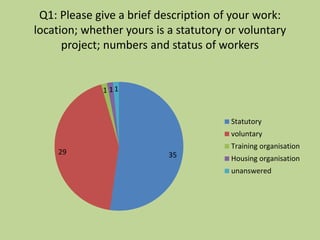
Q1: Please give a brief description of your work:
location; whether yours is a statutory or voluntary
project; numbers and status of workers
3529
1 1 1
Statutory
voluntary
Training organisation
Housing organisation
unanswered
0 5 10 15 20
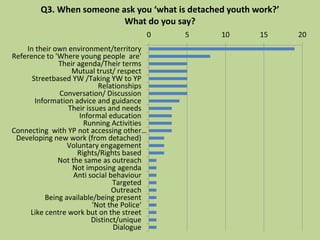
In their own environment/territory
Reference to 'Where young people are'
Their agenda/Their terms
Mutual trust/ respect
Streetbased YW /Taking YW to YP
Relationships
Conversation/ Discussion
Information advice and guidance
Their issues and needs
Informal education
Running Activities
Connecting with YP not accessing other…
Developing new work (from detached)
Voluntary engagement
Rights/Rights based
Not the same as outreach
Not imposing agenda
Anti social behaviour
Targeted
Outreach
Being available/being present
'Not the Police'
Like centre work but on the street
Distinct/unique
Dialogue
Q3. When someone ask you ‘what is detached youth work?’
What do you say?
Q3. When someone asks you ‘What is detached
youth work?’ What do you say?
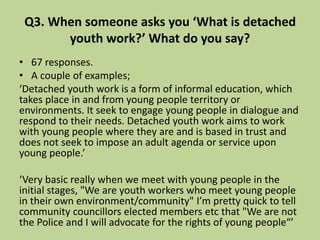
• 67 responses.
• A couple of examples;
‘Detached youth work is a form of informal education, which
takes place in and from young people territory or
environments. It seek to engage young people in dialogue and
respond to their needs. Detached youth work aims to work
with young people where they are and is based in trust and
does not seek to impose an adult agenda or service upon
young people.’
‘Very basic really when we meet with young people in the
initial stages, "We are youth workers who meet young people
in their own environment/community" I’m pretty quick to tell
community councillors elected members etc that "We are not
the Police and I will advocate for the rights of young people“’
0 5 10 15 20 25 30 35
Detached Youth Workers
Youth Workers
Street based workers/street workers
Outreach workers
Street (based) youth workers
Detached workers
Youth and community workers
Youth support workers
Community intervention workers
Young people's workers
Community reassurance workers
Detached street workers
Young (organisation name) workers
Detached response workers
Street engagement workers
Local prevention detached youth workers
Street team
Young people's workers
Youth officers
Q4. Are your workers called ‘detached youth workers’ or
something else: if so what?
Q4. Are your workers called 'detached youth
workers', or something else; if so what?
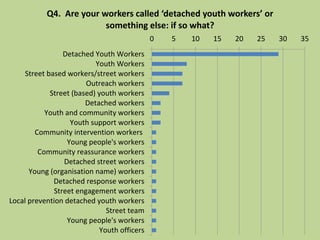
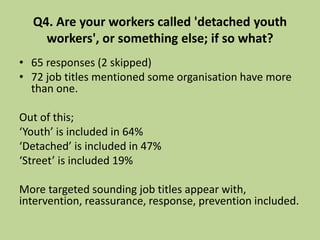
• 65 responses (2 skipped)
• 72 job titles mentioned some organisation have more
than one.
Out of this;
‘Youth’ is included in 64%
‘Detached’ is included in 47%
‘Street’ is included 19%
More targeted sounding job titles appear with,
intervention, reassurance, response, prevention included.
0 2 4 6 8 10 12 14 16
Support/encouragement
ASB/ Crime reduction
Positive activities/opportunities for young…
Social/informal education/learning
Advice, information and guidance
Build relationships
Overcome disadvantage/inequalities
Personal development
Safety/Safeguarding
Skills/capabilities
Community cohesion/involvement
Signposting
Fun/enjoyment
Confidence/Esteem
Listening
Encourage participation
Gangs
Broaden horizons/life choices
Be there/ be available
Tackling Child Sexual Exploitation
Help with transitions
Belong and thrive
Advocate for young people
Empowering young people
Meeting the needs of young people
Equipping young people
Mediation/Community
Young people's agenda
Q5. What are your organisation’s aims and objectives?
Q5. What are your organisation's aims and objectives?
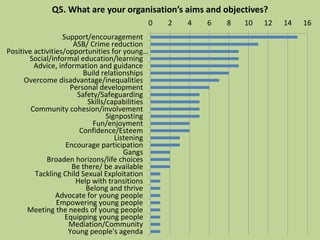
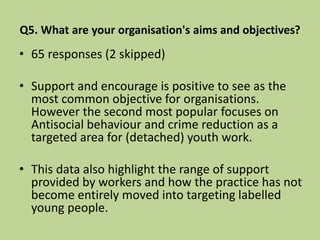
• 65 responses (2 skipped)
• Support and encourage is positive to see as the
most common objective for organisations.
However the second most popular focuses on
Antisocial behaviour and crime reduction as a
targeted area for (detached) youth work.
• This data also highlight the range of support
provided by workers and how the practice has not
become entirely moved into targeting labelled
young people.
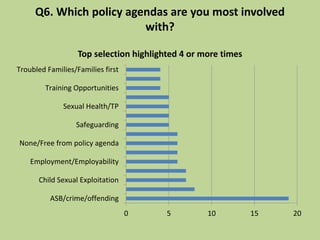
Q6. Which policy agendas are you most involved
with?
0 5 10 15 20
ASB/crime/offending
Child Sexual Exploitation
Employment/Employability
None/Free from policy agenda
Safeguarding
Sexual Health/TP
Training Opportunities
Troubled Families/Families first
Top selection highlighted 4 or more times
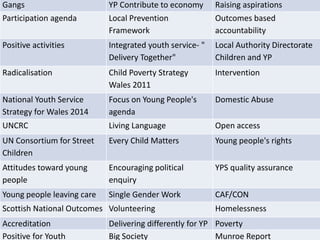
Continued
Gangs YP Contribute to economy Raising aspirations
Participation agenda Local Prevention
Framework
Outcomes based
accountability
Positive activities Integrated youth service- "
Delivery Together"
Local Authority Directorate
Children and YP
Radicalisation Child Poverty Strategy
Wales 2011
Intervention
National Youth Service
Strategy for Wales 2014
Focus on Young People's
agenda
Domestic Abuse
UNCRC Living Language Open access
UN Consortium for Street
Children
Every Child Matters Young people's rights
Attitudes toward young
people
Encouraging political
enquiry
YPS quality assurance
Young people leaving care Single Gender Work CAF/CON
Scottish National Outcomes Volunteering Homelessness
Accreditation Delivering differently for YP Poverty
Positive for Youth Big Society Munroe Report
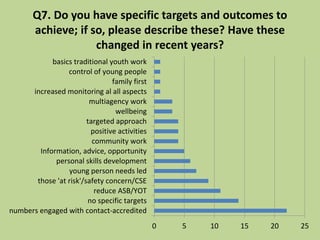
Q7. Do you have specific targets and outcomes to
achieve; if so, please describe these? Have these
changed in recent years?
0 5 10 15 20 25
numbers engaged with contact-accredited
no specific targets
reduce ASB/YOT
those 'at risk'/safety concern/CSE
young person needs led
personal skills development
Information, advice, opportunity
community work
positive activities
targeted approach
wellbeing
multiagency work
increased monitoring al all aspects
family first
control of young people
basics traditional youth work
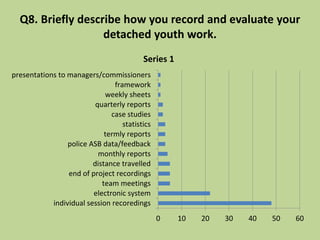
Q8. Briefly describe how you record and evaluate your
detached youth work.
0 10 20 30 40 50 60
individual session recoredings
electronic system
team meetings
end of project recordings
distance travelled
monthly reports
police ASB data/feedback
termly reports
statistics
case studies
quarterly reports
weekly sheets
framework
presentations to managers/commissioners
Series 1
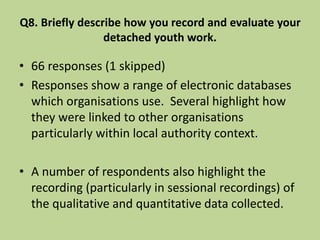
Q8. Briefly describe how you record and evaluate your
detached youth work.
• 66 responses (1 skipped)
• Responses show a range of electronic databases
which organisations use. Several highlight how
they were linked to other organisations
particularly within local authority context.
• A number of respondents also highlight the
recording (particularly in sessional recordings) of
the qualitative and quantitative data collected.
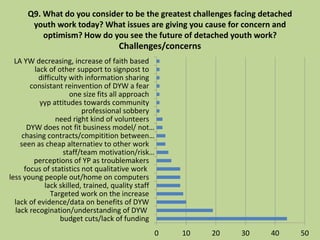
Q9. What do you consider to be the greatest challenges facing detached
youth work today? What issues are giving you cause for concern and
optimism? How do you see the future of detached youth work?
0 10 20 30 40 50
budget cuts/lack of funding
lack recogination/understanding of DYW
lack of evidence/data on benefits of DYW
Targeted work on the increase
lack skilled, trained, quality staff
less young people out/home on computers
focus of statistics not qualitative work
perceptions of YP as troublemakers
staff/team motivation/risk…
seen as cheap alternatiev to other work
chasing contracts/compitition between…
DYW does not fit business model/ not…
need right kind of volunteers
professional sobbery
yyp attitudes towards community
one size fits all approach
consistant reinvention of DYW a fear
difficulty with information sharing
lack of other support to signpost to
LA YW decreasing, increase of faith based
Challenges/concerns
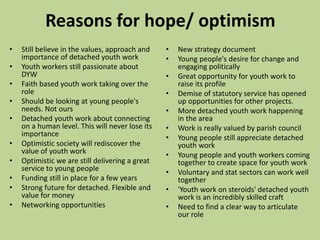
Reasons for hope/ optimism
• New strategy document
• Young people's desire for change and
engaging politically
• Great opportunity for youth work to
raise its profile
• Demise of statutory service has opened
up opportunities for other projects.
• More detached youth work happening
in the area
• Work is really valued by parish council
• Young people still appreciate detached
youth work
• Young people and youth workers coming
together to create space for youth work
• Voluntary and stat sectors can work well
together
• 'Youth work on steroids' detached youth
work is an incredibly skilled craft
• Need to find a clear way to articulate
our role
• Still believe in the values, approach and
importance of detached youth work
• Youth workers still passionate about
DYW
• Faith based youth work taking over the
role
• Should be looking at young people's
needs. Not ours
• Detached youth work about connecting
on a human level. This will never lose its
importance
• Optimistic society will rediscover the
value of youth work
• Optimistic we are still delivering a great
service to young people
• Funding still in place for a few years
• Strong future for detached. Flexible and
value for money
• Networking opportunities

Surveying the landscape

  • 1.
    Surveying the landscape DetachedYouth Work and Street Work Questionnaire results 2015
  • 2.
    Data collection • Surveymonkeyquestionnaire • 10 questions • E-mailed to Federation contact list • Also promoted on Facebook and Twitter • Intention to understand the situation of detached youth work in the mix of extensive cuts. • 67 respondents (some did not complete all questions)
  • 3.
    Q1: Please givea brief description of your work: location; whether yours is a statutory or voluntary project; numbers and status of workers 3529 1 1 1 Statutory voluntary Training organisation Housing organisation unanswered
  • 4.
    0 5 1015 20 In their own environment/territory Reference to 'Where young people are' Their agenda/Their terms Mutual trust/ respect Streetbased YW /Taking YW to YP Relationships Conversation/ Discussion Information advice and guidance Their issues and needs Informal education Running Activities Connecting with YP not accessing other… Developing new work (from detached) Voluntary engagement Rights/Rights based Not the same as outreach Not imposing agenda Anti social behaviour Targeted Outreach Being available/being present 'Not the Police' Like centre work but on the street Distinct/unique Dialogue Q3. When someone ask you ‘what is detached youth work?’ What do you say?
  • 5.
    Q3. When someoneasks you ‘What is detached youth work?’ What do you say? • 67 responses. • A couple of examples; ‘Detached youth work is a form of informal education, which takes place in and from young people territory or environments. It seek to engage young people in dialogue and respond to their needs. Detached youth work aims to work with young people where they are and is based in trust and does not seek to impose an adult agenda or service upon young people.’ ‘Very basic really when we meet with young people in the initial stages, "We are youth workers who meet young people in their own environment/community" I’m pretty quick to tell community councillors elected members etc that "We are not the Police and I will advocate for the rights of young people“’
  • 6.
    0 5 1015 20 25 30 35 Detached Youth Workers Youth Workers Street based workers/street workers Outreach workers Street (based) youth workers Detached workers Youth and community workers Youth support workers Community intervention workers Young people's workers Community reassurance workers Detached street workers Young (organisation name) workers Detached response workers Street engagement workers Local prevention detached youth workers Street team Young people's workers Youth officers Q4. Are your workers called ‘detached youth workers’ or something else: if so what?
  • 7.
    Q4. Are yourworkers called 'detached youth workers', or something else; if so what? • 65 responses (2 skipped) • 72 job titles mentioned some organisation have more than one. Out of this; ‘Youth’ is included in 64% ‘Detached’ is included in 47% ‘Street’ is included 19% More targeted sounding job titles appear with, intervention, reassurance, response, prevention included.
  • 8.
    0 2 46 8 10 12 14 16 Support/encouragement ASB/ Crime reduction Positive activities/opportunities for young… Social/informal education/learning Advice, information and guidance Build relationships Overcome disadvantage/inequalities Personal development Safety/Safeguarding Skills/capabilities Community cohesion/involvement Signposting Fun/enjoyment Confidence/Esteem Listening Encourage participation Gangs Broaden horizons/life choices Be there/ be available Tackling Child Sexual Exploitation Help with transitions Belong and thrive Advocate for young people Empowering young people Meeting the needs of young people Equipping young people Mediation/Community Young people's agenda Q5. What are your organisation’s aims and objectives?
  • 9.
    Q5. What areyour organisation's aims and objectives? • 65 responses (2 skipped) • Support and encourage is positive to see as the most common objective for organisations. However the second most popular focuses on Antisocial behaviour and crime reduction as a targeted area for (detached) youth work. • This data also highlight the range of support provided by workers and how the practice has not become entirely moved into targeting labelled young people.
  • 10.
    Q6. Which policyagendas are you most involved with? 0 5 10 15 20 ASB/crime/offending Child Sexual Exploitation Employment/Employability None/Free from policy agenda Safeguarding Sexual Health/TP Training Opportunities Troubled Families/Families first Top selection highlighted 4 or more times
  • 11.
    Continued Gangs YP Contributeto economy Raising aspirations Participation agenda Local Prevention Framework Outcomes based accountability Positive activities Integrated youth service- " Delivery Together" Local Authority Directorate Children and YP Radicalisation Child Poverty Strategy Wales 2011 Intervention National Youth Service Strategy for Wales 2014 Focus on Young People's agenda Domestic Abuse UNCRC Living Language Open access UN Consortium for Street Children Every Child Matters Young people's rights Attitudes toward young people Encouraging political enquiry YPS quality assurance Young people leaving care Single Gender Work CAF/CON Scottish National Outcomes Volunteering Homelessness Accreditation Delivering differently for YP Poverty Positive for Youth Big Society Munroe Report
  • 12.
    Q7. Do youhave specific targets and outcomes to achieve; if so, please describe these? Have these changed in recent years? 0 5 10 15 20 25 numbers engaged with contact-accredited no specific targets reduce ASB/YOT those 'at risk'/safety concern/CSE young person needs led personal skills development Information, advice, opportunity community work positive activities targeted approach wellbeing multiagency work increased monitoring al all aspects family first control of young people basics traditional youth work
  • 13.
    Q8. Briefly describehow you record and evaluate your detached youth work. 0 10 20 30 40 50 60 individual session recoredings electronic system team meetings end of project recordings distance travelled monthly reports police ASB data/feedback termly reports statistics case studies quarterly reports weekly sheets framework presentations to managers/commissioners Series 1
  • 14.
    Q8. Briefly describehow you record and evaluate your detached youth work. • 66 responses (1 skipped) • Responses show a range of electronic databases which organisations use. Several highlight how they were linked to other organisations particularly within local authority context. • A number of respondents also highlight the recording (particularly in sessional recordings) of the qualitative and quantitative data collected.
  • 15.
    Q9. What doyou consider to be the greatest challenges facing detached youth work today? What issues are giving you cause for concern and optimism? How do you see the future of detached youth work? 0 10 20 30 40 50 budget cuts/lack of funding lack recogination/understanding of DYW lack of evidence/data on benefits of DYW Targeted work on the increase lack skilled, trained, quality staff less young people out/home on computers focus of statistics not qualitative work perceptions of YP as troublemakers staff/team motivation/risk… seen as cheap alternatiev to other work chasing contracts/compitition between… DYW does not fit business model/ not… need right kind of volunteers professional sobbery yyp attitudes towards community one size fits all approach consistant reinvention of DYW a fear difficulty with information sharing lack of other support to signpost to LA YW decreasing, increase of faith based Challenges/concerns
  • 16.
    Reasons for hope/optimism • New strategy document • Young people's desire for change and engaging politically • Great opportunity for youth work to raise its profile • Demise of statutory service has opened up opportunities for other projects. • More detached youth work happening in the area • Work is really valued by parish council • Young people still appreciate detached youth work • Young people and youth workers coming together to create space for youth work • Voluntary and stat sectors can work well together • 'Youth work on steroids' detached youth work is an incredibly skilled craft • Need to find a clear way to articulate our role • Still believe in the values, approach and importance of detached youth work • Youth workers still passionate about DYW • Faith based youth work taking over the role • Should be looking at young people's needs. Not ours • Detached youth work about connecting on a human level. This will never lose its importance • Optimistic society will rediscover the value of youth work • Optimistic we are still delivering a great service to young people • Funding still in place for a few years • Strong future for detached. Flexible and value for money • Networking opportunities