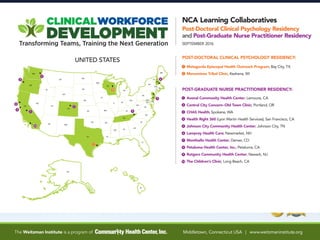
We will begin shortly…
Welcome
1
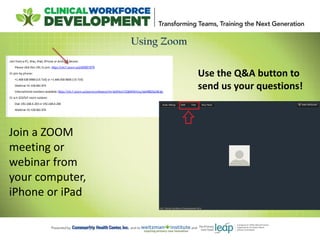
Using Zoom
Join a ZOOM
meeting or
webinar from
your computer,
iPhone or iPad
Use the Q&A button to
send us your questions!
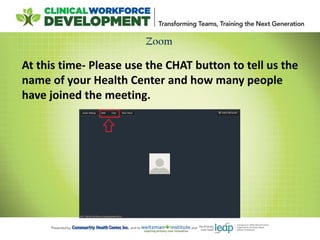
Zoom
At this time- Please use the CHAT button to tell us the
name of your Health Center and how many people
have joined the meeting.
4
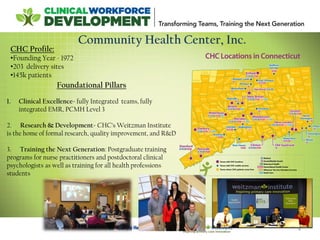
Community Health Center, Inc.
Foundational Pillars
1. Clinical Excellence- fully Integrated teams, fully
integrated EMR, PCMH Level 3
2. Research & Development- CHC’s Weitzman Institute
is the home of formal research, quality improvement, and R&D
3. Training the Next Generation: Postgraduate training
programs for nurse practitioners and postdoctoral clinical
psychologists as well as training for all health professions
students
CHC Profile:
•Founding Year - 1972
•203 delivery sites
•145k patients
The Community Health Center, Inc. and its Weitzman Institute will provide
education, information, and training to interested health centers in Transforming
Teams and Training the Next Generation
• National Webinars on advancing team based care, implementing post-
graduate residency programs, and health professions students in FQHCs.
• Invited participation in Learning Collaboratives to advance team based care
or implement a post-graduate residency program at your health center.
CHC’s NCA on Clinical Workforce Development
The National Training and Technical Assistance Cooperative Agreements (NCAs) provide
free training and technical assistance that is data driven, cutting edge and focused on
quality and operational improvement to support health centers and look-alikes.
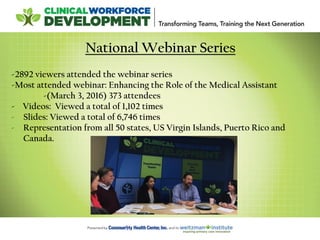
National Webinar Series
-2892 viewers attended the webinar series
-Most attended webinar: Enhancing the Role of the Medical Assistant
-(March 3, 2016) 373 attendees
- Videos: Viewed a total of 1,102 times
- Slides: Viewed a total of 6,746 times
- Representation from all 50 states, US Virgin Islands, Puerto Rico and
Canada.
The LC Teams
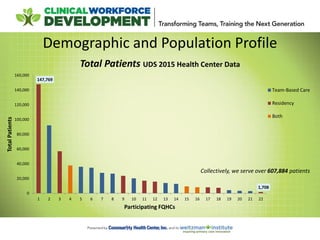
147,769
1,708
0
20,000
40,000
60,000
80,000
100,000
120,000
140,000
160,000
1 2 3 4 5 6 7 8 9 10 11 12 13 14 15 16 17 18 19 20 21 22
TotalPatients
Participating FQHCs
Total Patients UDS 2015 Health Center Data
Team-Based Care
Residency
Both
Demographic and Population Profile
Collectively, we serve over 607,884 patients
Demographic and Population Profile
0%
10%
20%
30%
40%
50%
60%
70%
80%
90%
100%
1 2 3 4 5 6 7 8 9 10 11 12 13 14 15 16 17 18 19 20 21 22
%ofTotalPatients
Participating FQHCs
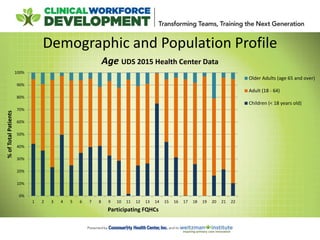
Age UDS 2015 Health Center Data
Older Adults (age 65 and over)
Adult (18 - 64)
Children (< 18 years old)
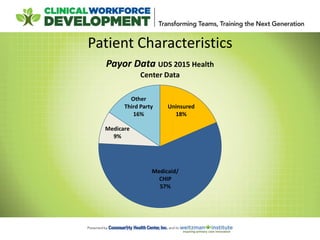
Patient Characteristics
Uninsured
18%
Medicaid/
CHIP
57%
Medicare
9%
Other
Third Party
16%
Payor Data UDS 2015 Health
Center Data
Almost all health centers offer
Medical, Dental and Mental
Health services.
Staffing and Utilization: UDS
Table 5 – We encourage you
to look at your data!
Quality Improvement Education
Patti Feeney
Manager, Quality Improvement Education
Effective Meeting Skills
Providing meeting and team structure for coaches
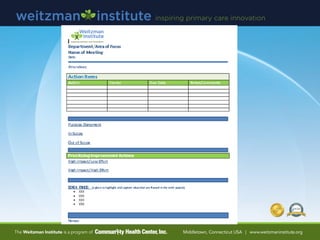
I. AGENDA
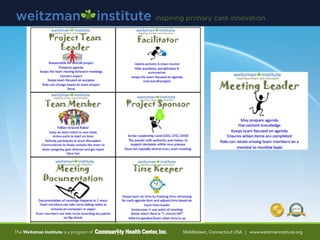
II. MEETING ROLES
III. ACTION PLAN
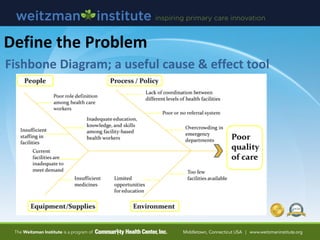
Define the Problem
Fishbone Diagram; a useful cause & effect tool
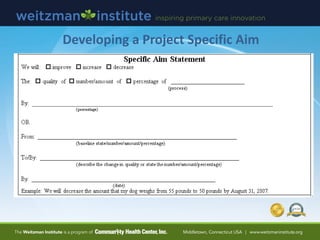
Developing a Project Specific Aim
All tools referenced in today’s session and support
material can be found by following theses links:
NCA Team-Based Care Learning Collaborative
NCA Post-Graduate Residency Learning Collaborative
Tools and Resources >> Quality Improvement
Welcome
NCA Post-Graduate Residency
Learning Collaborative
Organizational Overview
Interviews : General Impressions
 A lot of variation in QI experience, from none to expert
 Five organizations host medical residents from university
hospital programs; most have pre-licensure students from
various disciplines; none run their own residency programs
 Many mentioned the complexity of FQHC patients, requiring
specialized training NPs don’t get in their graduate programs
 Several mentioned that many new NPs have never worked as
RNs, and are coming from other fields into the direct entry
accelerated programs
Interviews : Expectations and Goals
• Want best practices and structure/guidance/resources
from the LC: how-to
• The first year out of school is overwhelming for new NPs
and want to help with the transition
• Recruitment/retention are major goals
• Concerns: organizational structure and resources required
to host and sustain an accredited program; financial
implications
Team Coaches
Name of FQHC Coach
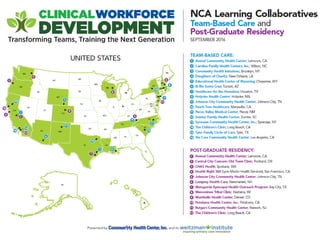
Avenal Community Health Center Veronica Vo Lumley
Central City Concern- Old Town Clinic Lauren Land
CHAS Health Marcus Riccelli
Lamprey Health Care Evalie Crosby
Lyon Martin Health Services Nina Soares
Matagorda Episcopal Health Outreach Program Jessica Russell
Menominee Tribal Clinic Diane Hietpas
Montbello Health Center Lisa Wanger
Johnson City Community Health Center Dr. Flo Weierbach
Petaluma Health Center, Inc. Carlin Chi
Rutgers Community Health Center Mary DiGiulio
The Children’s Clinic Jack Tsai
CHCI Mentors
 Post-Doctoral Clinical Psychology Residency Programs
Kerry Bamrick
Senior Program Manager
Post-Graduate Residency Programs
Kerry@chc1.com
 Post-Graduate Nurse Practitioner Residency Programs
Anna Rogers
Project Director
National Cooperative Agreement
RogersA@chc1.com
Charise Corsino
Program Manager
Nurse-Practitioner Residency Program
charise@chc1.com
Coach and Mentor Roles
Role of the Coach Role of the Mentor
• Teach team how to prepare and facilitate
effective meetings.
• Provide coaching support between and during
weekly team meetings.
• Participate in weekly conference calls with
mentor to discuss progress and stuck points.
• Help team follow timelines and complete
assignments and progress reporting.
• Share team’s progress with the mentor and
other teams during collaborative sessions.
• Meet with coach weekly to discuss
progress.
• Work directly with coach to identify
successes and work through challenges
and stuck points.
• Help coach run an effective meeting for
their team and develop other coaching
skills.
• Be available for individual sessions with
coach for specific team and program
development.
Drivers for Starting a Program
• Your organization should ask – Why do we want to
start a post-graduate residency training program?
• Our drivers for starting postgraduate training
programs
– Nurse Practitioner Residency Training Program
– Post Doctoral Clinical Psychology Training Program
Polling Question
• Has your organization established your drivers for
starting a program – Yes or No?
• What is your primary reason for starting a post-
graduate training program?
– Recruitment and Retention
– Committed to Training
– Staff Development
– Staff Satisfaction
– Patient Access
Questions?
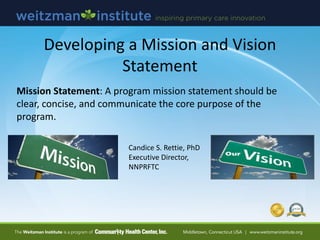
Developing a Mission and Vision
Statement
Mission Statement: A program mission statement should be
clear, concise, and communicate the core purpose of the
program.
Candice S. Rettie, PhD
Executive Director,
NNPRFTC
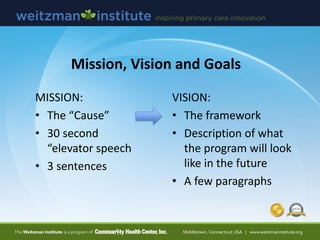
Mission, Vision and Goals
MISSION:
• The “Cause”
• 30 second
“elevator speech
• 3 sentences
VISION:
• The framework
• Description of what
the program will look
like in the future
• A few paragraphs
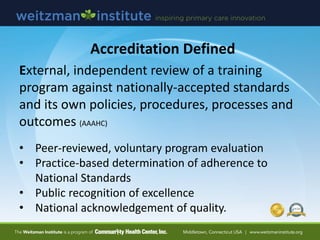
Accreditation Defined
External, independent review of a training
program against nationally-accepted standards
and its own policies, procedures, processes and
outcomes (AAAHC)
• Peer-reviewed, voluntary program evaluation
• Practice-based determination of adherence to
National Standards
• Public recognition of excellence
• National acknowledgement of quality.
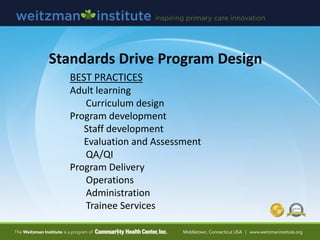
Standards Drive Program Design
BEST PRACTICES
Adult learning
Curriculum design
Program development
Staff development
Evaluation and Assessment
QA/QI
Program Delivery
Operations
Administration
Trainee Services
Contact info:
Candice S. Rettie, PhD – Executive Director
Candice.rettie@nppostgradtraining.com
Office: 202-780-9651
Twitter: @nppostgrad
www.nppostgradtraining.com
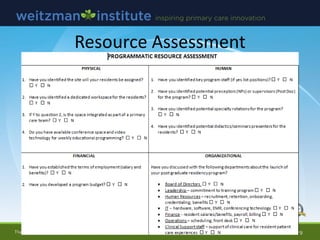
Resource Assessment
Review Assignments
• Develop Program Drivers
• Develop Program Mission and Vision statements
• Complete Resource Assessment
• Establish meeting day and time and have first
meeting (if already haven't done this)
Q&A
Please use the Q&A feature to ask questions

NCA - PGR- Session 1 Slides

  • 1.
    We will beginshortly… Welcome 1
  • 2.
    Using Zoom Join aZOOM meeting or webinar from your computer, iPhone or iPad Use the Q&A button to send us your questions!
  • 3.
    Zoom At this time-Please use the CHAT button to tell us the name of your Health Center and how many people have joined the meeting.
  • 4.
    4 Community Health Center,Inc. Foundational Pillars 1. Clinical Excellence- fully Integrated teams, fully integrated EMR, PCMH Level 3 2. Research & Development- CHC’s Weitzman Institute is the home of formal research, quality improvement, and R&D 3. Training the Next Generation: Postgraduate training programs for nurse practitioners and postdoctoral clinical psychologists as well as training for all health professions students CHC Profile: •Founding Year - 1972 •203 delivery sites •145k patients
  • 5.
    The Community HealthCenter, Inc. and its Weitzman Institute will provide education, information, and training to interested health centers in Transforming Teams and Training the Next Generation • National Webinars on advancing team based care, implementing post- graduate residency programs, and health professions students in FQHCs. • Invited participation in Learning Collaboratives to advance team based care or implement a post-graduate residency program at your health center. CHC’s NCA on Clinical Workforce Development The National Training and Technical Assistance Cooperative Agreements (NCAs) provide free training and technical assistance that is data driven, cutting edge and focused on quality and operational improvement to support health centers and look-alikes.
  • 6.
    National Webinar Series -2892viewers attended the webinar series -Most attended webinar: Enhancing the Role of the Medical Assistant -(March 3, 2016) 373 attendees - Videos: Viewed a total of 1,102 times - Slides: Viewed a total of 6,746 times - Representation from all 50 states, US Virgin Islands, Puerto Rico and Canada.
  • 7.
  • 8.
    147,769 1,708 0 20,000 40,000 60,000 80,000 100,000 120,000 140,000 160,000 1 2 34 5 6 7 8 9 10 11 12 13 14 15 16 17 18 19 20 21 22 TotalPatients Participating FQHCs Total Patients UDS 2015 Health Center Data Team-Based Care Residency Both Demographic and Population Profile Collectively, we serve over 607,884 patients
  • 9.
    Demographic and PopulationProfile 0% 10% 20% 30% 40% 50% 60% 70% 80% 90% 100% 1 2 3 4 5 6 7 8 9 10 11 12 13 14 15 16 17 18 19 20 21 22 %ofTotalPatients Participating FQHCs Age UDS 2015 Health Center Data Older Adults (age 65 and over) Adult (18 - 64) Children (< 18 years old)
  • 10.
  • 11.
    Almost all healthcenters offer Medical, Dental and Mental Health services. Staffing and Utilization: UDS Table 5 – We encourage you to look at your data!
  • 12.
    Quality Improvement Education PattiFeeney Manager, Quality Improvement Education
  • 13.
    Effective Meeting Skills Providingmeeting and team structure for coaches I. AGENDA II. MEETING ROLES III. ACTION PLAN
  • 17.
    Define the Problem FishboneDiagram; a useful cause & effect tool
  • 18.
  • 19.
    All tools referencedin today’s session and support material can be found by following theses links: NCA Team-Based Care Learning Collaborative NCA Post-Graduate Residency Learning Collaborative Tools and Resources >> Quality Improvement
  • 20.
  • 21.
  • 22.
    Interviews : GeneralImpressions  A lot of variation in QI experience, from none to expert  Five organizations host medical residents from university hospital programs; most have pre-licensure students from various disciplines; none run their own residency programs  Many mentioned the complexity of FQHC patients, requiring specialized training NPs don’t get in their graduate programs  Several mentioned that many new NPs have never worked as RNs, and are coming from other fields into the direct entry accelerated programs
  • 23.
    Interviews : Expectationsand Goals • Want best practices and structure/guidance/resources from the LC: how-to • The first year out of school is overwhelming for new NPs and want to help with the transition • Recruitment/retention are major goals • Concerns: organizational structure and resources required to host and sustain an accredited program; financial implications
  • 24.
    Team Coaches Name ofFQHC Coach Avenal Community Health Center Veronica Vo Lumley Central City Concern- Old Town Clinic Lauren Land CHAS Health Marcus Riccelli Lamprey Health Care Evalie Crosby Lyon Martin Health Services Nina Soares Matagorda Episcopal Health Outreach Program Jessica Russell Menominee Tribal Clinic Diane Hietpas Montbello Health Center Lisa Wanger Johnson City Community Health Center Dr. Flo Weierbach Petaluma Health Center, Inc. Carlin Chi Rutgers Community Health Center Mary DiGiulio The Children’s Clinic Jack Tsai
  • 25.
    CHCI Mentors  Post-DoctoralClinical Psychology Residency Programs Kerry Bamrick Senior Program Manager Post-Graduate Residency Programs Kerry@chc1.com  Post-Graduate Nurse Practitioner Residency Programs Anna Rogers Project Director National Cooperative Agreement RogersA@chc1.com Charise Corsino Program Manager Nurse-Practitioner Residency Program charise@chc1.com
  • 26.
    Coach and MentorRoles Role of the Coach Role of the Mentor • Teach team how to prepare and facilitate effective meetings. • Provide coaching support between and during weekly team meetings. • Participate in weekly conference calls with mentor to discuss progress and stuck points. • Help team follow timelines and complete assignments and progress reporting. • Share team’s progress with the mentor and other teams during collaborative sessions. • Meet with coach weekly to discuss progress. • Work directly with coach to identify successes and work through challenges and stuck points. • Help coach run an effective meeting for their team and develop other coaching skills. • Be available for individual sessions with coach for specific team and program development.
  • 27.
    Drivers for Startinga Program • Your organization should ask – Why do we want to start a post-graduate residency training program? • Our drivers for starting postgraduate training programs – Nurse Practitioner Residency Training Program – Post Doctoral Clinical Psychology Training Program
  • 28.
    Polling Question • Hasyour organization established your drivers for starting a program – Yes or No? • What is your primary reason for starting a post- graduate training program? – Recruitment and Retention – Committed to Training – Staff Development – Staff Satisfaction – Patient Access
  • 29.
  • 30.
    Developing a Missionand Vision Statement Mission Statement: A program mission statement should be clear, concise, and communicate the core purpose of the program. Candice S. Rettie, PhD Executive Director, NNPRFTC
  • 31.
    Mission, Vision andGoals MISSION: • The “Cause” • 30 second “elevator speech • 3 sentences VISION: • The framework • Description of what the program will look like in the future • A few paragraphs
  • 32.
    Accreditation Defined External, independentreview of a training program against nationally-accepted standards and its own policies, procedures, processes and outcomes (AAAHC) • Peer-reviewed, voluntary program evaluation • Practice-based determination of adherence to National Standards • Public recognition of excellence • National acknowledgement of quality.
  • 33.
    Standards Drive ProgramDesign BEST PRACTICES Adult learning Curriculum design Program development Staff development Evaluation and Assessment QA/QI Program Delivery Operations Administration Trainee Services
  • 34.
    Contact info: Candice S.Rettie, PhD – Executive Director Candice.rettie@nppostgradtraining.com Office: 202-780-9651 Twitter: @nppostgrad www.nppostgradtraining.com
  • 35.
  • 36.
    Review Assignments • DevelopProgram Drivers • Develop Program Mission and Vision statements • Complete Resource Assessment • Establish meeting day and time and have first meeting (if already haven't done this)
  • 37.
    Q&A Please use theQ&A feature to ask questions