The Three Pillars Approach to 
Your Agile Test Strategy 
Bob Galen 
President & Principal Consultant 
RGCG, LLC 
bob@rgalen.com
Introduction 
Bob Galen 
 Independent Agile Coach (CSC) at RGCG, LLC 
 Principle Agile Evangelist at Velocity Partners 
 Somewhere ‘north’ of 30 years overall experience  
 Wide variety of technical stacks and business domains 
 Developer first, then Project Management / Leadership, then 
Testing 
 Senior/Executive software development leadership for 20 years 
 Practicing formal agility since 2000 
 XP, Lean, Scrum, and Kanban experience 
 From Cary, North Carolina 
 Connect w/ me via LinkedIn and Twitter @bobgalen 
Bias Disclaimer: 
Agile is THE BEST Methodology 
for Software Development… 
However, NOT a Silver Bullet! 
Copyright © 2014 RGCG, LLC 2
Copyright © 2014 RGCG, LLC 3
Introduction 
Mary Thorn 
 Mary Thorn is the Director of QA and Agile Coach at 
ChannelAdvisor in Morrisville, North Carolina, 
 Mary has a broad testing background that spans 
automation, data warehouses, and web-based systems 
in a wide variety of technologies and testing 
techniques. 
 During her more than fifteen years of experience in 
healthcare, HR, agriculture, and SaaS-based products, 
 Mary has held manager and contributor level positions 
in software development organizations. 
 She has a strong interest in agile testing methodologies 
and direct experience leading agile teams through 
Scrum adoption & beyond. 
Copyright © 2014 RGCG, LLC 4
Agile Testing & Quality 
Let’s explore your strategies? 
 What are your current strategies towards: 
 Software testing? 
 And towards quality? 
 How are they “linked” together? 
 Anything missing? 
 How does it “fit” with your overall agile strategy? 
 Get together in “pairs” and chat about this for 5-10 
minutes. 
 Then we’ll gather your results… 
Copyright © 2014 RGCG, LLC 5
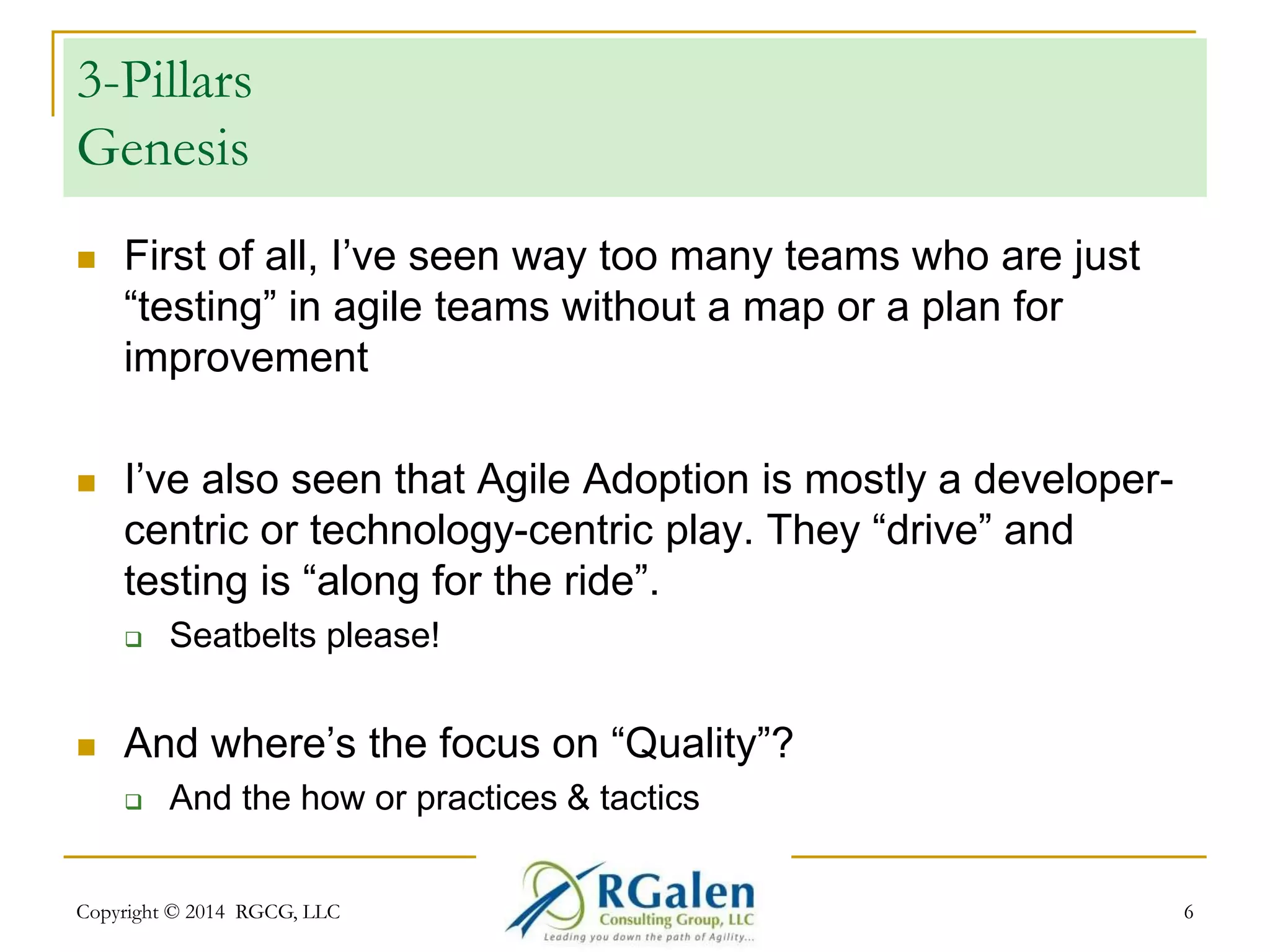
3-Pillars 
Genesis 
 First of all, I’ve seen way too many teams who are just 
“testing” in agile teams without a map or a plan for 
improvement 
 I’ve also seen that Agile Adoption is mostly a developer-centric 
or technology-centric play. They “drive” and 
testing is “along for the ride”. 
 Seatbelts please! 
 And where’s the focus on “Quality”? 
 And the how or practices & tactics 
Copyright © 2014 RGCG, LLC 6
3-Pillars 
Genesis 
 I’ve learned that “Balance” is important 
 A sad tale of: 
 Thousands of ATDD testing; Gherkin run amok 
 All of them are working; continuously testing; increasing 
“coverage’ and life is Good! 
 BUT 
 These same teams couldn’t write a cohesive User Story to save 
their life 
 So, where were the Acceptance Tests coming from? 
Copyright © 2014 RGCG, LLC 7
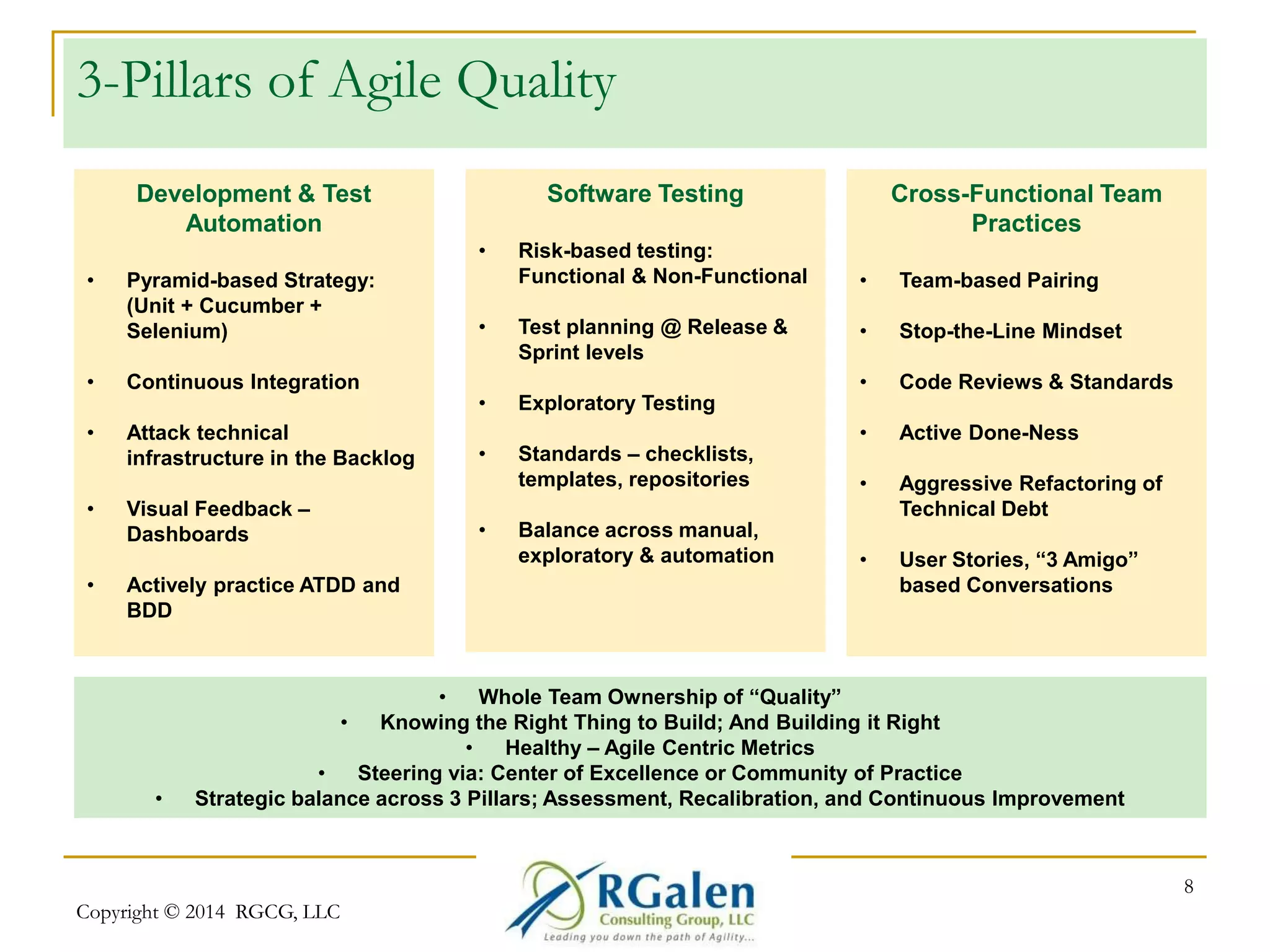
3-Pillars of Agile Quality 
Copyright © 2014 RGCG, LLC 
8 
Development & Test 
Automation 
• Pyramid-based Strategy: 
(Unit + Cucumber + 
Selenium) 
• Continuous Integration 
• Attack technical 
infrastructure in the Backlog 
• Visual Feedback – 
Dashboards 
• Actively practice ATDD and 
BDD 
Software Testing 
• Risk-based testing: 
Functional & Non-Functional 
• Test planning @ Release & 
Sprint levels 
• Exploratory Testing 
• Standards – checklists, 
templates, repositories 
• Balance across manual, 
exploratory & automation 
Cross-Functional Team 
Practices 
• Team-based Pairing 
• Stop-the-Line Mindset 
• Code Reviews & Standards 
• Active Done-Ness 
• Aggressive Refactoring of 
Technical Debt 
• User Stories, “3 Amigo” 
based Conversations 
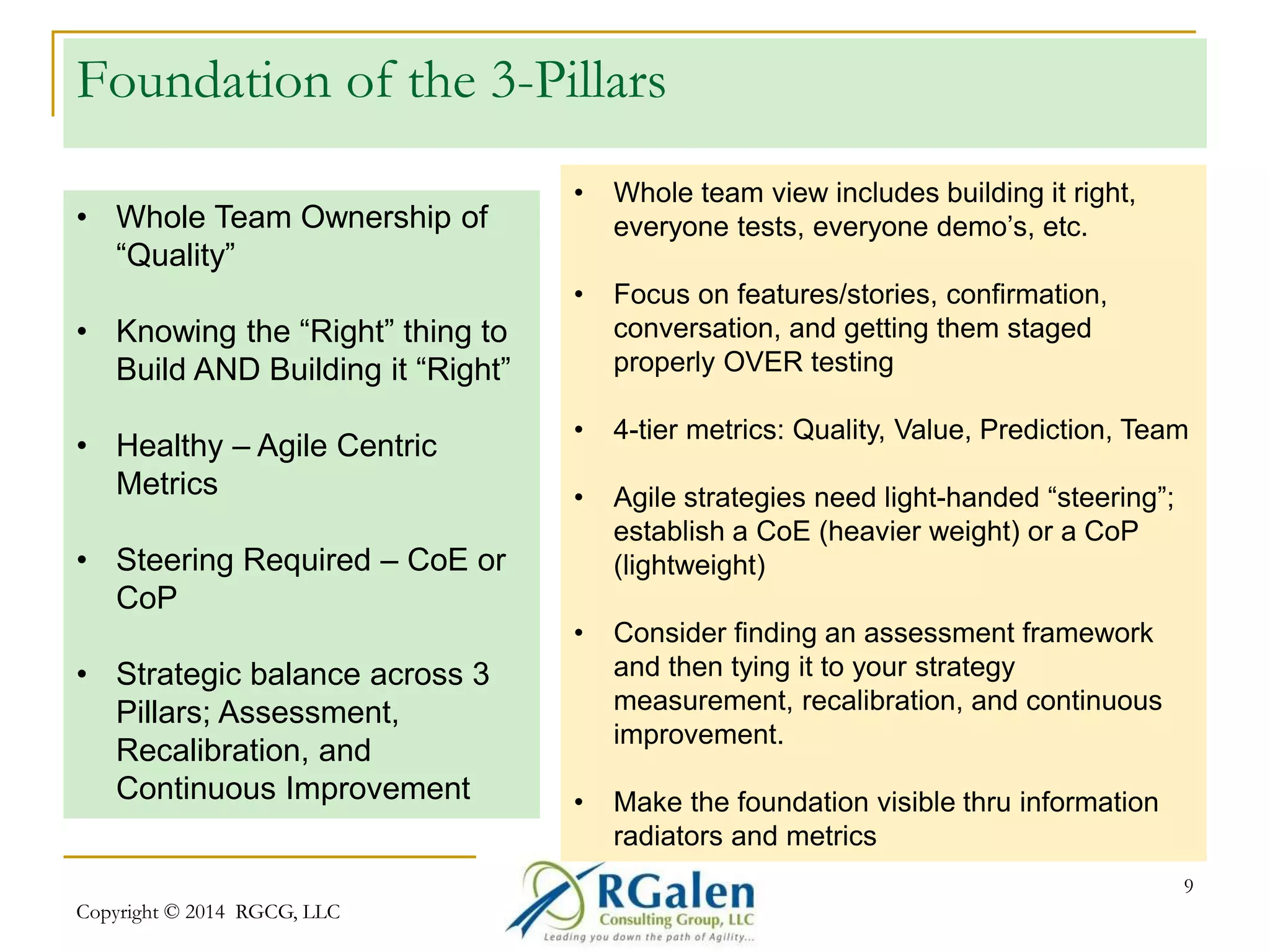
• Whole Team Ownership of “Quality” 
• Knowing the Right Thing to Build; And Building it Right 
• Healthy – Agile Centric Metrics 
• Steering via: Center of Excellence or Community of Practice 
• Strategic balance across 3 Pillars; Assessment, Recalibration, and Continuous Improvement
Foundation of the 3-Pillars 
Copyright © 2014 RGCG, LLC 
9 
• Whole Team Ownership of 
“Quality” 
• Knowing the “Right” thing to 
Build AND Building it “Right” 
• Healthy – Agile Centric 
Metrics 
• Steering Required – CoE or 
CoP 
• Strategic balance across 3 
Pillars; Assessment, 
Recalibration, and 
Continuous Improvement 
• Whole team view includes building it right, 
everyone tests, everyone demo’s, etc. 
• Focus on features/stories, confirmation, 
conversation, and getting them staged 
properly OVER testing 
• 4-tier metrics: Quality, Value, Prediction, Team 
• Agile strategies need light-handed “steering”; 
establish a CoE (heavier weight) or a CoP 
(lightweight) 
• Consider finding an assessment framework 
and then tying it to your strategy 
measurement, recalibration, and continuous 
improvement. 
• Make the foundation visible thru information 
radiators and metrics
3-Pillars of Agile Quality 
Copyright © 2014 RGCG, LLC 
10 
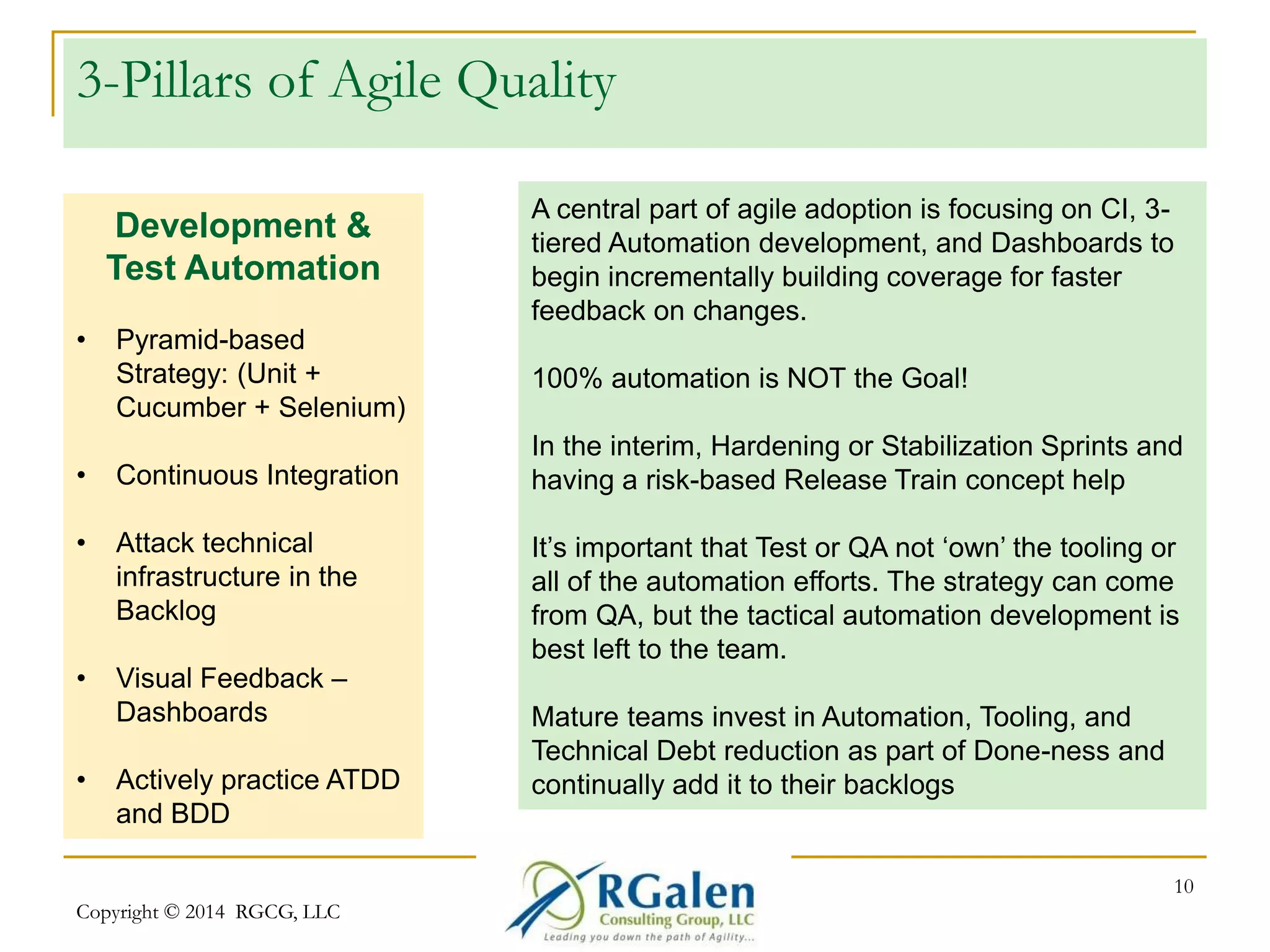
Development & 
Test Automation 
• Pyramid-based 
Strategy: (Unit + 
Cucumber + Selenium) 
• Continuous Integration 
• Attack technical 
infrastructure in the 
Backlog 
• Visual Feedback – 
Dashboards 
• Actively practice ATDD 
and BDD 
A central part of agile adoption is focusing on CI, 3- 
tiered Automation development, and Dashboards to 
begin incrementally building coverage for faster 
feedback on changes. 
100% automation is NOT the Goal! 
In the interim, Hardening or Stabilization Sprints and 
having a risk-based Release Train concept help 
It’s important that Test or QA not ‘own’ the tooling or 
all of the automation efforts. The strategy can come 
from QA, but the tactical automation development is 
best left to the team. 
Mature teams invest in Automation, Tooling, and 
Technical Debt reduction as part of Done-ness and 
continually add it to their backlogs
3-Pillars of Agile Quality 
Copyright © 2014 RGCG, LLC 
11 
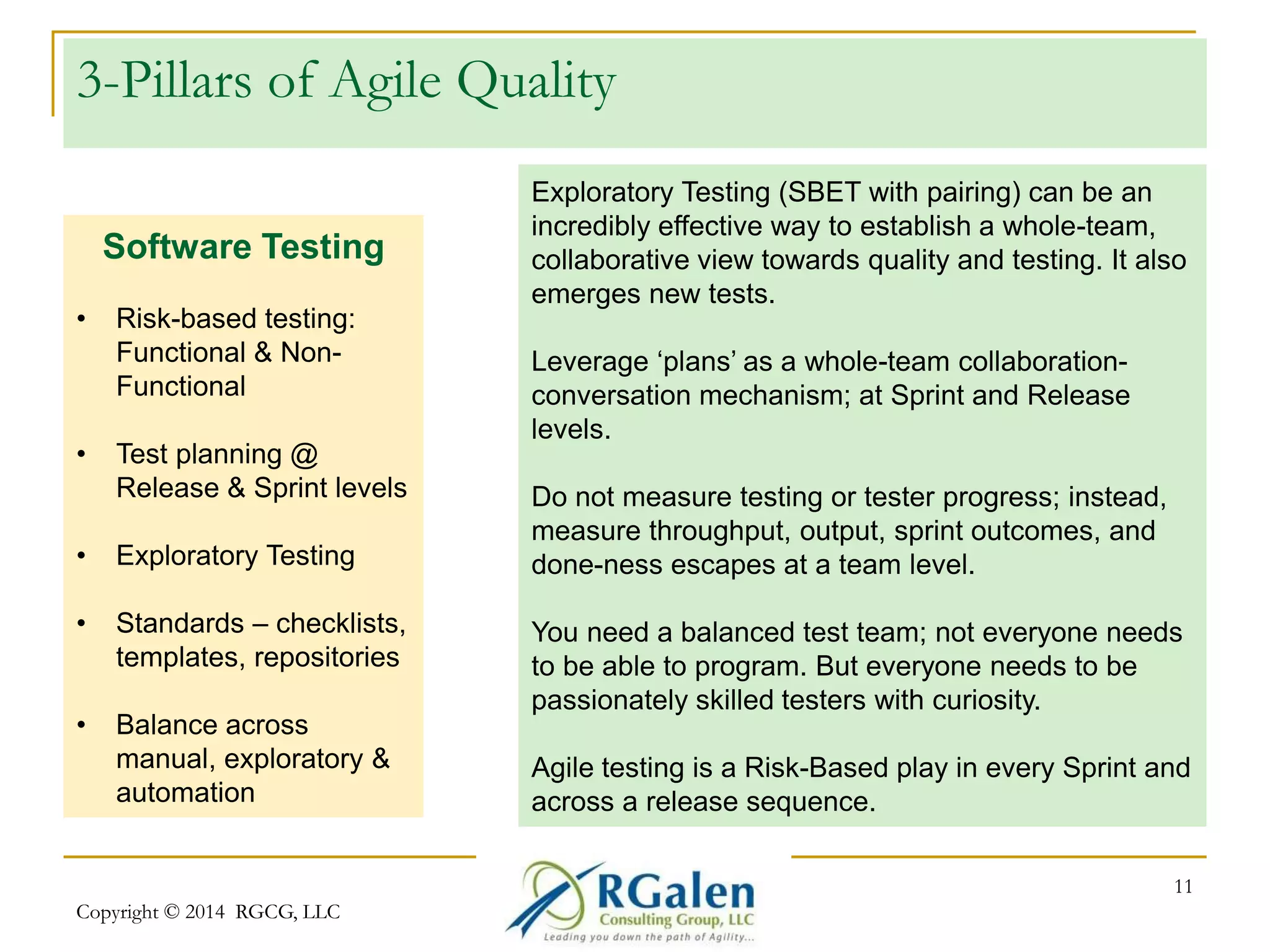
Software Testing 
• Risk-based testing: 
Functional & Non- 
Functional 
• Test planning @ 
Release & Sprint levels 
• Exploratory Testing 
• Standards – checklists, 
templates, repositories 
• Balance across 
manual, exploratory & 
automation 
Exploratory Testing (SBET with pairing) can be an 
incredibly effective way to establish a whole-team, 
collaborative view towards quality and testing. It also 
emerges new tests. 
Leverage ‘plans’ as a whole-team collaboration-conversation 
mechanism; at Sprint and Release 
levels. 
Do not measure testing or tester progress; instead, 
measure throughput, output, sprint outcomes, and 
done-ness escapes at a team level. 
You need a balanced test team; not everyone needs 
to be able to program. But everyone needs to be 
passionately skilled testers with curiosity. 
Agile testing is a Risk-Based play in every Sprint and 
across a release sequence.
3-Pillars of Agile Quality 
Copyright © 2014 RGCG, LLC 
12 
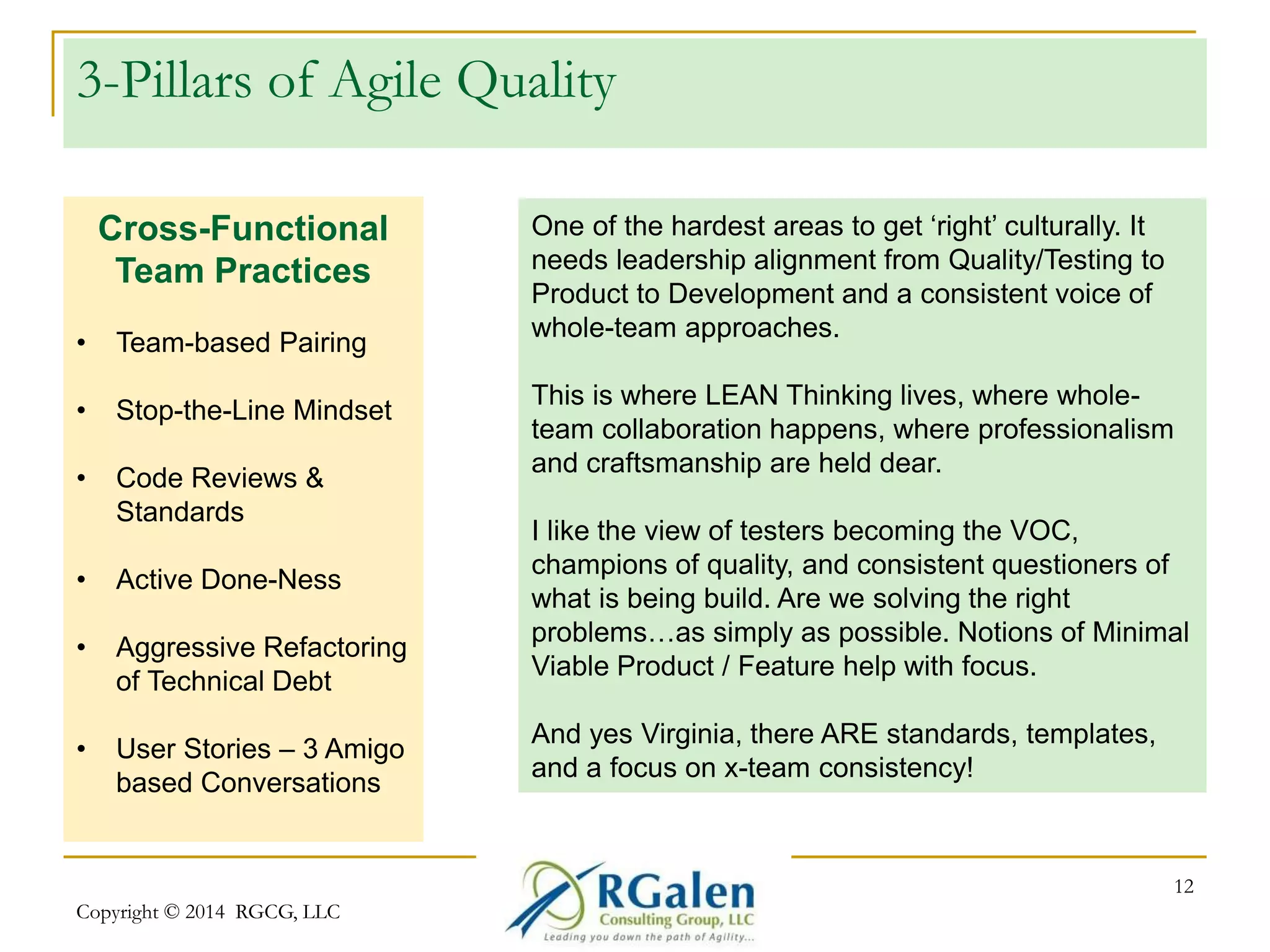
Cross-Functional 
Team Practices 
• Team-based Pairing 
• Stop-the-Line Mindset 
• Code Reviews & 
Standards 
• Active Done-Ness 
• Aggressive Refactoring 
of Technical Debt 
• User Stories – 3 Amigo 
based Conversations 
One of the hardest areas to get ‘right’ culturally. It 
needs leadership alignment from Quality/Testing to 
Product to Development and a consistent voice of 
whole-team approaches. 
This is where LEAN Thinking lives, where whole-team 
collaboration happens, where professionalism 
and craftsmanship are held dear. 
I like the view of testers becoming the VOC, 
champions of quality, and consistent questioners of 
what is being build. Are we solving the right 
problems…as simply as possible. Notions of Minimal 
Viable Product / Feature help with focus. 
And yes Virginia, there ARE standards, templates, 
and a focus on x-team consistency!
Software Testing 
Strategies 
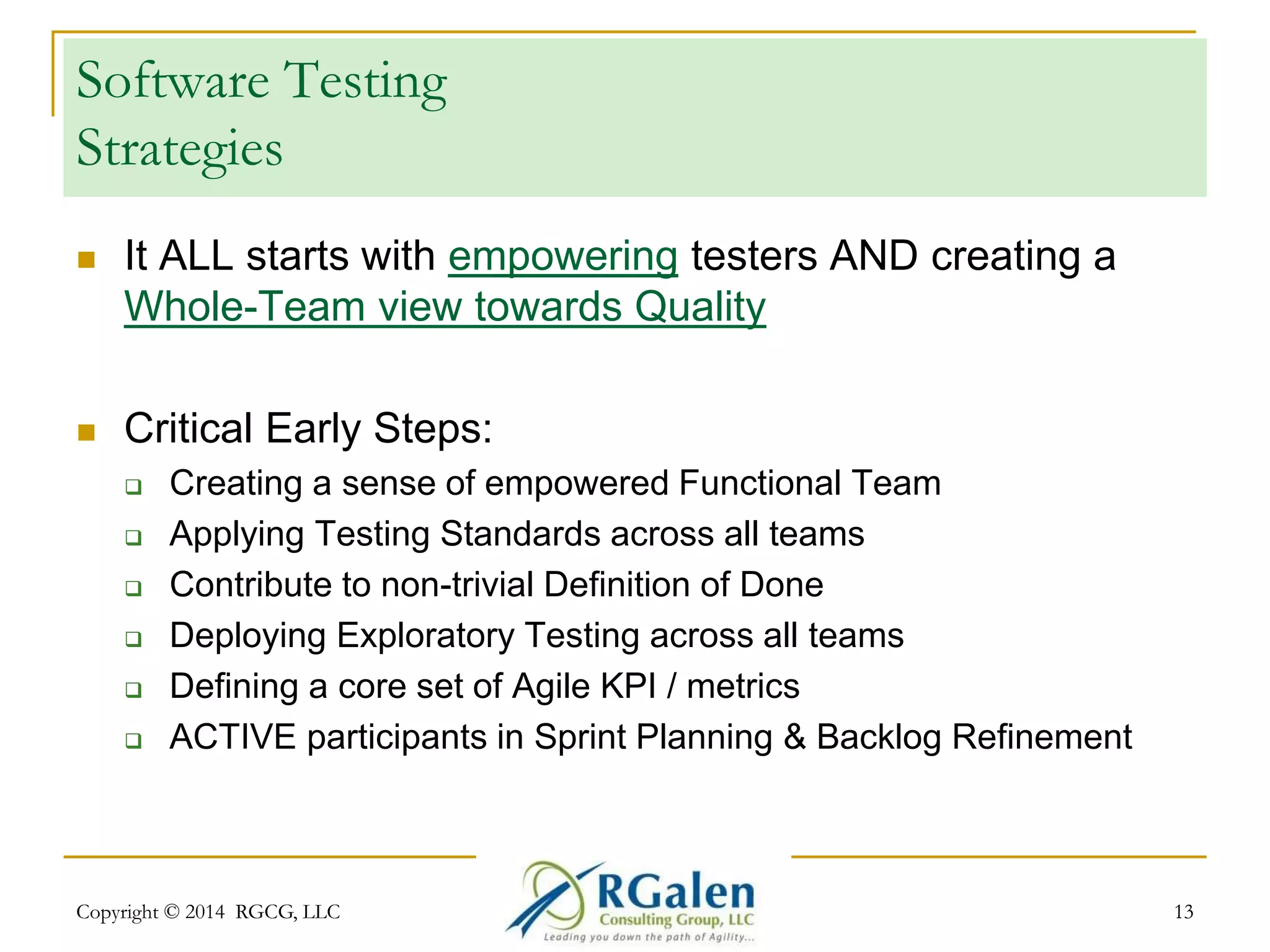
 It ALL starts with empowering testers AND creating a 
Whole-Team view towards Quality 
 Critical Early Steps: 
 Creating a sense of empowered Functional Team 
 Applying Testing Standards across all teams 
 Contribute to non-trivial Definition of Done 
 Deploying Exploratory Testing across all teams 
 Defining a core set of Agile KPI / metrics 
 ACTIVE participants in Sprint Planning & Backlog Refinement 
Copyright © 2014 RGCG, LLC 13
Cross-Functional Team Practices 
Strategies 
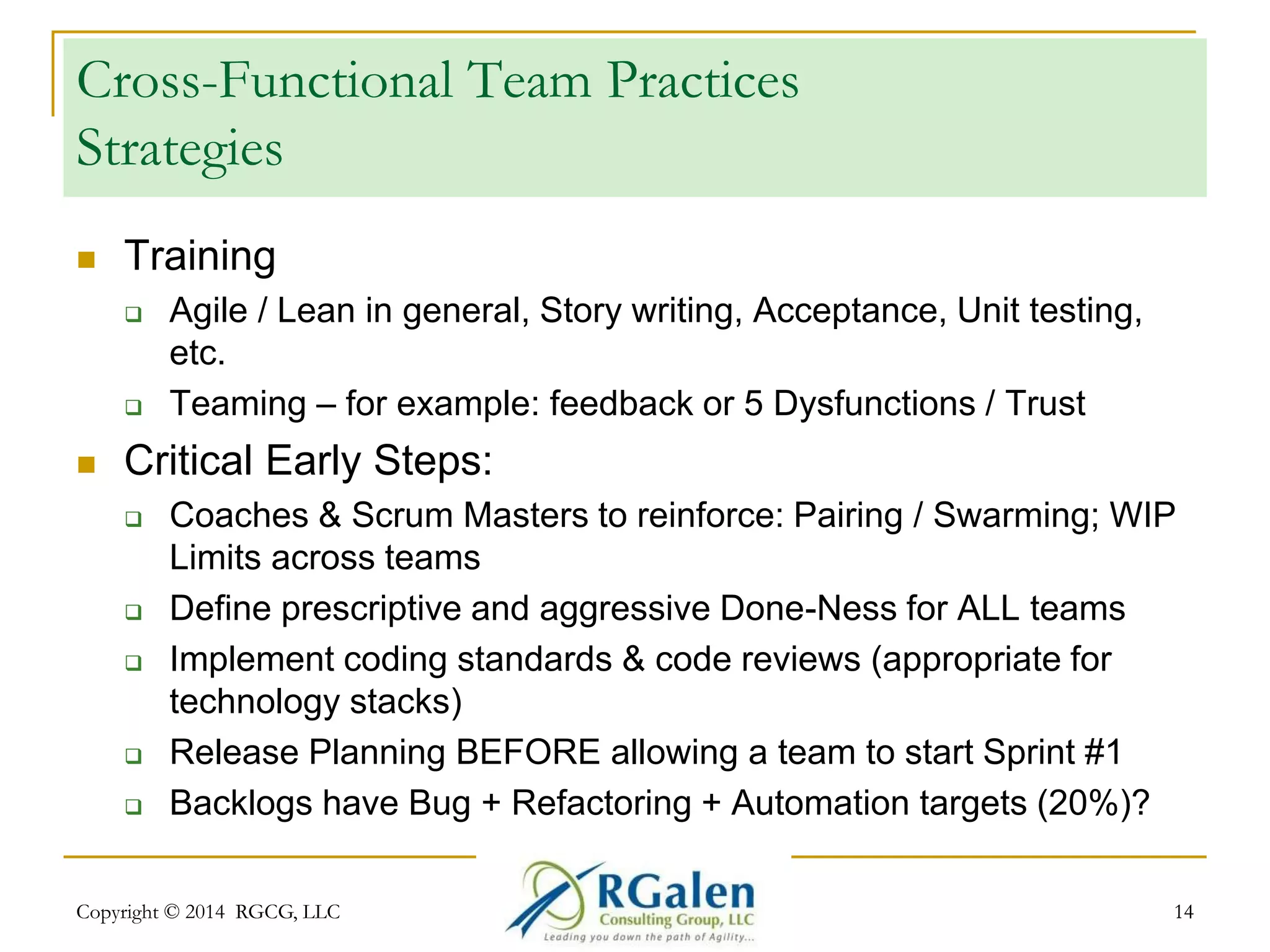
 Training 
 Agile / Lean in general, Story writing, Acceptance, Unit testing, 
etc. 
 Teaming – for example: feedback or 5 Dysfunctions / Trust 
 Critical Early Steps: 
 Coaches & Scrum Masters to reinforce: Pairing / Swarming; WIP 
Limits across teams 
 Define prescriptive and aggressive Done-Ness for ALL teams 
 Implement coding standards & code reviews (appropriate for 
technology stacks) 
 Release Planning BEFORE allowing a team to start Sprint #1 
 Backlogs have Bug + Refactoring + Automation targets (20%)? 
Copyright © 2014 RGCG, LLC 14
Organizational Quality 
Strategies - Tips 
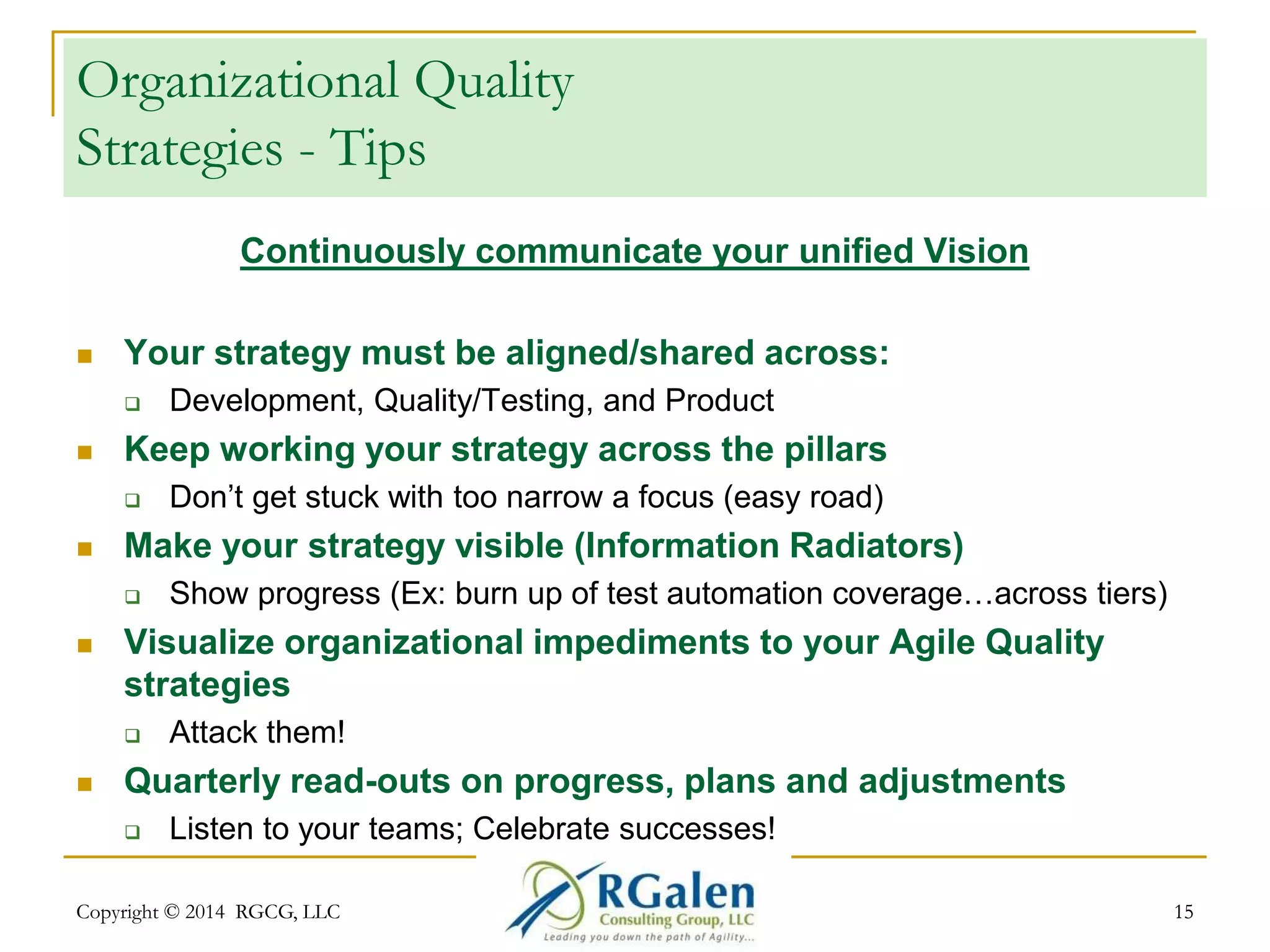
Continuously communicate your unified Vision 
 Your strategy must be aligned/shared across: 
 Development, Quality/Testing, and Product 
 Keep working your strategy across the pillars 
 Don’t get stuck with too narrow a focus (easy road) 
 Make your strategy visible (Information Radiators) 
 Show progress (Ex: burn up of test automation coverage…across tiers) 
 Visualize organizational impediments to your Agile Quality 
strategies 
 Attack them! 
 Quarterly read-outs on progress, plans and adjustments 
 Listen to your teams; Celebrate successes! 
Copyright © 2014 RGCG, LLC 15
3-Pillars of Agile Quality – QUESTIONS? 
Copyright © 2014 RGCG, LLC 
16 
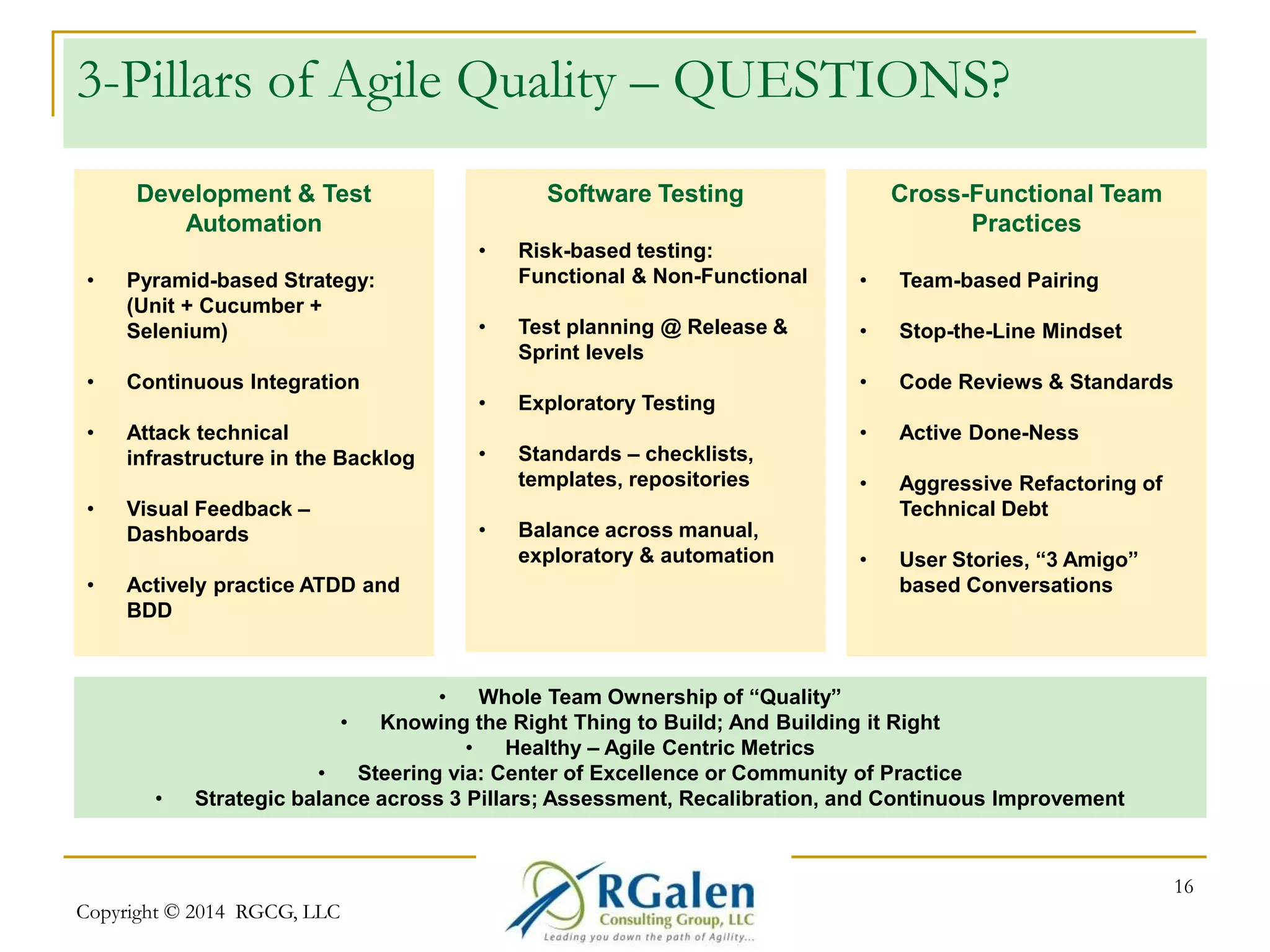
Development & Test 
Automation 
• Pyramid-based Strategy: 
(Unit + Cucumber + 
Selenium) 
• Continuous Integration 
• Attack technical 
infrastructure in the Backlog 
• Visual Feedback – 
Dashboards 
• Actively practice ATDD and 
BDD 
Software Testing 
• Risk-based testing: 
Functional & Non-Functional 
• Test planning @ Release & 
Sprint levels 
• Exploratory Testing 
• Standards – checklists, 
templates, repositories 
• Balance across manual, 
exploratory & automation 
Cross-Functional Team 
Practices 
• Team-based Pairing 
• Stop-the-Line Mindset 
• Code Reviews & Standards 
• Active Done-Ness 
• Aggressive Refactoring of 
Technical Debt 
• User Stories, “3 Amigo” 
based Conversations 
• Whole Team Ownership of “Quality” 
• Knowing the Right Thing to Build; And Building it Right 
• Healthy – Agile Centric Metrics 
• Steering via: Center of Excellence or Community of Practice 
• Strategic balance across 3 Pillars; Assessment, Recalibration, and Continuous Improvement
Contact Info 
Bob Galen 
Principal Consultant, 
RGalen Consulting Group, L.L.C. 
Experience-driven agile focused training, 
coaching & consulting 
Cell: (919) 272-0719 
bob@rgalen.com www.rgalen.com 
bgalen@velocitypartners.net www.velocitypartners.net 
Blogs 
Project Times - http://www.projecttimes.com/robert-galen/ 
BA Times - http://www.batimes.com/robert-galen/ 
Podcast on all things ‘agile’ - http://www.meta-cast.com/ 
Copyright © 2014 RGCG, LLC 17
Additional Topics 
Copyright © 2014 RGCG, LLC 18
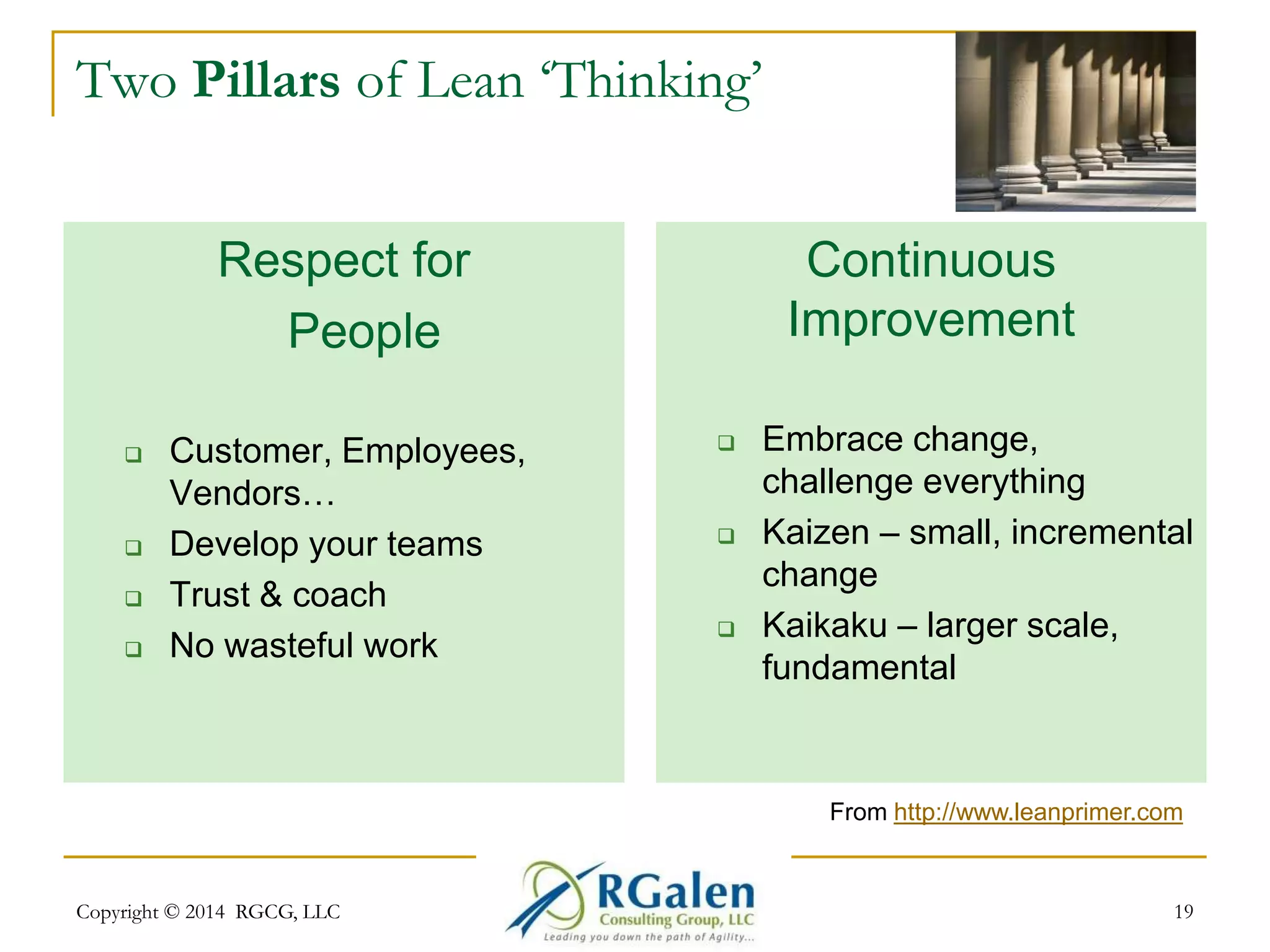
Two Pillars of Lean ‘Thinking’ 
Respect for 
People 
 Customer, Employees, 
Vendors… 
 Develop your teams 
 Trust & coach 
 No wasteful work 
Continuous 
Improvement 
 Embrace change, 
challenge everything 
 Kaizen – small, incremental 
change 
 Kaikaku – larger scale, 
fundamental 
From http://www.leanprimer.com 
19 
Copyright © 2014 RGCG, LLC
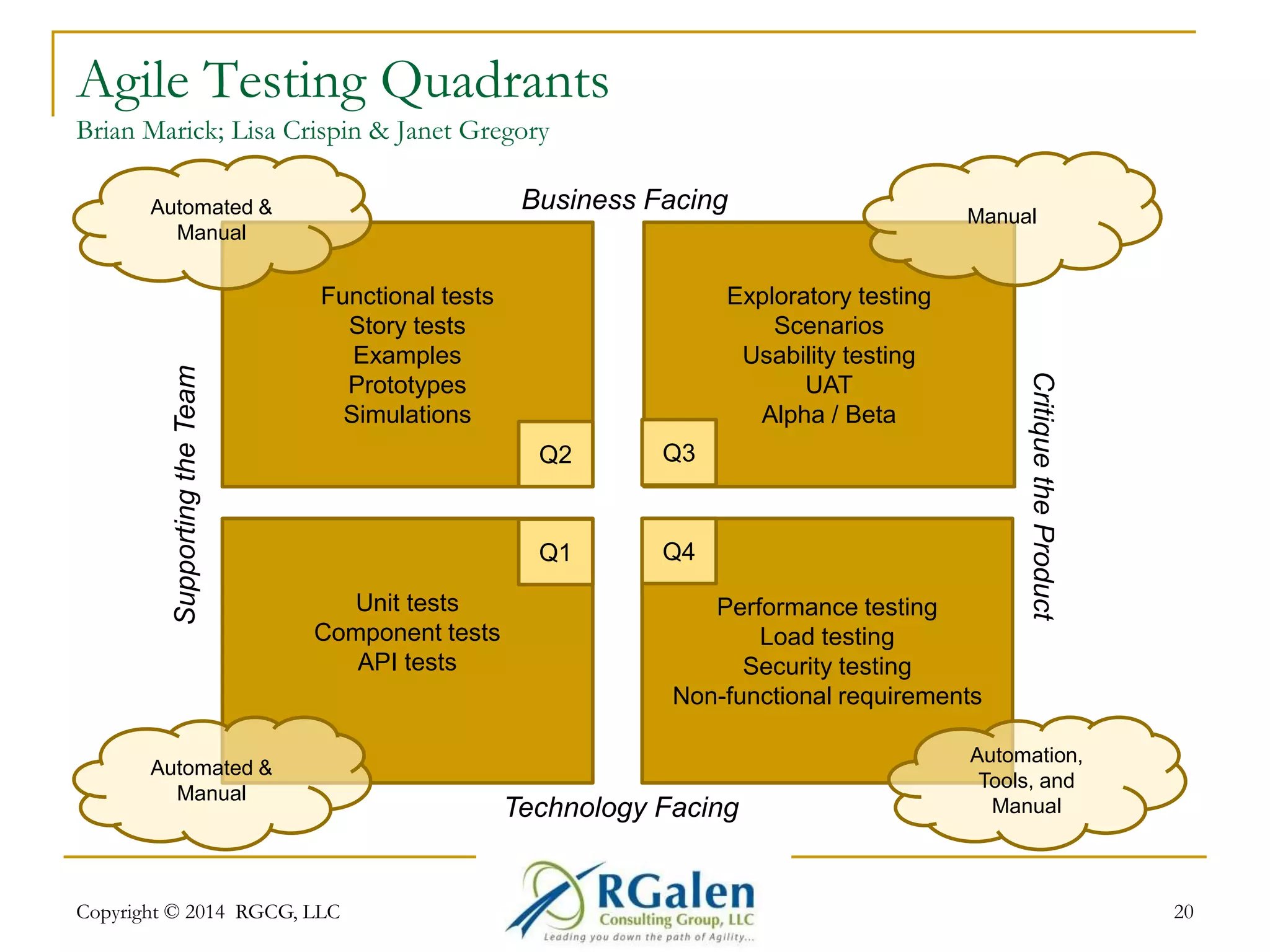
Agile Testing Quadrants 
Brian Marick; Lisa Crispin & Janet Gregory 
Business Facing 
Exploratory testing 
Scenarios 
Usability testing 
UAT 
Alpha / Beta 
Functional tests 
Story tests 
Examples 
Prototypes 
Simulations 
Unit tests 
Component tests 
API tests 
Performance testing 
Load testing 
Security testing 
Q2 Q3 
Q4 
Manual 
Non-functional requirements 
Q1 
Automated & 
Manual 
Supporting the Team 
Automated & 
Manual 
Critique the Product 
Automation, 
Tools, and 
Manual 
Technology Facing 
Copyright © 2014 RGCG, LLC 20
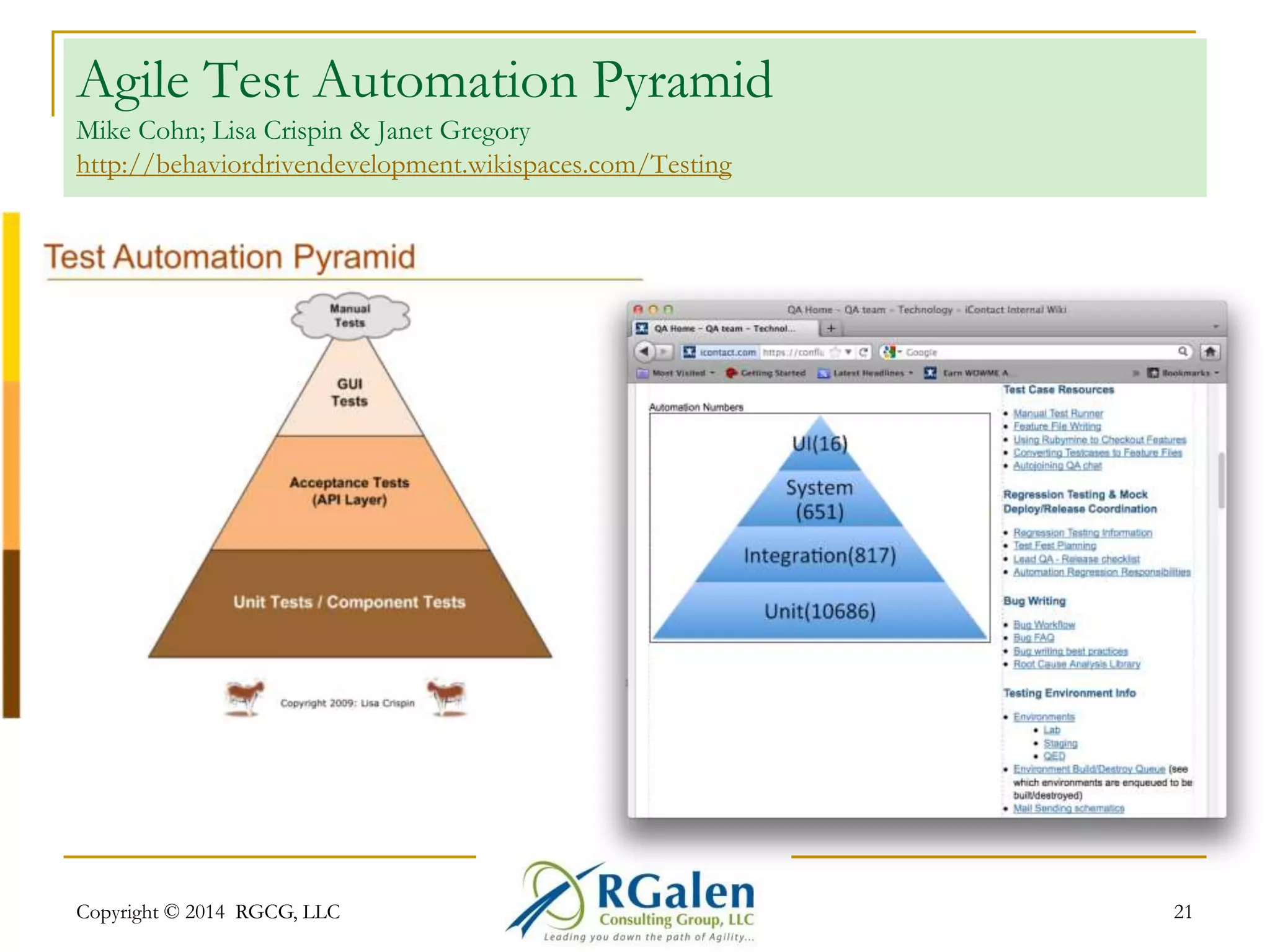
Agile Test Automation Pyramid 
Mike Cohn; Lisa Crispin & Janet Gregory 
http://behaviordrivendevelopment.wikispaces.com/Testing 
Copyright © 2014 RGCG, LLC 21
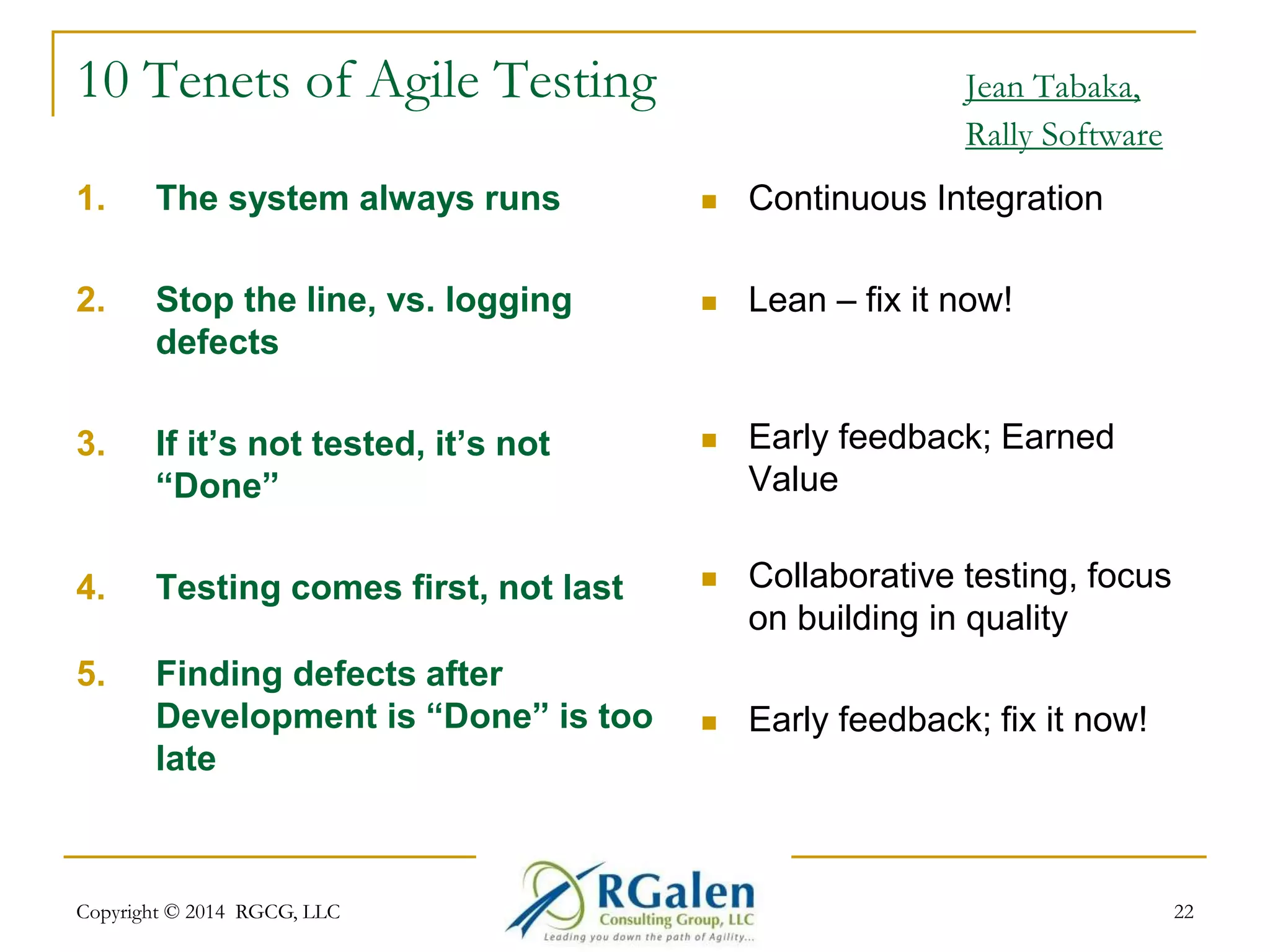
10 Tenets of Agile Testing Jean Tabaka, 
Rally Software 
1. The system always runs 
2. Stop the line, vs. logging 
defects 
3. If it’s not tested, it’s not 
“Done” 
4. Testing comes first, not last 
5. Finding defects after 
Development is “Done” is too 
late 
 Continuous Integration 
 Lean – fix it now! 
 Early feedback; Earned 
Value 
 Collaborative testing, focus 
on building in quality 
 Early feedback; fix it now! 
Copyright © 2014 RGCG, LLC 22
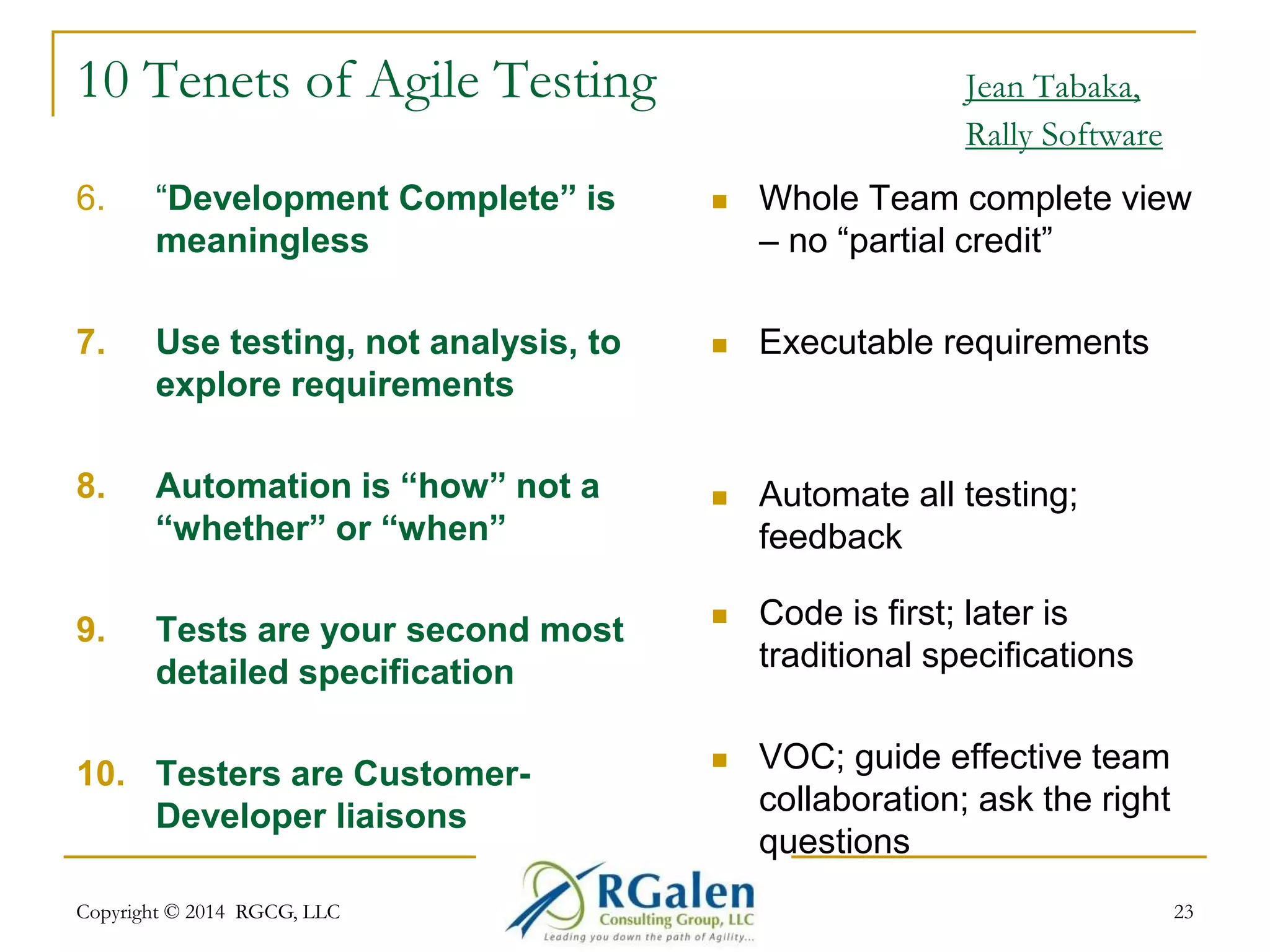
10 Tenets of Agile Testing Jean Tabaka, 
Rally Software 
6. “Development Complete” is 
meaningless 
7. Use testing, not analysis, to 
explore requirements 
8. Automation is “how” not a 
“whether” or “when” 
9. Tests are your second most 
detailed specification 
10. Testers are Customer- 
Developer liaisons 
 Whole Team complete view 
– no “partial credit” 
 Executable requirements 
 Automate all testing; 
feedback 
 Code is first; later is 
traditional specifications 
 VOC; guide effective team 
collaboration; ask the right 
questions 
Copyright © 2014 RGCG, LLC 23
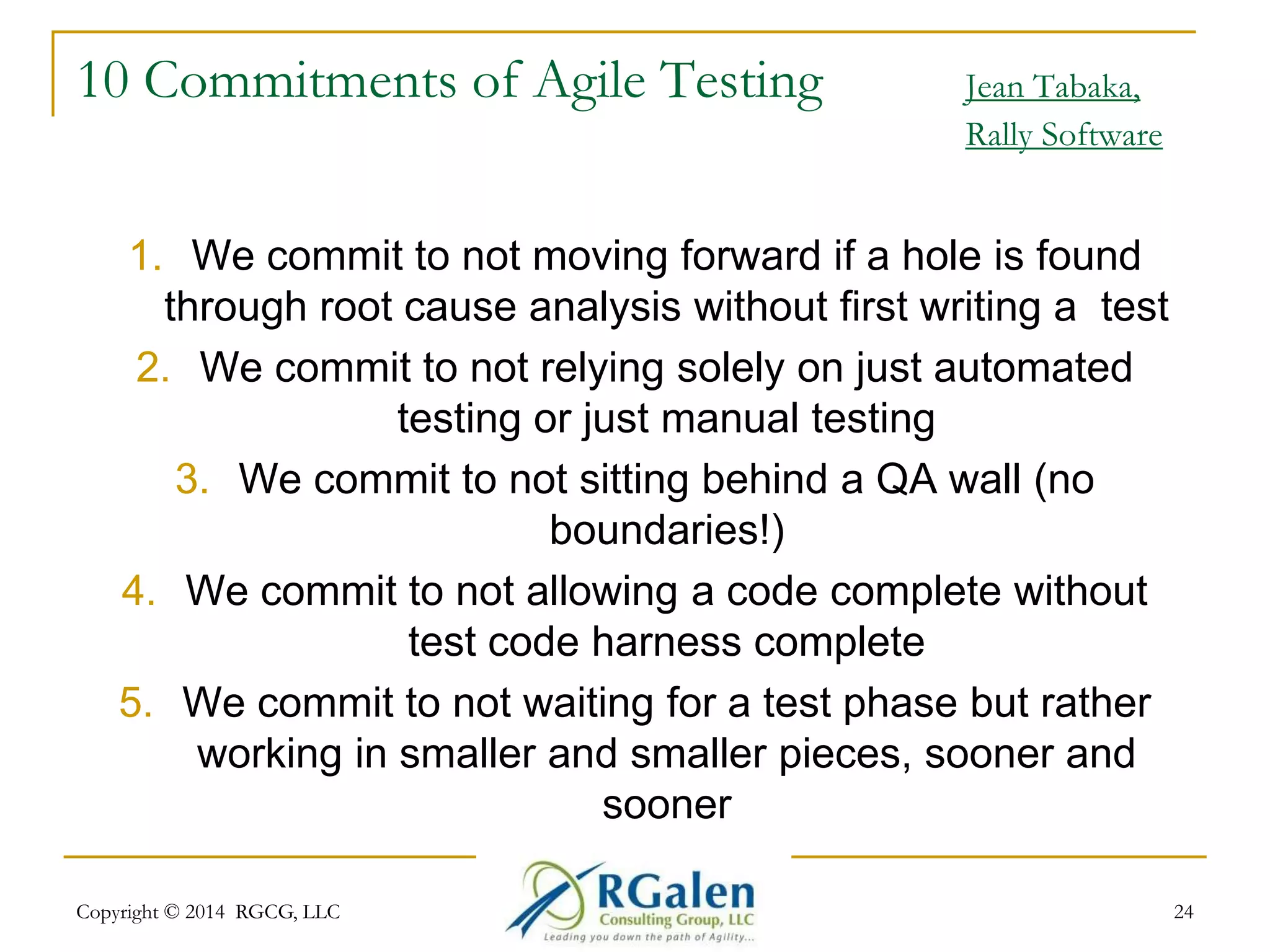
10 Commitments of Agile Testing Jean Tabaka, 
Rally Software 
1. We commit to not moving forward if a hole is found 
through root cause analysis without first writing a test 
2. We commit to not relying solely on just automated 
testing or just manual testing 
3. We commit to not sitting behind a QA wall (no 
boundaries!) 
4. We commit to not allowing a code complete without 
test code harness complete 
5. We commit to not waiting for a test phase but rather 
working in smaller and smaller pieces, sooner and 
sooner 
Copyright © 2014 RGCG, LLC 24
10 Commitments of Agile Testing Jean Tabaka, 
Rally Software 
6. We commit to not testing one iteration after 
development is “Done” 
7. We commit to not allowing surprises to accumulate for 
large end-to-end testing (“mock it now”) 
8. We commit to not leaving the riskiest tests to the end 
9. We commit to being an equal participant with the 
customer and the developer in defining “Doneness” 
10.We commit to not taking this oath lightly 
Copyright © 2014 RGCG, LLC 25

The 3 Pillars Approach to Agile Testing Strategy with Bob Galen & Mary Thorn

  • 1.
    The Three PillarsApproach to Your Agile Test Strategy Bob Galen President & Principal Consultant RGCG, LLC bob@rgalen.com
  • 2.
    Introduction Bob Galen  Independent Agile Coach (CSC) at RGCG, LLC  Principle Agile Evangelist at Velocity Partners  Somewhere ‘north’ of 30 years overall experience   Wide variety of technical stacks and business domains  Developer first, then Project Management / Leadership, then Testing  Senior/Executive software development leadership for 20 years  Practicing formal agility since 2000  XP, Lean, Scrum, and Kanban experience  From Cary, North Carolina  Connect w/ me via LinkedIn and Twitter @bobgalen Bias Disclaimer: Agile is THE BEST Methodology for Software Development… However, NOT a Silver Bullet! Copyright © 2014 RGCG, LLC 2
  • 3.
    Copyright © 2014RGCG, LLC 3
  • 4.
    Introduction Mary Thorn  Mary Thorn is the Director of QA and Agile Coach at ChannelAdvisor in Morrisville, North Carolina,  Mary has a broad testing background that spans automation, data warehouses, and web-based systems in a wide variety of technologies and testing techniques.  During her more than fifteen years of experience in healthcare, HR, agriculture, and SaaS-based products,  Mary has held manager and contributor level positions in software development organizations.  She has a strong interest in agile testing methodologies and direct experience leading agile teams through Scrum adoption & beyond. Copyright © 2014 RGCG, LLC 4
  • 5.
    Agile Testing &Quality Let’s explore your strategies?  What are your current strategies towards:  Software testing?  And towards quality?  How are they “linked” together?  Anything missing?  How does it “fit” with your overall agile strategy?  Get together in “pairs” and chat about this for 5-10 minutes.  Then we’ll gather your results… Copyright © 2014 RGCG, LLC 5
  • 6.
    3-Pillars Genesis First of all, I’ve seen way too many teams who are just “testing” in agile teams without a map or a plan for improvement  I’ve also seen that Agile Adoption is mostly a developer-centric or technology-centric play. They “drive” and testing is “along for the ride”.  Seatbelts please!  And where’s the focus on “Quality”?  And the how or practices & tactics Copyright © 2014 RGCG, LLC 6
  • 7.
    3-Pillars Genesis I’ve learned that “Balance” is important  A sad tale of:  Thousands of ATDD testing; Gherkin run amok  All of them are working; continuously testing; increasing “coverage’ and life is Good!  BUT  These same teams couldn’t write a cohesive User Story to save their life  So, where were the Acceptance Tests coming from? Copyright © 2014 RGCG, LLC 7
  • 8.
    3-Pillars of AgileQuality Copyright © 2014 RGCG, LLC 8 Development & Test Automation • Pyramid-based Strategy: (Unit + Cucumber + Selenium) • Continuous Integration • Attack technical infrastructure in the Backlog • Visual Feedback – Dashboards • Actively practice ATDD and BDD Software Testing • Risk-based testing: Functional & Non-Functional • Test planning @ Release & Sprint levels • Exploratory Testing • Standards – checklists, templates, repositories • Balance across manual, exploratory & automation Cross-Functional Team Practices • Team-based Pairing • Stop-the-Line Mindset • Code Reviews & Standards • Active Done-Ness • Aggressive Refactoring of Technical Debt • User Stories, “3 Amigo” based Conversations • Whole Team Ownership of “Quality” • Knowing the Right Thing to Build; And Building it Right • Healthy – Agile Centric Metrics • Steering via: Center of Excellence or Community of Practice • Strategic balance across 3 Pillars; Assessment, Recalibration, and Continuous Improvement
  • 9.
    Foundation of the3-Pillars Copyright © 2014 RGCG, LLC 9 • Whole Team Ownership of “Quality” • Knowing the “Right” thing to Build AND Building it “Right” • Healthy – Agile Centric Metrics • Steering Required – CoE or CoP • Strategic balance across 3 Pillars; Assessment, Recalibration, and Continuous Improvement • Whole team view includes building it right, everyone tests, everyone demo’s, etc. • Focus on features/stories, confirmation, conversation, and getting them staged properly OVER testing • 4-tier metrics: Quality, Value, Prediction, Team • Agile strategies need light-handed “steering”; establish a CoE (heavier weight) or a CoP (lightweight) • Consider finding an assessment framework and then tying it to your strategy measurement, recalibration, and continuous improvement. • Make the foundation visible thru information radiators and metrics
  • 10.
    3-Pillars of AgileQuality Copyright © 2014 RGCG, LLC 10 Development & Test Automation • Pyramid-based Strategy: (Unit + Cucumber + Selenium) • Continuous Integration • Attack technical infrastructure in the Backlog • Visual Feedback – Dashboards • Actively practice ATDD and BDD A central part of agile adoption is focusing on CI, 3- tiered Automation development, and Dashboards to begin incrementally building coverage for faster feedback on changes. 100% automation is NOT the Goal! In the interim, Hardening or Stabilization Sprints and having a risk-based Release Train concept help It’s important that Test or QA not ‘own’ the tooling or all of the automation efforts. The strategy can come from QA, but the tactical automation development is best left to the team. Mature teams invest in Automation, Tooling, and Technical Debt reduction as part of Done-ness and continually add it to their backlogs
  • 11.
    3-Pillars of AgileQuality Copyright © 2014 RGCG, LLC 11 Software Testing • Risk-based testing: Functional & Non- Functional • Test planning @ Release & Sprint levels • Exploratory Testing • Standards – checklists, templates, repositories • Balance across manual, exploratory & automation Exploratory Testing (SBET with pairing) can be an incredibly effective way to establish a whole-team, collaborative view towards quality and testing. It also emerges new tests. Leverage ‘plans’ as a whole-team collaboration-conversation mechanism; at Sprint and Release levels. Do not measure testing or tester progress; instead, measure throughput, output, sprint outcomes, and done-ness escapes at a team level. You need a balanced test team; not everyone needs to be able to program. But everyone needs to be passionately skilled testers with curiosity. Agile testing is a Risk-Based play in every Sprint and across a release sequence.
  • 12.
    3-Pillars of AgileQuality Copyright © 2014 RGCG, LLC 12 Cross-Functional Team Practices • Team-based Pairing • Stop-the-Line Mindset • Code Reviews & Standards • Active Done-Ness • Aggressive Refactoring of Technical Debt • User Stories – 3 Amigo based Conversations One of the hardest areas to get ‘right’ culturally. It needs leadership alignment from Quality/Testing to Product to Development and a consistent voice of whole-team approaches. This is where LEAN Thinking lives, where whole-team collaboration happens, where professionalism and craftsmanship are held dear. I like the view of testers becoming the VOC, champions of quality, and consistent questioners of what is being build. Are we solving the right problems…as simply as possible. Notions of Minimal Viable Product / Feature help with focus. And yes Virginia, there ARE standards, templates, and a focus on x-team consistency!
  • 13.
    Software Testing Strategies  It ALL starts with empowering testers AND creating a Whole-Team view towards Quality  Critical Early Steps:  Creating a sense of empowered Functional Team  Applying Testing Standards across all teams  Contribute to non-trivial Definition of Done  Deploying Exploratory Testing across all teams  Defining a core set of Agile KPI / metrics  ACTIVE participants in Sprint Planning & Backlog Refinement Copyright © 2014 RGCG, LLC 13
  • 14.
    Cross-Functional Team Practices Strategies  Training  Agile / Lean in general, Story writing, Acceptance, Unit testing, etc.  Teaming – for example: feedback or 5 Dysfunctions / Trust  Critical Early Steps:  Coaches & Scrum Masters to reinforce: Pairing / Swarming; WIP Limits across teams  Define prescriptive and aggressive Done-Ness for ALL teams  Implement coding standards & code reviews (appropriate for technology stacks)  Release Planning BEFORE allowing a team to start Sprint #1  Backlogs have Bug + Refactoring + Automation targets (20%)? Copyright © 2014 RGCG, LLC 14
  • 15.
    Organizational Quality Strategies- Tips Continuously communicate your unified Vision  Your strategy must be aligned/shared across:  Development, Quality/Testing, and Product  Keep working your strategy across the pillars  Don’t get stuck with too narrow a focus (easy road)  Make your strategy visible (Information Radiators)  Show progress (Ex: burn up of test automation coverage…across tiers)  Visualize organizational impediments to your Agile Quality strategies  Attack them!  Quarterly read-outs on progress, plans and adjustments  Listen to your teams; Celebrate successes! Copyright © 2014 RGCG, LLC 15
  • 16.
    3-Pillars of AgileQuality – QUESTIONS? Copyright © 2014 RGCG, LLC 16 Development & Test Automation • Pyramid-based Strategy: (Unit + Cucumber + Selenium) • Continuous Integration • Attack technical infrastructure in the Backlog • Visual Feedback – Dashboards • Actively practice ATDD and BDD Software Testing • Risk-based testing: Functional & Non-Functional • Test planning @ Release & Sprint levels • Exploratory Testing • Standards – checklists, templates, repositories • Balance across manual, exploratory & automation Cross-Functional Team Practices • Team-based Pairing • Stop-the-Line Mindset • Code Reviews & Standards • Active Done-Ness • Aggressive Refactoring of Technical Debt • User Stories, “3 Amigo” based Conversations • Whole Team Ownership of “Quality” • Knowing the Right Thing to Build; And Building it Right • Healthy – Agile Centric Metrics • Steering via: Center of Excellence or Community of Practice • Strategic balance across 3 Pillars; Assessment, Recalibration, and Continuous Improvement
  • 17.
    Contact Info BobGalen Principal Consultant, RGalen Consulting Group, L.L.C. Experience-driven agile focused training, coaching & consulting Cell: (919) 272-0719 bob@rgalen.com www.rgalen.com bgalen@velocitypartners.net www.velocitypartners.net Blogs Project Times - http://www.projecttimes.com/robert-galen/ BA Times - http://www.batimes.com/robert-galen/ Podcast on all things ‘agile’ - http://www.meta-cast.com/ Copyright © 2014 RGCG, LLC 17
  • 18.
    Additional Topics Copyright© 2014 RGCG, LLC 18
  • 19.
    Two Pillars ofLean ‘Thinking’ Respect for People  Customer, Employees, Vendors…  Develop your teams  Trust & coach  No wasteful work Continuous Improvement  Embrace change, challenge everything  Kaizen – small, incremental change  Kaikaku – larger scale, fundamental From http://www.leanprimer.com 19 Copyright © 2014 RGCG, LLC
  • 20.
    Agile Testing Quadrants Brian Marick; Lisa Crispin & Janet Gregory Business Facing Exploratory testing Scenarios Usability testing UAT Alpha / Beta Functional tests Story tests Examples Prototypes Simulations Unit tests Component tests API tests Performance testing Load testing Security testing Q2 Q3 Q4 Manual Non-functional requirements Q1 Automated & Manual Supporting the Team Automated & Manual Critique the Product Automation, Tools, and Manual Technology Facing Copyright © 2014 RGCG, LLC 20
  • 21.
    Agile Test AutomationPyramid Mike Cohn; Lisa Crispin & Janet Gregory http://behaviordrivendevelopment.wikispaces.com/Testing Copyright © 2014 RGCG, LLC 21
  • 22.
    10 Tenets ofAgile Testing Jean Tabaka, Rally Software 1. The system always runs 2. Stop the line, vs. logging defects 3. If it’s not tested, it’s not “Done” 4. Testing comes first, not last 5. Finding defects after Development is “Done” is too late  Continuous Integration  Lean – fix it now!  Early feedback; Earned Value  Collaborative testing, focus on building in quality  Early feedback; fix it now! Copyright © 2014 RGCG, LLC 22
  • 23.
    10 Tenets ofAgile Testing Jean Tabaka, Rally Software 6. “Development Complete” is meaningless 7. Use testing, not analysis, to explore requirements 8. Automation is “how” not a “whether” or “when” 9. Tests are your second most detailed specification 10. Testers are Customer- Developer liaisons  Whole Team complete view – no “partial credit”  Executable requirements  Automate all testing; feedback  Code is first; later is traditional specifications  VOC; guide effective team collaboration; ask the right questions Copyright © 2014 RGCG, LLC 23
  • 24.
    10 Commitments ofAgile Testing Jean Tabaka, Rally Software 1. We commit to not moving forward if a hole is found through root cause analysis without first writing a test 2. We commit to not relying solely on just automated testing or just manual testing 3. We commit to not sitting behind a QA wall (no boundaries!) 4. We commit to not allowing a code complete without test code harness complete 5. We commit to not waiting for a test phase but rather working in smaller and smaller pieces, sooner and sooner Copyright © 2014 RGCG, LLC 24
  • 25.
    10 Commitments ofAgile Testing Jean Tabaka, Rally Software 6. We commit to not testing one iteration after development is “Done” 7. We commit to not allowing surprises to accumulate for large end-to-end testing (“mock it now”) 8. We commit to not leaving the riskiest tests to the end 9. We commit to being an equal participant with the customer and the developer in defining “Doneness” 10.We commit to not taking this oath lightly Copyright © 2014 RGCG, LLC 25

Editor's Notes

  • #20 http://en.wikipedia.org/wiki/Kaikaku http://en.wikipedia.org/wiki/Kaizen