Overall Document Preparation
forNBA – An Overview
Date: 5/12/2020
Dr T M Inba Malar M.E, Ph.D
Professor/ECE
RMK College of Engineering and
Technology
2.
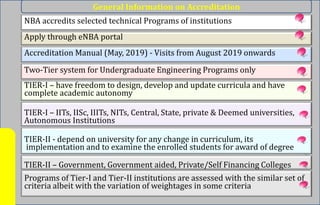
NBA accredits selectedtechnical Programs of institutions
Apply through eNBA portal
Accreditation Manual (May, 2019) - Visits from August 2019 onwards
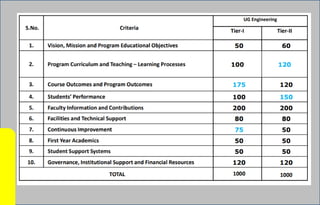
Two-Tier system for Undergraduate Engineering Programs only
TIER-I – have freedom to design, develop and update curricula and have
complete academic autonomy
TIER-I – IITs, IISc, IIITs, NITs, Central, State, private & Deemed universities,
Autonomous Institutions
General Information on Accreditation
TIER-II – Government, Government aided, Private/Self Financing Colleges
Programs of Tier-I and Tier-II institutions are assessed with the similar set of
criteria albeit with the variation of weightages in some criteria
TIER-II - depend on university for any change in curriculum, its
implementation and to examine the enrolled students for award of degree
3.
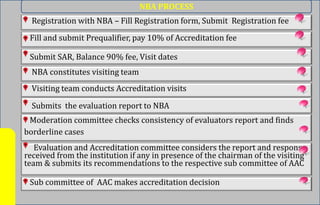
Registration with NBA– Fill Registration form, Submit Registration fee
Fill and submit Prequalifier, pay 10% of Accreditation fee
Submit SAR, Balance 90% fee, Visit dates
NBA constitutes visiting team
Visiting team conducts Accreditation visits
Submits the evaluation report to NBA
NBA PROCESS
Evaluation and Accreditation committee considers the report and response
received from the institution if any in presence of the chairman of the visiting
team & submits its recommendations to the respective sub committee of AAC
Sub committee of AAC makes accreditation decision
Moderation committee checks consistency of evaluators report and finds
borderline cases
4.
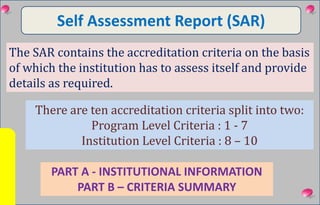
Self Assessment Report(SAR)
PART A - INSTITUTIONAL INFORMATION
PART B – CRITERIA SUMMARY
The SAR contains the accreditation criteria on the basis
of which the institution has to assess itself and provide
details as required.
There are ten accreditation criteria split into two:
Program Level Criteria : 1 - 7
Institution Level Criteria : 8 – 10
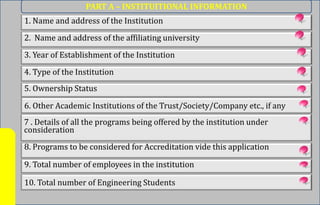
1. Name andaddress of the Institution
2. Name and address of the affiliating university
3. Year of Establishment of the Institution
4. Type of the Institution
5. Ownership Status
6. Other Academic Institutions of the Trust/Society/Company etc., if any
PART A – INSTITUITIONAL INFORMATION
8. Programs to be considered for Accreditation vide this application
9. Total number of employees in the institution
10. Total number of Engineering Students
7 . Details of all the programs being offered by the institution under
consideration
7.
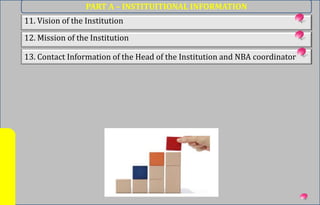
11. Vision ofthe Institution
12. Mission of the Institution
13. Contact Information of the Head of the Institution and NBA coordinator
PART A – INSTITUITIONAL INFORMATION
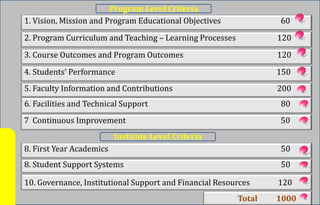
1. Vision, Missionand Program Educational Objectives 60
2. Program Curriculum and Teaching – Learning Processes 120
3. Course Outcomes and Program Outcomes 120
4. Students’ Performance 150
5. Faculty Information and Contributions 200
6. Facilities and Technical Support 80
Program Level Criteria
8. First Year Academics 50
8. Student Support Systems 50
10. Governance, Institutional Support and Financial Resources 120
Institute Level Criteria
Total 1000
7 Continuous Improvement 50
11.
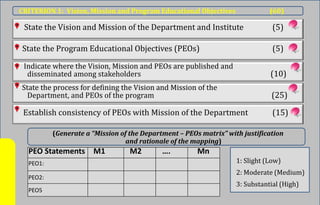
State the Visionand Mission of the Department and Institute (5)
State the Program Educational Objectives (PEOs) (5)
Indicate where the Vision, Mission and PEOs are published and
disseminated among stakeholders (10)
State the process for defining the Vision and Mission of the
Department, and PEOs of the program (25)
Establish consistency of PEOs with Mission of the Department (15)
CRITERION 1: Vision, Mission and Program Educational Objectives (60)
PEO Statements M1 M2 …. Mn
PEO1:
PEO2:
PEO5
1: Slight (Low)
2: Moderate (Medium)
3: Substantial (High)
(Generate a “Mission of the Department – PEOs matrix” with justification
and rationale of the mapping)
12.
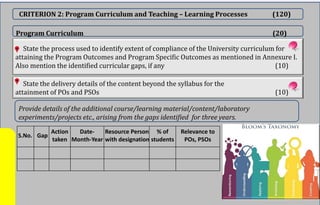
State the processused to identify extent of compliance of the University curriculum for
attaining the Program Outcomes and Program Specific Outcomes as mentioned in Annexure I.
Also mention the identified curricular gaps, if any (10)
State the delivery details of the content beyond the syllabus for the
attainment of POs and PSOs (10)
CRITERION 2: Program Curriculum and Teaching – Learning Processes (120)
Provide details of the additional course/learning material/content/laboratory
experiments/projects etc., arising from the gaps identified for three years.
Program Curriculum (20)
S.No. Gap
Action
taken
Date-
Month-Year
Resource Person
with designation
% of
students
Relevance to
POs, PSOs
13.
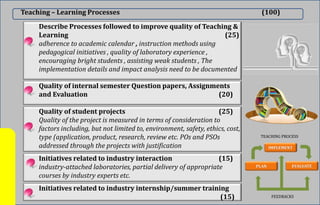
Teaching – LearningProcesses (100)
Describe Processes followed to improve quality of Teaching &
Learning (25)
adherence to academic calendar , instruction methods using
pedagogical initiatives , quality of laboratory experience ,
encouraging bright students , assisting weak students , The
implementation details and impact analysis need to be documented
Quality of internal semester Question papers, Assignments
and Evaluation (20)
Quality of student projects (25)
Quality of the project is measured in terms of consideration to
factors including, but not limited to, environment, safety, ethics, cost,
type (application, product, research, review etc. POs and PSOs
addressed through the projects with justification
Initiatives related to industry interaction (15)
industry-attached laboratories, partial delivery of appropriate
courses by industry experts etc.
Initiatives related to industry internship/summer training
(15)
IMPLEMENT
EVALUATE
PLAN
FEEDBACKS
TEACHING PROCESS
14.
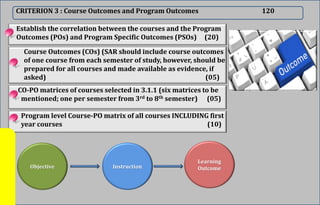
CRITERION 3 :Course Outcomes and Program Outcomes 120
(100)
Establish the correlation between the courses and the Program
Outcomes (POs) and Program Specific Outcomes (PSOs) (20)
CO-PO matrices of courses selected in 3.1.1 (six matrices to be
mentioned; one per semester from 3rd to 8th semester) (05)
Program level Course-PO matrix of all courses INCLUDING first
year courses (10)
Course Outcomes (COs) (SAR should include course outcomes
of one course from each semester of study, however, should be
prepared for all courses and made available as evidence, if
asked) (05)
Objective Instruction
Learning
Outcome
15.
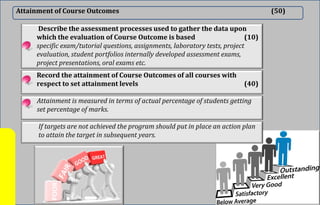
Attainment of CourseOutcomes (50)
(100)
Describe the assessment processes used to gather the data upon
which the evaluation of Course Outcome is based (10)
specific exam/tutorial questions, assignments, laboratory tests, project
evaluation, student portfolios internally developed assessment exams,
project presentations, oral exams etc.
Attainment is measured in terms of actual percentage of students getting
set percentage of marks.
Record the attainment of Course Outcomes of all courses with
respect to set attainment levels (40)
If targets are not achieved the program should put in place an action plan
to attain the target in subsequent years.
16.
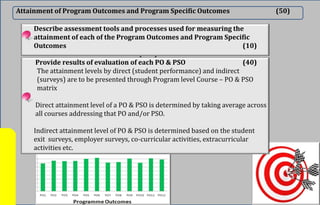
Attainment of ProgramOutcomes and Program Specific Outcomes (50)
(100)
Describe assessment tools and processes used for measuring the
attainment of each of the Program Outcomes and Program Specific
Outcomes (10)
Provide results of evaluation of each PO & PSO (40)
The attainment levels by direct (student performance) and indirect
(surveys) are to be presented through Program level Course – PO & PSO
matrix
Direct attainment level of a PO & PSO is determined by taking average across
all courses addressing that PO and/or PSO.
Indirect attainment level of PO & PSO is determined based on the student
exit surveys, employer surveys, co-curricular activities, extracurricular
activities etc.
17.
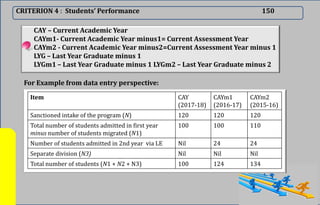
CRITERION 4 :Students’ Performance 150
CAY – Current Academic Year
CAYm1- Current Academic Year minus1= Current Assessment Year
CAYm2 - Current Academic Year minus2=Current Assessment Year minus 1
LYG – Last Year Graduate minus 1
LYGm1 – Last Year Graduate minus 1 LYGm2 – Last Year Graduate minus 2
For Example from data entry perspective:
Item CAY
(2017-18)
CAYm1
(2016-17)
CAYm2
(2015-16)
Sanctioned intake of the program (N) 120 120 120
Total number of students admitted in first year
minus number of students migrated (N1)
100 100 110
Number of students admitted in 2nd year via LE Nil 24 24
Separate division (N3) Nil Nil Nil
Total number of students (N1 + N2 + N3) 100 124 134
18.
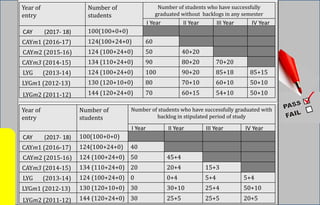
Year of
entry
Number of
students
Numberof students who have successfully
graduated without backlogs in any semester
I Year II Year III Year IV Year
CAY (2017- 18) 100(100+0+0)
CAYm1 (2016-17) 124(100+24+0) 60
CAYm2 (2015-16) 124 (100+24+0) 50 40+20
CAYm3 (2014-15) 134 (110+24+0) 90 80+20 70+20
LYG (2013-14) 124 (100+24+0) 100 90+20 85+18 85+15
LYGm1 (2012-13) 130 (120+10+0) 80 70+10 60+10 50+10
LYGm2 (2011-12) 144 (120+24+0) 70 60+15 54+10 50+10
Year of
entry
Number of
students
Number of students who have successfully graduated with
backlog in stipulated period of study
I Year II Year III Year IV Year
CAY (2017- 18) 100(100+0+0)
CAYm1 (2016-17) 124(100+24+0) 40
CAYm2 (2015-16) 124 (100+24+0) 50 45+4
CAYm3 (2014-15) 134 (110+24+0) 20 20+4 15+3
LYG (2013-14) 124 (100+24+0) 0 0+4 5+4 5+4
LYGm1 (2012-13) 130 (120+10+0) 30 30+10 25+4 50+10
LYGm2 (2011-12) 144 (120+24+0) 30 25+5 25+5 20+5
19.
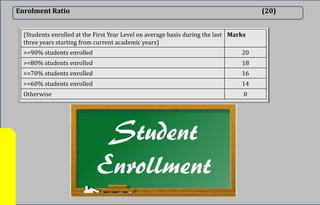
Enrolment Ratio (20)
(Studentsenrolled at the First Year Level on average basis during the last
three years starting from current academic years)
Marks
>=90% students enrolled 20
>=80% students enrolled 18
>=70% students enrolled 16
>=60% students enrolled 14
Otherwise 0
20.
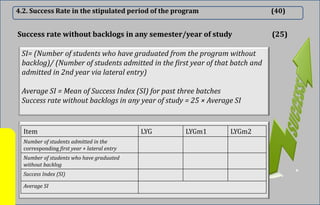
4.2. Success Ratein the stipulated period of the program (40)
SI= (Number of students who have graduated from the program without
backlog)/ (Number of students admitted in the first year of that batch and
admitted in 2nd year via lateral entry)
Average SI = Mean of Success Index (SI) for past three batches
Success rate without backlogs in any year of study = 25 × Average SI
Success rate without backlogs in any semester/year of study (25)
Item LYG LYGm1 LYGm2
Number of students admitted in the
corresponding first year + lateral entry
Number of students who have graduated
without backlog
Success Index (SI)
Average SI
21.
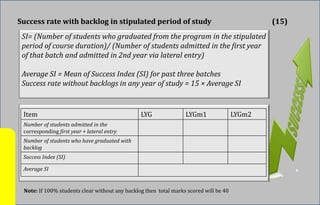
SI= (Number ofstudents who graduated from the program in the stipulated
period of course duration)/ (Number of students admitted in the first year
of that batch and admitted in 2nd year via lateral entry)
Average SI = Mean of Success Index (SI) for past three batches
Success rate without backlogs in any year of study = 15 × Average SI
Success rate with backlog in stipulated period of study (15)
Item LYG LYGm1 LYGm2
Number of students admitted in the
corresponding first year + lateral entry
Number of students who have graduated with
backlog
Success Index (SI)
Average SI
Note: If 100% students clear without any backlog then total marks scored will be 40
22.
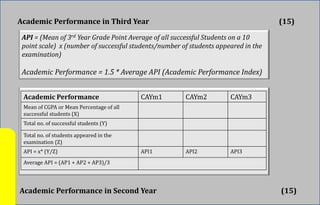
API = (Meanof 3rd Year Grade Point Average of all successful Students on a 10
point scale) x (number of successful students/number of students appeared in the
examination)
Academic Performance = 1.5 * Average API (Academic Performance Index)
Academic Performance in Third Year (15)
Academic Performance CAYm1 CAYm2 CAYm3
Mean of CGPA or Mean Percentage of all
successful students (X)
Total no. of successful students (Y)
Total no. of students appeared in the
examination (Z)
API = x* (Y/Z) API1 API2 API3
Average API = (AP1 + AP2 + AP3)/3
Academic Performance in Second Year (15)
23.
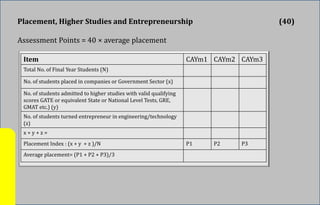
Placement, Higher Studiesand Entrepreneurship (40)
Assessment Points = 40 × average placement
Item CAYm1 CAYm2 CAYm3
Total No. of Final Year Students (N)
No. of students placed in companies or Government Sector (x)
No. of students admitted to higher studies with valid qualifying
scores GATE or equivalent State or National Level Tests, GRE,
GMAT etc.) (y)
No. of students turned entrepreneur in engineering/technology
(z)
x + y + z =
Placement Index : (x + y + z )/N P1 P2 P3
Average placement= (P1 + P2 + P3)/3
24.
Professional Activities (20)
Professionalsocieties/chapters and organizing engineering events (5)
(The Department shall provide relevant details)
Publication of technical magazines, newsletters, etc. (5)
(The Department shall list the publications mentioned earlier along with the
names of the editors, publishers, etc.)
Participation in inter-institute events by students of the program of
study (10)
(The Department shall provide a table indicating those publications, which
received awards in the events/conferences organized by other institutes.)
25.
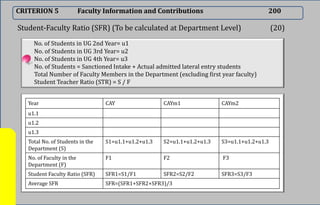
CRITERION 5 FacultyInformation and Contributions 200
No. of Students in UG 2nd Year= u1
No. of Students in UG 3rd Year= u2
No. of Students in UG 4th Year= u3
No. of Students = Sanctioned Intake + Actual admitted lateral entry students
Total Number of Faculty Members in the Department (excluding first year faculty)
Student Teacher Ratio (STR) = S / F
Student-Faculty Ratio (SFR) (To be calculated at Department Level) (20)
Year CAY CAYm1 CAYm2
u1.1
u1.2
u1.3
Total No. of Students in the
Department (S)
S1=u1.1+u1.2+u1.3 S2=u1.1+u1.2+u1.3 S3=u1.1+u1.2+u1.3
No. of Faculty in the
Department (F)
F1 F2 F3
Student Faculty Ratio (SFR) SFR1=S1/F1 SFR2=S2/F2 SFR3=S3/F3
Average SFR SFR=(SFR1+SFR2+SFR3)/3
26.
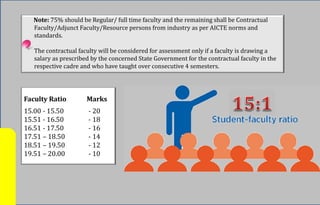
Note: 75% shouldbe Regular/ full time faculty and the remaining shall be Contractual
Faculty/Adjunct Faculty/Resource persons from industry as per AICTE norms and
standards.
The contractual faculty will be considered for assessment only if a faculty is drawing a
salary as prescribed by the concerned State Government for the contractual faculty in the
respective cadre and who have taught over consecutive 4 semesters.
Faculty Ratio Marks
15.00 - 15.50 - 20
15.51 - 16.50 - 18
16.51 - 17.50 - 16
17.51 – 18.50 - 14
18.51 – 19.50 - 12
19.51 – 20.00 - 10
27.
Faculty Cadre Proportion(25)
The reference Faculty cadre proportion is 1(F1):2(F2):6(F3)
F1: Number of Professors required = 1/9 x Number of Faculty required to comply with 15:1
F2: Number of Associate Professors required = 2/9 x Number of Faculty required
F3: Number of Assistant Professors required = 6/9 x Number of Faculty required
Year Professors Associate Professors Assistant Professors
Required F1 Available Required F2 Available Required F3 Available
CAY
CAYm1
CAYm2
Average
Numbers
RF1= AF1= RF2= AF2= RF3= AF3=
Cadre Ratio Marks= [(AF1/ RF1) + (AF2/ RF2) x 0.6 + (AF3/RF3)x 0.4] x 12.5
28.
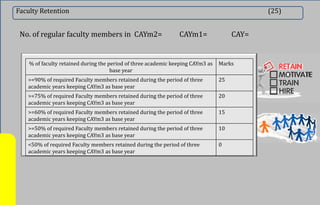
Faculty Retention (25)
No.of regular faculty members in CAYm2= CAYm1= CAY=
% of faculty retained during the period of three academic keeping CAYm3 as
base year
Marks
>=90% of required Faculty members retained during the period of three
academic years keeping CAYm3 as base year
25
>=75% of required Faculty members retained during the period of three
academic years keeping CAYm3 as base year
20
>=60% of required Faculty members retained during the period of three
academic years keeping CAYm3 as base year
15
>=50% of required Faculty members retained during the period of three
academic years keeping CAYm3 as base year
10
<50% of required Faculty members retained during the period of three
academic years keeping CAYm3 as base year
0
29.
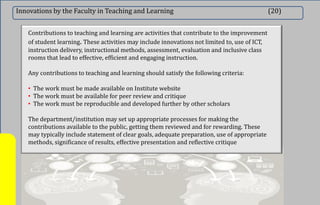
Innovations by theFaculty in Teaching and Learning (20)
Contributions to teaching and learning are activities that contribute to the improvement
of student learning. These activities may include innovations not limited to, use of ICT,
instruction delivery, instructional methods, assessment, evaluation and inclusive class
rooms that lead to effective, efficient and engaging instruction.
Any contributions to teaching and learning should satisfy the following criteria:
• The work must be made available on Institute website
• The work must be available for peer review and critique
• The work must be reproducible and developed further by other scholars
The department/institution may set up appropriate processes for making the
contributions available to the public, getting them reviewed and for rewarding. These
may typically include statement of clear goals, adequate preparation, use of appropriate
methods, significance of results, effective presentation and reflective critique
30.
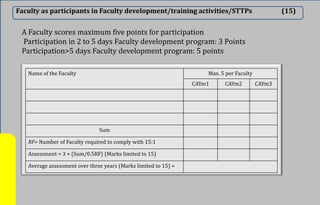
Faculty as participantsin Faculty development/training activities/STTPs (15)
A Faculty scores maximum five points for participation
Participation in 2 to 5 days Faculty development program: 3 Points
Participation>5 days Faculty development program: 5 points
Name of the Faculty Max. 5 per Faculty
CAYm1 CAYm2 CAYm3
Sum
RF= Number of Faculty required to comply with 15:1
Assessment = 3 × (Sum/0.5RF) (Marks limited to 15)
Average assessment over three years (Marks limited to 15) =
31.
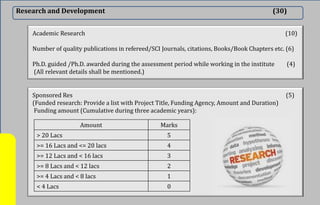
Research and Development(30)
Academic Research (10)
Number of quality publications in refereed/SCI Journals, citations, Books/Book Chapters etc. (6)
Ph.D. guided /Ph.D. awarded during the assessment period while working in the institute (4)
(All relevant details shall be mentioned.)
Sponsored Res (5)
(Funded research: Provide a list with Project Title, Funding Agency, Amount and Duration)
Funding amount (Cumulative during three academic years):
Amount Marks
> 20 Lacs 5
>= 16 Lacs and <= 20 lacs 4
>= 12 Lacs and < 16 lacs 3
>= 8 Lacs and < 12 lacs 2
>= 4 Lacs and < 8 lacs 1
< 4 Lacs 0
32.
Research and Development(30)
Development activities (10)
Provide details:
Product Development Research laboratories Instructional materials
Working models/charts/monograms etc.
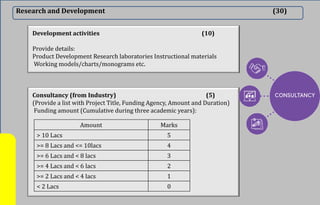
Consultancy (from Industry) (5)
(Provide a list with Project Title, Funding Agency, Amount and Duration)
Funding amount (Cumulative during three academic years):
Amount Marks
> 10 Lacs 5
>= 8 Lacs and <= 10lacs 4
>= 6 Lacs and < 8 lacs 3
>= 4 Lacs and < 6 lacs 2
>= 2 Lacs and < 4 lacs 1
< 2 Lacs 0
33.
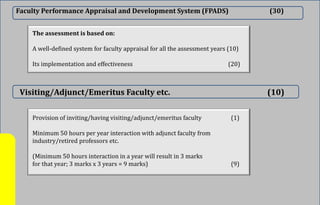
Faculty Performance Appraisaland Development System (FPADS) (30)
The assessment is based on:
A well-defined system for faculty appraisal for all the assessment years (10)
Its implementation and effectiveness (20)
Provision of inviting/having visiting/adjunct/emeritus faculty (1)
Minimum 50 hours per year interaction with adjunct faculty from
industry/retired professors etc.
(Minimum 50 hours interaction in a year will result in 3 marks
for that year; 3 marks x 3 years = 9 marks) (9)
Visiting/Adjunct/Emeritus Faculty etc. (10)
34.
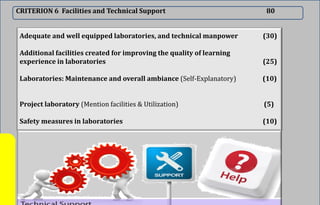
CRITERION 6 Facilitiesand Technical Support 80
Adequate and well equipped laboratories, and technical manpower (30)
Additional facilities created for improving the quality of learning
experience in laboratories (25)
Laboratories: Maintenance and overall ambiance (Self-Explanatory) (10)
Project laboratory (Mention facilities & Utilization) (5)
Safety measures in laboratories (10)
35.
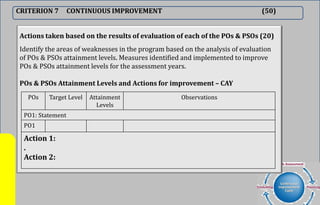
CRITERION 7 CONTINUOUSIMPROVEMENT (50)
Actions taken based on the results of evaluation of each of the POs & PSOs (20)
Identify the areas of weaknesses in the program based on the analysis of evaluation
of POs & PSOs attainment levels. Measures identified and implemented to improve
POs & PSOs attainment levels for the assessment years.
POs & PSOs Attainment Levels and Actions for improvement – CAY
POs Target Level Attainment
Levels
Observations
PO1: Statement
PO1
Action 1:
.
Action 2:
36.
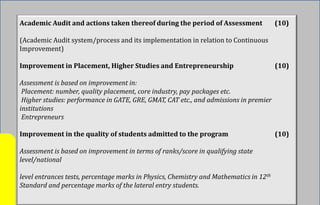
Academic Audit andactions taken thereof during the period of Assessment (10)
(Academic Audit system/process and its implementation in relation to Continuous
Improvement)
Improvement in Placement, Higher Studies and Entrepreneurship (10)
Assessment is based on improvement in:
Placement: number, quality placement, core industry, pay packages etc.
Higher studies: performance in GATE, GRE, GMAT, CAT etc., and admissions in premier
institutions
Entrepreneurs
Improvement in the quality of students admitted to the program (10)
Assessment is based on improvement in terms of ranks/score in qualifying state
level/national
level entrances tests, percentage marks in Physics, Chemistry and Mathematics in 12th
Standard and percentage marks of the lateral entry students.
37.
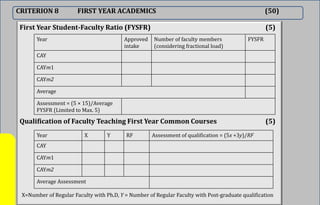
CRITERION 8 FIRSTYEAR ACADEMICS (50)
First Year Student-Faculty Ratio (FYSFR) (5)
Year Approved
intake
Number of faculty members
(considering fractional load)
FYSFR
CAY
CAYm1
CAYm2
Average
Assessment = (5 × 15)/Average
FYSFR (Limited to Max. 5)
Qualification of Faculty Teaching First Year Common Courses (5)
Year X Y RF Assessment of qualification = (5x +3y)/RF
CAY
CAYm1
CAYm2
Average Assessment
X=Number of Regular Faculty with Ph.D, Y = Number of Regular Faculty with Post-graduate qualification
38.
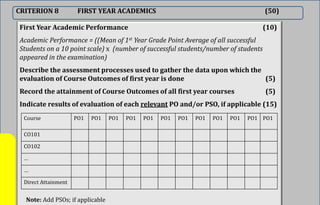
CRITERION 8 FIRSTYEAR ACADEMICS (50)
First Year Academic Performance (10)
Academic Performance = ((Mean of 1st Year Grade Point Average of all successful
Students on a 10 point scale) x (number of successful students/number of students
appeared in the examination)
Describe the assessment processes used to gather the data upon which the
evaluation of Course Outcomes of first year is done (5)
Record the attainment of Course Outcomes of all first year courses (5)
Indicate results of evaluation of each relevant PO and/or PSO, if applicable (15)
Course PO1 PO1 PO1 PO1 PO1 PO1 PO1 PO1 PO1 PO1 PO1 PO1
CO101
CO102
…
…
Direct Attainment
Note: Add PSOs; if applicable
39.
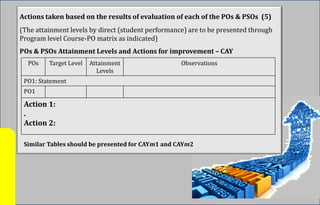
Actions taken basedon the results of evaluation of each of the POs & PSOs (5)
(The attainment levels by direct (student performance) are to be presented through
Program level Course-PO matrix as indicated)
POs & PSOs Attainment Levels and Actions for improvement – CAY
POs Target Level Attainment
Levels
Observations
PO1: Statement
PO1
Action 1:
.
Action 2:
Similar Tables should be presented for CAYm1 and CAYm2
40.
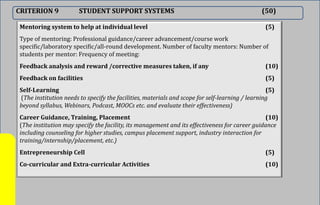
CRITERION 9 STUDENTSUPPORT SYSTEMS (50)
Mentoring system to help at individual level (5)
Type of mentoring: Professional guidance/career advancement/course work
specific/laboratory specific/all-round development. Number of faculty mentors: Number of
students per mentor: Frequency of meeting:
Feedback analysis and reward /corrective measures taken, if any (10)
Feedback on facilities (5)
Self-Learning (5)
(The institution needs to specify the facilities, materials and scope for self-learning / learning
beyond syllabus, Webinars, Podcast, MOOCs etc. and evaluate their effectiveness)
Career Guidance, Training, Placement (10)
(The institution may specify the facility, its management and its effectiveness for career guidance
including counseling for higher studies, campus placement support, industry interaction for
training/internship/placement, etc.)
Entrepreneurship Cell (5)
Co-curricular and Extra-curricular Activities (10)
41.
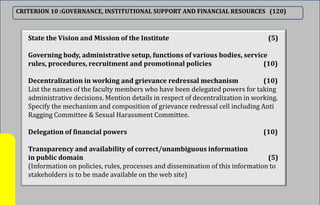
CRITERION 10 :GOVERNANCE,INSTITUTIONAL SUPPORT AND FINANCIAL RESOURCES (120)
State the Vision and Mission of the Institute (5)
Governing body, administrative setup, functions of various bodies, service
rules, procedures, recruitment and promotional policies (10)
Decentralization in working and grievance redressal mechanism (10)
List the names of the faculty members who have been delegated powers for taking
administrative decisions. Mention details in respect of decentralization in working.
Specify the mechanism and composition of grievance redressal cell including Anti
Ragging Committee & Sexual Harassment Committee.
Delegation of financial powers (10)
Transparency and availability of correct/unambiguous information
in public domain (5)
(Information on policies, rules, processes and dissemination of this information to
stakeholders is to be made available on the web site)
42.
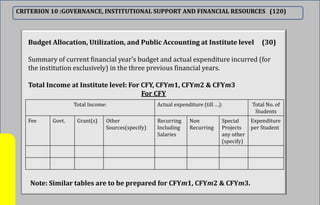
CRITERION 10 :GOVERNANCE,INSTITUTIONAL SUPPORT AND FINANCIAL RESOURCES (120)
Budget Allocation, Utilization, and Public Accounting at Institute level (30)
Summary of current financial year’s budget and actual expenditure incurred (for
the institution exclusively) in the three previous financial years.
Total Income at Institute level: For CFY, CFYm1, CFYm2 & CFYm3
For CFY
Total Income: Actual expenditure (till …): Total No. of
Students
Fee Govt. Grant(s) Other
Sources(specify)
Recurring
Including
Salaries
Non
Recurring
Special
Projects
any other
(specify)
Expenditure
per Student
Note: Similar tables are to be prepared for CFYm1, CFYm2 & CFYm3.




![Faculty Cadre Proportion (25)
The reference Faculty cadre proportion is 1(F1):2(F2):6(F3)
F1: Number of Professors required = 1/9 x Number of Faculty required to comply with 15:1
F2: Number of Associate Professors required = 2/9 x Number of Faculty required
F3: Number of Assistant Professors required = 6/9 x Number of Faculty required
Year Professors Associate Professors Assistant Professors
Required F1 Available Required F2 Available Required F3 Available
CAY
CAYm1
CAYm2
Average
Numbers
RF1= AF1= RF2= AF2= RF3= AF3=
Cadre Ratio Marks= [(AF1/ RF1) + (AF2/ RF2) x 0.6 + (AF3/RF3)x 0.4] x 12.5](https://image.slidesharecdn.com/nbatieriisarpreparation-250330090732-6906ebd8/85/NBA-SELF-ASSESSMENT-REPORT-SAR-PREPARATION-27-320.jpg)