USDA Final Genetically Modified
Organism (GMO) Label Rule
Presented By
Dr. John M. Ryan
http://www.RyanSystems.com
jryan@RyanSystems.com
U.S. 386 837-7375
Retired Administrator of Quality
Assurance for the
Hawaii State Department of Agriculture
Dr. John M. Ryan
PCQI Validation Specialist
• Background
• Rules
• Review Rule Definitions
• Plan label change implementation immediately
• Compliance with mandatory deadlines based on company size
• Know your label options
• Understand the exemptions
• Detectability Issues
• Record Keeping Requirements
Agenda
http://www.RyanSystems.com
4
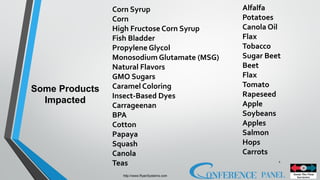
Corn Syrup
Corn
High Fructose Corn Syrup
Fish Bladder
Propylene Glycol
Monosodium Glutamate (MSG)
Natural Flavors
GMO Sugars
Caramel Coloring
Insect-Based Dyes
Carrageenan
BPA
Cotton
Papaya
Squash
Canola
Teas
http://www.RyanSystems.com
Alfalfa
Potatoes
Canola Oil
Flax
Tobacco
Sugar Beet
Beet
Flax
Tomato
Rapeseed
Apple
Soybeans
Apples
Salmon
Hops
Carrots
Some Products
Impacted
http://www.RyanSystems.com
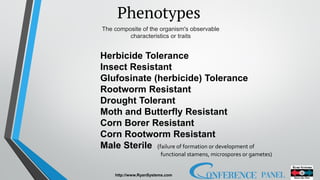
Herbicide Tolerance
Insect Resistant
Glufosinate (herbicide) Tolerance
Rootworm Resistant
Drought Tolerant
Moth and Butterfly Resistant
Corn Borer Resistant
Corn Rootworm Resistant
Male Sterile (failure of formation or development of
functional stamens, microspores or gametes)
Phenotypes
The composite of the organism's observable
characteristics or traits
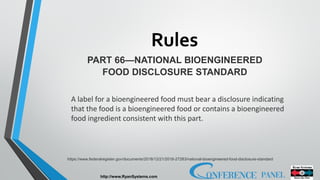
Rules
http://www.RyanSystems.com
PART 66—NATIONAL BIOENGINEERED
FOOD DISCLOSURE STANDARD
https://www.federalregister.gov/documents/2018/12/21/2018-27283/national-bioengineered-food-disclosure-standard
A label for a bioengineered food must bear a disclosure indicating
that the food is a bioengineered food or contains a bioengineered
food ingredient consistent with this part.
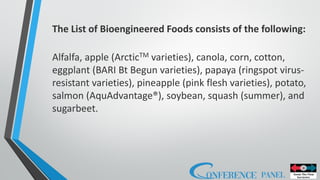
The List of Bioengineered Foods consists of the following:
Alfalfa, apple (ArcticTM varieties), canola, corn, cotton,
eggplant (BARI Bt Begun varieties), papaya (ringspot virus-
resistant varieties), pineapple (pink flesh varieties), potato,
salmon (AquAdvantage®), soybean, squash (summer), and
sugarbeet.
Exemptions
(a) Food served in a restaurant or similar retail food establishment.
(b) Very small food manufacturers.
(c) A food in which no ingredient intentionally contains a bioengineered (BE)
substance, with an allowance for inadvertent or technically unavoidable BE
presence of up to five percent (5%) for each ingredient.
(d) A food derived from an animal shall not be considered a bioengineered food
solely because the animal consumed feed produced from, containing, or consisting
of a bioengineered substance.
(i) A food that contains genetic material that has been modified
through in vitro recombinant deoxyribonucleic acid (rDNA)
techniques and for which the modification could not otherwise be
obtained through conventional breeding or found in
nature; provided that
(ii) Such a food does not contain modified genetic material if the
genetic material is not detectable
Basic Definitions
10
http://www.RyanSystems.com
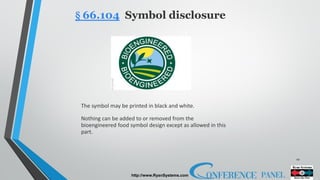
§ 66.104 Symbol disclosure
The symbol may be printed in black and white.
Nothing can be added to or removed from the
bioengineered food symbol design except as allowed in this
part.
https://www.foodqualityandsafety.com/wp-content/uploads/2019/01/e_update_0119-300x216.jpg
http://www.RyanSystems.com
§ 66.106 Electronic or digital link disclosure
Accompanying statement
(1)An electronic or digital disclosure must be accompanied by, and be
placed directly above or below, this statement: “Scan here for more
food information” or equivalent language
(2)The electronic or digital disclosure must also be accompanied by a
telephone number that will provide the bioengineered food disclosure
to the consumer, regardless of the time of day (must be in close
proximity to the digital link)
12
http://www.RyanSystems.com
Must not charge a person any fee to access the bioengineered food
information through text message
(a) Label must include this statement “Text [command word] to [number] for
bioengineered food information.”
(b) The response must be a one-time response and the only information in the
response must be the appropriate bioengineered food disclosure
(c) The response must exclude marketing and promotional information.
§ 66.108 Text message disclosure
http://www.RyanSystems.com
§ 66.116 Voluntary disclosure
(a) Disclosure of bioengineered food by exempt entities. If a food on the
List of Bioengineered Foods is subject to disclosure, a very small food
manufacturer, restaurant, or similar retail food establishment may
voluntarily provide that disclosure. The disclosure must be in one or
more of the forms described in this paragraph
(1) A text disclosure
(2) A symbol disclosure
(3) An electronic or digital link disclosure
(4) A text message disclosure
(5) Appropriate small manufacturer and small and very small package
disclosure options
§ 66.302 Recordkeeping requirements.
(a) General. (1) Regulated entities must maintain records
(2) electronic or paper formats and must contain sufficient detail
(3) maintained for at least two years beyond the date the food or food product is sold or distributed
for retail sale.
(4) Examples: Supply chain records, bills of lading, invoices, supplier attestations, labels, contracts, Start
Printed Page 65876brokers' statements, third party certifications, laboratory testing results, validated
process verifications, and other records generated or maintained by the regulated entity in the normal
course of business (traceability)
(b) Recordkeeping requirements. (1) If a food (including an ingredient produced from such food) is on
the List of Bioengineered Foods, the regulated entity must maintain records regarding that food or
food ingredient.
(2) If a food (including an ingredient produced from such food) bears a
bioengineered food disclosure based on actual knowledge and is not on the
List of Bioengineered Foods, regulated entities must maintain records for
such food or food ingredient.
http://www.RyanSystems.com
jryan@RyanSystems.com
U.S. 386 837-7375
Retired Administrator of Quality
Assurance for the
Hawaii State Department of Agriculture
Dr. John M. Ryan
PCQI Validation Specialist
Register Now

USDA Final Genetically Modified Organism (GMO) Label Rule

  • 1.
    USDA Final GeneticallyModified Organism (GMO) Label Rule Presented By Dr. John M. Ryan
  • 2.
    http://www.RyanSystems.com http://www.RyanSystems.com jryan@RyanSystems.com U.S. 386 837-7375 RetiredAdministrator of Quality Assurance for the Hawaii State Department of Agriculture Dr. John M. Ryan PCQI Validation Specialist
  • 3.
    • Background • Rules •Review Rule Definitions • Plan label change implementation immediately • Compliance with mandatory deadlines based on company size • Know your label options • Understand the exemptions • Detectability Issues • Record Keeping Requirements Agenda http://www.RyanSystems.com
  • 4.
    4 Corn Syrup Corn High FructoseCorn Syrup Fish Bladder Propylene Glycol Monosodium Glutamate (MSG) Natural Flavors GMO Sugars Caramel Coloring Insect-Based Dyes Carrageenan BPA Cotton Papaya Squash Canola Teas http://www.RyanSystems.com Alfalfa Potatoes Canola Oil Flax Tobacco Sugar Beet Beet Flax Tomato Rapeseed Apple Soybeans Apples Salmon Hops Carrots Some Products Impacted
  • 5.
    http://www.RyanSystems.com Herbicide Tolerance Insect Resistant Glufosinate(herbicide) Tolerance Rootworm Resistant Drought Tolerant Moth and Butterfly Resistant Corn Borer Resistant Corn Rootworm Resistant Male Sterile (failure of formation or development of functional stamens, microspores or gametes) Phenotypes The composite of the organism's observable characteristics or traits
  • 6.
    Rules http://www.RyanSystems.com PART 66—NATIONAL BIOENGINEERED FOODDISCLOSURE STANDARD https://www.federalregister.gov/documents/2018/12/21/2018-27283/national-bioengineered-food-disclosure-standard A label for a bioengineered food must bear a disclosure indicating that the food is a bioengineered food or contains a bioengineered food ingredient consistent with this part.
  • 7.
    The List ofBioengineered Foods consists of the following: Alfalfa, apple (ArcticTM varieties), canola, corn, cotton, eggplant (BARI Bt Begun varieties), papaya (ringspot virus- resistant varieties), pineapple (pink flesh varieties), potato, salmon (AquAdvantage®), soybean, squash (summer), and sugarbeet.
  • 8.
    Exemptions (a) Food servedin a restaurant or similar retail food establishment. (b) Very small food manufacturers. (c) A food in which no ingredient intentionally contains a bioengineered (BE) substance, with an allowance for inadvertent or technically unavoidable BE presence of up to five percent (5%) for each ingredient. (d) A food derived from an animal shall not be considered a bioengineered food solely because the animal consumed feed produced from, containing, or consisting of a bioengineered substance.
  • 9.
    (i) A foodthat contains genetic material that has been modified through in vitro recombinant deoxyribonucleic acid (rDNA) techniques and for which the modification could not otherwise be obtained through conventional breeding or found in nature; provided that (ii) Such a food does not contain modified genetic material if the genetic material is not detectable Basic Definitions
  • 10.
    10 http://www.RyanSystems.com § 66.104 Symboldisclosure The symbol may be printed in black and white. Nothing can be added to or removed from the bioengineered food symbol design except as allowed in this part. https://www.foodqualityandsafety.com/wp-content/uploads/2019/01/e_update_0119-300x216.jpg
  • 11.
    http://www.RyanSystems.com § 66.106 Electronicor digital link disclosure Accompanying statement (1)An electronic or digital disclosure must be accompanied by, and be placed directly above or below, this statement: “Scan here for more food information” or equivalent language (2)The electronic or digital disclosure must also be accompanied by a telephone number that will provide the bioengineered food disclosure to the consumer, regardless of the time of day (must be in close proximity to the digital link)
  • 12.
    12 http://www.RyanSystems.com Must not chargea person any fee to access the bioengineered food information through text message (a) Label must include this statement “Text [command word] to [number] for bioengineered food information.” (b) The response must be a one-time response and the only information in the response must be the appropriate bioengineered food disclosure (c) The response must exclude marketing and promotional information. § 66.108 Text message disclosure
  • 13.
    http://www.RyanSystems.com § 66.116 Voluntarydisclosure (a) Disclosure of bioengineered food by exempt entities. If a food on the List of Bioengineered Foods is subject to disclosure, a very small food manufacturer, restaurant, or similar retail food establishment may voluntarily provide that disclosure. The disclosure must be in one or more of the forms described in this paragraph (1) A text disclosure (2) A symbol disclosure (3) An electronic or digital link disclosure (4) A text message disclosure (5) Appropriate small manufacturer and small and very small package disclosure options
  • 14.
    § 66.302 Recordkeepingrequirements. (a) General. (1) Regulated entities must maintain records (2) electronic or paper formats and must contain sufficient detail (3) maintained for at least two years beyond the date the food or food product is sold or distributed for retail sale. (4) Examples: Supply chain records, bills of lading, invoices, supplier attestations, labels, contracts, Start Printed Page 65876brokers' statements, third party certifications, laboratory testing results, validated process verifications, and other records generated or maintained by the regulated entity in the normal course of business (traceability) (b) Recordkeeping requirements. (1) If a food (including an ingredient produced from such food) is on the List of Bioengineered Foods, the regulated entity must maintain records regarding that food or food ingredient. (2) If a food (including an ingredient produced from such food) bears a bioengineered food disclosure based on actual knowledge and is not on the List of Bioengineered Foods, regulated entities must maintain records for such food or food ingredient.
  • 15.
    http://www.RyanSystems.com jryan@RyanSystems.com U.S. 386 837-7375 RetiredAdministrator of Quality Assurance for the Hawaii State Department of Agriculture Dr. John M. Ryan PCQI Validation Specialist
  • 16.