ARTICLE                                                                                                                                         doi:10.1038/nature10158


Genome sequence and analysis of the
tuber crop potato
The Potato Genome Sequencing Consortium*


   Potato (Solanum tuberosum L.) is the world’s most important non-grain food crop and is central to global food security. It
   is clonally propagated, highly heterozygous, autotetraploid, and suffers acute inbreeding depression. Here we use a
   homozygous doubled-monoploid potato clone to sequence and assemble 86% of the 844-megabase genome. We predict
   39,031 protein-coding genes and present evidence for at least two genome duplication events indicative of a
   palaeopolyploid origin. As the first genome sequence of an asterid, the potato genome reveals 2,642 genes specific to
   this large angiosperm clade. We also sequenced a heterozygous diploid clone and show that gene presence/absence
   variants and other potentially deleterious mutations occur frequently and are a likely cause of inbreeding depression.
   Gene family expansion, tissue-specific expression and recruitment of genes to new pathways contributed to the
   evolution of tuber development. The potato genome sequence provides a platform for genetic improvement of this
   vital crop.


Potato (Solanum tuberosum L.) is a member of the Solanaceae, an                               deep transcriptome sequence from both genotypes, allowed us to
economically important family that includes tomato, pepper, aubergine                         explore potato genome structure and organization, as well as key
(eggplant), petunia and tobacco. Potato belongs to the asterid clade of                       aspects of the biology and evolution of this important crop.
eudicot plants that represents ,25% of flowering plant species and
from which a complete genome sequence has not yet, to our knowledge,                          Genome assembly and annotation
been published. Potato occupies a wide eco-geographical range1 and is
                                                                                              We sequenced the nuclear and organellar genomes of DM using a
unique among the major world food crops in producing stolons (under-
                                                                                              whole-genome shotgun sequencing (WGS) approach. We generated
ground stems) that under suitable environmental conditions swell to
                                                                                              96.6 Gb of raw sequence from two next-generation sequencing (NGS)
form tubers. Its worldwide importance, especially within the developing
                                                                                              platforms, Illumina Genome Analyser and Roche Pyrosequencing, as
world, is growing rapidly, with production in 2009 reaching 330 million                       well as conventional Sanger sequencing technologies. The genome
tons (http://www.fao.org). The tubers are a globally important dietary                        was assembled using SOAPdenovo4, resulting in a final assembly of
source of starch, protein, antioxidants and vitamins2, serving the plant                      727 Mb, of which 93.9% is non-gapped sequence. Ninety per cent of
as both a storage organ and a vegetative propagation system. Despite the                      the assembly falls into 443 superscaffolds larger than 349 kb. The 17-
importance of tubers, the evolutionary and developmental mechanisms                           nucleotide depth distribution (Supplementary Fig. 1) suggests a gen-
of their initiation and growth remain elusive.                                                ome size of 844 Mb, consistent with estimates from flow cytometry5.
   Outside of its natural range in South America, the cultivated potato                       Our assembly of 727 Mb is 117 Mb less than the estimated genome
is considered to have a narrow genetic base resulting originally from                         size. Analysis of the DM scaffolds indicates 62.2% repetitive content in
limited germplasm introductions to Europe. Most potato cultivars are                          the assembled section of the DM genome, less than the 74.8% esti-
autotetraploid (2n 5 4x 5 48), highly heterozygous, suffer acute                              mated from bacterial artificial chromosome (BAC) and fosmid end
inbreeding depression, and are susceptible to many devastating pests                          sequences (Supplementary Table 1), indicating that much of the unas-
and pathogens, as exemplified by the Irish potato famine in the mid-                          sembled genome is composed of repetitive sequences.
nineteenth century. Together, these attributes present a significant                             We assessed the quality of the WGS assembly through alignment to
barrier to potato improvement using classical breeding approaches.                            Sanger-derived phase 2 BAC sequences. In an alignment length of
A challenge to the scientific community is to obtain a genome                                 ,1 Mb (99.4% coverage), no gross assembly errors were detected
sequence that will ultimately facilitate advances in breeding.                                (Supplementary Table 2 and Supplementary Fig. 2). Alignment of
   To overcome the key issue of heterozygosity and allow us to gen-                           fosmid and BAC paired-end sequences to the WGS scaffolds revealed
erate a high-quality draft potato genome sequence, we used a unique                           limited (#0.12%) potential misassemblies (Supplementary Table 3).
homozygous form of potato called a doubled monoploid, derived                                 Extensive coverage of the potato genome in this assembly was con-
using classical tissue culture techniques3. The draft genome sequence                         firmed using available expressed sequence tag (EST) data; 97.1% of
from this genotype, S. tuberosum group Phureja DM1-3 516 R44                                  181,558 available Sanger-sequenced S. tuberosum ESTs (.200 bp)
(hereafter referred to as DM), was used to integrate sequence data                            were detected. Repetitive sequences account for at least 62.2% of the
from a heterozygous diploid breeding line, S. tuberosum group                                 assembled genome (452.5 Mb) (Supplementary Table 1) with long
Tuberosum RH89-039-16 (hereafter referred to as RH). These two                                terminal repeat retrotransposons comprising the majority of the
genotypes represent a sample of potato genomic diversity; DM with                             transposable element classes, representing 29.4% of the genome. In
its fingerling (elongated) tubers was derived from a primitive South                          addition, subtelomeric repeats were identified at or near chromo-
American cultivar whereas RH more closely resembles commercially                              somal ends (Fig. 1). Using a newly constructed genetic map based
cultivated tetraploid potato. The combined data resources, allied to                          on 2,603 polymorphic markers in conjunction with other available
*Lists of authors and their affiliations appear at the end of the paper.


                                                                                                                        1 4 J U LY 2 0 1 1 | V O L 4 7 5 | N AT U R E | 1 8 9
                                                              ©2011 Macmillan Publishers Limited. All rights reserved
RESEARCH ARTICLE


                                                               0 Mb
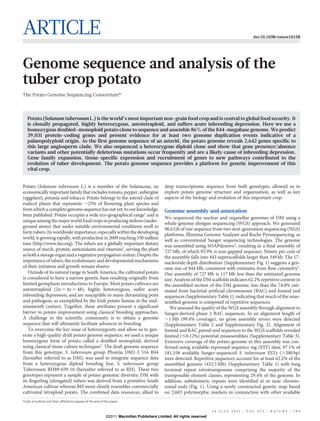
                                         12                                       Ch                                                 Karyotypes of RH and DM suggested similar heterochromatin
                                    Chr                                                r1
                                                                                                                                 content6 (Supplementary Table 6 and Supplementary Fig. 4) with


                                                                        20
                                              40


                                                                                  40
                                                          a


                                    20
                        0                                                                                                        large blocks of heterochromatin located at the pericentromeric


                                                                                        60
                           M                              b
                        40  b                                                                                                    regions (Fig. 1). As observed in other plant genomes, there was an
                 1


                                                                                                b
                                                                                             0 0
               r1


                                                                                              M
                                                          c                                                                      inverse relationship between gene density and repetitive sequences


                                                                                              8
             Ch


                  20


                                                                                                             Ch
                                                          d                                                                      (Fig. 1). However, many predicted genes in heterochromatic regions
        0M                                                                                                  20


                                                                                                               r2
              b                                           e                                                                      are expressed, consistent with observations in tomato7 that genic
        40                                                 f                                                     40              ‘islands’ are present in the heterochromatic ‘ocean’.
    0


                                                                                                                     b
                                                                                                                  0M
Chr1


       20                                                                                                                        Genome evolution


                                                                                                                          Chr3
                                                                                                                   20            Potato is the first sequenced genome of an asterid, a clade within
0 Mb                                                                                                                             eudicots that encompasses nearly 70,000 species characterized by
                                                                                                                   40
                                                                                                                                 unique morphological, developmental and compositional features8.
       40                                                                                                          0 Mb          Orthologous clustering of the predicted potato proteome with 11 other
Chr9


                                                                                                                                 green plant genomes revealed 4,479 potato genes in 3,181 families in
        20                                                                                                        20
                                                                                                                                 common (Fig. 2a); 24,051 potato genes clustered with at least one of
                                                                                                                                 the 11 genomes. Filtering against transposable elements and 153


                                                                                                                     r4
          b                                                                                                  40
        0M 0


                                                                                                                  Ch
          4                                                                                                                      nonasterid and 57 asterid publicly available transcript-sequence data
                                                                                                       60                        sets yielded 2,642 high-confidence asterid-specific and 3,372 potato-
                   20                                                                             0
                                                                                                      M
            Ch


                                                                                                        b                        lineage-specific genes (Supplementary Fig. 5); both sets were enriched
              r8


                           b


                                                                                                                                 for genes of unknown function that had less expression support than
                                                                                            20
                        M
                       0


                                40


                                                                                                 r5                              the core Viridiplantae genes. Genes encoding transcription factors,
                                                                              40


                                                                                             Ch
                                                                               0M
                                          20


                                                                       20
                                                   0 Mb


                                 Ch                                                                                              self-incompatibility, and defence-related proteins were evident in the
                                                           40


                                   r7
                                                                                 b


                                                                      Chr6                                                       asterid-specific gene set (Supplementary Table 7) and presumably con-
                             a Chromosome karyotype                     centromere
                                                                                                                                 tribute to the unique characteristics of asterids.
                                                                                                                                    Structurally, we identified 1,811 syntenic gene blocks involving
                             b Gene density (genes per Mb) 0                                76                                   10,046 genes in the potato genome (Supplementary Table 8). On
                             c Repeats coverage (%)                           0             100
                                                                                                                                 the basis of these pairwise paralogous segments, we calculated an
                                                                                                                                 age distribution based on the number of transversions at fourfold
                             d Transcription state                                                                               degenerate sites (4DTv) for all duplicate pairs. In general, two signifi-
                                0         3        6 (x10,000 FKPM, bin = 1 Mb)                                                  cant groups of blocks are seen in the potato genome (4DTv ,0.36 and
                                                                                                                                 ,1.0; Fig. 2b), suggesting two whole-genome duplication (WGD)
                             e GC content                                                                                        events. We also identified collinear blocks between potato and three
                                30       40    50 (GC%, bin = 1 Mb)                                                              rosid genomes (Vitis vinifera, Arabidopsis thaliana and Populus
                                                                                                                                 trichocarpa) that also suggest both events (Fig. 2c and Supplemen-
                             f Subtelomeric repeats distribution
                                                                                                                                 tary Fig. 6). The ancient WGD corresponds to the ancestral hexaploi-
Figure 1 | The potato genome. a, Ideograms of the 12 pseudochromosomes of                                                        dization (c) event in grape (Fig. 2b), consistent with a previous report
potato (in Mb scales). Each of the 12 pachytene chromosomes from DM was                                                          based on EST analysis that the two main branches of eudicots, the
digitally aligned with the ideogram (the amount of DNA in each unit of the                                                       asterids and rosids, may share the same palaeo-hexaploid duplication
pachytene chromosomes is not in proportion to the scales of the                                                                  event9. The c event probably occurred after the divergence between
pseudochromosomes). b, Gene density represented as number of genes per Mb
                                                                                                                                 dicots and monocots about 185 6 55 million years ago10. The recent
(non-overlapping, window size 5 1 Mb). c, Percentage of coverage of repetitive
sequences (non-overlapping windows, window size 5 1 Mb). d, Transcription
                                                                                                                                 duplication can therefore be placed at ,67 million years ago, consist-
state. The transcription level for each gene was estimated by averaging the                                                      ent with the WGD that occurred near the Cretaceous–Tertiary
fragments per kb exon model per million mapped reads (FPKM) from different                                                       boundary (,65 million years ago)11. The divergence of potato and
tissues in non-overlapping 1-Mb windows. e, GC content was estimated by the                                                      grape occurred at ,89 million years ago (4DTv ,0.48), which is likely
per cent G1C in 1-Mb non-overlapping windows. f, Distribution of the                                                             to represent the split between the rosids and asterids.
subtelomeric repeat sequence CL14_cons.
                                                                                                                                 Haplotype diversity
genetic and physical maps, we genetically anchored 623 Mb (86%) of                                                               High heterozygosity and inbreeding depression are inherent to
the assembled genome (Supplementary Fig. 3), and constructed pseu-                                                               potato, a species that predominantly outcrosses and propagates by
domolecules for each of the 12 chromosomes (Fig. 1), which harbour                                                               means of vegetative organs. Indeed, the phenotypes of DM and RH
90.3% of the predicted genes.                                                                                                    differ, with RH more vigorous than DM (Fig. 3a). To explore the
   To aid annotation and address a series of biological questions, we                                                            extent of haplotype diversity and possible causes of inbreeding
generated 31.5 Gb of RNA-Seq data from 32 DM and 16 RH libraries                                                                 depression, we sequenced and assembled 1,644 RH BAC clones gen-
representing all major tissue types, developmental stages and res-                                                               erating 178 Mb of non-redundant sequence from both haplotypes
ponses to abiotic and biotic stresses (Supplementary Table 4). For                                                               (,10% of the RH genome with uneven coverage) (Supplementary
annotation, reads were mapped against the DM genome sequence                                                                     Tables 9–11). After filtering to remove repetitive sequences, we
(90.2% of 824,621,408 DM reads and 88.6% of 140,375,647 RH reads)                                                                aligned 99 Mb of RH sequence (55%) to the DM genome. These
and in combination with ab initio gene prediction, protein and EST                                                               regions were largely collinear with an overall sequence identity of
alignments, we annotated 39,031 protein-coding genes. RNA-Seq                                                                    97.5%, corresponding to one single-nucleotide polymorphism
data revealed alternative splicing; 9,875 genes (25.3%) encoded two                                                              (SNP) every 40 bp and one insertion/deletion (indel) every 394 bp
or more isoforms, indicative of more functional variation than re-                                                               (average length 12.8 bp). Between the two RH haplotypes, 6.6 Mb of
presented by the gene set alone. Overall, 87.9% of the gene models                                                               sequence could be aligned with 96.5% identity, corresponding to 1
were supported by transcript and/or protein similarity with only                                                                 SNP per 29 bp and 1 indel per 253 bp (average length 10.4 bp).
12.1% derived solely from ab initio gene predictions (Supplemen-                                                                    Current algorithms are of limited use in de novo whole-genome
tary Table 5).                                                                                                                   assembly or haplotype reconstruction of highly heterozygous genomes
1 9 0 | N AT U R E | V O L 4 7 5 | 1 4 J U LY 2 0 1 1
                                                                             ©2011 Macmillan Publishers Limited. All rights reserved
ARTICLE RESEARCH

                                     a                   Eudicots
                                                                                             Algae, mosses
                                                                                                                                                      b
                                                       (Arabidopsis,                                                                                                                                                                Grape–Grape
                                                                                           (Chlamydomonas,                                                                          8
                                                      Carica, Glycine,                                                                                                                                                              Potato–Potato
                                                                                             Physcomitrella)
                                        Monocots      Populus, Vitis)                                                                                                                                                               Potato–Grape


                                                                                                                                                     Percentage of syntenic genes
                                                                                                                            Solanum
                                     (Brachypodium,
                                                                                                                           tuberosum
                                     Oryza, Sorghum,                                                                                                                                                              Speciation event
                                                                                                 373                     group Phureja                                              6
                                           Zea)                104
                                                                                               (1,112)
                                                              (852)


                                                            177                2 (17)
                                                          (2,321)                                       1 (4)                                                                       4
                                                2,653                                                                    1,291
                                               (12,805)                                                                 (8,035)
                                                                      406                    19
                                                                    (5,853)                 (223)
                                                                                                                                                                                                              Recent duplication
                                                                                                                                                                                    2                                  Ancient duplication
                                                                                3,181
                                                                               (59,681)
                                                                                                      500
                                                              1 (11)
                                                                                                    (4,802)
                                                                                      2,107
                                                                           0 (0)     (34,243)                                                                                       0
                                                                                    49
                                                                                   (347)                                                                                                0.0           0.5             1.0            1.5                2.0
                                                                                                                                                                                                                     4DTv
                                     c
                                                            Chr3                                                 Chr5                                               Chr1                                   Chr4                             Chr2
                                     Arabidopsis


                                     Potato          Chr1           Chr2              Chr3                      Chr4          Chr5            Chr6                                  Chr7       Chr8           Chr9          Chr10     Chr11             Chr12


                                     Grape
                                                   Chr13    Chr16      Chr3           Chr14 Chr17               Chr18     Chr1       Chr9   Chr15    Chr6                            Chr2     Chr12 Chr4     Chr19   Chr8    Chr7   Chr11    Chr10      Chr5


Figure 2 | Comparative analyses and evolution of the potato genome.                                                                             within the component is noted within parentheses. b, Genome duplication in
a, Clusters of orthologous and paralogous gene families in 12 plant species as                                                                  dicot genomes as revealed through 4DTv analyses. c, Syntenic blocks between
identified by OrthoMCL33. Gene family number is listed in each of the                                                                           A. thaliana, potato, and V. vinifera (grape) demonstrating a high degree of
components; the number of genes within the families for all of the species                                                                      conserved gene order between these taxa.
 a                                                                  c     01                                                                    02                                   03          04           05            06      07             08           09   10   11   12
             DM                      RH         DM                                     RH
                                                                                                                                  DM RH DM RH DM RH DM RH DM RH DM RH DM RH DM RH DM RH DM RH DM RH DM RH
                                                                                                                          0

                                                                                                                        10

                                                                                                                        20

                                                                                                                        30

                                                                                                                        40
b
    10 × 108                   DM                                          RH                                           50

                                                                                                                        60
Volume


                                                                                                                                                                                                                                         Centromere
         5 × 10⁸
                                                                                                                        70                                                                                                               PS in DM only
                                                                                                                                                                                                                                         Homozygous PS in RH
                                                                                                                        80                                                                                                               Heterozygous PS in RH, shared by DM
                                                                                                                                                                                                                                         Heterozygous PS in RH, not shared by DM
                   0     100    200        300     0   100                          200                300             90                                                                                                                Homozygous FS in RH
                                         31-mer frequency                                                              Mb
         d                                                                                                                                                                                                                               Heterozygous FS in RH
              B CDE                                                                                                                                                                           TU V 1
                                                                            RH Chr5
                                                                           haplotype 0


             C1C2D E FGH I
                                                                                              DM Chr5
                                                                                                                                                                                                                                         Matched regions
                                                                                                                                                                                                                                         Unmatched regions
                                                                                                                                                                                                                                         Genes
                                                                                                                                                                                                                                         Gene with premature stop codon
                                                                                                                                                                                                                                         Specific gene in RH
                       DE F GH I J                                         2                                                  3                                                                       4              5 6 7
                                                                                             RH Chr5                                                                                                                                     CNV
                                                                                            haplotype 1

Figure 3 | Haplotype diversity and inbreeding depression. a, Plants and                                                                         stop, frameshift and presence/absence variation mutations contributing to
tubers of DM and RH showing that RH has greater vigour. b, Illumina K-mer                                                                       inbreeding depression. The hypothetical RH pseudomolecules were solely inferred
volume histograms of DM and RH. The volume of K-mers (y-axis) is plotted                                                                        from the corresponding DM ones. Owing to the inability to assign heterozygous
against the frequency at which they occur (x-axis). The leftmost truncated peaks at                                                             PS and FS of RH to a definite haplotype, all heterozygous PS and FS were arbitrarily
low frequency and high volume represent K-mers containing essentially random                                                                    mapped to the left haplotype of RH. d, A zoom-in comparative view of the DM
sequencing errors, whereas the distribution to the right represents proper                                                                      and RH genomes. The left and right alignments are derived from the euchromatic
(putatively error-free) data. In contrast to the single modality of DM, RH exhibits                                                             and heterochromatic regions of chromosome 5, respectively. Most of the gene
clear bi-modality caused by heterozygosity. c, Genomic distribution of premature                                                                annotations, including PS and RH-specific genes, are supported by transcript data.

                                                                                                                                                                                                                      1 4 J U LY 2 0 1 1 | V O L 4 7 5 | N AT U R E | 1 9 1
                                                                    ©2011 Macmillan Publishers Limited. All rights reserved
RESEARCH ARTICLE

such as RH, as shown by K-mer frequency count histograms (Fig. 3b                towards the plastidic starch synthesis pathway in tubers of RH,
and Supplementary Table 12). To complement the BAC-level compar-                 thereby causing a flux of carbon into the amyloplast. This contrasts
ative analysis and provide a genome-wide perspective of heterozygosity           with the cereal endosperm where carbon is transported into the amy-
in RH, we mapped 1,118 million whole-genome NGS reads from RH                    loplast in the form of ADP-glucose via a specific transporter (brittle 1
(843 coverage) onto the DM assembly. A total of 457.3 million reads              protein17). Carbon transport into the amyloplasts of potato tubers is
uniquely aligned providing 90.6% (659.1 Mb) coverage. We identified              primarily in the form of glucose-6-phosphate18, although recent evid-
3.67 million SNPs between DM and one or both haplotypes of RH, with              ence indicates that glucose-1-phosphate is quantitatively important
an error rate of 0.91% based on evaluation of RH BAC sequences. We               under certain conditions19. The transport mechanism for glucose-1-
used this data set to explore the possible causes of inbreeding depression       phosphate is unknown and the genome sequence contains six genes
by quantifying the occurrence of premature stop, frameshift and pres-            for hexose-phosphate transporters with two highly and specifically
ence/absence variants12, as these disable gene function and contribute to        expressed in stolons and tubers. Furthermore, an additional 23 genes
genetic load (Supplementary Tables 13–16). We identified 3,018 SNPs              encode proteins homologous to other carbohydrate derivative trans-
predicted to induce premature stop codons in RH, with 606 homo-                  porters, such as triose phosphate, phosphoenolpyruvate, or UDP-
zygous (in both haplotypes) and 2,412 heterozygous. In DM, 940 pre-              glucuronic acid transporters and two loci with homologues for the
mature stop codons were identified. In the 2,412 heterozygous RH                 brittle 1 protein. By contrast, in leaves, carbon-fixation-specific genes
premature stop codons, 652 were shared with DM and the remaining                 such as plastidic aldolase, fructose-1,6-biphosphatase and distinct leaf
1,760 were found in RH only (Fig. 3c and Supplementary Table 13).                isoforms of starch synthase, starch branching enzyme, starch phos-
Frameshift mutations were identified in 80 loci within RH, 49 homo-              phorylase and ADP-glucose pyrophosphorylase were upregulated. Of
zygous and 31 heterozygous, concentrated in seven genomic regions                particular interest is the difference in tuber expression of enzymes
(Fig. 3c and Supplementary Table 14). Finally, we identified presence/           involved in the hydrolytic and phosphorolytic starch degradation
absence variations for 275 genes; 246 were RH specific (absent in DM)            pathways. Considerably greater levels of a-amylase (10–25-fold)
and 29 were DM specific, with 125 and 9 supported by RNA-Seq and/or              and b-amylase (5–10-fold) mRNAs were found in DM tubers com-
Gene Ontology13 annotation for RH and DM, respectively (Supplemen-               pared to RH, whereas a-1,4 glucan phosphorylase mRNA was equi-
tary Tables 15 and 16). Collectively, these data indicate that the               valent in DM and RH tubers. These gene expression differences
complement of homozygous deleterious alleles in DM may be respons-               between the breeding line RH and the more primitive DM are con-
ible for its reduced level of vigour (Fig. 3a).                                  sistent with the concept that increasing tuber yield may be partially
   The divergence between potato haplotypes is similar to that                   attained by selection for decreased activity of the hydrolytic starch
reported between out-crossing maize accessions14 and, coupled with               degradation pathway.
our inability to successfully align 45% of the BAC sequences, intra-                Recent studies using a potato genotype strictly dependent on short
and inter-genome diversity seem to be a significant feature of the               days for tuber induction (S. tuberosum group Andigena) identified a
potato genome. A detailed comparison of the three haplotypes (DM                 potato homologue (SP6A) of A. thaliana FLOWERING LOCUS T
and the two haplotypes of RH) at two genomic regions (334 kb in                  (FT) as the long-distance tuberization inductive signal. SP6A is pro-
length) using the RH BAC sequence (Fig. 3d and Supplementary                     duced in the leaves, consistent with its role as the mobile signal (S.
Tables 17 and 18) revealed considerable sequence and structural vari-            Prat, personal communication). SP/FT is a multi-gene family
ation. In one region (‘euchromatic’; Fig. 3d) we observed one instance           (Supplementary Text and Supplementary Fig. 7) and expression of
of copy number variation, five genes with premature stop codons, and             a second FT homologue, SP5G, in mature tubers suggests a possible
seven RH-specific genes. These observations indicate that the plas-              function in the control of tuber sprouting, a photoperiod-dependent
ticity of the potato genome is greater than revealed from the unas-              phenomenon20. Likewise, expression of a homologue of the A. thaliana
sembled RH NGS. Improved assembly algorithms, increased read                     flowering time MADS box gene SOC1, acting downstream of FT21, is
lengths, and de novo sequences of additional haplotypes will reveal              restricted to tuber sprouts (Supplementary Fig. 8). Expression of a third
the full catalogue of genes critical to inbreeding depression.                   FT homologue, SP3D, does not correlate with tuberization induction
                                                                                 but instead with transition to flowering, which is regulated indepen-
Tuber biology                                                                    dently of day length (S. Prat, personal communication). These data
In developing DM and RH tubers, 15,235 genes were expressed in the               indicate that neofunctionalization of the day-length-dependent
transition from stolons to tubers, with 1,217 transcripts exhibiting             flowering control pathway has occurred in potato to control formation
.5-fold expression in stolons versus five RH tuber tissues (young tuber,         and possibly sprouting of a novel storage organ, the tuber (Supplemen-
mature tuber, tuber peel, cortex and pith; Supplementary Table 19). Of           tary Fig. 9).
these, 333 transcripts were upregulated during the transition from
stolon to tuber, with the most highly upregulated transcripts encoding           Disease resistance
storage proteins. Foremost among these were the genes encoding                   Potato is susceptible to a wide range of pests and pathogens and the
proteinase inhibitors and patatin (15 genes), in which the phospholi-            identification of genes conferring disease resistance has been a major
pase A function has been largely replaced by a protein storage function          focus of the research community. Most cloned disease resistance
in the tuber15. In particular, a large family of 28 Kunitz protease inhib-       genes in the Solanaceae encode nucleotide-binding site (NBS) and
itor genes (KTIs) was identified with twice the number of genes in               leucine-rich-repeat (LRR) domains. The DM assembly contains 408
potato compared to tomato. The KTI genes are distributed across the              NBS-LRR-encoding genes, 57 Toll/interleukin-1 receptor/plant R
genome with individual members exhibiting specific expression pat-               gene homology (TIR) domains and 351 non-TIR types (Supplemen-
terns (Fig. 4a, b). KTIs are frequently induced after pest and pathogen          tary Table 20), similar to the 402 resistance (R) gene candidates in
attack and act primarily as inhibitors of exogenous proteinases16; there-        Populus22. Highly related homologues of the cloned potato late blight
fore the expansion of the KTI family may provide resistance to biotic            resistance genes R1, RB, R2, R3a, Rpi-blb2 and Rpi-vnt1.1 were present
stress for the newly evolved vulnerable underground organ.                       in the assembly. In RH, the chromosome 5 R1 cluster contains two
   The stolon to tuber transition also coincides with strong upregula-           distinct haplotypes; one is collinear with the R1 region in DM
tion of genes associated with starch biosynthesis (Fig. 4c). We                  (Supplementary Fig. 10), yet neither the DM nor the RH R1 regions
observed several starch biosynthetic genes that were 3–8-fold more               are collinear with other potato R1 regions23,24. Comparison of the DM
highly expressed in tuber tissues of RH compared to DM (Fig. 4c).                potato R gene sequences with well-established gene models (func-
Together this suggests a stronger shift from the relatively low sink             tional R genes) indicates that many NBS-LRR genes (39.4%) are pseu-
strength of the ATP-generating general carbon metabolism reactions               dogenes owing to indels, frameshift mutations, or premature stop
1 9 2 | N AT U R E | V O L 4 7 5 | 1 4 J U LY 2 0 1 1
                                                   ©2011 Macmillan Publishers Limited. All rights reserved
ARTICLE RESEARCH

a                                                                                                                              Figure 4 | Gene expression of selected tissues and
               A                                                       B C                   D                                 genes. a, KTI gene organization across the potato
Chr3I
             19.27 Mb           19.28 Mb                19.29 Mb          19.30 Mb       19.31 Mb   19.32 Mb                   genome. Black arrows indicate the location of
                     A B           C               D           E F         G     H        I     J    K       L   M             individual genes on six scaffolds located on four
Chr3II                                                                                                                         chromosomes. b, Phylogenetic tree and KTI gene
             23.4 Mb                23.5 Mb             23.6 Mb            23.7 Mb       23.8 Mb    23.9Mb           24.0 Mb
                 A                                            B       C      D
                                                                                                                               expression heat map. The KTI genes were clustered
Chr3III                                                                                                                        using all potato and tomato genes available with the
             42.7 Mb                42.8 Mb             42.9 Mb           43.0 Mb        43.1 Mb                               Populus KTI gene as an out-group. The tissue
                          A
Chr4                                                                                                                           specificity of individual members of the highly
             4.30 Mb            4.35 Mb                 4.40 Mb                                                                expanded potato gene family is shown in the heat
              A B                  C                                                                                           map. Expression levels are indicated by shades of
Chr6
             59.60 Mb               59.65 Mb            59.70 Mb          59.75 Mb                                             red, where white indicates no expression or lack of
                                A              B                                     C                                         data for tomato and poplar. c, A model of starch
Chr12                                                                                                                          synthesis showing enzyme activities is shown on
             58.86 Mb               58.87 Mb            58.88 Mb          58.89 Mb       58.90 Mb
                                                                                                                               the left. AGPase, ADP-glucose pyrophosphorylase;


                                                        DM Whole flower
                                                                                                                               F16BP, fructose-1,6-biphosphatase; HexK,
                                                        RH Mature tuber
                                                        RH Tuber sprout

                                                        RH Tuber cortex
                                                        RH Young tuber


                                                        RH Shoot apex
                                                        RH Tuber peel
                                                        RH Tuber pith
                                                                                                                               hexokinase; INV, invertase; PFK,


                                                        DM Stamen


                                                        DM Carpels
                                                        DM Tuber 1
                                                        DM Tuber 2


                                                        RH Flowers
b


                                                        RH Stamen


                                                        DM Leaves


                                                        DM Shoots
                                                        DM Petiole
                                                        DM Sepals


                                                        RH Leaves
                                                        DM Stolon


                                                        RH Petiole
                                                        DM Callus


                                                        DM Petals
                                                        RH Stolon
                                                        DM Roots
                                                        RH Roots
                                                                                                                               phosphofructokinase; PFPP, pyrophosphate-


                                                        RH Stem
                                                                                                                               fructose-6-phosphate-1-phosphotransferase; PGI,
                                                                                                                               phosphoglucose isomerase; PGM,
                                               3I-A                                                               –10.0        phosphoglucomutase; SBE, starch branching
                                               3I-C                                                               –6.7
                                                                                                                  –3.3         enzyme; SP, starch phosphorylase; SPP, sucrose
                                                                                                                  0.0
                                               3I-B
                                               3II-A                                                              3.3          phosphate phosphatase; SS, starch synthase; SuSy,
                                               3III-A                                                             6.7          sucrose synthase; SUPS, sucrose phosphate
                                                                                                                  10.0
                                               3II-B
                                                                                                                  No data
                                                                                                                               synthase; UDP-GPP, UDP-glucose
                                               3I-D                                                                            pyrophosphorylase. The grey background denotes
                                               3II-E
                                               3II-J                                                                           substrate (sucrose) and product (starch) and the
                                               3II-H                                                                           red background indicates genes that are specifically
                                               3II-M                                                                           upregulated in RH versus DM. On the right, a heat
                                               3II-F
                                               3II-D                                                                           map of the genes involved in carbohydrate
                                               3II-K
                                               3II-G                                                                           metabolism is shown. ADP-glucose
                                               3II-I
                                               12-C                                                                            pyrophosphorylase large subunit, AGPase (l);
                                               12-A
                                               12-B                                                                            ADP-glucose pyrophosphorylase small
                                               3II-C
                                               6-A                                                                             subunit, AGPase (s); ADP-glucose
                                               6-B                                                                             pyrophosphorylase small subunit 3, AGPase 3 (s);
                                                                                                                               cytosolic fructose-1,6-biphosphatase, F16BP (c);
                                               3II-B                                                                           granule bound starch synthase, GBSS; leaf type L
                                               3III-D                                                                          starch phosphorylase, Leaf type SP; plastidic
                                               6-C
                                                                                                                               phosphoglucomutase, pPGM; starch branching
    Potato                                     4-A
                                                                                                                               enzyme II, SBE II; soluble starch synthase, SSS;
    Tomato                                     3II-L
                                                                                                                               starch synthase V, SSV; three variants of plastidic
    Poplar                                     3III-C                                                                          aldolase, PA.
                                                        DM Whole flower
                                                        RH Mature tuber


                                                        RH Tuber sprout
                                                        RH Young tuber


                                                        RH Shoot apex
                                                        DM Stamen


                                                                                                                     1.0
                                                        DM Tuber 1
                                                        DM Tuber 2


                                                        RH Flowers


c
                                                        RH Stamen


                                                        DM Leaves
                                                        DM Petiole
                                                        DM Carpel
                                                        DM Stolon


                                                        RH Petiole
                                                        RH Cortex


                                                        DM Callus
                                                        RH Stolon


                                                        DM Shoot
                                                        DM Sepal


                                                                                                                     0.8
                                                        DM Petal
                                                        RH Stem
                                                        DM Root


                                                        RH Root
                                                        RH Peel


                                                        RH Leaf
                                                        RH Pith


                                                                                                                     0.6
                                                                                                                     0.4
                                                                                                                     0.2
Cytosol                                Plastid                                                                       0.0
                Sucrose                                                                                      SSS
                                                                                                             SS V
       INV         SuSy       SSP                                                                            pPGM
                                                                                                             GBSS
                                                                                                             AGPase (l)
              UDP-GPP                                                                                        AGPase (s)
                                           PGM                                                               SBE
                                                                                                             SP
                   PGM                SP                                                                     β-Amylase
      HexK                                 AGPase                                                            α-Amylase
                   PGI                                                                                       SSS
                           SUPS                                                                              SBE II
                                              SS                                                             Leaf type SP
    F16BP      PFK       PFPP                                                                                AGPase 3 (s)
                                            SBE                                                              PA
                                                                                                             PA
                                                                                                             PA
             Glycolysis                 Starch                                                               F16BP (c)
                                                                                                             β-Amylase I


codons including the R1, R3a and Rpi-vnt1.1 clusters that contain                                    heterozygosity and were able to generate a high-quality draft potato
extensive chimaeras and exhibit evolutionary patterns of type I R                                    genome sequence that provides new insights into eudicot genome
genes25. This high rate of pseudogenization parallels the rapid                                      evolution. Using a combination of data from the vigorous, heterozyg-
evolution of effector genes observed in the potato late blight patho-                                ous diploid RH and relatively weak, doubled-monoploid DM, we could
gen, Phytophthora infestans26. Coupled with abundant haplotype                                       directly address the form and extent of heterozygosity in potato and
diversity, tetraploid potato may therefore contain thousands of R-                                   provide the first view into the complexities that underlie inbreeding
gene analogues.                                                                                      depression. Combined with other recent studies, the potato genome
                                                                                                     sequence may elucidate the evolution of tuberization. This evolutionary
Conclusions and future directions                                                                    innovation evolved exclusively in the Solanum section Petota that
We sequenced a unique doubled-monoploid potato clone to overcome                                     encompasses ,200 species distributed from the southwestern United
the problems associated with genome assembly due to high levels of                                   States to central Argentina and Chile. Neighbouring Solanum species,
                                                                                                                               1 4 J U LY 2 0 1 1 | VO L 4 7 5 | N AT U R E | 1 9 3
                                                                     ©2011 Macmillan Publishers Limited. All rights reserved
RESEARCH ARTICLE

including the Lycopersicon section, which comprises wild and culti-                            17. Shannon, J. C., Pien, F. M. & Liu, K. C. Nucleotides and nucleotide sugars in
                                                                                                   developing maize endosperms: synthesis of ADP-glucose in brittle-1. Plant Physiol.
vated tomatoes, did not acquire this trait. Both gene family expansion                             110, 835–843 (1996).
and recruitment of existing genes for new pathways contributed to the                          18. Tauberger, E. et al. Antisense inhibition of plastidial phosphoglucomutase
evolution of tuber development in potato.                                                          provides compelling evidence that potato tuber amyloplasts import carbon from
                                                                                                   the cytosol in the form of glucose-6-phosphate. Plant J. 23, 43–53 (2000).
   Given the pivotal role of potato in world food production and                               19. Fettke, J. et al. Glucose 1-phosphate is efficiently taken up by potato (Solanum
security, the potato genome provides a new resource for use in breed-                              tuberosum) tuber parenchyma cells and converted to reserve starch granules. New
ing. Many traits of interest to plant breeders are quantitative in nature                          Phytol. 185, 663–675 (2010).
and the genome sequence will simplify both their characterization and                          20. Sonnewald, U. Control of potato tuber sprouting. Trends Plant Sci. 6, 333–335
                                                                                                   (2001).
deployment in cultivars. Whereas much genetic research is conducted                            21. Yoo, S. K. et al. CONSTANS activates SUPPRESSOR OF OVEREXPRESSION OF
at the diploid level in potato, almost all potato cultivars are tetraploid                         CONSTANS 1 through FLOWERING LOCUS T to promote flowering in Arabidopsis.
and most breeding is conducted in tetraploid material. Hence, the                                  Plant Physiol. 139, 770–778 (2005).
                                                                                               22. Kohler, A. et al. Genome-wide identi?cation of NBS resistance genes in Populus
development of experimental and computational methods for routine                                  trichocarpa. Plant Mol. Biol. 66, 619–636 (2008).
and informative high-resolution genetic characterization of poly-                              23. Ballvora, A. et al. Comparative sequence analysis of Solanum and Arabidopsis in a
ploids remains an important goal for the realization of many of the                                hot spot for pathogen resistance on potato chromosome V reveals a patchwork of
                                                                                                   conserved and rapidly evolving genome segments. BMC Genomics 8, 112 (2007).
potential benefits of the potato genome sequence.
                                                                                               24. Kuang, H. et al. The R1 resistance gene cluster contains three groups of
                                                                                                   independently evolving, type I R1 homologues and shows substantial structural
METHODS SUMMARY                                                                                    variation among haplotypes of Solanum demissum. Plant J. 44, 37–51 (2005).
DM1-3 516 R44 (DM) resulted from chromosome doubling of a monoploid                            25. Kuang, H., Woo, S. S., Meyers, B. C., Nevo, E. & Michelmore, R. W. Multiple genetic
(1n 5 1x 5 12) derived by anther culture of a heterozygous diploid (2n 5 2x 5 24)                  processes result in heterogeneous rates of evolution within the major cluster
S. tuberosum group Phureja clone (PI 225669)27. RH89-039-16 (RH) is a diploid clone                disease resistance genes in lettuce. Plant Cell 16, 2870–2894 (2004).
                                                                                               26. Haas, B. J. et al. Genome sequence and analysis of the Irish potato famine
derived from a cross between a S. tuberosum ‘dihaploid’ (SUH2293) and a diploid                    pathogen Phytophthora infestans. Nature 461, 393–398 (2009).
clone (BC1034) generated from a cross between two S. tuberosum 3 S. tuberosum                  27. Haynes, F. L. in Prospects for the Potato in the Developing World: an International
group Phureja hybrids28 (Supplementary Fig. 11). Sequence data from three plat-                    Symposium on Key Problems and Potentials for Greater Use of the Potato in the
forms, Sanger, Roche 454 Pyrosequencing, and Illumina Sequencing-by-Synthesis,                     Developing World (ed. French, E. R.) 100–110 (International Potato Center (CIP),
were used to assemble the DM genome using the SOAPdenovo assembly algorithm4.                      1972).
The RH genotype was sequenced using shotgun sequencing of BACs and WGS in                      28. van Os, H. et al. Construction of a 10,000-marker ultradense genetic
                                                                                                   recombination map of potato: providing a framework for accelerated gene
which reads were mapped to the DM reference assembly. Superscaffolds were                          isolation and a genomewide physical map. Genetics 173, 1075–1087 (2006).
anchored to the 12 linkage groups using a combination of in silico and genetic                 29. Chen, N. Using RepeatMasker to identify repetitive elements in genomic
mapping data. Repeat sequences were identified through sequence similarity at the                  sequences. Curr. Protoc. Bioinformatics 25, 4.10.1–4.10.14 (2004).
nucleotide and protein level29. Genes were annotated using a combined approach30 on            30. Elsik, C. G. et al. Creating a honey bee consensus gene set. Genome Biol. 8, R13
the repeat masked genome with ab initio gene predictions, protein similarity and                   (2007).
transcripts to build optimal gene models. Illumina RNA-Seq reads were mapped to                31. Trapnell, C., Pachter, L. & Salzberg, S. L. TopHat: discovering splice junctions with
                                                                                                   RNA-Seq. Bioinformatics 25, 1105–1111 (2009).
the DM draft sequence using Tophat31 and expression levels from the representative             32. Trapnell, C. et al. Transcript assembly and quantification by RNA-Seq reveals
transcript were determined using Cufflinks32.                                                      unannotated transcripts and isoform switching during cell differentiation. Nature
                                                                                                   Biotechnol. 28, 511–515 (2010).
Full Methods and any associated references are available in the online version of              33. Li, L., Stoeckert, C. J. Jr & Roos, D. S. OrthoMCL: identification of ortholog groups for
the paper at www.nature.com/nature.                                                                eukaryotic genomes. Genome Res. 13, 2178–2189 (2003).

Received 11 January; accepted 3 May 2011.                                                      Supplementary Information is linked to the online version of the paper at
                                                                                               www.nature.com/nature.
Published online 10 July 2011.
                                                                                               Acknowledgements We acknowledge the assistance of W. Amoros, B. Babinska,
1.    Hijmans, R. J. Global distribution of the potato crop. Am. J. Potato Res. 78, 403–412    R. V. Baslerov, B. K. Bumazhkin, M. F. Carboni, T. Conner, J. Coombs, L. Daddiego, J. M.
      (2001).                                                                                  D’Ambrosio, G. Diretto, S. B. Divito, D. Douches, M. Filipiak, G. Gianese, R. Hutten,
2.                              ´                   ´
      Burlingame, B., Mouille, B. & Charrondiere, R. Nutrients, bioactive non-nutrients        E. Jacobsen, E. Kalinska, S. Kamoun, D. Kells, H. Kossowska, L. Lopez,
      and anti-nutrients in potatoes. J. Food Compost. Anal. 22, 494–502 (2009).               M. Magallanes-Lundback, T. Miranda, P. S. Naik, A. N. Panteleeva, D. Pattanayak,
3.    Paz, M. M. & Veilleux, R. E. Influence of culture medium and in vitro conditions on      E. O. Patutina, M. Portantier, S. Rawat, R. Simon, B. P. Singh, B. Singh, W. Stiekema,
      shoot regeneration in Solanum phureja monoploids and fertility of regenerated            M. V. Sukhacheva and C. Town in providing plant material, generating data, annotation,
      doubled monoploids. Plant Breed. 118, 53–57 (1999).                                      analyses, and discussions. We are indebted to additional faculty and staff of the
4.    Li, R. et al. De novo assembly of human genomes with massively parallel short read       BGI-Shenzhen, J Craig Venter Institute, and MSU Research Technology Support Facility
      sequencing. Genome Res. 20, 265–272 (2010).                                              who contributed to this project. Background and preliminary data were provided by the
5.    Arumuganathan, K. & Earle, E. Nuclear DNA content of some important plant                Centre for BioSystems Genomics (CBSG), EU-project (APOPHYS
      species. Plant Mol. Biol. Rep. 9, 208–218 (1991).                                        EU-QLRT-2001-01849) and US Department of Agriculture National Institute of Food
6.    Tang, X. et al. Assignment of genetic linkage maps to diploid Solanum tuberosum          and Agriculture SolCAP project (2008-55300-04757 and 2009-85606-05673). We
      pachytene chromosomes by BAC-FISH technology. Chromosome Res. 17,                        acknowledge the funding made available by the ‘‘863’’ National High Tech Research
      899–915 (2009).                                                                          Development Program in China (2006AA100107), ‘‘973’’ National Key Basic Research
7.    Peters, S. A. et al. Solanum lycopersicum cv. Heinz 1706 chromosome 6:                   Program in China (2006CB101904, 2007CB815703, 2007CB815705,
      distribution and abundance of genes and retrotransposable elements. Plant J. 58,         2009CB119000), Board of Wageningen University and Research Centre, CAPES -
      857–869 (2009).                                                                          Brazilian Ministry of Education, Chinese Academy of Agricultural Sciences (seed grant
8.    Albach, D. C., Soltis, P. S. & Soltis, D. E. Patterns of embryological and biochemical   to S.H.), Chinese Ministry of Agriculture (The ‘‘948’’ Program), Chinese Ministry of
      evolution in the Asterids. Syst. Bot. 26, 242–262 (2001).                                Finance (1251610601001), Chinese Ministry of Science and Technology
9.    Tang, H. et al. Unraveling ancient hexaploidy through multiply-aligned angiosperm        (2007DFB30080), China Postdoctoral Science Foundation (20070420446 to Z.Z.),
      gene maps. Genome Res. 18, 1944–1954 (2008).                                             CONICET (Argentina), DAFF Research Stimulus Fund (07-567), CONICYT-Chile
10.   Jaillon, O. et al. The grapevine genome sequence suggests ancestral                      (PBCT-PSD-03), Danish Council for Strategic Research Programme Commission on
      hexaploidization in major angiosperm phyla. Nature 449, 463–467 (2007).                  Health, Food and Welfare (2101-07-0116), Danish Council for Strategic Research
11.   Fawcett, J. A., Maere, S. & Van de Peer, Y. Plants with double genomes might have        Programme Commission on Strategic Growth Technologies (Grant 2106-07-0021),
      had a better chance to survive the Cretaceous–Tertiary extinction event. Proc. Natl      FINCyT ((099-FINCyT-EQUIP-2009)/(076-FINCyT-PIN-2008), Pre           ´stamo BID no.
      Acad. Sci. USA 106, 5737–5742 (2009).                                                    1663/OC-PE, FONDAP and BASAL-CMM), Fund for Economic Structural Support
12.   Lai, J. et al. Genome-wide patterns of genetic variation among elite maize inbred        (FES), HarvestPlus Challenge Program, Indian Council of Agricultural Research,
      lines. Nature Genet. 42, 1027–1030 (2010).                                               INIA-Ministry of Agriculture of Chile, Instituto Nacional de Innovacion Agraria-Ministry
13.   Ashburner, M. et al. Gene ontology: tool for the unification of biology. Nature Genet.                                                           ´
                                                                                               of Agriculture of Peru, Instituto Nacional de Tecnologıa Agropecuaria (INTA), Italian
      25, 25–29 (2000).                                                                        Ministry of Research (Special Fund for Basic Research), International Potato Center
14.   Gore, M. A. et al. A first-generation haplotype map of maize. Science 326,               (CIP-CGIAR core funds), LBMG of Center for Genome Regulation and Center for
      1115–1117 (2009).                                                                        Mathematical Modeling, Universidad de Chile (UMI 2807 CNRS), Ministry of Education
15.   Prat, S. et al. Gene expression during tuber development in potato plants. FEBS          and Science of Russia (contract 02.552.11.7073), National Nature Science Foundation
      Lett. 268, 334–338 (1990).                                                               of China (30671319, 30725008, 30890032, 30971995), Natural Science Foundation
16.   Glaczinski, H., Heibges, A., Salamini, R. & Gebhardt, C. Members of the Kunitz-type      of Shandong Province in China (Y2006D21), Netherlands Technology Foundation
      protease inhibitor gene family of potato inhibit soluble tuber invertase in vitro.       (STW), Netherlands Genomics Initiative (NGI), Netherlands Ministries of Economic
      Potato Res. 45, 163–176 (2002).                                                          Affairs (EZ) and Agriculture (LNV), New Zealand Institute for Crop & Food Research Ltd

1 9 4 | N AT U R E | VO L 4 7 5 | 1 4 J U LY 2 0 1 1
                                                          ©2011 Macmillan Publishers Limited. All rights reserved
ARTICLE RESEARCH

Strategic Science Initiative, Perez Guerrero Fund, Peruvian Ministry of                                         Gerard J. Bishop10; Instituto de Investigaciones Agropecuarias Boris Sagredo
Agriculture-Technical Secretariat of coordination with the CGIAR, Peruvian National                             (Principal Investigator)11, Nilo Mejıa11; Institute of Biochemistry & Biophysics
                                                                                                                                                    ´
Council of Science and Technology (CONCYTEC), Polish Ministry of Science and Higher                             Wlodzimierz Zagorski (Principal Investigator)12, Robert Gromadka12, Jan Gawor12,
                                                                                ´                                                12
Education (47/PGS/2006/01), Programa Cooperativo para el Desarrollo Tecnologico                                 Pawel Szczesny ; Institute of Vegetables & Flowers, Chinese Academy of
Agroalimentario y Agroindustrial del Cono Sur (PROCISUR), Project Programa                                      Agricultural Sciences Sanwen Huang (Principal Investigator)13, Zhonghua Zhang13,
                                     ´
Bicentenario de Ciencia y Tecnologıa - Conicyt, PBCT - Conicyt PSD-03, Russian                                  Chunbo Liang13, Jun He13, Ying Li13, Ying He13, Jianfei Xu13, Youjun Zhang13, Binyan
                                                         ´
Foundation for Basic Research (09-04-12275), Secretarıa de Ciencia y Tecnologıa ´                               Xie13, Yongchen Du13, Dongyu Qu (Principal Investigator)13; International Potato
                                                ´
(SECyT) actual Ministerio de Ciencia y Tecnologıa (MINCyT), Argentina, Shenzhen                                 Center Merideth Bonierbale14, Marc Ghislain14, Maria del Rosario Herrera14; Italian
Municipal Government of China (CXB200903110066A, ZYC200903240077A,                                              National Agency for New Technologies, Energy & Sustainable Development Giovanni
ZYC200903240076A), Solexa project (272-07-0196), Special Multilateral Fund of the                               Giuliano (Principal Investigator)15, Marco Pietrella15, Gaetano Perrotta15, Paolo
Inter-American Council for Integral Development (FEMCIDI), Teagasc, Teagasc Walsh                               Facella15; J Craig Venter Institute Kimberly O’Brien16; Laboratorio de
Fellowship Scheme, The New Zealand Institute for Plant & Food Research Ltd                                                        ´                                    ´
                                                                                                                Agrobiotecnologıa, Instituto Nacional de Tecnologıa Agropecuaria Sergio E. Feingold
Capability Fund, UK Potato Genome Sequencing grant (Scottish Government Rural                                   (Principal Investigator)17, Leandro E. Barreiro17, Gabriela A. Massa17; Laboratorio de
and Environment Research and Analysis Directorate (RERAD), Department for                                       Biologıa de Sistemas, Universidad Nacional de LaPlata Luis Diambra18; Michigan
                                                                                                                       ´
Environment, Food and Rural Affairs (DEFRA), Agriculture and Horticulture                                       State University Brett R. Whitty19, Brieanne Vaillancourt19, Haining Lin19, Alicia N.
Development Board - Potato Council), UK Biotechnology and Biological Sciences                                   Massa , Michael Geoffroy19, Steven Lundback19, Dean DellaPenna19, C. Robin Buell
                                                                                                                       19

Research Council (Grant BB/F012640), US National Science Foundation Plant                                       (Principal Investigator)19; Scottish Crop Research Institute Sanjeev Kumar
Genome Research Program (DBI-0604907 /DBI-0834044), Virginia Agricultural                                       Sharma20{, David F. Marshall20{, Robbie Waugh20{, Glenn J. Bryan (Principal
Experiment Station USDA Hatch Funds (135853), and Wellcome Trust Strategic award                                Investigator)20{; Teagasc Crops Research Centre Marialaura Destefanis21, Istvan
(WT 083481).                                                                                                    Nagy21, Dan Milbourne (Principal Investigator)21; The New Zealand Institute for Plant
                                                                                                                & Food Research Ltd Susan J. Thomson22, Mark Fiers22, Jeanne M. E. Jacobs (Principal
Author Contributions A.D.G., A.G., A.N.M., A.V.B., A.V.M., B.B.K., B.K., B.R.W., B.S., B.t.L.H.,
B.V., B.X., B.Z., C.L., C.R.B., C.W.B.B., D.F.M., D. Martinez, D. Milbourne, D.M.A.M., D.M.B.,                  Investigator)22; University of Aalborg Ka L. Nielsen (Principal Investigator)23, Mads
                                                                                                                                                           ˚re
D.D., D.M., E.D., F.G., G.A.M., G.A.T., G.D.l.C., G.G., G.J. Bishop, G.J. Bryan, G.L., G.O., G.P.,              Sønderkær23; University of Wisconsin Marina Iovene24, Giovana A. Torres24, Jiming
G.Z., H.K., H.L., H.v.E., I.N., J.d.B., J.G., J.H., J.J., J.M.E.J., J.W., J.X., K.L.N., K.O’B., L.D., L.E.B.,   Jiang (Principal Investigator)24; Virginia Polytechnic Institute & State University
M.B., M.D., M.d.R.H., M.F., M. Geoffroy, M.Ghislain, M.I., M.P., M.S., M.T., N.M., N.V.R., O.P.,                Richard E. Veilleux25; Wageningen University & Research Centre Christian W. B.
P.F., P.N., P.S., Q.H., R.C.H.J.v.H., R.E.V., R.G., R.G.F.V., R. Lozano, R. Li, S.C., S.E.F., S.H.,             Bachem (Principal Investigator)26, Jan de Boer26, Theo Borm26, Bjorn Kloosterman26,
S.J.T., S.K.C., S.K.S., S.L., S.P., S.Y., T.B., T.V.K., V.U.P., X. Xiong, X. Xu, Y.D., Y.H., Y.L., Y.Y., Y.Z.   Herman van Eck26, Erwin Datema27, Bas te Lintel Hekkert27, Aska Goverse28,29,
and Z.Z. were involved in experimental design, data generation and/or data analysis.                            Roeland C. H. J. van Ham27,28 & Richard G. F. Visser26,28
A.N.M., B.K., C.R.B., C.W.B.B., D.D., D. Milbourne, D.M.A.M., D.M.B., E.D., G.G., G.J. Bishop,
                                                                                                                1
G.J. Bryan, G.O., H.L., I.N., J.d.B., J.J., J.M.E.J., K.L.N., M.B., M.F., M.D., M.S., O.P., R.C.H.J.v.H.,         BGI-Shenzhen, Chinese Ministry of Agricultural, Key Lab of Genomics, Beishan Industrial
R.E.V., R.G.F.V., R. Lozano, R.W., S.E.F., S.H., S.J.T., S.K.S., T.B. and X. Xu wrote the                       Zone, Yantian District, Shenzhen 518083, China. 2Cayetano Heredia University,
manuscript. B.S., C.R.B., C.W.B.B., D.F.M., D. Milbourne, D.M.A.M., D.Q., G.G., G.J. Bishop,                    Genomics Research Unit, Av Honorio Delgado 430, Lima 31, Peru and San Cristobal of
G.J. Bryan, G.O., G.P., J.M.E.J., J.W., K.G.S., R.G.F.V., R. Li, R.W., S.E.F., S.H., S.K.C., S.Y., W.Z.         Huamanga University, Biotechnology and Plant Genetics Laboratory, Ayacucho, Peru.
                                                                                                                3
and Y.D. supervised data generation/analysis and managed the project. C.R.B.,                                     Central Potato Research Institute, Shimla 171001, Himachal Pradesh, India. 4Centre
C.W.B.B., G.J. Bryan, G.O., J.M.E.J. and S.H. are members of The Potato Genome                                  Bioengineering RAS, Prospekt 60-letya Oktyabrya, 7-1, Moscow 117312, Russia. 5Center
Sequencing Consortium Steering Committee.                                                                       for Genome Regulation and Center for Mathematical Modeling, Universidad de Chile (UMI
                                                                                                                2807 CNRS), Chile. 6College of Life Sciences, University of Dundee, Dow Street, Dundee
Author Information BAC and fosmid end sequences have been deposited in the GSS
                                                                                                                DD1 5EH, UK. 7High Technology Research Center, Shandong Academy of Agricultural
division of GenBank (BAC: GS025503–GS026177, GS262924–GS365942,
                                                                                                                Sciences, 11 Sangyuan Road, Jinan 250100, P. R. China. 8Huazhong Agriculture
GS504213–GS557003; fosmid: FI900795–FI901529, FI907952–FI927051,
                                                                                                                University, Ministry of Education, College of Horticulture and Forestry, Department of
GS557234–GS594339, GS635316–GS765761). DM Illumina GA2 WGS and Roche
                                                                                                                Vegetable Crops, Key Laboratory of Horticulture Biology, Wuhan 430070, P. R. China.
454 sequences have been deposited in the NCBI Sequence Read Archive                                             9
                                                                                                                  Hunan Agricultural University, College of Horticulture and Landscape, Changsha, Hunan
(SRA029323) and EBI Short Read Archive (ERP000411) respectively. RH NGS
                                                                                                                410128, China. 10Imperial College London, Division of Biology, South Kensington
sequences have been deposited in the EBI Short Read Archive (ERP000627). DM and
                                                                                                                Campus, London SW7 1AZ, UK. 11Instituto de Investigaciones Agropecuarias, Avda.
RH RNA-Seq reads have been deposited in the NCBI Sequence Read Archive
                                                                                                                                                                                           ´
                                                                                                                Salamanca s/n, Km 105 ruta 5 sur, sector Los Choapinos. Rengo, Region del Libertador
(SRA030516; study SRP005965) and the European Nucleotide Database
                                                                                                                Bernardo O’Higgins, Co   ´digo Postal 2940000, Chile. 12Institute of Biochemistry and
ArrayExpress Database (E-MTAB-552; study ERP000527), respectively. The DM Whole
                                                                                                                Biophysics, DNA Sequencing and Oligonucleotides Synthesis Laboratory, PAS ul.
Genome Shotgun project has been deposited at DDBJ/EMBL/GenBank under the
accession AEWC00000000. The version described in this paper is the First Version,                               Pawinskiego 5a, 02-106 Warsaw, Poland. 13Institute of Vegetables and Flowers, Chinese
AEWC01000000. Genome sequence and annotation can be obtained and viewed at                                      Academy of Agricultural Sciences, Key Laboratory of Horticultural Crops Genetic
http://potatogenome.net. Reprints and permissions information is available at                                   Improvement of Ministry of Agriculture, Sino-Dutch Joint Lab of Horticultural Genomics
www.nature.com/reprints. This paper is distributed under the terms of the Creative                              Technology, Beijing 100081, China. 14International Potato Center, P.O. Box 1558, Lima
Commons Attribution-Non-Commercial-Share Alike licence, and is freely available to                              12, Peru. 15Italian National Agency for New Technologies, Energy and Sustainable
all readers at www.nature.com/nature. The authors declare no competing financial                                Development (ENEA), Casaccia Research Center, Via Anguillarese 301, 00123 Roma, Italy
interests. Readers are welcome to comment on the online version of this article at                              and Trisaia Research Center, S.S. 106 Ionica - Km 419,50 75026 Rotondella (Matera),
www.nature.com/nature. Correspondence and requests for materials should be                                      Italy. 16J Craig Venter Institute, 9712 Medical Center Dr, Rockville, Maryland 20850, USA.
                                                                                                                17
addressed to S.H. (huangsanwen@caas.net.cn), C.R.B. (buell@msu.edu) or R.G.F.V.                                                                      ´       ´n
                                                                                                                   Laboratorio de Agrobiotecnologıa, Estacio Experimental Agropecuaria Balcarce,
(Richard.Visser@wur.nl).                                                                                                                          ´
                                                                                                                Instituto Nacional de Tecnologıa Agropecuaria (INTA) cc276 (7620) Balcarce, Argentina.
                                                                                                                18
                                                                                                                                          ´
                                                                                                                   Laboratorio de Biologıa de Sistemas, CREG, Universidad Nacional de LaPlata, 1888,
                                                                                                                Argentina. 19Michigan State University, East Lansing, Michigan 48824, USA. 20Scottish
                                                                                                                Crop Research Institute, Genetics Programme, Invergowrie, Dundee DD2 5DA, UK.
                                                                                                                21
                                                                                                                   Teagasc Crops Research Centre, Oak Park, Carlow, Ireland. 22The New Zealand Institute
The Potato Genome Consortium (Participants are listed alphabetically by institution.)                           for Plant & Food Research Ltd., Private Bag 4704, Christchurch 8140, New Zealand.
                                                                                                                23
                                                                                                                   University of Aalborg (AAU), Department of Biotechnology, Chemistry and
BGI-Shenzhen Xun Xu1, Shengkai Pan1, Shifeng Cheng1, Bo Zhang1, Desheng Mu1,                                    Environmental Engineering, Sohngaardsholmsvej 49, 9000 Aalborg, Denmark.
                                                                                                                24
Peixiang Ni1, Gengyun Zhang1, Shuang Yang (Principal Investigator)1, Ruiqiang Li                                   University of Wisconsin-Madison, Department of Horticulture, 1575 Linden Drive,
(Principal Investigator)1, Jun Wang (Principal Investigator)1; Cayetano Heredia                                 Madison, Wisconsin 53706, USA. 25Virginia Polytechnic Institute and State University,
University Gisella Orjeda (Principal Investigator)2, Frank Guzman2, Michael Torres2,                            Department of Horticulture, 544 Latham Hall, Blacksburg, Virginia 24061, USA.
                                                                                                                26
Roberto Lozano2, Olga Ponce2, Diana Martinez2, German De la Cruz2; Central Potato
                                                         ´                                                         Wageningen University and Research Centre, Dept. of Plant Sciences, Laboratory of
Research Institute S. K. Chakrabarti (Principal Investigator)3, Virupaksh U. Patil3;                            Plant Breeding, Droevendaalsesteeg 1, 6708PB Wageningen, Netherlands.
                                                                                                                27
Centre Bioengineering RAS Konstantin G. Skryabin (Principal Investigator)4, Boris B.                               Wageningen University and Research Centre, Applied Bioinformatics, Plant Research
Kuznetsov4, Nikolai V. Ravin4, Tatjana V. Kolganova4, Alexey V. Beletsky4, Andrei V.                            International, Droevendaalsesteeg 1, 6708PB Wageningen, Netherlands. 28Centre for
Mardanov4; CGR-CMM, Universidad de Chile Alex Di Genova5; College of Life                                       BioSystems Genomics, Droevendaalsesteeg 1, 6708PB Wageningen, Netherlands.
                                                                                                                29
Sciences, University of Dundee Daniel M. Bolser6, David M. A. Martin (Principal                                    Wageningen University and Research Centre, Dept. of Plant Sciences, Laboratory of
Investigator)6; High Technology Research Center, Shandong Academy of Agricultural                               Nematology, Droevendaalsesteeg 1, 6708PB Wageningen, Netherlands. {Present
Sciences Guangcun Li7, Yu Yang7; Huazhong Agriculture University Hanhui Kuang8,                                 address: The James Hutton Institute, Invergowrie, Dundee, DD2 5DA, UK (S.K.S., D.F.M.,
Qun Hu8; Hunan Agricultural University Xingyao Xiong9; Imperial College London                                  R.W., G.J. Bryan).


                                                                                                                                               1 4 J U LY 2 0 1 1 | VO L 4 7 5 | N AT U R E | 1 9 5
                                                                  ©2011 Macmillan Publishers Limited. All rights reserved
RESEARCH ARTICLE

METHODS                                                                                     SNP markers were designed directly from assembled sequence scaffolds, whereas
DM whole-genome shotgun sequencing and assembly. Libraries were con-                        polymorphic DArT marker sequences were searched against the scaffolds for
structed from DM genomic DNA and sequenced on the Sanger, Illumina                          high-quality unique matches. A total of 4,836 STS markers including 2,174
Genome Analyser 2 (GA2) and Roche 454 platforms using standard protocols                    DArTs, 2,304 SNPs and 358 SSRs were analysed on 180 progeny clones from a
(see Supplementary Text). A BAC library and three fosmid libraries were end                 backcross population ((DM 3 DI) 3 DI) developed at CIP between DM and DI
sequenced using the Sanger platform. For the Illumina GA2 platform, we generated            (CIP no. 703825), a heterozygous diploid S. tuberosum group Stenotomum
70.6 Gb of 37–73 bp paired-end reads from 16 libraries with insert lengths of 200–          (formerly S. stenotomum ssp. goniocalyx) landrace clone. The data from 2,603
811 bp (Supplementary Tables 21 and 22). We also generated 18.7 Gb of Illumina              polymorphic STS markers comprising 1,881 DArTs, 393 SNPs and 329 SSR
mate-pair libraries (2, 5 and 10 kb insert size). In total, 7.2 Gb of 454 single-end data   alleles were analysed using JoinMap 4 (ref. 38) and yielded the expected 12 potato
were generated and applied for gap filling to improve the assembly, of which 4.7 Gb         linkage groups. Supplementary Fig. 3 represents the mapping and anchoring of
(12,594,513 reads) were incorporated into the final assembly. For the 8 and 20 kb           the potato genome, using chromosome 7 as an example.
454 paired-end reads, representing 0.7 and 1.0 Gb of raw data respectively, 90.7 Mb            Anchoring the DM genome was accomplished using direct and indirect
(511,254 reads) and 211 Mb (1,525,992 reads), respectively, were incorporated into          approaches. The direct approach employed the ((DM 3 DI) 3 DI) linkage map
the final assembly.                                                                         whereby 2,037 of the 2,603 STS markers comprised of 1,402 DArTs, 376 SNPs and
    We generated a high-quality potato genome using the short read assembly                 259 SSRs could be uniquely anchored on the DM superscaffolds. This approach
software SOAPdenovo4 (Version 1014). We first assembled 69.4 Gb of GA2                      anchored ,52% (394 Mb) of the assembly arranged into 334 superscaffolds
paired-end short reads into contigs, which are sequence assemblies without gaps             (Supplementary Table 27 and Supplementary Fig. 3).
composed of overlapping reads. To increase the assembly accuracy, only 78.3% of                RH is the male parent of the mapping population of the ultra-high-density
the reads with high quality were considered. Then contigs were further linked into          (UHD) linkage map28 used for construction and genetic anchoring of the physical
scaffolds by paired-end relationships (,300 to ,550 bp insert size), mate-pair              map using the RHPOTKEY BAC library39. The indirect mapping approach
reads (2 to approximately 10 kb), fosmid ends (,40 kb, 90,407 pairs of end                  exploited in silico anchoring using the RH genetic and physical map28,40, as well
sequences) and BAC ends (,100 kb, 71,375 pairs of end sequences). We then                   as tomato genetic map data from SGN (http://solgenomics.net/). Amplified frag-
filled gaps with the entire short-read data generated using Illumina GA2 reads.             ment length polymorphism markers from the RH genetic map were linked to DM
The primary contig N50 size (the contig length such that using equal or longer              sequence scaffolds via BLAST alignment36 of whole-genome-profiling sequence
contigs produces half of the bases of the assembled genome) was 697 bp and                  tags41 obtained from anchored seed BACs in the RH physical map, or by direct
increased to 1,318 kb after gap-filling (Supplementary Tables 23 and 24). When              alignment of fully sequenced RH seed BACs to the DM sequence. The combined
only the paired-end relationships were used in the assembly process, the N50                marker alignments were processed into robust anchor points. The tomato
scaffold size was 22.4 kb. Adding mate-pair reads with 2, 5 and 10 kb insert sizes,         sequence markers from the genetic maps were aligned to the DM assembly using
the N50 scaffold size increased to 67, 173 and 389 kb, respectively. When inte-             SSAHA2 (ref. 42). Positions of ambiguously anchored superscaffolds were manu-
grated with additional libraries of larger insert size, such as fosmid and BAC end          ally checked and corrected. This approach anchored an additional ,32% of the
sequences, the N50 reached 1,318 kb. The final assembly size was 727 Mb, 93.87%             assembly (229 Mb). In 294 cases, the two independent approaches provided direct
of which is non-gapped sequence. We further filled the gaps with 6.74 fold                  support for each other, anchoring the same scaffold to the same position on the
coverage of 454 data, which increased the N50 contig size to 31,429 bp with                 two maps.
15.4% of the gaps filled.                                                                      Overall, the two strategies anchored 649 superscaffolds to approximate posi-
    The single-base accuracy of the assembly was estimated by the depth and                 tions on the genetic map of potato covering a length of 623 Mb. The 623 Mb
proportion of disconcordant reads. For the DM v3.0 assembly, 95.45% of 880                  (,86%) anchored genome includes ,90% of the 39,031 predicted genes. Of the
million usable reads could be mapped back to the assembled genome by SOAP                   unanchored superscaffolds, 84 were found in the N90 (622 scaffolds greater than
2.20 (ref. 34) using optimal parameters. The read depth was calculated for each             0.25 Mb), constituting 17 Mb of the overall assembly or 2% of the assembled
genomic location and peak depth for whole genome and the CDS regions are 100                genome. The longest anchored superscaffold is 7 Mb (from chromosome 1)
and 105, respectively. Approximately 96% of the assembled sequences had more                and the longest unanchored superscaffold is 2.5 Mb.
than 20-fold coverage (Supplementary Fig. 1). The overall GC content of the                 Identification of repetitive sequences. Transposable elements (TEs) in the
potato genome is about 34.8% with a positive correlation between GC content                 potato genome assembly were identified at the DNA and protein level.
and sequencing depth (data not shown). The DM potato should have few het-                   RepeatMasker29 was applied using Repbase43 for TE identification at the DNA
erozygous sites and 93.04% of the sites can be supported by at least 90% reads,             level. At the protein level, RepeatProteinMask29,44 was used in a WuBlastX36
suggesting high base quality and accuracy.                                                  search against the TE protein database to further identify TEs. Overlapping
RH genome sequencing. Whole-genome sequencing of genotype RH was per-                       TEs belonging to the same repeat class were collated, and sequences were
formed on the Illumina GA2 platform using a variety of fragment sizes and reads             removed if they overlapped .80% and belonged to different repeat classes.
lengths resulting in a total of 144 Gb of raw data (Supplementary Table 25). These          Gene prediction. To predict genes, we performed ab initio predictions on the
data were filtered using a custom C program and assembled using SOAPdenovo                  repeat-masked genome and then integrated the results with spliced alignments of
1.03 (ref. 4). Additionally, four 20-kb mate-pair libraries were sequenced on a             proteins and transcripts to genome sequences using GLEAN30. The potato genome
Roche 454 Titanium sequencer, amounting to 581 Mb of raw data (Supplemen-                   was masked by identified repeat sequences longer than 500 bp, except for mini-
tary Table 26). The resulting sequences were filtered for duplicates using custom           ature inverted repeat transposable elements which are usually found near genes or
Python scripts.                                                                             inside introns45. The software Augustus46 and Genscan47 was used for ab initio
    The RH BACs were sequenced using a combination of Sanger and 454 sequen-                predictions with parameters trained for A. thaliana. For similarity-based gene
cing at various levels of coverage (Supplementary Tables 9–11). Consensus base              prediction, we aligned the protein sequences of four sequenced plants (A. thaliana,
calling errors in the BAC sequences were corrected using custom Python and C                Carica papaya, V. vinifera and Oryza sativa) onto the potato genome using
scripts using a similar approach to that described previously35 (Supplementary              TBLASTN with an E-value cut-off of 1 3 1025, and then similar genome sequences
Text). Sequence overlaps between BACs within the same physical tiling path were             were aligned against the matching proteins using Genewise48 for accurately spliced
identified using megablast from BLAST 2.2.21 (ref. 36) and merged with mega-                alignments. In EST-based predictions, EST sequences of 11 Solanum species were
merger from the EMBOSS 6.1.0 package37. Using the same pipeline, several                    aligned against the potato genome using BLAT (identity $0.95, coverage $0.90)
kilobase-sized gaps were closed through alignment of a preliminary RH whole-                to generate spliced alignments. All these resources and prediction approaches were
genome assembly. The resulting non-redundant contigs were scaffolded by map-                combined by GLEAN30 to build the consensus gene set. To finalize the gene set, we
ping the RH whole-genome Illumina and 454 mated sequences against these                     aligned the RNA-Seq from 32 libraries, of which eight were sequenced with both
contigs using SOAPalign 2.20 (ref. 34) and subsequently processing these map-               single- and paired-end reads, to the genome using Tophat31 and the alignments
ping results with a custom Python script. The scaffolds were then ordered into              were then used as input for Cufflinks32 using the default parameters. Gene, tran-
superscaffolds based on the BAC order in the tiling paths of the FPC map. This              script and peptide sets were filtered to remove small genes, genes modelled across
procedure removed 25 Mb of redundant sequence, reduced the number of                        sequencing gaps, TE-encoding genes, and other incorrect annotations. The final
sequence fragments from 17,228 to 3,768, and increased the N50 sequence length              gene set contains 39,031 genes with 56,218 protein-coding transcripts, of which
from 24 to 144 kb (Supplementary Tables 9 and 10).                                          52,925 nonidentical proteins were retained for analysis.
Construction of the DM genetic map and anchoring of the genome. To anchor                   Transcriptome sequencing. RNA was isolated from many tissues of DM and RH
and fully orientate physical contigs along the chromosome, a genetic map was                that represent developmental, abiotic stress and biotic stress conditions (Sup-
developed de novo using sequence-tagged-site (STS) markers comprising simple                plementary Table 4 and Supplementary Text). cDNA libraries were constructed
sequence repeats (SSR), SNPs, and diversity array technology (DArT). SSR and                (Illumina) and sequenced on an Illumina GA2 in the single- and/or paired-end


                                                        ©2011 Macmillan Publishers Limited. All rights reserved
ARTICLE RESEARCH

mode. To represent the expression of each gene, we selected a representative            SNP was considered a heterozygous premature stop codon gene in RH. In addi-
transcript from each gene model by selecting the longest CDS from each gene.            tion, both categories can be further divided into premature stop codons shared
The aligned read data were generated by Tophat31 and the selected transcripts           with DM or not shared with DM. As a result, the numbers of premature stop
used as input into Cufflinks32, a short-read transcript assembler that calculates the   codons are 606 homozygous PS genes in RH, 1,760 heterozygous PS genes in RH
fragments per kb per million mapped reads (FPKM) as expression values for each          but not shared with DM, 288 PS in DM only, and 652 heterozygous premature
transcript. Cufflinks was run with default settings, with a maximum intron length       stop codons in RH and shared by DM.
of 15,000. FPKM values were reported and tabulated for each transcript (Sup-               To identify genes with frameshift mutations in RH, we identified all the genes
plementary Table 19).                                                                   containing indels of which the length could not be divided by 3. We found 80
Comparative genome analyses. Paralogous and orthologous clusters were iden-             genes with frameshift mutations, of which 31 were heterozygous and 49 were
tified using OrthoMCL49 using the predicted proteomes of 11 plant species               homozygous.
(Supplementary Table 28). After removing 1,602 TE-related genes that were                  To identify DM-specific genes, we mapped all the RH Illumina GA2 reads to
not filtered in earlier annotation steps, asterid-specific and potato-lineage-          the DM genome assembly. If the gene was not mapped to any RH read, it was
specific genes were identified using the initial OrthoMCL clustering followed           considered a DM-specific gene. We identified 35 DM-specific genes, 11 of which
by BLAST searches (E-value cut-off of 1 3 1025) against assemblies of ESTs              are supported by similarity to entries in the KEGG database57. To identify RH-
available from the PlantGDB project (http://plantgdb.org; 153 nonasterid species        specific genes, we assembled the RH Illumina GA2 reads that did not map to the
and 57 asterid species; Supplementary Fig. 5 and Supplementary Table 29).               DM genome into RH-specific scaffolds. Then, these scaffolds were annotated
Analysis of protein domains was performed using the Pfam hmm models iden-               using the same strategy as for DM. To exclude contamination, we aligned the
tified by InterProScan searches against InterPro (http://www.ebi.ac.uk/interpro).       CDS sequences against the protein set of bacteria with the E-value cut-off of
We compared the Pfam domains of the asterid-specific and potato-lineage-                1 3 1025 using Blastx. CDS sequences with .90% identity and .90% coverage
specific sets with those that are shared with at least one other nonasterid genome      were considered contaminants and were excluded. In addition, all DM RNA-seq
or transcriptome. A Fisher’s exact test was used to detect significant differences in   reads were mapped onto the CDS sequences, and CDS sequences with homolog-
Pfam representation between protein sets.                                               ous reads were excluded because these genes may be due to incorrect assembly. In
    After removing the self and multiple matches, the syntenic blocks ($5 genes         total, we predicted 246 RH specific genes, 34 of which are supported by Gene
per block) were identified using MCscan9 and i-adhore 3.0 (ref. 50) based on the        Ontology annotation17.
aligned protein gene pairs (Supplementary Table 8). For the self-aligned results,
each aligned block represents the paralogous segments pair that arose from the          34. Li, R. et al. SOAP2: an improved ultrafast tool for short read alignment.
                                                                                            Bioinformatics 25, 1966–1967 (2009).
genome duplication whereas, for the inter-species alignment results, each aligned       35. Chaisson, M., Pevzner, P. & Tang, H. Fragment assembly with short reads.
block represents the orthologous pair derived from the shared ancestor. We                  Bioinformatics 20, 2067–2074 (2004).
calculated the 4DTv (fourfold degenerate synonymous sites of the third codons)          36. Altschul, S. F. et al. Gapped BLAST and PSI-BLAST: a new generation of protein
for each gene pair from the aligned block and give a distribution for the 4DTv              database search programs. Nucleic Acids Res. 25, 3389–3402 (1997).
value to estimate the speciation or WGD event that occurred in evolutionary             37. Rice, P., Longden, I. & Bleasby, A. EMBOSS: the European Molecular Biology Open
history.                                                                                    Software Suite. Trends Genet. 16, 276–277 (2000).
                                                                                        38. Van Ooijen, J. W. in JoinMap 4, Software for the Calculation of Genetic Linkage Maps in
Identification of disease resistance genes. Predicted open reading frames                   Experimental Populations (ed. Kyazma, B. V.) (Wageningen, 2006).
(ORFs) from the annotation of S. tuberosum group Phureja assembly V3 were               39. Borm, T. J. Construction and Use of a Physical Map of Potato. PhD thesis,
screened using HMMER V.3 (http://hmmer.janelia.org/software) against the raw                Wageningen Univ. (2008).
hidden Markov model (HMM) corresponding to the Pfam NBS (NB-ARC)                        40. Visser, R. G. F. et al. Sequencing the potato genome: outline and first results to
family (PF00931). The HMM was downloaded from the Pfam home page                            come from the elucidation of the sequence of the world’s third most important
                                                                                            crop. Am. J. Potato Res. 86, 417–429 (2009).
(http://pfam.sanger.ac.uk/). The analysis using the raw HMM of the NBS domain
                                                                                        41. Van der Vossen, E. et al. in Whole Genome Profiling of the Diploid Potato Clone RH89-
resulted in 351 candidates. From these, a high quality protein set (,1 3 10260)             039-16 (Plant & Animal Genomes XVIII Conference, 2010).
was aligned and used to construct a potato-specific NBS HMM using the module            42. Ning, Z., Cox, A. J. & Mullikin, J. C. SSAHA: a fast search method for large DNA
‘hmmbuild’. Using this new potato-specific model, we identified 500 NBS-                    databases. Genome Res. 11, 1725–1729 (2001).
candidate proteins that were individually analysed. To detect TIR and LRR               43. Jurka, J. et al. Repbase Update, a database of eukaryotic repetitive elements.
domains, Pfam HMM searches were used. The raw TIR HMM (PF01582) and                         Cytogenet. Genome Res. 110, 462–467 (2005).
                                                                                        44. Jiang, Z., Hubley, R., Smit, A. & Eichler, E. E. DupMasker: a tool for annotating
LRR 1 HMM (PF00560) were downloaded and compared against the two sets of
                                                                                            primate segmental duplications. Genome Res. 18, 1362–1368 (2008).
NBS-encoding amino acid sequences using HMMER V3. Both TIR and LRR                      45. Kuang, H. et al. Identification of miniature inverted-repeat transposable elements
domains were validated using NCBI conserved domains and multiple expectation                (MITEs) and biogenesis of their siRNAs in the Solanaceae: new functional
maximization for motif elicitation (MEME)51. In the case of LRRs, MEME was                  implications for MITEs. Genome Res. 19, 42–56 (2009).
also useful to detect the number of repeats of this particular domain in the protein.   46. Stanke, M., Steinkamp, R., Waack, S. & Morgenstern, B. AUGUSTUS: a web server
As previously reported52, Pfam analysis could not identify the CC motif in the              for gene finding in eukaryotes. Nucleic Acids Res. 32, W309–W312 (2004).
                                                                                        47. Burge, C. & Karlin, S. Prediction of complete gene structures in human genomic
N-terminal region. CC domains were thus analysed using the MARCOIL53 pro-                   DNA. J. Mol. Biol. 268, 78–94 (1997).
gram with a threshold probability of 90 (ref. 52) and double-checked using              48. Birney, E., Clamp, M. & Durbin, R. GeneWise and Genomewise. Genome Res. 14,
paircoil2 (ref. 54) with a P-score cut-off of 0.025 (ref. 55). Selected genes               988–995 (2004).
(61.5 kb) were searched using BLASTX against a reference R-gene set56 to find           49. Chen, F., Mackey, A. J., Vermunt, J. K. & Roos, D. S. Assessing performance of
a well-characterized homologue. The reference set was used to select and annotate           orthology detection strategies applied to eukaryotic genomes. PLoS ONE 2, e383
as pseudogenes those peptides that had large deletions, insertions, frameshift              (2007).
                                                                                        50. Simillion, C., Janssens, K., Sterck, L. & Van de Peer, Y. i-ADHoRe 2.0: an improved
mutations, or premature stop codons. DNA and protein comparisons were used.                 tool to detect degenerated genomic homology using genomic profiles.
Haplotype diversity analysis. RH reads generated by the Illumina GA2 were                   Bioinformatics 24, 127–128 (2008).
mapped onto the DM genome assembly using SOAP2.20 (ref. 34) allowing at                 51. Bailey, T. L. & Elkan, C. The value of prior knowledge in discovering motifs with
most four mismatches and SNPs were called using SOAPsnp. Q20 was used to                    MEME. Proc. Int. Conf. Intell. Syst. Mol. Biol. 3, 21–29 (1995).
filter the SNPs owing to sequencing errors. To exclude SNP calling errors caused        52. Mun, J. H., Yu, H. J., Park, S. & Park, B. S. Genome-wide identification of NBS-
                                                                                            encoding resistance genes in Brassica rapa. Mol. Genet. Genomics 282, 617–631
by incorrect alignments, we excluded adjacent SNPs separated by ,5 bp.
                                                                                            (2009).
SOAPindel was used to detect the indels between DM and RH. Only indels                  53. Delorenzi, M. & Speed, T. An HMM model for coiled-coil domains and a
supported by more than three uniquely mapped reads were retained. Owing to                  comparison with PSSM-based predictions. Bioinformatics 18, 617–625 (2002).
the heterozygosity of RH, the SNPs and indels were classified into heterozygous         54. McDonnell, A. V., Jiang, T., Keating, A. E. & Berger, B. Paircoil2: improved
and homozygous SNPs or indels.                                                              predictions of coiled coils from sequence. Bioinformatics 22, 356–358 (2006).
    On the basis of the annotated genes in the DM genome assembly, we extracted         55. Porter, B. W. et al. Genome-wide analysis of Carica papaya reveals a small NBS
                                                                                            resistance gene family. Mol. Genet. Genomics 281, 609–626 (2009).
the SNPs located at coding regions and stop codons. If a homozygous SNP in RH
                                                                                        56. Sanseverino, W. et al. PRGdb: a bioinformatics platform for plant resistance gene
within a coding region induced a premature stop codon, we defined the gene                  analysis. Nucleic Acids Res. 38, D814–D821 (2010).
harbouring this SNP as a homozygous premature stop gene in RH. If the SNP               57. Kanehisa, M., Goto, S., Kawashima, S., Okuno, Y. & Hattori, M. The KEGG resource
inducing a premature stop codon was heterozygous, the gene harbouring this                  for deciphering the genome. Nucleic Acids Res. 32, D277–D280 (2004).


                                                    ©2011 Macmillan Publishers Limited. All rights reserved

Nature potato

  • 1.
    ARTICLE doi:10.1038/nature10158 Genome sequence and analysis of the tuber crop potato The Potato Genome Sequencing Consortium* Potato (Solanum tuberosum L.) is the world’s most important non-grain food crop and is central to global food security. It is clonally propagated, highly heterozygous, autotetraploid, and suffers acute inbreeding depression. Here we use a homozygous doubled-monoploid potato clone to sequence and assemble 86% of the 844-megabase genome. We predict 39,031 protein-coding genes and present evidence for at least two genome duplication events indicative of a palaeopolyploid origin. As the first genome sequence of an asterid, the potato genome reveals 2,642 genes specific to this large angiosperm clade. We also sequenced a heterozygous diploid clone and show that gene presence/absence variants and other potentially deleterious mutations occur frequently and are a likely cause of inbreeding depression. Gene family expansion, tissue-specific expression and recruitment of genes to new pathways contributed to the evolution of tuber development. The potato genome sequence provides a platform for genetic improvement of this vital crop. Potato (Solanum tuberosum L.) is a member of the Solanaceae, an deep transcriptome sequence from both genotypes, allowed us to economically important family that includes tomato, pepper, aubergine explore potato genome structure and organization, as well as key (eggplant), petunia and tobacco. Potato belongs to the asterid clade of aspects of the biology and evolution of this important crop. eudicot plants that represents ,25% of flowering plant species and from which a complete genome sequence has not yet, to our knowledge, Genome assembly and annotation been published. Potato occupies a wide eco-geographical range1 and is We sequenced the nuclear and organellar genomes of DM using a unique among the major world food crops in producing stolons (under- whole-genome shotgun sequencing (WGS) approach. We generated ground stems) that under suitable environmental conditions swell to 96.6 Gb of raw sequence from two next-generation sequencing (NGS) form tubers. Its worldwide importance, especially within the developing platforms, Illumina Genome Analyser and Roche Pyrosequencing, as world, is growing rapidly, with production in 2009 reaching 330 million well as conventional Sanger sequencing technologies. The genome tons (http://www.fao.org). The tubers are a globally important dietary was assembled using SOAPdenovo4, resulting in a final assembly of source of starch, protein, antioxidants and vitamins2, serving the plant 727 Mb, of which 93.9% is non-gapped sequence. Ninety per cent of as both a storage organ and a vegetative propagation system. Despite the the assembly falls into 443 superscaffolds larger than 349 kb. The 17- importance of tubers, the evolutionary and developmental mechanisms nucleotide depth distribution (Supplementary Fig. 1) suggests a gen- of their initiation and growth remain elusive. ome size of 844 Mb, consistent with estimates from flow cytometry5. Outside of its natural range in South America, the cultivated potato Our assembly of 727 Mb is 117 Mb less than the estimated genome is considered to have a narrow genetic base resulting originally from size. Analysis of the DM scaffolds indicates 62.2% repetitive content in limited germplasm introductions to Europe. Most potato cultivars are the assembled section of the DM genome, less than the 74.8% esti- autotetraploid (2n 5 4x 5 48), highly heterozygous, suffer acute mated from bacterial artificial chromosome (BAC) and fosmid end inbreeding depression, and are susceptible to many devastating pests sequences (Supplementary Table 1), indicating that much of the unas- and pathogens, as exemplified by the Irish potato famine in the mid- sembled genome is composed of repetitive sequences. nineteenth century. Together, these attributes present a significant We assessed the quality of the WGS assembly through alignment to barrier to potato improvement using classical breeding approaches. Sanger-derived phase 2 BAC sequences. In an alignment length of A challenge to the scientific community is to obtain a genome ,1 Mb (99.4% coverage), no gross assembly errors were detected sequence that will ultimately facilitate advances in breeding. (Supplementary Table 2 and Supplementary Fig. 2). Alignment of To overcome the key issue of heterozygosity and allow us to gen- fosmid and BAC paired-end sequences to the WGS scaffolds revealed erate a high-quality draft potato genome sequence, we used a unique limited (#0.12%) potential misassemblies (Supplementary Table 3). homozygous form of potato called a doubled monoploid, derived Extensive coverage of the potato genome in this assembly was con- using classical tissue culture techniques3. The draft genome sequence firmed using available expressed sequence tag (EST) data; 97.1% of from this genotype, S. tuberosum group Phureja DM1-3 516 R44 181,558 available Sanger-sequenced S. tuberosum ESTs (.200 bp) (hereafter referred to as DM), was used to integrate sequence data were detected. Repetitive sequences account for at least 62.2% of the from a heterozygous diploid breeding line, S. tuberosum group assembled genome (452.5 Mb) (Supplementary Table 1) with long Tuberosum RH89-039-16 (hereafter referred to as RH). These two terminal repeat retrotransposons comprising the majority of the genotypes represent a sample of potato genomic diversity; DM with transposable element classes, representing 29.4% of the genome. In its fingerling (elongated) tubers was derived from a primitive South addition, subtelomeric repeats were identified at or near chromo- American cultivar whereas RH more closely resembles commercially somal ends (Fig. 1). Using a newly constructed genetic map based cultivated tetraploid potato. The combined data resources, allied to on 2,603 polymorphic markers in conjunction with other available *Lists of authors and their affiliations appear at the end of the paper. 1 4 J U LY 2 0 1 1 | V O L 4 7 5 | N AT U R E | 1 8 9 ©2011 Macmillan Publishers Limited. All rights reserved
  • 2.
    RESEARCH ARTICLE 0 Mb 12 Ch Karyotypes of RH and DM suggested similar heterochromatin Chr r1 content6 (Supplementary Table 6 and Supplementary Fig. 4) with 20 40 40 a 20 0 large blocks of heterochromatin located at the pericentromeric 60 M b 40 b regions (Fig. 1). As observed in other plant genomes, there was an 1 b 0 0 r1 M c inverse relationship between gene density and repetitive sequences 8 Ch 20 Ch d (Fig. 1). However, many predicted genes in heterochromatic regions 0M 20 r2 b e are expressed, consistent with observations in tomato7 that genic 40 f 40 ‘islands’ are present in the heterochromatic ‘ocean’. 0 b 0M Chr1 20 Genome evolution Chr3 20 Potato is the first sequenced genome of an asterid, a clade within 0 Mb eudicots that encompasses nearly 70,000 species characterized by 40 unique morphological, developmental and compositional features8. 40 0 Mb Orthologous clustering of the predicted potato proteome with 11 other Chr9 green plant genomes revealed 4,479 potato genes in 3,181 families in 20 20 common (Fig. 2a); 24,051 potato genes clustered with at least one of the 11 genomes. Filtering against transposable elements and 153 r4 b 40 0M 0 Ch 4 nonasterid and 57 asterid publicly available transcript-sequence data 60 sets yielded 2,642 high-confidence asterid-specific and 3,372 potato- 20 0 M Ch b lineage-specific genes (Supplementary Fig. 5); both sets were enriched r8 b for genes of unknown function that had less expression support than 20 M 0 40 r5 the core Viridiplantae genes. Genes encoding transcription factors, 40 Ch 0M 20 20 0 Mb Ch self-incompatibility, and defence-related proteins were evident in the 40 r7 b Chr6 asterid-specific gene set (Supplementary Table 7) and presumably con- a Chromosome karyotype centromere tribute to the unique characteristics of asterids. Structurally, we identified 1,811 syntenic gene blocks involving b Gene density (genes per Mb) 0 76 10,046 genes in the potato genome (Supplementary Table 8). On c Repeats coverage (%) 0 100 the basis of these pairwise paralogous segments, we calculated an age distribution based on the number of transversions at fourfold d Transcription state degenerate sites (4DTv) for all duplicate pairs. In general, two signifi- 0 3 6 (x10,000 FKPM, bin = 1 Mb) cant groups of blocks are seen in the potato genome (4DTv ,0.36 and ,1.0; Fig. 2b), suggesting two whole-genome duplication (WGD) e GC content events. We also identified collinear blocks between potato and three 30 40 50 (GC%, bin = 1 Mb) rosid genomes (Vitis vinifera, Arabidopsis thaliana and Populus trichocarpa) that also suggest both events (Fig. 2c and Supplemen- f Subtelomeric repeats distribution tary Fig. 6). The ancient WGD corresponds to the ancestral hexaploi- Figure 1 | The potato genome. a, Ideograms of the 12 pseudochromosomes of dization (c) event in grape (Fig. 2b), consistent with a previous report potato (in Mb scales). Each of the 12 pachytene chromosomes from DM was based on EST analysis that the two main branches of eudicots, the digitally aligned with the ideogram (the amount of DNA in each unit of the asterids and rosids, may share the same palaeo-hexaploid duplication pachytene chromosomes is not in proportion to the scales of the event9. The c event probably occurred after the divergence between pseudochromosomes). b, Gene density represented as number of genes per Mb dicots and monocots about 185 6 55 million years ago10. The recent (non-overlapping, window size 5 1 Mb). c, Percentage of coverage of repetitive sequences (non-overlapping windows, window size 5 1 Mb). d, Transcription duplication can therefore be placed at ,67 million years ago, consist- state. The transcription level for each gene was estimated by averaging the ent with the WGD that occurred near the Cretaceous–Tertiary fragments per kb exon model per million mapped reads (FPKM) from different boundary (,65 million years ago)11. The divergence of potato and tissues in non-overlapping 1-Mb windows. e, GC content was estimated by the grape occurred at ,89 million years ago (4DTv ,0.48), which is likely per cent G1C in 1-Mb non-overlapping windows. f, Distribution of the to represent the split between the rosids and asterids. subtelomeric repeat sequence CL14_cons. Haplotype diversity genetic and physical maps, we genetically anchored 623 Mb (86%) of High heterozygosity and inbreeding depression are inherent to the assembled genome (Supplementary Fig. 3), and constructed pseu- potato, a species that predominantly outcrosses and propagates by domolecules for each of the 12 chromosomes (Fig. 1), which harbour means of vegetative organs. Indeed, the phenotypes of DM and RH 90.3% of the predicted genes. differ, with RH more vigorous than DM (Fig. 3a). To explore the To aid annotation and address a series of biological questions, we extent of haplotype diversity and possible causes of inbreeding generated 31.5 Gb of RNA-Seq data from 32 DM and 16 RH libraries depression, we sequenced and assembled 1,644 RH BAC clones gen- representing all major tissue types, developmental stages and res- erating 178 Mb of non-redundant sequence from both haplotypes ponses to abiotic and biotic stresses (Supplementary Table 4). For (,10% of the RH genome with uneven coverage) (Supplementary annotation, reads were mapped against the DM genome sequence Tables 9–11). After filtering to remove repetitive sequences, we (90.2% of 824,621,408 DM reads and 88.6% of 140,375,647 RH reads) aligned 99 Mb of RH sequence (55%) to the DM genome. These and in combination with ab initio gene prediction, protein and EST regions were largely collinear with an overall sequence identity of alignments, we annotated 39,031 protein-coding genes. RNA-Seq 97.5%, corresponding to one single-nucleotide polymorphism data revealed alternative splicing; 9,875 genes (25.3%) encoded two (SNP) every 40 bp and one insertion/deletion (indel) every 394 bp or more isoforms, indicative of more functional variation than re- (average length 12.8 bp). Between the two RH haplotypes, 6.6 Mb of presented by the gene set alone. Overall, 87.9% of the gene models sequence could be aligned with 96.5% identity, corresponding to 1 were supported by transcript and/or protein similarity with only SNP per 29 bp and 1 indel per 253 bp (average length 10.4 bp). 12.1% derived solely from ab initio gene predictions (Supplemen- Current algorithms are of limited use in de novo whole-genome tary Table 5). assembly or haplotype reconstruction of highly heterozygous genomes 1 9 0 | N AT U R E | V O L 4 7 5 | 1 4 J U LY 2 0 1 1 ©2011 Macmillan Publishers Limited. All rights reserved
  • 3.
    ARTICLE RESEARCH a Eudicots Algae, mosses b (Arabidopsis, Grape–Grape (Chlamydomonas, 8 Carica, Glycine, Potato–Potato Physcomitrella) Monocots Populus, Vitis) Potato–Grape Percentage of syntenic genes Solanum (Brachypodium, tuberosum Oryza, Sorghum, Speciation event 373 group Phureja 6 Zea) 104 (1,112) (852) 177 2 (17) (2,321) 1 (4) 4 2,653 1,291 (12,805) (8,035) 406 19 (5,853) (223) Recent duplication 2 Ancient duplication 3,181 (59,681) 500 1 (11) (4,802) 2,107 0 (0) (34,243) 0 49 (347) 0.0 0.5 1.0 1.5 2.0 4DTv c Chr3 Chr5 Chr1 Chr4 Chr2 Arabidopsis Potato Chr1 Chr2 Chr3 Chr4 Chr5 Chr6 Chr7 Chr8 Chr9 Chr10 Chr11 Chr12 Grape Chr13 Chr16 Chr3 Chr14 Chr17 Chr18 Chr1 Chr9 Chr15 Chr6 Chr2 Chr12 Chr4 Chr19 Chr8 Chr7 Chr11 Chr10 Chr5 Figure 2 | Comparative analyses and evolution of the potato genome. within the component is noted within parentheses. b, Genome duplication in a, Clusters of orthologous and paralogous gene families in 12 plant species as dicot genomes as revealed through 4DTv analyses. c, Syntenic blocks between identified by OrthoMCL33. Gene family number is listed in each of the A. thaliana, potato, and V. vinifera (grape) demonstrating a high degree of components; the number of genes within the families for all of the species conserved gene order between these taxa. a c 01 02 03 04 05 06 07 08 09 10 11 12 DM RH DM RH DM RH DM RH DM RH DM RH DM RH DM RH DM RH DM RH DM RH DM RH DM RH DM RH 0 10 20 30 40 b 10 × 108 DM RH 50 60 Volume Centromere 5 × 10⁸ 70 PS in DM only Homozygous PS in RH 80 Heterozygous PS in RH, shared by DM Heterozygous PS in RH, not shared by DM 0 100 200 300 0 100 200 300 90 Homozygous FS in RH 31-mer frequency Mb d Heterozygous FS in RH B CDE TU V 1 RH Chr5 haplotype 0 C1C2D E FGH I DM Chr5 Matched regions Unmatched regions Genes Gene with premature stop codon Specific gene in RH DE F GH I J 2 3 4 5 6 7 RH Chr5 CNV haplotype 1 Figure 3 | Haplotype diversity and inbreeding depression. a, Plants and stop, frameshift and presence/absence variation mutations contributing to tubers of DM and RH showing that RH has greater vigour. b, Illumina K-mer inbreeding depression. The hypothetical RH pseudomolecules were solely inferred volume histograms of DM and RH. The volume of K-mers (y-axis) is plotted from the corresponding DM ones. Owing to the inability to assign heterozygous against the frequency at which they occur (x-axis). The leftmost truncated peaks at PS and FS of RH to a definite haplotype, all heterozygous PS and FS were arbitrarily low frequency and high volume represent K-mers containing essentially random mapped to the left haplotype of RH. d, A zoom-in comparative view of the DM sequencing errors, whereas the distribution to the right represents proper and RH genomes. The left and right alignments are derived from the euchromatic (putatively error-free) data. In contrast to the single modality of DM, RH exhibits and heterochromatic regions of chromosome 5, respectively. Most of the gene clear bi-modality caused by heterozygosity. c, Genomic distribution of premature annotations, including PS and RH-specific genes, are supported by transcript data. 1 4 J U LY 2 0 1 1 | V O L 4 7 5 | N AT U R E | 1 9 1 ©2011 Macmillan Publishers Limited. All rights reserved
  • 4.
    RESEARCH ARTICLE such asRH, as shown by K-mer frequency count histograms (Fig. 3b towards the plastidic starch synthesis pathway in tubers of RH, and Supplementary Table 12). To complement the BAC-level compar- thereby causing a flux of carbon into the amyloplast. This contrasts ative analysis and provide a genome-wide perspective of heterozygosity with the cereal endosperm where carbon is transported into the amy- in RH, we mapped 1,118 million whole-genome NGS reads from RH loplast in the form of ADP-glucose via a specific transporter (brittle 1 (843 coverage) onto the DM assembly. A total of 457.3 million reads protein17). Carbon transport into the amyloplasts of potato tubers is uniquely aligned providing 90.6% (659.1 Mb) coverage. We identified primarily in the form of glucose-6-phosphate18, although recent evid- 3.67 million SNPs between DM and one or both haplotypes of RH, with ence indicates that glucose-1-phosphate is quantitatively important an error rate of 0.91% based on evaluation of RH BAC sequences. We under certain conditions19. The transport mechanism for glucose-1- used this data set to explore the possible causes of inbreeding depression phosphate is unknown and the genome sequence contains six genes by quantifying the occurrence of premature stop, frameshift and pres- for hexose-phosphate transporters with two highly and specifically ence/absence variants12, as these disable gene function and contribute to expressed in stolons and tubers. Furthermore, an additional 23 genes genetic load (Supplementary Tables 13–16). We identified 3,018 SNPs encode proteins homologous to other carbohydrate derivative trans- predicted to induce premature stop codons in RH, with 606 homo- porters, such as triose phosphate, phosphoenolpyruvate, or UDP- zygous (in both haplotypes) and 2,412 heterozygous. In DM, 940 pre- glucuronic acid transporters and two loci with homologues for the mature stop codons were identified. In the 2,412 heterozygous RH brittle 1 protein. By contrast, in leaves, carbon-fixation-specific genes premature stop codons, 652 were shared with DM and the remaining such as plastidic aldolase, fructose-1,6-biphosphatase and distinct leaf 1,760 were found in RH only (Fig. 3c and Supplementary Table 13). isoforms of starch synthase, starch branching enzyme, starch phos- Frameshift mutations were identified in 80 loci within RH, 49 homo- phorylase and ADP-glucose pyrophosphorylase were upregulated. Of zygous and 31 heterozygous, concentrated in seven genomic regions particular interest is the difference in tuber expression of enzymes (Fig. 3c and Supplementary Table 14). Finally, we identified presence/ involved in the hydrolytic and phosphorolytic starch degradation absence variations for 275 genes; 246 were RH specific (absent in DM) pathways. Considerably greater levels of a-amylase (10–25-fold) and 29 were DM specific, with 125 and 9 supported by RNA-Seq and/or and b-amylase (5–10-fold) mRNAs were found in DM tubers com- Gene Ontology13 annotation for RH and DM, respectively (Supplemen- pared to RH, whereas a-1,4 glucan phosphorylase mRNA was equi- tary Tables 15 and 16). Collectively, these data indicate that the valent in DM and RH tubers. These gene expression differences complement of homozygous deleterious alleles in DM may be respons- between the breeding line RH and the more primitive DM are con- ible for its reduced level of vigour (Fig. 3a). sistent with the concept that increasing tuber yield may be partially The divergence between potato haplotypes is similar to that attained by selection for decreased activity of the hydrolytic starch reported between out-crossing maize accessions14 and, coupled with degradation pathway. our inability to successfully align 45% of the BAC sequences, intra- Recent studies using a potato genotype strictly dependent on short and inter-genome diversity seem to be a significant feature of the days for tuber induction (S. tuberosum group Andigena) identified a potato genome. A detailed comparison of the three haplotypes (DM potato homologue (SP6A) of A. thaliana FLOWERING LOCUS T and the two haplotypes of RH) at two genomic regions (334 kb in (FT) as the long-distance tuberization inductive signal. SP6A is pro- length) using the RH BAC sequence (Fig. 3d and Supplementary duced in the leaves, consistent with its role as the mobile signal (S. Tables 17 and 18) revealed considerable sequence and structural vari- Prat, personal communication). SP/FT is a multi-gene family ation. In one region (‘euchromatic’; Fig. 3d) we observed one instance (Supplementary Text and Supplementary Fig. 7) and expression of of copy number variation, five genes with premature stop codons, and a second FT homologue, SP5G, in mature tubers suggests a possible seven RH-specific genes. These observations indicate that the plas- function in the control of tuber sprouting, a photoperiod-dependent ticity of the potato genome is greater than revealed from the unas- phenomenon20. Likewise, expression of a homologue of the A. thaliana sembled RH NGS. Improved assembly algorithms, increased read flowering time MADS box gene SOC1, acting downstream of FT21, is lengths, and de novo sequences of additional haplotypes will reveal restricted to tuber sprouts (Supplementary Fig. 8). Expression of a third the full catalogue of genes critical to inbreeding depression. FT homologue, SP3D, does not correlate with tuberization induction but instead with transition to flowering, which is regulated indepen- Tuber biology dently of day length (S. Prat, personal communication). These data In developing DM and RH tubers, 15,235 genes were expressed in the indicate that neofunctionalization of the day-length-dependent transition from stolons to tubers, with 1,217 transcripts exhibiting flowering control pathway has occurred in potato to control formation .5-fold expression in stolons versus five RH tuber tissues (young tuber, and possibly sprouting of a novel storage organ, the tuber (Supplemen- mature tuber, tuber peel, cortex and pith; Supplementary Table 19). Of tary Fig. 9). these, 333 transcripts were upregulated during the transition from stolon to tuber, with the most highly upregulated transcripts encoding Disease resistance storage proteins. Foremost among these were the genes encoding Potato is susceptible to a wide range of pests and pathogens and the proteinase inhibitors and patatin (15 genes), in which the phospholi- identification of genes conferring disease resistance has been a major pase A function has been largely replaced by a protein storage function focus of the research community. Most cloned disease resistance in the tuber15. In particular, a large family of 28 Kunitz protease inhib- genes in the Solanaceae encode nucleotide-binding site (NBS) and itor genes (KTIs) was identified with twice the number of genes in leucine-rich-repeat (LRR) domains. The DM assembly contains 408 potato compared to tomato. The KTI genes are distributed across the NBS-LRR-encoding genes, 57 Toll/interleukin-1 receptor/plant R genome with individual members exhibiting specific expression pat- gene homology (TIR) domains and 351 non-TIR types (Supplemen- terns (Fig. 4a, b). KTIs are frequently induced after pest and pathogen tary Table 20), similar to the 402 resistance (R) gene candidates in attack and act primarily as inhibitors of exogenous proteinases16; there- Populus22. Highly related homologues of the cloned potato late blight fore the expansion of the KTI family may provide resistance to biotic resistance genes R1, RB, R2, R3a, Rpi-blb2 and Rpi-vnt1.1 were present stress for the newly evolved vulnerable underground organ. in the assembly. In RH, the chromosome 5 R1 cluster contains two The stolon to tuber transition also coincides with strong upregula- distinct haplotypes; one is collinear with the R1 region in DM tion of genes associated with starch biosynthesis (Fig. 4c). We (Supplementary Fig. 10), yet neither the DM nor the RH R1 regions observed several starch biosynthetic genes that were 3–8-fold more are collinear with other potato R1 regions23,24. Comparison of the DM highly expressed in tuber tissues of RH compared to DM (Fig. 4c). potato R gene sequences with well-established gene models (func- Together this suggests a stronger shift from the relatively low sink tional R genes) indicates that many NBS-LRR genes (39.4%) are pseu- strength of the ATP-generating general carbon metabolism reactions dogenes owing to indels, frameshift mutations, or premature stop 1 9 2 | N AT U R E | V O L 4 7 5 | 1 4 J U LY 2 0 1 1 ©2011 Macmillan Publishers Limited. All rights reserved
  • 5.
    ARTICLE RESEARCH a Figure 4 | Gene expression of selected tissues and A B C D genes. a, KTI gene organization across the potato Chr3I 19.27 Mb 19.28 Mb 19.29 Mb 19.30 Mb 19.31 Mb 19.32 Mb genome. Black arrows indicate the location of A B C D E F G H I J K L M individual genes on six scaffolds located on four Chr3II chromosomes. b, Phylogenetic tree and KTI gene 23.4 Mb 23.5 Mb 23.6 Mb 23.7 Mb 23.8 Mb 23.9Mb 24.0 Mb A B C D expression heat map. The KTI genes were clustered Chr3III using all potato and tomato genes available with the 42.7 Mb 42.8 Mb 42.9 Mb 43.0 Mb 43.1 Mb Populus KTI gene as an out-group. The tissue A Chr4 specificity of individual members of the highly 4.30 Mb 4.35 Mb 4.40 Mb expanded potato gene family is shown in the heat A B C map. Expression levels are indicated by shades of Chr6 59.60 Mb 59.65 Mb 59.70 Mb 59.75 Mb red, where white indicates no expression or lack of A B C data for tomato and poplar. c, A model of starch Chr12 synthesis showing enzyme activities is shown on 58.86 Mb 58.87 Mb 58.88 Mb 58.89 Mb 58.90 Mb the left. AGPase, ADP-glucose pyrophosphorylase; DM Whole flower F16BP, fructose-1,6-biphosphatase; HexK, RH Mature tuber RH Tuber sprout RH Tuber cortex RH Young tuber RH Shoot apex RH Tuber peel RH Tuber pith hexokinase; INV, invertase; PFK, DM Stamen DM Carpels DM Tuber 1 DM Tuber 2 RH Flowers b RH Stamen DM Leaves DM Shoots DM Petiole DM Sepals RH Leaves DM Stolon RH Petiole DM Callus DM Petals RH Stolon DM Roots RH Roots phosphofructokinase; PFPP, pyrophosphate- RH Stem fructose-6-phosphate-1-phosphotransferase; PGI, phosphoglucose isomerase; PGM, 3I-A –10.0 phosphoglucomutase; SBE, starch branching 3I-C –6.7 –3.3 enzyme; SP, starch phosphorylase; SPP, sucrose 0.0 3I-B 3II-A 3.3 phosphate phosphatase; SS, starch synthase; SuSy, 3III-A 6.7 sucrose synthase; SUPS, sucrose phosphate 10.0 3II-B No data synthase; UDP-GPP, UDP-glucose 3I-D pyrophosphorylase. The grey background denotes 3II-E 3II-J substrate (sucrose) and product (starch) and the 3II-H red background indicates genes that are specifically 3II-M upregulated in RH versus DM. On the right, a heat 3II-F 3II-D map of the genes involved in carbohydrate 3II-K 3II-G metabolism is shown. ADP-glucose 3II-I 12-C pyrophosphorylase large subunit, AGPase (l); 12-A 12-B ADP-glucose pyrophosphorylase small 3II-C 6-A subunit, AGPase (s); ADP-glucose 6-B pyrophosphorylase small subunit 3, AGPase 3 (s); cytosolic fructose-1,6-biphosphatase, F16BP (c); 3II-B granule bound starch synthase, GBSS; leaf type L 3III-D starch phosphorylase, Leaf type SP; plastidic 6-C phosphoglucomutase, pPGM; starch branching Potato 4-A enzyme II, SBE II; soluble starch synthase, SSS; Tomato 3II-L starch synthase V, SSV; three variants of plastidic Poplar 3III-C aldolase, PA. DM Whole flower RH Mature tuber RH Tuber sprout RH Young tuber RH Shoot apex DM Stamen 1.0 DM Tuber 1 DM Tuber 2 RH Flowers c RH Stamen DM Leaves DM Petiole DM Carpel DM Stolon RH Petiole RH Cortex DM Callus RH Stolon DM Shoot DM Sepal 0.8 DM Petal RH Stem DM Root RH Root RH Peel RH Leaf RH Pith 0.6 0.4 0.2 Cytosol Plastid 0.0 Sucrose SSS SS V INV SuSy SSP pPGM GBSS AGPase (l) UDP-GPP AGPase (s) PGM SBE SP PGM SP β-Amylase HexK AGPase α-Amylase PGI SSS SUPS SBE II SS Leaf type SP F16BP PFK PFPP AGPase 3 (s) SBE PA PA PA Glycolysis Starch F16BP (c) β-Amylase I codons including the R1, R3a and Rpi-vnt1.1 clusters that contain heterozygosity and were able to generate a high-quality draft potato extensive chimaeras and exhibit evolutionary patterns of type I R genome sequence that provides new insights into eudicot genome genes25. This high rate of pseudogenization parallels the rapid evolution. Using a combination of data from the vigorous, heterozyg- evolution of effector genes observed in the potato late blight patho- ous diploid RH and relatively weak, doubled-monoploid DM, we could gen, Phytophthora infestans26. Coupled with abundant haplotype directly address the form and extent of heterozygosity in potato and diversity, tetraploid potato may therefore contain thousands of R- provide the first view into the complexities that underlie inbreeding gene analogues. depression. Combined with other recent studies, the potato genome sequence may elucidate the evolution of tuberization. This evolutionary Conclusions and future directions innovation evolved exclusively in the Solanum section Petota that We sequenced a unique doubled-monoploid potato clone to overcome encompasses ,200 species distributed from the southwestern United the problems associated with genome assembly due to high levels of States to central Argentina and Chile. Neighbouring Solanum species, 1 4 J U LY 2 0 1 1 | VO L 4 7 5 | N AT U R E | 1 9 3 ©2011 Macmillan Publishers Limited. All rights reserved
  • 6.
    RESEARCH ARTICLE including theLycopersicon section, which comprises wild and culti- 17. Shannon, J. C., Pien, F. M. & Liu, K. C. Nucleotides and nucleotide sugars in developing maize endosperms: synthesis of ADP-glucose in brittle-1. Plant Physiol. vated tomatoes, did not acquire this trait. Both gene family expansion 110, 835–843 (1996). and recruitment of existing genes for new pathways contributed to the 18. Tauberger, E. et al. Antisense inhibition of plastidial phosphoglucomutase evolution of tuber development in potato. provides compelling evidence that potato tuber amyloplasts import carbon from the cytosol in the form of glucose-6-phosphate. Plant J. 23, 43–53 (2000). Given the pivotal role of potato in world food production and 19. Fettke, J. et al. Glucose 1-phosphate is efficiently taken up by potato (Solanum security, the potato genome provides a new resource for use in breed- tuberosum) tuber parenchyma cells and converted to reserve starch granules. New ing. Many traits of interest to plant breeders are quantitative in nature Phytol. 185, 663–675 (2010). and the genome sequence will simplify both their characterization and 20. Sonnewald, U. Control of potato tuber sprouting. Trends Plant Sci. 6, 333–335 (2001). deployment in cultivars. Whereas much genetic research is conducted 21. Yoo, S. K. et al. CONSTANS activates SUPPRESSOR OF OVEREXPRESSION OF at the diploid level in potato, almost all potato cultivars are tetraploid CONSTANS 1 through FLOWERING LOCUS T to promote flowering in Arabidopsis. and most breeding is conducted in tetraploid material. Hence, the Plant Physiol. 139, 770–778 (2005). 22. Kohler, A. et al. Genome-wide identi?cation of NBS resistance genes in Populus development of experimental and computational methods for routine trichocarpa. Plant Mol. Biol. 66, 619–636 (2008). and informative high-resolution genetic characterization of poly- 23. Ballvora, A. et al. Comparative sequence analysis of Solanum and Arabidopsis in a ploids remains an important goal for the realization of many of the hot spot for pathogen resistance on potato chromosome V reveals a patchwork of conserved and rapidly evolving genome segments. BMC Genomics 8, 112 (2007). potential benefits of the potato genome sequence. 24. Kuang, H. et al. The R1 resistance gene cluster contains three groups of independently evolving, type I R1 homologues and shows substantial structural METHODS SUMMARY variation among haplotypes of Solanum demissum. Plant J. 44, 37–51 (2005). DM1-3 516 R44 (DM) resulted from chromosome doubling of a monoploid 25. Kuang, H., Woo, S. S., Meyers, B. C., Nevo, E. & Michelmore, R. W. Multiple genetic (1n 5 1x 5 12) derived by anther culture of a heterozygous diploid (2n 5 2x 5 24) processes result in heterogeneous rates of evolution within the major cluster S. tuberosum group Phureja clone (PI 225669)27. RH89-039-16 (RH) is a diploid clone disease resistance genes in lettuce. Plant Cell 16, 2870–2894 (2004). 26. Haas, B. J. et al. Genome sequence and analysis of the Irish potato famine derived from a cross between a S. tuberosum ‘dihaploid’ (SUH2293) and a diploid pathogen Phytophthora infestans. Nature 461, 393–398 (2009). clone (BC1034) generated from a cross between two S. tuberosum 3 S. tuberosum 27. Haynes, F. L. in Prospects for the Potato in the Developing World: an International group Phureja hybrids28 (Supplementary Fig. 11). Sequence data from three plat- Symposium on Key Problems and Potentials for Greater Use of the Potato in the forms, Sanger, Roche 454 Pyrosequencing, and Illumina Sequencing-by-Synthesis, Developing World (ed. French, E. R.) 100–110 (International Potato Center (CIP), were used to assemble the DM genome using the SOAPdenovo assembly algorithm4. 1972). The RH genotype was sequenced using shotgun sequencing of BACs and WGS in 28. van Os, H. et al. Construction of a 10,000-marker ultradense genetic recombination map of potato: providing a framework for accelerated gene which reads were mapped to the DM reference assembly. Superscaffolds were isolation and a genomewide physical map. Genetics 173, 1075–1087 (2006). anchored to the 12 linkage groups using a combination of in silico and genetic 29. Chen, N. Using RepeatMasker to identify repetitive elements in genomic mapping data. Repeat sequences were identified through sequence similarity at the sequences. Curr. Protoc. Bioinformatics 25, 4.10.1–4.10.14 (2004). nucleotide and protein level29. Genes were annotated using a combined approach30 on 30. Elsik, C. G. et al. Creating a honey bee consensus gene set. Genome Biol. 8, R13 the repeat masked genome with ab initio gene predictions, protein similarity and (2007). transcripts to build optimal gene models. Illumina RNA-Seq reads were mapped to 31. Trapnell, C., Pachter, L. & Salzberg, S. L. TopHat: discovering splice junctions with RNA-Seq. Bioinformatics 25, 1105–1111 (2009). the DM draft sequence using Tophat31 and expression levels from the representative 32. Trapnell, C. et al. Transcript assembly and quantification by RNA-Seq reveals transcript were determined using Cufflinks32. unannotated transcripts and isoform switching during cell differentiation. Nature Biotechnol. 28, 511–515 (2010). Full Methods and any associated references are available in the online version of 33. Li, L., Stoeckert, C. J. Jr & Roos, D. S. OrthoMCL: identification of ortholog groups for the paper at www.nature.com/nature. eukaryotic genomes. Genome Res. 13, 2178–2189 (2003). Received 11 January; accepted 3 May 2011. Supplementary Information is linked to the online version of the paper at www.nature.com/nature. Published online 10 July 2011. Acknowledgements We acknowledge the assistance of W. Amoros, B. Babinska, 1. Hijmans, R. J. Global distribution of the potato crop. Am. J. Potato Res. 78, 403–412 R. V. Baslerov, B. K. Bumazhkin, M. F. Carboni, T. Conner, J. Coombs, L. Daddiego, J. M. (2001). D’Ambrosio, G. Diretto, S. B. Divito, D. Douches, M. Filipiak, G. Gianese, R. Hutten, 2. ´ ´ Burlingame, B., Mouille, B. & Charrondiere, R. Nutrients, bioactive non-nutrients E. Jacobsen, E. Kalinska, S. Kamoun, D. Kells, H. Kossowska, L. Lopez, and anti-nutrients in potatoes. J. Food Compost. Anal. 22, 494–502 (2009). M. Magallanes-Lundback, T. Miranda, P. S. Naik, A. N. Panteleeva, D. Pattanayak, 3. Paz, M. M. & Veilleux, R. E. Influence of culture medium and in vitro conditions on E. O. Patutina, M. Portantier, S. Rawat, R. Simon, B. P. Singh, B. Singh, W. Stiekema, shoot regeneration in Solanum phureja monoploids and fertility of regenerated M. V. Sukhacheva and C. Town in providing plant material, generating data, annotation, doubled monoploids. Plant Breed. 118, 53–57 (1999). analyses, and discussions. We are indebted to additional faculty and staff of the 4. Li, R. et al. De novo assembly of human genomes with massively parallel short read BGI-Shenzhen, J Craig Venter Institute, and MSU Research Technology Support Facility sequencing. Genome Res. 20, 265–272 (2010). who contributed to this project. Background and preliminary data were provided by the 5. Arumuganathan, K. & Earle, E. Nuclear DNA content of some important plant Centre for BioSystems Genomics (CBSG), EU-project (APOPHYS species. Plant Mol. Biol. Rep. 9, 208–218 (1991). EU-QLRT-2001-01849) and US Department of Agriculture National Institute of Food 6. Tang, X. et al. Assignment of genetic linkage maps to diploid Solanum tuberosum and Agriculture SolCAP project (2008-55300-04757 and 2009-85606-05673). We pachytene chromosomes by BAC-FISH technology. Chromosome Res. 17, acknowledge the funding made available by the ‘‘863’’ National High Tech Research 899–915 (2009). Development Program in China (2006AA100107), ‘‘973’’ National Key Basic Research 7. Peters, S. A. et al. Solanum lycopersicum cv. Heinz 1706 chromosome 6: Program in China (2006CB101904, 2007CB815703, 2007CB815705, distribution and abundance of genes and retrotransposable elements. Plant J. 58, 2009CB119000), Board of Wageningen University and Research Centre, CAPES - 857–869 (2009). Brazilian Ministry of Education, Chinese Academy of Agricultural Sciences (seed grant 8. Albach, D. C., Soltis, P. S. & Soltis, D. E. Patterns of embryological and biochemical to S.H.), Chinese Ministry of Agriculture (The ‘‘948’’ Program), Chinese Ministry of evolution in the Asterids. Syst. Bot. 26, 242–262 (2001). Finance (1251610601001), Chinese Ministry of Science and Technology 9. Tang, H. et al. Unraveling ancient hexaploidy through multiply-aligned angiosperm (2007DFB30080), China Postdoctoral Science Foundation (20070420446 to Z.Z.), gene maps. Genome Res. 18, 1944–1954 (2008). CONICET (Argentina), DAFF Research Stimulus Fund (07-567), CONICYT-Chile 10. Jaillon, O. et al. The grapevine genome sequence suggests ancestral (PBCT-PSD-03), Danish Council for Strategic Research Programme Commission on hexaploidization in major angiosperm phyla. Nature 449, 463–467 (2007). Health, Food and Welfare (2101-07-0116), Danish Council for Strategic Research 11. Fawcett, J. A., Maere, S. & Van de Peer, Y. Plants with double genomes might have Programme Commission on Strategic Growth Technologies (Grant 2106-07-0021), had a better chance to survive the Cretaceous–Tertiary extinction event. Proc. Natl FINCyT ((099-FINCyT-EQUIP-2009)/(076-FINCyT-PIN-2008), Pre ´stamo BID no. Acad. Sci. USA 106, 5737–5742 (2009). 1663/OC-PE, FONDAP and BASAL-CMM), Fund for Economic Structural Support 12. Lai, J. et al. Genome-wide patterns of genetic variation among elite maize inbred (FES), HarvestPlus Challenge Program, Indian Council of Agricultural Research, lines. Nature Genet. 42, 1027–1030 (2010). INIA-Ministry of Agriculture of Chile, Instituto Nacional de Innovacion Agraria-Ministry 13. Ashburner, M. et al. Gene ontology: tool for the unification of biology. Nature Genet. ´ of Agriculture of Peru, Instituto Nacional de Tecnologıa Agropecuaria (INTA), Italian 25, 25–29 (2000). Ministry of Research (Special Fund for Basic Research), International Potato Center 14. Gore, M. A. et al. A first-generation haplotype map of maize. Science 326, (CIP-CGIAR core funds), LBMG of Center for Genome Regulation and Center for 1115–1117 (2009). Mathematical Modeling, Universidad de Chile (UMI 2807 CNRS), Ministry of Education 15. Prat, S. et al. Gene expression during tuber development in potato plants. FEBS and Science of Russia (contract 02.552.11.7073), National Nature Science Foundation Lett. 268, 334–338 (1990). of China (30671319, 30725008, 30890032, 30971995), Natural Science Foundation 16. Glaczinski, H., Heibges, A., Salamini, R. & Gebhardt, C. Members of the Kunitz-type of Shandong Province in China (Y2006D21), Netherlands Technology Foundation protease inhibitor gene family of potato inhibit soluble tuber invertase in vitro. (STW), Netherlands Genomics Initiative (NGI), Netherlands Ministries of Economic Potato Res. 45, 163–176 (2002). Affairs (EZ) and Agriculture (LNV), New Zealand Institute for Crop & Food Research Ltd 1 9 4 | N AT U R E | VO L 4 7 5 | 1 4 J U LY 2 0 1 1 ©2011 Macmillan Publishers Limited. All rights reserved
  • 7.
    ARTICLE RESEARCH Strategic ScienceInitiative, Perez Guerrero Fund, Peruvian Ministry of Gerard J. Bishop10; Instituto de Investigaciones Agropecuarias Boris Sagredo Agriculture-Technical Secretariat of coordination with the CGIAR, Peruvian National (Principal Investigator)11, Nilo Mejıa11; Institute of Biochemistry & Biophysics ´ Council of Science and Technology (CONCYTEC), Polish Ministry of Science and Higher Wlodzimierz Zagorski (Principal Investigator)12, Robert Gromadka12, Jan Gawor12, ´ 12 Education (47/PGS/2006/01), Programa Cooperativo para el Desarrollo Tecnologico Pawel Szczesny ; Institute of Vegetables & Flowers, Chinese Academy of Agroalimentario y Agroindustrial del Cono Sur (PROCISUR), Project Programa Agricultural Sciences Sanwen Huang (Principal Investigator)13, Zhonghua Zhang13, ´ Bicentenario de Ciencia y Tecnologıa - Conicyt, PBCT - Conicyt PSD-03, Russian Chunbo Liang13, Jun He13, Ying Li13, Ying He13, Jianfei Xu13, Youjun Zhang13, Binyan ´ Foundation for Basic Research (09-04-12275), Secretarıa de Ciencia y Tecnologıa ´ Xie13, Yongchen Du13, Dongyu Qu (Principal Investigator)13; International Potato ´ (SECyT) actual Ministerio de Ciencia y Tecnologıa (MINCyT), Argentina, Shenzhen Center Merideth Bonierbale14, Marc Ghislain14, Maria del Rosario Herrera14; Italian Municipal Government of China (CXB200903110066A, ZYC200903240077A, National Agency for New Technologies, Energy & Sustainable Development Giovanni ZYC200903240076A), Solexa project (272-07-0196), Special Multilateral Fund of the Giuliano (Principal Investigator)15, Marco Pietrella15, Gaetano Perrotta15, Paolo Inter-American Council for Integral Development (FEMCIDI), Teagasc, Teagasc Walsh Facella15; J Craig Venter Institute Kimberly O’Brien16; Laboratorio de Fellowship Scheme, The New Zealand Institute for Plant & Food Research Ltd ´ ´ Agrobiotecnologıa, Instituto Nacional de Tecnologıa Agropecuaria Sergio E. Feingold Capability Fund, UK Potato Genome Sequencing grant (Scottish Government Rural (Principal Investigator)17, Leandro E. Barreiro17, Gabriela A. Massa17; Laboratorio de and Environment Research and Analysis Directorate (RERAD), Department for Biologıa de Sistemas, Universidad Nacional de LaPlata Luis Diambra18; Michigan ´ Environment, Food and Rural Affairs (DEFRA), Agriculture and Horticulture State University Brett R. Whitty19, Brieanne Vaillancourt19, Haining Lin19, Alicia N. Development Board - Potato Council), UK Biotechnology and Biological Sciences Massa , Michael Geoffroy19, Steven Lundback19, Dean DellaPenna19, C. Robin Buell 19 Research Council (Grant BB/F012640), US National Science Foundation Plant (Principal Investigator)19; Scottish Crop Research Institute Sanjeev Kumar Genome Research Program (DBI-0604907 /DBI-0834044), Virginia Agricultural Sharma20{, David F. Marshall20{, Robbie Waugh20{, Glenn J. Bryan (Principal Experiment Station USDA Hatch Funds (135853), and Wellcome Trust Strategic award Investigator)20{; Teagasc Crops Research Centre Marialaura Destefanis21, Istvan (WT 083481). Nagy21, Dan Milbourne (Principal Investigator)21; The New Zealand Institute for Plant & Food Research Ltd Susan J. Thomson22, Mark Fiers22, Jeanne M. E. Jacobs (Principal Author Contributions A.D.G., A.G., A.N.M., A.V.B., A.V.M., B.B.K., B.K., B.R.W., B.S., B.t.L.H., B.V., B.X., B.Z., C.L., C.R.B., C.W.B.B., D.F.M., D. Martinez, D. Milbourne, D.M.A.M., D.M.B., Investigator)22; University of Aalborg Ka L. Nielsen (Principal Investigator)23, Mads ˚re D.D., D.M., E.D., F.G., G.A.M., G.A.T., G.D.l.C., G.G., G.J. Bishop, G.J. Bryan, G.L., G.O., G.P., Sønderkær23; University of Wisconsin Marina Iovene24, Giovana A. Torres24, Jiming G.Z., H.K., H.L., H.v.E., I.N., J.d.B., J.G., J.H., J.J., J.M.E.J., J.W., J.X., K.L.N., K.O’B., L.D., L.E.B., Jiang (Principal Investigator)24; Virginia Polytechnic Institute & State University M.B., M.D., M.d.R.H., M.F., M. Geoffroy, M.Ghislain, M.I., M.P., M.S., M.T., N.M., N.V.R., O.P., Richard E. Veilleux25; Wageningen University & Research Centre Christian W. B. P.F., P.N., P.S., Q.H., R.C.H.J.v.H., R.E.V., R.G., R.G.F.V., R. Lozano, R. Li, S.C., S.E.F., S.H., Bachem (Principal Investigator)26, Jan de Boer26, Theo Borm26, Bjorn Kloosterman26, S.J.T., S.K.C., S.K.S., S.L., S.P., S.Y., T.B., T.V.K., V.U.P., X. Xiong, X. Xu, Y.D., Y.H., Y.L., Y.Y., Y.Z. Herman van Eck26, Erwin Datema27, Bas te Lintel Hekkert27, Aska Goverse28,29, and Z.Z. were involved in experimental design, data generation and/or data analysis. Roeland C. H. J. van Ham27,28 & Richard G. F. Visser26,28 A.N.M., B.K., C.R.B., C.W.B.B., D.D., D. Milbourne, D.M.A.M., D.M.B., E.D., G.G., G.J. Bishop, 1 G.J. Bryan, G.O., H.L., I.N., J.d.B., J.J., J.M.E.J., K.L.N., M.B., M.F., M.D., M.S., O.P., R.C.H.J.v.H., BGI-Shenzhen, Chinese Ministry of Agricultural, Key Lab of Genomics, Beishan Industrial R.E.V., R.G.F.V., R. Lozano, R.W., S.E.F., S.H., S.J.T., S.K.S., T.B. and X. Xu wrote the Zone, Yantian District, Shenzhen 518083, China. 2Cayetano Heredia University, manuscript. B.S., C.R.B., C.W.B.B., D.F.M., D. Milbourne, D.M.A.M., D.Q., G.G., G.J. Bishop, Genomics Research Unit, Av Honorio Delgado 430, Lima 31, Peru and San Cristobal of G.J. Bryan, G.O., G.P., J.M.E.J., J.W., K.G.S., R.G.F.V., R. Li, R.W., S.E.F., S.H., S.K.C., S.Y., W.Z. Huamanga University, Biotechnology and Plant Genetics Laboratory, Ayacucho, Peru. 3 and Y.D. supervised data generation/analysis and managed the project. C.R.B., Central Potato Research Institute, Shimla 171001, Himachal Pradesh, India. 4Centre C.W.B.B., G.J. Bryan, G.O., J.M.E.J. and S.H. are members of The Potato Genome Bioengineering RAS, Prospekt 60-letya Oktyabrya, 7-1, Moscow 117312, Russia. 5Center Sequencing Consortium Steering Committee. for Genome Regulation and Center for Mathematical Modeling, Universidad de Chile (UMI 2807 CNRS), Chile. 6College of Life Sciences, University of Dundee, Dow Street, Dundee Author Information BAC and fosmid end sequences have been deposited in the GSS DD1 5EH, UK. 7High Technology Research Center, Shandong Academy of Agricultural division of GenBank (BAC: GS025503–GS026177, GS262924–GS365942, Sciences, 11 Sangyuan Road, Jinan 250100, P. R. China. 8Huazhong Agriculture GS504213–GS557003; fosmid: FI900795–FI901529, FI907952–FI927051, University, Ministry of Education, College of Horticulture and Forestry, Department of GS557234–GS594339, GS635316–GS765761). DM Illumina GA2 WGS and Roche Vegetable Crops, Key Laboratory of Horticulture Biology, Wuhan 430070, P. R. China. 454 sequences have been deposited in the NCBI Sequence Read Archive 9 Hunan Agricultural University, College of Horticulture and Landscape, Changsha, Hunan (SRA029323) and EBI Short Read Archive (ERP000411) respectively. RH NGS 410128, China. 10Imperial College London, Division of Biology, South Kensington sequences have been deposited in the EBI Short Read Archive (ERP000627). DM and Campus, London SW7 1AZ, UK. 11Instituto de Investigaciones Agropecuarias, Avda. RH RNA-Seq reads have been deposited in the NCBI Sequence Read Archive ´ Salamanca s/n, Km 105 ruta 5 sur, sector Los Choapinos. Rengo, Region del Libertador (SRA030516; study SRP005965) and the European Nucleotide Database Bernardo O’Higgins, Co ´digo Postal 2940000, Chile. 12Institute of Biochemistry and ArrayExpress Database (E-MTAB-552; study ERP000527), respectively. The DM Whole Biophysics, DNA Sequencing and Oligonucleotides Synthesis Laboratory, PAS ul. Genome Shotgun project has been deposited at DDBJ/EMBL/GenBank under the accession AEWC00000000. The version described in this paper is the First Version, Pawinskiego 5a, 02-106 Warsaw, Poland. 13Institute of Vegetables and Flowers, Chinese AEWC01000000. Genome sequence and annotation can be obtained and viewed at Academy of Agricultural Sciences, Key Laboratory of Horticultural Crops Genetic http://potatogenome.net. Reprints and permissions information is available at Improvement of Ministry of Agriculture, Sino-Dutch Joint Lab of Horticultural Genomics www.nature.com/reprints. This paper is distributed under the terms of the Creative Technology, Beijing 100081, China. 14International Potato Center, P.O. Box 1558, Lima Commons Attribution-Non-Commercial-Share Alike licence, and is freely available to 12, Peru. 15Italian National Agency for New Technologies, Energy and Sustainable all readers at www.nature.com/nature. The authors declare no competing financial Development (ENEA), Casaccia Research Center, Via Anguillarese 301, 00123 Roma, Italy interests. Readers are welcome to comment on the online version of this article at and Trisaia Research Center, S.S. 106 Ionica - Km 419,50 75026 Rotondella (Matera), www.nature.com/nature. Correspondence and requests for materials should be Italy. 16J Craig Venter Institute, 9712 Medical Center Dr, Rockville, Maryland 20850, USA. 17 addressed to S.H. (huangsanwen@caas.net.cn), C.R.B. (buell@msu.edu) or R.G.F.V. ´ ´n Laboratorio de Agrobiotecnologıa, Estacio Experimental Agropecuaria Balcarce, (Richard.Visser@wur.nl). ´ Instituto Nacional de Tecnologıa Agropecuaria (INTA) cc276 (7620) Balcarce, Argentina. 18 ´ Laboratorio de Biologıa de Sistemas, CREG, Universidad Nacional de LaPlata, 1888, Argentina. 19Michigan State University, East Lansing, Michigan 48824, USA. 20Scottish Crop Research Institute, Genetics Programme, Invergowrie, Dundee DD2 5DA, UK. 21 Teagasc Crops Research Centre, Oak Park, Carlow, Ireland. 22The New Zealand Institute The Potato Genome Consortium (Participants are listed alphabetically by institution.) for Plant & Food Research Ltd., Private Bag 4704, Christchurch 8140, New Zealand. 23 University of Aalborg (AAU), Department of Biotechnology, Chemistry and BGI-Shenzhen Xun Xu1, Shengkai Pan1, Shifeng Cheng1, Bo Zhang1, Desheng Mu1, Environmental Engineering, Sohngaardsholmsvej 49, 9000 Aalborg, Denmark. 24 Peixiang Ni1, Gengyun Zhang1, Shuang Yang (Principal Investigator)1, Ruiqiang Li University of Wisconsin-Madison, Department of Horticulture, 1575 Linden Drive, (Principal Investigator)1, Jun Wang (Principal Investigator)1; Cayetano Heredia Madison, Wisconsin 53706, USA. 25Virginia Polytechnic Institute and State University, University Gisella Orjeda (Principal Investigator)2, Frank Guzman2, Michael Torres2, Department of Horticulture, 544 Latham Hall, Blacksburg, Virginia 24061, USA. 26 Roberto Lozano2, Olga Ponce2, Diana Martinez2, German De la Cruz2; Central Potato ´ Wageningen University and Research Centre, Dept. of Plant Sciences, Laboratory of Research Institute S. K. Chakrabarti (Principal Investigator)3, Virupaksh U. Patil3; Plant Breeding, Droevendaalsesteeg 1, 6708PB Wageningen, Netherlands. 27 Centre Bioengineering RAS Konstantin G. Skryabin (Principal Investigator)4, Boris B. Wageningen University and Research Centre, Applied Bioinformatics, Plant Research Kuznetsov4, Nikolai V. Ravin4, Tatjana V. Kolganova4, Alexey V. Beletsky4, Andrei V. International, Droevendaalsesteeg 1, 6708PB Wageningen, Netherlands. 28Centre for Mardanov4; CGR-CMM, Universidad de Chile Alex Di Genova5; College of Life BioSystems Genomics, Droevendaalsesteeg 1, 6708PB Wageningen, Netherlands. 29 Sciences, University of Dundee Daniel M. Bolser6, David M. A. Martin (Principal Wageningen University and Research Centre, Dept. of Plant Sciences, Laboratory of Investigator)6; High Technology Research Center, Shandong Academy of Agricultural Nematology, Droevendaalsesteeg 1, 6708PB Wageningen, Netherlands. {Present Sciences Guangcun Li7, Yu Yang7; Huazhong Agriculture University Hanhui Kuang8, address: The James Hutton Institute, Invergowrie, Dundee, DD2 5DA, UK (S.K.S., D.F.M., Qun Hu8; Hunan Agricultural University Xingyao Xiong9; Imperial College London R.W., G.J. Bryan). 1 4 J U LY 2 0 1 1 | VO L 4 7 5 | N AT U R E | 1 9 5 ©2011 Macmillan Publishers Limited. All rights reserved
  • 8.
    RESEARCH ARTICLE METHODS SNP markers were designed directly from assembled sequence scaffolds, whereas DM whole-genome shotgun sequencing and assembly. Libraries were con- polymorphic DArT marker sequences were searched against the scaffolds for structed from DM genomic DNA and sequenced on the Sanger, Illumina high-quality unique matches. A total of 4,836 STS markers including 2,174 Genome Analyser 2 (GA2) and Roche 454 platforms using standard protocols DArTs, 2,304 SNPs and 358 SSRs were analysed on 180 progeny clones from a (see Supplementary Text). A BAC library and three fosmid libraries were end backcross population ((DM 3 DI) 3 DI) developed at CIP between DM and DI sequenced using the Sanger platform. For the Illumina GA2 platform, we generated (CIP no. 703825), a heterozygous diploid S. tuberosum group Stenotomum 70.6 Gb of 37–73 bp paired-end reads from 16 libraries with insert lengths of 200– (formerly S. stenotomum ssp. goniocalyx) landrace clone. The data from 2,603 811 bp (Supplementary Tables 21 and 22). We also generated 18.7 Gb of Illumina polymorphic STS markers comprising 1,881 DArTs, 393 SNPs and 329 SSR mate-pair libraries (2, 5 and 10 kb insert size). In total, 7.2 Gb of 454 single-end data alleles were analysed using JoinMap 4 (ref. 38) and yielded the expected 12 potato were generated and applied for gap filling to improve the assembly, of which 4.7 Gb linkage groups. Supplementary Fig. 3 represents the mapping and anchoring of (12,594,513 reads) were incorporated into the final assembly. For the 8 and 20 kb the potato genome, using chromosome 7 as an example. 454 paired-end reads, representing 0.7 and 1.0 Gb of raw data respectively, 90.7 Mb Anchoring the DM genome was accomplished using direct and indirect (511,254 reads) and 211 Mb (1,525,992 reads), respectively, were incorporated into approaches. The direct approach employed the ((DM 3 DI) 3 DI) linkage map the final assembly. whereby 2,037 of the 2,603 STS markers comprised of 1,402 DArTs, 376 SNPs and We generated a high-quality potato genome using the short read assembly 259 SSRs could be uniquely anchored on the DM superscaffolds. This approach software SOAPdenovo4 (Version 1014). We first assembled 69.4 Gb of GA2 anchored ,52% (394 Mb) of the assembly arranged into 334 superscaffolds paired-end short reads into contigs, which are sequence assemblies without gaps (Supplementary Table 27 and Supplementary Fig. 3). composed of overlapping reads. To increase the assembly accuracy, only 78.3% of RH is the male parent of the mapping population of the ultra-high-density the reads with high quality were considered. Then contigs were further linked into (UHD) linkage map28 used for construction and genetic anchoring of the physical scaffolds by paired-end relationships (,300 to ,550 bp insert size), mate-pair map using the RHPOTKEY BAC library39. The indirect mapping approach reads (2 to approximately 10 kb), fosmid ends (,40 kb, 90,407 pairs of end exploited in silico anchoring using the RH genetic and physical map28,40, as well sequences) and BAC ends (,100 kb, 71,375 pairs of end sequences). We then as tomato genetic map data from SGN (http://solgenomics.net/). Amplified frag- filled gaps with the entire short-read data generated using Illumina GA2 reads. ment length polymorphism markers from the RH genetic map were linked to DM The primary contig N50 size (the contig length such that using equal or longer sequence scaffolds via BLAST alignment36 of whole-genome-profiling sequence contigs produces half of the bases of the assembled genome) was 697 bp and tags41 obtained from anchored seed BACs in the RH physical map, or by direct increased to 1,318 kb after gap-filling (Supplementary Tables 23 and 24). When alignment of fully sequenced RH seed BACs to the DM sequence. The combined only the paired-end relationships were used in the assembly process, the N50 marker alignments were processed into robust anchor points. The tomato scaffold size was 22.4 kb. Adding mate-pair reads with 2, 5 and 10 kb insert sizes, sequence markers from the genetic maps were aligned to the DM assembly using the N50 scaffold size increased to 67, 173 and 389 kb, respectively. When inte- SSAHA2 (ref. 42). Positions of ambiguously anchored superscaffolds were manu- grated with additional libraries of larger insert size, such as fosmid and BAC end ally checked and corrected. This approach anchored an additional ,32% of the sequences, the N50 reached 1,318 kb. The final assembly size was 727 Mb, 93.87% assembly (229 Mb). In 294 cases, the two independent approaches provided direct of which is non-gapped sequence. We further filled the gaps with 6.74 fold support for each other, anchoring the same scaffold to the same position on the coverage of 454 data, which increased the N50 contig size to 31,429 bp with two maps. 15.4% of the gaps filled. Overall, the two strategies anchored 649 superscaffolds to approximate posi- The single-base accuracy of the assembly was estimated by the depth and tions on the genetic map of potato covering a length of 623 Mb. The 623 Mb proportion of disconcordant reads. For the DM v3.0 assembly, 95.45% of 880 (,86%) anchored genome includes ,90% of the 39,031 predicted genes. Of the million usable reads could be mapped back to the assembled genome by SOAP unanchored superscaffolds, 84 were found in the N90 (622 scaffolds greater than 2.20 (ref. 34) using optimal parameters. The read depth was calculated for each 0.25 Mb), constituting 17 Mb of the overall assembly or 2% of the assembled genomic location and peak depth for whole genome and the CDS regions are 100 genome. The longest anchored superscaffold is 7 Mb (from chromosome 1) and 105, respectively. Approximately 96% of the assembled sequences had more and the longest unanchored superscaffold is 2.5 Mb. than 20-fold coverage (Supplementary Fig. 1). The overall GC content of the Identification of repetitive sequences. Transposable elements (TEs) in the potato genome is about 34.8% with a positive correlation between GC content potato genome assembly were identified at the DNA and protein level. and sequencing depth (data not shown). The DM potato should have few het- RepeatMasker29 was applied using Repbase43 for TE identification at the DNA erozygous sites and 93.04% of the sites can be supported by at least 90% reads, level. At the protein level, RepeatProteinMask29,44 was used in a WuBlastX36 suggesting high base quality and accuracy. search against the TE protein database to further identify TEs. Overlapping RH genome sequencing. Whole-genome sequencing of genotype RH was per- TEs belonging to the same repeat class were collated, and sequences were formed on the Illumina GA2 platform using a variety of fragment sizes and reads removed if they overlapped .80% and belonged to different repeat classes. lengths resulting in a total of 144 Gb of raw data (Supplementary Table 25). These Gene prediction. To predict genes, we performed ab initio predictions on the data were filtered using a custom C program and assembled using SOAPdenovo repeat-masked genome and then integrated the results with spliced alignments of 1.03 (ref. 4). Additionally, four 20-kb mate-pair libraries were sequenced on a proteins and transcripts to genome sequences using GLEAN30. The potato genome Roche 454 Titanium sequencer, amounting to 581 Mb of raw data (Supplemen- was masked by identified repeat sequences longer than 500 bp, except for mini- tary Table 26). The resulting sequences were filtered for duplicates using custom ature inverted repeat transposable elements which are usually found near genes or Python scripts. inside introns45. The software Augustus46 and Genscan47 was used for ab initio The RH BACs were sequenced using a combination of Sanger and 454 sequen- predictions with parameters trained for A. thaliana. For similarity-based gene cing at various levels of coverage (Supplementary Tables 9–11). Consensus base prediction, we aligned the protein sequences of four sequenced plants (A. thaliana, calling errors in the BAC sequences were corrected using custom Python and C Carica papaya, V. vinifera and Oryza sativa) onto the potato genome using scripts using a similar approach to that described previously35 (Supplementary TBLASTN with an E-value cut-off of 1 3 1025, and then similar genome sequences Text). Sequence overlaps between BACs within the same physical tiling path were were aligned against the matching proteins using Genewise48 for accurately spliced identified using megablast from BLAST 2.2.21 (ref. 36) and merged with mega- alignments. In EST-based predictions, EST sequences of 11 Solanum species were merger from the EMBOSS 6.1.0 package37. Using the same pipeline, several aligned against the potato genome using BLAT (identity $0.95, coverage $0.90) kilobase-sized gaps were closed through alignment of a preliminary RH whole- to generate spliced alignments. All these resources and prediction approaches were genome assembly. The resulting non-redundant contigs were scaffolded by map- combined by GLEAN30 to build the consensus gene set. To finalize the gene set, we ping the RH whole-genome Illumina and 454 mated sequences against these aligned the RNA-Seq from 32 libraries, of which eight were sequenced with both contigs using SOAPalign 2.20 (ref. 34) and subsequently processing these map- single- and paired-end reads, to the genome using Tophat31 and the alignments ping results with a custom Python script. The scaffolds were then ordered into were then used as input for Cufflinks32 using the default parameters. Gene, tran- superscaffolds based on the BAC order in the tiling paths of the FPC map. This script and peptide sets were filtered to remove small genes, genes modelled across procedure removed 25 Mb of redundant sequence, reduced the number of sequencing gaps, TE-encoding genes, and other incorrect annotations. The final sequence fragments from 17,228 to 3,768, and increased the N50 sequence length gene set contains 39,031 genes with 56,218 protein-coding transcripts, of which from 24 to 144 kb (Supplementary Tables 9 and 10). 52,925 nonidentical proteins were retained for analysis. Construction of the DM genetic map and anchoring of the genome. To anchor Transcriptome sequencing. RNA was isolated from many tissues of DM and RH and fully orientate physical contigs along the chromosome, a genetic map was that represent developmental, abiotic stress and biotic stress conditions (Sup- developed de novo using sequence-tagged-site (STS) markers comprising simple plementary Table 4 and Supplementary Text). cDNA libraries were constructed sequence repeats (SSR), SNPs, and diversity array technology (DArT). SSR and (Illumina) and sequenced on an Illumina GA2 in the single- and/or paired-end ©2011 Macmillan Publishers Limited. All rights reserved
  • 9.
    ARTICLE RESEARCH mode. Torepresent the expression of each gene, we selected a representative SNP was considered a heterozygous premature stop codon gene in RH. In addi- transcript from each gene model by selecting the longest CDS from each gene. tion, both categories can be further divided into premature stop codons shared The aligned read data were generated by Tophat31 and the selected transcripts with DM or not shared with DM. As a result, the numbers of premature stop used as input into Cufflinks32, a short-read transcript assembler that calculates the codons are 606 homozygous PS genes in RH, 1,760 heterozygous PS genes in RH fragments per kb per million mapped reads (FPKM) as expression values for each but not shared with DM, 288 PS in DM only, and 652 heterozygous premature transcript. Cufflinks was run with default settings, with a maximum intron length stop codons in RH and shared by DM. of 15,000. FPKM values were reported and tabulated for each transcript (Sup- To identify genes with frameshift mutations in RH, we identified all the genes plementary Table 19). containing indels of which the length could not be divided by 3. We found 80 Comparative genome analyses. Paralogous and orthologous clusters were iden- genes with frameshift mutations, of which 31 were heterozygous and 49 were tified using OrthoMCL49 using the predicted proteomes of 11 plant species homozygous. (Supplementary Table 28). After removing 1,602 TE-related genes that were To identify DM-specific genes, we mapped all the RH Illumina GA2 reads to not filtered in earlier annotation steps, asterid-specific and potato-lineage- the DM genome assembly. If the gene was not mapped to any RH read, it was specific genes were identified using the initial OrthoMCL clustering followed considered a DM-specific gene. We identified 35 DM-specific genes, 11 of which by BLAST searches (E-value cut-off of 1 3 1025) against assemblies of ESTs are supported by similarity to entries in the KEGG database57. To identify RH- available from the PlantGDB project (http://plantgdb.org; 153 nonasterid species specific genes, we assembled the RH Illumina GA2 reads that did not map to the and 57 asterid species; Supplementary Fig. 5 and Supplementary Table 29). DM genome into RH-specific scaffolds. Then, these scaffolds were annotated Analysis of protein domains was performed using the Pfam hmm models iden- using the same strategy as for DM. To exclude contamination, we aligned the tified by InterProScan searches against InterPro (http://www.ebi.ac.uk/interpro). CDS sequences against the protein set of bacteria with the E-value cut-off of We compared the Pfam domains of the asterid-specific and potato-lineage- 1 3 1025 using Blastx. CDS sequences with .90% identity and .90% coverage specific sets with those that are shared with at least one other nonasterid genome were considered contaminants and were excluded. In addition, all DM RNA-seq or transcriptome. A Fisher’s exact test was used to detect significant differences in reads were mapped onto the CDS sequences, and CDS sequences with homolog- Pfam representation between protein sets. ous reads were excluded because these genes may be due to incorrect assembly. In After removing the self and multiple matches, the syntenic blocks ($5 genes total, we predicted 246 RH specific genes, 34 of which are supported by Gene per block) were identified using MCscan9 and i-adhore 3.0 (ref. 50) based on the Ontology annotation17. aligned protein gene pairs (Supplementary Table 8). For the self-aligned results, each aligned block represents the paralogous segments pair that arose from the 34. Li, R. et al. SOAP2: an improved ultrafast tool for short read alignment. Bioinformatics 25, 1966–1967 (2009). genome duplication whereas, for the inter-species alignment results, each aligned 35. Chaisson, M., Pevzner, P. & Tang, H. Fragment assembly with short reads. block represents the orthologous pair derived from the shared ancestor. We Bioinformatics 20, 2067–2074 (2004). calculated the 4DTv (fourfold degenerate synonymous sites of the third codons) 36. Altschul, S. F. et al. Gapped BLAST and PSI-BLAST: a new generation of protein for each gene pair from the aligned block and give a distribution for the 4DTv database search programs. Nucleic Acids Res. 25, 3389–3402 (1997). value to estimate the speciation or WGD event that occurred in evolutionary 37. Rice, P., Longden, I. & Bleasby, A. EMBOSS: the European Molecular Biology Open history. Software Suite. Trends Genet. 16, 276–277 (2000). 38. Van Ooijen, J. W. in JoinMap 4, Software for the Calculation of Genetic Linkage Maps in Identification of disease resistance genes. Predicted open reading frames Experimental Populations (ed. Kyazma, B. V.) (Wageningen, 2006). (ORFs) from the annotation of S. tuberosum group Phureja assembly V3 were 39. Borm, T. J. Construction and Use of a Physical Map of Potato. PhD thesis, screened using HMMER V.3 (http://hmmer.janelia.org/software) against the raw Wageningen Univ. (2008). hidden Markov model (HMM) corresponding to the Pfam NBS (NB-ARC) 40. Visser, R. G. F. et al. Sequencing the potato genome: outline and first results to family (PF00931). The HMM was downloaded from the Pfam home page come from the elucidation of the sequence of the world’s third most important crop. Am. J. Potato Res. 86, 417–429 (2009). (http://pfam.sanger.ac.uk/). The analysis using the raw HMM of the NBS domain 41. Van der Vossen, E. et al. in Whole Genome Profiling of the Diploid Potato Clone RH89- resulted in 351 candidates. From these, a high quality protein set (,1 3 10260) 039-16 (Plant & Animal Genomes XVIII Conference, 2010). was aligned and used to construct a potato-specific NBS HMM using the module 42. Ning, Z., Cox, A. J. & Mullikin, J. C. SSAHA: a fast search method for large DNA ‘hmmbuild’. Using this new potato-specific model, we identified 500 NBS- databases. Genome Res. 11, 1725–1729 (2001). candidate proteins that were individually analysed. To detect TIR and LRR 43. Jurka, J. et al. Repbase Update, a database of eukaryotic repetitive elements. domains, Pfam HMM searches were used. The raw TIR HMM (PF01582) and Cytogenet. Genome Res. 110, 462–467 (2005). 44. Jiang, Z., Hubley, R., Smit, A. & Eichler, E. E. DupMasker: a tool for annotating LRR 1 HMM (PF00560) were downloaded and compared against the two sets of primate segmental duplications. Genome Res. 18, 1362–1368 (2008). NBS-encoding amino acid sequences using HMMER V3. Both TIR and LRR 45. Kuang, H. et al. Identification of miniature inverted-repeat transposable elements domains were validated using NCBI conserved domains and multiple expectation (MITEs) and biogenesis of their siRNAs in the Solanaceae: new functional maximization for motif elicitation (MEME)51. In the case of LRRs, MEME was implications for MITEs. Genome Res. 19, 42–56 (2009). also useful to detect the number of repeats of this particular domain in the protein. 46. Stanke, M., Steinkamp, R., Waack, S. & Morgenstern, B. AUGUSTUS: a web server As previously reported52, Pfam analysis could not identify the CC motif in the for gene finding in eukaryotes. Nucleic Acids Res. 32, W309–W312 (2004). 47. Burge, C. & Karlin, S. Prediction of complete gene structures in human genomic N-terminal region. CC domains were thus analysed using the MARCOIL53 pro- DNA. J. Mol. Biol. 268, 78–94 (1997). gram with a threshold probability of 90 (ref. 52) and double-checked using 48. Birney, E., Clamp, M. & Durbin, R. GeneWise and Genomewise. Genome Res. 14, paircoil2 (ref. 54) with a P-score cut-off of 0.025 (ref. 55). Selected genes 988–995 (2004). (61.5 kb) were searched using BLASTX against a reference R-gene set56 to find 49. Chen, F., Mackey, A. J., Vermunt, J. K. & Roos, D. S. Assessing performance of a well-characterized homologue. The reference set was used to select and annotate orthology detection strategies applied to eukaryotic genomes. PLoS ONE 2, e383 as pseudogenes those peptides that had large deletions, insertions, frameshift (2007). 50. Simillion, C., Janssens, K., Sterck, L. & Van de Peer, Y. i-ADHoRe 2.0: an improved mutations, or premature stop codons. DNA and protein comparisons were used. tool to detect degenerated genomic homology using genomic profiles. Haplotype diversity analysis. RH reads generated by the Illumina GA2 were Bioinformatics 24, 127–128 (2008). mapped onto the DM genome assembly using SOAP2.20 (ref. 34) allowing at 51. Bailey, T. L. & Elkan, C. The value of prior knowledge in discovering motifs with most four mismatches and SNPs were called using SOAPsnp. Q20 was used to MEME. Proc. Int. Conf. Intell. Syst. Mol. Biol. 3, 21–29 (1995). filter the SNPs owing to sequencing errors. To exclude SNP calling errors caused 52. Mun, J. H., Yu, H. J., Park, S. & Park, B. S. Genome-wide identification of NBS- encoding resistance genes in Brassica rapa. Mol. Genet. Genomics 282, 617–631 by incorrect alignments, we excluded adjacent SNPs separated by ,5 bp. (2009). SOAPindel was used to detect the indels between DM and RH. Only indels 53. Delorenzi, M. & Speed, T. An HMM model for coiled-coil domains and a supported by more than three uniquely mapped reads were retained. Owing to comparison with PSSM-based predictions. Bioinformatics 18, 617–625 (2002). the heterozygosity of RH, the SNPs and indels were classified into heterozygous 54. McDonnell, A. V., Jiang, T., Keating, A. E. & Berger, B. Paircoil2: improved and homozygous SNPs or indels. predictions of coiled coils from sequence. Bioinformatics 22, 356–358 (2006). On the basis of the annotated genes in the DM genome assembly, we extracted 55. Porter, B. W. et al. Genome-wide analysis of Carica papaya reveals a small NBS resistance gene family. Mol. Genet. Genomics 281, 609–626 (2009). the SNPs located at coding regions and stop codons. If a homozygous SNP in RH 56. Sanseverino, W. et al. PRGdb: a bioinformatics platform for plant resistance gene within a coding region induced a premature stop codon, we defined the gene analysis. Nucleic Acids Res. 38, D814–D821 (2010). harbouring this SNP as a homozygous premature stop gene in RH. If the SNP 57. Kanehisa, M., Goto, S., Kawashima, S., Okuno, Y. & Hattori, M. The KEGG resource inducing a premature stop codon was heterozygous, the gene harbouring this for deciphering the genome. Nucleic Acids Res. 32, D277–D280 (2004). ©2011 Macmillan Publishers Limited. All rights reserved